11Copyright © 2012, Elsevier Inc. All rights reserved.
1 -1 - 11
Distributed and Cloud ComputingDistributed and Cloud Computing
K. Hwang, G. Fox and J. DongarraK. Hwang, G. Fox and J. Dongarra
Chapter 4: Cloud Platform ArchitectureChapter 4: Cloud Platform Architecture
over Virtualized Datacentersover Virtualized Datacenters
Adapted from Kai HwangAdapted from Kai Hwang
University of Southern CaliforniaUniversity of Southern California
22
Public, Private & Hybrid Clouds
33Copyright © 2012, Elsevier Inc. All rights reserved.
1 -1 - 33
Public Clouds vs. Private Clouds :Public Clouds vs. Private Clouds :
Characteristics Public clouds Private clouds
Technology
leverage and
ownership
Owned by service providers
Leverage existing IT infrastructure and
personnel; owned by individual
organization
Management of
provisioned
resources
Creating and managing VM instances within
proprietary infrastructure; promote
standardization, preserves capital
investment, application flexibility
Client managed; achieve customization
and offer higher efficiency
Workload
distribution
methods and
loading policies
Handle workload without communication
dependency; distribute data and VM
resources; surge workload is off-loaded
Handle workload dynamically, but can
better balance workloads; distribute
data and VM resources
Security and
data privacy
enforcement
Publicly accessible through remote
interface
Access is limited; provide pre-
production testing and enforce data
privacy and security policies
Example
platforms
Google App Engine, Amazon AWS,
Microsoft Azure
IBM RC2
44Copyright © 2012, Elsevier Inc. All rights reserved.
1 -1 - 44
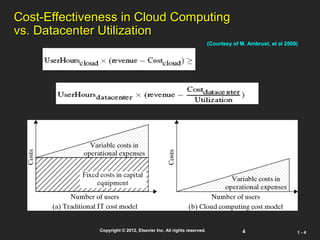
Cost-Effectiveness in Cloud ComputingCost-Effectiveness in Cloud Computing
vs. Datacenter Utilizationvs. Datacenter Utilization
(Courtesy of M. Ambrust, et al 2009)
55Copyright © 2012, Elsevier Inc. All rights reserved.
1 -1 - 55
66Copyright © 2012, Elsevier Inc. All rights reserved.
1 -1 - 66
77
Infrastructure as a service (IaaS)Infrastructure as a service (IaaS)
Most basic cloud service modelMost basic cloud service model
Cloud providers offer computers, as physical or more oftenCloud providers offer computers, as physical or more often
as virtual machines, and other resources.as virtual machines, and other resources.
Virtual machines are run as guests by a hypervisor, suchVirtual machines are run as guests by a hypervisor, such
as Xen or KVM.as Xen or KVM.
Cloud users deploy their applications by then installingCloud users deploy their applications by then installing
operating system images on the machines as well as theiroperating system images on the machines as well as their
application software.application software.
Cloud providers typically bill IaaS services on a utilityCloud providers typically bill IaaS services on a utility
computing basis, that is, cost will reflect the amount ofcomputing basis, that is, cost will reflect the amount of
resources allocated and consumed.resources allocated and consumed.
Examples of IaaS include: Amazon CloudFormation (andExamples of IaaS include: Amazon CloudFormation (and
underlying services such as Amazon EC2), Rackspaceunderlying services such as Amazon EC2), Rackspace
Cloud, Terremark, and Google Compute Engine.Cloud, Terremark, and Google Compute Engine.
88Copyright © 2012, Elsevier Inc. All rights reserved.
1 -1 - 88
Some IaaS Offerings from Public Clouds :
99
Platform as a service (PaaS)
Cloud providers deliver a computing platform
typically including operating system, programming
language execution environment, database, and
web server.
Application developers develop and run their
software on a cloud platform without the cost and
complexity of buying and managing the underlying
hardware and software layers.
Examples of PaaS include: Amazon Elastic
Beanstalk, Cloud Foundry, Heroku, Force.com,
EngineYard, Mendix, Google App Engine, Microsoft
Azure and OrangeScape.
1010Copyright © 2012, Elsevier Inc. All rights reserved.
1 -1 - 1010
PaaS Offerings from Public Clouds
1111
Software as a service (SaaS)Software as a service (SaaS)
Cloud providers install and operate application
software in the cloud and cloud users access the
software from cloud clients.
The pricing model for SaaS applications is
typically a monthly or yearly flat fee per user, so
price is scalable and adjustable if users are added
or removed at any point.
Examples of SaaS include: Google Apps,
innkeypos, Quickbooks Online, Limelight Video
Platform, Salesforce.com, and Microsoft Office 365.
1212Copyright © 2012, Elsevier Inc. All rights reserved.
1 -1 - 1212
Warehouse-Scale Computer (WSC)
 Provides Internet services
 Search, social networking, online maps, video sharing, online
shopping, email, cloud computing, etc.
 Differences with HPC “clusters”:
 Clusters have higher performance processors and network
 Clusters emphasize thread-level parallelism, WSCs emphasize
request-level parallelism
 Differences with datacenters:
 Datacenters consolidate different machines and software into
one location
 Datacenters emphasize virtual machines and hardware
heterogeneity in order to serve varied customers
(Courtesy of Hennessy and Patterson, 2012)
1313Copyright © 2012, Elsevier Inc. All rights reserved.
1 -1 - 1313
Design Considerations for WSC:
 Cost-performance
 Small savings add up
 Energy efficiency
 Affects power distribution and cooling
 Work per joule
 Dependability via redundancy
 Network I/O
 Interactive and batch processing workloads
 Ample computational parallelism is not important
 Most jobs are totally independent
 “Request-level parallelism”
 Operational costs count
 Power consumption is a primary constraint when designing system
 Scale and its opportunities and problems
 Can afford customized systems since WSC require volume purchase
(Courtesy of Hennessy and Patterson, 2012)
1414Copyright © 2012, Elsevier Inc. All rights reserved.
1 -1 - 1414
Typical Datacenter Layout
1515Copyright © 2012, Elsevier Inc. All rights reserved.
1 -1 - 1515
Power and Cooling Requirements
 Cooling system also uses water (evaporation and spills)
 E.g. 70,000 to 200,000 gallons per day for an 8 MW facility
 Power cost breakdown:
 Chillers: 30-50% of the power used by the IT equipment
 Air conditioning: 10-20% of the IT power, mostly due to fans
 How many servers can a WSC support?
 Each server:
 “Nameplate power rating” gives maximum power consumption
 To get actual, measure power under actual workloads
 Oversubscribe cumulative server power by 40%, but monitor power
closely
(Courtesy of Hennessy and Patterson, 2012)
1616Copyright © 2012, Elsevier Inc. All rights reserved.
1 -1 - 1616
(Courtesy of Luiz Andre Barroso and Urs Holzle, Google Inc., 2009)
1717Copyright © 2012, Elsevier Inc. All rights reserved.
1 -1 - 1717
Measuring Efficiency of a WSC
 Power Utilization Effectiveness (PEU)
 = Total facility power / IT equipment power
 Median PUE on 2006 study was 1.69
 Performance
 Latency is important metric because it is seen by
users
 Bing study: users will use search less as
response time increases
 Service Level Objectives (SLOs)/Service Level
Agreements (SLAs)
 E.g. 99% of requests be below 100 ms
(Courtesy of Hennessy and Patterson, 2012)
1818
Modular Data Center
1919Copyright © 2012, Elsevier Inc. All rights reserved.
1 -1 - 1919
Cloud Computing
 WSCs offer economies of scale that cannot
be achieved with a datacenter:
 5.7 times reduction in storage costs
 7.1 times reduction in administrative costs
 7.3 times reduction in networking costs
 This has given rise to cloud services such as
Amazon Web Services
 “Utility Computing”
 Based on using open source virtual machine and
operating system software
(Courtesy of Hennessy and Patterson, 2012)
2020Copyright © 2012, Elsevier Inc. All rights reserved.
1 -1 - 2020
Enabling Technologies for The Clouds
2121Copyright © 2012, Elsevier Inc. All rights reserved.
1 -1 - 2121
Cloud Computing as A Service
[9]
2222Copyright © 2012, Elsevier Inc. All rights reserved.
1 -1 - 2222
2323Copyright © 2012, Elsevier Inc. All rights reserved.
1 -1 - 2323
Virtualized
servers,
storage , and
network for
cloud platform
construction
2424Copyright © 2012, Elsevier Inc. All rights reserved.
1 -1 - 2424
2525Copyright © 2012, Elsevier Inc. All rights reserved.
1 -1 - 2525
25
Challenges/Issues in Cloud Computing
2626Copyright © 2012, Elsevier Inc. All rights reserved.
1 -1 - 2626
Challenges in Cloud Computing (1)
 Concerns from The Industry (Providers)
 Replacement Cost
 Exponential increase in cost to maintain the infrastructure
 Vendor Lock-in
 No standard API or protocol can be very serious
 Standardization
 No standard metric for QoS is limiting the popularity
 Security and Confidentiality
 Trust model for cloud computing
 Control Mechanism
 Users do not have any control over infrastructures
2727Copyright © 2012, Elsevier Inc. All rights reserved.
1 -1 - 2727
Challenges in Cloud Computing (2)
 Concerns from Research Community :
 Conflict to legacy programs
 With difficulty in developing a new application due to lack of control
 Provenance
 How to reproduce results in different infrastructures
 Reduction in Latency
 No specially designed interconnect used
 Very low controllability in layout of interconnect due to abstraction
 Programming Model
 Hard to debug where programming naturally error-prone
 Details about infrastructure are hidden
 QoS Measurement
 Especially for ubiquitous computing where context changes
2828
Public Clouds and Service Offerings
2929Copyright © 2012, Elsevier Inc. All rights reserved.
1 -1 - 2929
3030Copyright © 2012, Elsevier Inc. All rights reserved.
1 -1 - 3030
Platform as a Service (PaaS): Google App Engine
 This platform allows users to develop and host web application in Google
datacenters with automatic scaling according to the demand.
 It is a free service for a certain limit and it only requires a Gmail account to
access the services. After the free limit is exceeded the customers are
charged for additional storage, bandwidth and instance hours.
 The current version supports Java, Python and Go as the programming
languages and Google plans to add more languages in the future.
 All billed App Engine applications have a 99.95% uptime SLA. App Engine is
designed to sustain multiple datacenter outages without any downtime.
 The app engine has a few restrictions - can only execute code called from
an HTTP request, Java applications may only use a subset from the JRE
standard edition and Java application cannot create new threads.
3131Copyright © 2012, Elsevier Inc. All rights reserved.
1 -1 - 3131
Google AppEgine (GAE)
3232Copyright © 2012, Elsevier Inc. All rights reserved.
1 -1 - 3232
3333Copyright © 2012, Elsevier Inc. All rights reserved.
1 -1 - 3333
AWS –AWS – a leader in providing public IaaS servicesa leader in providing public IaaS services.
 EC2 (Elastic compute cloud allows users to rent virtual computers to run their own
computer applications. It allows scalable deployment. A user can create, launch, and
terminate server instances as needed, paying by the hour for active servers.
 S3 (simple storage service) provides the object-oriented storage service for users.
 EBS (Elastic block service) provides the block storage interface which can be used to
support traditional applications.
 Amazon DevPay is a simple to use online billing and account management service that
makes it easy for businesses
 MPI clusters uses hardware-assisted virtualization instead of para-virtualization and users
are free to create a new AMIs
 AWS import/export allows one to ship large volumes of data to and from EC2 by shipping
physical discs.
 Brokering systems offer a striking model for controlling sensors and providing office support
of smartphones and tablets.
 Small-business companies can put their business on the Amazon cloud platform. Using
AWS they can service a large number of internet users and make profits through those paid
services.
3434Copyright © 2012, Elsevier Inc. All rights reserved.
1 -1 - 3434
Amazon Web Services (AWS)
3535Copyright © 2012, Elsevier Inc. All rights reserved.
1 -1 - 3535
Amazon’s LessonAmazon’s Lesson
 Down for 3 days since
4/22/2011
 1000x of businesses went
offline. E.g. Pfizer, Netflix,
Quora, Foursquare,Reddit
 SLA contract
 99.95% availability
(<4.5hour down )
 10% penalty, otherwise
3636Copyright © 2012, Elsevier Inc. All rights reserved.
1 -1 - 3636
Microsoft Azure Cloud :
This is essentially a PaaS Cloud.
• Windows Azure run its cluster hosted at Microsoft's datacenters
that manages computing and storage resources.
• One can download Azure development kit to run a local version
of Azure. It allows Azure applications to be developed and
debugged one the windows 7 hosts.
• All cloud services can interact with traditional MS software
applications such as Windows Live, Office Live, Exchange Online,
etc.
• If offers a Windows-based cloud platform using Microsoft
virtualization technology.
• Applications are built on VM’s deployed on the data-center
services.
• Azure manages all servers, storage and network resources
of the data center.
3737Copyright © 2012, Elsevier Inc. All rights reserved.
1 -1 - 3737
Microsoft Windows Azure
3838Copyright © 2012, Elsevier Inc. All rights reserved.
1 -1 - 3838
Cloud Services and Major Providers
3939Copyright © 2012, Elsevier Inc. All rights reserved.
1 -1 - 3939
4040Copyright © 2012, Elsevier Inc. All rights reserved.
1 -1 - 4040
40
XEx =' XEx =' XEx ='
 Protecting datacenters must first secure cloud resources and uphold
user privacy and data integrity.
 Trust overlay networks could be applied to build reputation systems for
establishing the trust among interactive datacenters.
 A watermarking technique is suggested to protect shared data objects
and massively distributed software modules.
 These techniques safeguard user authentication and tighten the data
access-control in public clouds.
 The new approach could be more cost-effective than using the
traditional encryption and firewalls to secure the clouds.
Security and Trust Barriers
in Cloud Computing
4141
Security Aware Cloud Platform
4242
Cloud Service Models & Security Measures

cloud computing

  • 1.
    11Copyright © 2012,Elsevier Inc. All rights reserved. 1 -1 - 11 Distributed and Cloud ComputingDistributed and Cloud Computing K. Hwang, G. Fox and J. DongarraK. Hwang, G. Fox and J. Dongarra Chapter 4: Cloud Platform ArchitectureChapter 4: Cloud Platform Architecture over Virtualized Datacentersover Virtualized Datacenters Adapted from Kai HwangAdapted from Kai Hwang University of Southern CaliforniaUniversity of Southern California
  • 2.
    22 Public, Private &Hybrid Clouds
  • 3.
    33Copyright © 2012,Elsevier Inc. All rights reserved. 1 -1 - 33 Public Clouds vs. Private Clouds :Public Clouds vs. Private Clouds : Characteristics Public clouds Private clouds Technology leverage and ownership Owned by service providers Leverage existing IT infrastructure and personnel; owned by individual organization Management of provisioned resources Creating and managing VM instances within proprietary infrastructure; promote standardization, preserves capital investment, application flexibility Client managed; achieve customization and offer higher efficiency Workload distribution methods and loading policies Handle workload without communication dependency; distribute data and VM resources; surge workload is off-loaded Handle workload dynamically, but can better balance workloads; distribute data and VM resources Security and data privacy enforcement Publicly accessible through remote interface Access is limited; provide pre- production testing and enforce data privacy and security policies Example platforms Google App Engine, Amazon AWS, Microsoft Azure IBM RC2
  • 4.
    44Copyright © 2012,Elsevier Inc. All rights reserved. 1 -1 - 44 Cost-Effectiveness in Cloud ComputingCost-Effectiveness in Cloud Computing vs. Datacenter Utilizationvs. Datacenter Utilization (Courtesy of M. Ambrust, et al 2009)
  • 5.
    55Copyright © 2012,Elsevier Inc. All rights reserved. 1 -1 - 55
  • 6.
    66Copyright © 2012,Elsevier Inc. All rights reserved. 1 -1 - 66
  • 7.
    77 Infrastructure as aservice (IaaS)Infrastructure as a service (IaaS) Most basic cloud service modelMost basic cloud service model Cloud providers offer computers, as physical or more oftenCloud providers offer computers, as physical or more often as virtual machines, and other resources.as virtual machines, and other resources. Virtual machines are run as guests by a hypervisor, suchVirtual machines are run as guests by a hypervisor, such as Xen or KVM.as Xen or KVM. Cloud users deploy their applications by then installingCloud users deploy their applications by then installing operating system images on the machines as well as theiroperating system images on the machines as well as their application software.application software. Cloud providers typically bill IaaS services on a utilityCloud providers typically bill IaaS services on a utility computing basis, that is, cost will reflect the amount ofcomputing basis, that is, cost will reflect the amount of resources allocated and consumed.resources allocated and consumed. Examples of IaaS include: Amazon CloudFormation (andExamples of IaaS include: Amazon CloudFormation (and underlying services such as Amazon EC2), Rackspaceunderlying services such as Amazon EC2), Rackspace Cloud, Terremark, and Google Compute Engine.Cloud, Terremark, and Google Compute Engine.
  • 8.
    88Copyright © 2012,Elsevier Inc. All rights reserved. 1 -1 - 88 Some IaaS Offerings from Public Clouds :
  • 9.
    99 Platform as aservice (PaaS) Cloud providers deliver a computing platform typically including operating system, programming language execution environment, database, and web server. Application developers develop and run their software on a cloud platform without the cost and complexity of buying and managing the underlying hardware and software layers. Examples of PaaS include: Amazon Elastic Beanstalk, Cloud Foundry, Heroku, Force.com, EngineYard, Mendix, Google App Engine, Microsoft Azure and OrangeScape.
  • 10.
    1010Copyright © 2012,Elsevier Inc. All rights reserved. 1 -1 - 1010 PaaS Offerings from Public Clouds
  • 11.
    1111 Software as aservice (SaaS)Software as a service (SaaS) Cloud providers install and operate application software in the cloud and cloud users access the software from cloud clients. The pricing model for SaaS applications is typically a monthly or yearly flat fee per user, so price is scalable and adjustable if users are added or removed at any point. Examples of SaaS include: Google Apps, innkeypos, Quickbooks Online, Limelight Video Platform, Salesforce.com, and Microsoft Office 365.
  • 12.
    1212Copyright © 2012,Elsevier Inc. All rights reserved. 1 -1 - 1212 Warehouse-Scale Computer (WSC)  Provides Internet services  Search, social networking, online maps, video sharing, online shopping, email, cloud computing, etc.  Differences with HPC “clusters”:  Clusters have higher performance processors and network  Clusters emphasize thread-level parallelism, WSCs emphasize request-level parallelism  Differences with datacenters:  Datacenters consolidate different machines and software into one location  Datacenters emphasize virtual machines and hardware heterogeneity in order to serve varied customers (Courtesy of Hennessy and Patterson, 2012)
  • 13.
    1313Copyright © 2012,Elsevier Inc. All rights reserved. 1 -1 - 1313 Design Considerations for WSC:  Cost-performance  Small savings add up  Energy efficiency  Affects power distribution and cooling  Work per joule  Dependability via redundancy  Network I/O  Interactive and batch processing workloads  Ample computational parallelism is not important  Most jobs are totally independent  “Request-level parallelism”  Operational costs count  Power consumption is a primary constraint when designing system  Scale and its opportunities and problems  Can afford customized systems since WSC require volume purchase (Courtesy of Hennessy and Patterson, 2012)
  • 14.
    1414Copyright © 2012,Elsevier Inc. All rights reserved. 1 -1 - 1414 Typical Datacenter Layout
  • 15.
    1515Copyright © 2012,Elsevier Inc. All rights reserved. 1 -1 - 1515 Power and Cooling Requirements  Cooling system also uses water (evaporation and spills)  E.g. 70,000 to 200,000 gallons per day for an 8 MW facility  Power cost breakdown:  Chillers: 30-50% of the power used by the IT equipment  Air conditioning: 10-20% of the IT power, mostly due to fans  How many servers can a WSC support?  Each server:  “Nameplate power rating” gives maximum power consumption  To get actual, measure power under actual workloads  Oversubscribe cumulative server power by 40%, but monitor power closely (Courtesy of Hennessy and Patterson, 2012)
  • 16.
    1616Copyright © 2012,Elsevier Inc. All rights reserved. 1 -1 - 1616 (Courtesy of Luiz Andre Barroso and Urs Holzle, Google Inc., 2009)
  • 17.
    1717Copyright © 2012,Elsevier Inc. All rights reserved. 1 -1 - 1717 Measuring Efficiency of a WSC  Power Utilization Effectiveness (PEU)  = Total facility power / IT equipment power  Median PUE on 2006 study was 1.69  Performance  Latency is important metric because it is seen by users  Bing study: users will use search less as response time increases  Service Level Objectives (SLOs)/Service Level Agreements (SLAs)  E.g. 99% of requests be below 100 ms (Courtesy of Hennessy and Patterson, 2012)
  • 18.
  • 19.
    1919Copyright © 2012,Elsevier Inc. All rights reserved. 1 -1 - 1919 Cloud Computing  WSCs offer economies of scale that cannot be achieved with a datacenter:  5.7 times reduction in storage costs  7.1 times reduction in administrative costs  7.3 times reduction in networking costs  This has given rise to cloud services such as Amazon Web Services  “Utility Computing”  Based on using open source virtual machine and operating system software (Courtesy of Hennessy and Patterson, 2012)
  • 20.
    2020Copyright © 2012,Elsevier Inc. All rights reserved. 1 -1 - 2020 Enabling Technologies for The Clouds
  • 21.
    2121Copyright © 2012,Elsevier Inc. All rights reserved. 1 -1 - 2121 Cloud Computing as A Service [9]
  • 22.
    2222Copyright © 2012,Elsevier Inc. All rights reserved. 1 -1 - 2222
  • 23.
    2323Copyright © 2012,Elsevier Inc. All rights reserved. 1 -1 - 2323 Virtualized servers, storage , and network for cloud platform construction
  • 24.
    2424Copyright © 2012,Elsevier Inc. All rights reserved. 1 -1 - 2424
  • 25.
    2525Copyright © 2012,Elsevier Inc. All rights reserved. 1 -1 - 2525 25 Challenges/Issues in Cloud Computing
  • 26.
    2626Copyright © 2012,Elsevier Inc. All rights reserved. 1 -1 - 2626 Challenges in Cloud Computing (1)  Concerns from The Industry (Providers)  Replacement Cost  Exponential increase in cost to maintain the infrastructure  Vendor Lock-in  No standard API or protocol can be very serious  Standardization  No standard metric for QoS is limiting the popularity  Security and Confidentiality  Trust model for cloud computing  Control Mechanism  Users do not have any control over infrastructures
  • 27.
    2727Copyright © 2012,Elsevier Inc. All rights reserved. 1 -1 - 2727 Challenges in Cloud Computing (2)  Concerns from Research Community :  Conflict to legacy programs  With difficulty in developing a new application due to lack of control  Provenance  How to reproduce results in different infrastructures  Reduction in Latency  No specially designed interconnect used  Very low controllability in layout of interconnect due to abstraction  Programming Model  Hard to debug where programming naturally error-prone  Details about infrastructure are hidden  QoS Measurement  Especially for ubiquitous computing where context changes
  • 28.
    2828 Public Clouds andService Offerings
  • 29.
    2929Copyright © 2012,Elsevier Inc. All rights reserved. 1 -1 - 2929
  • 30.
    3030Copyright © 2012,Elsevier Inc. All rights reserved. 1 -1 - 3030 Platform as a Service (PaaS): Google App Engine  This platform allows users to develop and host web application in Google datacenters with automatic scaling according to the demand.  It is a free service for a certain limit and it only requires a Gmail account to access the services. After the free limit is exceeded the customers are charged for additional storage, bandwidth and instance hours.  The current version supports Java, Python and Go as the programming languages and Google plans to add more languages in the future.  All billed App Engine applications have a 99.95% uptime SLA. App Engine is designed to sustain multiple datacenter outages without any downtime.  The app engine has a few restrictions - can only execute code called from an HTTP request, Java applications may only use a subset from the JRE standard edition and Java application cannot create new threads.
  • 31.
    3131Copyright © 2012,Elsevier Inc. All rights reserved. 1 -1 - 3131 Google AppEgine (GAE)
  • 32.
    3232Copyright © 2012,Elsevier Inc. All rights reserved. 1 -1 - 3232
  • 33.
    3333Copyright © 2012,Elsevier Inc. All rights reserved. 1 -1 - 3333 AWS –AWS – a leader in providing public IaaS servicesa leader in providing public IaaS services.  EC2 (Elastic compute cloud allows users to rent virtual computers to run their own computer applications. It allows scalable deployment. A user can create, launch, and terminate server instances as needed, paying by the hour for active servers.  S3 (simple storage service) provides the object-oriented storage service for users.  EBS (Elastic block service) provides the block storage interface which can be used to support traditional applications.  Amazon DevPay is a simple to use online billing and account management service that makes it easy for businesses  MPI clusters uses hardware-assisted virtualization instead of para-virtualization and users are free to create a new AMIs  AWS import/export allows one to ship large volumes of data to and from EC2 by shipping physical discs.  Brokering systems offer a striking model for controlling sensors and providing office support of smartphones and tablets.  Small-business companies can put their business on the Amazon cloud platform. Using AWS they can service a large number of internet users and make profits through those paid services.
  • 34.
    3434Copyright © 2012,Elsevier Inc. All rights reserved. 1 -1 - 3434 Amazon Web Services (AWS)
  • 35.
    3535Copyright © 2012,Elsevier Inc. All rights reserved. 1 -1 - 3535 Amazon’s LessonAmazon’s Lesson  Down for 3 days since 4/22/2011  1000x of businesses went offline. E.g. Pfizer, Netflix, Quora, Foursquare,Reddit  SLA contract  99.95% availability (<4.5hour down )  10% penalty, otherwise
  • 36.
    3636Copyright © 2012,Elsevier Inc. All rights reserved. 1 -1 - 3636 Microsoft Azure Cloud : This is essentially a PaaS Cloud. • Windows Azure run its cluster hosted at Microsoft's datacenters that manages computing and storage resources. • One can download Azure development kit to run a local version of Azure. It allows Azure applications to be developed and debugged one the windows 7 hosts. • All cloud services can interact with traditional MS software applications such as Windows Live, Office Live, Exchange Online, etc. • If offers a Windows-based cloud platform using Microsoft virtualization technology. • Applications are built on VM’s deployed on the data-center services. • Azure manages all servers, storage and network resources of the data center.
  • 37.
    3737Copyright © 2012,Elsevier Inc. All rights reserved. 1 -1 - 3737 Microsoft Windows Azure
  • 38.
    3838Copyright © 2012,Elsevier Inc. All rights reserved. 1 -1 - 3838 Cloud Services and Major Providers
  • 39.
    3939Copyright © 2012,Elsevier Inc. All rights reserved. 1 -1 - 3939
  • 40.
    4040Copyright © 2012,Elsevier Inc. All rights reserved. 1 -1 - 4040 40 XEx =' XEx =' XEx ='  Protecting datacenters must first secure cloud resources and uphold user privacy and data integrity.  Trust overlay networks could be applied to build reputation systems for establishing the trust among interactive datacenters.  A watermarking technique is suggested to protect shared data objects and massively distributed software modules.  These techniques safeguard user authentication and tighten the data access-control in public clouds.  The new approach could be more cost-effective than using the traditional encryption and firewalls to secure the clouds. Security and Trust Barriers in Cloud Computing
  • 41.
  • 42.
    4242 Cloud Service Models& Security Measures

Editor's Notes

  • #36 SLA = Service Level Agreement
  • #39 Cloud applications are the key global opportunity for developers during next four years 2009: $8.5 billion 2013: $16.8 billion