Conventions of a
docum
entary
Length
Short films tend to be around 5 – 35 minutes long. With 2- 3 main
characters. Characters are kept to a minimum due to the length of a
short film. This way the plot is kept to an understandable level
without trying to make it too complex. This is also done to try and
achieve a sense of relationship between viewer and characters.
Currently we have assigned two main persons to our documentary;
professor gauntlet and Mr Jeff Kindleysides. We have chosen these
two as we feel that they provide two different sides of the spectrum.
Professor gauntlet provides a more academic view on the subject.
Mr Jeff Kindleysides however has a more personal attatchement to
the creative industry with more business based opinions.
costs
Due to short films having a niche following the budget naturally is
smaller. For this reason it is generally independent production
companies that make short films. The smaller production budget
results in a stripping back of equipment, locations and other cost
variable things.
We fit this convention of having a small production team and a small
budget with limited equipment as the most we are spending on is
the travelling cost down to London for our interview with professor
gauntlet. We have also managed to get all of our intereviews for
free.
Plot
Short films usually base themselves on a generic emotion feeling or
situation that we feel on a daily basis. This is done to make the
short film more relatable to a mass audience. The plots tend to
stimulate the thought processes of many on a certain subject such
as creativity reaching the audience on an interlectual level.
Our documentary is based on what creativity is to different people. We
aim to look at creativity in a number of ways to perhaps challenge
some peoples views on creativity and explore them in more depth.
Genre conventions
Observational documentaries
This type aims to look at the world as if looking through an open
window into the world. The film makers try to not effect the
happenings around them to ensure that they capture an accurate
representation on what they are filming. With this type of
documentary there is no sound both diegetic and non diegetic. This
type also refrains from using any type of interview or reenactments
and subjects that are in the shot would act as if the camera where
non existent.
We like the idea of looking upon the subject as if we where not there as
we feel this gives a more cinematic result which is what we are
looking for however we obviously do not like the idea of not having
any sound or interviews within our production so we are looking to
combine the two main themes of observational and expository.
Genre conventions
Expository is a documentary that speaks directly to the viewer in a
authorities way. Obviously this is not what we want as we want the
interviewees to speak for themselves. The reason we would take an
expository style forward is because this style aims to prove a point
which we are trying to do with the idea of creativity being different
to everyone.
We feel that a combination of the two gives a style that is more to our
tastes. As expository allows us to prove our point that creativity is
different to everyone and the observational style lends itself to a
more cinematic style.
Reflexive is a type of documentary that focuses on the constructive
nature. It welcomes the audience in to acknowledge the creative
process of the documentary. A reflexive documentary aims to
engage the audience in different issues. They often look at a variety
of different aspects to get the audience to think beyond their own
views. This is helped by the fact that a a reflexive documentary
opens the audience up to the creative process such as sound editing
and recordings.
We like the idea of opening the audience up to different areas and
broadening their view on different subjects. We feel that our idea of
having a variety of different minds from different areas of the
creative industry will agree to this mode of documentary.
Conventions of a radio advertisements
The most conventional technique used in radio adverts is the use of VOICE OVER:
voice over is the use of a voice to describe the product and help the listener
to grasp an understanding of what the radio advert is aiming to advertise.
Because a radio advert is just through the use of sound the voice over needs
to have a strong presence in order to have impact and for the name of the
product to stand out. It is conventional to have a clear speaker who will do
the voice over of the advert.
Another convention for a radio trailer is to have sound effect such as Foley sound
to compliment the voice over. This is done to make the advertisement a little
more interesting than what it would be with just a voice over and often makes
the advert more specific to the a certain product such as sprites advert
which we analyzed earlier. The popping noises in the advert mimicked the
sounds of a can being opened and a tennis ball hitting the ground.
The length of a radio advert can be anywhere from 20 – 40 seconds in length.
This gives just enough time for all of the information to be put forward and
for the advert to be effective.
For a documentary advert it would be conventional to include some sound bed
from the documentary itself such as a snippet from an interview to give the
listeners an idea as to what the documentary is like.
What Is a film poster
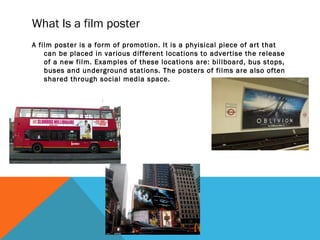
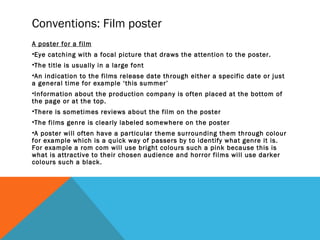
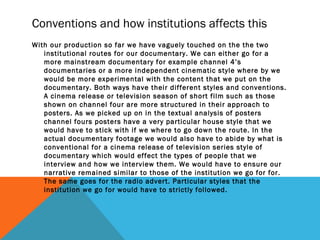
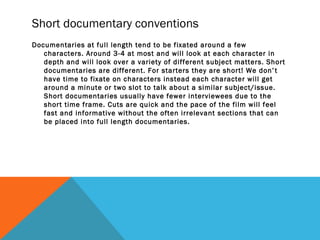
A film poster is a form of promotion. It is a phyisical piece of art that
can be placed in various different locations to advertise the release
of a new film. Examples of these locations are: billboard, bus stops,
buses and underground stations. The posters of films are also often
shared through social media space.
Conventions: Film poster
A poster for a film
•Eye catching with a focal picture that draws the attention to the poster.
•The title is usually in a large font
•An indication to the films release date through either a specific date or just
a general time for example ‘this summer’
•Information about the production company is often placed at the bottom of
the page or at the top.
•There is sometimes reviews about the film on the poster
•The films genre is clearly labeled somewhere on the poster
•A poster will often have a particular theme surrounding them through colour
for example which is a quick way of passers by to identify what genre it is.
For example a rom com will use bright colours such a pink because this is
what is attractive to their chosen audience and horror films will use darker
colours such a black.
Conventions and how institutions affects this
With our production so far we have vaguely touched on the the two
institutional routes for our documentary. We can either go for a
more mainstream documentary for example channel 4’s
documentaries or a more independent cinematic style where by we
would be more experimental with the content that we put on the
documentary. Both ways have their different styles and conventions.
A cinema release or television season of short film such as those
shown on channel four are more structured in their approach to
posters. As we picked up on in the textual analysis of posters
channel fours posters have a very particular house style that we
would have to stick with if we where to go down the route. In the
actual documentary footage we would also have to abide by what is
conventional for a cinema release of television series style of
documentary which would effect the types of people that we
interview and how we interview them. We would have to ensure our
narrative remained similar to those of the institution we go for for.
The same goes for the radio advert. Particular styles that the
institution we go for would have to strictly followed.
Short documentary conventions
Documentaries at full length tend to be fixated around a few
characters. Around 3-4 at most and will look at each character in
depth and will look over a variety of different subject matters. Short
documentaries are different. For starters they are short! We don’t
have time to fixate on characters instead each character will get
around a minute or two slot to talk about a similar subject/issue.
Short documentaries usually have fewer interviewees due to the
short time frame. Cuts are quick and the pace of the film will feel
fast and informative without the often irrelevant sections that can
be placed into full length documentaries.
Conventions: what we are taking forward: radio
We are going to stick to most of the radio advert conventions as we feel
that going against them will potentially result in not having a very
clear radio trailer and therefore it not being very clear to the
audience what the radio advert is advertising. We also feel that
sticking to the conventions of a radio trailer would maximize the
results it has.
The conventions that we are specifically staying with is the use of a
voice over. Although our voice over will not be a large part of the
radio advert because sound clips from the documentary will
dominate, voice over will make an appearance at the end of the
documentary when the title is said out loud. Having the sound clips
from the documentary ensures that we do stay within conventions of
radio adverts for documentaries. At the beginning of our radio
advert we are thinking about having the sound of different tools in
the workshop in quick cuts. The idea of having this at the beginning
of a radio advert is conventional as it is a way of grabbing the
audiences attention.
Conventions: what we are taking forward: Poster
In terms of conventions for a poster we think that we may go against a
few as most of the poster we are looking at do challenge some
conventions and the target market we are aiming our film at are not
the sort that would be attracted by a generic poster. However
having said this there are still many conventions that we are going
to follow on order to make sure that it does not lose its
effectiveness.
There are certain conventions such as institutional information that we
are taking forward because in a real life situation this is often
compulsory. We have also decided to take on the idea of having a
tagline which isn't necessarily a convention but is an option that can
make for a nice addition to a poster campaign when done correctly.
We have discussed the idea of taking on a design that utilizes the
central section of the rule of thirds more than anywhere else. A
design such as this is conventional for a minimalistic poster. We are
definitely going to have the font on a larger scale and also have
review quotes on either side of the central section to ensure the
side sections on the rule of thirds do not look to bare. We feel that
the cinematic style that we are currently thinking about taking
forward would suit a more independent cinematic release as part of
a short film documentary.

Conventions finished

  • 1.
  • 2.
    Length Short films tendto be around 5 – 35 minutes long. With 2- 3 main characters. Characters are kept to a minimum due to the length of a short film. This way the plot is kept to an understandable level without trying to make it too complex. This is also done to try and achieve a sense of relationship between viewer and characters. Currently we have assigned two main persons to our documentary; professor gauntlet and Mr Jeff Kindleysides. We have chosen these two as we feel that they provide two different sides of the spectrum. Professor gauntlet provides a more academic view on the subject. Mr Jeff Kindleysides however has a more personal attatchement to the creative industry with more business based opinions.
  • 3.
    costs Due to shortfilms having a niche following the budget naturally is smaller. For this reason it is generally independent production companies that make short films. The smaller production budget results in a stripping back of equipment, locations and other cost variable things. We fit this convention of having a small production team and a small budget with limited equipment as the most we are spending on is the travelling cost down to London for our interview with professor gauntlet. We have also managed to get all of our intereviews for free.
  • 4.
    Plot Short films usuallybase themselves on a generic emotion feeling or situation that we feel on a daily basis. This is done to make the short film more relatable to a mass audience. The plots tend to stimulate the thought processes of many on a certain subject such as creativity reaching the audience on an interlectual level. Our documentary is based on what creativity is to different people. We aim to look at creativity in a number of ways to perhaps challenge some peoples views on creativity and explore them in more depth.
  • 5.
    Genre conventions Observational documentaries Thistype aims to look at the world as if looking through an open window into the world. The film makers try to not effect the happenings around them to ensure that they capture an accurate representation on what they are filming. With this type of documentary there is no sound both diegetic and non diegetic. This type also refrains from using any type of interview or reenactments and subjects that are in the shot would act as if the camera where non existent. We like the idea of looking upon the subject as if we where not there as we feel this gives a more cinematic result which is what we are looking for however we obviously do not like the idea of not having any sound or interviews within our production so we are looking to combine the two main themes of observational and expository.
  • 6.
    Genre conventions Expository isa documentary that speaks directly to the viewer in a authorities way. Obviously this is not what we want as we want the interviewees to speak for themselves. The reason we would take an expository style forward is because this style aims to prove a point which we are trying to do with the idea of creativity being different to everyone. We feel that a combination of the two gives a style that is more to our tastes. As expository allows us to prove our point that creativity is different to everyone and the observational style lends itself to a more cinematic style. Reflexive is a type of documentary that focuses on the constructive nature. It welcomes the audience in to acknowledge the creative process of the documentary. A reflexive documentary aims to engage the audience in different issues. They often look at a variety of different aspects to get the audience to think beyond their own views. This is helped by the fact that a a reflexive documentary opens the audience up to the creative process such as sound editing and recordings. We like the idea of opening the audience up to different areas and broadening their view on different subjects. We feel that our idea of having a variety of different minds from different areas of the creative industry will agree to this mode of documentary.
  • 7.
    Conventions of aradio advertisements The most conventional technique used in radio adverts is the use of VOICE OVER: voice over is the use of a voice to describe the product and help the listener to grasp an understanding of what the radio advert is aiming to advertise. Because a radio advert is just through the use of sound the voice over needs to have a strong presence in order to have impact and for the name of the product to stand out. It is conventional to have a clear speaker who will do the voice over of the advert. Another convention for a radio trailer is to have sound effect such as Foley sound to compliment the voice over. This is done to make the advertisement a little more interesting than what it would be with just a voice over and often makes the advert more specific to the a certain product such as sprites advert which we analyzed earlier. The popping noises in the advert mimicked the sounds of a can being opened and a tennis ball hitting the ground. The length of a radio advert can be anywhere from 20 – 40 seconds in length. This gives just enough time for all of the information to be put forward and for the advert to be effective. For a documentary advert it would be conventional to include some sound bed from the documentary itself such as a snippet from an interview to give the listeners an idea as to what the documentary is like.
  • 8.
    What Is afilm poster A film poster is a form of promotion. It is a phyisical piece of art that can be placed in various different locations to advertise the release of a new film. Examples of these locations are: billboard, bus stops, buses and underground stations. The posters of films are also often shared through social media space.
  • 9.
    Conventions: Film poster Aposter for a film •Eye catching with a focal picture that draws the attention to the poster. •The title is usually in a large font •An indication to the films release date through either a specific date or just a general time for example ‘this summer’ •Information about the production company is often placed at the bottom of the page or at the top. •There is sometimes reviews about the film on the poster •The films genre is clearly labeled somewhere on the poster •A poster will often have a particular theme surrounding them through colour for example which is a quick way of passers by to identify what genre it is. For example a rom com will use bright colours such a pink because this is what is attractive to their chosen audience and horror films will use darker colours such a black.
  • 10.
    Conventions and howinstitutions affects this With our production so far we have vaguely touched on the the two institutional routes for our documentary. We can either go for a more mainstream documentary for example channel 4’s documentaries or a more independent cinematic style where by we would be more experimental with the content that we put on the documentary. Both ways have their different styles and conventions. A cinema release or television season of short film such as those shown on channel four are more structured in their approach to posters. As we picked up on in the textual analysis of posters channel fours posters have a very particular house style that we would have to stick with if we where to go down the route. In the actual documentary footage we would also have to abide by what is conventional for a cinema release of television series style of documentary which would effect the types of people that we interview and how we interview them. We would have to ensure our narrative remained similar to those of the institution we go for for. The same goes for the radio advert. Particular styles that the institution we go for would have to strictly followed.
  • 11.
    Short documentary conventions Documentariesat full length tend to be fixated around a few characters. Around 3-4 at most and will look at each character in depth and will look over a variety of different subject matters. Short documentaries are different. For starters they are short! We don’t have time to fixate on characters instead each character will get around a minute or two slot to talk about a similar subject/issue. Short documentaries usually have fewer interviewees due to the short time frame. Cuts are quick and the pace of the film will feel fast and informative without the often irrelevant sections that can be placed into full length documentaries.
  • 12.
    Conventions: what weare taking forward: radio We are going to stick to most of the radio advert conventions as we feel that going against them will potentially result in not having a very clear radio trailer and therefore it not being very clear to the audience what the radio advert is advertising. We also feel that sticking to the conventions of a radio trailer would maximize the results it has. The conventions that we are specifically staying with is the use of a voice over. Although our voice over will not be a large part of the radio advert because sound clips from the documentary will dominate, voice over will make an appearance at the end of the documentary when the title is said out loud. Having the sound clips from the documentary ensures that we do stay within conventions of radio adverts for documentaries. At the beginning of our radio advert we are thinking about having the sound of different tools in the workshop in quick cuts. The idea of having this at the beginning of a radio advert is conventional as it is a way of grabbing the audiences attention.
  • 13.
    Conventions: what weare taking forward: Poster In terms of conventions for a poster we think that we may go against a few as most of the poster we are looking at do challenge some conventions and the target market we are aiming our film at are not the sort that would be attracted by a generic poster. However having said this there are still many conventions that we are going to follow on order to make sure that it does not lose its effectiveness. There are certain conventions such as institutional information that we are taking forward because in a real life situation this is often compulsory. We have also decided to take on the idea of having a tagline which isn't necessarily a convention but is an option that can make for a nice addition to a poster campaign when done correctly. We have discussed the idea of taking on a design that utilizes the central section of the rule of thirds more than anywhere else. A design such as this is conventional for a minimalistic poster. We are definitely going to have the font on a larger scale and also have review quotes on either side of the central section to ensure the side sections on the rule of thirds do not look to bare. We feel that the cinematic style that we are currently thinking about taking forward would suit a more independent cinematic release as part of a short film documentary.