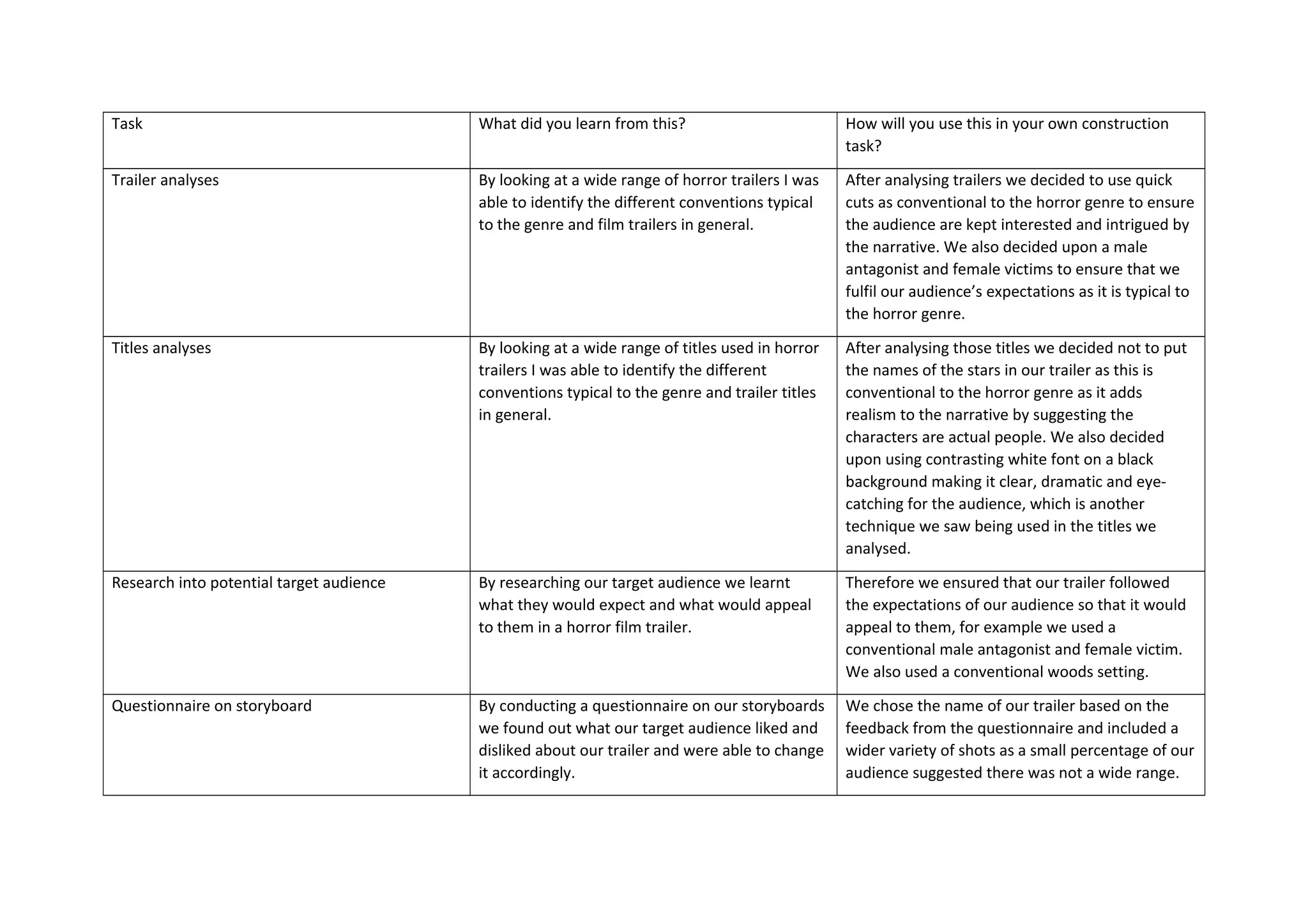
Task What did you learn from this? How will you use this in your own construction
task?
Trailer analyses By looking at a wide range of horror trailers I was
able to identify the different conventions typical
to the genre and film trailers in general.
After analysing trailers we decided to use quick
cuts as conventional to the horror genre to ensure
the audience are kept interested and intrigued by
the narrative. We also decided upon a male
antagonist and female victims to ensure that we
fulfil our audience’s expectations as it is typical to
the horror genre.
Titles analyses By looking at a wide range of titles used in horror
trailers I was able to identify the different
conventions typical to the genre and trailer titles
in general.
After analysing those titles we decided not to put
the names of the stars in our trailer as this is
conventional to the horror genre as it adds
realism to the narrative by suggesting the
characters are actual people. We also decided
upon using contrasting white font on a black
background making it clear, dramatic and eye-
catching for the audience, which is another
technique we saw being used in the titles we
analysed.
Research into potential target audience By researching our target audience we learnt
what they would expect and what would appeal
to them in a horror film trailer.
Therefore we ensured that our trailer followed
the expectations of our audience so that it would
appeal to them, for example we used a
conventional male antagonist and female victim.
We also used a conventional woods setting.
Questionnaire on storyboard By conducting a questionnaire on our storyboards
we found out what our target audience liked and
disliked about our trailer and were able to change
it accordingly.
We chose the name of our trailer based on the
feedback from the questionnaire and included a
wider variety of shots as a small percentage of our
audience suggested there was not a wide range.
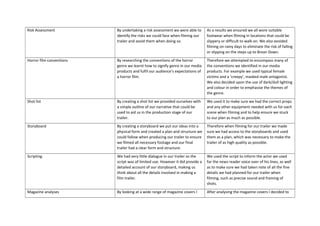
Risk Assessment By undertaking a risk assessment we were able to
identify the risks we could face when filming our
trailer and avoid them when doing so.
As a results we ensured we all wore suitable
footwear when filming in locations that could be
slippery or difficult to walk on. We also avoided
filming on rainy days to eliminate the risk of falling
or slipping on the steps up to Brean Down.
Horror film conventions By researching the conventions of the horror
genre we learnt how to signify genre in our media
products and fulfil our audience’s expectations of
a horror film.
Therefore we attempted to encompass many of
the conventions we identified in our media
products. For example we used typical female
victims and a ‘creepy’, masked male antagonist.
We also decided upon the use of dark/dull lighting
and colour in order to emphasise the themes of
the genre.
Shot list By creating a shot list we provided ourselves with
a simple outline of our narrative that could be
used to aid us in the production stage of our
trailer.
We used it to make sure we had the correct props
and any other equipment needed with us for each
scene when filming and to help ensure we stuck
to our plan as much as possible.
Storyboard By creating a storyboard we put our ideas into a
physical form and created a plan and structure we
could follow when producing our trailer to ensure
we filmed all necessary footage and our final
trailer had a clear form and structure.
Therefore when filming for our trailer we made
sure we had access to the storyboards and used
them as a plan, which was necessary to make the
trailer of as high quality as possible.
Scripting We had very little dialogue in our trailer so the
script was of limited use. However it did provide a
detailed account of our storyboard, making us
think about all the details involved in making a
film trailer.
We used the script to inform the actor we used
for the news reader voice over of his lines, as well
as to make sure we had taken note of all the fine
details we had planned for our trailer when
filming, such as precise sound and framing of
shots.
Magazine analyses By looking at a wide range of magazine covers I After analysing the magazine covers I decided to
was able to identify the different conventions
typical to film magazine covers and magazine
covers in general.
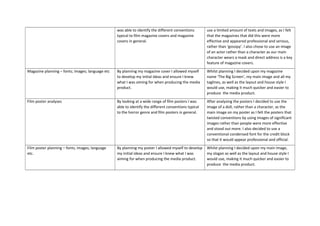
use a limited amount of texts and images, as I felt
that the magazines that did this were more
effective and appeared professional and serious,
rather than ‘gossipy’. I also chose to use an image
of an actor rather than a character as our main
character wears a mask and direct address is a key
feature of magazine covers.
Magazine planning – fonts; images; language etc By planning my magazine cover I allowed myself
to develop my initial ideas and ensure I knew
what I was aiming for when producing the media
product.
Whilst planning I decided upon my magazine
name ‘The Big Screen’, my main image and all my
taglines, as well as the layout and house style I
would use, making it much quicker and easier to
produce the media product.
Film poster analyses By looking at a wide range of film posters I was
able to identify the different conventions typical
to the horror genre and film posters in general.
After analysing the posters I decided to use the
image of a doll, rather than a character, as the
main image on my poster as I felt the posters that
twisted conventions by using images of significant
images rather than people were more effective
and stood out more. I also decided to use a
conventional condensed font for the credit block
so that it would appear professional and official.
Film poster planning – fonts; images; language
etc.
By planning my poster I allowed myself to develop
my initial ideas and ensure I knew what I was
aiming for when producing the media product.
Whilst planning I decided upon my main image,
my slogan as well as the layout and house style I
would use, making it much quicker and easier to
produce the media product.

Reflection page

  • 1.
    Task What didyou learn from this? How will you use this in your own construction task? Trailer analyses By looking at a wide range of horror trailers I was able to identify the different conventions typical to the genre and film trailers in general. After analysing trailers we decided to use quick cuts as conventional to the horror genre to ensure the audience are kept interested and intrigued by the narrative. We also decided upon a male antagonist and female victims to ensure that we fulfil our audience’s expectations as it is typical to the horror genre. Titles analyses By looking at a wide range of titles used in horror trailers I was able to identify the different conventions typical to the genre and trailer titles in general. After analysing those titles we decided not to put the names of the stars in our trailer as this is conventional to the horror genre as it adds realism to the narrative by suggesting the characters are actual people. We also decided upon using contrasting white font on a black background making it clear, dramatic and eye- catching for the audience, which is another technique we saw being used in the titles we analysed. Research into potential target audience By researching our target audience we learnt what they would expect and what would appeal to them in a horror film trailer. Therefore we ensured that our trailer followed the expectations of our audience so that it would appeal to them, for example we used a conventional male antagonist and female victim. We also used a conventional woods setting. Questionnaire on storyboard By conducting a questionnaire on our storyboards we found out what our target audience liked and disliked about our trailer and were able to change it accordingly. We chose the name of our trailer based on the feedback from the questionnaire and included a wider variety of shots as a small percentage of our audience suggested there was not a wide range.
  • 2.
    Risk Assessment Byundertaking a risk assessment we were able to identify the risks we could face when filming our trailer and avoid them when doing so. As a results we ensured we all wore suitable footwear when filming in locations that could be slippery or difficult to walk on. We also avoided filming on rainy days to eliminate the risk of falling or slipping on the steps up to Brean Down. Horror film conventions By researching the conventions of the horror genre we learnt how to signify genre in our media products and fulfil our audience’s expectations of a horror film. Therefore we attempted to encompass many of the conventions we identified in our media products. For example we used typical female victims and a ‘creepy’, masked male antagonist. We also decided upon the use of dark/dull lighting and colour in order to emphasise the themes of the genre. Shot list By creating a shot list we provided ourselves with a simple outline of our narrative that could be used to aid us in the production stage of our trailer. We used it to make sure we had the correct props and any other equipment needed with us for each scene when filming and to help ensure we stuck to our plan as much as possible. Storyboard By creating a storyboard we put our ideas into a physical form and created a plan and structure we could follow when producing our trailer to ensure we filmed all necessary footage and our final trailer had a clear form and structure. Therefore when filming for our trailer we made sure we had access to the storyboards and used them as a plan, which was necessary to make the trailer of as high quality as possible. Scripting We had very little dialogue in our trailer so the script was of limited use. However it did provide a detailed account of our storyboard, making us think about all the details involved in making a film trailer. We used the script to inform the actor we used for the news reader voice over of his lines, as well as to make sure we had taken note of all the fine details we had planned for our trailer when filming, such as precise sound and framing of shots. Magazine analyses By looking at a wide range of magazine covers I After analysing the magazine covers I decided to
  • 3.
    was able toidentify the different conventions typical to film magazine covers and magazine covers in general. use a limited amount of texts and images, as I felt that the magazines that did this were more effective and appeared professional and serious, rather than ‘gossipy’. I also chose to use an image of an actor rather than a character as our main character wears a mask and direct address is a key feature of magazine covers. Magazine planning – fonts; images; language etc By planning my magazine cover I allowed myself to develop my initial ideas and ensure I knew what I was aiming for when producing the media product. Whilst planning I decided upon my magazine name ‘The Big Screen’, my main image and all my taglines, as well as the layout and house style I would use, making it much quicker and easier to produce the media product. Film poster analyses By looking at a wide range of film posters I was able to identify the different conventions typical to the horror genre and film posters in general. After analysing the posters I decided to use the image of a doll, rather than a character, as the main image on my poster as I felt the posters that twisted conventions by using images of significant images rather than people were more effective and stood out more. I also decided to use a conventional condensed font for the credit block so that it would appear professional and official. Film poster planning – fonts; images; language etc. By planning my poster I allowed myself to develop my initial ideas and ensure I knew what I was aiming for when producing the media product. Whilst planning I decided upon my main image, my slogan as well as the layout and house style I would use, making it much quicker and easier to produce the media product.