Evaluation – (Alex Townsley)


       In what ways does your media
     product use, develop or challenge
    forms and conventions of real media
                products?
The Digipak
A convention is the way a certain media product stereotypically goes about doing
things. For example, in this circumstance – the way a band usually creates a digipak.
As you can see from the production process of the digipak I aimed to create a digipak
which went against the conventional approach. When researching the band ‘Alt-
J’, I found that their album case was very unusual. I believe that they chose to do this
in order to reflect their approach to music. I chose to incorporate this idea into our
digipak.
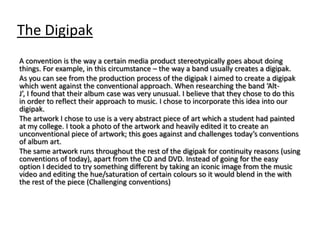
The artwork I chose to use is a very abstract piece of art which a student had painted
at my college. I took a photo of the artwork and heavily edited it to create an
unconventional piece of artwork; this goes against and challenges today’s conventions
of album art.
The same artwork runs throughout the rest of the digipak for continuity reasons (using
conventions of today), apart from the CD and DVD. Instead of going for the easy
option I decided to try something different by taking an iconic image from the music
video and editing the hue/saturation of certain colours so it would blend in the with
the rest of the piece (Challenging conventions)
Digipak continued…
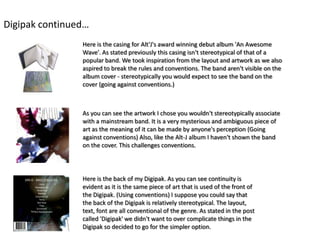
                Here is the casing for Alt'J's award winning debut album 'An Awesome
                Wave'. As stated previously this casing isn't stereotypical of that of a
                popular band. We took inspiration from the layout and artwork as we also
                aspired to break the rules and conventions. The band aren't visible on the
                album cover - stereotypically you would expect to see the band on the
                cover (going against conventions.)


                As you can see the artwork I chose you wouldn't stereotypically associate
                with a mainstream band. It is a very mysterious and ambiguous piece of
                art as the meaning of it can be made by anyone's perception (Going
                against conventions) Also, like the Alt-J album I haven't shown the band
                on the cover. This challenges conventions.


                Here is the back of my Digipak. As you can see continuity is
                evident as it is the same piece of art that is used of the front of
                the Digipak. (Using conventions) I suppose you could say that
                the back of the Digipak is relatively stereotypical. The layout,
                text, font are all conventional of the genre. As stated in the post
                called 'Digipak' we didn't want to over complicate things in the
                Digipak so decided to go for the simpler option.
The Posters
Part of the promotional process was to create an poster for the digipak. Instead of just creating
one poster for the digipak, I decided to create another one for a tour - as I felt without one it
wouldn't fully promote the band.

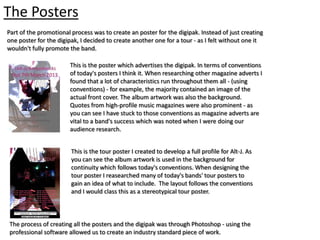
                       This is the poster which advertises the digipak. In terms of conventions
                       of today's posters I think it. When researching other magazine adverts I
                       found that a lot of characteristics run throughout them all - (using
                       conventions) - for example, the majority contained an image of the
                       actual front cover. The album artwork was also the background.
                       Quotes from high-profile music magazines were also prominent - as
                       you can see I have stuck to those conventions as magazine adverts are
                       vital to a band's success which was noted when I were doing our
                       audience research.


                        This is the tour poster I created to develop a full profile for Alt-J. As
                        you can see the album artwork is used in the background for
                        continuity which follows today's conventions. When designing the
                        tour poster I reasearched many of today's bands' tour posters to
                        gain an idea of what to include. The layout follows the conventions
                        and I would class this as a stereotypical tour poster.


The process of creating all the posters and the digipak was through Photoshop - using the
professional software allowed us to create an industry standard piece of work.
The Music Video
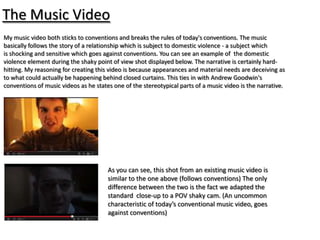
My music video both sticks to conventions and breaks the rules of today's conventions. The music
basically follows the story of a relationship which is subject to domestic violence - a subject which
is shocking and sensitive which goes against conventions. You can see an example of the domestic
violence element during the shaky point of view shot displayed below. The narrative is certainly hard-
hitting. My reasoning for creating this video is because appearances and material needs are deceiving as
to what could actually be happening behind closed curtains. This ties in with Andrew Goodwin's
conventions of music videos as he states one of the stereotypical parts of a music video is the narrative.


                                       As you can see, this shot from an existing music video is
                                       similar to the one above (follows conventions) The only
                                       difference between the two is the fact we adapted the
                                       standard close-up to a POV shaky cam. (An uncommon
                                       characteristic of today’s conventional music video, goes
                                       against conventions)
The Music Video Continued…
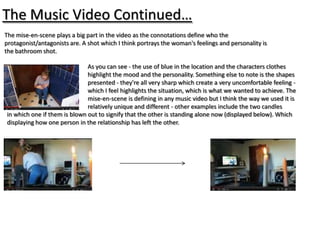
The mise-en-scene plays a big part in the video as the connotations define who the
protagonist/antagonists are. A shot which I think portrays the woman's feelings and personality is
the bathroom shot.

                              As you can see - the use of blue in the location and the characters clothes
                              highlight the mood and the personality. Something else to note is the shapes
                              presented - they're all very sharp which create a very uncomfortable feeling -
                              which I feel highlights the situation, which is what we wanted to achieve. The
                              mise-en-scene is defining in any music video but I think the way we used it is
                              relatively unique and different - other examples include the two candles
in which one if them is blown out to signify that the other is standing alone now (displayed below). Which
displaying how one person in the relationship has left the other.
The Music Video Continued…
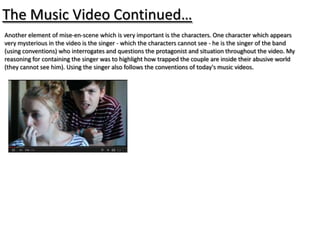
Another element of mise-en-scene which is very important is the characters. One character which appears
very mysterious in the video is the singer - which the characters cannot see - he is the singer of the band
(using conventions) who interrogates and questions the protagonist and situation throughout the video. My
reasoning for containing the singer was to highlight how trapped the couple are inside their abusive world
(they cannot see him). Using the singer also follows the conventions of today's music videos.
The Music Video Continued…
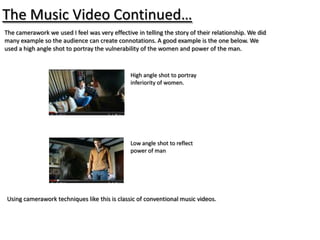
The camerawork we used I feel was very effective in telling the story of their relationship. We did
many example so the audience can create connotations. A good example is the one below. We
used a high angle shot to portray the vulnerability of the women and power of the man.


                                               High angle shot to portray
                                               inferiority of women.


                                               Low angle shot to reflect
                                               power of man


Using camerawork techniques like this is classic of conventional music videos.
The Music Video Continued…
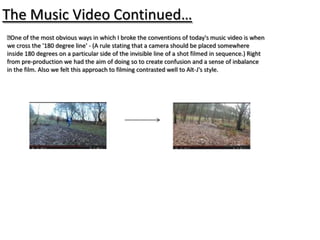
 of the most obvious ways in which I broke the conventions of today's music video is when
  One
we cross the '180 degree line' - (A rule stating that a camera should be placed somewhere
inside 180 degrees on a particular side of the invisible line of a shot filmed in sequence.) Right
from pre-production we had the aim of doing so to create confusion and a sense of inbalance
in the film. Also we felt this approach to filming contrasted well to Alt-J's style.

Conventions

  • 1.
    Evaluation – (AlexTownsley) In what ways does your media product use, develop or challenge forms and conventions of real media products?
  • 2.
    The Digipak A conventionis the way a certain media product stereotypically goes about doing things. For example, in this circumstance – the way a band usually creates a digipak. As you can see from the production process of the digipak I aimed to create a digipak which went against the conventional approach. When researching the band ‘Alt- J’, I found that their album case was very unusual. I believe that they chose to do this in order to reflect their approach to music. I chose to incorporate this idea into our digipak. The artwork I chose to use is a very abstract piece of art which a student had painted at my college. I took a photo of the artwork and heavily edited it to create an unconventional piece of artwork; this goes against and challenges today’s conventions of album art. The same artwork runs throughout the rest of the digipak for continuity reasons (using conventions of today), apart from the CD and DVD. Instead of going for the easy option I decided to try something different by taking an iconic image from the music video and editing the hue/saturation of certain colours so it would blend in the with the rest of the piece (Challenging conventions)
  • 3.
    Digipak continued… Here is the casing for Alt'J's award winning debut album 'An Awesome Wave'. As stated previously this casing isn't stereotypical of that of a popular band. We took inspiration from the layout and artwork as we also aspired to break the rules and conventions. The band aren't visible on the album cover - stereotypically you would expect to see the band on the cover (going against conventions.) As you can see the artwork I chose you wouldn't stereotypically associate with a mainstream band. It is a very mysterious and ambiguous piece of art as the meaning of it can be made by anyone's perception (Going against conventions) Also, like the Alt-J album I haven't shown the band on the cover. This challenges conventions. Here is the back of my Digipak. As you can see continuity is evident as it is the same piece of art that is used of the front of the Digipak. (Using conventions) I suppose you could say that the back of the Digipak is relatively stereotypical. The layout, text, font are all conventional of the genre. As stated in the post called 'Digipak' we didn't want to over complicate things in the Digipak so decided to go for the simpler option.
  • 4.
    The Posters Part ofthe promotional process was to create an poster for the digipak. Instead of just creating one poster for the digipak, I decided to create another one for a tour - as I felt without one it wouldn't fully promote the band. This is the poster which advertises the digipak. In terms of conventions of today's posters I think it. When researching other magazine adverts I found that a lot of characteristics run throughout them all - (using conventions) - for example, the majority contained an image of the actual front cover. The album artwork was also the background. Quotes from high-profile music magazines were also prominent - as you can see I have stuck to those conventions as magazine adverts are vital to a band's success which was noted when I were doing our audience research. This is the tour poster I created to develop a full profile for Alt-J. As you can see the album artwork is used in the background for continuity which follows today's conventions. When designing the tour poster I reasearched many of today's bands' tour posters to gain an idea of what to include. The layout follows the conventions and I would class this as a stereotypical tour poster. The process of creating all the posters and the digipak was through Photoshop - using the professional software allowed us to create an industry standard piece of work.
  • 5.
    The Music Video Mymusic video both sticks to conventions and breaks the rules of today's conventions. The music basically follows the story of a relationship which is subject to domestic violence - a subject which is shocking and sensitive which goes against conventions. You can see an example of the domestic violence element during the shaky point of view shot displayed below. The narrative is certainly hard- hitting. My reasoning for creating this video is because appearances and material needs are deceiving as to what could actually be happening behind closed curtains. This ties in with Andrew Goodwin's conventions of music videos as he states one of the stereotypical parts of a music video is the narrative. As you can see, this shot from an existing music video is similar to the one above (follows conventions) The only difference between the two is the fact we adapted the standard close-up to a POV shaky cam. (An uncommon characteristic of today’s conventional music video, goes against conventions)
  • 6.
    The Music VideoContinued… The mise-en-scene plays a big part in the video as the connotations define who the protagonist/antagonists are. A shot which I think portrays the woman's feelings and personality is the bathroom shot. As you can see - the use of blue in the location and the characters clothes highlight the mood and the personality. Something else to note is the shapes presented - they're all very sharp which create a very uncomfortable feeling - which I feel highlights the situation, which is what we wanted to achieve. The mise-en-scene is defining in any music video but I think the way we used it is relatively unique and different - other examples include the two candles in which one if them is blown out to signify that the other is standing alone now (displayed below). Which displaying how one person in the relationship has left the other.
  • 7.
    The Music VideoContinued… Another element of mise-en-scene which is very important is the characters. One character which appears very mysterious in the video is the singer - which the characters cannot see - he is the singer of the band (using conventions) who interrogates and questions the protagonist and situation throughout the video. My reasoning for containing the singer was to highlight how trapped the couple are inside their abusive world (they cannot see him). Using the singer also follows the conventions of today's music videos.
  • 8.
    The Music VideoContinued… The camerawork we used I feel was very effective in telling the story of their relationship. We did many example so the audience can create connotations. A good example is the one below. We used a high angle shot to portray the vulnerability of the women and power of the man. High angle shot to portray inferiority of women. Low angle shot to reflect power of man Using camerawork techniques like this is classic of conventional music videos.
  • 9.
    The Music VideoContinued…  of the most obvious ways in which I broke the conventions of today's music video is when One we cross the '180 degree line' - (A rule stating that a camera should be placed somewhere inside 180 degrees on a particular side of the invisible line of a shot filmed in sequence.) Right from pre-production we had the aim of doing so to create confusion and a sense of inbalance in the film. Also we felt this approach to filming contrasted well to Alt-J's style.