Conventions
Front Cover

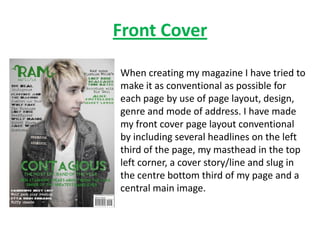
When creating my magazine I have tried to
make it as conventional as possible for
each page by use of page layout, design,
genre and mode of address. I have made
my front cover page layout conventional
by including several headlines on the left
third of the page, my masthead in the top
left corner, a cover story/line and slug in
the centre bottom third of my page and a
central main image.
Front Cover
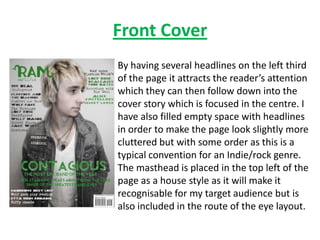
By having several headlines on the left third
of the page it attracts the reader’s attention
which they can then follow down into the
cover story which is focused in the centre. I
have also filled empty space with headlines
in order to make the page look slightly more
cluttered but with some order as this is a
typical convention for an Indie/rock genre.
The masthead is placed in the top left of the
page as a house style as it will make it
recognisable for my target audience but is
also included in the route of the eye layout.
Front Cover
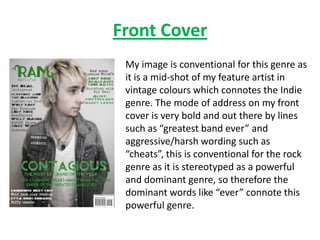
 My image is conventional for this genre as
 it is a mid-shot of my feature artist in
 vintage colours which connotes the Indie
 genre. The mode of address on my front
 cover is very bold and out there by lines
 such as “greatest band ever” and
 aggressive/harsh wording such as
 “cheats”, this is conventional for the rock
 genre as it is stereotyped as a powerful
 and dominant genre, so therefore the
 dominant words like “ever” connote this
 powerful genre.
Contents
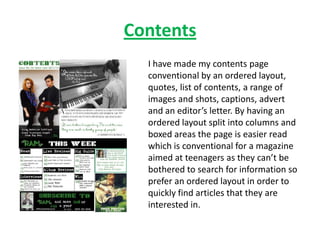
  I have made my contents page
  conventional by an ordered layout,
  quotes, list of contents, a range of
  images and shots, captions, advert
  and an editor’s letter. By having an
  ordered layout split into columns and
  boxed areas the page is easier read
  which is conventional for a magazine
  aimed at teenagers as they can’t be
  bothered to search for information so
  prefer an ordered layout in order to
  quickly find articles that they are
  interested in.
Contents
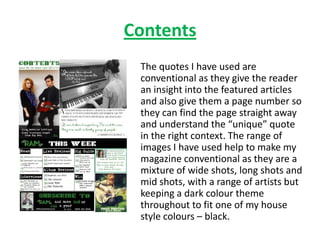
 The quotes I have used are
 conventional as they give the reader
 an insight into the featured articles
 and also give them a page number so
 they can find the page straight away
 and understand the “unique” quote
 in the right context. The range of
 images I have used help to make my
 magazine conventional as they are a
 mixture of wide shots, long shots and
 mid shots, with a range of artists but
 keeping a dark colour theme
 throughout to fit one of my house
 style colours – black.
Contents
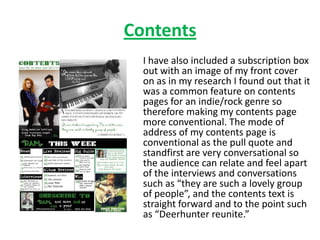
  I have also included a subscription box
  out with an image of my front cover
  on as in my research I found out that it
  was a common feature on contents
  pages for an indie/rock genre so
  therefore making my contents page
  more conventional. The mode of
  address of my contents page is
  conventional as the pull quote and
  standfirst are very conversational so
  the audience can relate and feel apart
  of the interviews and conversations
  such as “they are such a lovely group
  of people”, and the contents text is
  straight forward and to the point such
  as “Deerhunter reunite.”
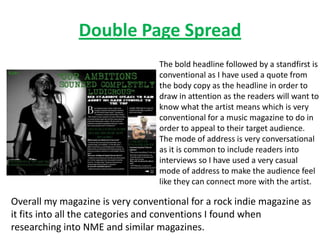
Double Page Spread
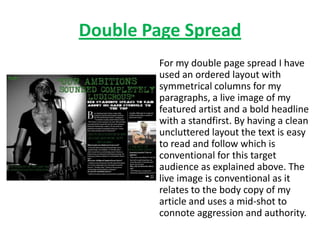
        For my double page spread I have
        used an ordered layout with
        symmetrical columns for my
        paragraphs, a live image of my
        featured artist and a bold headline
        with a standfirst. By having a clean
        uncluttered layout the text is easy
        to read and follow which is
        conventional for this target
        audience as explained above. The
        live image is conventional as it
        relates to the body copy of my
        article and uses a mid-shot to
        connote aggression and authority.
Double Page Spread
                                  The bold headline followed by a standfirst is
                                  conventional as I have used a quote from
                                  the body copy as the headline in order to
                                  draw in attention as the readers will want to
                                  know what the artist means which is very
                                  conventional for a music magazine to do in
                                  order to appeal to their target audience.
                                  The mode of address is very conversational
                                  as it is common to include readers into
                                  interviews so I have used a very casual
                                  mode of address to make the audience feel
                                  like they can connect more with the artist.

Overall my magazine is very conventional for a rock indie magazine as
it fits into all the categories and conventions I found when
researching into NME and similar magazines.

Conventions

  • 1.
  • 2.
    Front Cover When creatingmy magazine I have tried to make it as conventional as possible for each page by use of page layout, design, genre and mode of address. I have made my front cover page layout conventional by including several headlines on the left third of the page, my masthead in the top left corner, a cover story/line and slug in the centre bottom third of my page and a central main image.
  • 3.
    Front Cover By havingseveral headlines on the left third of the page it attracts the reader’s attention which they can then follow down into the cover story which is focused in the centre. I have also filled empty space with headlines in order to make the page look slightly more cluttered but with some order as this is a typical convention for an Indie/rock genre. The masthead is placed in the top left of the page as a house style as it will make it recognisable for my target audience but is also included in the route of the eye layout.
  • 4.
    Front Cover Myimage is conventional for this genre as it is a mid-shot of my feature artist in vintage colours which connotes the Indie genre. The mode of address on my front cover is very bold and out there by lines such as “greatest band ever” and aggressive/harsh wording such as “cheats”, this is conventional for the rock genre as it is stereotyped as a powerful and dominant genre, so therefore the dominant words like “ever” connote this powerful genre.
  • 5.
    Contents Ihave made my contents page conventional by an ordered layout, quotes, list of contents, a range of images and shots, captions, advert and an editor’s letter. By having an ordered layout split into columns and boxed areas the page is easier read which is conventional for a magazine aimed at teenagers as they can’t be bothered to search for information so prefer an ordered layout in order to quickly find articles that they are interested in.
  • 6.
    Contents The quotesI have used are conventional as they give the reader an insight into the featured articles and also give them a page number so they can find the page straight away and understand the “unique” quote in the right context. The range of images I have used help to make my magazine conventional as they are a mixture of wide shots, long shots and mid shots, with a range of artists but keeping a dark colour theme throughout to fit one of my house style colours – black.
  • 7.
    Contents Ihave also included a subscription box out with an image of my front cover on as in my research I found out that it was a common feature on contents pages for an indie/rock genre so therefore making my contents page more conventional. The mode of address of my contents page is conventional as the pull quote and standfirst are very conversational so the audience can relate and feel apart of the interviews and conversations such as “they are such a lovely group of people”, and the contents text is straight forward and to the point such as “Deerhunter reunite.”
  • 8.
    Double Page Spread For my double page spread I have used an ordered layout with symmetrical columns for my paragraphs, a live image of my featured artist and a bold headline with a standfirst. By having a clean uncluttered layout the text is easy to read and follow which is conventional for this target audience as explained above. The live image is conventional as it relates to the body copy of my article and uses a mid-shot to connote aggression and authority.
  • 9.
    Double Page Spread The bold headline followed by a standfirst is conventional as I have used a quote from the body copy as the headline in order to draw in attention as the readers will want to know what the artist means which is very conventional for a music magazine to do in order to appeal to their target audience. The mode of address is very conversational as it is common to include readers into interviews so I have used a very casual mode of address to make the audience feel like they can connect more with the artist. Overall my magazine is very conventional for a rock indie magazine as it fits into all the categories and conventions I found when researching into NME and similar magazines.