Teacher Education
through Inquiry
Programs and Possibilities in and for the Ed.D.
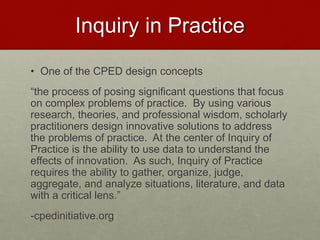
Inquiry in Practice
• One of the CPED design concepts
“the process of posing significant questions that focus
on complex problems of practice. By using various
research, theories, and professional wisdom, scholarly
practitioners design innovative solutions to address
the problems of practice. At the center of Inquiry of
Practice is the ability to use data to understand the
effects of innovation. As such, Inquiry of Practice
requires the ability to gather, organize, judge,
aggregate, and analyze situations, literature, and data
with a critical lens.”
-cpedinitiative.org
Inquiry in UNL’s TLTE
• Inquiry orientation= identified program feature
• Involves “[R]esearch design and data collection and
analysis skills fostering practitioner-based action
research in preparation for the conduct and
documentation of the capstone project.”
• -cehs.unl.edu/tlte/edd-cohort-scholars-educational-
practice
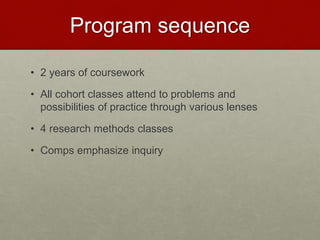
Program sequence
• 2 years of coursework
• All cohort classes attend to problems and
possibilities of practice through various lenses
• 4 research methods classes
• Comps emphasize inquiry
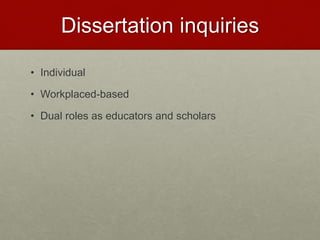
Dissertation inquiries
• Individual
• Workplaced-based
• Dual roles as educators and scholars
Faculty as Inquirers
• Regular student responses to questionnaires
• Also through faculty meetings, interviews, course
evaluations, and observations
• Attentive and responsive to program impact
• Related publications at end
To consider…
• The role of faculty as preparers of scholarly
practitioners
• Why CPED-influenced programs have the potential
to transform education through the impact of their
graduates
UNL TLTE CPED Ed.D.
Bibliography
• Chan, E. (2012). From teacher to researcher,
researcher to teacher; Examining teachers’
experiences of conducting research in their
education settings. In M. Macintyre Latta & S.
Wunder (Eds.). Placing practitioner knowledge at the
center of teacher education; Rethinking the policies
and practices of the education doctorate. (pp. 179-
198). Charlotte, NC: Information Age.
• Chan, E., Heaton, R.M., Swidler, S.A., & Wunder, S.
(2013). Examining CPED cohort dissertations: A
window into the learning of EdD students. Planning
& Changing, 44( 3/4), 266-285.
Bibliography
(cont’d, 2)
• Hamann, E., & Wunder, S. (2013). Using a cohort
approach to convert EdD students into critical
friends. In V. A. Storey (Ed.). Redesigning
professional education doctorates; Applications of
critical friendship theory to the EdD. (pp. 161-176).
New York, NY: Palgrave Macmillan.
• Heaton, R. M., & Swidler, S. A. (2012). Learning to
see inquiry as a resource for practice. In M.
Macintyre Latta & S. Wunder (Eds.). Placing
practitioner knowledge at the center of teacher
education; Rethinking the policies and practices of
the education doctorate. (pp. 89-104). Charlotte,
NC: Information Age.
Bibliography
(cont’d. 3)
• Macintyre Latta, M. & Wunder, S. (2012) Investing in the
formative nature of professional learning; Redirecting,
mediating, and generating education practice-as-policy.
In M. Macintyre Latta, & S. Wunder (Eds.).Placing
practitioner knowledge at the center of teacher
education; Rethinking the policies and practices of the
education doctorate.(pp. 3-25). Charlotte, NC:
Information Age.
• McGowan, T. M., & Pedersen, J. E. (2012). No longer
“PhD-Lite:” Establishing a professional practice doctorate
of substance. In M. Macintyre Latta & S. Wunder
(Eds.).Placing practitioner knowledge at the center of
teacher education; Rethinking the policies and practices
of the education doctorate.(pp. 233-248). Charlotte, NC:
Information Age.

Wunder

  • 1.
    Teacher Education through Inquiry Programsand Possibilities in and for the Ed.D.
  • 2.
    Inquiry in Practice •One of the CPED design concepts “the process of posing significant questions that focus on complex problems of practice. By using various research, theories, and professional wisdom, scholarly practitioners design innovative solutions to address the problems of practice. At the center of Inquiry of Practice is the ability to use data to understand the effects of innovation. As such, Inquiry of Practice requires the ability to gather, organize, judge, aggregate, and analyze situations, literature, and data with a critical lens.” -cpedinitiative.org
  • 3.
    Inquiry in UNL’sTLTE • Inquiry orientation= identified program feature • Involves “[R]esearch design and data collection and analysis skills fostering practitioner-based action research in preparation for the conduct and documentation of the capstone project.” • -cehs.unl.edu/tlte/edd-cohort-scholars-educational- practice
  • 4.
    Program sequence • 2years of coursework • All cohort classes attend to problems and possibilities of practice through various lenses • 4 research methods classes • Comps emphasize inquiry
  • 5.
    Dissertation inquiries • Individual •Workplaced-based • Dual roles as educators and scholars
  • 6.
    Faculty as Inquirers •Regular student responses to questionnaires • Also through faculty meetings, interviews, course evaluations, and observations • Attentive and responsive to program impact • Related publications at end
  • 7.
    To consider… • Therole of faculty as preparers of scholarly practitioners • Why CPED-influenced programs have the potential to transform education through the impact of their graduates
  • 8.
    UNL TLTE CPEDEd.D. Bibliography • Chan, E. (2012). From teacher to researcher, researcher to teacher; Examining teachers’ experiences of conducting research in their education settings. In M. Macintyre Latta & S. Wunder (Eds.). Placing practitioner knowledge at the center of teacher education; Rethinking the policies and practices of the education doctorate. (pp. 179- 198). Charlotte, NC: Information Age. • Chan, E., Heaton, R.M., Swidler, S.A., & Wunder, S. (2013). Examining CPED cohort dissertations: A window into the learning of EdD students. Planning & Changing, 44( 3/4), 266-285.
  • 9.
    Bibliography (cont’d, 2) • Hamann,E., & Wunder, S. (2013). Using a cohort approach to convert EdD students into critical friends. In V. A. Storey (Ed.). Redesigning professional education doctorates; Applications of critical friendship theory to the EdD. (pp. 161-176). New York, NY: Palgrave Macmillan. • Heaton, R. M., & Swidler, S. A. (2012). Learning to see inquiry as a resource for practice. In M. Macintyre Latta & S. Wunder (Eds.). Placing practitioner knowledge at the center of teacher education; Rethinking the policies and practices of the education doctorate. (pp. 89-104). Charlotte, NC: Information Age.
  • 10.
    Bibliography (cont’d. 3) • MacintyreLatta, M. & Wunder, S. (2012) Investing in the formative nature of professional learning; Redirecting, mediating, and generating education practice-as-policy. In M. Macintyre Latta, & S. Wunder (Eds.).Placing practitioner knowledge at the center of teacher education; Rethinking the policies and practices of the education doctorate.(pp. 3-25). Charlotte, NC: Information Age. • McGowan, T. M., & Pedersen, J. E. (2012). No longer “PhD-Lite:” Establishing a professional practice doctorate of substance. In M. Macintyre Latta & S. Wunder (Eds.).Placing practitioner knowledge at the center of teacher education; Rethinking the policies and practices of the education doctorate.(pp. 233-248). Charlotte, NC: Information Age.