Sources: Parks text book of Preventive and
Social Medicine
1. To impart evidence based
research oriented medical
education
2. To provide best possible patient
care
3. To inculcate the values of mutual
respect and ethical practice of
medicine
Vision & Mission of RMU
 Learning outcomes (1 slide)
 Core Subject (24 slides)
 EOLA(End of lecture assessment) (1 slide)
 Further reading/Digital Library References (I slide)
( Research, Bioethics, Artificial Intelligence)
Define and comprehend the definition & rationale of
sampling.
Understand the Concept of non-probability sampling
technique
Enlist the types of non-probability sampling
Appraise different scenarios to apply different non -
probability technique
Calculate sample size for any study design
 In non-probability/non-random sampling,
every participant DOESN’T get an equal
chance of being included or excluded from
the study population.
CONVENIENCE
SAMPLING
PURPOSIVE
SAMPLING
QUOTA
SAMPLING
SNOWBALL
SAMPLING
DIMENSIONAL
SAMPLING
CONSECUTIVE
 Convenience sampling is a type of sampling
where the first available primary data source
will be used for the research without
additional requirements.
 In other words, this sampling method
involves getting participants wherever you
can find them and typically wherever is
convenient.
 Generalizability of results is compromised.
 It involves taking every patient who
meets the selection criteria over a specified
time interval or number of patients.
 It is the best of the nonprobability
techniques and one that is very often
practical.
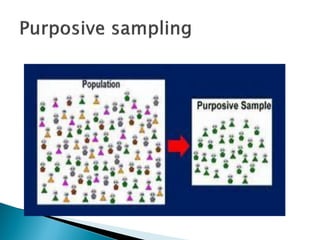
 Also known as judgment, selective or
subjective sampling.
 Researcher relies on his or her own judgment
when choosing members of population to
participate in the study.
 useful in situationsto reach a targeted sample
quickly, and where sampling for
proportionality is not the main concern.
It is widely used in public opinion polls and market research
surveys.
Sub-groups are made on the basis of some shared
characteristics like age, sex, religion, etc. These are called
quota control factors.
population is divided into subgroups and then sample is taken
non-randomly from these subgroups.
DIVIDE THE POPULATION INTO
EXCLUSIVE SUBGROUPS
SELECT SAMPLE BY USING NON-
RANDOM SAMPLING TECHNIQUE.
POOL THEM ALL TEGETHER
 It’s better to do quota sampling
proportionately but can be done
disproportionately as wellll….
 As this is non- probability sampling!!!!
 In this sampling, research participants recruit
other participants.
 Also called networking sampling.
 Does that make any sense????
 It is useful in finding subjects which may not
like to disclose their identity.
 e.g. homosexuals, drug addicts, sex workers,
child abusers, etc..
IDENTIFY POTENTIAL SUBJECTS IN THE
POPULATION
ASK THEM TO RECRUIT OTHER
INDIVIDUALS.
REPEAT THESE STEPS TILL THE TIME
THAT DESIRED SAMPLE SIZE IS
ACHIEVED.
 It is an extension to quota sampling.
 The researcher takes into account several
characteristics e.g. gender, age, income,
residence and education.
 The researcher must ensure that there is at
least one person in the study representing
each of the chosen characteristics.
SPECIFY ALL THE
DIMENSIONS OR VARIABLES .
CHOOSE A SAMPLE THAT
CONTAINS ATLEAST ONE
CASE OF EACH VARIABLE
 EXAMPLE:
 For example, out of 10 people the researcher
ensures they have interviewed 2 people that
are a certain gender, 2 a certain age group
and 2 who have an income between £25000
and £30000.
A sample that is TOO BIG will lead to the waste
of precious resources such as time and money,
while a sample that is TOO SMALL will not
allow you to gain reliable insights.
n = N × Z2 × P×(100-P) / d2 (N-1) + Z2 × P
× (100-P)
WHERE
n is sample size
N is size of population
Z is level of confidence, i.e. 95%=1.96
P is presumed prevalence in %age
d is acceptable margin of error usually 5%
 This is the positive and negative deviation
you allow on your survey results for the
sample.
 The deviation between the opinions of your
respondents and the opinion of the entire
population
 Suppose you set your margin of error on 5%.
If – let’s hope so! – 90% of your survey
respondents like the ‘Fall 2016’ line, a 5%
margin of error means that you can be ‘sure’
that between 85% (90%-5) and 95% (90%+5)
of the entire population actually likes the ‘Fall
2016’ line.
 It tells you how sure you can be that between
85% and 95% of the population likes the ‘Fall
2016’ campaign.
 Suppose you chose the 95% confidence level –
then in 95% of the time between 85% and 95%
of the population likes the ‘Fall 2016’ line.
 Research, Bioethics, Artificial
Intelligence
 https://www.ncbi.nlm.nih.gov/pmc/articles/P
MC4017493/#:~:text=The%20following%20si
mple%20formula%20would,pilot%20study%20
conducted%20by%20the
 https://onlinelibrary.wiley.com/doi/abs/10.1
111/1467-8551.12064
 https://scholar.google.com.pk/scholar?q=co
nvenience+sampling+ethical+issues&hl=en&
as_sdt=0&as_vis=1&oi=scholart
 A physician intends to conduct a study on
prevalence and risk factors of hypertension in
the community in which he is serving. For this
purpose he selects 100 patients visiting his
clinic. This sampling is of which type?
◦ Convenience
◦ Purposive
◦ Quota
◦ consecutive
◦ Snowball

Non-probability sampling Community Medicine

  • 1.
    Sources: Parks textbook of Preventive and Social Medicine
  • 3.
    1. To impartevidence based research oriented medical education 2. To provide best possible patient care 3. To inculcate the values of mutual respect and ethical practice of medicine Vision & Mission of RMU
  • 4.
     Learning outcomes(1 slide)  Core Subject (24 slides)  EOLA(End of lecture assessment) (1 slide)  Further reading/Digital Library References (I slide) ( Research, Bioethics, Artificial Intelligence)
  • 5.
    Define and comprehendthe definition & rationale of sampling. Understand the Concept of non-probability sampling technique Enlist the types of non-probability sampling Appraise different scenarios to apply different non - probability technique Calculate sample size for any study design
  • 7.
     In non-probability/non-randomsampling, every participant DOESN’T get an equal chance of being included or excluded from the study population.
  • 9.
  • 10.
     Convenience samplingis a type of sampling where the first available primary data source will be used for the research without additional requirements.  In other words, this sampling method involves getting participants wherever you can find them and typically wherever is convenient.  Generalizability of results is compromised.
  • 12.
     It involvestaking every patient who meets the selection criteria over a specified time interval or number of patients.  It is the best of the nonprobability techniques and one that is very often practical.
  • 14.
     Also knownas judgment, selective or subjective sampling.  Researcher relies on his or her own judgment when choosing members of population to participate in the study.  useful in situationsto reach a targeted sample quickly, and where sampling for proportionality is not the main concern.
  • 16.
    It is widelyused in public opinion polls and market research surveys. Sub-groups are made on the basis of some shared characteristics like age, sex, religion, etc. These are called quota control factors. population is divided into subgroups and then sample is taken non-randomly from these subgroups.
  • 18.
    DIVIDE THE POPULATIONINTO EXCLUSIVE SUBGROUPS SELECT SAMPLE BY USING NON- RANDOM SAMPLING TECHNIQUE. POOL THEM ALL TEGETHER
  • 19.
     It’s betterto do quota sampling proportionately but can be done disproportionately as wellll….  As this is non- probability sampling!!!!
  • 20.
     In thissampling, research participants recruit other participants.  Also called networking sampling.  Does that make any sense????
  • 21.
     It isuseful in finding subjects which may not like to disclose their identity.  e.g. homosexuals, drug addicts, sex workers, child abusers, etc..
  • 22.
    IDENTIFY POTENTIAL SUBJECTSIN THE POPULATION ASK THEM TO RECRUIT OTHER INDIVIDUALS. REPEAT THESE STEPS TILL THE TIME THAT DESIRED SAMPLE SIZE IS ACHIEVED.
  • 23.
     It isan extension to quota sampling.  The researcher takes into account several characteristics e.g. gender, age, income, residence and education.  The researcher must ensure that there is at least one person in the study representing each of the chosen characteristics.
  • 24.
    SPECIFY ALL THE DIMENSIONSOR VARIABLES . CHOOSE A SAMPLE THAT CONTAINS ATLEAST ONE CASE OF EACH VARIABLE
  • 25.
     EXAMPLE:  Forexample, out of 10 people the researcher ensures they have interviewed 2 people that are a certain gender, 2 a certain age group and 2 who have an income between £25000 and £30000.
  • 26.
    A sample thatis TOO BIG will lead to the waste of precious resources such as time and money, while a sample that is TOO SMALL will not allow you to gain reliable insights.
  • 27.
    n = N× Z2 × P×(100-P) / d2 (N-1) + Z2 × P × (100-P) WHERE n is sample size N is size of population Z is level of confidence, i.e. 95%=1.96 P is presumed prevalence in %age d is acceptable margin of error usually 5%
  • 28.
     This isthe positive and negative deviation you allow on your survey results for the sample.  The deviation between the opinions of your respondents and the opinion of the entire population
  • 29.
     Suppose youset your margin of error on 5%. If – let’s hope so! – 90% of your survey respondents like the ‘Fall 2016’ line, a 5% margin of error means that you can be ‘sure’ that between 85% (90%-5) and 95% (90%+5) of the entire population actually likes the ‘Fall 2016’ line.
  • 30.
     It tellsyou how sure you can be that between 85% and 95% of the population likes the ‘Fall 2016’ campaign.  Suppose you chose the 95% confidence level – then in 95% of the time between 85% and 95% of the population likes the ‘Fall 2016’ line.
  • 31.
     Research, Bioethics,Artificial Intelligence
  • 32.
  • 33.
     A physicianintends to conduct a study on prevalence and risk factors of hypertension in the community in which he is serving. For this purpose he selects 100 patients visiting his clinic. This sampling is of which type? ◦ Convenience ◦ Purposive ◦ Quota ◦ consecutive ◦ Snowball