Cocreating democracy By roeland jaap in ‘t veld May 24 2011 [email_address]
Content explanation Digression on concepts A fundamental transition: The landscape: today’s world The regime: towards knowledge democracy The niches: co-creation  “ we live in times of profound change”
Knowledge democracy Triangle media, science, democracy Evolution of each cornerstone Tensions between bilateral relations Emerging tensions in the triangle
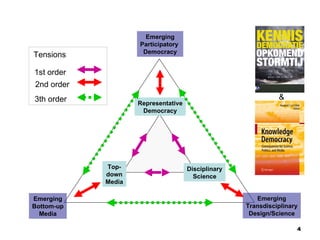
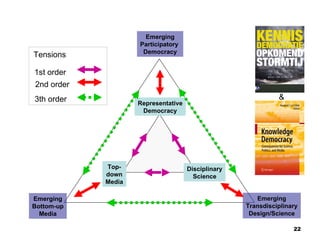
Representative Democracy Disciplinary Science Emerging Bottom-up Media Top- down Media Emerging Transdisciplinary Design/Science Emerging Participatory  Democracy Tensions 1st order 2nd order 3th order &
Three domains: science, politics and media Powell’s presentation in the UN on mass destruction weapons in Irak: Media: neutral transfer of informaton? Evidence-based policy? Democracy at work? Nightmare: lies, manipulation,criminal acts
Democracy 1 Representative democracy weakening because of fragmentation of value patterns, loss of ideologies (but also because of the hype dominance caused by the interaction between politics and the corporate media)
Democracy 2 Individual treated by public bodies as institutional role player: Voter Client  Citizen as a creative contributor neglected
Democracy 3 More participatory democracy necessary to overcome the weakness of representative democracy Participation based upon territory, function, interests, talent Participation in many degrees: advise, cocreation, autarchy (citizen initiatives) Burning questions as to the relations between participatory and representative democracy
Science and society Humboldtian ideal of cloister science: relates to basic research Senseful accumulation of knowledge then is the only objective Much production of knowledge however should be related to the world
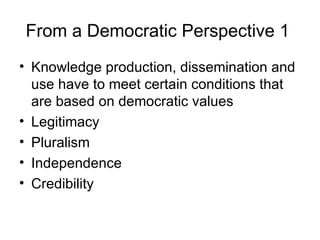
From a Democratic Perspective 1  Knowledge production, dissemination and use have to meet certain conditions that are based on democratic values Legitimacy  Pluralism  Independence Credibility
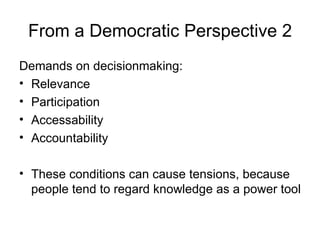
From a Democratic Perspective 2 Demands on decisionmaking: Relevance Participation Accessability Accountability These conditions can cause tensions, because people tend to regard knowledge as a power tool
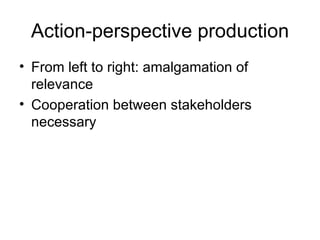
Action-perspective production From left to right: amalgamation of relevance Cooperation between stakeholders necessary
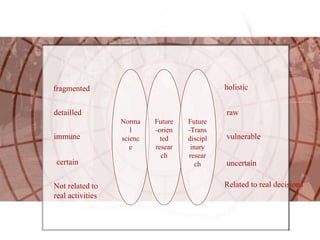
fragmented holistic detailled immune certain Not related to real activities raw vulnerable uncertain Related to real decisions Normal science Future-orien ted research Future-Trans disciplinary research
Logic of research Basic, normal: curiosity, meaningful accumulation of knowledge, no external interests relevant Problem- oriented: meeting with problem owners, at least interdisciplinary character of research
Today’s political agenda’s Wicked problems dominate No consensus on values, no consensus on knowledge Extreme complexity and uncertainty Authority fails systematically
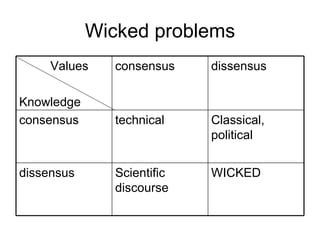
Wicked problems Values Knowledge  consensus dissensus consensus technical Classical, political dissensus Scientific discourse WICKED
Transdisciplinarity =cocreation Trajectory from problem to perspective for action Criterion for success is social robustness, consent, plausibility, not truth or validity Not only interdisciplinary, but always interaction between knowledge producers and policymakers
Media 1 Classical media are enterprises with power: Castells points at switching power Structural mutual dependencies between politicians and classical media Classical media evolve in global business networks
Media 2 Social media: mass self communication No ownership visible Inclusion and exclusion are vague Consumer is producer =prosumer No editors, so no selection
Media 3 The presence of social media liberates the politician from the classical media in principle Communities exist in social media
Media 4 Society is richer than ever on social media: Masses Crowds  Publics Communities  Individuals
Representative Democracy Disciplinary Science Emerging Bottom-up Media Top- down Media Emerging Transdisciplinary Design/Science Emerging Participatory  Democracy Tensions 1st order 2nd order 3th order &
Knowledge Democracy: Emerging Concept Analogy with Knowledge Economy Scientific, Persuasive and Programmatic Meaning Based on Perceived Tensions and Problems Normative in scope, not in substance
Values  Substantial vs relational Relational values like equality a.o. relate to collective good and bad decision making procedures Relational values determine the opportunities for cocreation
Institutions  Realise values in society, produce meaning Are solidified and mortal Democracy,networks,markets are institutions Networks are based on empathy, because of complementarity of actors (nodes)
Games  Zero sum vs positive sum games Political power games are zero-sum games Zero sum games are obsolete Contracts and networks are positive sum games
Tensions  Participatory democracy, social media and transdisciplinarity demand new modes of governance in order to overcome the immense complexity
Cocreation Beyond coöperaton because the belief in processes as creative events prohibits a power orientation The result of the process is richer than the contribution of any partner Each individual will is moderated by the enriched self-interest or the moderate altruism of the partners
Co-creation and politics Politics will develop a hostile attitude towards co-creation because it devastates the core surplus value as to content of the politician The remaining role for politics is process architect (meta governor)
Co-creation and knowledge democracy Co-creation will be the core characteristic of the marriage between transdisciplinarity and participative democracy Cocreation is hope

Co- creating Democracy: Roeland Japp in't Veld

  • 1.
    Cocreating democracy Byroeland jaap in ‘t veld May 24 2011 [email_address]
  • 2.
    Content explanation Digressionon concepts A fundamental transition: The landscape: today’s world The regime: towards knowledge democracy The niches: co-creation “ we live in times of profound change”
  • 3.
    Knowledge democracy Trianglemedia, science, democracy Evolution of each cornerstone Tensions between bilateral relations Emerging tensions in the triangle
  • 4.
    Representative Democracy DisciplinaryScience Emerging Bottom-up Media Top- down Media Emerging Transdisciplinary Design/Science Emerging Participatory Democracy Tensions 1st order 2nd order 3th order &
  • 5.
    Three domains: science,politics and media Powell’s presentation in the UN on mass destruction weapons in Irak: Media: neutral transfer of informaton? Evidence-based policy? Democracy at work? Nightmare: lies, manipulation,criminal acts
  • 6.
    Democracy 1 Representativedemocracy weakening because of fragmentation of value patterns, loss of ideologies (but also because of the hype dominance caused by the interaction between politics and the corporate media)
  • 7.
    Democracy 2 Individualtreated by public bodies as institutional role player: Voter Client Citizen as a creative contributor neglected
  • 8.
    Democracy 3 Moreparticipatory democracy necessary to overcome the weakness of representative democracy Participation based upon territory, function, interests, talent Participation in many degrees: advise, cocreation, autarchy (citizen initiatives) Burning questions as to the relations between participatory and representative democracy
  • 9.
    Science and societyHumboldtian ideal of cloister science: relates to basic research Senseful accumulation of knowledge then is the only objective Much production of knowledge however should be related to the world
  • 10.
    From a DemocraticPerspective 1 Knowledge production, dissemination and use have to meet certain conditions that are based on democratic values Legitimacy Pluralism Independence Credibility
  • 11.
    From a DemocraticPerspective 2 Demands on decisionmaking: Relevance Participation Accessability Accountability These conditions can cause tensions, because people tend to regard knowledge as a power tool
  • 12.
    Action-perspective production Fromleft to right: amalgamation of relevance Cooperation between stakeholders necessary
  • 13.
    fragmented holistic detailledimmune certain Not related to real activities raw vulnerable uncertain Related to real decisions Normal science Future-orien ted research Future-Trans disciplinary research
  • 14.
    Logic of researchBasic, normal: curiosity, meaningful accumulation of knowledge, no external interests relevant Problem- oriented: meeting with problem owners, at least interdisciplinary character of research
  • 15.
    Today’s political agenda’sWicked problems dominate No consensus on values, no consensus on knowledge Extreme complexity and uncertainty Authority fails systematically
  • 16.
    Wicked problems ValuesKnowledge consensus dissensus consensus technical Classical, political dissensus Scientific discourse WICKED
  • 17.
    Transdisciplinarity =cocreation Trajectoryfrom problem to perspective for action Criterion for success is social robustness, consent, plausibility, not truth or validity Not only interdisciplinary, but always interaction between knowledge producers and policymakers
  • 18.
    Media 1 Classicalmedia are enterprises with power: Castells points at switching power Structural mutual dependencies between politicians and classical media Classical media evolve in global business networks
  • 19.
    Media 2 Socialmedia: mass self communication No ownership visible Inclusion and exclusion are vague Consumer is producer =prosumer No editors, so no selection
  • 20.
    Media 3 Thepresence of social media liberates the politician from the classical media in principle Communities exist in social media
  • 21.
    Media 4 Societyis richer than ever on social media: Masses Crowds Publics Communities Individuals
  • 22.
    Representative Democracy DisciplinaryScience Emerging Bottom-up Media Top- down Media Emerging Transdisciplinary Design/Science Emerging Participatory Democracy Tensions 1st order 2nd order 3th order &
  • 23.
    Knowledge Democracy: EmergingConcept Analogy with Knowledge Economy Scientific, Persuasive and Programmatic Meaning Based on Perceived Tensions and Problems Normative in scope, not in substance
  • 24.
    Values Substantialvs relational Relational values like equality a.o. relate to collective good and bad decision making procedures Relational values determine the opportunities for cocreation
  • 25.
    Institutions Realisevalues in society, produce meaning Are solidified and mortal Democracy,networks,markets are institutions Networks are based on empathy, because of complementarity of actors (nodes)
  • 26.
    Games Zerosum vs positive sum games Political power games are zero-sum games Zero sum games are obsolete Contracts and networks are positive sum games
  • 27.
    Tensions Participatorydemocracy, social media and transdisciplinarity demand new modes of governance in order to overcome the immense complexity
  • 28.
    Cocreation Beyond coöperatonbecause the belief in processes as creative events prohibits a power orientation The result of the process is richer than the contribution of any partner Each individual will is moderated by the enriched self-interest or the moderate altruism of the partners
  • 29.
    Co-creation and politicsPolitics will develop a hostile attitude towards co-creation because it devastates the core surplus value as to content of the politician The remaining role for politics is process architect (meta governor)
  • 30.
    Co-creation and knowledgedemocracy Co-creation will be the core characteristic of the marriage between transdisciplinarity and participative democracy Cocreation is hope

Editor's Notes

  • #14 De verschillen tussen gewoon onderzoek, toekomstgericht onderzoek en TO3 zijn: gefragmenteerd versus holistisch gedetailleerd versus ruw immuun versus kwetsbaar (sneller niet meer valide en betrouwbaar) zeker en onzeker (ook de mogelijke maar niet waarschijnlijke ontwikkelingen krijgen een plaats: meer creativiteit) niet gerelateerd aan handelingsperspectieven (want onafhankelijk en in laboratoriumsituatie ontwikkeld: er moet een vertaalslag plaatsvinden naar de complexe situatie) en wel aan handelingsperspectieven gerelateerd omdat het in interactie met de compelxe situatie is ontwikkeld en de wensen en belangen er in opgenomen zijn. Vragen??