Lesson 4:
CONTROL VOLUME ANALYSIS
USING ENERGY
1
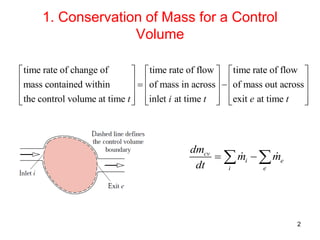
1. Conservation of Mass for a Control
Volume
2
time rate of change of time rate of flow time rate of flow
mass contained within of mass in across of mass out across
the control volume at time inlet at time exit at timet i t e t
    
         
        




cv
i e
i e
dm
m m
dt
  
3
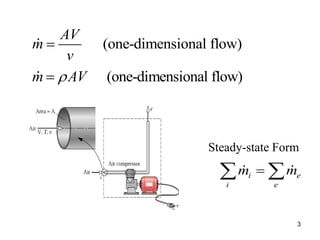
(one-dimensional flow)m AV
(one-dimensional flow)
AV
m
v

i e
i e
m m 
Steady-state Form
4
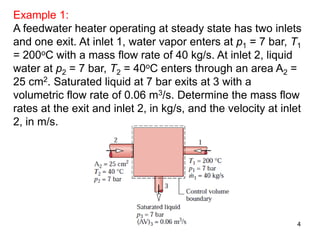
Example 1:
A feedwater heater operating at steady state has two inlets
and one exit. At inlet 1, water vapor enters at p1 = 7 bar, T1
= 200oC with a mass flow rate of 40 kg/s. At inlet 2, liquid
water at p2 = 7 bar, T2 = 40oC enters through an area A2 =
25 cm2. Saturated liquid at 7 bar exits at 3 with a
volumetric flow rate of 0.06 m3/s. Determine the mass flow
rates at the exit and inlet 2, in kg/s, and the velocity at inlet
2, in m/s.
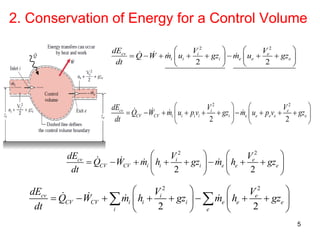
2. Conservation of Energy for a Control Volume
5
2 2
2 2
cv i e
i i i e e e
dE V V
Q W m u gz m u gz
dt
   
          
   
2 2
2 2
cv i e
CV CV i i i e e e
i e
dE V V
Q W m h gz m h gz
dt
   
          
   
 
2 2
2 2
cv i e
CV CV i i i i i e e e e e
dE V V
Q W m u p v gz m u p v gz
dt
   
            
   
2 2
2 2
cv i e
CV CV i i i e e e
dE V V
Q W m h gz m h gz
dt
   
          
   
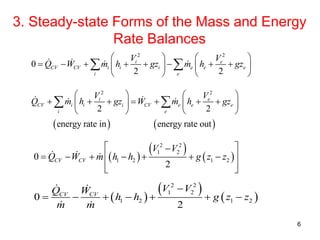
3. Steady-state Forms of the Mass and Energy
Rate Balances
6
 
 
 
2 2
1 2
1 2 1 20
2
CV CV
V VQ W
h h g z z
m m

      
2 2
0
2 2
i e
CV CV i i i e e e
i e
V V
Q W m h gz m h gz
   
          
   
 
   
2 2
2 2
energy rate in energy rate out
i e
CV i i i CV e e e
i e
V V
Q m h gz W m h gz
   
         
   
 
 
 
 
2 2
1 2
1 2 1 20
2
CV CV
V V
Q W m h h g z z
 
       
  
7
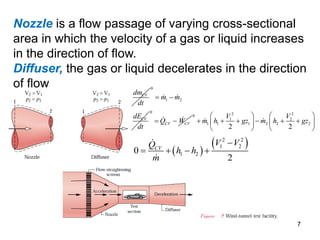
Nozzle is a flow passage of varying cross-sectional
area in which the velocity of a gas or liquid increases
in the direction of flow.
Diffuser, the gas or liquid decelerates in the direction
of flow
CVdm
dt
0
1 2
CV
m m
dE
dt
 
0
CV CVQ W 
2 20
1 2
1 1 1 2 2 2
2 2
V V
m h gz m h gz
   
        
   
 
 2 2
1 2
1 20
2
CV
V VQ
h h
m

   
8
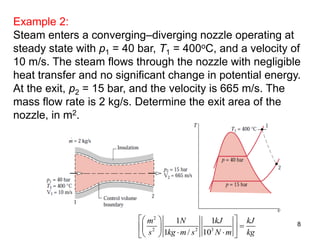
Example 2:
Steam enters a converging–diverging nozzle operating at
steady state with p1 = 40 bar, T1 = 400oC, and a velocity of
10 m/s. The steam flows through the nozzle with negligible
heat transfer and no significant change in potential energy.
At the exit, p2 = 15 bar, and the velocity is 665 m/s. The
mass flow rate is 2 kg/s. Determine the exit area of the
nozzle, in m2.
2
2 2 3
1 1
1 / 10
m N kJ kJ
s kg m s N m kg
  
  
   
9
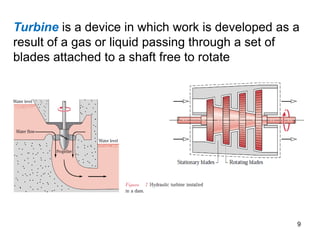
Turbine is a device in which work is developed as a
result of a gas or liquid passing through a set of
blades attached to a shaft free to rotate
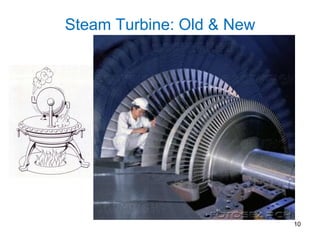
Steam Turbine: Old & New
10
11
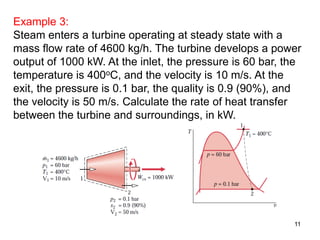
Example 3:
Steam enters a turbine operating at steady state with a
mass flow rate of 4600 kg/h. The turbine develops a power
output of 1000 kW. At the inlet, the pressure is 60 bar, the
temperature is 400oC, and the velocity is 10 m/s. At the
exit, the pressure is 0.1 bar, the quality is 0.9 (90%), and
the velocity is 50 m/s. Calculate the rate of heat transfer
between the turbine and surroundings, in kW.
12
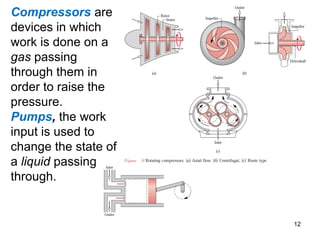
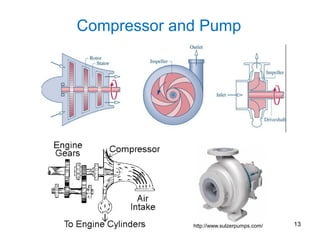
Compressors are
devices in which
work is done on a
gas passing
through them in
order to raise the
pressure.
Pumps, the work
input is used to
change the state of
a liquid passing
through.
http://www.sulzerpumps.com/
Compressor and Pump
13
14
Example 4:
Air enters a compressor operating at steady state at a
pressure of 1 bar, a temperature of 290 K, and a velocity of 6
m/s through an inlet with an area of 0.1 m2. At the exit, the
pressure is 7 bar, the temperature is 450 K, and the velocity
is 2 m/s. Heat transfer from the compressor to its
surroundings occurs at a rate of 180 kJ/min. Employing the
ideal gas model, calculate the power input to the
compressor, in kW.
15
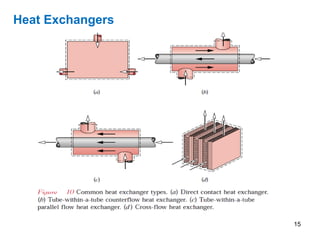
Heat Exchangers
16
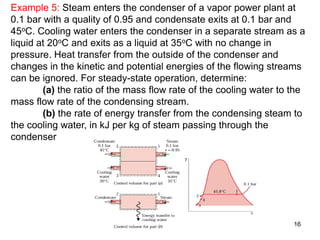
Example 5: Steam enters the condenser of a vapor power plant at
0.1 bar with a quality of 0.95 and condensate exits at 0.1 bar and
45oC. Cooling water enters the condenser in a separate stream as a
liquid at 20oC and exits as a liquid at 35oC with no change in
pressure. Heat transfer from the outside of the condenser and
changes in the kinetic and potential energies of the flowing streams
can be ignored. For steady-state operation, determine:
(a) the ratio of the mass flow rate of the cooling water to the
mass flow rate of the condensing stream.
(b) the rate of energy transfer from the condensing steam to
the cooling water, in kJ per kg of steam passing through the
condenser
17
Throttling Devices: A significant reduction in pressure
can be achieved simply by introducing a restriction into
a line through which a gas or liquid flows.
1 20
0 CV CV
m m
Q W
 
 
2 20
1 2
1 1 1 2 2 2
2 2
V V
m h gz m h gz
   
        
   
2 2
1 2
1 2
2 2
V V
h h  
1 2h h
18
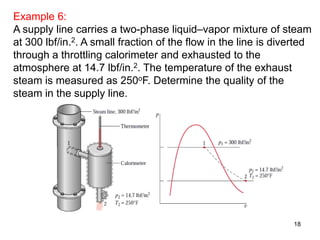
Example 6:
A supply line carries a two-phase liquid–vapor mixture of steam
at 300 lbf/in.2. A small fraction of the flow in the line is diverted
through a throttling calorimeter and exhausted to the
atmosphere at 14.7 lbf/in.2. The temperature of the exhaust
steam is measured as 250oF. Determine the quality of the
steam in the supply line.
19
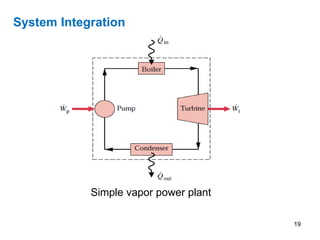
System Integration
Simple vapor power plant

CONTROL VOLUME ANALYSIS USING ENERGY for Mechanical and Industrial Engineering

  • 1.
    Lesson 4: CONTROL VOLUMEANALYSIS USING ENERGY 1
  • 2.
    1. Conservation ofMass for a Control Volume 2 time rate of change of time rate of flow time rate of flow mass contained within of mass in across of mass out across the control volume at time inlet at time exit at timet i t e t                             cv i e i e dm m m dt   
  • 3.
    3 (one-dimensional flow)m AV (one-dimensionalflow) AV m v  i e i e m m  Steady-state Form
  • 4.
    4 Example 1: A feedwaterheater operating at steady state has two inlets and one exit. At inlet 1, water vapor enters at p1 = 7 bar, T1 = 200oC with a mass flow rate of 40 kg/s. At inlet 2, liquid water at p2 = 7 bar, T2 = 40oC enters through an area A2 = 25 cm2. Saturated liquid at 7 bar exits at 3 with a volumetric flow rate of 0.06 m3/s. Determine the mass flow rates at the exit and inlet 2, in kg/s, and the velocity at inlet 2, in m/s.
  • 5.
    2. Conservation ofEnergy for a Control Volume 5 2 2 2 2 cv i e i i i e e e dE V V Q W m u gz m u gz dt                    2 2 2 2 cv i e CV CV i i i e e e i e dE V V Q W m h gz m h gz dt                      2 2 2 2 cv i e CV CV i i i i i e e e e e dE V V Q W m u p v gz m u p v gz dt                      2 2 2 2 cv i e CV CV i i i e e e dE V V Q W m h gz m h gz dt                   
  • 6.
    3. Steady-state Formsof the Mass and Energy Rate Balances 6       2 2 1 2 1 2 1 20 2 CV CV V VQ W h h g z z m m         2 2 0 2 2 i e CV CV i i i e e e i e V V Q W m h gz m h gz                          2 2 2 2 energy rate in energy rate out i e CV i i i CV e e e i e V V Q m h gz W m h gz                           2 2 1 2 1 2 1 20 2 CV CV V V Q W m h h g z z             
  • 7.
    7 Nozzle is aflow passage of varying cross-sectional area in which the velocity of a gas or liquid increases in the direction of flow. Diffuser, the gas or liquid decelerates in the direction of flow CVdm dt 0 1 2 CV m m dE dt   0 CV CVQ W  2 20 1 2 1 1 1 2 2 2 2 2 V V m h gz m h gz                     2 2 1 2 1 20 2 CV V VQ h h m     
  • 8.
    8 Example 2: Steam entersa converging–diverging nozzle operating at steady state with p1 = 40 bar, T1 = 400oC, and a velocity of 10 m/s. The steam flows through the nozzle with negligible heat transfer and no significant change in potential energy. At the exit, p2 = 15 bar, and the velocity is 665 m/s. The mass flow rate is 2 kg/s. Determine the exit area of the nozzle, in m2. 2 2 2 3 1 1 1 / 10 m N kJ kJ s kg m s N m kg          
  • 9.
    9 Turbine is adevice in which work is developed as a result of a gas or liquid passing through a set of blades attached to a shaft free to rotate
  • 10.
  • 11.
    11 Example 3: Steam entersa turbine operating at steady state with a mass flow rate of 4600 kg/h. The turbine develops a power output of 1000 kW. At the inlet, the pressure is 60 bar, the temperature is 400oC, and the velocity is 10 m/s. At the exit, the pressure is 0.1 bar, the quality is 0.9 (90%), and the velocity is 50 m/s. Calculate the rate of heat transfer between the turbine and surroundings, in kW.
  • 12.
    12 Compressors are devices inwhich work is done on a gas passing through them in order to raise the pressure. Pumps, the work input is used to change the state of a liquid passing through.
  • 13.
  • 14.
    14 Example 4: Air entersa compressor operating at steady state at a pressure of 1 bar, a temperature of 290 K, and a velocity of 6 m/s through an inlet with an area of 0.1 m2. At the exit, the pressure is 7 bar, the temperature is 450 K, and the velocity is 2 m/s. Heat transfer from the compressor to its surroundings occurs at a rate of 180 kJ/min. Employing the ideal gas model, calculate the power input to the compressor, in kW.
  • 15.
  • 16.
    16 Example 5: Steamenters the condenser of a vapor power plant at 0.1 bar with a quality of 0.95 and condensate exits at 0.1 bar and 45oC. Cooling water enters the condenser in a separate stream as a liquid at 20oC and exits as a liquid at 35oC with no change in pressure. Heat transfer from the outside of the condenser and changes in the kinetic and potential energies of the flowing streams can be ignored. For steady-state operation, determine: (a) the ratio of the mass flow rate of the cooling water to the mass flow rate of the condensing stream. (b) the rate of energy transfer from the condensing steam to the cooling water, in kJ per kg of steam passing through the condenser
  • 17.
    17 Throttling Devices: Asignificant reduction in pressure can be achieved simply by introducing a restriction into a line through which a gas or liquid flows. 1 20 0 CV CV m m Q W     2 20 1 2 1 1 1 2 2 2 2 2 V V m h gz m h gz                  2 2 1 2 1 2 2 2 V V h h   1 2h h
  • 18.
    18 Example 6: A supplyline carries a two-phase liquid–vapor mixture of steam at 300 lbf/in.2. A small fraction of the flow in the line is diverted through a throttling calorimeter and exhausted to the atmosphere at 14.7 lbf/in.2. The temperature of the exhaust steam is measured as 250oF. Determine the quality of the steam in the supply line.
  • 19.