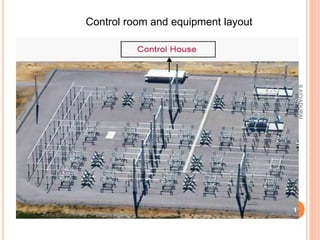
Control room and equipment layout
1
SAYYADURAI
Control house construction:
1.Foundation
2.Floor
3.Control house structure
1.Control house layout:
1.Control and relay protection panels
2.DC equipment
3.AC equipment
4.Cableways
5.Cable entrance
6.Lighting
7.Control house HVAC systems
8.Control house plumbing
9.Communications
2
SAYYADURAI
Control house construction
Nowadays, the control house is one of the main parts in every
modern HV switchyard and substation.
 Substations have grown in complexity and equipment such as
circuit breakers, switch disconnectors, CT, VTs and others must be
controlled, monitored and protected from some common point in the
field.
Foundation
The control house foundation consists of a spread footing with
either masonry blocks or cast-in place walls.
The footing is designed for an allowable bearing capacity based on
soil data. If soil data is not available, a maximum bearing of 48 k Pa
can be used.
The footings are installed below frost depth and in accordance with
local building codes and practices.
Drilled piers are an alternative to spread footings. Drilled piers are
especially applicable for pre-engineered metal buildings with
structural supporting bases that can rest directly on the piers without
requiring a concrete floor slab. Soil data is necessary for determining
the required depth, diameter, and reinforcing of the piers.
3
SAYYADURAI
Damp-proofing of foundation walls is desirable, especially if concrete
block is used. If a basement level is constructed, damp-proofing should be
provided.
Footing drains are usually provided when a basement level is
constructed.
All foundation walls should be insulated with a 5.1-cm (2-inch) thickness
of rigid insulation for energy conservation.
It is preferable to install the insulation on the inside of the walls, although
the outside is acceptable.
Nowadays, the control house is one of the main parts in every modern HV
switchyard and substation.
Simply, because substations have grown in complexity and equipment
such as circuit breakers, switch dis connectors, CT, VTs and others must
be controlled, monitored and protected from some common point
(CONTROL FOOM) in the field.
Necessity for supplemental equipment such as protection relays, controls,
batteries, communications equipment, and LV distribution equipment also
increases.
All that equipment must be placed somewhere in the field.
 For small distribution substations, this equipment can usually be
contained in weatherproof enclosures or control cabinets.
 For larger substations, separate equipment housing is necessary.
4
SAYYADURAI
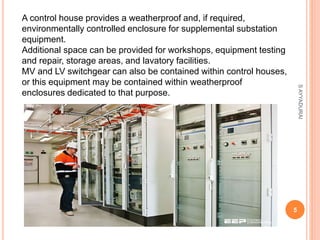
A control house provides a weatherproof and, if required,
environmentally controlled enclosure for supplemental substation
equipment.
Additional space can be provided for workshops, equipment testing
and repair, storage areas, and lavatory facilities.
MV and LV switchgear can also be contained within control houses,
or this equipment may be contained within weatherproof
enclosures dedicated to that purpose.
5
SAYYADURAI
6
SAYYADURAI
CONTROL & RELAY PANELS
7
SAYYADURAI
SAYYADURAI
8
RELAY PANELS
9
SAYYADURAI
10
SAYYADURAI
11
SAYYADURAI
12
SAYYADURAI
13
SAYYADURAI
14
SAYYADURAI
RELAY PANELS
15
SAYYADURAI
16
SAYYADURAI
17
SAYYADURAI

Control room and pannels

  • 1.
    Control room andequipment layout 1 SAYYADURAI
  • 2.
    Control house construction: 1.Foundation 2.Floor 3.Controlhouse structure 1.Control house layout: 1.Control and relay protection panels 2.DC equipment 3.AC equipment 4.Cableways 5.Cable entrance 6.Lighting 7.Control house HVAC systems 8.Control house plumbing 9.Communications 2 SAYYADURAI
  • 3.
    Control house construction Nowadays,the control house is one of the main parts in every modern HV switchyard and substation.  Substations have grown in complexity and equipment such as circuit breakers, switch disconnectors, CT, VTs and others must be controlled, monitored and protected from some common point in the field. Foundation The control house foundation consists of a spread footing with either masonry blocks or cast-in place walls. The footing is designed for an allowable bearing capacity based on soil data. If soil data is not available, a maximum bearing of 48 k Pa can be used. The footings are installed below frost depth and in accordance with local building codes and practices. Drilled piers are an alternative to spread footings. Drilled piers are especially applicable for pre-engineered metal buildings with structural supporting bases that can rest directly on the piers without requiring a concrete floor slab. Soil data is necessary for determining the required depth, diameter, and reinforcing of the piers. 3 SAYYADURAI
  • 4.
    Damp-proofing of foundationwalls is desirable, especially if concrete block is used. If a basement level is constructed, damp-proofing should be provided. Footing drains are usually provided when a basement level is constructed. All foundation walls should be insulated with a 5.1-cm (2-inch) thickness of rigid insulation for energy conservation. It is preferable to install the insulation on the inside of the walls, although the outside is acceptable. Nowadays, the control house is one of the main parts in every modern HV switchyard and substation. Simply, because substations have grown in complexity and equipment such as circuit breakers, switch dis connectors, CT, VTs and others must be controlled, monitored and protected from some common point (CONTROL FOOM) in the field. Necessity for supplemental equipment such as protection relays, controls, batteries, communications equipment, and LV distribution equipment also increases. All that equipment must be placed somewhere in the field.  For small distribution substations, this equipment can usually be contained in weatherproof enclosures or control cabinets.  For larger substations, separate equipment housing is necessary. 4 SAYYADURAI
  • 5.
    A control houseprovides a weatherproof and, if required, environmentally controlled enclosure for supplemental substation equipment. Additional space can be provided for workshops, equipment testing and repair, storage areas, and lavatory facilities. MV and LV switchgear can also be contained within control houses, or this equipment may be contained within weatherproof enclosures dedicated to that purpose. 5 SAYYADURAI
  • 6.
  • 7.
    CONTROL & RELAYPANELS 7 SAYYADURAI
  • 8.
  • 9.
  • 10.
  • 11.
  • 12.
  • 13.
  • 14.
  • 15.
  • 16.
  • 17.

Editor's Notes

  • #2 Control room equipment layout