GREEN UNIVERSITY OF BANGLADESH
Department Of Textile
ASSIGNMENT
Remarks:
Course Code : TE 311
Course Title : Textile Mill Utilities
Submitted By:
Name : Md Rakibul Hassan
ID : 183014057
Section : E1
Department : Textile
Date Of Submission : 21-09-2020
Assignment On : 1. Effects of engine emission on environment and ways
to reduce them.
2. An analysis on the selection of the lubrication system in
Engines.
Submitted to:
Name : Mr. Md Al Amin Hossain
Designation : Lecturer
Department : Textile
Answer To The Question No: 01
Effects Of Engine Emission On Environment And Ways to Reduce Them:
Introduction:
An increased diesel engine population has created pressures on controlling diesel PM and NOx
emissions. The initial progress in diesel emission control was achieved through engine technologies,
including changes in the combustion chamber design, improved fuel systems, charge air cooling, and
special attention to lube oil consumption. Emission standards implemented in the 2005-2010
timeframe additionally require the use of exhaust aftertreatment methods on new diesel engines.
These methods include diesel particulate filters, urea-SCR catalysts, and NOx adsorbers. An emission
is something that has been emitted released or discharged. In general, emissions consist of things like
gas, liquid, heat, sound, light, and radiation.
Emissions can come from natural sources or from machines. A specific example of an emission is the
exhaust from cars (in the U.S., such emissions are regulated through emissions tests). This exhaust is
just one form of carbon emissions—greenhouse gases from various sources that are known to
contribute to global warming and climate change.
Emission can also refer to an instance or the process of emitting, as in This filter is designed to reduce
the emission of light.
Example: Carbon dioxide emissions from volcanoes are much lower than those from cars and
airplanes.
Transportation sector alone utilizes most of the fossil fuels such as petrol, diesel, kerosene and
methanol. Considering all major anthropogenic source categories, with exception of agriculture, the
transportation sector of our economy releases about one-third of the total emissions of Volatile
Organic Compounds (VOCs), nitrogen oxides (NOx), and lead (Pb) and more than two-thirds of the
carbon monoxide (CO). The CO and the VOCs, (almost all as hydrocarbons) are products of
inefficient combustion (Henry and Heinke, 1995). Bailey (1995) and Lilley (2000) have also
underscored the significance of carbon monoxide (CO) fumes and spilled oil as major pollutants
from vehicle sources that gravely endanger human life and nature.
According to Okoko (2005), a study carried out in Germany reported that approximately 3% of
all journeys were less than 500 m. One-third of car journeys were not greater than 3 km and one-
half not more than 5 km. Often, these journeys are of a short duration of about 15 minutes. The
implication of this is that most private cars operate inefficiently in terms of energy consumption. On
short-distance journeys, the car engine is cold and runs least efficiently due to incomplete combustion
of fuel, which will significantly influence the composition and magnitude of the organic emissions
from vehicles.
Thus the problems of traffic pollution are particularly acute in a number of major cities,
especially in cities where traffic jam is a common experience as considerable amount of fuel
is used while cars are trapped in traffic congestion. As congestion in towns and cities increases
and traffic slows down, emissions are increasing much faster than the actual growth in vehicle
numbers. Also, research carried out by Bull (1991) on emissions from different types of
motor vehicle and fuel type reveals that older vehicles and those that are incorrectly maintained
contribute a disproportionate amount to aerial pollution.
In most major cities of developing countries the vehicle fleet is quite old and poorly maintained
and traffic congestion is more of the rule than exception. The ever-growing body of evidence on
the dangers posed by vehicular emissions on the environment therefore ought to lead to heightened
public awareness and concern about the problem in developing countries. Unfortunately, this
level of awareness is still lacking in many respects, partly because of a lack of appreciation of the
scale and nature of the problem. This paper presents a review of the emissions of pollutants
from vehicles and their transformation and impact on the environment. The options for control
and management of vehicular emissions have also been discussed.
Where does emission come from?
The first records of the word emission come from the early 1600s. It ultimately derives from the Latin
verb ēmittere, from e-, meaning “out of,” and mittere, “to send.”
An emission is something sent out from something else. Such emissions are often by-products
released during the course of other processes—such as smoke being emitted from a factory or heat
being emitted from a machine. Emissions from cars and airplanes come from the burning of fuel by
their engines. In physics and electronics, the word is used in a more specific way to refer to the amount
of electrons being emitted from an object.
Vehicle Emissions:
Thousands of motorized vehicles ply the major roads and streets of Nigerian cities daily. The
same is true of many other countries of the world. In doing this, the vehicles consume millions of
litres of petrol daily. The combustion of transportation fuels by these vehicles releases several
contaminants into the atmosphere, including carbon monoxide, hydrocarbons, oxides of nitrogen,
and lead and other particulate matter. Once emitted into the atmosphere, air pollutants undergo
mixing or diffusion, the degree of which depends on topographic, climatic, and meteorological
conditions (Zannetti, 1992). Since the 1950‟s it has been recognized that transportation engines
in developed countries are the major source of air pollution (Milton, 1995), while it is apparent
that the proportions to be attributed to various causes vary both in time and from place to place, typical
USA, figures are shown in Table 1. It can be seen that transportation is responsible for the biggest
share of CO, HC, and NOx in the atmosphere as well as a large proportion of the particulate
matter.
Types of Emission Pollutants:
Some of emissions are mentioned bellow-
1. Hydrocarbons:
Emissions of hydrocarbons indicate low combustion efficiency in internal combustion engines and
they arise when vaporised unburned fuel or partially burned fuel products, leave the combustion
region and are emitted with the exhaust. Unburned hydrocarbon emissions are independent of air/fuel
ratio. They normally arise from shortcomings in the fuel injection system. The level of unburned
hydrocarbons in the exhaust gases in generally specified in terms of the total hydrocarbon
concentration expressed in parts per million of carbon atoms. The total hydrocarbon emission is a
useful measure of combustion inefficiency. Some of these hydrocarbons are nearly inert
physiologically and are virtually uncreative from standpoint of photochemical smog. Others are
highly reactive in the smog-producing chemistry. Hydrocarbon compounds are divided into non-
reactive and reactive based on their potential for oxidant formation in the photochemical smog
chemistry. Some hydrocarbons are known carcinogens (Patterson and Henein, 1992). Fuel
composition can significantly influence the composition and magnitude of the organic emissions.
Fuels containing high proportions of aromatics and olefins produce relatively higher
concentrations of reactive hydrocarbons. Oxygenates are present in engine exhaust, and are
known to participate in the formation of photochemical smog. Some oxygenates are also irritants
and odorants. The oxygenates are generally categorized as carbonyls, phenols, and other non-
carbonyls. The carbonyls of interest are low molecular weight aldehydes and aliphatic ketones.
The volatile aldehydes are eye and also irritants. Carbonyls account for about 10 percent of HC
emissions from diesel passenger car engines, but in spark-ignition engine HC emissions are very
low. Phenols are odorants and irritants but their levels are much lower than aldehyde level.
2. Oxides of nitrogen (NOx):
Motor vehicles are the principal source of NO and of its oxidation product NO2. Nitric Oxide (NO)
and Nitrogen dioxide (NO2) are usually grouped together as Nitrogen oxides (NOx) emissions. Nitric
oxide is the predominant oxide of nitrogen produced inside the engine cylinder. The principal source
of NO is the oxidation of atmospheric (molecular) nitrogen. However, if the fuel contains
significant nitrogen the oxidation of the fuel nitrogen – containing compounds is an additional
source of NO. In the combustion of near-stoichiometric fuel-air mixtures, the principal reactions
governing the formation of NO from molecular nitrogen are:
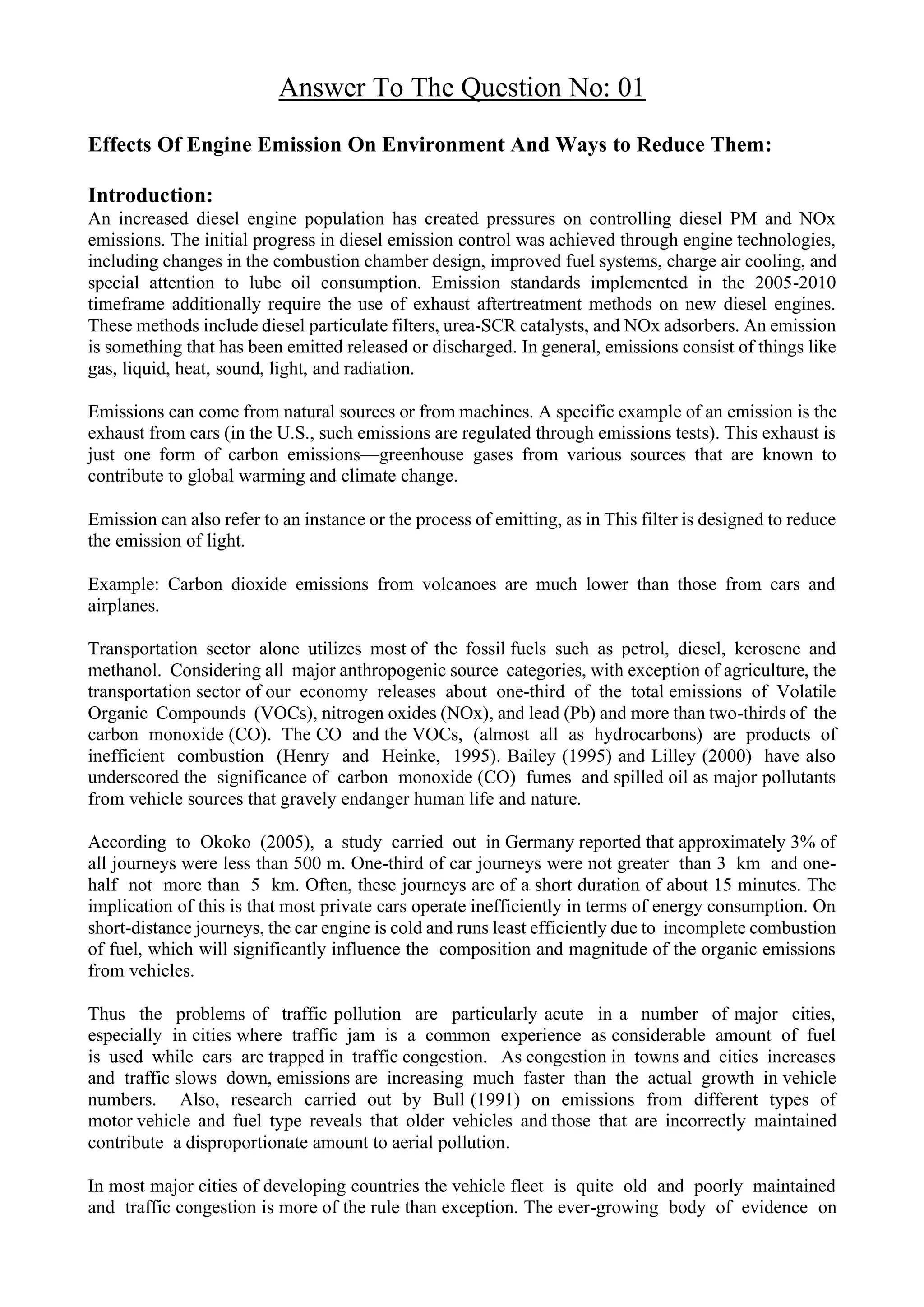
O2 + 2N2 = 2NO + N2 (1)
N2 + 2O2 = 2NO + O2 (2)
N2 + 2OH– = 2NO + H2 (3)
Hilliard and Wheeler (1979) worked on chemical equilibrium of burned gases at typical flame
temperatures, their studies reveal that NO2/NO ratio is negligibly small for spark ignition engines.
While in diesel engines, NO2 can be 10 to 30 percent of the total exhaust oxides of nitrogen
emissions. NO formed in the flame zone can be rapidly converted to NO2
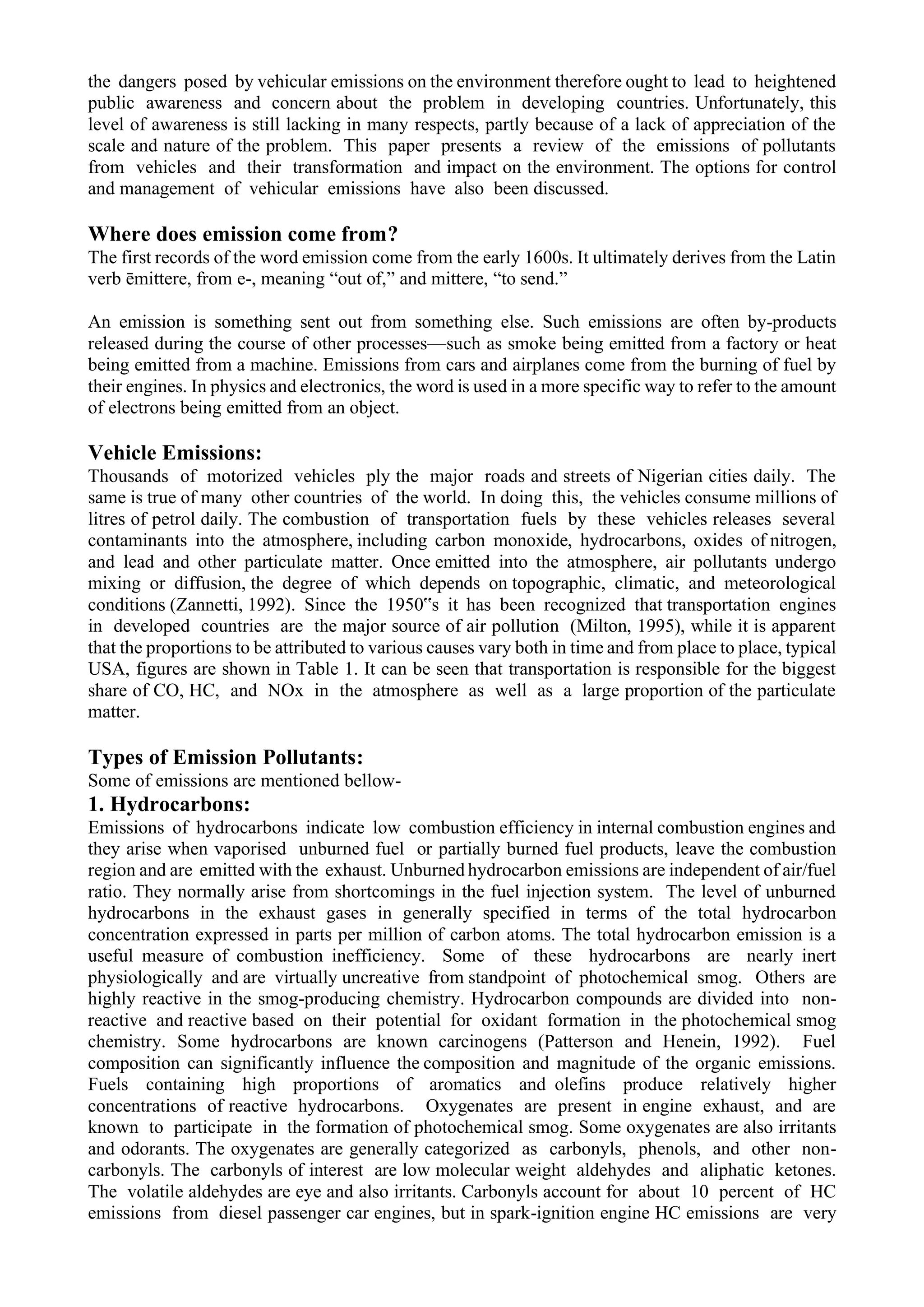
NO + O2 = NO2 + ½O2 (4)
It is customary to measure total oxides of nitrogen emissions, NO plus NO2, with a
chemiluminescence‟s analyzer and call the combination NOx (Lavoie and Blumberg, 1980). It
is always important to check carefully whether specific emissions data for NOx are given in
terms of mass of NO or mass of NO2, which have molecular weights of 30 and 46 respectively.
Oxides of nitrogen are important constituents of photochemical smog. In addition to the
greenhouse effect, oxides of nitrogen contribute to environmental pollution in three ways:
depletion of the ozone layer, production of acid rain and general air pollution.
3. Carbon Monoxide (CO):
Most of the CO in the ambient air comes from vehicle exhaust. Internal combustion engines do not
burn fuel completely to CO2 and water; some unburned fuel will always be exhausted, with CO as
a component. For rich air/fuel mixtures, CO concentration in the exhaust is high, since the
amount of excess fuel (unburned fuel) will be high. While for weak air/fuel mixtures, CO
emissions are very low, therefore, they are not considered as important. According to John
(1998), the levels of CO observed in spark-ignition engine exhaust gases are lower than the value
measured within the combustion chamber. Therefore, some of the CO that formed in the
combustion process are oxidized to CO2 before they are discharged into the atmosphere.
4. Carbon dioxide (CO2):
Combustion of petrol takes place in the internal part of the engine of a vehicle. If a typical
hydrocarbon octane, is taken to represent petrol, an equation may be written for the combustion
occurring in the engine as follows:
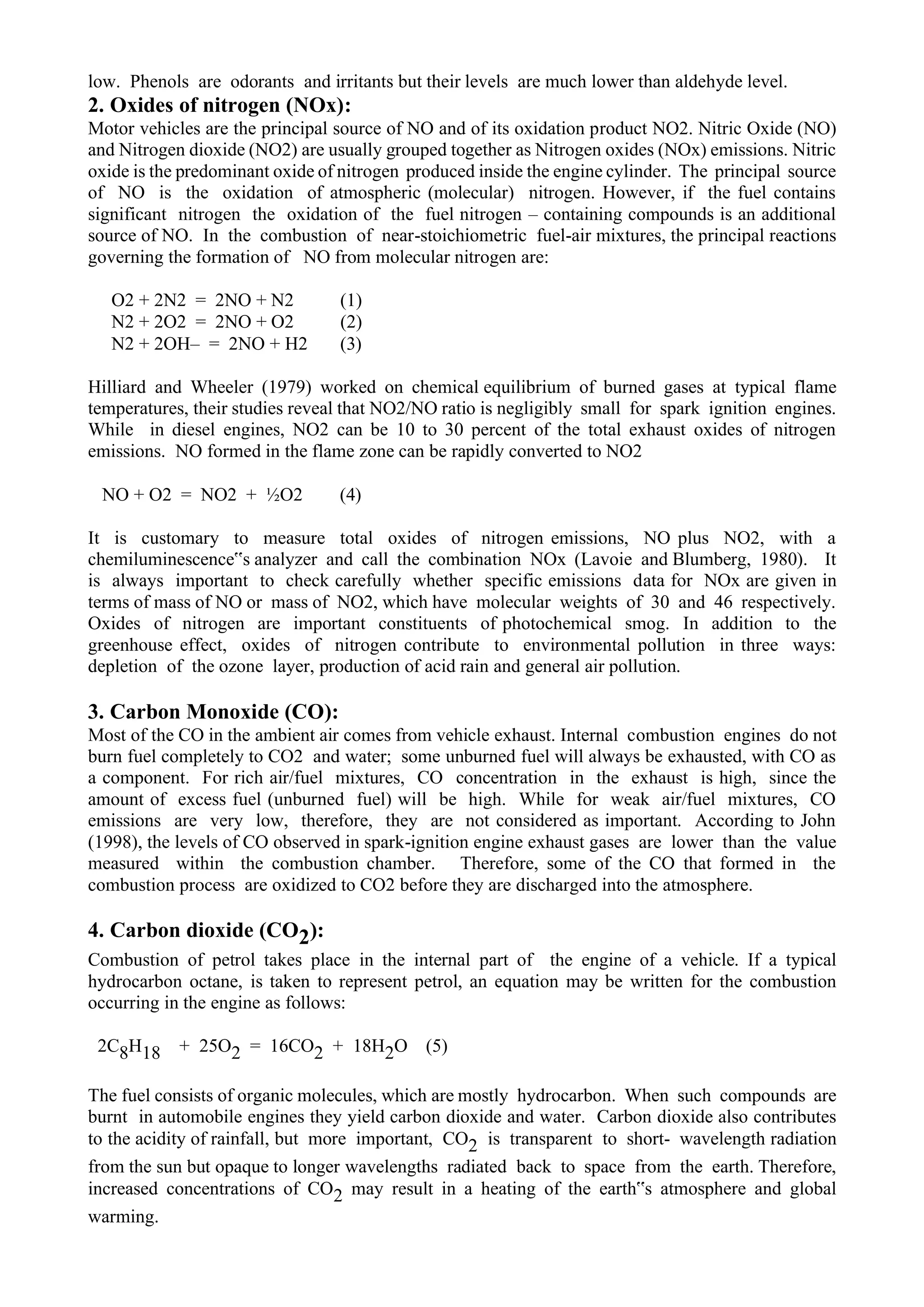
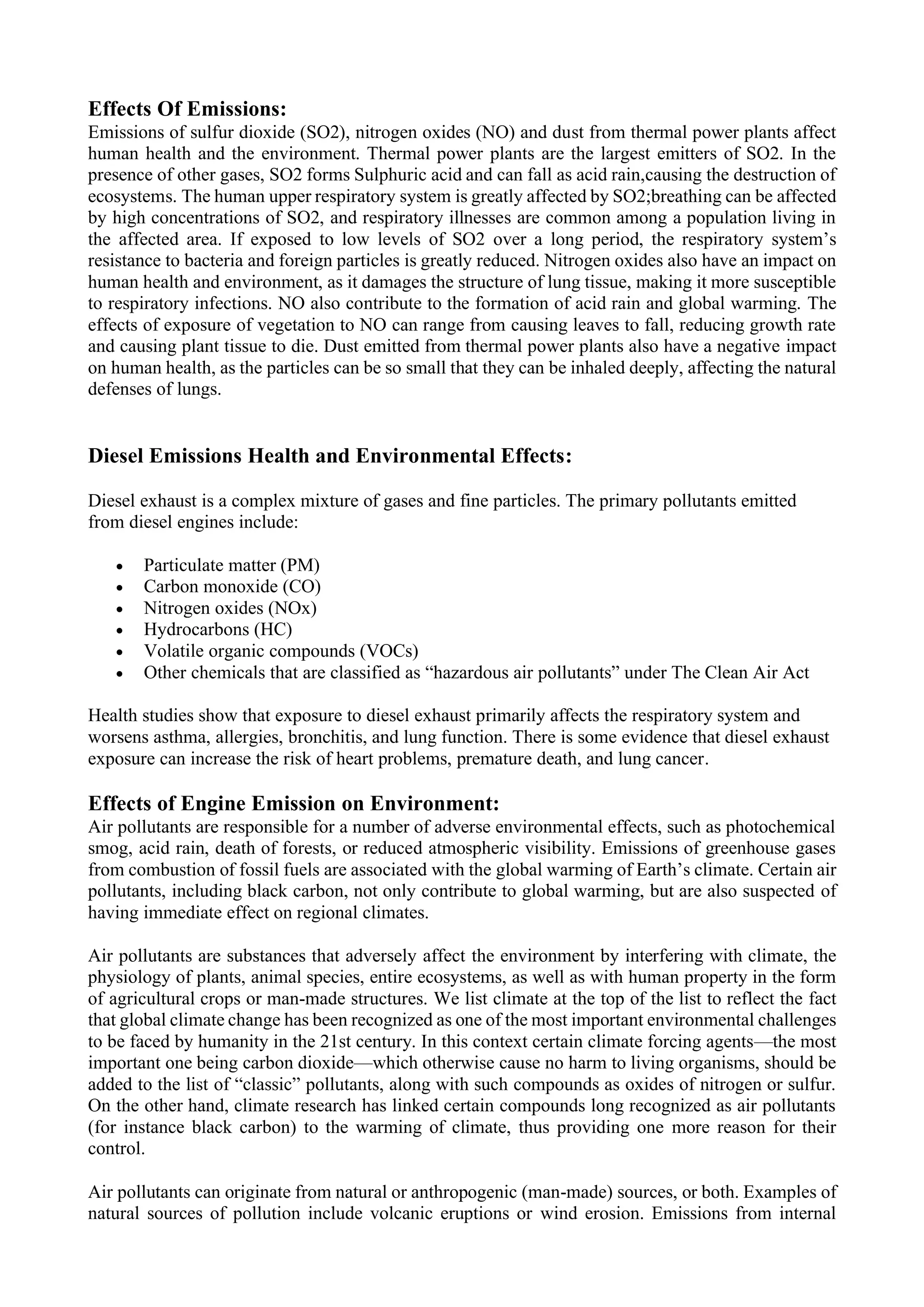
2C8H18 + 25O2 = 16CO2 + 18H2O (5)
The fuel consists of organic molecules, which are mostly hydrocarbon. When such compounds are
burnt in automobile engines they yield carbon dioxide and water. Carbon dioxide also contributes
to the acidity of rainfall, but more important, CO2 is transparent to short- wavelength radiation
from the sun but opaque to longer wavelengths radiated back to space from the earth. Therefore,
increased concentrations of CO2 may result in a heating of the earth‟s atmosphere and global
warming.
Effects Of Emissions:
Emissions of sulfur dioxide (SO2), nitrogen oxides (NO) and dust from thermal power plants affect
human health and the environment. Thermal power plants are the largest emitters of SO2. In the
presence of other gases, SO2 forms Sulphuric acid and can fall as acid rain,causing the destruction of
ecosystems. The human upper respiratory system is greatly affected by SO2;breathing can be affected
by high concentrations of SO2, and respiratory illnesses are common among a population living in
the affected area. If exposed to low levels of SO2 over a long period, the respiratory system’s
resistance to bacteria and foreign particles is greatly reduced. Nitrogen oxides also have an impact on
human health and environment, as it damages the structure of lung tissue, making it more susceptible
to respiratory infections. NO also contribute to the formation of acid rain and global warming. The
effects of exposure of vegetation to NO can range from causing leaves to fall, reducing growth rate
and causing plant tissue to die. Dust emitted from thermal power plants also have a negative impact
on human health, as the particles can be so small that they can be inhaled deeply, affecting the natural
defenses of lungs.
Diesel Emissions Health and Environmental Effects:
Diesel exhaust is a complex mixture of gases and fine particles. The primary pollutants emitted
from diesel engines include:
• Particulate matter (PM)
• Carbon monoxide (CO)
• Nitrogen oxides (NOx)
• Hydrocarbons (HC)
• Volatile organic compounds (VOCs)
• Other chemicals that are classified as “hazardous air pollutants” under The Clean Air Act
Health studies show that exposure to diesel exhaust primarily affects the respiratory system and
worsens asthma, allergies, bronchitis, and lung function. There is some evidence that diesel exhaust
exposure can increase the risk of heart problems, premature death, and lung cancer.
Effects of Engine Emission on Environment:
Air pollutants are responsible for a number of adverse environmental effects, such as photochemical
smog, acid rain, death of forests, or reduced atmospheric visibility. Emissions of greenhouse gases
from combustion of fossil fuels are associated with the global warming of Earth’s climate. Certain air
pollutants, including black carbon, not only contribute to global warming, but are also suspected of
having immediate effect on regional climates.
Air pollutants are substances that adversely affect the environment by interfering with climate, the
physiology of plants, animal species, entire ecosystems, as well as with human property in the form
of agricultural crops or man-made structures. We list climate at the top of the list to reflect the fact
that global climate change has been recognized as one of the most important environmental challenges
to be faced by humanity in the 21st century. In this context certain climate forcing agents—the most
important one being carbon dioxide—which otherwise cause no harm to living organisms, should be
added to the list of “classic” pollutants, along with such compounds as oxides of nitrogen or sulfur.
On the other hand, climate research has linked certain compounds long recognized as air pollutants
(for instance black carbon) to the warming of climate, thus providing one more reason for their
control.
Air pollutants can originate from natural or anthropogenic (man-made) sources, or both. Examples of
natural sources of pollution include volcanic eruptions or wind erosion. Emissions from internal
combustion engines are an exemplary source of anthropogenic pollution. Some sources of pollution,
such as forest fires, can be related to both natural phenomena and human activities.
Atmospheric reactions can transform primary pollutants into different chemical species. These
reactions can produce both harmless compounds and secondary air pollutants that may be more
harmful than their precursors.
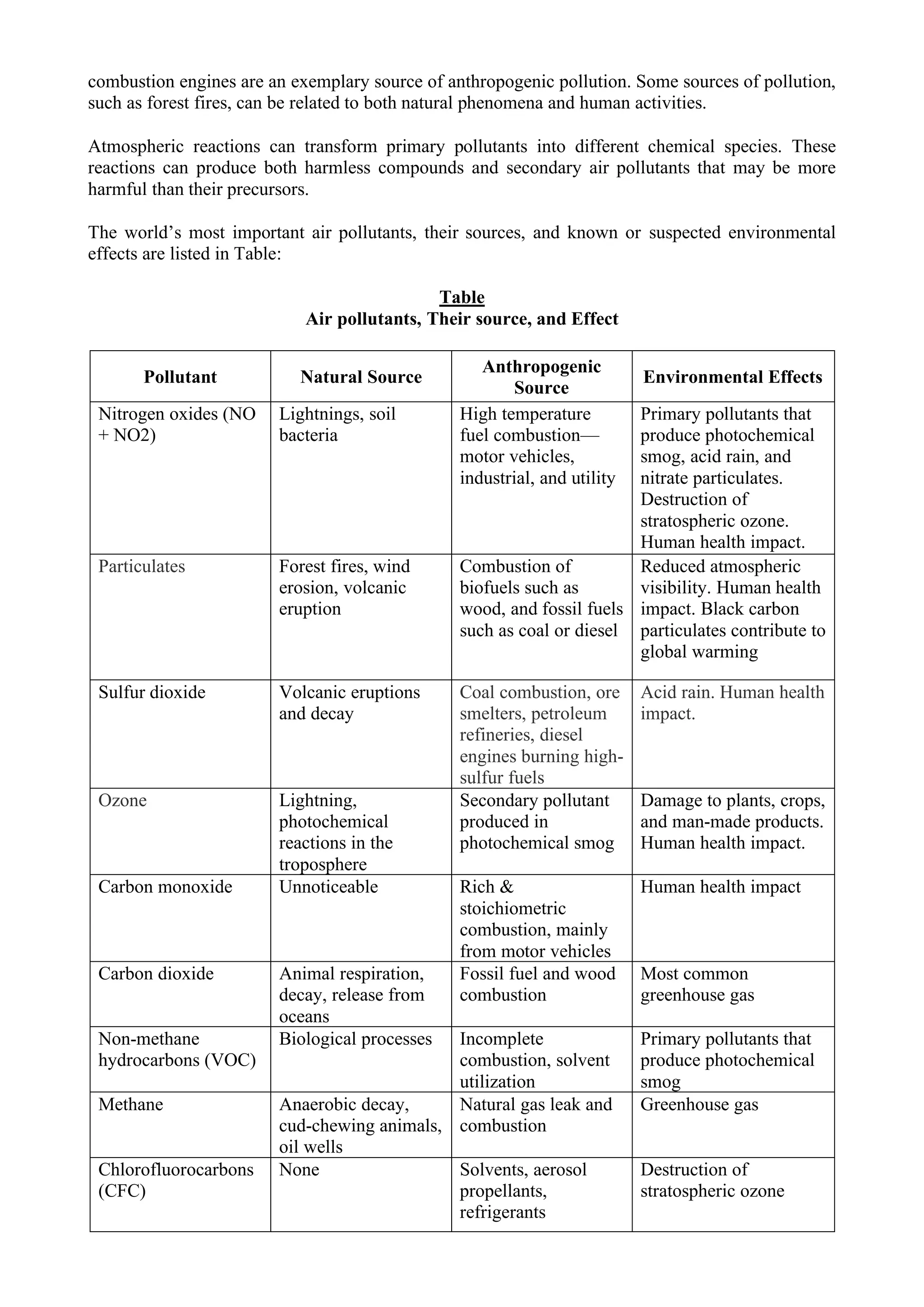
The world’s most important air pollutants, their sources, and known or suspected environmental
effects are listed in Table:
Table
Air pollutants, Their source, and Effect
Pollutant Natural Source
Anthropogenic
Source
Environmental Effects
Nitrogen oxides (NO
+ NO2)
Lightnings, soil
bacteria
High temperature
fuel combustion—
motor vehicles,
industrial, and utility
Primary pollutants that
produce photochemical
smog, acid rain, and
nitrate particulates.
Destruction of
stratospheric ozone.
Human health impact.
Particulates Forest fires, wind
erosion, volcanic
eruption
Combustion of
biofuels such as
wood, and fossil fuels
such as coal or diesel
Reduced atmospheric
visibility. Human health
impact. Black carbon
particulates contribute to
global warming
Sulfur dioxide Volcanic eruptions
and decay
Coal combustion, ore
smelters, petroleum
refineries, diesel
engines burning high-
sulfur fuels
Acid rain. Human health
impact.
Ozone Lightning,
photochemical
reactions in the
troposphere
Secondary pollutant
produced in
photochemical smog
Damage to plants, crops,
and man-made products.
Human health impact.
Carbon monoxide Unnoticeable Rich &
stoichiometric
combustion, mainly
from motor vehicles
Human health impact
Carbon dioxide Animal respiration,
decay, release from
oceans
Fossil fuel and wood
combustion
Most common
greenhouse gas
Non-methane
hydrocarbons (VOC)
Biological processes Incomplete
combustion, solvent
utilization
Primary pollutants that
produce photochemical
smog
Methane Anaerobic decay,
cud-chewing animals,
oil wells
Natural gas leak and
combustion
Greenhouse gas
Chlorofluorocarbons
(CFC)
None Solvents, aerosol
propellants,
refrigerants
Destruction of
stratospheric ozone
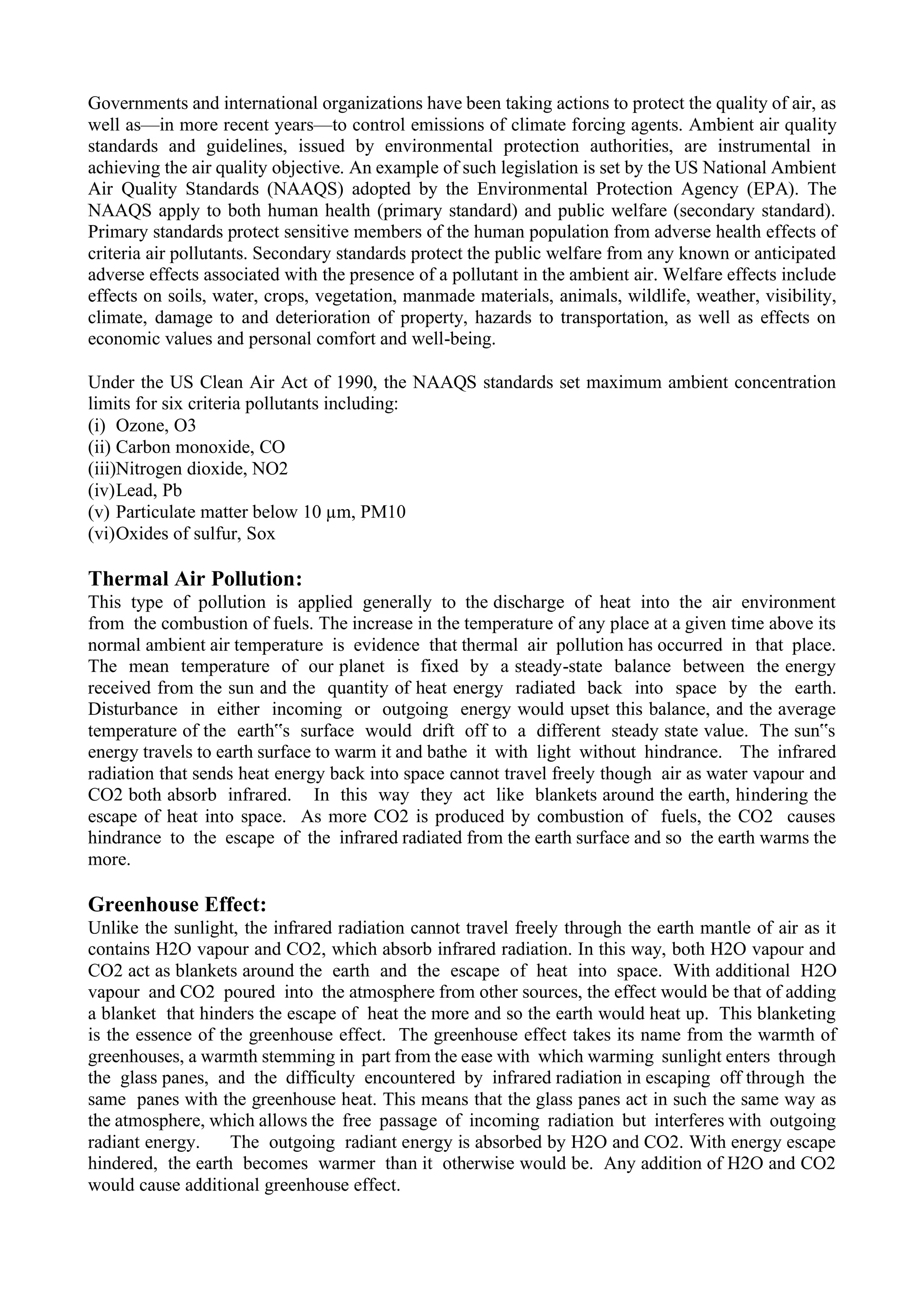
Governments and international organizations have been taking actions to protect the quality of air, as
well as—in more recent years—to control emissions of climate forcing agents. Ambient air quality
standards and guidelines, issued by environmental protection authorities, are instrumental in
achieving the air quality objective. An example of such legislation is set by the US National Ambient
Air Quality Standards (NAAQS) adopted by the Environmental Protection Agency (EPA). The
NAAQS apply to both human health (primary standard) and public welfare (secondary standard).
Primary standards protect sensitive members of the human population from adverse health effects of
criteria air pollutants. Secondary standards protect the public welfare from any known or anticipated
adverse effects associated with the presence of a pollutant in the ambient air. Welfare effects include
effects on soils, water, crops, vegetation, manmade materials, animals, wildlife, weather, visibility,
climate, damage to and deterioration of property, hazards to transportation, as well as effects on
economic values and personal comfort and well-being.
Under the US Clean Air Act of 1990, the NAAQS standards set maximum ambient concentration
limits for six criteria pollutants including:
(i) Ozone, O3
(ii) Carbon monoxide, CO
(iii)Nitrogen dioxide, NO2
(iv)Lead, Pb
(v) Particulate matter below 10 µm, PM10
(vi)Oxides of sulfur, Sox
Thermal Air Pollution:
This type of pollution is applied generally to the discharge of heat into the air environment
from the combustion of fuels. The increase in the temperature of any place at a given time above its
normal ambient air temperature is evidence that thermal air pollution has occurred in that place.
The mean temperature of our planet is fixed by a steady-state balance between the energy
received from the sun and the quantity of heat energy radiated back into space by the earth.
Disturbance in either incoming or outgoing energy would upset this balance, and the average
temperature of the earth‟s surface would drift off to a different steady state value. The sun‟s
energy travels to earth surface to warm it and bathe it with light without hindrance. The infrared
radiation that sends heat energy back into space cannot travel freely though air as water vapour and
CO2 both absorb infrared. In this way they act like blankets around the earth, hindering the
escape of heat into space. As more CO2 is produced by combustion of fuels, the CO2 causes
hindrance to the escape of the infrared radiated from the earth surface and so the earth warms the
more.
Greenhouse Effect:
Unlike the sunlight, the infrared radiation cannot travel freely through the earth mantle of air as it
contains H2O vapour and CO2, which absorb infrared radiation. In this way, both H2O vapour and
CO2 act as blankets around the earth and the escape of heat into space. With additional H2O
vapour and CO2 poured into the atmosphere from other sources, the effect would be that of adding
a blanket that hinders the escape of heat the more and so the earth would heat up. This blanketing
is the essence of the greenhouse effect. The greenhouse effect takes its name from the warmth of
greenhouses, a warmth stemming in part from the ease with which warming sunlight enters through
the glass panes, and the difficulty encountered by infrared radiation in escaping off through the
same panes with the greenhouse heat. This means that the glass panes act in such the same way as
the atmosphere, which allows the free passage of incoming radiation but interferes with outgoing
radiant energy. The outgoing radiant energy is absorbed by H2O and CO2. With energy escape
hindered, the earth becomes warmer than it otherwise would be. Any addition of H2O and CO2
would cause additional greenhouse effect.
Ozone Depletion:
The culprits causing ozone depletion are water vapour and nitrogen (II) oxide, NO. The ollutants
enter the stratosphere where the ozone layer is. Photochemical reaction occurs in the stratosphere
whereby oxygen molecule splits to oxygen atoms. The oxygen atom combines with oxygen
molecule leading to the production of ozone
O2 + [O] = O3 (7)
Oxygen atom reacts with water to give hydroxyl ions and which reduce ozone to oxygen molecule:
H2O + [O] = 2OH (8)
OH + O3 = H-O-O + O2 (9)
This step accounts for 11% depletion of ozone. Again, ozone is attacked by NO and is reduced
to molecular oxygen.
NO + O3 = NO2 + O2 (10)
Thus we have ozone depletion as given by equations (9) and (10). Unfortunately, eq.(10) is not the
end of the story. Further reaction occurs between NO2 and [O] which regenerates NO molecules
from NO2 viz:
NO2 + [O] = NO + O2 (11)
NO + O3 = NO2 + O2 (12)
Thus the cycle can proceed over and over again, consuming quantities of O3 with small initial
amounts of NO.
Effects On Agriculture:
Optimum plant growth requires adequate light, heat, moisture, nutrients and appropriate soil
conditions. An imbalance in any of these results in a stress to the plant, which may result in restricted
growth or foliage markings. Pollution provides an extra undesirable stress. If this stress is too high,
then the plant will die, despite the relatively complex biological defence mechanisms (e.g.
rebuilding of damaged tissue).
Plants absorb gaseous pollutant through their leaves because one of their major functions is
to absorb atmospheric gases. Examination of leaf structure reveals three regions: the epidermis (out
layer), the mesophyll and the veins, which transport water and nutrients around the plant. Gases
and small particulates enter the leaf through the stomata (leaf pores), to the air spaces of the mesophyll
(Posthumus, 1983). Symptoms of damage to the examined leaves are:
(i) necrosis and bleaching of leaf margins;
(ii) glazing and silvering of surfaces, especially the
undersides;
(iii) chlorosis (loss of chlorophyll);
(iv) flecking or stippling of upper surfaces
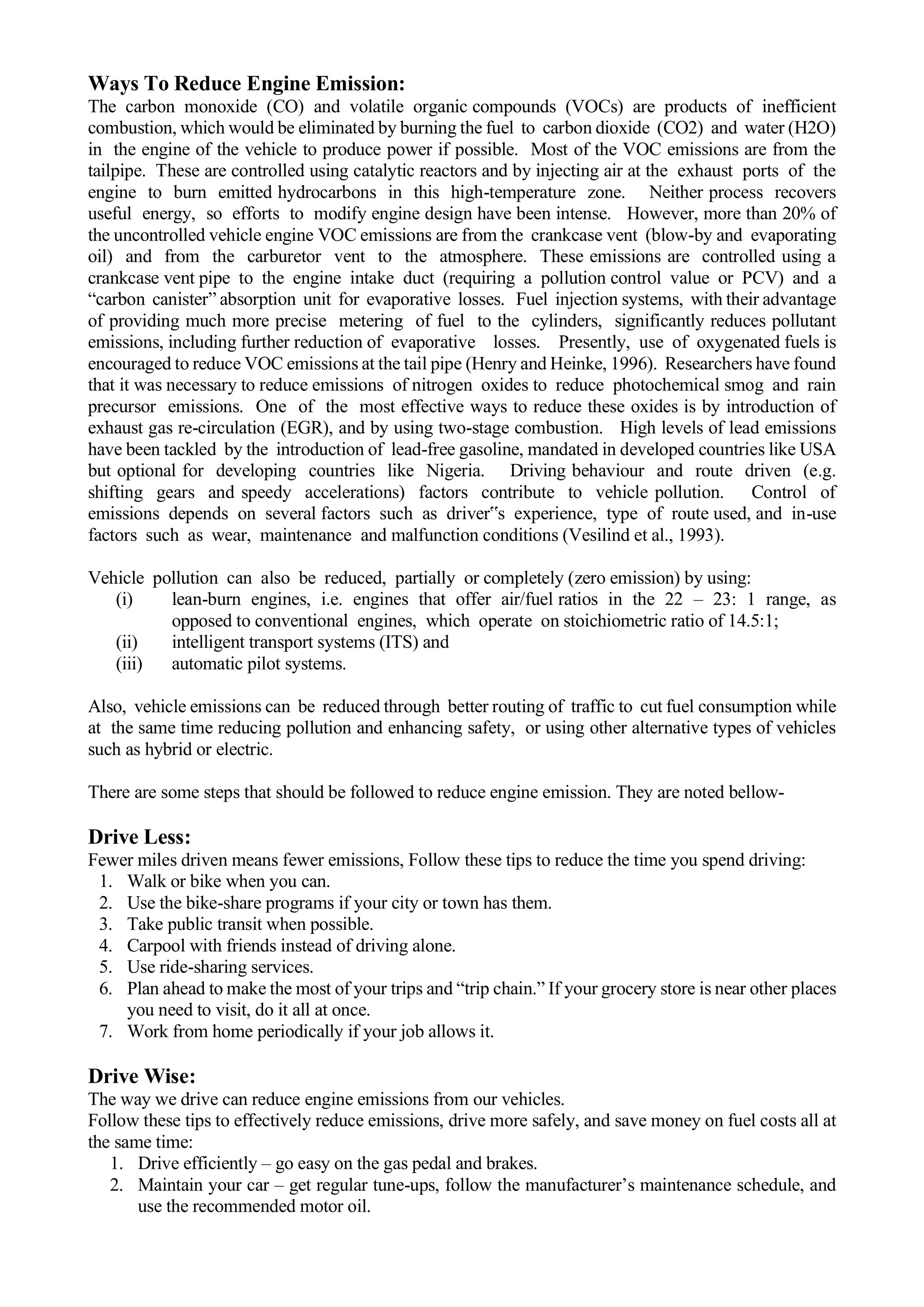
Ways To Reduce Engine Emission:
The carbon monoxide (CO) and volatile organic compounds (VOCs) are products of inefficient
combustion, which would be eliminated by burning the fuel to carbon dioxide (CO2) and water (H2O)
in the engine of the vehicle to produce power if possible. Most of the VOC emissions are from the
tailpipe. These are controlled using catalytic reactors and by injecting air at the exhaust ports of the
engine to burn emitted hydrocarbons in this high-temperature zone. Neither process recovers
useful energy, so efforts to modify engine design have been intense. However, more than 20% of
the uncontrolled vehicle engine VOC emissions are from the crankcase vent (blow-by and evaporating
oil) and from the carburetor vent to the atmosphere. These emissions are controlled using a
crankcase vent pipe to the engine intake duct (requiring a pollution control value or PCV) and a
“carbon canister” absorption unit for evaporative losses. Fuel injection systems, with their advantage
of providing much more precise metering of fuel to the cylinders, significantly reduces pollutant
emissions, including further reduction of evaporative losses. Presently, use of oxygenated fuels is
encouraged to reduce VOC emissions at the tail pipe (Henry and Heinke, 1996). Researchers have found
that it was necessary to reduce emissions of nitrogen oxides to reduce photochemical smog and rain
precursor emissions. One of the most effective ways to reduce these oxides is by introduction of
exhaust gas re-circulation (EGR), and by using two-stage combustion. High levels of lead emissions
have been tackled by the introduction of lead-free gasoline, mandated in developed countries like USA
but optional for developing countries like Nigeria. Driving behaviour and route driven (e.g.
shifting gears and speedy accelerations) factors contribute to vehicle pollution. Control of
emissions depends on several factors such as driver‟s experience, type of route used, and in-use
factors such as wear, maintenance and malfunction conditions (Vesilind et al., 1993).
Vehicle pollution can also be reduced, partially or completely (zero emission) by using:
(i) lean-burn engines, i.e. engines that offer air/fuel ratios in the 22 – 23: 1 range, as
opposed to conventional engines, which operate on stoichiometric ratio of 14.5:1;
(ii) intelligent transport systems (ITS) and
(iii) automatic pilot systems.
Also, vehicle emissions can be reduced through better routing of traffic to cut fuel consumption while
at the same time reducing pollution and enhancing safety, or using other alternative types of vehicles
such as hybrid or electric.
There are some steps that should be followed to reduce engine emission. They are noted bellow-
Drive Less:
Fewer miles driven means fewer emissions, Follow these tips to reduce the time you spend driving:
1. Walk or bike when you can.
2. Use the bike-share programs if your city or town has them.
3. Take public transit when possible.
4. Carpool with friends instead of driving alone.
5. Use ride-sharing services.
6. Plan ahead to make the most of your trips and “trip chain.” If your grocery store is near other places
you need to visit, do it all at once.
7. Work from home periodically if your job allows it.
Drive Wise:
The way we drive can reduce engine emissions from our vehicles.
Follow these tips to effectively reduce emissions, drive more safely, and save money on fuel costs all at
the same time:
1. Drive efficiently – go easy on the gas pedal and brakes.
2. Maintain your car – get regular tune-ups, follow the manufacturer’s maintenance schedule, and
use the recommended motor oil.
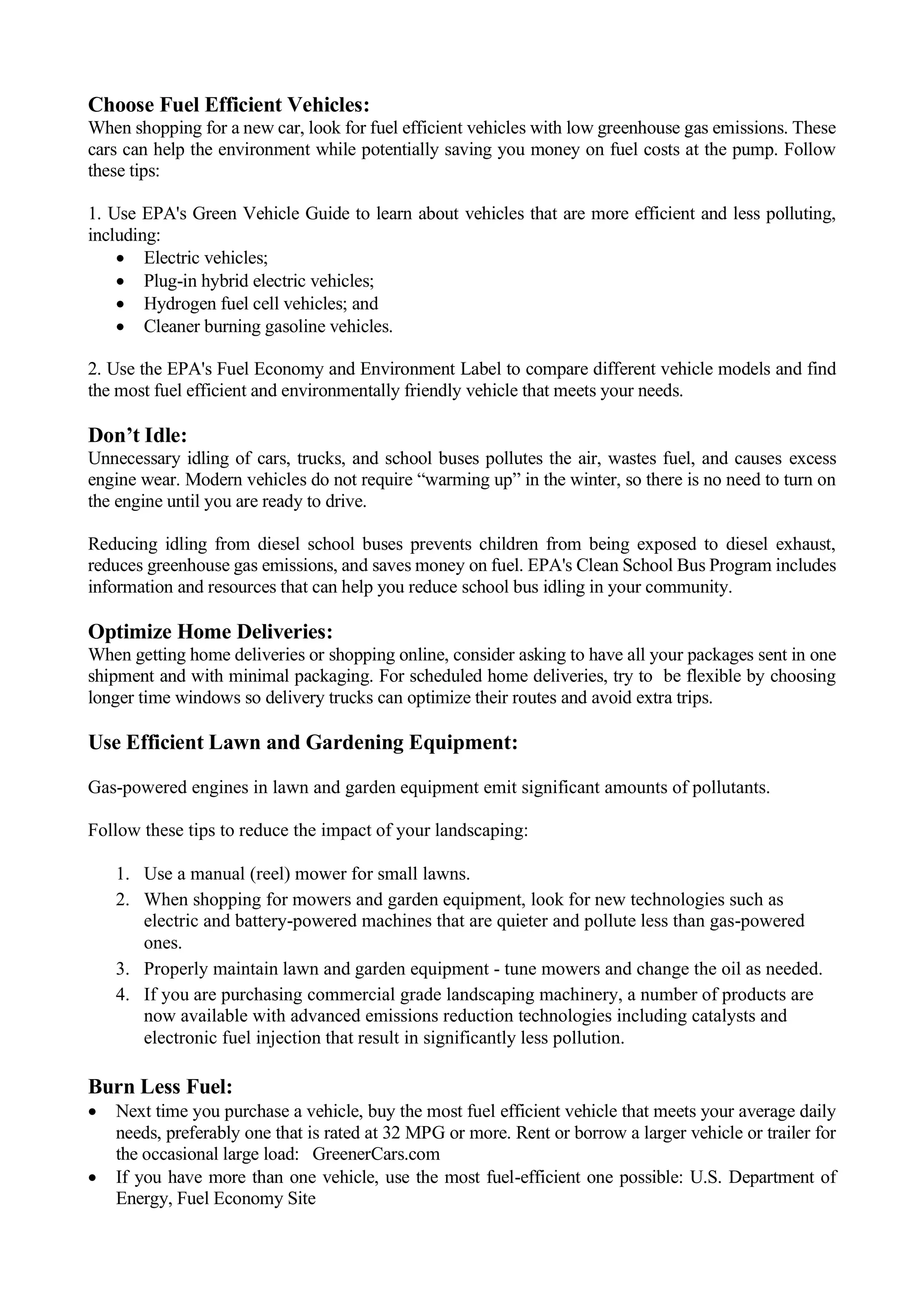
Choose Fuel Efficient Vehicles:
When shopping for a new car, look for fuel efficient vehicles with low greenhouse gas emissions. These
cars can help the environment while potentially saving you money on fuel costs at the pump. Follow
these tips:
1. Use EPA's Green Vehicle Guide to learn about vehicles that are more efficient and less polluting,
including:
• Electric vehicles;
• Plug-in hybrid electric vehicles;
• Hydrogen fuel cell vehicles; and
• Cleaner burning gasoline vehicles.
2. Use the EPA's Fuel Economy and Environment Label to compare different vehicle models and find
the most fuel efficient and environmentally friendly vehicle that meets your needs.
Don’t Idle:
Unnecessary idling of cars, trucks, and school buses pollutes the air, wastes fuel, and causes excess
engine wear. Modern vehicles do not require “warming up” in the winter, so there is no need to turn on
the engine until you are ready to drive.
Reducing idling from diesel school buses prevents children from being exposed to diesel exhaust,
reduces greenhouse gas emissions, and saves money on fuel. EPA's Clean School Bus Program includes
information and resources that can help you reduce school bus idling in your community.
Optimize Home Deliveries:
When getting home deliveries or shopping online, consider asking to have all your packages sent in one
shipment and with minimal packaging. For scheduled home deliveries, try to be flexible by choosing
longer time windows so delivery trucks can optimize their routes and avoid extra trips.
Use Efficient Lawn and Gardening Equipment:
Gas-powered engines in lawn and garden equipment emit significant amounts of pollutants.
Follow these tips to reduce the impact of your landscaping:
1. Use a manual (reel) mower for small lawns.
2. When shopping for mowers and garden equipment, look for new technologies such as
electric and battery-powered machines that are quieter and pollute less than gas-powered
ones.
3. Properly maintain lawn and garden equipment - tune mowers and change the oil as needed.
4. If you are purchasing commercial grade landscaping machinery, a number of products are
now available with advanced emissions reduction technologies including catalysts and
electronic fuel injection that result in significantly less pollution.
Burn Less Fuel:
• Next time you purchase a vehicle, buy the most fuel efficient vehicle that meets your average daily
needs, preferably one that is rated at 32 MPG or more. Rent or borrow a larger vehicle or trailer for
the occasional large load: GreenerCars.com
• If you have more than one vehicle, use the most fuel-efficient one possible: U.S. Department of
Energy, Fuel Economy Site
• Use transit and car- or van-pool as often as you can. Doing so three times a week can reduce your
fuel consumption up to 50%.
• Bike or walk to avoid fuel use entirely.
• Telecommute (working from a home-based location via phone or Internet) to reduce driving:
Midwest Institute for Telecommuting Education (MITE)
• Minimize driving by working and playing closer to home.
• Plan errands to avoid unnecessary driving.
• Accelerate gradually — a smooth start uses less fuel
Burn Fuel Cleaner:
• Keep your vehicle well-tuned and tires inflated properly to reduce exhaust emissions.
• Combine errands into one trip — cars pollute less when they are warmed up.
• Avoid idling — idling exhaust contains more pollutants than running exhaust.
• If you purchase a new car, look for a low emission vehicle or LEV
Burn Cleaner Fuel:
• Low-sulfur gasoline (available in the Twin Cities) reduces pollutants by 10-15%
• 85% ethanol fuel (E85) can be used in flexible fuel vehicles.
• Other alternative transportation fuels such as natural gas a bio-diesel are most practical for fleets of
vehicles
Engine Design Technologies For Emission Reduction:
Technology Emission Impact Significance
Compression Ignition (Diesel) Engines
Fuel injection Capabilities have evolved significantly. Significant improvements
in injection technology started in the 1990s with widespread
implementation of systems capable of variable injection timing
through the use of electronic controls. Engines with EGR place
the highest demand on fuel injection pressure. Light-duty vehicles
use the most demanding multiple injection strategies.
injection timing Primarily used to limit NOx
emissions
Injection timing affects
combustion phasing; retarding
the combustion phasing can be
used to limit NOx emissions.
injection pressure Primarily used to limit soot
(PM) emissions
Higher injection pressure can
lower soot emissions;
especially important when
combined with NOx control
technologies such as EGR
that would otherwise increase
soot emissions.
multiple injections Various Multiple injections strategies
have been developed to lower
NOx, soot, HC and CO
emissions
Exhaust gas
recirculation (EGR)
In diesel engines, primary
application is to control NOx
emissions
Commonly used in many light-
and heavy-duty duty diesel
engines. High pressure EGR
delivery can introduce a fuel
consumption penalty through
higher pumping losses. Low
pressure EGR has lower
pumping losses but is more
difficult to control during
transient operation. Other
measures to limit potential
increases in soot and possibly
HC and CO can be required.
Intake boosting Primary emissions impact is to
lower soot (PM) production.
Also important for efficiency
gains.
Higher intake pressure
increases air/fuel ratio for
given fuel injection amount
and lowers soot
production.Can be an
important measure to offset
unwanted decreases in
performance and increased
emissions with NOx control
measures such as EGR. Often
accompanied by improved
intake charge cooling
capabilities. Enables engine
downsizing for efficiency
gains. Introduces challenges
such as turbocharger lag that
can require complex solutions.
Positive Ignition (SI) Engines
Fuel injection Fuel consumption and
particulate emissions
The shift from port injection to
gasoline direct injection (GDI)
was driven by the use of
engine downsizing to meet
fuel consumption and
CO2 requirements. GDI
engines have a higher
tendency to produce small
particle emissions that can be
partially offset by refinements
in fuel injection system design.
Intake boosting Fuel consumption Enabler for engine downsizing
and reduced fuel consumption
and CO2 emissions.
Combustion Fuel consumption Advanced combustion
concepts can improve
efficiency through faster
combustion and lower heat
losses.
EGR At one time used to limit NOx
emissions. Modern
approaches focus mainly on
reducing fuel consumption
In SI engines, EGR is an
alternative to fuel enrichment
at high loads to reduce knock
propensity and lower exhaust
temperature at high power. At
part load conditions, it can
reduce pumping losses.
Conclusion:
The dramatic increase in public awareness and concern about the state of the global and local
environments, which has occurred in recent decades, has been accompanied and partly prompted
by an ever-growing body of evidence on the extent to which pollution has caused severe
environmental degradation. Considering all major anthropogenic source categories, with exception
of agriculture, the transportation sector of our economy accounts for the major part of atmospheric
pollution.
Answer To The Question No: 3
An Analysis On The Selection Of The Lubrication System In Engines:
Introduction:
Proper lubrication requires two main considerations: the correct choice of lubricant and the most efficient
way of applying it. Failure with either selection can result in a major equipment malfunction. This article
will describe how to select the right lubrication system for any processplant.
When two metallic surfaces under direct contact move over each other, they create friction which
generates heat. This causes excessive wear and tear of those moving parts. However, when a film of
lubricating matter separates them from each other, they do not come in physical contact with each other.
Thus, lubrication is a process that separates the moving parts by supplying a flow of a lubricating
substance between them. The lubricant could be liquid, gas or solid. However, lubrication system mainly
uses liquid lubricants.
The Engine Lubrication System:
1. Minimizes power loss by reducing the friction between the moving parts.
2. Reduces the wear and tear of the moving parts.
3. Provides cooling effect to the hot parts.
4. Provides cushioning effect against vibrations caused by the engine.
5. Carries out the internal cleaning of the engine.
6. Helps piston rings to seal against high-pressure gases in the cylinder.
Manual Lubrication:
The vast majority of greasing points are manually lubricated. During the last 15 years, several new
products have been introduced to ease the lubrication technician’s work, including grease meters,
cordless grease guns and computer-monitored greasing systems that employ radio-frequency
identification (RFID) technology to identify lube points. There are also systems that use acoustic aids to
sense when the lubricant has reached the rolling edge of the bearing.
All of these products have made manual greasing more reliable. Today, no lube tech should be forced to
perform his job with only a manual grease gun and count strokes to obtain the correct amount. At the
very least, the technician should have a grease meter. If the plant has a large number of lube points, a
cordless grease gun would also be of great help.
Automatic Lubrication Systems:
Automatic lubrication systems are designed to eliminate manual labor costs while allowing the machine
to be lubricated during normal production. These systems can also minimize the risk of lubricant
contamination, avoid potential hazards associated with manual lubrication and provide better control of
the amount of lubricant dispensed. A variety of system configurations are available, including dual-line,
single-line volumetric, single-line progressive and single-point systems.
Dual-line Systems:
The dual-line system is the predominant lubrication system in heavy process industries. These
systems are very reliable, simple to understand and maintain, and allow you to easily expand or
reduce the number of points. Their name comes from the fact that they have two main
distribution lines.
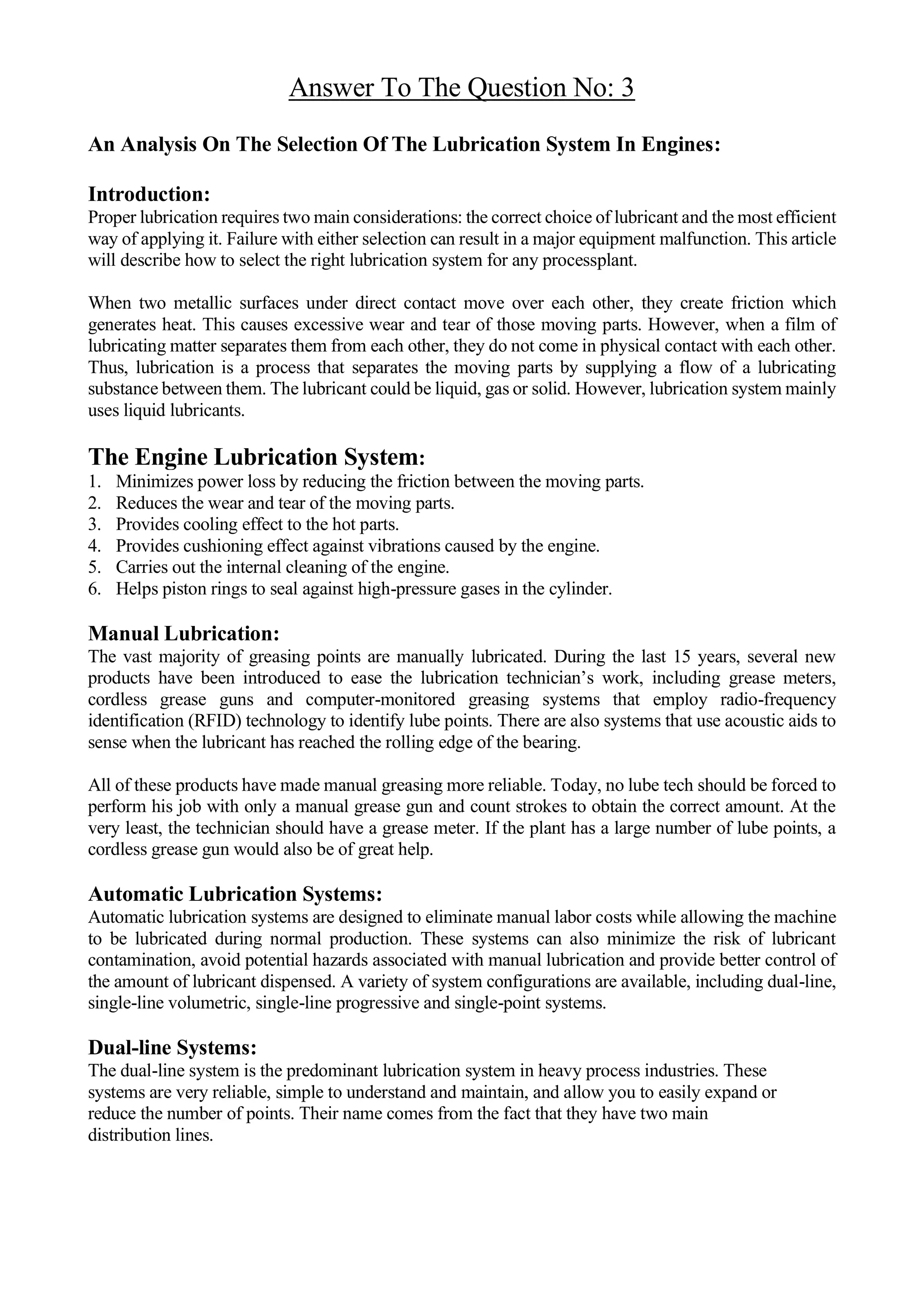
Fig: An Example Of Dual Line System
Pressurized lubricant entering the dispenser from line 1 forces the pilot piston (the lower one) to the left,
allowing pressure to be applied to the right side of the main piston. The main piston then begins to move
to the left. This dispenses the lubricant on the left side of the main piston through the pilot piston and the
check valve to the bearing connected to the outlet.
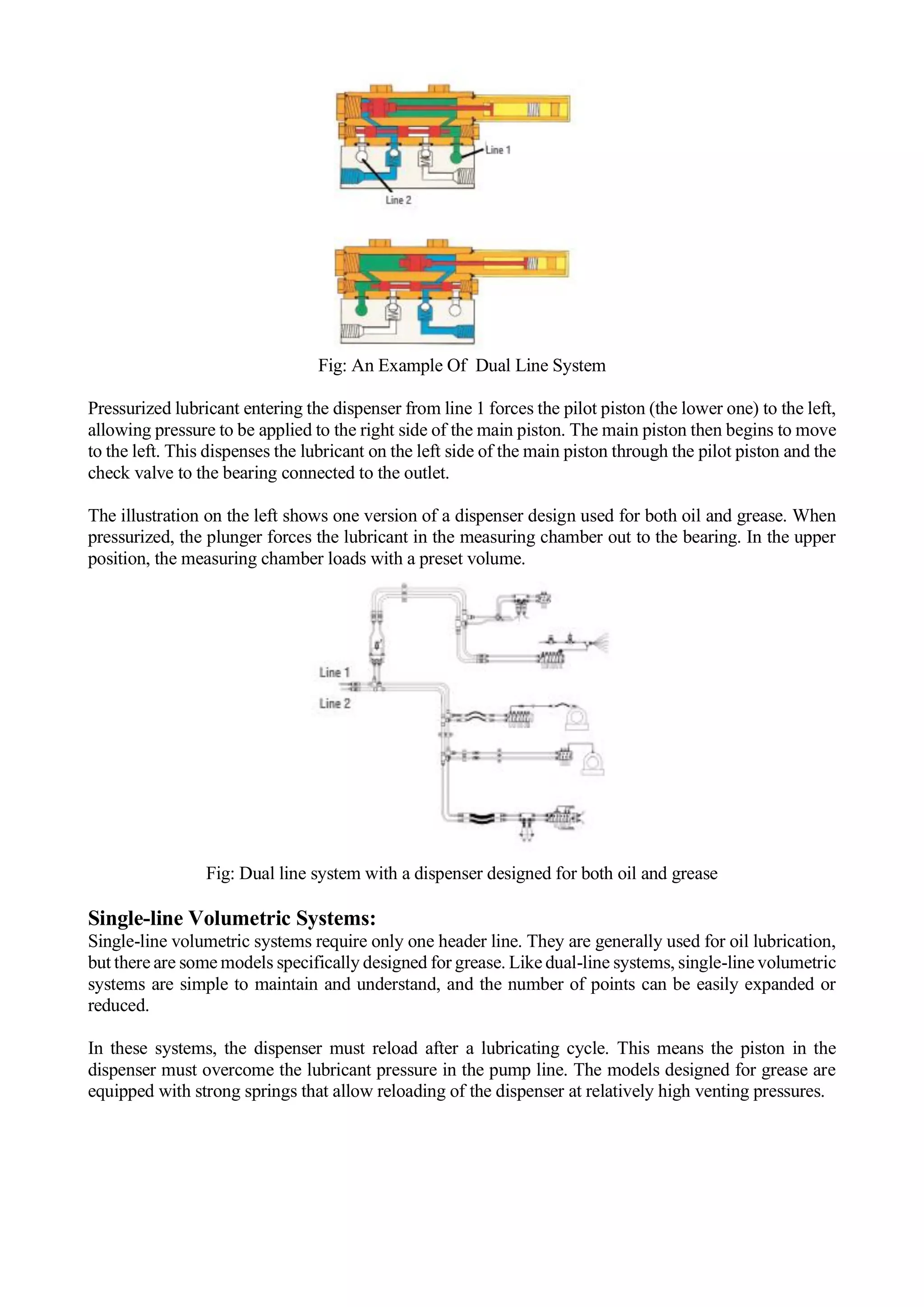
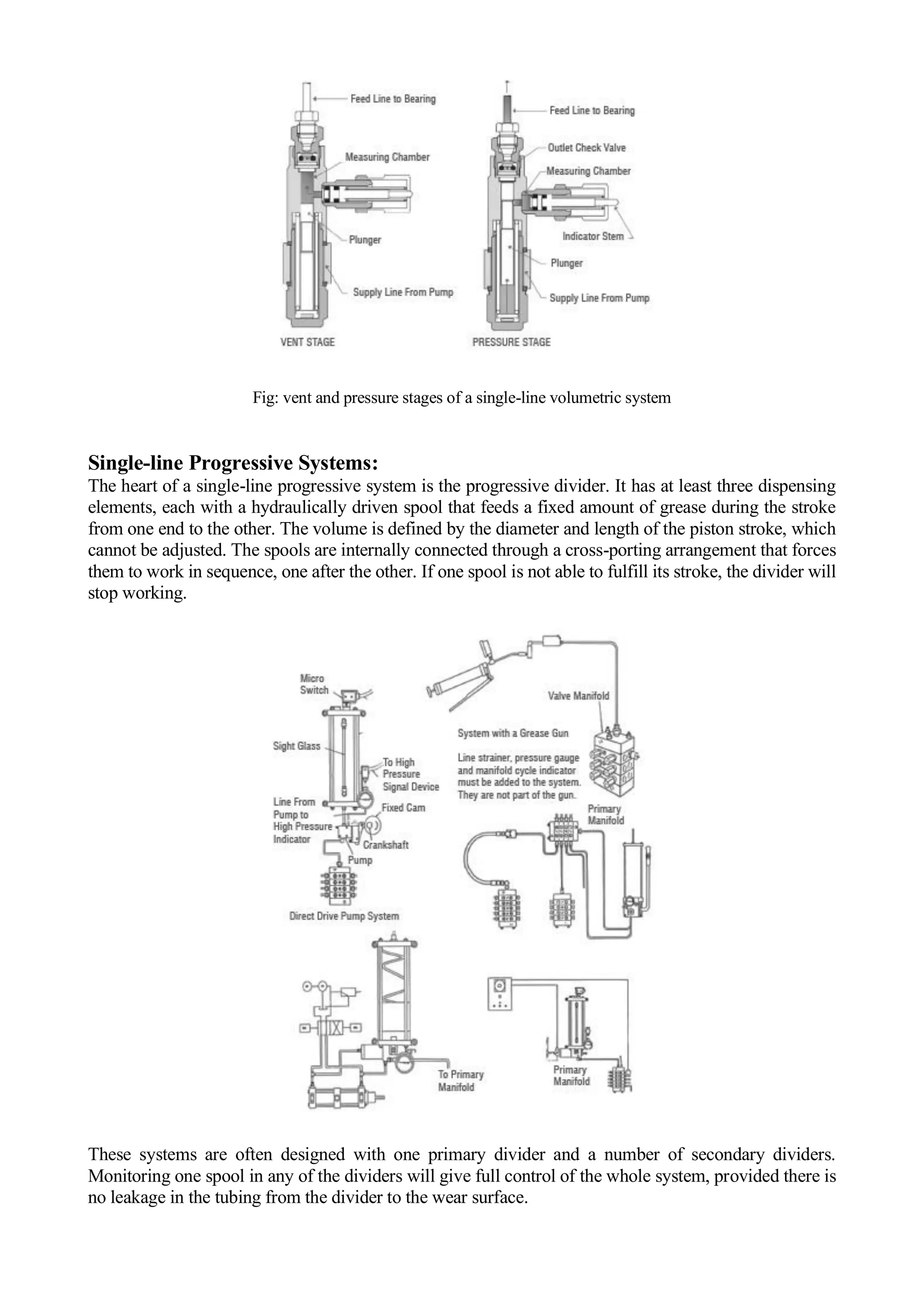
The illustration on the left shows one version of a dispenser design used for both oil and grease. When
pressurized, the plunger forces the lubricant in the measuring chamber out to the bearing. In the upper
position, the measuring chamber loads with a preset volume.
Fig: Dual line system with a dispenser designed for both oil and grease
Single-line Volumetric Systems:
Single-line volumetric systems require only one header line. They are generally used for oil lubrication,
but there are some models specifically designed for grease. Like dual-line systems, single-line volumetric
systems are simple to maintain and understand, and the number of points can be easily expanded or
reduced.
In these systems, the dispenser must reload after a lubricating cycle. This means the piston in the
dispenser must overcome the lubricant pressure in the pump line. The models designed for grease are
equipped with strong springs that allow reloading of the dispenser at relatively high venting pressures.
Fig: vent and pressure stages of a single-line volumetric system
Single-line Progressive Systems:
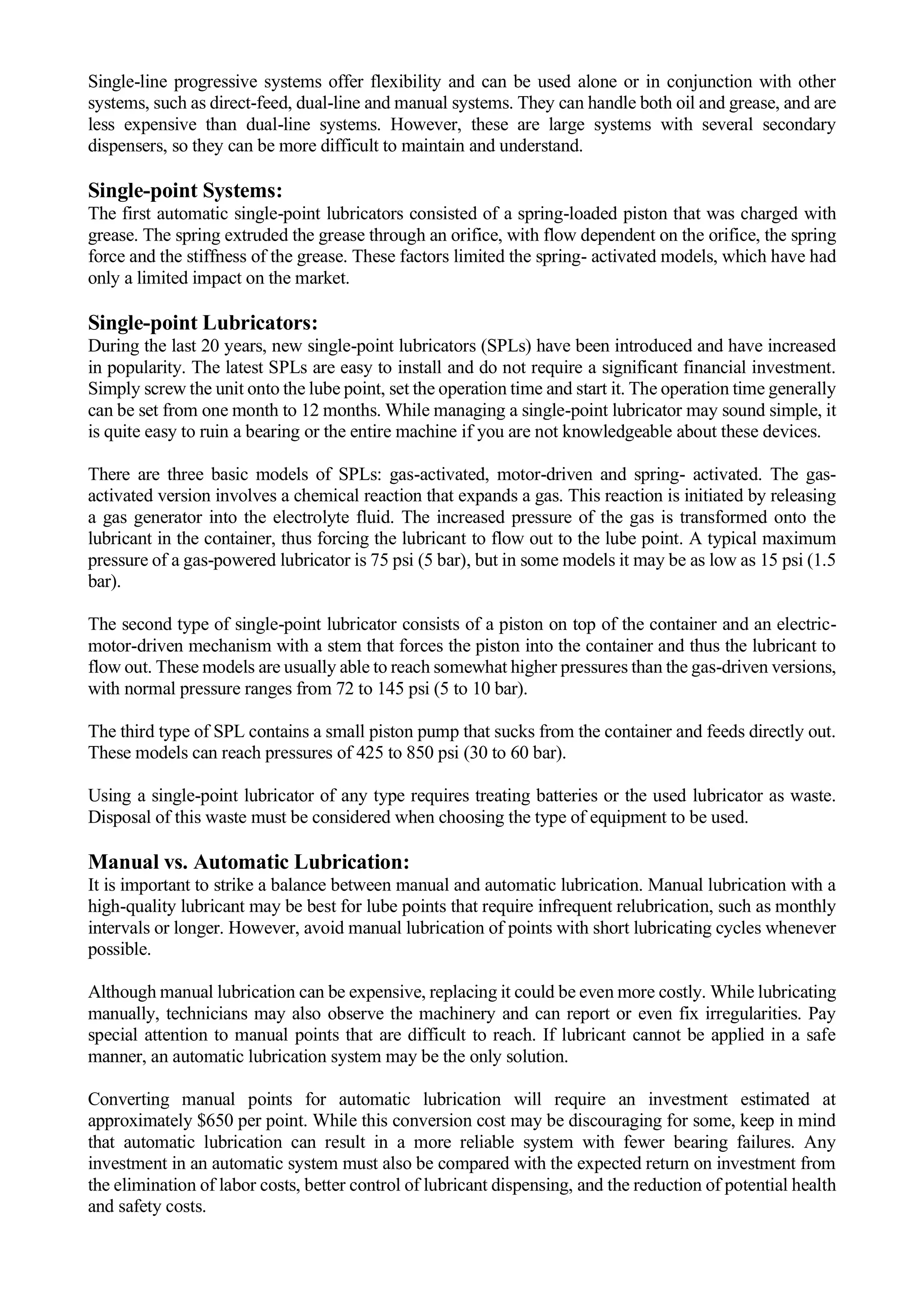
The heart of a single-line progressive system is the progressive divider. It has at least three dispensing
elements, each with a hydraulically driven spool that feeds a fixed amount of grease during the stroke
from one end to the other. The volume is defined by the diameter and length of the piston stroke, which
cannot be adjusted. The spools are internally connected through a cross-porting arrangement that forces
them to work in sequence, one after the other. If one spool is not able to fulfill its stroke, the divider will
stop working.
These systems are often designed with one primary divider and a number of secondary dividers.
Monitoring one spool in any of the dividers will give full control of the whole system, provided there is
no leakage in the tubing from the divider to the wear surface.
Single-line progressive systems offer flexibility and can be used alone or in conjunction with other
systems, such as direct-feed, dual-line and manual systems. They can handle both oil and grease, and are
less expensive than dual-line systems. However, these are large systems with several secondary
dispensers, so they can be more difficult to maintain and understand.
Single-point Systems:
The first automatic single-point lubricators consisted of a spring-loaded piston that was charged with
grease. The spring extruded the grease through an orifice, with flow dependent on the orifice, the spring
force and the stiffness of the grease. These factors limited the spring- activated models, which have had
only a limited impact on the market.
Single-point Lubricators:
During the last 20 years, new single-point lubricators (SPLs) have been introduced and have increased
in popularity. The latest SPLs are easy to install and do not require a significant financial investment.
Simply screw the unit onto the lube point, set the operation time and start it. The operation time generally
can be set from one month to 12 months. While managing a single-point lubricator may sound simple, it
is quite easy to ruin a bearing or the entire machine if you are not knowledgeable about these devices.
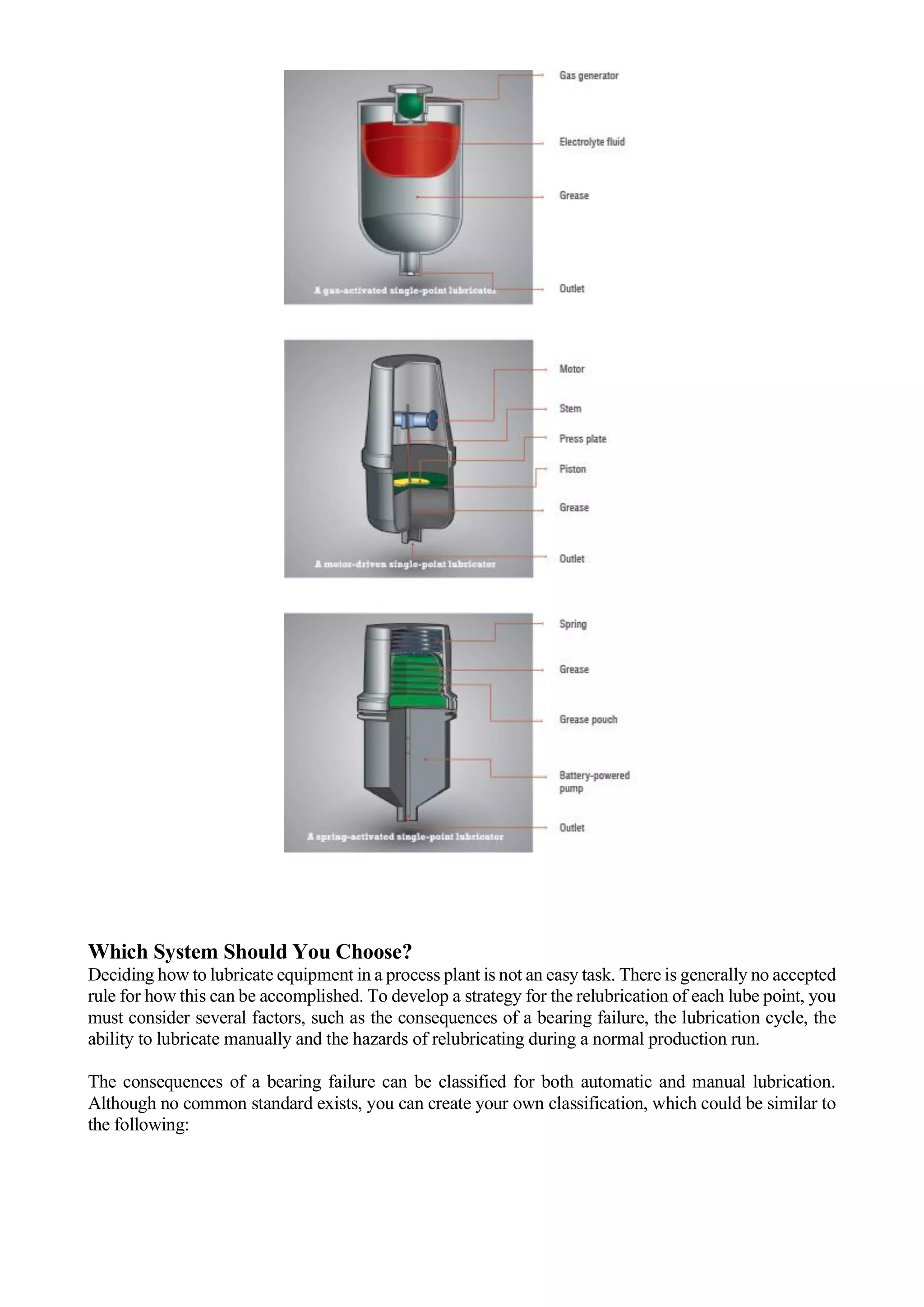
There are three basic models of SPLs: gas-activated, motor-driven and spring- activated. The gas-
activated version involves a chemical reaction that expands a gas. This reaction is initiated by releasing
a gas generator into the electrolyte fluid. The increased pressure of the gas is transformed onto the
lubricant in the container, thus forcing the lubricant to flow out to the lube point. A typical maximum
pressure of a gas-powered lubricator is 75 psi (5 bar), but in some models it may be as low as 15 psi (1.5
bar).
The second type of single-point lubricator consists of a piston on top of the container and an electric-
motor-driven mechanism with a stem that forces the piston into the container and thus the lubricant to
flow out. These models are usually able to reach somewhat higher pressures than the gas-driven versions,
with normal pressure ranges from 72 to 145 psi (5 to 10 bar).
The third type of SPL contains a small piston pump that sucks from the container and feeds directly out.
These models can reach pressures of 425 to 850 psi (30 to 60 bar).
Using a single-point lubricator of any type requires treating batteries or the used lubricator as waste.
Disposal of this waste must be considered when choosing the type of equipment to be used.
Manual vs. Automatic Lubrication:
It is important to strike a balance between manual and automatic lubrication. Manual lubrication with a
high-quality lubricant may be best for lube points that require infrequent relubrication, such as monthly
intervals or longer. However, avoid manual lubrication of points with short lubricating cycles whenever
possible.
Although manual lubrication can be expensive, replacing it could be even more costly. While lubricating
manually, technicians may also observe the machinery and can report or even fix irregularities. Pay
special attention to manual points that are difficult to reach. If lubricant cannot be applied in a safe
manner, an automatic lubrication system may be the only solution.
Converting manual points for automatic lubrication will require an investment estimated at
approximately $650 per point. While this conversion cost may be discouraging for some, keep in mind
that automatic lubrication can result in a more reliable system with fewer bearing failures. Any
investment in an automatic system must also be compared with the expected return on investment from
the elimination of labor costs, better control of lubricant dispensing, and the reduction of potential health
and safety costs.
Which System Should You Choose?
Deciding how to lubricate equipment in a process plant is not an easy task. There is generally no accepted
rule for how this can be accomplished. To develop a strategy for the relubrication of each lube point, you
must consider several factors, such as the consequences of a bearing failure, the lubrication cycle, the
ability to lubricate manually and the hazards of relubricating during a normal production run.
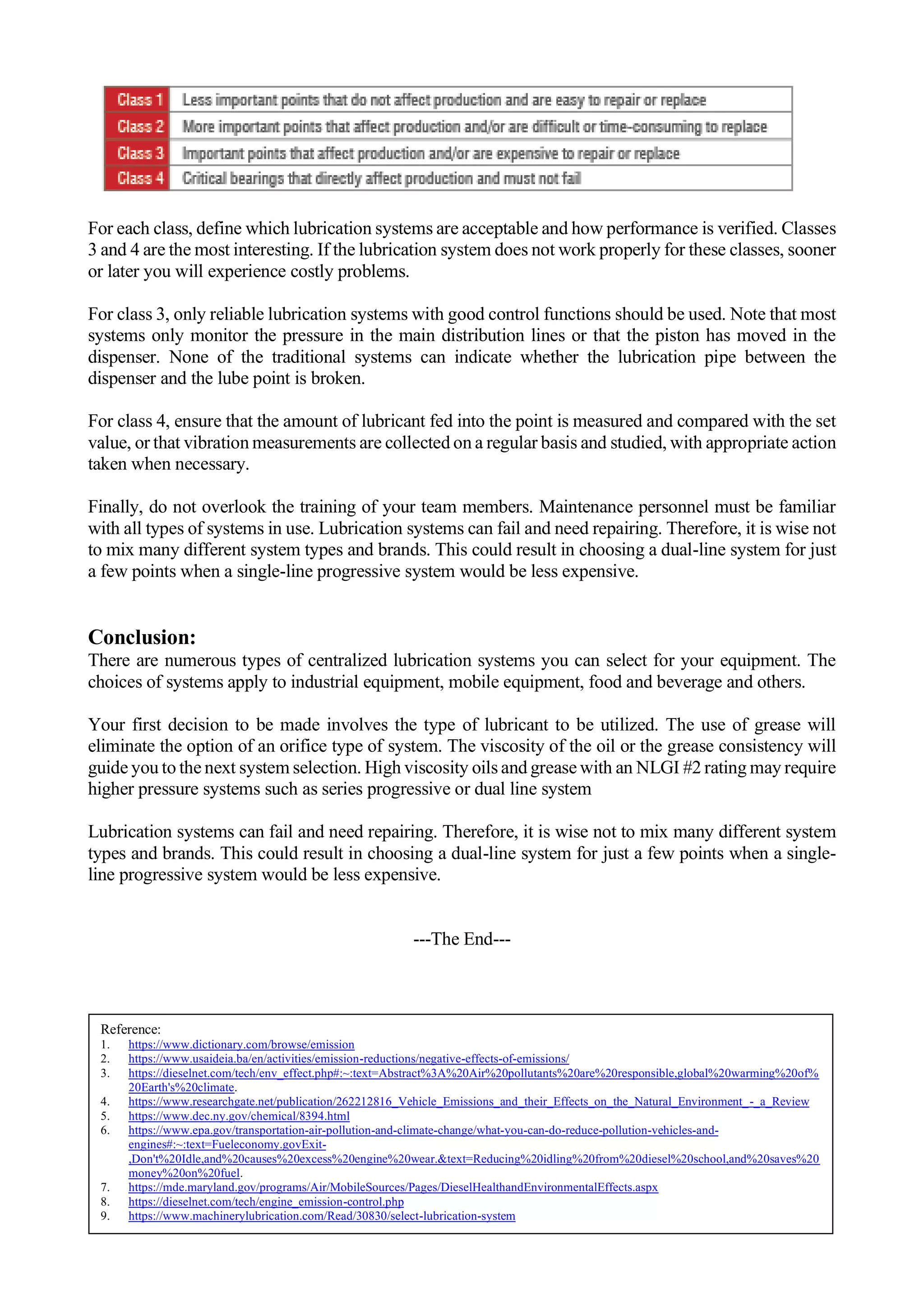
The consequences of a bearing failure can be classified for both automatic and manual lubrication.
Although no common standard exists, you can create your own classification, which could be similar to
the following:
For each class, define which lubrication systems are acceptable and how performance is verified. Classes
3 and 4 are the most interesting. If the lubrication system does not work properly for these classes, sooner
or later you will experience costly problems.
For class 3, only reliable lubrication systems with good control functions should be used. Note that most
systems only monitor the pressure in the main distribution lines or that the piston has moved in the
dispenser. None of the traditional systems can indicate whether the lubrication pipe between the
dispenser and the lube point is broken.
For class 4, ensure that the amount of lubricant fed into the point is measured and compared with the set
value, or that vibration measurements are collected on a regular basis and studied, with appropriate action
taken when necessary.
Finally, do not overlook the training of your team members. Maintenance personnel must be familiar
with all types of systems in use. Lubrication systems can fail and need repairing. Therefore, it is wise not
to mix many different system types and brands. This could result in choosing a dual-line system for just
a few points when a single-line progressive system would be less expensive.
Conclusion:
There are numerous types of centralized lubrication systems you can select for your equipment. The
choices of systems apply to industrial equipment, mobile equipment, food and beverage and others.
Your first decision to be made involves the type of lubricant to be utilized. The use of grease will
eliminate the option of an orifice type of system. The viscosity of the oil or the grease consistency will
guide you to the next system selection. High viscosity oils and grease with an NLGI #2 rating may require
higher pressure systems such as series progressive or dual line system
Lubrication systems can fail and need repairing. Therefore, it is wise not to mix many different system
types and brands. This could result in choosing a dual-line system for just a few points when a single-
line progressive system would be less expensive.
---The End---
Reference:
1. https://www.dictionary.com/browse/emission
2. https://www.usaideia.ba/en/activities/emission-reductions/negative-effects-of-emissions/
3. https://dieselnet.com/tech/env_effect.php#:~:text=Abstract%3A%20Air%20pollutants%20are%20responsible,global%20warming%20of%
20Earth's%20climate.
4. https://www.researchgate.net/publication/262212816_Vehicle_Emissions_and_their_Effects_on_the_Natural_Environment_-_a_Review
5. https://www.dec.ny.gov/chemical/8394.html
6. https://www.epa.gov/transportation-air-pollution-and-climate-change/what-you-can-do-reduce-pollution-vehicles-and-
engines#:~:text=Fueleconomy.govExit-
,Don't%20Idle,and%20causes%20excess%20engine%20wear.&text=Reducing%20idling%20from%20diesel%20school,and%20saves%20
money%20on%20fuel.
7. https://mde.maryland.gov/programs/Air/MobileSources/Pages/DieselHealthandEnvironmentalEffects.aspx
8. https://dieselnet.com/tech/engine_emission-control.php
9. https://www.machinerylubrication.com/Read/30830/select-lubrication-system
Effects Of Engine Emission On Environment | Selection Of The Lubrication System In Engine

Effects Of Engine Emission On Environment | Selection Of The Lubrication System In Engine

  • 1.
    GREEN UNIVERSITY OFBANGLADESH Department Of Textile ASSIGNMENT Remarks: Course Code : TE 311 Course Title : Textile Mill Utilities Submitted By: Name : Md Rakibul Hassan ID : 183014057 Section : E1 Department : Textile Date Of Submission : 21-09-2020 Assignment On : 1. Effects of engine emission on environment and ways to reduce them. 2. An analysis on the selection of the lubrication system in Engines. Submitted to: Name : Mr. Md Al Amin Hossain Designation : Lecturer Department : Textile
  • 2.
    Answer To TheQuestion No: 01 Effects Of Engine Emission On Environment And Ways to Reduce Them: Introduction: An increased diesel engine population has created pressures on controlling diesel PM and NOx emissions. The initial progress in diesel emission control was achieved through engine technologies, including changes in the combustion chamber design, improved fuel systems, charge air cooling, and special attention to lube oil consumption. Emission standards implemented in the 2005-2010 timeframe additionally require the use of exhaust aftertreatment methods on new diesel engines. These methods include diesel particulate filters, urea-SCR catalysts, and NOx adsorbers. An emission is something that has been emitted released or discharged. In general, emissions consist of things like gas, liquid, heat, sound, light, and radiation. Emissions can come from natural sources or from machines. A specific example of an emission is the exhaust from cars (in the U.S., such emissions are regulated through emissions tests). This exhaust is just one form of carbon emissions—greenhouse gases from various sources that are known to contribute to global warming and climate change. Emission can also refer to an instance or the process of emitting, as in This filter is designed to reduce the emission of light. Example: Carbon dioxide emissions from volcanoes are much lower than those from cars and airplanes. Transportation sector alone utilizes most of the fossil fuels such as petrol, diesel, kerosene and methanol. Considering all major anthropogenic source categories, with exception of agriculture, the transportation sector of our economy releases about one-third of the total emissions of Volatile Organic Compounds (VOCs), nitrogen oxides (NOx), and lead (Pb) and more than two-thirds of the carbon monoxide (CO). The CO and the VOCs, (almost all as hydrocarbons) are products of inefficient combustion (Henry and Heinke, 1995). Bailey (1995) and Lilley (2000) have also underscored the significance of carbon monoxide (CO) fumes and spilled oil as major pollutants from vehicle sources that gravely endanger human life and nature. According to Okoko (2005), a study carried out in Germany reported that approximately 3% of all journeys were less than 500 m. One-third of car journeys were not greater than 3 km and one- half not more than 5 km. Often, these journeys are of a short duration of about 15 minutes. The implication of this is that most private cars operate inefficiently in terms of energy consumption. On short-distance journeys, the car engine is cold and runs least efficiently due to incomplete combustion of fuel, which will significantly influence the composition and magnitude of the organic emissions from vehicles. Thus the problems of traffic pollution are particularly acute in a number of major cities, especially in cities where traffic jam is a common experience as considerable amount of fuel is used while cars are trapped in traffic congestion. As congestion in towns and cities increases and traffic slows down, emissions are increasing much faster than the actual growth in vehicle numbers. Also, research carried out by Bull (1991) on emissions from different types of motor vehicle and fuel type reveals that older vehicles and those that are incorrectly maintained contribute a disproportionate amount to aerial pollution. In most major cities of developing countries the vehicle fleet is quite old and poorly maintained and traffic congestion is more of the rule than exception. The ever-growing body of evidence on
  • 3.
    the dangers posedby vehicular emissions on the environment therefore ought to lead to heightened public awareness and concern about the problem in developing countries. Unfortunately, this level of awareness is still lacking in many respects, partly because of a lack of appreciation of the scale and nature of the problem. This paper presents a review of the emissions of pollutants from vehicles and their transformation and impact on the environment. The options for control and management of vehicular emissions have also been discussed. Where does emission come from? The first records of the word emission come from the early 1600s. It ultimately derives from the Latin verb ēmittere, from e-, meaning “out of,” and mittere, “to send.” An emission is something sent out from something else. Such emissions are often by-products released during the course of other processes—such as smoke being emitted from a factory or heat being emitted from a machine. Emissions from cars and airplanes come from the burning of fuel by their engines. In physics and electronics, the word is used in a more specific way to refer to the amount of electrons being emitted from an object. Vehicle Emissions: Thousands of motorized vehicles ply the major roads and streets of Nigerian cities daily. The same is true of many other countries of the world. In doing this, the vehicles consume millions of litres of petrol daily. The combustion of transportation fuels by these vehicles releases several contaminants into the atmosphere, including carbon monoxide, hydrocarbons, oxides of nitrogen, and lead and other particulate matter. Once emitted into the atmosphere, air pollutants undergo mixing or diffusion, the degree of which depends on topographic, climatic, and meteorological conditions (Zannetti, 1992). Since the 1950‟s it has been recognized that transportation engines in developed countries are the major source of air pollution (Milton, 1995), while it is apparent that the proportions to be attributed to various causes vary both in time and from place to place, typical USA, figures are shown in Table 1. It can be seen that transportation is responsible for the biggest share of CO, HC, and NOx in the atmosphere as well as a large proportion of the particulate matter. Types of Emission Pollutants: Some of emissions are mentioned bellow- 1. Hydrocarbons: Emissions of hydrocarbons indicate low combustion efficiency in internal combustion engines and they arise when vaporised unburned fuel or partially burned fuel products, leave the combustion region and are emitted with the exhaust. Unburned hydrocarbon emissions are independent of air/fuel ratio. They normally arise from shortcomings in the fuel injection system. The level of unburned hydrocarbons in the exhaust gases in generally specified in terms of the total hydrocarbon concentration expressed in parts per million of carbon atoms. The total hydrocarbon emission is a useful measure of combustion inefficiency. Some of these hydrocarbons are nearly inert physiologically and are virtually uncreative from standpoint of photochemical smog. Others are highly reactive in the smog-producing chemistry. Hydrocarbon compounds are divided into non- reactive and reactive based on their potential for oxidant formation in the photochemical smog chemistry. Some hydrocarbons are known carcinogens (Patterson and Henein, 1992). Fuel composition can significantly influence the composition and magnitude of the organic emissions. Fuels containing high proportions of aromatics and olefins produce relatively higher concentrations of reactive hydrocarbons. Oxygenates are present in engine exhaust, and are known to participate in the formation of photochemical smog. Some oxygenates are also irritants and odorants. The oxygenates are generally categorized as carbonyls, phenols, and other non- carbonyls. The carbonyls of interest are low molecular weight aldehydes and aliphatic ketones. The volatile aldehydes are eye and also irritants. Carbonyls account for about 10 percent of HC emissions from diesel passenger car engines, but in spark-ignition engine HC emissions are very
  • 4.
    low. Phenols areodorants and irritants but their levels are much lower than aldehyde level. 2. Oxides of nitrogen (NOx): Motor vehicles are the principal source of NO and of its oxidation product NO2. Nitric Oxide (NO) and Nitrogen dioxide (NO2) are usually grouped together as Nitrogen oxides (NOx) emissions. Nitric oxide is the predominant oxide of nitrogen produced inside the engine cylinder. The principal source of NO is the oxidation of atmospheric (molecular) nitrogen. However, if the fuel contains significant nitrogen the oxidation of the fuel nitrogen – containing compounds is an additional source of NO. In the combustion of near-stoichiometric fuel-air mixtures, the principal reactions governing the formation of NO from molecular nitrogen are: O2 + 2N2 = 2NO + N2 (1) N2 + 2O2 = 2NO + O2 (2) N2 + 2OH– = 2NO + H2 (3) Hilliard and Wheeler (1979) worked on chemical equilibrium of burned gases at typical flame temperatures, their studies reveal that NO2/NO ratio is negligibly small for spark ignition engines. While in diesel engines, NO2 can be 10 to 30 percent of the total exhaust oxides of nitrogen emissions. NO formed in the flame zone can be rapidly converted to NO2 NO + O2 = NO2 + ½O2 (4) It is customary to measure total oxides of nitrogen emissions, NO plus NO2, with a chemiluminescence‟s analyzer and call the combination NOx (Lavoie and Blumberg, 1980). It is always important to check carefully whether specific emissions data for NOx are given in terms of mass of NO or mass of NO2, which have molecular weights of 30 and 46 respectively. Oxides of nitrogen are important constituents of photochemical smog. In addition to the greenhouse effect, oxides of nitrogen contribute to environmental pollution in three ways: depletion of the ozone layer, production of acid rain and general air pollution. 3. Carbon Monoxide (CO): Most of the CO in the ambient air comes from vehicle exhaust. Internal combustion engines do not burn fuel completely to CO2 and water; some unburned fuel will always be exhausted, with CO as a component. For rich air/fuel mixtures, CO concentration in the exhaust is high, since the amount of excess fuel (unburned fuel) will be high. While for weak air/fuel mixtures, CO emissions are very low, therefore, they are not considered as important. According to John (1998), the levels of CO observed in spark-ignition engine exhaust gases are lower than the value measured within the combustion chamber. Therefore, some of the CO that formed in the combustion process are oxidized to CO2 before they are discharged into the atmosphere. 4. Carbon dioxide (CO2): Combustion of petrol takes place in the internal part of the engine of a vehicle. If a typical hydrocarbon octane, is taken to represent petrol, an equation may be written for the combustion occurring in the engine as follows: 2C8H18 + 25O2 = 16CO2 + 18H2O (5) The fuel consists of organic molecules, which are mostly hydrocarbon. When such compounds are burnt in automobile engines they yield carbon dioxide and water. Carbon dioxide also contributes to the acidity of rainfall, but more important, CO2 is transparent to short- wavelength radiation from the sun but opaque to longer wavelengths radiated back to space from the earth. Therefore, increased concentrations of CO2 may result in a heating of the earth‟s atmosphere and global warming.
  • 5.
    Effects Of Emissions: Emissionsof sulfur dioxide (SO2), nitrogen oxides (NO) and dust from thermal power plants affect human health and the environment. Thermal power plants are the largest emitters of SO2. In the presence of other gases, SO2 forms Sulphuric acid and can fall as acid rain,causing the destruction of ecosystems. The human upper respiratory system is greatly affected by SO2;breathing can be affected by high concentrations of SO2, and respiratory illnesses are common among a population living in the affected area. If exposed to low levels of SO2 over a long period, the respiratory system’s resistance to bacteria and foreign particles is greatly reduced. Nitrogen oxides also have an impact on human health and environment, as it damages the structure of lung tissue, making it more susceptible to respiratory infections. NO also contribute to the formation of acid rain and global warming. The effects of exposure of vegetation to NO can range from causing leaves to fall, reducing growth rate and causing plant tissue to die. Dust emitted from thermal power plants also have a negative impact on human health, as the particles can be so small that they can be inhaled deeply, affecting the natural defenses of lungs. Diesel Emissions Health and Environmental Effects: Diesel exhaust is a complex mixture of gases and fine particles. The primary pollutants emitted from diesel engines include: • Particulate matter (PM) • Carbon monoxide (CO) • Nitrogen oxides (NOx) • Hydrocarbons (HC) • Volatile organic compounds (VOCs) • Other chemicals that are classified as “hazardous air pollutants” under The Clean Air Act Health studies show that exposure to diesel exhaust primarily affects the respiratory system and worsens asthma, allergies, bronchitis, and lung function. There is some evidence that diesel exhaust exposure can increase the risk of heart problems, premature death, and lung cancer. Effects of Engine Emission on Environment: Air pollutants are responsible for a number of adverse environmental effects, such as photochemical smog, acid rain, death of forests, or reduced atmospheric visibility. Emissions of greenhouse gases from combustion of fossil fuels are associated with the global warming of Earth’s climate. Certain air pollutants, including black carbon, not only contribute to global warming, but are also suspected of having immediate effect on regional climates. Air pollutants are substances that adversely affect the environment by interfering with climate, the physiology of plants, animal species, entire ecosystems, as well as with human property in the form of agricultural crops or man-made structures. We list climate at the top of the list to reflect the fact that global climate change has been recognized as one of the most important environmental challenges to be faced by humanity in the 21st century. In this context certain climate forcing agents—the most important one being carbon dioxide—which otherwise cause no harm to living organisms, should be added to the list of “classic” pollutants, along with such compounds as oxides of nitrogen or sulfur. On the other hand, climate research has linked certain compounds long recognized as air pollutants (for instance black carbon) to the warming of climate, thus providing one more reason for their control. Air pollutants can originate from natural or anthropogenic (man-made) sources, or both. Examples of natural sources of pollution include volcanic eruptions or wind erosion. Emissions from internal
  • 6.
    combustion engines arean exemplary source of anthropogenic pollution. Some sources of pollution, such as forest fires, can be related to both natural phenomena and human activities. Atmospheric reactions can transform primary pollutants into different chemical species. These reactions can produce both harmless compounds and secondary air pollutants that may be more harmful than their precursors. The world’s most important air pollutants, their sources, and known or suspected environmental effects are listed in Table: Table Air pollutants, Their source, and Effect Pollutant Natural Source Anthropogenic Source Environmental Effects Nitrogen oxides (NO + NO2) Lightnings, soil bacteria High temperature fuel combustion— motor vehicles, industrial, and utility Primary pollutants that produce photochemical smog, acid rain, and nitrate particulates. Destruction of stratospheric ozone. Human health impact. Particulates Forest fires, wind erosion, volcanic eruption Combustion of biofuels such as wood, and fossil fuels such as coal or diesel Reduced atmospheric visibility. Human health impact. Black carbon particulates contribute to global warming Sulfur dioxide Volcanic eruptions and decay Coal combustion, ore smelters, petroleum refineries, diesel engines burning high- sulfur fuels Acid rain. Human health impact. Ozone Lightning, photochemical reactions in the troposphere Secondary pollutant produced in photochemical smog Damage to plants, crops, and man-made products. Human health impact. Carbon monoxide Unnoticeable Rich & stoichiometric combustion, mainly from motor vehicles Human health impact Carbon dioxide Animal respiration, decay, release from oceans Fossil fuel and wood combustion Most common greenhouse gas Non-methane hydrocarbons (VOC) Biological processes Incomplete combustion, solvent utilization Primary pollutants that produce photochemical smog Methane Anaerobic decay, cud-chewing animals, oil wells Natural gas leak and combustion Greenhouse gas Chlorofluorocarbons (CFC) None Solvents, aerosol propellants, refrigerants Destruction of stratospheric ozone
  • 7.
    Governments and internationalorganizations have been taking actions to protect the quality of air, as well as—in more recent years—to control emissions of climate forcing agents. Ambient air quality standards and guidelines, issued by environmental protection authorities, are instrumental in achieving the air quality objective. An example of such legislation is set by the US National Ambient Air Quality Standards (NAAQS) adopted by the Environmental Protection Agency (EPA). The NAAQS apply to both human health (primary standard) and public welfare (secondary standard). Primary standards protect sensitive members of the human population from adverse health effects of criteria air pollutants. Secondary standards protect the public welfare from any known or anticipated adverse effects associated with the presence of a pollutant in the ambient air. Welfare effects include effects on soils, water, crops, vegetation, manmade materials, animals, wildlife, weather, visibility, climate, damage to and deterioration of property, hazards to transportation, as well as effects on economic values and personal comfort and well-being. Under the US Clean Air Act of 1990, the NAAQS standards set maximum ambient concentration limits for six criteria pollutants including: (i) Ozone, O3 (ii) Carbon monoxide, CO (iii)Nitrogen dioxide, NO2 (iv)Lead, Pb (v) Particulate matter below 10 µm, PM10 (vi)Oxides of sulfur, Sox Thermal Air Pollution: This type of pollution is applied generally to the discharge of heat into the air environment from the combustion of fuels. The increase in the temperature of any place at a given time above its normal ambient air temperature is evidence that thermal air pollution has occurred in that place. The mean temperature of our planet is fixed by a steady-state balance between the energy received from the sun and the quantity of heat energy radiated back into space by the earth. Disturbance in either incoming or outgoing energy would upset this balance, and the average temperature of the earth‟s surface would drift off to a different steady state value. The sun‟s energy travels to earth surface to warm it and bathe it with light without hindrance. The infrared radiation that sends heat energy back into space cannot travel freely though air as water vapour and CO2 both absorb infrared. In this way they act like blankets around the earth, hindering the escape of heat into space. As more CO2 is produced by combustion of fuels, the CO2 causes hindrance to the escape of the infrared radiated from the earth surface and so the earth warms the more. Greenhouse Effect: Unlike the sunlight, the infrared radiation cannot travel freely through the earth mantle of air as it contains H2O vapour and CO2, which absorb infrared radiation. In this way, both H2O vapour and CO2 act as blankets around the earth and the escape of heat into space. With additional H2O vapour and CO2 poured into the atmosphere from other sources, the effect would be that of adding a blanket that hinders the escape of heat the more and so the earth would heat up. This blanketing is the essence of the greenhouse effect. The greenhouse effect takes its name from the warmth of greenhouses, a warmth stemming in part from the ease with which warming sunlight enters through the glass panes, and the difficulty encountered by infrared radiation in escaping off through the same panes with the greenhouse heat. This means that the glass panes act in such the same way as the atmosphere, which allows the free passage of incoming radiation but interferes with outgoing radiant energy. The outgoing radiant energy is absorbed by H2O and CO2. With energy escape hindered, the earth becomes warmer than it otherwise would be. Any addition of H2O and CO2 would cause additional greenhouse effect.
  • 8.
    Ozone Depletion: The culpritscausing ozone depletion are water vapour and nitrogen (II) oxide, NO. The ollutants enter the stratosphere where the ozone layer is. Photochemical reaction occurs in the stratosphere whereby oxygen molecule splits to oxygen atoms. The oxygen atom combines with oxygen molecule leading to the production of ozone O2 + [O] = O3 (7) Oxygen atom reacts with water to give hydroxyl ions and which reduce ozone to oxygen molecule: H2O + [O] = 2OH (8) OH + O3 = H-O-O + O2 (9) This step accounts for 11% depletion of ozone. Again, ozone is attacked by NO and is reduced to molecular oxygen. NO + O3 = NO2 + O2 (10) Thus we have ozone depletion as given by equations (9) and (10). Unfortunately, eq.(10) is not the end of the story. Further reaction occurs between NO2 and [O] which regenerates NO molecules from NO2 viz: NO2 + [O] = NO + O2 (11) NO + O3 = NO2 + O2 (12) Thus the cycle can proceed over and over again, consuming quantities of O3 with small initial amounts of NO. Effects On Agriculture: Optimum plant growth requires adequate light, heat, moisture, nutrients and appropriate soil conditions. An imbalance in any of these results in a stress to the plant, which may result in restricted growth or foliage markings. Pollution provides an extra undesirable stress. If this stress is too high, then the plant will die, despite the relatively complex biological defence mechanisms (e.g. rebuilding of damaged tissue). Plants absorb gaseous pollutant through their leaves because one of their major functions is to absorb atmospheric gases. Examination of leaf structure reveals three regions: the epidermis (out layer), the mesophyll and the veins, which transport water and nutrients around the plant. Gases and small particulates enter the leaf through the stomata (leaf pores), to the air spaces of the mesophyll (Posthumus, 1983). Symptoms of damage to the examined leaves are: (i) necrosis and bleaching of leaf margins; (ii) glazing and silvering of surfaces, especially the undersides; (iii) chlorosis (loss of chlorophyll); (iv) flecking or stippling of upper surfaces
  • 9.
    Ways To ReduceEngine Emission: The carbon monoxide (CO) and volatile organic compounds (VOCs) are products of inefficient combustion, which would be eliminated by burning the fuel to carbon dioxide (CO2) and water (H2O) in the engine of the vehicle to produce power if possible. Most of the VOC emissions are from the tailpipe. These are controlled using catalytic reactors and by injecting air at the exhaust ports of the engine to burn emitted hydrocarbons in this high-temperature zone. Neither process recovers useful energy, so efforts to modify engine design have been intense. However, more than 20% of the uncontrolled vehicle engine VOC emissions are from the crankcase vent (blow-by and evaporating oil) and from the carburetor vent to the atmosphere. These emissions are controlled using a crankcase vent pipe to the engine intake duct (requiring a pollution control value or PCV) and a “carbon canister” absorption unit for evaporative losses. Fuel injection systems, with their advantage of providing much more precise metering of fuel to the cylinders, significantly reduces pollutant emissions, including further reduction of evaporative losses. Presently, use of oxygenated fuels is encouraged to reduce VOC emissions at the tail pipe (Henry and Heinke, 1996). Researchers have found that it was necessary to reduce emissions of nitrogen oxides to reduce photochemical smog and rain precursor emissions. One of the most effective ways to reduce these oxides is by introduction of exhaust gas re-circulation (EGR), and by using two-stage combustion. High levels of lead emissions have been tackled by the introduction of lead-free gasoline, mandated in developed countries like USA but optional for developing countries like Nigeria. Driving behaviour and route driven (e.g. shifting gears and speedy accelerations) factors contribute to vehicle pollution. Control of emissions depends on several factors such as driver‟s experience, type of route used, and in-use factors such as wear, maintenance and malfunction conditions (Vesilind et al., 1993). Vehicle pollution can also be reduced, partially or completely (zero emission) by using: (i) lean-burn engines, i.e. engines that offer air/fuel ratios in the 22 – 23: 1 range, as opposed to conventional engines, which operate on stoichiometric ratio of 14.5:1; (ii) intelligent transport systems (ITS) and (iii) automatic pilot systems. Also, vehicle emissions can be reduced through better routing of traffic to cut fuel consumption while at the same time reducing pollution and enhancing safety, or using other alternative types of vehicles such as hybrid or electric. There are some steps that should be followed to reduce engine emission. They are noted bellow- Drive Less: Fewer miles driven means fewer emissions, Follow these tips to reduce the time you spend driving: 1. Walk or bike when you can. 2. Use the bike-share programs if your city or town has them. 3. Take public transit when possible. 4. Carpool with friends instead of driving alone. 5. Use ride-sharing services. 6. Plan ahead to make the most of your trips and “trip chain.” If your grocery store is near other places you need to visit, do it all at once. 7. Work from home periodically if your job allows it. Drive Wise: The way we drive can reduce engine emissions from our vehicles. Follow these tips to effectively reduce emissions, drive more safely, and save money on fuel costs all at the same time: 1. Drive efficiently – go easy on the gas pedal and brakes. 2. Maintain your car – get regular tune-ups, follow the manufacturer’s maintenance schedule, and use the recommended motor oil.
  • 10.
    Choose Fuel EfficientVehicles: When shopping for a new car, look for fuel efficient vehicles with low greenhouse gas emissions. These cars can help the environment while potentially saving you money on fuel costs at the pump. Follow these tips: 1. Use EPA's Green Vehicle Guide to learn about vehicles that are more efficient and less polluting, including: • Electric vehicles; • Plug-in hybrid electric vehicles; • Hydrogen fuel cell vehicles; and • Cleaner burning gasoline vehicles. 2. Use the EPA's Fuel Economy and Environment Label to compare different vehicle models and find the most fuel efficient and environmentally friendly vehicle that meets your needs. Don’t Idle: Unnecessary idling of cars, trucks, and school buses pollutes the air, wastes fuel, and causes excess engine wear. Modern vehicles do not require “warming up” in the winter, so there is no need to turn on the engine until you are ready to drive. Reducing idling from diesel school buses prevents children from being exposed to diesel exhaust, reduces greenhouse gas emissions, and saves money on fuel. EPA's Clean School Bus Program includes information and resources that can help you reduce school bus idling in your community. Optimize Home Deliveries: When getting home deliveries or shopping online, consider asking to have all your packages sent in one shipment and with minimal packaging. For scheduled home deliveries, try to be flexible by choosing longer time windows so delivery trucks can optimize their routes and avoid extra trips. Use Efficient Lawn and Gardening Equipment: Gas-powered engines in lawn and garden equipment emit significant amounts of pollutants. Follow these tips to reduce the impact of your landscaping: 1. Use a manual (reel) mower for small lawns. 2. When shopping for mowers and garden equipment, look for new technologies such as electric and battery-powered machines that are quieter and pollute less than gas-powered ones. 3. Properly maintain lawn and garden equipment - tune mowers and change the oil as needed. 4. If you are purchasing commercial grade landscaping machinery, a number of products are now available with advanced emissions reduction technologies including catalysts and electronic fuel injection that result in significantly less pollution. Burn Less Fuel: • Next time you purchase a vehicle, buy the most fuel efficient vehicle that meets your average daily needs, preferably one that is rated at 32 MPG or more. Rent or borrow a larger vehicle or trailer for the occasional large load: GreenerCars.com • If you have more than one vehicle, use the most fuel-efficient one possible: U.S. Department of Energy, Fuel Economy Site
  • 11.
    • Use transitand car- or van-pool as often as you can. Doing so three times a week can reduce your fuel consumption up to 50%. • Bike or walk to avoid fuel use entirely. • Telecommute (working from a home-based location via phone or Internet) to reduce driving: Midwest Institute for Telecommuting Education (MITE) • Minimize driving by working and playing closer to home. • Plan errands to avoid unnecessary driving. • Accelerate gradually — a smooth start uses less fuel Burn Fuel Cleaner: • Keep your vehicle well-tuned and tires inflated properly to reduce exhaust emissions. • Combine errands into one trip — cars pollute less when they are warmed up. • Avoid idling — idling exhaust contains more pollutants than running exhaust. • If you purchase a new car, look for a low emission vehicle or LEV Burn Cleaner Fuel: • Low-sulfur gasoline (available in the Twin Cities) reduces pollutants by 10-15% • 85% ethanol fuel (E85) can be used in flexible fuel vehicles. • Other alternative transportation fuels such as natural gas a bio-diesel are most practical for fleets of vehicles Engine Design Technologies For Emission Reduction: Technology Emission Impact Significance Compression Ignition (Diesel) Engines Fuel injection Capabilities have evolved significantly. Significant improvements in injection technology started in the 1990s with widespread implementation of systems capable of variable injection timing through the use of electronic controls. Engines with EGR place the highest demand on fuel injection pressure. Light-duty vehicles use the most demanding multiple injection strategies. injection timing Primarily used to limit NOx emissions Injection timing affects combustion phasing; retarding the combustion phasing can be used to limit NOx emissions. injection pressure Primarily used to limit soot (PM) emissions Higher injection pressure can lower soot emissions; especially important when combined with NOx control technologies such as EGR that would otherwise increase soot emissions. multiple injections Various Multiple injections strategies have been developed to lower NOx, soot, HC and CO emissions Exhaust gas recirculation (EGR) In diesel engines, primary application is to control NOx emissions Commonly used in many light- and heavy-duty duty diesel engines. High pressure EGR delivery can introduce a fuel consumption penalty through higher pumping losses. Low pressure EGR has lower pumping losses but is more
  • 12.
    difficult to controlduring transient operation. Other measures to limit potential increases in soot and possibly HC and CO can be required. Intake boosting Primary emissions impact is to lower soot (PM) production. Also important for efficiency gains. Higher intake pressure increases air/fuel ratio for given fuel injection amount and lowers soot production.Can be an important measure to offset unwanted decreases in performance and increased emissions with NOx control measures such as EGR. Often accompanied by improved intake charge cooling capabilities. Enables engine downsizing for efficiency gains. Introduces challenges such as turbocharger lag that can require complex solutions. Positive Ignition (SI) Engines Fuel injection Fuel consumption and particulate emissions The shift from port injection to gasoline direct injection (GDI) was driven by the use of engine downsizing to meet fuel consumption and CO2 requirements. GDI engines have a higher tendency to produce small particle emissions that can be partially offset by refinements in fuel injection system design. Intake boosting Fuel consumption Enabler for engine downsizing and reduced fuel consumption and CO2 emissions. Combustion Fuel consumption Advanced combustion concepts can improve efficiency through faster combustion and lower heat losses. EGR At one time used to limit NOx emissions. Modern approaches focus mainly on reducing fuel consumption In SI engines, EGR is an alternative to fuel enrichment at high loads to reduce knock propensity and lower exhaust temperature at high power. At part load conditions, it can reduce pumping losses. Conclusion: The dramatic increase in public awareness and concern about the state of the global and local environments, which has occurred in recent decades, has been accompanied and partly prompted by an ever-growing body of evidence on the extent to which pollution has caused severe environmental degradation. Considering all major anthropogenic source categories, with exception of agriculture, the transportation sector of our economy accounts for the major part of atmospheric pollution.
  • 13.
    Answer To TheQuestion No: 3 An Analysis On The Selection Of The Lubrication System In Engines: Introduction: Proper lubrication requires two main considerations: the correct choice of lubricant and the most efficient way of applying it. Failure with either selection can result in a major equipment malfunction. This article will describe how to select the right lubrication system for any processplant. When two metallic surfaces under direct contact move over each other, they create friction which generates heat. This causes excessive wear and tear of those moving parts. However, when a film of lubricating matter separates them from each other, they do not come in physical contact with each other. Thus, lubrication is a process that separates the moving parts by supplying a flow of a lubricating substance between them. The lubricant could be liquid, gas or solid. However, lubrication system mainly uses liquid lubricants. The Engine Lubrication System: 1. Minimizes power loss by reducing the friction between the moving parts. 2. Reduces the wear and tear of the moving parts. 3. Provides cooling effect to the hot parts. 4. Provides cushioning effect against vibrations caused by the engine. 5. Carries out the internal cleaning of the engine. 6. Helps piston rings to seal against high-pressure gases in the cylinder. Manual Lubrication: The vast majority of greasing points are manually lubricated. During the last 15 years, several new products have been introduced to ease the lubrication technician’s work, including grease meters, cordless grease guns and computer-monitored greasing systems that employ radio-frequency identification (RFID) technology to identify lube points. There are also systems that use acoustic aids to sense when the lubricant has reached the rolling edge of the bearing. All of these products have made manual greasing more reliable. Today, no lube tech should be forced to perform his job with only a manual grease gun and count strokes to obtain the correct amount. At the very least, the technician should have a grease meter. If the plant has a large number of lube points, a cordless grease gun would also be of great help. Automatic Lubrication Systems: Automatic lubrication systems are designed to eliminate manual labor costs while allowing the machine to be lubricated during normal production. These systems can also minimize the risk of lubricant contamination, avoid potential hazards associated with manual lubrication and provide better control of the amount of lubricant dispensed. A variety of system configurations are available, including dual-line, single-line volumetric, single-line progressive and single-point systems. Dual-line Systems: The dual-line system is the predominant lubrication system in heavy process industries. These systems are very reliable, simple to understand and maintain, and allow you to easily expand or reduce the number of points. Their name comes from the fact that they have two main distribution lines.
  • 14.
    Fig: An ExampleOf Dual Line System Pressurized lubricant entering the dispenser from line 1 forces the pilot piston (the lower one) to the left, allowing pressure to be applied to the right side of the main piston. The main piston then begins to move to the left. This dispenses the lubricant on the left side of the main piston through the pilot piston and the check valve to the bearing connected to the outlet. The illustration on the left shows one version of a dispenser design used for both oil and grease. When pressurized, the plunger forces the lubricant in the measuring chamber out to the bearing. In the upper position, the measuring chamber loads with a preset volume. Fig: Dual line system with a dispenser designed for both oil and grease Single-line Volumetric Systems: Single-line volumetric systems require only one header line. They are generally used for oil lubrication, but there are some models specifically designed for grease. Like dual-line systems, single-line volumetric systems are simple to maintain and understand, and the number of points can be easily expanded or reduced. In these systems, the dispenser must reload after a lubricating cycle. This means the piston in the dispenser must overcome the lubricant pressure in the pump line. The models designed for grease are equipped with strong springs that allow reloading of the dispenser at relatively high venting pressures.
  • 15.
    Fig: vent andpressure stages of a single-line volumetric system Single-line Progressive Systems: The heart of a single-line progressive system is the progressive divider. It has at least three dispensing elements, each with a hydraulically driven spool that feeds a fixed amount of grease during the stroke from one end to the other. The volume is defined by the diameter and length of the piston stroke, which cannot be adjusted. The spools are internally connected through a cross-porting arrangement that forces them to work in sequence, one after the other. If one spool is not able to fulfill its stroke, the divider will stop working. These systems are often designed with one primary divider and a number of secondary dividers. Monitoring one spool in any of the dividers will give full control of the whole system, provided there is no leakage in the tubing from the divider to the wear surface.
  • 16.
    Single-line progressive systemsoffer flexibility and can be used alone or in conjunction with other systems, such as direct-feed, dual-line and manual systems. They can handle both oil and grease, and are less expensive than dual-line systems. However, these are large systems with several secondary dispensers, so they can be more difficult to maintain and understand. Single-point Systems: The first automatic single-point lubricators consisted of a spring-loaded piston that was charged with grease. The spring extruded the grease through an orifice, with flow dependent on the orifice, the spring force and the stiffness of the grease. These factors limited the spring- activated models, which have had only a limited impact on the market. Single-point Lubricators: During the last 20 years, new single-point lubricators (SPLs) have been introduced and have increased in popularity. The latest SPLs are easy to install and do not require a significant financial investment. Simply screw the unit onto the lube point, set the operation time and start it. The operation time generally can be set from one month to 12 months. While managing a single-point lubricator may sound simple, it is quite easy to ruin a bearing or the entire machine if you are not knowledgeable about these devices. There are three basic models of SPLs: gas-activated, motor-driven and spring- activated. The gas- activated version involves a chemical reaction that expands a gas. This reaction is initiated by releasing a gas generator into the electrolyte fluid. The increased pressure of the gas is transformed onto the lubricant in the container, thus forcing the lubricant to flow out to the lube point. A typical maximum pressure of a gas-powered lubricator is 75 psi (5 bar), but in some models it may be as low as 15 psi (1.5 bar). The second type of single-point lubricator consists of a piston on top of the container and an electric- motor-driven mechanism with a stem that forces the piston into the container and thus the lubricant to flow out. These models are usually able to reach somewhat higher pressures than the gas-driven versions, with normal pressure ranges from 72 to 145 psi (5 to 10 bar). The third type of SPL contains a small piston pump that sucks from the container and feeds directly out. These models can reach pressures of 425 to 850 psi (30 to 60 bar). Using a single-point lubricator of any type requires treating batteries or the used lubricator as waste. Disposal of this waste must be considered when choosing the type of equipment to be used. Manual vs. Automatic Lubrication: It is important to strike a balance between manual and automatic lubrication. Manual lubrication with a high-quality lubricant may be best for lube points that require infrequent relubrication, such as monthly intervals or longer. However, avoid manual lubrication of points with short lubricating cycles whenever possible. Although manual lubrication can be expensive, replacing it could be even more costly. While lubricating manually, technicians may also observe the machinery and can report or even fix irregularities. Pay special attention to manual points that are difficult to reach. If lubricant cannot be applied in a safe manner, an automatic lubrication system may be the only solution. Converting manual points for automatic lubrication will require an investment estimated at approximately $650 per point. While this conversion cost may be discouraging for some, keep in mind that automatic lubrication can result in a more reliable system with fewer bearing failures. Any investment in an automatic system must also be compared with the expected return on investment from the elimination of labor costs, better control of lubricant dispensing, and the reduction of potential health and safety costs.
  • 17.
    Which System ShouldYou Choose? Deciding how to lubricate equipment in a process plant is not an easy task. There is generally no accepted rule for how this can be accomplished. To develop a strategy for the relubrication of each lube point, you must consider several factors, such as the consequences of a bearing failure, the lubrication cycle, the ability to lubricate manually and the hazards of relubricating during a normal production run. The consequences of a bearing failure can be classified for both automatic and manual lubrication. Although no common standard exists, you can create your own classification, which could be similar to the following:
  • 18.
    For each class,define which lubrication systems are acceptable and how performance is verified. Classes 3 and 4 are the most interesting. If the lubrication system does not work properly for these classes, sooner or later you will experience costly problems. For class 3, only reliable lubrication systems with good control functions should be used. Note that most systems only monitor the pressure in the main distribution lines or that the piston has moved in the dispenser. None of the traditional systems can indicate whether the lubrication pipe between the dispenser and the lube point is broken. For class 4, ensure that the amount of lubricant fed into the point is measured and compared with the set value, or that vibration measurements are collected on a regular basis and studied, with appropriate action taken when necessary. Finally, do not overlook the training of your team members. Maintenance personnel must be familiar with all types of systems in use. Lubrication systems can fail and need repairing. Therefore, it is wise not to mix many different system types and brands. This could result in choosing a dual-line system for just a few points when a single-line progressive system would be less expensive. Conclusion: There are numerous types of centralized lubrication systems you can select for your equipment. The choices of systems apply to industrial equipment, mobile equipment, food and beverage and others. Your first decision to be made involves the type of lubricant to be utilized. The use of grease will eliminate the option of an orifice type of system. The viscosity of the oil or the grease consistency will guide you to the next system selection. High viscosity oils and grease with an NLGI #2 rating may require higher pressure systems such as series progressive or dual line system Lubrication systems can fail and need repairing. Therefore, it is wise not to mix many different system types and brands. This could result in choosing a dual-line system for just a few points when a single- line progressive system would be less expensive. ---The End--- Reference: 1. https://www.dictionary.com/browse/emission 2. https://www.usaideia.ba/en/activities/emission-reductions/negative-effects-of-emissions/ 3. https://dieselnet.com/tech/env_effect.php#:~:text=Abstract%3A%20Air%20pollutants%20are%20responsible,global%20warming%20of% 20Earth's%20climate. 4. https://www.researchgate.net/publication/262212816_Vehicle_Emissions_and_their_Effects_on_the_Natural_Environment_-_a_Review 5. https://www.dec.ny.gov/chemical/8394.html 6. https://www.epa.gov/transportation-air-pollution-and-climate-change/what-you-can-do-reduce-pollution-vehicles-and- engines#:~:text=Fueleconomy.govExit- ,Don't%20Idle,and%20causes%20excess%20engine%20wear.&text=Reducing%20idling%20from%20diesel%20school,and%20saves%20 money%20on%20fuel. 7. https://mde.maryland.gov/programs/Air/MobileSources/Pages/DieselHealthandEnvironmentalEffects.aspx 8. https://dieselnet.com/tech/engine_emission-control.php 9. https://www.machinerylubrication.com/Read/30830/select-lubrication-system