Objectives of the lecture
By the end of the lecture , the students should:
Define Gametogenesis
Clarify Hypothalamic - Pituitary - Gonadal Axis
Understand hormonal control of spermatogenesis
Explainhormonal control of oogenesis
Recall feedback mechanisms
Gametogenesis
Means the development of mature ova andsperm
It includes spermatogenesis and oogenesis
Hormonal control of
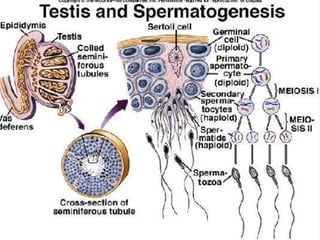
Spermatogenesis
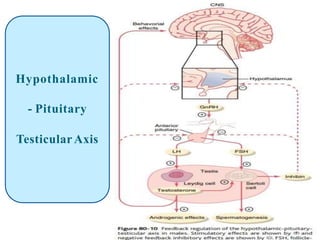
Hypothalamic
- Pituitary
TesticularAxis
Hormonal control of spermatogenesis
1- Hypothalamic control:
* The hypothalamus contains neurons originated in arcuate N and end in
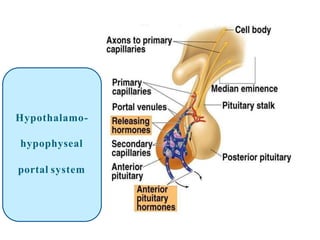
median eminence, when stimulated release of GnRH that passes
through the hypothalamo-hypophyseal portal circulation Anterior
Pituitary gland controlling gonadotropins (FSH and LH) secretions.
* Various psychic stimuli feeding into the hypothalamus
excitatory or inhibitory effect on gonadotropin secretion
altering the degree of fertility.
Hypothalamo-
hypophyseal
portal system
Gonadotropin releasing hormone (GnRH)
Gn-RHis a 10-amino acid peptide (decapeptide)
secreted by the hypothalamic neurons.
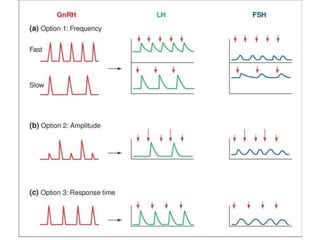
The Gn-RH is secreted intermittently a few minutes at
atime once every 1 to 3 hours (pulsatile secretion).
Gn-RH stimulates the release of gonadotropic
hormones (FSH, LH) through cyclic AMP.
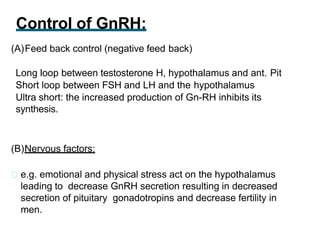
Control of GnRH:
(A)Feed back control (negative feed back)
Long loop between testosterone H, hypothalamus and ant. Pit
Short loop between FSH and LH and the hypothalamus
Ultra short: the increased production of Gn-RH inhibits its
synthesis.
(B)Nervous factors:
e.g. emotional and physical stress act on the hypothalamus
leading to decrease GnRH secretion resulting in decreased
secretion of pituitary gonadotropins and decrease fertility in
men.
They are glycoproteinssecreted by gonadotropesof anterior pituitary
gland under the effect of GnRH
* FSH (follicle stimulating hormone):
It is needed for growth and maturation of the testis.
It stimulates spermatogenesis
It is trophic to Sertoli cells.
It is needed for the normal functions of Sertoli cells.
It promotes the production of androgen binding protein
(ABP)
* LH (luteinizing hormone) :
It is trophic to leydig cells .
It stimulates and maintains testosterone secretion by leydig
cells .
2- pituitary gonadotropins
a) Testosterone:
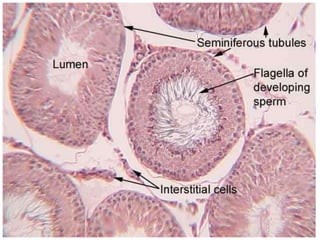
- It is secreted by the Leydig cells located in the interstitium of
the testis
division &
- It is responsible for the growth,
development, maintenance of the germinal
epithelium.
- It is needed for spermatogenesis
b) Estrogen:
- It is formed by the Sertoli cells under FSH stimulation.
- It is essentialfor spermiogenesis (conversion of
spermatid to sperm).
- Excessiveestrogen inhibits FSH secretion depression of
spermatogenesis.
3- Steroid hormones
4 - Other hormones
a) Thyroxin:
It Stimulates spermatogenesis via the stimulatory effect
on cell metabolism.
b)Growth hormone(GH):
It promotes early division of the spermatogonia, in its
absence as in pituitary dwarfism, spermatogenesis is
severely deficient or absent, thus causing infertility.
Effect of Human Chorionic Gonadotropin
(HCG) on the Fetal Testes
During pregnancy, (HCG) is secreted by the placenta.
This hormone has almost the same effects as LH.
(HCG) stimulates interstitial cell of the testes of the male fetus, resulting
in the production of testosterone in male fetus until the time of birth.
This small secretion of testosterone during gestation causes the fetus
to grow male sex organs instead of female organs.
Near the end of pregnancy, the testosterone secreted by the fetal testes also
causes the testes to descend into the scrotum
Cryptorchidism
Cryptorchidism means failure of a testis to descend
from the abdomen into the scrotum at or near the
time of birth, mainly due to deficiency of
testosterone H
A testis that remains throughout life in the
abdominal cavity is incapable of forming sperms
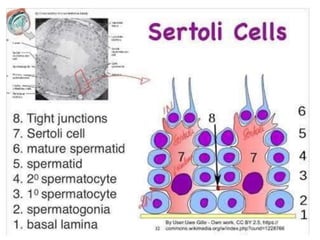
(1)Mullerian inhibitory factor (MIF), during fetal
development to inhibit the formation of fallopian tubes
from the mullerian ducts in male fetus.
(2)Estradiol, as one of the stimulatory factors in
spermatogenesis.
(3)Inhibin, has a feedback inhibitory effect on the anterior
pituitary gland to prevent over secretion of FSH.
(4)Androgen – binding protein (ABP), that maintain a
high, stable supply of androgen in the tubular fluid.
Sertoli cells secrete some hormones:
Hormonal control of
oogenesis
Ovarian cycle
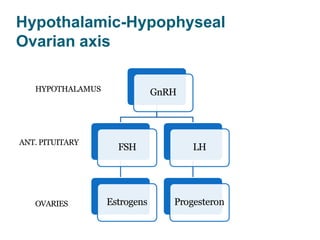
The female hormonal system, like that of the male,
consists of three levels of hormones, as follows:
1. A hypothalamic gonadotropin-releasing hormone (GnRH)
2.The anterior pituitary gonadotropins, follicle-stimulating
hormone (FSH) and luteinizing hormone (LH), both of
which are secreted in response to the release of GnRH
from the hypothalamus
3.The ovarian sex hormones, estrogens and
progesterone, which are secreted by the ovaries in
response to FSH and LH.
These various hormones are not secreted in constant
amounts throughout the female monthly sexual cycle;
they are secreted at differing rates during different parts
of the cycle.
The ovarian changes that occur during the sexual cycle
depend
completely on the gonadotropic hormones FSH and LH.
In the absence of these hormones, the ovaries remain
inactive, which is the case throughout childhood,
At age 9 to 12 years, the pituitary begins to secrete
progressively more FSH and LH, which leads to onset of
normal monthly sexual cycles beginning between the ages
of 11 and 15 years.
This period of change is called puberty, and the time of the
first menstrual cycle is called menarche.
Hypothalamic-Hypophyseal
Ovarian axis
GnRH
FSH
Estrogens
LH
Progesteron
HYPOTHALAMUS
ANT. PITUITARY
OVARIES
Intermittent, Pulsatile Secretion of
GnRH by the
Hypothalamus
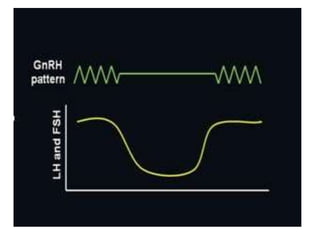
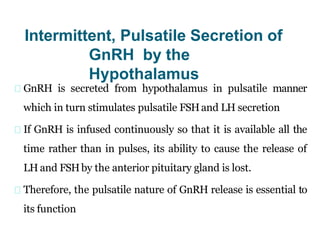
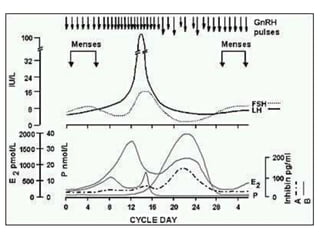
GnRH is secreted from hypothalamus in pulsatile manner
which in turn stimulates pulsatile FSHand LH secretion
If GnRH is infused continuously so that it is available all the
time rather than in pulses, its ability to cause the release of
LH and FSHby the anterior pituitary gland is lost.
Therefore, the pulsatile nature of GnRH release is essential to
its function
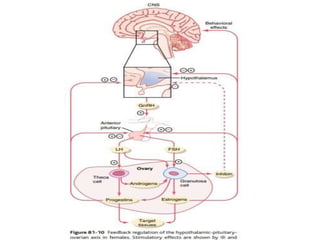
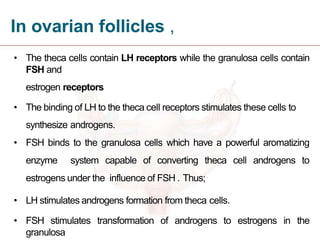
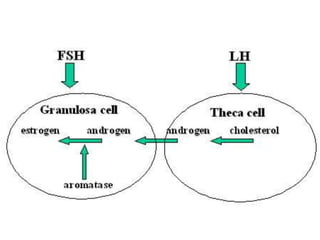
In ovarian follicles ,
• The theca cells contain LH receptors while the granulosa cells contain
FSH and
estrogen receptors
• The binding of LH to the theca cell receptors stimulates these cells to
synthesize androgens.
• FSH binds to the granulosa cells which have a powerful aromatizing
enzyme system capable of converting theca cell androgens to
estrogens under the influence of FSH . Thus;
• LH stimulates androgens formation from theca cells.
• FSH stimulates transformation of androgens to estrogens in the
granulosa
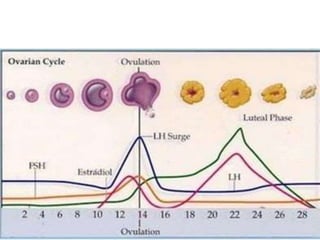
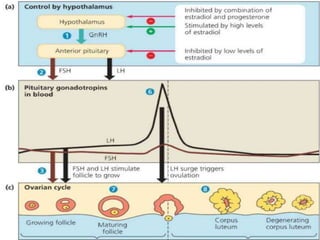
The ovarian cycle is divided into follicular phase and luteal phase :
Follicular phase : from start of cycle till time of ovulation , during
which follicular development occurs ( FSH dependent )
Luteal phase : from ovulation till the end of the cycle , in which
corpus luteum is present ( LH dependent )
estrogen inhibits this secretion in a negative feedback mechanism .
In follicular phase :
At the start of the cycle , plasma levels of ovarian steroids are
basal and so , no – ve feed back inhibition on FSH and LH
secretion .
This permits the release of FSH and LH from anterior pituitary .
FSH stimulates follicular growth and the follicles progress
The follicular cells continue to produce estrogen under the effect of
FSH and estrogen level in plasma increase progressively
Estrogen exerts a negative feed back inhibition on FSH secretion
( by day 7 ) .
The – ve feed back inhibition helps to cause atresia in all follicles except
the dominant follicle .
a. ↓ FSH leads to ↓ estrogen formation in atretic follicles with regression in
rate of growth ( estrogen stimulates growth of the follicles ) .
b. The dominant follicle has more estrogen production, more growth of
cells → more FSH receptors → more estrogen production → ( positive
feed back ) .
Many other factors help the dominant follicle to continue
e.g.
A group of growth factors
Inhibin hormone secreted by follicular cells which inhibit
FSH
secretion
i.e. FSH stimulates inhibin production from granulosa
cells and then inhibin inhibits FSH release ( - ve feed
back ) .
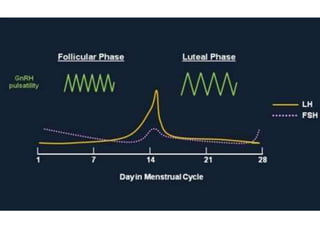
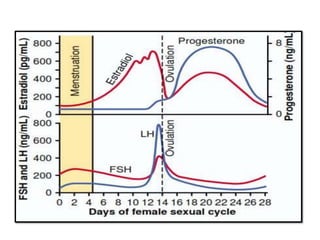
At the mid-cycle , a rapid rise in LH secretion occurs
which is
called LH surge.
This may be caused by estrogen, which now exerts a +ve
feed back mechanism on LH release from anterior
pituitary causing rapid rise in LH secretion
At the same time a smaller rise in FSH release also occur
which is called mid-cycle FSH surge .
Thus , ovulatory surge of LH and FSH can be defined as :
sudden rapid increase in LH and to a lesser extent FSH
production from anterior pituitary just before ovulation as a result
of ↑ in estrogen production from the graffian follicle
LH and FSH help the following :
Complete miosis of oocyte .
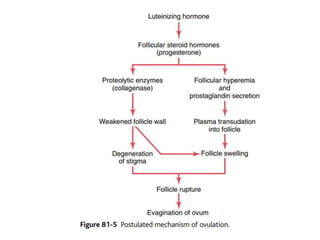
Activate proteolytic enzymes which digest follicular wall
Vasodilatation of follicular vessels causing its swelling and
rupture
This LH surge (and FSH surge) is the main stimulus
for ovulation So absent surge will cause failure of
ovulation
After ovulation ( luteal phase (
The rupture of the follicle and release of the ovum cause a
drop of estrogen with lack of its + ve feed back on LH, this
causes lowering of FSH and LH rapidly but their levels are
still enough to stimulate luteal cells to secrete estrogen and
progesterone .
Progressive increase in progesterone and estrogen coming
from corpus luteum cause – ve feed back inhibition on FSH
and LH secretion .
If pregnancy does not occur degeneration of corpus
luteum
occurs due to ↓↓ gonadotropic hormone .
If pregnancy occurs : corpus luteum is maintained
by
human chorionic gonadotropin secreted by placenta.
After degeneration of corpus luteum; no further
secretion of estrogen and progesterone → ↓ their level
in blood → this results in:
1 No inhibition of FSH and LH → ↑ FSH and LH →
start growth of new group of primordial follicles →
start a new cycle .
2 Menstruation: due to lack of hormonal support
to endometrium.
If the preovulatory surge of LH is not of sufficient
magnitude, ovulation will not occur and the cycle is said
to be “anovulatory.”
The lack of ovulation causes failure of development of the
corpus luteum, so there is almost no secretion of
progesterone during the latter portion of the cycle.
The cycle is shortened by several days
The first few cycles after the onset of puberty are usually
anovulatory, and also the cycles occurring several months
to years before menopause, this is because the LH surge
is not potent enough at these times to cause ovulation.
FSH causes early follicular development in the
ovaries and secretion of estrogen.
LH & FSH are essential for final maturation of
follicles.
LH surge is responsible for the ovulation and
corpus luteum formation and stimulate secretion
of progesterone and estrogen.
Estrogen is responsible for the proliferative phase
of endometrial cycle
Progesterone and estrogen are responsible for the
secretory phase of endometrial cycle
Summary
Estrogen has negative feedback inhibition on FSH and
LH secretion during the early part of the follicular phase
of the cycle.
Inhibin hormone from the ovarian follicles inhibits FSH
secretion.
Increase estrogen 24 before ovulation initiate the LH
surge with positive feedback that produce ovulation.
At the mid luteal phase, the high level of estrogen and
progesterone has negative feedback inhibition on FSH
and LH.
control of Gametogenesis.pptx

control of Gametogenesis.pptx

  • 2.
    Objectives of thelecture By the end of the lecture , the students should: Define Gametogenesis Clarify Hypothalamic - Pituitary - Gonadal Axis Understand hormonal control of spermatogenesis Explainhormonal control of oogenesis Recall feedback mechanisms
  • 3.
    Gametogenesis Means the developmentof mature ova andsperm It includes spermatogenesis and oogenesis
  • 4.
  • 5.
  • 6.
    Hormonal control ofspermatogenesis 1- Hypothalamic control: * The hypothalamus contains neurons originated in arcuate N and end in median eminence, when stimulated release of GnRH that passes through the hypothalamo-hypophyseal portal circulation Anterior Pituitary gland controlling gonadotropins (FSH and LH) secretions. * Various psychic stimuli feeding into the hypothalamus excitatory or inhibitory effect on gonadotropin secretion altering the degree of fertility.
  • 7.
  • 8.
    Gonadotropin releasing hormone(GnRH) Gn-RHis a 10-amino acid peptide (decapeptide) secreted by the hypothalamic neurons. The Gn-RH is secreted intermittently a few minutes at atime once every 1 to 3 hours (pulsatile secretion). Gn-RH stimulates the release of gonadotropic hormones (FSH, LH) through cyclic AMP.
  • 11.
    Control of GnRH: (A)Feedback control (negative feed back) Long loop between testosterone H, hypothalamus and ant. Pit Short loop between FSH and LH and the hypothalamus Ultra short: the increased production of Gn-RH inhibits its synthesis. (B)Nervous factors: e.g. emotional and physical stress act on the hypothalamus leading to decrease GnRH secretion resulting in decreased secretion of pituitary gonadotropins and decrease fertility in men.
  • 12.
    They are glycoproteinssecretedby gonadotropesof anterior pituitary gland under the effect of GnRH * FSH (follicle stimulating hormone): It is needed for growth and maturation of the testis. It stimulates spermatogenesis It is trophic to Sertoli cells. It is needed for the normal functions of Sertoli cells. It promotes the production of androgen binding protein (ABP) * LH (luteinizing hormone) : It is trophic to leydig cells . It stimulates and maintains testosterone secretion by leydig cells . 2- pituitary gonadotropins
  • 15.
    a) Testosterone: - Itis secreted by the Leydig cells located in the interstitium of the testis division & - It is responsible for the growth, development, maintenance of the germinal epithelium. - It is needed for spermatogenesis b) Estrogen: - It is formed by the Sertoli cells under FSH stimulation. - It is essentialfor spermiogenesis (conversion of spermatid to sperm). - Excessiveestrogen inhibits FSH secretion depression of spermatogenesis. 3- Steroid hormones
  • 16.
    4 - Otherhormones a) Thyroxin: It Stimulates spermatogenesis via the stimulatory effect on cell metabolism. b)Growth hormone(GH): It promotes early division of the spermatogonia, in its absence as in pituitary dwarfism, spermatogenesis is severely deficient or absent, thus causing infertility.
  • 17.
    Effect of HumanChorionic Gonadotropin (HCG) on the Fetal Testes During pregnancy, (HCG) is secreted by the placenta. This hormone has almost the same effects as LH. (HCG) stimulates interstitial cell of the testes of the male fetus, resulting in the production of testosterone in male fetus until the time of birth. This small secretion of testosterone during gestation causes the fetus to grow male sex organs instead of female organs. Near the end of pregnancy, the testosterone secreted by the fetal testes also causes the testes to descend into the scrotum
  • 18.
    Cryptorchidism Cryptorchidism means failureof a testis to descend from the abdomen into the scrotum at or near the time of birth, mainly due to deficiency of testosterone H A testis that remains throughout life in the abdominal cavity is incapable of forming sperms
  • 19.
    (1)Mullerian inhibitory factor(MIF), during fetal development to inhibit the formation of fallopian tubes from the mullerian ducts in male fetus. (2)Estradiol, as one of the stimulatory factors in spermatogenesis. (3)Inhibin, has a feedback inhibitory effect on the anterior pituitary gland to prevent over secretion of FSH. (4)Androgen – binding protein (ABP), that maintain a high, stable supply of androgen in the tubular fluid. Sertoli cells secrete some hormones:
  • 21.
  • 22.
  • 23.
    The female hormonalsystem, like that of the male, consists of three levels of hormones, as follows: 1. A hypothalamic gonadotropin-releasing hormone (GnRH) 2.The anterior pituitary gonadotropins, follicle-stimulating hormone (FSH) and luteinizing hormone (LH), both of which are secreted in response to the release of GnRH from the hypothalamus 3.The ovarian sex hormones, estrogens and progesterone, which are secreted by the ovaries in response to FSH and LH. These various hormones are not secreted in constant amounts throughout the female monthly sexual cycle; they are secreted at differing rates during different parts of the cycle.
  • 24.
    The ovarian changesthat occur during the sexual cycle depend completely on the gonadotropic hormones FSH and LH. In the absence of these hormones, the ovaries remain inactive, which is the case throughout childhood, At age 9 to 12 years, the pituitary begins to secrete progressively more FSH and LH, which leads to onset of normal monthly sexual cycles beginning between the ages of 11 and 15 years. This period of change is called puberty, and the time of the first menstrual cycle is called menarche.
  • 25.
  • 26.
    Intermittent, Pulsatile Secretionof GnRH by the Hypothalamus GnRH is secreted from hypothalamus in pulsatile manner which in turn stimulates pulsatile FSHand LH secretion If GnRH is infused continuously so that it is available all the time rather than in pulses, its ability to cause the release of LH and FSHby the anterior pituitary gland is lost. Therefore, the pulsatile nature of GnRH release is essential to its function
  • 32.
    In ovarian follicles, • The theca cells contain LH receptors while the granulosa cells contain FSH and estrogen receptors • The binding of LH to the theca cell receptors stimulates these cells to synthesize androgens. • FSH binds to the granulosa cells which have a powerful aromatizing enzyme system capable of converting theca cell androgens to estrogens under the influence of FSH . Thus; • LH stimulates androgens formation from theca cells. • FSH stimulates transformation of androgens to estrogens in the granulosa
  • 34.
    The ovarian cycleis divided into follicular phase and luteal phase : Follicular phase : from start of cycle till time of ovulation , during which follicular development occurs ( FSH dependent ) Luteal phase : from ovulation till the end of the cycle , in which corpus luteum is present ( LH dependent ) estrogen inhibits this secretion in a negative feedback mechanism .
  • 35.
    In follicular phase: At the start of the cycle , plasma levels of ovarian steroids are basal and so , no – ve feed back inhibition on FSH and LH secretion . This permits the release of FSH and LH from anterior pituitary . FSH stimulates follicular growth and the follicles progress The follicular cells continue to produce estrogen under the effect of FSH and estrogen level in plasma increase progressively
  • 36.
    Estrogen exerts anegative feed back inhibition on FSH secretion ( by day 7 ) . The – ve feed back inhibition helps to cause atresia in all follicles except the dominant follicle . a. ↓ FSH leads to ↓ estrogen formation in atretic follicles with regression in rate of growth ( estrogen stimulates growth of the follicles ) . b. The dominant follicle has more estrogen production, more growth of cells → more FSH receptors → more estrogen production → ( positive feed back ) .
  • 37.
    Many other factorshelp the dominant follicle to continue e.g. A group of growth factors Inhibin hormone secreted by follicular cells which inhibit FSH secretion i.e. FSH stimulates inhibin production from granulosa cells and then inhibin inhibits FSH release ( - ve feed back ) .
  • 38.
    At the mid-cycle, a rapid rise in LH secretion occurs which is called LH surge. This may be caused by estrogen, which now exerts a +ve feed back mechanism on LH release from anterior pituitary causing rapid rise in LH secretion At the same time a smaller rise in FSH release also occur which is called mid-cycle FSH surge .
  • 41.
    Thus , ovulatorysurge of LH and FSH can be defined as : sudden rapid increase in LH and to a lesser extent FSH production from anterior pituitary just before ovulation as a result of ↑ in estrogen production from the graffian follicle LH and FSH help the following : Complete miosis of oocyte . Activate proteolytic enzymes which digest follicular wall Vasodilatation of follicular vessels causing its swelling and rupture This LH surge (and FSH surge) is the main stimulus for ovulation So absent surge will cause failure of ovulation
  • 42.
    After ovulation (luteal phase ( The rupture of the follicle and release of the ovum cause a drop of estrogen with lack of its + ve feed back on LH, this causes lowering of FSH and LH rapidly but their levels are still enough to stimulate luteal cells to secrete estrogen and progesterone . Progressive increase in progesterone and estrogen coming from corpus luteum cause – ve feed back inhibition on FSH and LH secretion .
  • 43.
    If pregnancy doesnot occur degeneration of corpus luteum occurs due to ↓↓ gonadotropic hormone . If pregnancy occurs : corpus luteum is maintained by human chorionic gonadotropin secreted by placenta.
  • 44.
    After degeneration ofcorpus luteum; no further secretion of estrogen and progesterone → ↓ their level in blood → this results in: 1 No inhibition of FSH and LH → ↑ FSH and LH → start growth of new group of primordial follicles → start a new cycle . 2 Menstruation: due to lack of hormonal support to endometrium.
  • 45.
    If the preovulatorysurge of LH is not of sufficient magnitude, ovulation will not occur and the cycle is said to be “anovulatory.” The lack of ovulation causes failure of development of the corpus luteum, so there is almost no secretion of progesterone during the latter portion of the cycle. The cycle is shortened by several days The first few cycles after the onset of puberty are usually anovulatory, and also the cycles occurring several months to years before menopause, this is because the LH surge is not potent enough at these times to cause ovulation.
  • 46.
    FSH causes earlyfollicular development in the ovaries and secretion of estrogen. LH & FSH are essential for final maturation of follicles. LH surge is responsible for the ovulation and corpus luteum formation and stimulate secretion of progesterone and estrogen. Estrogen is responsible for the proliferative phase of endometrial cycle Progesterone and estrogen are responsible for the secretory phase of endometrial cycle Summary
  • 47.
    Estrogen has negativefeedback inhibition on FSH and LH secretion during the early part of the follicular phase of the cycle. Inhibin hormone from the ovarian follicles inhibits FSH secretion. Increase estrogen 24 before ovulation initiate the LH surge with positive feedback that produce ovulation. At the mid luteal phase, the high level of estrogen and progesterone has negative feedback inhibition on FSH and LH.