DEPARTMENT OF RURAL MANAGEMENT
TEACHER INCHARGE- Dr. ABHILASH BABU
AJEET KUMAR
ROLL NO- 4460
CONTRACT
According to sec.2(h), a contract is defined as an
agreement enforceable by law.
Agreement- According to sec.2(e), every promise or
set of promises forming consideration for each other.
Promise- According to sec.2(b), when the person to
whom the proposal is made signifies his assent
thereto, the proposal is said to be accepted.
Proposal when accepted becomes a promise.
1. Offer & Acceptance
Should be Present
 At least two parties are needed to enter into a contact.
One party has to make an offer and other must accept
it.
 The person who makes the 'proposal' or 'offer' is called
the 'promisor' or 'offeror'. While, the person to whom
the offer is made is called the 'offeree’ or ‘promisee’.
There must be an 'offer' and an 'acceptance' to the
offer, resulting into an agreement.
2. Intention to create legal
relationship
A contract requires that the parties intend to enter into a
legally binding agreement. That is, the parties entering into
the contract must intend to create legal relations and
must understand that the agreement can
be enforced by law.
Case Law: In Balfour V. Balfour, a husband promised to pay
maintenance allowance every month to his wife, so long as
they remain separate. When he failed to perform this
promise, she brought an action to enforce. As it is an
agreement of domestic nature, it was held that it does not
contemplate to create any legal obligation
3. Free Consent
Consent means knowledge & approval of the parties
concerned.
Consent would be considered as free consent if it is not
vitiated by coercion, undue influence, fraud,
misrepresentation or mistake.
Example:- A threatened to shoot B if he (B) does not
lend him Rs 2000 & B agreed to it. Here the agreement
is entered into under coercion and hence voidable at
the option of B.
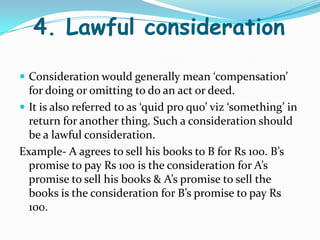
4. Lawful consideration
 Consideration would generally mean ‘compensation’
for doing or omitting to do an act or deed.
 It is also referred to as ‘quid pro quo’ viz ‘something’ in
return for another thing. Such a consideration should
be a lawful consideration.
Example- A agrees to sell his books to B for Rs 100. B’s
promise to pay Rs 100 is the consideration for A’s
promise to sell his books & A’s promise to sell the
books is the consideration for B’s promise to pay Rs
100.
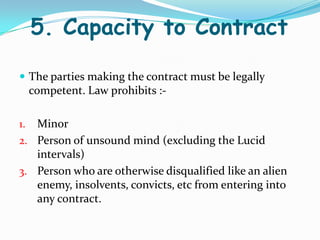
5. Capacity to Contract
 The parties making the contract must be legally
competent. Law prohibits :-
1. Minor
2. Person of unsound mind (excluding the Lucid
intervals)
3. Person who are otherwise disqualified like an alien
enemy, insolvents, convicts, etc from entering into
any contract.
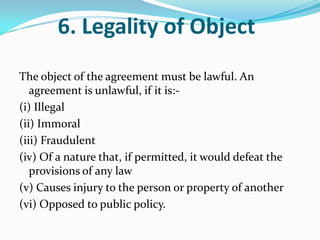
6. Legality of Object
The object of the agreement must be lawful. An
agreement is unlawful, if it is:-
(i) Illegal
(ii) Immoral
(iii) Fraudulent
(iv) Of a nature that, if permitted, it would defeat the
provisions of any law
(v) Causes injury to the person or property of another
(vi) Opposed to public policy.
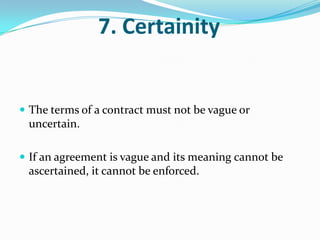
7. Certainity
 The terms of a contract must not be vague or
uncertain.
 If an agreement is vague and its meaning cannot be
ascertained, it cannot be enforced.
8. Possibility of Performance
 The terms of a contract must be such as are capable of
performance. An agreement to do an impossible act is
void and is not enforceable by law.
9. Writing & registration
 Generally, a contract may be oral or in writing.
However, certain contracts are required to be in
writing and may even require registration. Therefore,
where law requires an agreement to be put in writing
or be registered, the same must be complied with.
 For instance, the Indian Trusts Act requires the
creation of a trust to be reduced to writing.
Essentials of a valid contract

Essentials of a valid contract

  • 1.
    DEPARTMENT OF RURALMANAGEMENT TEACHER INCHARGE- Dr. ABHILASH BABU AJEET KUMAR ROLL NO- 4460
  • 2.
    CONTRACT According to sec.2(h),a contract is defined as an agreement enforceable by law. Agreement- According to sec.2(e), every promise or set of promises forming consideration for each other. Promise- According to sec.2(b), when the person to whom the proposal is made signifies his assent thereto, the proposal is said to be accepted. Proposal when accepted becomes a promise.
  • 4.
    1. Offer &Acceptance Should be Present  At least two parties are needed to enter into a contact. One party has to make an offer and other must accept it.  The person who makes the 'proposal' or 'offer' is called the 'promisor' or 'offeror'. While, the person to whom the offer is made is called the 'offeree’ or ‘promisee’. There must be an 'offer' and an 'acceptance' to the offer, resulting into an agreement.
  • 5.
    2. Intention tocreate legal relationship A contract requires that the parties intend to enter into a legally binding agreement. That is, the parties entering into the contract must intend to create legal relations and must understand that the agreement can be enforced by law. Case Law: In Balfour V. Balfour, a husband promised to pay maintenance allowance every month to his wife, so long as they remain separate. When he failed to perform this promise, she brought an action to enforce. As it is an agreement of domestic nature, it was held that it does not contemplate to create any legal obligation
  • 6.
    3. Free Consent Consentmeans knowledge & approval of the parties concerned. Consent would be considered as free consent if it is not vitiated by coercion, undue influence, fraud, misrepresentation or mistake. Example:- A threatened to shoot B if he (B) does not lend him Rs 2000 & B agreed to it. Here the agreement is entered into under coercion and hence voidable at the option of B.
  • 7.
    4. Lawful consideration Consideration would generally mean ‘compensation’ for doing or omitting to do an act or deed.  It is also referred to as ‘quid pro quo’ viz ‘something’ in return for another thing. Such a consideration should be a lawful consideration. Example- A agrees to sell his books to B for Rs 100. B’s promise to pay Rs 100 is the consideration for A’s promise to sell his books & A’s promise to sell the books is the consideration for B’s promise to pay Rs 100.
  • 8.
    5. Capacity toContract  The parties making the contract must be legally competent. Law prohibits :- 1. Minor 2. Person of unsound mind (excluding the Lucid intervals) 3. Person who are otherwise disqualified like an alien enemy, insolvents, convicts, etc from entering into any contract.
  • 9.
    6. Legality ofObject The object of the agreement must be lawful. An agreement is unlawful, if it is:- (i) Illegal (ii) Immoral (iii) Fraudulent (iv) Of a nature that, if permitted, it would defeat the provisions of any law (v) Causes injury to the person or property of another (vi) Opposed to public policy.
  • 10.
    7. Certainity  Theterms of a contract must not be vague or uncertain.  If an agreement is vague and its meaning cannot be ascertained, it cannot be enforced.
  • 11.
    8. Possibility ofPerformance  The terms of a contract must be such as are capable of performance. An agreement to do an impossible act is void and is not enforceable by law.
  • 12.
    9. Writing &registration  Generally, a contract may be oral or in writing. However, certain contracts are required to be in writing and may even require registration. Therefore, where law requires an agreement to be put in writing or be registered, the same must be complied with.  For instance, the Indian Trusts Act requires the creation of a trust to be reduced to writing.