Continuous Quality
Improvement (CQI)
Dr. Suhailan Safei
(suhailan@unisza.edu.my)
Deputy Director of e-Learning
Academic Quality and e-Learning Centre (AQeL)
Universiti Sultan Zainal Abidin
Gong Badak Campus
Senior Lecturer
Faculty of Informatics and Computing
Universiti Sultan Zainal Abidin
Besut Campus
24 December 2018
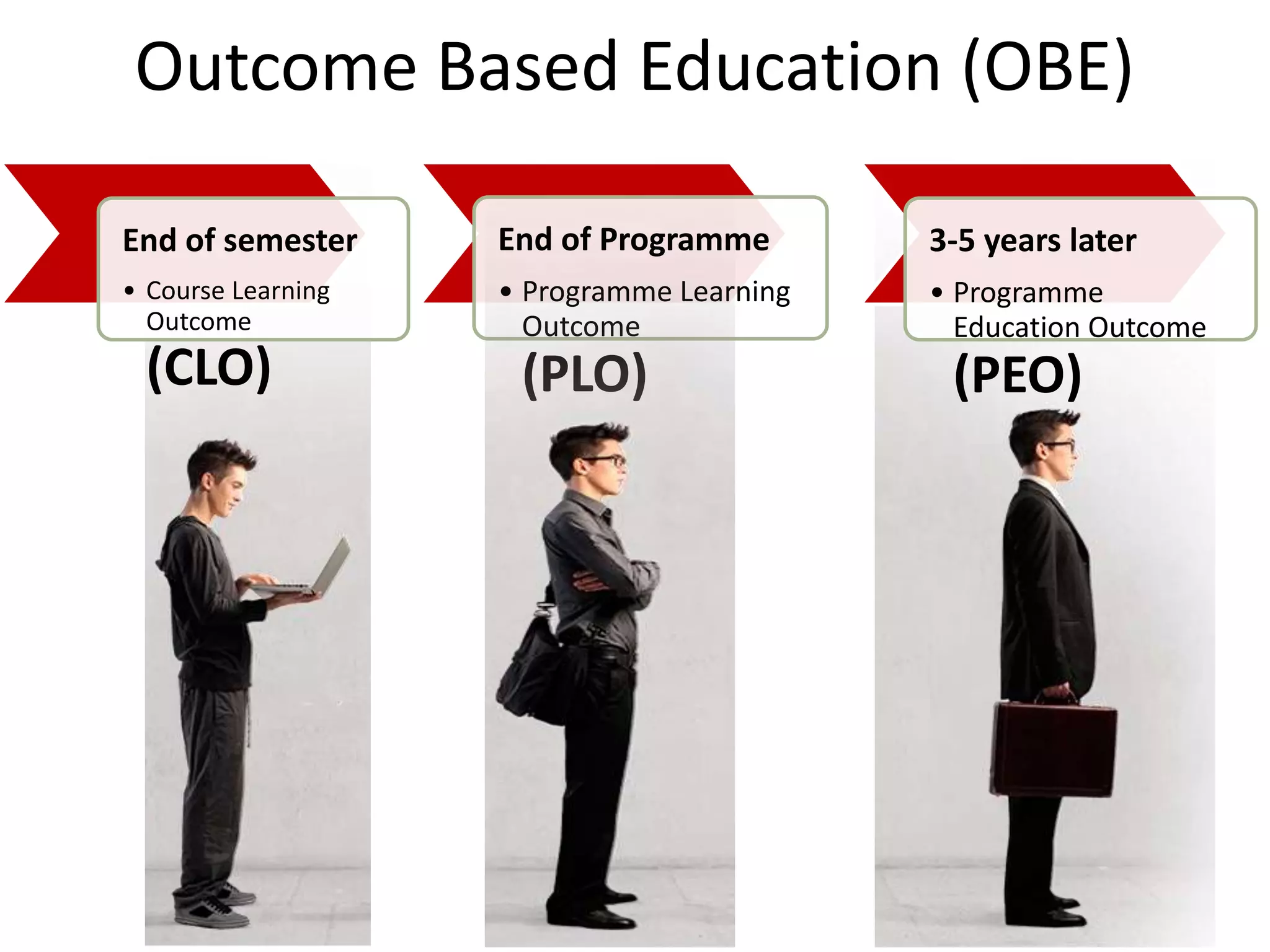
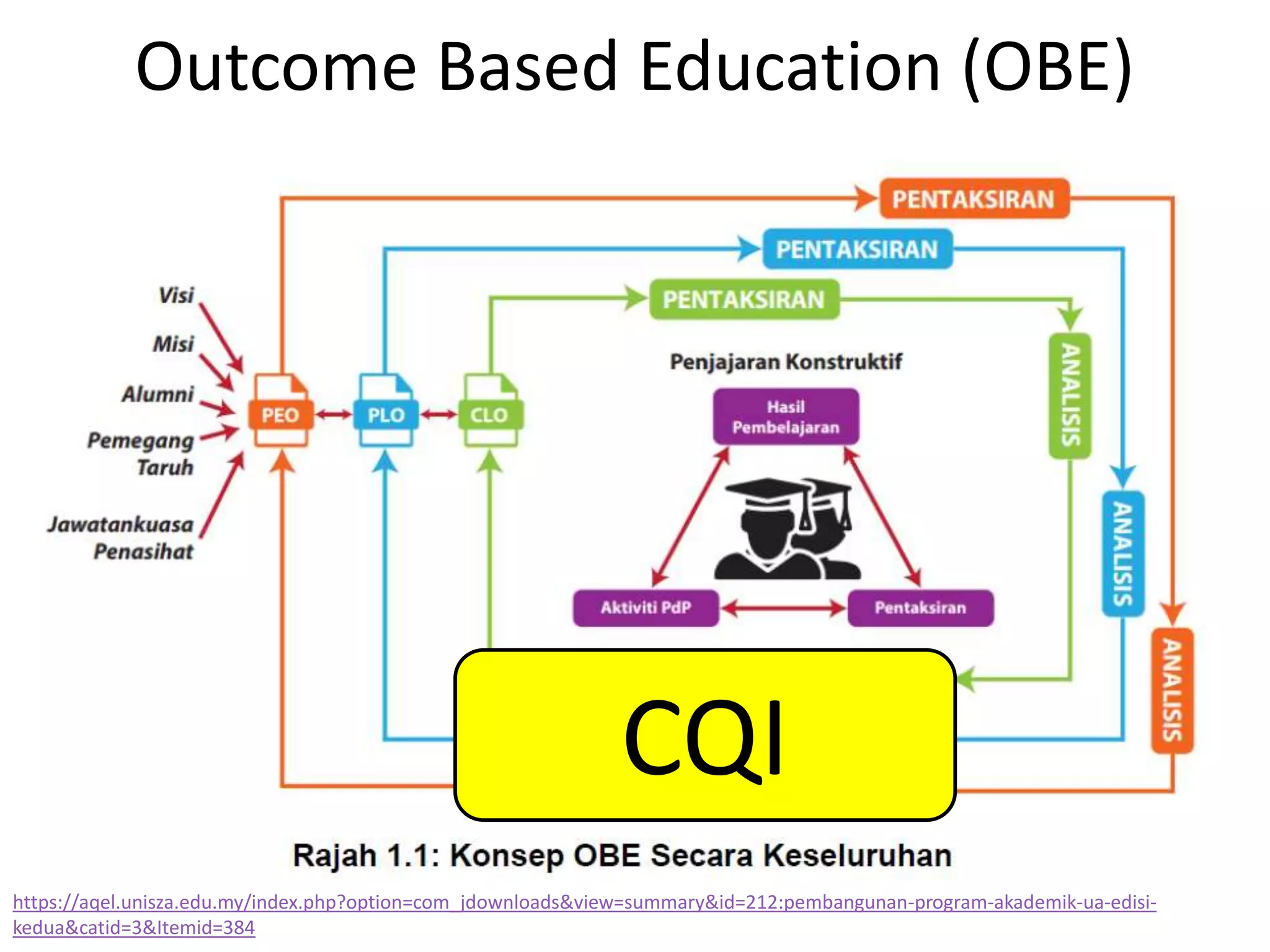
Outcome Based Education (OBE)
End of semester
• Course Learning
Outcome
(CLO)
End of Programme
• Programme Learning
Outcome
(PLO)
3-5 years later
• Programme
Education Outcome
(PEO)
Outcome Based Education (OBE)
https://aqel.unisza.edu.my/index.php?option=com_jdownloads&view=summary&id=212:pembangunan-program-akademik-ua-edisi-
kedua&catid=3&Itemid=384
CQI
Continuous Quality Improvement (CQI)
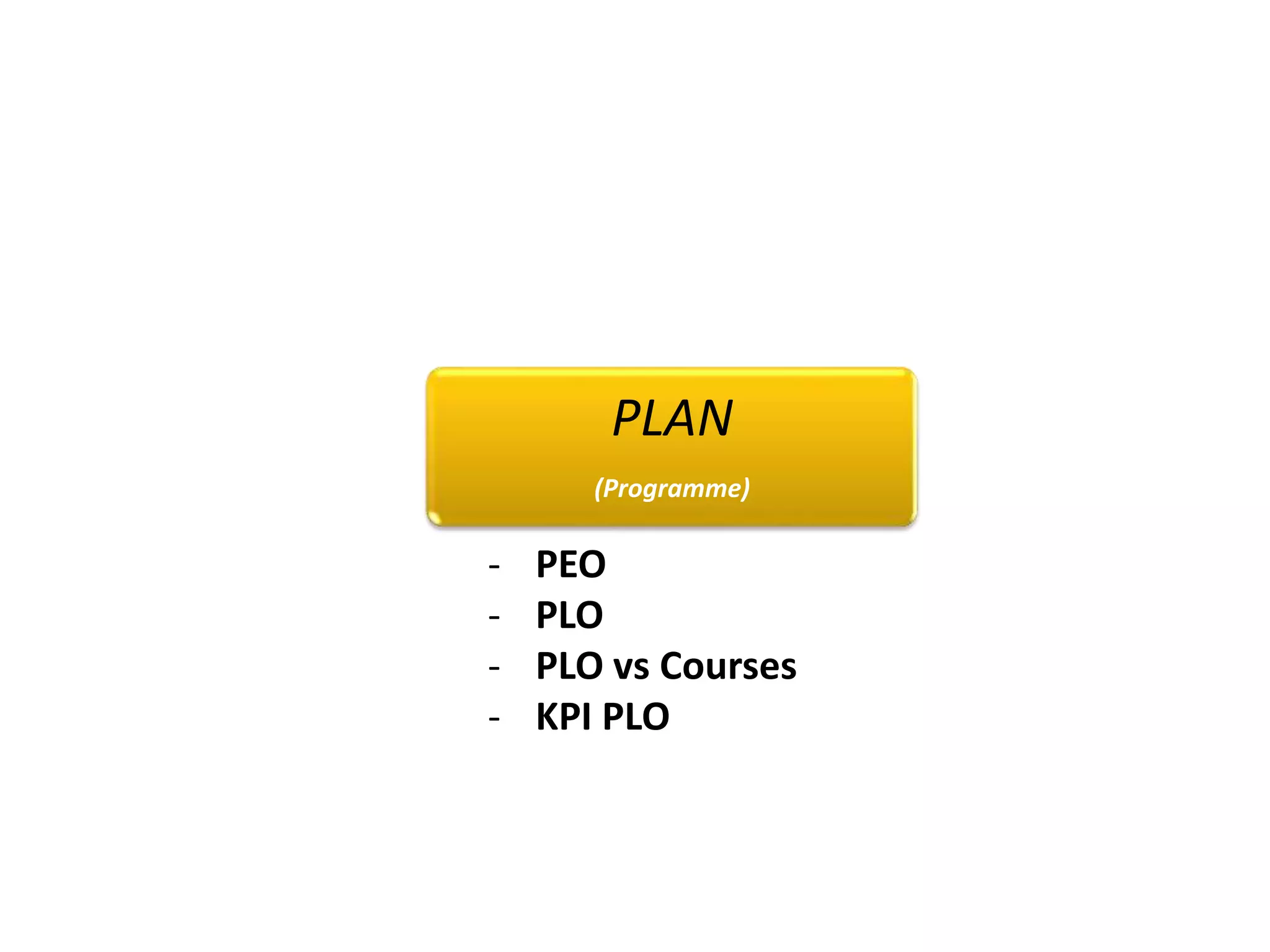
PLAN
(Programme)
DO
(Course Implementation)
CHECK
(Achievement Reports)
Action
(Review)
- PEO
- PLO
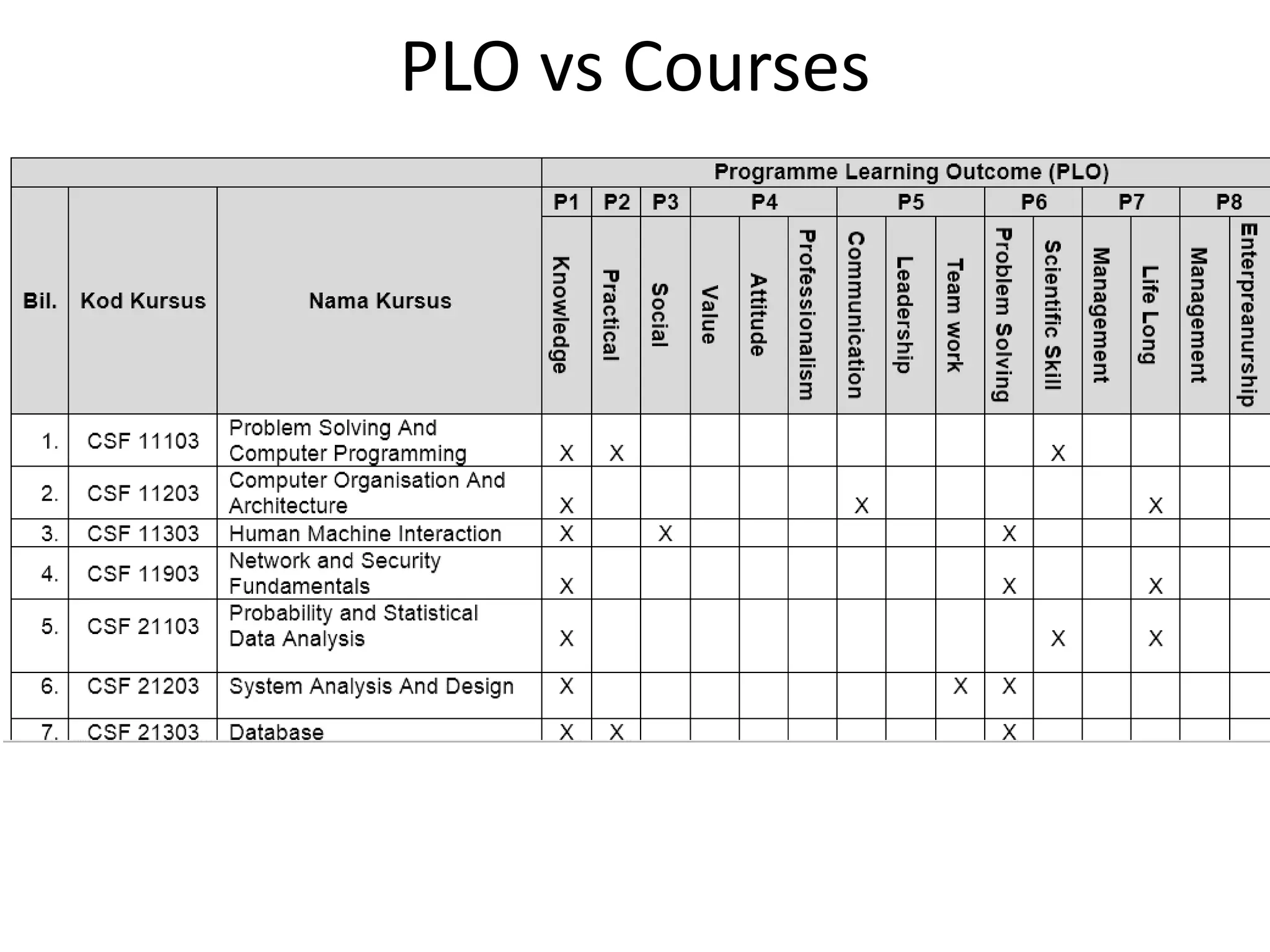
- PLO vs Courses
- KPI PLO
- CLO
- CLO vs PLO
- Delivery
- Assessment
- SLT
(Detailed Course Information – DCI)
Assessment
based on
- Grade
- CLO
Review report:
- CLO (CQI)
- PLO
- PEO
PLAN
(Programme)
- PEO
- PLO
- PLO vs Courses
- KPI PLO
Programme Education Outcome (PEO)
[Should be measured 3-5 years after graduation]
PEO1 Computer practitioners who synthesize and apply the
knowledge and understanding to provide technical
solutions for the software development industries locally
and globally.
PEO2 Computer technocrats who ethically and professionally
provide computer solutions to fulfil social responsibilities
of the diverse Malaysian community.
PEO3 Computer practitioners who lead and collaborate in teams
through effective communication in solving problems
scientifically.
PEO4 Computer practitioners who continually enhance personal
and professional know-how, and venturing new business
opportunities.
Programme Learning Outcome (PLO)
[Should be measured after completion on each student’s cohort]
UPON COMPLETION OF THIS PROGRAMME, STUDENT WILL BE ABLE TO:
PLO1: Acquire and apply knowledge of essential facts, concepts, principles, and
theories of Computer Science [MQF1:CS1]
PLO2: Applying computing skills in analyzing, modeling, designing, developing,
programming and evaluating efficient computing solutions in Computer
Science [MQF2:CS3]
PLO3: Fulfill obligations and social responsibilities using appropriate social skills
[MQF3:G5]
PLO4: Practice the value, attitude and professionalism in line with the related
code of conduct [MQF4:G5]
PLO5: Communicate effectively with peers, clients, superiors and society at
large; with appropriate leadership and team work skills [MQF5:G2,G3]
PLO6: Utilize scientific skills to analyze algorithms as well as designing optimal
solution to Computer Science [MQF6:G4,CS2]
PLO7: Manage information and engage in lifelong learning for academic and
career development [MQF7:G1]
PLO8: Possess managerial and entrepreneurship skills in business and real
world perspectives [MQF8:G6]
PLO vs Courses
KPI PLO
• Each PLO need to have a KPI to be achieved
for Continuous Quality Improvement.
e.g.:
80% of students pass on PLO1 (Knowledge)
80% of students pass on PLO2 (Practical skills)
.
.
80% of students pass on PLO6 (Problem Solving)
.
40% of students pass on PLO8 (Entrepreneurship)
Do
(Course Implementation)
- CLO
- CLO vs MQF/PLO
- Delivery
- Assessment
- SLT
(Detailed Course Information – DCI)
DCI
Nota: https://aqel.unisza.edu.my/index.php?option=com_jdownloads&view=category&catid=22&Itemid=303
CLO
SLT
Delivery &
Assessment
MQF vs PLO
CLO vs MQF
Check
(Achievement Report)
Assessment based on
- Grade
- CLO
Course Grade Report
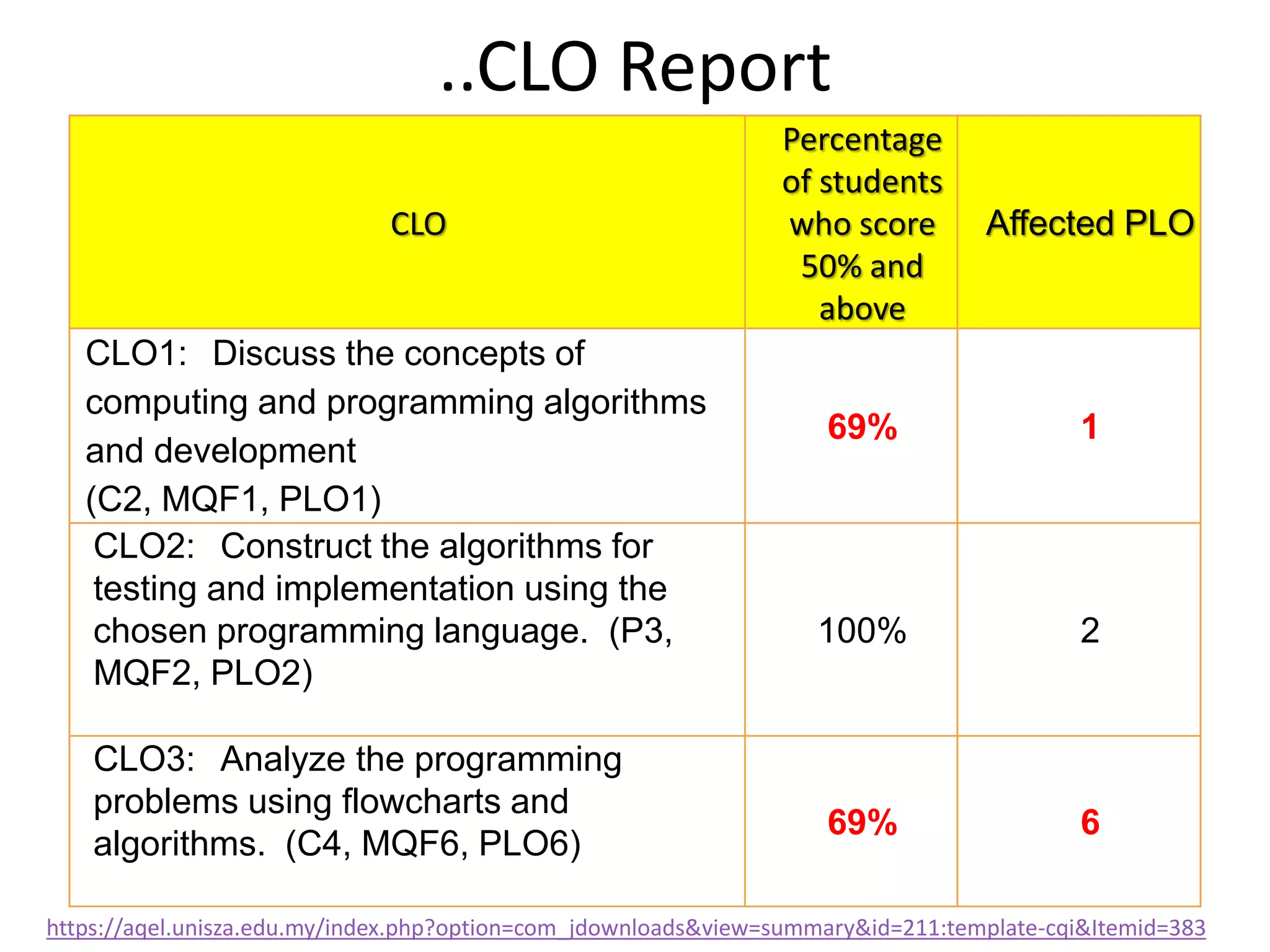
CLO Report
CLO
Percentage
of students
who score
50% and
above
Affected PLO
CLO1: Discuss the concepts of
computing and programming algorithms
and development
(C2, MQF1, PLO1)
69% 1
CLO2: Construct the algorithms for
testing and implementation using the
chosen programming language. (P3,
MQF2, PLO2)
100% 2
CLO3: Analyze the programming
problems using flowcharts and
algorithms. (C4, MQF6, PLO6)
69% 6
..CLO Report
https://aqel.unisza.edu.my/index.php?option=com_jdownloads&view=summary&id=211:template-cqi&Itemid=383
Action
(Review & Improve)
Review and Improvement for :
1. CLO (end of semester)
2. PLO (every completion of student’s cohort)
3. PEO (3-5 years after student’s graduation)
CQI1 – Course Quality Improvement
1. Every semester, lecturer need to make
comments on CLO achievement.
2. The comments can cover on:
- SLT review (too much assignment, or too few
assessment)
- Delivery method (enhanced learning
activities)
- Assessment types (not suitable, not assess on
CLO, question not follow bloom)
- PLO mapping (not appropriate/effective)
3. The report should be presented and endorsed at
Faculty level. If applicable, DCI should be changed
accordingly to be used for the next cohort.
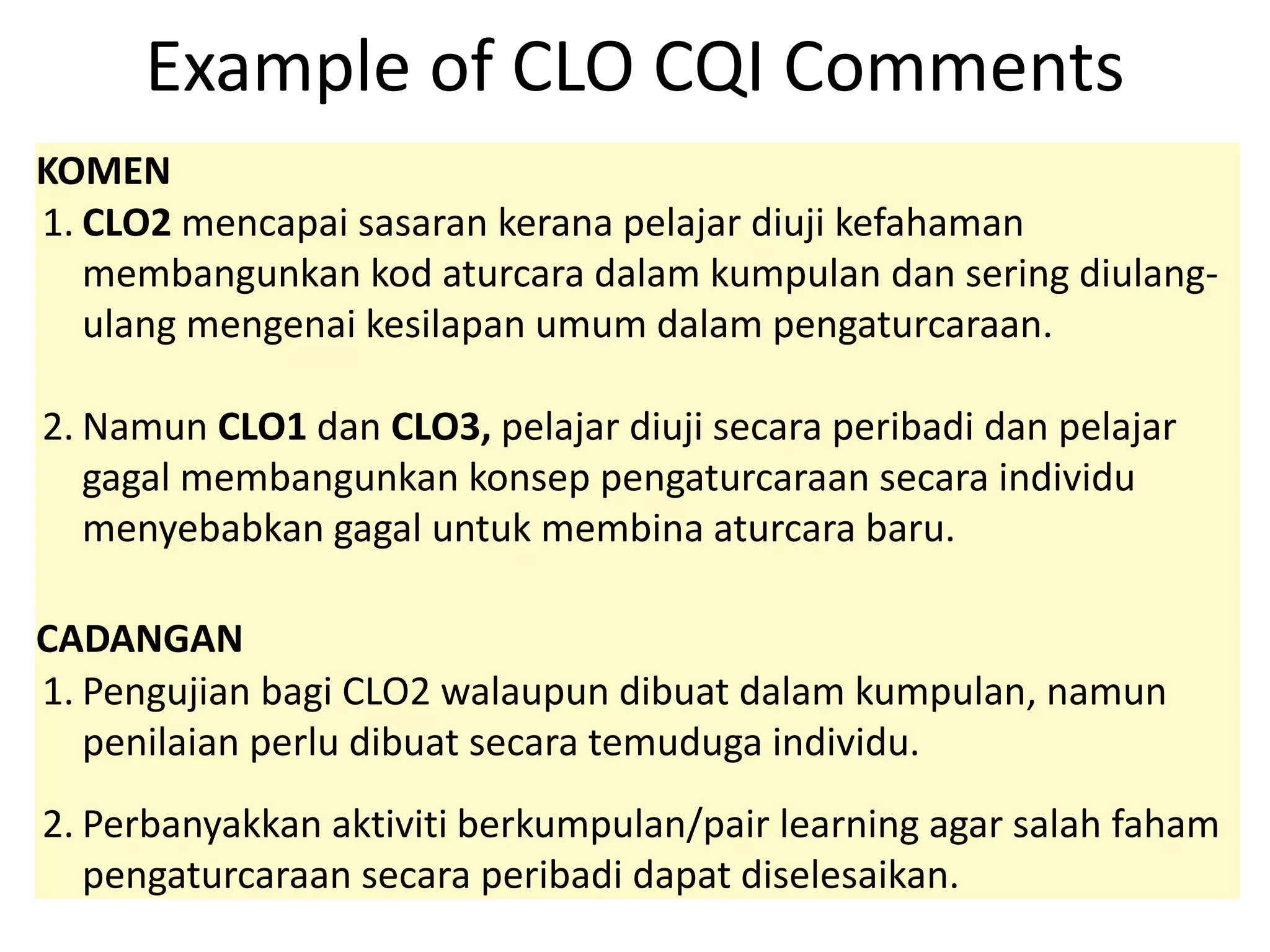
Example of CLO CQI Comments
KOMEN
1. CLO2 mencapai sasaran kerana pelajar diuji kefahaman
membangunkan kod aturcara dalam kumpulan dan sering diulang-
ulang mengenai kesilapan umum dalam pengaturcaraan.
2. Namun CLO1 dan CLO3, pelajar diuji secara peribadi dan pelajar
gagal membangunkan konsep pengaturcaraan secara individu
menyebabkan gagal untuk membina aturcara baru.
CADANGAN
1. Pengujian bagi CLO2 walaupun dibuat dalam kumpulan, namun
penilaian perlu dibuat secara temuduga individu.
2. Perbanyakkan aktiviti berkumpulan/pair learning agar salah faham
pengaturcaraan secara peribadi dapat diselesaikan.
CQI2 – Programme Quality Improvement
1. Every completion of a programme (student’s
cohort), faculty needs to report the KPI
achievement of the PLO for the cohort.
2. The improvement may cover on:
- Changes in PLO statements.
- Enhanced curriculum / syllabus
- New mapping of PLO-Courses
Example of PLO CQI Report
(Entry on Sem 1 Session 2017/2018)
ULASAN:
PLO1 & PLO3 tidak mencapai KPI 80% pelajar lulus dalam ilmu pengetahuan Sains Komputer
(Pembangunan Perisian) dan kemahiran sosial.
CADANGAN:
1. PLO1 bagi kursus Network & Security Fundamentals lebih sesuai dipetakan kepada PL04
(etika)
CQI3 – Education Quality Improvement
1. 3-5 years after the student graduation (working
experience & achievement), faculty needs to
report the KPI achievement of the PEO for the
programme and do a comprehensive curriculum
review.
2. The reports or comments from stakeholders
(students, alumni, industry, professional body,
tracer study, community, parents, KPM, MQA,
program standard, external examiner, market
survey) need also to be considered as the main
input for the curriculum review.
CQI Requirement
• CQI needs to be conducted for each academic
programme and course is meant to improve the quality
of the programme.
• CQI is also part of MQA* accreditation requirement
and one of PSPTN element that is used for ranking
IPTA/IPTS (SETARA)**
– CAP : P&P
– Objektif : Mempertingkat kualiti program akademik
– KPI : Peratusan kursus yang telah melalui *CQI bagi setiap
program
– CQI = elemen yang perlu ditekankan dalam proses ini
adalah learning outcome achievement, correction and
corrective action, prevention and preventive action
*http://www.mohe.gov.my/psptn/index.php?option=com_content&view=article&id=74&Itemid=60
**http://www.mqa.gov.my/portal2012/SETARA11/SETARA%20%2711%20ADVERTORIAL%20BI.pdf
Continuous Quality Improvement (CQI)

Continuous Quality Improvement (CQI)

  • 1.
    Continuous Quality Improvement (CQI) Dr.Suhailan Safei (suhailan@unisza.edu.my) Deputy Director of e-Learning Academic Quality and e-Learning Centre (AQeL) Universiti Sultan Zainal Abidin Gong Badak Campus Senior Lecturer Faculty of Informatics and Computing Universiti Sultan Zainal Abidin Besut Campus 24 December 2018
  • 2.
    Outcome Based Education(OBE) End of semester • Course Learning Outcome (CLO) End of Programme • Programme Learning Outcome (PLO) 3-5 years later • Programme Education Outcome (PEO)
  • 3.
    Outcome Based Education(OBE) https://aqel.unisza.edu.my/index.php?option=com_jdownloads&view=summary&id=212:pembangunan-program-akademik-ua-edisi- kedua&catid=3&Itemid=384 CQI
  • 4.
    Continuous Quality Improvement(CQI) PLAN (Programme) DO (Course Implementation) CHECK (Achievement Reports) Action (Review) - PEO - PLO - PLO vs Courses - KPI PLO - CLO - CLO vs PLO - Delivery - Assessment - SLT (Detailed Course Information – DCI) Assessment based on - Grade - CLO Review report: - CLO (CQI) - PLO - PEO
  • 5.
    PLAN (Programme) - PEO - PLO -PLO vs Courses - KPI PLO
  • 6.
    Programme Education Outcome(PEO) [Should be measured 3-5 years after graduation] PEO1 Computer practitioners who synthesize and apply the knowledge and understanding to provide technical solutions for the software development industries locally and globally. PEO2 Computer technocrats who ethically and professionally provide computer solutions to fulfil social responsibilities of the diverse Malaysian community. PEO3 Computer practitioners who lead and collaborate in teams through effective communication in solving problems scientifically. PEO4 Computer practitioners who continually enhance personal and professional know-how, and venturing new business opportunities.
  • 7.
    Programme Learning Outcome(PLO) [Should be measured after completion on each student’s cohort] UPON COMPLETION OF THIS PROGRAMME, STUDENT WILL BE ABLE TO: PLO1: Acquire and apply knowledge of essential facts, concepts, principles, and theories of Computer Science [MQF1:CS1] PLO2: Applying computing skills in analyzing, modeling, designing, developing, programming and evaluating efficient computing solutions in Computer Science [MQF2:CS3] PLO3: Fulfill obligations and social responsibilities using appropriate social skills [MQF3:G5] PLO4: Practice the value, attitude and professionalism in line with the related code of conduct [MQF4:G5] PLO5: Communicate effectively with peers, clients, superiors and society at large; with appropriate leadership and team work skills [MQF5:G2,G3] PLO6: Utilize scientific skills to analyze algorithms as well as designing optimal solution to Computer Science [MQF6:G4,CS2] PLO7: Manage information and engage in lifelong learning for academic and career development [MQF7:G1] PLO8: Possess managerial and entrepreneurship skills in business and real world perspectives [MQF8:G6]
  • 8.
  • 9.
    KPI PLO • EachPLO need to have a KPI to be achieved for Continuous Quality Improvement. e.g.: 80% of students pass on PLO1 (Knowledge) 80% of students pass on PLO2 (Practical skills) . . 80% of students pass on PLO6 (Problem Solving) . 40% of students pass on PLO8 (Entrepreneurship)
  • 10.
    Do (Course Implementation) - CLO -CLO vs MQF/PLO - Delivery - Assessment - SLT (Detailed Course Information – DCI)
  • 11.
  • 12.
  • 13.
  • 14.
  • 15.
    CLO Percentage of students who score 50%and above Affected PLO CLO1: Discuss the concepts of computing and programming algorithms and development (C2, MQF1, PLO1) 69% 1 CLO2: Construct the algorithms for testing and implementation using the chosen programming language. (P3, MQF2, PLO2) 100% 2 CLO3: Analyze the programming problems using flowcharts and algorithms. (C4, MQF6, PLO6) 69% 6 ..CLO Report https://aqel.unisza.edu.my/index.php?option=com_jdownloads&view=summary&id=211:template-cqi&Itemid=383
  • 16.
    Action (Review & Improve) Reviewand Improvement for : 1. CLO (end of semester) 2. PLO (every completion of student’s cohort) 3. PEO (3-5 years after student’s graduation)
  • 17.
    CQI1 – CourseQuality Improvement 1. Every semester, lecturer need to make comments on CLO achievement. 2. The comments can cover on: - SLT review (too much assignment, or too few assessment) - Delivery method (enhanced learning activities) - Assessment types (not suitable, not assess on CLO, question not follow bloom) - PLO mapping (not appropriate/effective) 3. The report should be presented and endorsed at Faculty level. If applicable, DCI should be changed accordingly to be used for the next cohort.
  • 18.
    Example of CLOCQI Comments KOMEN 1. CLO2 mencapai sasaran kerana pelajar diuji kefahaman membangunkan kod aturcara dalam kumpulan dan sering diulang- ulang mengenai kesilapan umum dalam pengaturcaraan. 2. Namun CLO1 dan CLO3, pelajar diuji secara peribadi dan pelajar gagal membangunkan konsep pengaturcaraan secara individu menyebabkan gagal untuk membina aturcara baru. CADANGAN 1. Pengujian bagi CLO2 walaupun dibuat dalam kumpulan, namun penilaian perlu dibuat secara temuduga individu. 2. Perbanyakkan aktiviti berkumpulan/pair learning agar salah faham pengaturcaraan secara peribadi dapat diselesaikan.
  • 19.
    CQI2 – ProgrammeQuality Improvement 1. Every completion of a programme (student’s cohort), faculty needs to report the KPI achievement of the PLO for the cohort. 2. The improvement may cover on: - Changes in PLO statements. - Enhanced curriculum / syllabus - New mapping of PLO-Courses
  • 20.
    Example of PLOCQI Report (Entry on Sem 1 Session 2017/2018) ULASAN: PLO1 & PLO3 tidak mencapai KPI 80% pelajar lulus dalam ilmu pengetahuan Sains Komputer (Pembangunan Perisian) dan kemahiran sosial. CADANGAN: 1. PLO1 bagi kursus Network & Security Fundamentals lebih sesuai dipetakan kepada PL04 (etika)
  • 21.
    CQI3 – EducationQuality Improvement 1. 3-5 years after the student graduation (working experience & achievement), faculty needs to report the KPI achievement of the PEO for the programme and do a comprehensive curriculum review. 2. The reports or comments from stakeholders (students, alumni, industry, professional body, tracer study, community, parents, KPM, MQA, program standard, external examiner, market survey) need also to be considered as the main input for the curriculum review.
  • 22.
    CQI Requirement • CQIneeds to be conducted for each academic programme and course is meant to improve the quality of the programme. • CQI is also part of MQA* accreditation requirement and one of PSPTN element that is used for ranking IPTA/IPTS (SETARA)** – CAP : P&P – Objektif : Mempertingkat kualiti program akademik – KPI : Peratusan kursus yang telah melalui *CQI bagi setiap program – CQI = elemen yang perlu ditekankan dalam proses ini adalah learning outcome achievement, correction and corrective action, prevention and preventive action *http://www.mohe.gov.my/psptn/index.php?option=com_content&view=article&id=74&Itemid=60 **http://www.mqa.gov.my/portal2012/SETARA11/SETARA%20%2711%20ADVERTORIAL%20BI.pdf