Computer Science: Graded Unit 2
H48Y 35 | Fazly Jabbar
Computer Science: Graded Unit 2
Unit purpose
 This Graded Unit is designed to provide evidence that the candidate has
achieved the following principal aims of the HND Computer Science:
– To develop an awareness of current professional practices and technologies within the domain of
computer science.
– To develop a range of specialist knowledge and skills that reflects recent, in-demand
developments in applications developments, web and mobile programming and database
developments.
– Where applicable, to provide learners with a range of underpinning knowledge that is supported
by a wide range of vendors.
– To offer articulation routes to a range of university degree programmes by developing scholarly
activities and an independent learning environment.
– To offer flexibility with the themes of Units across a range of computer science related areas
Recommended prior knowledge and skills
 On completion of the Unit the candidate should be able to:
– It is recommended that the candidate should have completed or be in the
process of completing the following Units relating to the above specific aims
prior to undertaking this Graded Unit:
– H173 34 Developing Software: Introduction
– H1F7 34 Professionalism and Ethics in Computing
– H175 34 Computer Systems Fundamentals
– H177 34 Troubleshooting Computer Problems
– H178 34 Team Working in Computing
– H16W 35 Relational Database Management Systems
– H1J9 35 Software Development: Developing Websites for Multiplatform Use
– H16S 35 Managing a Web Server
Writing the Project Brief (assignment task) :
 Each candidate should undertake an individual project and it is envisaged that the candidate will
carry out a project which encompasses all of the knowledge and skills required to complete a small
scale project for an external client (such as the development of a commercially viable website or the
development of a PC based management system).
– Interpret the needs of the brief.
– Gather information to clarify the brief.
– Decide upon and develop a design approach.
– Carry out development.
– Evaluate the product and their performance.
 The Unit will be project-based and allow the candidate the flexibility to select from a variety of different
projects, eg the practical implementation of a software development project (mobile app/web
site/game/stand-alone application), designing a network topology for a small to medium sized company,
producing a report/feasibility study on the implementation of IT systems for an organisation or setting up
a Service Desk.
Guidance on grading candidates :
 Grade A
– Has sufficient evidence for all three stages of the project produced to a high standard,
and is quite clearly inter-related.
– Demonstrates an accurate and insightful interpretation of the project brief.
– Is highly focused and relevant to the tasks associated with the project brief.
– Is clear and well-structured throughout and the language used is of a uniformly high
standard in terms of level, accuracy and technical content.
– Effectively consolidates and integrates the required knowledge and skills.
– Demonstrates the candidate’s ability to work autonomously with minimum support or
revision.
Guidance on grading candidates :
 Grade C
– Has sufficient evidence for all three stages of the project and is produced overall to an
adequate standard.
– Demonstrates an acceptable interpretation of the project brief.
– Is focused and relevant to the tasks associated with the project brief.
– Is satisfactorily structured and the language used is adequate in terms of level, accuracy
and technical content.
– Consolidates and integrates knowledge and skills but this may lack some continuity and
consistency
– Demonstrates the candidates’ ability to work with limited support and occasional revision




Guidance on grading candidates :
 Assessors will assign an overall grade to the candidate for this Graded Unit based on the following grade
boundaries.
– A = 70%–100%
– B = 60%–69%
– C = 50%–59%
 Any candidate who has failed their graded unit or wishes to upgrade their award must be given a re-
assessment opportunity, or in exceptional circumstances, two re-assessment opportunities. In the case of
project-based graded units, this must be done using a substantially different project.
 The final grading given must reflect the quality of the candidate’s evidence at the time of the completion of the
graded unit. Candidates must be awarded the highest grade achieved — whether through first submission or
through any re-assessment, remediation, and/or reasonable assistance provided.
 The candidate must achieve a minimum of:
– 50% of total marks for the Planning stage
– 50% of total marks for the Developing stage
– 50% of total marks for the Evaluating stage
Instructions for designing the assessment task :
 The Unit is project-based and allows the learner the flexibility to select from a variety of different projects which are
relevant to the Computer Science curriculum, eg developing a website or implementing a web server or a database
system
 The assessment task should require the learner to:
– Analyse the task and decide on a course of action for undertaking the project
– Identify the requirements for the project
– Plan the solution for the project
– Organise work through to project completion
– Develop the product to meet the solution
– Track and document work undertaken through to project completion
– Test the solution tracking any changes and making amendments where required
– Reflect on what has been done and draw conclusions for the future
– Critically evaluate the approach taken developing the project and draw conclusions the critical analysis should
cover two areas

Instructions for designing the assessment task :
 1. Product produced — Reflect on the product that has been produced, critically
evaluating the approach/strategy taken for all stages of activity.
 2. Individual reflective analysis — A learner should provide an evaluation of their
activities drawing conclusions to help future performance.
Stage 1— Analysis & Planning (40%) Maximum
 1.1 An analysis of the project assignment brief -— up to 30 marks
– Which should include but not be restricted to the following:
 1.1.1 Interpretation of the project assignment brief including any information gathered to clarify the brief
 1.1.2 Aims of the project assignment
 1.1.3 Requirements: eg functional/non-functional/constraints
 1.1.4 Identification of the key factors influencing the project
 1.1.5 Identification of resources, and materials required and how they will be accessed/obtained
 1.1.6 Identification of information sources to be used
 1.1.7 Undertaking the analysis using appropriate techniques
 1.2 Project plan — up to 10 marks
– Production of a detailed formal plan to undertake the project:
 1.2.1 with realistic timescales and identifying:
 1.2.2 timescales/schedules for each stage and overall completion
 1.2.3 milestones and deliverables
 1.2.4 main tasks
 1.2.5 resources

–

1.1.5 Resources and materials
– Here you should identify the resources required to carry out the project, eg sources of information,
procedures to be followed, people, equipment and other physical resources. You should also specify
how the required resources will be accessed/obtained.
1.1.7 Analysis
– You should undertake the analysis using appropriate techniques. The most important thing here is to
ensure that you and your client have a common understanding of what you’re trying to achieve, ie what
the client expects to receive is the same as what you intend to deliver.
 Your analysis might make use of the following techniques:
 research using both online and offline sources, eg vendor websites, product manuals
 review of existing documentation
 interviews with staff involved
1.2 Project Plan
 You should produce a detailed formal plan to undertake the project.
 This should have realistic timescales (2 marks) and should identify:
– Timescales/schedules for each stage and overall completion (2 marks)
– Milestones and deliverables (2 marks)
– Main tasks (2 marks)
– Resources (2 marks)
 The project plan must include testing. Marks will be deducted for its omission.
 If you are familiar with the use of Project Management software, you could use this
Stage 2 — Developing (40%) Maximum
 The assessor’s role is as a facilitator and so to gain high marks the candidate must demonstrate a high degree of
autonomy in the developing activities.
 Evidence of the candidate:
– Implementing the planned solution to the task and tracking the implementation — up to 30 marks
– Testing the implemented solution tracking any changes and making amendments where required — up to 8 marks
– Managing the project — up to 2 marks.
 The evidence may be recorded using appropriate techniques such as software, logbooks (electronic, manual or
both), work diaries, reports, etc.






Stage 2 — Implementing the planned solution
 Here you must provide evidence of implementing the planned solution to the task and tracking the
implementation. This will involve the implementation of the plan created in stage 1, reviewing or adjusting the plan if
required
 The evidence may be recorded using appropriate techniques such as software, logbooks (electronic, manual or both),
work diaries, reports, etc
 This project involves setting up a responsive website which can operate successfully on a range of platforms,
including smartphones and mobile devices.
 The website must be database driven and allow for straightforward addition, deletion and editing of stock data to be
carried out in-house.
 Customers must be able to set up accounts, purchase goods and make payment online.
 Server set-up and software installation must be carried out in-house.
 Where possible existing packaged solutions should be used, rather than those calling for extensive development of
bespoke code.
Stage 2 — Implementing the planned solution
 Evidence arising from this project should relate to material you have covered in earlier
Units, especially H16W 35: Relational Database Management Systems, H1J9 35:
Software Development: Developing Websites for Multiplatform Use and H16S 35:
Managing a Web Server.
 You should produce a report of around 25 pages documenting the underpinning
processes:
– identify and implement a suitable hardware and software platform (10 marks)
– install and configure the software (6 marks)
– set up a prototype which the company can extend later (14 marks)
 This might consist of an introductory page, several pages on each topic and a final page.
This should be fairly easy for you to produce, based on your teaching and lab notes for
the relevant topics.
Stage 2 — Developing
 2.2 Testing the implemented solution
– You should test the implemented solution, tracking any changes and making amendments where
required. (8 marks)
 2.3 Managing the project
– You should manage the project in line with the Project Plan drawn up earlier. (2 marks)
Stage 3 — Evaluating (20%) Maximum
 The assessor’s role is as a facilitator and so to gain high marks the candidate must demonstrate a high
degree of autonomy in the evaluating activities.
 Evidence should be in the form of a report showing the evaluation of the effectiveness of the approach/strategy
taken, which includes all stages of the activity up to 20 marks.
 The evaluation report should include all of the following:
– An outline of the assignment and to what extent the solution met the original requirements of the assignment
brief
– An assessment of the strengths and weaknesses of the outputs of the practical assignment
– Recommendations for any future development of the solution and reasons for these recommendations
– A summary of any modifications to the project plan, solution design and/or implementation, that were made
during the project. Including reference to any unforeseen events and how they were handled.
– Identification of any knowledge and skills which have been gained or developed while carrying out the project
assignment and how the actions/process of carrying out the project could have been improved



Stage 3 — Evaluating
 You are required to produce an evaluation report showing the effectiveness of the
approach/strategy taken which includes all stages of the activity, ie analysis of the activity, the
planning and organisation of the activity and the outcome of the activity.
 The evaluation report should include the sections specified below.
3.1 Outline of the assignment
– You should produce an outline of the assignment and to what extent the solution met the original
requirements of the assignment brief as noted below. (4 marks)
– You should give a statement regarding the extent to which each of these objectives has been
achieved. If an objective has not been achieved, or has only been partially achieved, you should
give an explanation.
 3.2 Strengths and weaknesses
– You should give an assessment of the strengths and weaknesses of the outputs of the practical
assignment. (4 marks)
 3.3 Recommendations
– You should make recommendations for any future development of the solution and give your reasons
for these recommendations. (4 marks)
Stage 3 — Evaluating
 3.4 Modifications
– You should give a summary of any modifications to the project plan, solution design
and/or implementation that were made during the project, including reference to any
unforeseen events and how they were handled. (4 marks)
 3.5 Knowledge and skills
– You should identify any knowledge and skills which have been gained or developed
while carrying out the project assignment and how the actions/process of carrying
out the project could have been improved. (4 marks)
Project E.g.
 Website Development – Basic functionalities
– Home Page
– Login to the website
– Register new User
– Change Password
– Forget Password
– Product Category Page
– Search basic
– Advance Search - Multiple
– Contact Page
– Cart functionality
– Admin functionality
– DB Connectivity
– Feedback options for the products
Project E.g.
 PC-Based Systems– Basic functionalities – Library systems
– Borrowing books
– Retuning books
– Register new students
– Reserving books
– Late payments
– Reports
– Edit Students records
– DB Connectivity
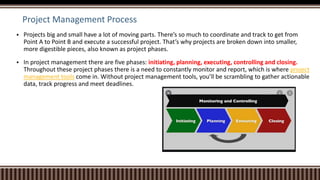
Project Management Process
 Projects big and small have a lot of moving parts. There’s so much to coordinate and track to get from
Point A to Point B and execute a successful project. That’s why projects are broken down into smaller,
more digestible pieces, also known as project phases.
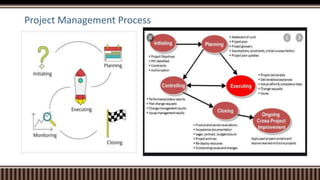
 In project management there are five phases: initiating, planning, executing, controlling and closing.
Throughout these project phases there is a need to constantly monitor and report, which is where project
management tools come in. Without project management tools, you’ll be scrambling to gather actionable
data, track progress and meet deadlines.
Project Management Process
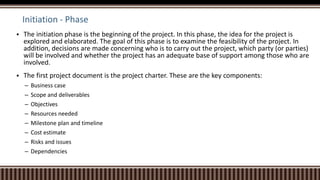
Initiation - Phase
 The initiation phase is the beginning of the project. In this phase, the idea for the project is
explored and elaborated. The goal of this phase is to examine the feasibility of the project. In
addition, decisions are made concerning who is to carry out the project, which party (or parties)
will be involved and whether the project has an adequate base of support among those who are
involved.
 The first project document is the project charter. These are the key components:
– Business case
– Scope and deliverables
– Objectives
– Resources needed
– Milestone plan and timeline
– Cost estimate
– Risks and issues
– Dependencies
Planning - Phase
 After initiating, the project is planned to an appropriate level of detail. The main purpose is to
plan time, cost and resources adequately to estimate the work needed and to manage risk
effectively during project execution.
 All of this information is recorded in the project management plan. As with the initiating process
group, a failure to plan adequately lessens the project's chance of success.
 Project planning includes the following:
– Developing the scope statement
– Developing the schedule (often a Gantt chart)
– Developing the budget
– Selecting the team
– Creating a work breakdown structure
– Identifying deliverables
– Planning for risk
– Establishing a communication plan
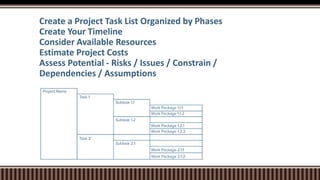
Create a Project Task List Organized by Phases
Create Your Timeline
Consider Available Resources
Estimate Project Costs
Assess Potential - Risks / Issues / Constrain /
Dependencies / Assumptions
Execution - Phase - Where All the Action Happens
 Executing consists of the processes used to complete the work defined in the project
management plan. It's about accomplishing the project's objectives. The executing
process involves co-ordinating people and resources, as well as integrating and
performing the project activities. The deliverables are produced as outputs from the
processes performed, as defined in the project management plan.
 The project execution phase is where deliverables are developed and completed, and
often feels like the meat of the project since a lot is happening during this time. This is
where all the work you’ve put into planning the project will be executed..
Monitoring & Controlling - Phase
 The monitoring process group involves managing and tracking the project. Potential
problems can be identified quickly for the team to take corrective action. The project
management plan is used for this purpose.
 Monitoring includes the following:
– Measuring ongoing project activities (where are we against where we should be?)
– Monitoring the project variables (cost, effort, scope) against the project management plan and the
project baseline (where should we be?)
– Identifying corrective actions to address risks and issues (how can we get back on track?)
– Managing changes using the change control process (what is the impact of this change?)
– The monitoring process group ends once the project has achieved its goals and objectives, as detailed
in the project contract. Monitoring also means that sometimes a project is stopped before completion.
This can happen for many reasons, including changes in the business, lack of resources or higher
priorities.
Closing- Phase
 Project closing is an important part of project management that's sometimes
overlooked. Closing a project means finishing all activities across all process groups,
disbanding the project team and signing off the project with the customer.
 At this point, it's important to know how well the project has performed. This task is
done using the project closure report. The report communicates how well the project
has performed against its original business case, quality measures, cost, duration and
tolerances.
 Rather than leave valuable project experiences locked in people's heads, it's a good idea
to complete and publish a lessons learned report. This report passes on valuable lessons
that future projects can apply.

Computer Science Graded Unit 2 - H48Y 35.pptx

  • 1.
    Computer Science: GradedUnit 2 H48Y 35 | Fazly Jabbar
  • 2.
    Computer Science: GradedUnit 2 Unit purpose  This Graded Unit is designed to provide evidence that the candidate has achieved the following principal aims of the HND Computer Science: – To develop an awareness of current professional practices and technologies within the domain of computer science. – To develop a range of specialist knowledge and skills that reflects recent, in-demand developments in applications developments, web and mobile programming and database developments. – Where applicable, to provide learners with a range of underpinning knowledge that is supported by a wide range of vendors. – To offer articulation routes to a range of university degree programmes by developing scholarly activities and an independent learning environment. – To offer flexibility with the themes of Units across a range of computer science related areas
  • 3.
    Recommended prior knowledgeand skills  On completion of the Unit the candidate should be able to: – It is recommended that the candidate should have completed or be in the process of completing the following Units relating to the above specific aims prior to undertaking this Graded Unit: – H173 34 Developing Software: Introduction – H1F7 34 Professionalism and Ethics in Computing – H175 34 Computer Systems Fundamentals – H177 34 Troubleshooting Computer Problems – H178 34 Team Working in Computing – H16W 35 Relational Database Management Systems – H1J9 35 Software Development: Developing Websites for Multiplatform Use – H16S 35 Managing a Web Server
  • 4.
    Writing the ProjectBrief (assignment task) :  Each candidate should undertake an individual project and it is envisaged that the candidate will carry out a project which encompasses all of the knowledge and skills required to complete a small scale project for an external client (such as the development of a commercially viable website or the development of a PC based management system). – Interpret the needs of the brief. – Gather information to clarify the brief. – Decide upon and develop a design approach. – Carry out development. – Evaluate the product and their performance.  The Unit will be project-based and allow the candidate the flexibility to select from a variety of different projects, eg the practical implementation of a software development project (mobile app/web site/game/stand-alone application), designing a network topology for a small to medium sized company, producing a report/feasibility study on the implementation of IT systems for an organisation or setting up a Service Desk.
  • 5.
    Guidance on gradingcandidates :  Grade A – Has sufficient evidence for all three stages of the project produced to a high standard, and is quite clearly inter-related. – Demonstrates an accurate and insightful interpretation of the project brief. – Is highly focused and relevant to the tasks associated with the project brief. – Is clear and well-structured throughout and the language used is of a uniformly high standard in terms of level, accuracy and technical content. – Effectively consolidates and integrates the required knowledge and skills. – Demonstrates the candidate’s ability to work autonomously with minimum support or revision.
  • 6.
    Guidance on gradingcandidates :  Grade C – Has sufficient evidence for all three stages of the project and is produced overall to an adequate standard. – Demonstrates an acceptable interpretation of the project brief. – Is focused and relevant to the tasks associated with the project brief. – Is satisfactorily structured and the language used is adequate in terms of level, accuracy and technical content. – Consolidates and integrates knowledge and skills but this may lack some continuity and consistency – Demonstrates the candidates’ ability to work with limited support and occasional revision    
  • 7.
    Guidance on gradingcandidates :  Assessors will assign an overall grade to the candidate for this Graded Unit based on the following grade boundaries. – A = 70%–100% – B = 60%–69% – C = 50%–59%  Any candidate who has failed their graded unit or wishes to upgrade their award must be given a re- assessment opportunity, or in exceptional circumstances, two re-assessment opportunities. In the case of project-based graded units, this must be done using a substantially different project.  The final grading given must reflect the quality of the candidate’s evidence at the time of the completion of the graded unit. Candidates must be awarded the highest grade achieved — whether through first submission or through any re-assessment, remediation, and/or reasonable assistance provided.  The candidate must achieve a minimum of: – 50% of total marks for the Planning stage – 50% of total marks for the Developing stage – 50% of total marks for the Evaluating stage
  • 8.
    Instructions for designingthe assessment task :  The Unit is project-based and allows the learner the flexibility to select from a variety of different projects which are relevant to the Computer Science curriculum, eg developing a website or implementing a web server or a database system  The assessment task should require the learner to: – Analyse the task and decide on a course of action for undertaking the project – Identify the requirements for the project – Plan the solution for the project – Organise work through to project completion – Develop the product to meet the solution – Track and document work undertaken through to project completion – Test the solution tracking any changes and making amendments where required – Reflect on what has been done and draw conclusions for the future – Critically evaluate the approach taken developing the project and draw conclusions the critical analysis should cover two areas 
  • 9.
    Instructions for designingthe assessment task :  1. Product produced — Reflect on the product that has been produced, critically evaluating the approach/strategy taken for all stages of activity.  2. Individual reflective analysis — A learner should provide an evaluation of their activities drawing conclusions to help future performance.
  • 10.
    Stage 1— Analysis& Planning (40%) Maximum  1.1 An analysis of the project assignment brief -— up to 30 marks – Which should include but not be restricted to the following:  1.1.1 Interpretation of the project assignment brief including any information gathered to clarify the brief  1.1.2 Aims of the project assignment  1.1.3 Requirements: eg functional/non-functional/constraints  1.1.4 Identification of the key factors influencing the project  1.1.5 Identification of resources, and materials required and how they will be accessed/obtained  1.1.6 Identification of information sources to be used  1.1.7 Undertaking the analysis using appropriate techniques  1.2 Project plan — up to 10 marks – Production of a detailed formal plan to undertake the project:  1.2.1 with realistic timescales and identifying:  1.2.2 timescales/schedules for each stage and overall completion  1.2.3 milestones and deliverables  1.2.4 main tasks  1.2.5 resources  – 
  • 11.
    1.1.5 Resources andmaterials – Here you should identify the resources required to carry out the project, eg sources of information, procedures to be followed, people, equipment and other physical resources. You should also specify how the required resources will be accessed/obtained.
  • 12.
    1.1.7 Analysis – Youshould undertake the analysis using appropriate techniques. The most important thing here is to ensure that you and your client have a common understanding of what you’re trying to achieve, ie what the client expects to receive is the same as what you intend to deliver.  Your analysis might make use of the following techniques:  research using both online and offline sources, eg vendor websites, product manuals  review of existing documentation  interviews with staff involved
  • 13.
    1.2 Project Plan You should produce a detailed formal plan to undertake the project.  This should have realistic timescales (2 marks) and should identify: – Timescales/schedules for each stage and overall completion (2 marks) – Milestones and deliverables (2 marks) – Main tasks (2 marks) – Resources (2 marks)  The project plan must include testing. Marks will be deducted for its omission.  If you are familiar with the use of Project Management software, you could use this
  • 14.
    Stage 2 —Developing (40%) Maximum  The assessor’s role is as a facilitator and so to gain high marks the candidate must demonstrate a high degree of autonomy in the developing activities.  Evidence of the candidate: – Implementing the planned solution to the task and tracking the implementation — up to 30 marks – Testing the implemented solution tracking any changes and making amendments where required — up to 8 marks – Managing the project — up to 2 marks.  The evidence may be recorded using appropriate techniques such as software, logbooks (electronic, manual or both), work diaries, reports, etc.      
  • 15.
    Stage 2 —Implementing the planned solution  Here you must provide evidence of implementing the planned solution to the task and tracking the implementation. This will involve the implementation of the plan created in stage 1, reviewing or adjusting the plan if required  The evidence may be recorded using appropriate techniques such as software, logbooks (electronic, manual or both), work diaries, reports, etc  This project involves setting up a responsive website which can operate successfully on a range of platforms, including smartphones and mobile devices.  The website must be database driven and allow for straightforward addition, deletion and editing of stock data to be carried out in-house.  Customers must be able to set up accounts, purchase goods and make payment online.  Server set-up and software installation must be carried out in-house.  Where possible existing packaged solutions should be used, rather than those calling for extensive development of bespoke code.
  • 16.
    Stage 2 —Implementing the planned solution  Evidence arising from this project should relate to material you have covered in earlier Units, especially H16W 35: Relational Database Management Systems, H1J9 35: Software Development: Developing Websites for Multiplatform Use and H16S 35: Managing a Web Server.  You should produce a report of around 25 pages documenting the underpinning processes: – identify and implement a suitable hardware and software platform (10 marks) – install and configure the software (6 marks) – set up a prototype which the company can extend later (14 marks)  This might consist of an introductory page, several pages on each topic and a final page. This should be fairly easy for you to produce, based on your teaching and lab notes for the relevant topics.
  • 17.
    Stage 2 —Developing  2.2 Testing the implemented solution – You should test the implemented solution, tracking any changes and making amendments where required. (8 marks)  2.3 Managing the project – You should manage the project in line with the Project Plan drawn up earlier. (2 marks)
  • 18.
    Stage 3 —Evaluating (20%) Maximum  The assessor’s role is as a facilitator and so to gain high marks the candidate must demonstrate a high degree of autonomy in the evaluating activities.  Evidence should be in the form of a report showing the evaluation of the effectiveness of the approach/strategy taken, which includes all stages of the activity up to 20 marks.  The evaluation report should include all of the following: – An outline of the assignment and to what extent the solution met the original requirements of the assignment brief – An assessment of the strengths and weaknesses of the outputs of the practical assignment – Recommendations for any future development of the solution and reasons for these recommendations – A summary of any modifications to the project plan, solution design and/or implementation, that were made during the project. Including reference to any unforeseen events and how they were handled. – Identification of any knowledge and skills which have been gained or developed while carrying out the project assignment and how the actions/process of carrying out the project could have been improved   
  • 19.
    Stage 3 —Evaluating  You are required to produce an evaluation report showing the effectiveness of the approach/strategy taken which includes all stages of the activity, ie analysis of the activity, the planning and organisation of the activity and the outcome of the activity.  The evaluation report should include the sections specified below. 3.1 Outline of the assignment – You should produce an outline of the assignment and to what extent the solution met the original requirements of the assignment brief as noted below. (4 marks) – You should give a statement regarding the extent to which each of these objectives has been achieved. If an objective has not been achieved, or has only been partially achieved, you should give an explanation.  3.2 Strengths and weaknesses – You should give an assessment of the strengths and weaknesses of the outputs of the practical assignment. (4 marks)  3.3 Recommendations – You should make recommendations for any future development of the solution and give your reasons for these recommendations. (4 marks)
  • 20.
    Stage 3 —Evaluating  3.4 Modifications – You should give a summary of any modifications to the project plan, solution design and/or implementation that were made during the project, including reference to any unforeseen events and how they were handled. (4 marks)  3.5 Knowledge and skills – You should identify any knowledge and skills which have been gained or developed while carrying out the project assignment and how the actions/process of carrying out the project could have been improved. (4 marks)
  • 21.
    Project E.g.  WebsiteDevelopment – Basic functionalities – Home Page – Login to the website – Register new User – Change Password – Forget Password – Product Category Page – Search basic – Advance Search - Multiple – Contact Page – Cart functionality – Admin functionality – DB Connectivity – Feedback options for the products
  • 22.
    Project E.g.  PC-BasedSystems– Basic functionalities – Library systems – Borrowing books – Retuning books – Register new students – Reserving books – Late payments – Reports – Edit Students records – DB Connectivity
  • 23.
    Project Management Process Projects big and small have a lot of moving parts. There’s so much to coordinate and track to get from Point A to Point B and execute a successful project. That’s why projects are broken down into smaller, more digestible pieces, also known as project phases.  In project management there are five phases: initiating, planning, executing, controlling and closing. Throughout these project phases there is a need to constantly monitor and report, which is where project management tools come in. Without project management tools, you’ll be scrambling to gather actionable data, track progress and meet deadlines.
  • 24.
  • 25.
    Initiation - Phase The initiation phase is the beginning of the project. In this phase, the idea for the project is explored and elaborated. The goal of this phase is to examine the feasibility of the project. In addition, decisions are made concerning who is to carry out the project, which party (or parties) will be involved and whether the project has an adequate base of support among those who are involved.  The first project document is the project charter. These are the key components: – Business case – Scope and deliverables – Objectives – Resources needed – Milestone plan and timeline – Cost estimate – Risks and issues – Dependencies
  • 26.
    Planning - Phase After initiating, the project is planned to an appropriate level of detail. The main purpose is to plan time, cost and resources adequately to estimate the work needed and to manage risk effectively during project execution.  All of this information is recorded in the project management plan. As with the initiating process group, a failure to plan adequately lessens the project's chance of success.  Project planning includes the following: – Developing the scope statement – Developing the schedule (often a Gantt chart) – Developing the budget – Selecting the team – Creating a work breakdown structure – Identifying deliverables – Planning for risk – Establishing a communication plan
  • 27.
    Create a ProjectTask List Organized by Phases Create Your Timeline Consider Available Resources Estimate Project Costs Assess Potential - Risks / Issues / Constrain / Dependencies / Assumptions
  • 28.
    Execution - Phase- Where All the Action Happens  Executing consists of the processes used to complete the work defined in the project management plan. It's about accomplishing the project's objectives. The executing process involves co-ordinating people and resources, as well as integrating and performing the project activities. The deliverables are produced as outputs from the processes performed, as defined in the project management plan.  The project execution phase is where deliverables are developed and completed, and often feels like the meat of the project since a lot is happening during this time. This is where all the work you’ve put into planning the project will be executed..
  • 29.
    Monitoring & Controlling- Phase  The monitoring process group involves managing and tracking the project. Potential problems can be identified quickly for the team to take corrective action. The project management plan is used for this purpose.  Monitoring includes the following: – Measuring ongoing project activities (where are we against where we should be?) – Monitoring the project variables (cost, effort, scope) against the project management plan and the project baseline (where should we be?) – Identifying corrective actions to address risks and issues (how can we get back on track?) – Managing changes using the change control process (what is the impact of this change?) – The monitoring process group ends once the project has achieved its goals and objectives, as detailed in the project contract. Monitoring also means that sometimes a project is stopped before completion. This can happen for many reasons, including changes in the business, lack of resources or higher priorities.
  • 30.
    Closing- Phase  Projectclosing is an important part of project management that's sometimes overlooked. Closing a project means finishing all activities across all process groups, disbanding the project team and signing off the project with the customer.  At this point, it's important to know how well the project has performed. This task is done using the project closure report. The report communicates how well the project has performed against its original business case, quality measures, cost, duration and tolerances.  Rather than leave valuable project experiences locked in people's heads, it's a good idea to complete and publish a lessons learned report. This report passes on valuable lessons that future projects can apply.