CONTEXTUALIZED INSTRUCTIONAL
MATERIALS ACROSS K TO 12
CURRICULA
School Learning Action Cell (SLAC) on Crafting of
LEONIDA D. GULAM
FEBRUARY 9, 2023
InitialsOfFunctionalDivision/InitialsOfWhoPrepared/ShortenedTitleOfActivity/InitialsOfDocument-Number/Date
TERMINAL OBJECTIVE
At the end of the session, the participants will be
able to develop contextualized instructional materials
across all learning areas
InitialsOfFunctionalDivision/InitialsOfWhoPrepared/ShortenedTitleOfActivity/InitialsOfDocument-Number/Date
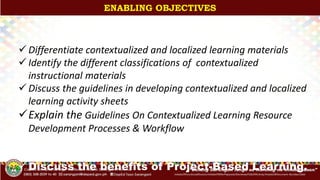
ENABLING OBJECTIVES
Differentiate contextualized and localized learning materials
 Identify the different classifications of contextualized
instructional materials
Discuss the guidelines in developing contextualized and localized
learning activity sheets
Explain the Guidelines On Contextualized Learning Resource
Development Processes & Workflow
 Discuss the benefits of Project-Based
 Discuss the benefits of Project-Based Learning.
GUIDELINES ON CONTEXTUALIZED LEARNING
RESOURCE DEVELOPMENT PROCESSES &
WORKFLOW
This guideline covers all submitted contextualized learning resources
as defined in the Framework for LRMDS v2.0 Series 2010 which
includes the following learning resource types:
• learner’s resource
• teaching resources
• professional development materials
The learning resources are classified as:
A. Text-based
Print materials:
Learning Activity Sheets (LAS)
Learner’s Material
Modules
Strategic Intervention Materials (SIMs)
Storybooks (Big and small books)
Reader
Workbook
Non-print materials:
Educational Audios
Interactive Learning Resources
Educational Videos Presentation Programs / Application Software (Apps)
Tactile Learning Resources
B. Non-text based/ Learning Tools and Equipment (LTE)
Mathematics Equipment
Science Equipment
TLE / TVL Equipment
Manipulatives
Artifacts
C. Any relevant learning resources
As defined in DepEd Order N. 32 S. 2015
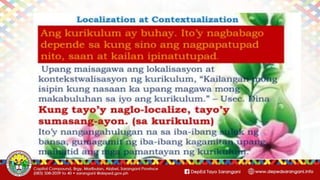
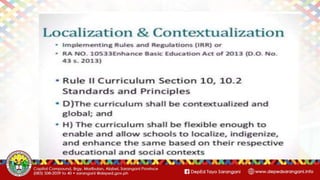
• Contextualization refers to the educational process of relating the
curriculum to a setting, situation or area of application to make the
competencies relevant, meaningful and useful to all learners.
• Indigenization refers to the processes of enhancing the curriculum,
competencies, education resources, and teaching learning process in
relation to the bio-geographical, historical and socio-cultural context of
the learner’s community.
• Localization refers to the process of relating learning content specified
in the curriculum to local information and materials in the learners’
community.
As defined in the LRMDS Framework v. 2, Series 2010 as stated
in DepED Order No. 76 S. 2011 Re: National Rollout and
Implementation of LRMDS
• Learning Resources (LR). Refers to any of the text-based materials
(print or non-print) or non-text—based materials (devices, tools,
equipment, manipulative toys) aligned to the K to 12 curriculum used
as primary bases or supplements to teaching and learning process.
• Learner’s Resource (LR) is any educational resource with a learning
purpose and must be aligned to the K to 12 Curriculum. This resource
is designed to be used directly by the student learners and or
integrated into teacher-developed lesson plans.
CLASSIFICATION OF LEARNING RESOURCES
A. Print-based Learning Resources:
• Activity Sheets (AS) are consumable learning resources with practice
exercises for learners to work on.
• Learner’s Materials (LM) is a prototype learning resource that is
completely and sufficiently developed based on the prescribed
learning competencies and curriculum standards for a specific grade
level in a target subject area.
• Modules are learning resources that provide course materials in a
logical, sequential order, guiding the learners through the content and
assessments in the order specified by the learning facilitators. It is
conceptualized as a self-contained, self-instructional, self paced,
interactive learning resource for learning a specific topic or lesson.
CLASSIFICATION OF LEARNING RESOURCES
A. Print-based Learning Resources:
• Strategic Intervention Materials (SIMs) are meant to re-teach the
concept(s) and skill(s) (Least Mastered Competencies). It is a material
given to the learners to help them master a competencybased skill
which they were not able develop during regular classroom teaching
(Bunagan, 2012).
• A Storybook is a contextualized teacher-made reading learning
resource that supports the implementation of the Mother Tongue
Based Multilingual Education (MTB-MLE) and the development of
literacy domains in the K to 12 Curriculum.
CLASSIFICATION OF LEARNING RESOURCES
A. Print-based Learning Resources:
• A Reader is a comprehensive but brief learning resource that provides
authoritative information on a specific topic representing the best
example of knowledge in a discipline and presentation of specific
ideas of authors with different perspectives. A reader is used by
learners to read, reflect, and respond. Teachers use readers to guide
discussions with consideration for ageappropriateness and time
allotment. It is most suitable for topics with general coverage and not
sequential or are stand-alone topics. Materials are already written
about the topics and are available.
• • A Workbook is a compilation of worksheets used by the learners to
practice what they are learning in a class.
CLASSIFICATION OF LEARNING RESOURCES
B. Non-text based/ Learning Tools and Equipment (LTE):
Learning Tools and Equipment are the constructed prototypical
tools or equipment patterned to an object which can be used in the
teaching-learning processes to help improve learning outcomes. These
are learning resources for science, math, and TVL i.e., manipulative,
models, devices, safety equipment and first aid kit, hand tools and
power tools, machines and another laboratory equipment.
• A Model is a reproduction of a real object in a small scale, large scale
or exact size but made of synthetic, indigenous and/or recycled
materials. It is a substitute for a real object which may or may not be
operational (adapted from Brown, et al 1969).
CLASSIFICATION OF LEARNING RESOURCES
B. Non-text based/ Learning Tools and Equipment (LTE):
• A Diorama is a three-dimensional representation of events, ideas or
concepts either in miniature or a large-scale by placing objects,
figures, etc., against a scenic background.
• Teaching Resource (TR) is any educational resource digital or
nondigital that supports teachers in curriculum development, delivery
and pedagogy or teacher trainers in the delivery of professional
development programs such as:
Daily Lesson Log
Daily Lesson Plan
Lesson Exemplar
Teacher’s Guide
CLASSIFICATION OF LEARNING RESOURCES
B. Non-text based/ Learning Tools and Equipment (LTE):
• A Teacher’s Guide (TG) is a prototype K to 12 teacher’s resource with
learning objectives, suggested teaching-learning strategies,
developmental activities, and evaluative measures that complement
with the contents of the accompanying Learner’s Material for a
specific grade level in a specific subject area.
CLASSIFICATION OF LEARNING RESOURCES
C. Professional Development Material (PDM) is any digital or non-
digital education training and development resource or program
designed with a training and development purpose. Such programs
may contain or reference LRs and TRs.
Manual contains step-by-step instructional procedures in the
development of a skill.
Professional Development Workbook
Professional Development Activities for Teachers
SDO GUIDELINES FOR
LEARNING ACTIVITY SHEETS
LAS?
The Learning Activity Sheet (LAS) is the main instructional
material of the DLP that promotes independent student learning. It
is a 1-page material that encapsulates specific learning targets in a
clear, simple, and concise manner to improve retention and mastery
of a topic that an average learner can accomplish even without prior
lecture. LAS is also a supplementary material that supports the
other learning modalities.
General Guidelines
LAS should be self explanatory that can be accomplished by an average student
without prior lecture.
There should be one (1) objective per LAS which is simple, specific, and
attainable.
For SLMs having 2 or more objectives, there should be at least 2 but not more
than 4 LAS per subject per week.
Concepts, questions, and tasks should always address the learning target.
LAS should be based from the SLM aligned with the MELC.
Each LAS should fit in 1 page only. Additional texts like stories, narratives, or
different types of literature may be added if it is needed for the activity. The
attachment should have a note to indicate that it will not be copied by hand but
to be read only.
General Guidelines
The Basic Information part will be in single space but the concept and activity
parts will be in 1.5 space.
Prescribed number of LAS per Grade level are:
- Kindergarten- maximum of 10 LAS per week
- Grades 1 to 6- maximum of 3 LAS per week per subject
- Grades 7 to 12 - maximum of 4 LAS per week per subject
- For MAPEH 1 to 12 - 1 LAS per component per week
Use colored illustrations and/or texts for Kindergarten to Grade 3. Black and
white illustrations (if necessary) and texts for Grade 4-12.
 Make use of age-appropriate language or vocabulary.
 Each LAS should have the following maximum number of items:
- Kinder to Grade Six: 5 items; and
- Grades Seven to Twelve: 10 items.
General Guidelines
 Use varied types of activities.
Use the following font sizes and styles:
- Kindergarten and Grade 3- font size 16 with Alfabeto font style
- Grade 4 to 6 - font size 14 with Arial font style
- Grade 7 to 12 - font size 12 with Arial font style:
Attributes of a legible typeface/font:
- Uniform letter proportions within the font
- Contrast within the font
- Clear symbol identification
- Good linkage of one letter to another when composed together
- Good printability
General Guidelines
Illustrations should …… (if necessary)
- be simple and easily recognizable.
- be clarified and support text.
- be properly labelled or captioned.
- be placed at the top or bottom of the page.
- be realistic with appropriate details such as color.
- be attractive and appealing.
CONTENT
There are 3 main parts of LAS:
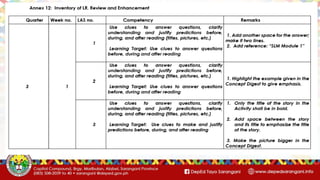
1. Basic Information includes name, grade and section, subject, name of
teacher, score, type of activity, activity title, learning target, and references
that learners should fill using some information provided by the teacher.
2. The Concept Digest includes bite-sized information to help explain the
learning target. An example or illustrations will be provided to further explain
the concept.
3. Activity is presented in different types (e.g. questions, exercises, problems,
varied activities) that address multiple intelligences among others to assess
learner's understanding of the lesson in a specific number of items across all
grade levels.
1. Basic Information includes name, grade and section, subject, name of
teacher, score, type of activity, activity title, learning target, and references
that learners should fill using some information provided by the teacher.
EXAMPLE 1:
1. Basic Information includes name, grade and section, subject, name of teacher, score, type of activity,
activity title, learning target, and references that learners should fill using some information provided
by the teacher.
EXAMPLE 2:
2. The Concept Digest includes bite-sized information to help explain the learning
target. An example or illustrations will be provided to further explain the concept.
EXAMPLE 1:
2. The Concept Digest includes bite-sized information to help explain the learning
target. An example or illustrations will be provided to further explain the concept.
EXAMPLE 2:
3. Activity is presented in different types (e.g. questions, exercises, problems, varied activities) that
address multiple intelligences among others to assess learner's understanding of the lesson in a specific
number of items across all grade levels.
EXAMPLE 1:
3. Activity is presented in different types (e.g. questions, exercises, problems, varied activities) that
address multiple intelligences among others to assess learner's understanding of the lesson in a specific
number of items across all grade levels.
EXAMPLE 2:
LEARNING ACTIVITIES
 Activities should be based with the existing Self Learning Modules (SLMs)
aligned with the Most Essential Learning Competencies.
 Activities are scaffolded (simple to complex) and logically-arranged.
 Activities are varied, creative, doable and realistic to meet the needs and
individual differences of learners.
 Activities are flexible - allowing learners to choose activities which suit their
physical and intellectual capacities, time and condition.
 Directions are clear, complete, and easy to follow and include
illustrations/diagrams whenever necessary.
 Adequate warning / cautionary notes are provided in topics and activities
where safety and health are of concern.
ASSESSMENT STRATEGIES
 Uses multiple formative assessment modes and approaches aligned with
learning goals to assess student learning.
 For activities/tests which would require learners to write answers, directions
should indicate that these will be written in separate sheets.
 Rubrics are provided for performance tests given.
CONTEXTUALIZATION-LAS-SDO-Guidelines.pptx

CONTEXTUALIZATION-LAS-SDO-Guidelines.pptx

  • 1.
    CONTEXTUALIZED INSTRUCTIONAL MATERIALS ACROSSK TO 12 CURRICULA School Learning Action Cell (SLAC) on Crafting of LEONIDA D. GULAM FEBRUARY 9, 2023
  • 2.
    InitialsOfFunctionalDivision/InitialsOfWhoPrepared/ShortenedTitleOfActivity/InitialsOfDocument-Number/Date TERMINAL OBJECTIVE At theend of the session, the participants will be able to develop contextualized instructional materials across all learning areas
  • 3.
    InitialsOfFunctionalDivision/InitialsOfWhoPrepared/ShortenedTitleOfActivity/InitialsOfDocument-Number/Date ENABLING OBJECTIVES Differentiate contextualizedand localized learning materials  Identify the different classifications of contextualized instructional materials Discuss the guidelines in developing contextualized and localized learning activity sheets Explain the Guidelines On Contextualized Learning Resource Development Processes & Workflow  Discuss the benefits of Project-Based  Discuss the benefits of Project-Based Learning.
  • 16.
    GUIDELINES ON CONTEXTUALIZEDLEARNING RESOURCE DEVELOPMENT PROCESSES & WORKFLOW This guideline covers all submitted contextualized learning resources as defined in the Framework for LRMDS v2.0 Series 2010 which includes the following learning resource types: • learner’s resource • teaching resources • professional development materials
  • 17.
    The learning resourcesare classified as: A. Text-based Print materials: Learning Activity Sheets (LAS) Learner’s Material Modules Strategic Intervention Materials (SIMs) Storybooks (Big and small books) Reader Workbook Non-print materials: Educational Audios Interactive Learning Resources Educational Videos Presentation Programs / Application Software (Apps) Tactile Learning Resources
  • 18.
    B. Non-text based/Learning Tools and Equipment (LTE) Mathematics Equipment Science Equipment TLE / TVL Equipment Manipulatives Artifacts C. Any relevant learning resources
  • 19.
    As defined inDepEd Order N. 32 S. 2015 • Contextualization refers to the educational process of relating the curriculum to a setting, situation or area of application to make the competencies relevant, meaningful and useful to all learners. • Indigenization refers to the processes of enhancing the curriculum, competencies, education resources, and teaching learning process in relation to the bio-geographical, historical and socio-cultural context of the learner’s community. • Localization refers to the process of relating learning content specified in the curriculum to local information and materials in the learners’ community.
  • 20.
    As defined inthe LRMDS Framework v. 2, Series 2010 as stated in DepED Order No. 76 S. 2011 Re: National Rollout and Implementation of LRMDS • Learning Resources (LR). Refers to any of the text-based materials (print or non-print) or non-text—based materials (devices, tools, equipment, manipulative toys) aligned to the K to 12 curriculum used as primary bases or supplements to teaching and learning process. • Learner’s Resource (LR) is any educational resource with a learning purpose and must be aligned to the K to 12 Curriculum. This resource is designed to be used directly by the student learners and or integrated into teacher-developed lesson plans.
  • 21.
    CLASSIFICATION OF LEARNINGRESOURCES A. Print-based Learning Resources: • Activity Sheets (AS) are consumable learning resources with practice exercises for learners to work on. • Learner’s Materials (LM) is a prototype learning resource that is completely and sufficiently developed based on the prescribed learning competencies and curriculum standards for a specific grade level in a target subject area. • Modules are learning resources that provide course materials in a logical, sequential order, guiding the learners through the content and assessments in the order specified by the learning facilitators. It is conceptualized as a self-contained, self-instructional, self paced, interactive learning resource for learning a specific topic or lesson.
  • 22.
    CLASSIFICATION OF LEARNINGRESOURCES A. Print-based Learning Resources: • Strategic Intervention Materials (SIMs) are meant to re-teach the concept(s) and skill(s) (Least Mastered Competencies). It is a material given to the learners to help them master a competencybased skill which they were not able develop during regular classroom teaching (Bunagan, 2012). • A Storybook is a contextualized teacher-made reading learning resource that supports the implementation of the Mother Tongue Based Multilingual Education (MTB-MLE) and the development of literacy domains in the K to 12 Curriculum.
  • 23.
    CLASSIFICATION OF LEARNINGRESOURCES A. Print-based Learning Resources: • A Reader is a comprehensive but brief learning resource that provides authoritative information on a specific topic representing the best example of knowledge in a discipline and presentation of specific ideas of authors with different perspectives. A reader is used by learners to read, reflect, and respond. Teachers use readers to guide discussions with consideration for ageappropriateness and time allotment. It is most suitable for topics with general coverage and not sequential or are stand-alone topics. Materials are already written about the topics and are available. • • A Workbook is a compilation of worksheets used by the learners to practice what they are learning in a class.
  • 24.
    CLASSIFICATION OF LEARNINGRESOURCES B. Non-text based/ Learning Tools and Equipment (LTE): Learning Tools and Equipment are the constructed prototypical tools or equipment patterned to an object which can be used in the teaching-learning processes to help improve learning outcomes. These are learning resources for science, math, and TVL i.e., manipulative, models, devices, safety equipment and first aid kit, hand tools and power tools, machines and another laboratory equipment. • A Model is a reproduction of a real object in a small scale, large scale or exact size but made of synthetic, indigenous and/or recycled materials. It is a substitute for a real object which may or may not be operational (adapted from Brown, et al 1969).
  • 25.
    CLASSIFICATION OF LEARNINGRESOURCES B. Non-text based/ Learning Tools and Equipment (LTE): • A Diorama is a three-dimensional representation of events, ideas or concepts either in miniature or a large-scale by placing objects, figures, etc., against a scenic background. • Teaching Resource (TR) is any educational resource digital or nondigital that supports teachers in curriculum development, delivery and pedagogy or teacher trainers in the delivery of professional development programs such as: Daily Lesson Log Daily Lesson Plan Lesson Exemplar Teacher’s Guide
  • 26.
    CLASSIFICATION OF LEARNINGRESOURCES B. Non-text based/ Learning Tools and Equipment (LTE): • A Teacher’s Guide (TG) is a prototype K to 12 teacher’s resource with learning objectives, suggested teaching-learning strategies, developmental activities, and evaluative measures that complement with the contents of the accompanying Learner’s Material for a specific grade level in a specific subject area.
  • 27.
    CLASSIFICATION OF LEARNINGRESOURCES C. Professional Development Material (PDM) is any digital or non- digital education training and development resource or program designed with a training and development purpose. Such programs may contain or reference LRs and TRs. Manual contains step-by-step instructional procedures in the development of a skill. Professional Development Workbook Professional Development Activities for Teachers
  • 28.
  • 29.
    LAS? The Learning ActivitySheet (LAS) is the main instructional material of the DLP that promotes independent student learning. It is a 1-page material that encapsulates specific learning targets in a clear, simple, and concise manner to improve retention and mastery of a topic that an average learner can accomplish even without prior lecture. LAS is also a supplementary material that supports the other learning modalities.
  • 30.
    General Guidelines LAS shouldbe self explanatory that can be accomplished by an average student without prior lecture. There should be one (1) objective per LAS which is simple, specific, and attainable. For SLMs having 2 or more objectives, there should be at least 2 but not more than 4 LAS per subject per week. Concepts, questions, and tasks should always address the learning target. LAS should be based from the SLM aligned with the MELC. Each LAS should fit in 1 page only. Additional texts like stories, narratives, or different types of literature may be added if it is needed for the activity. The attachment should have a note to indicate that it will not be copied by hand but to be read only.
  • 31.
    General Guidelines The BasicInformation part will be in single space but the concept and activity parts will be in 1.5 space. Prescribed number of LAS per Grade level are: - Kindergarten- maximum of 10 LAS per week - Grades 1 to 6- maximum of 3 LAS per week per subject - Grades 7 to 12 - maximum of 4 LAS per week per subject - For MAPEH 1 to 12 - 1 LAS per component per week Use colored illustrations and/or texts for Kindergarten to Grade 3. Black and white illustrations (if necessary) and texts for Grade 4-12.  Make use of age-appropriate language or vocabulary.  Each LAS should have the following maximum number of items: - Kinder to Grade Six: 5 items; and - Grades Seven to Twelve: 10 items.
  • 32.
    General Guidelines  Usevaried types of activities. Use the following font sizes and styles: - Kindergarten and Grade 3- font size 16 with Alfabeto font style - Grade 4 to 6 - font size 14 with Arial font style - Grade 7 to 12 - font size 12 with Arial font style: Attributes of a legible typeface/font: - Uniform letter proportions within the font - Contrast within the font - Clear symbol identification - Good linkage of one letter to another when composed together - Good printability
  • 33.
    General Guidelines Illustrations should…… (if necessary) - be simple and easily recognizable. - be clarified and support text. - be properly labelled or captioned. - be placed at the top or bottom of the page. - be realistic with appropriate details such as color. - be attractive and appealing.
  • 34.
    CONTENT There are 3main parts of LAS: 1. Basic Information includes name, grade and section, subject, name of teacher, score, type of activity, activity title, learning target, and references that learners should fill using some information provided by the teacher. 2. The Concept Digest includes bite-sized information to help explain the learning target. An example or illustrations will be provided to further explain the concept. 3. Activity is presented in different types (e.g. questions, exercises, problems, varied activities) that address multiple intelligences among others to assess learner's understanding of the lesson in a specific number of items across all grade levels.
  • 35.
    1. Basic Informationincludes name, grade and section, subject, name of teacher, score, type of activity, activity title, learning target, and references that learners should fill using some information provided by the teacher. EXAMPLE 1:
  • 36.
    1. Basic Informationincludes name, grade and section, subject, name of teacher, score, type of activity, activity title, learning target, and references that learners should fill using some information provided by the teacher. EXAMPLE 2:
  • 37.
    2. The ConceptDigest includes bite-sized information to help explain the learning target. An example or illustrations will be provided to further explain the concept. EXAMPLE 1:
  • 38.
    2. The ConceptDigest includes bite-sized information to help explain the learning target. An example or illustrations will be provided to further explain the concept. EXAMPLE 2:
  • 39.
    3. Activity ispresented in different types (e.g. questions, exercises, problems, varied activities) that address multiple intelligences among others to assess learner's understanding of the lesson in a specific number of items across all grade levels. EXAMPLE 1:
  • 40.
    3. Activity ispresented in different types (e.g. questions, exercises, problems, varied activities) that address multiple intelligences among others to assess learner's understanding of the lesson in a specific number of items across all grade levels. EXAMPLE 2:
  • 41.
    LEARNING ACTIVITIES  Activitiesshould be based with the existing Self Learning Modules (SLMs) aligned with the Most Essential Learning Competencies.  Activities are scaffolded (simple to complex) and logically-arranged.  Activities are varied, creative, doable and realistic to meet the needs and individual differences of learners.  Activities are flexible - allowing learners to choose activities which suit their physical and intellectual capacities, time and condition.  Directions are clear, complete, and easy to follow and include illustrations/diagrams whenever necessary.  Adequate warning / cautionary notes are provided in topics and activities where safety and health are of concern.
  • 42.
    ASSESSMENT STRATEGIES  Usesmultiple formative assessment modes and approaches aligned with learning goals to assess student learning.  For activities/tests which would require learners to write answers, directions should indicate that these will be written in separate sheets.  Rubrics are provided for performance tests given.