Context-Aware Games for
Education and Wellbeing
Teemu H. Laine
UbiLife lab, Dept. of Information and Computer Engineering
Ajou University
teemu@ubilife.net (www.ubilife.net)
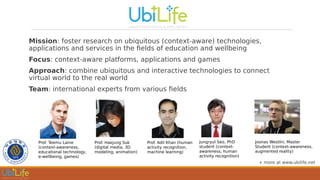
Mission: foster research on ubiquitous (context-aware) technologies,
applications and services in the fields of education and wellbeing
Focus: context-aware platforms, applications and games
Approach: combine ubiquitous and interactive technologies to connect
virtual world to the real world
Team: international experts from various fields
Prof. Teemu Laine
(context-awareness,
educational technology,
e-wellbeing, games)
Prof. Haejung Suk
(digital media, 3D
modeling, animation)
Prof. Adil Khan (human
activity recognition,
machine learning)
Jungryul Seo, PhD
student (context-
awareness, human
activity recognition)
+ more at www.ubilife.net
Joonas Westlin, Master
Student (context-awareness,
augmented reality)
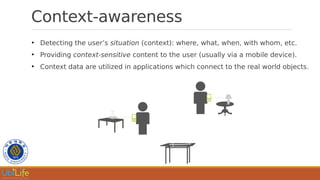
Context-awareness
●
Detecting the user’s situation (context): where, what, when, with whom, etc.
●
Providing context-sensitive content to the user (usually via a mobile device).
●
Context data are utilized in applications which connect to the real world objects.
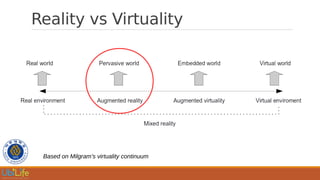
Reality vs Virtuality
Based on Milgram’s virtuality continuum
Why games?
●
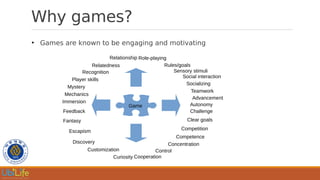
Games are known to be engaging and motivating
Game
Advancement
Autonomy
Challenge
Clear goals
Competition
Competence
Concentration
Control
CooperationCuriosity
Customization
Discovery
Escapism
Fantasy
Feedback
Immersion
Mechanics
Mystery
Player skills
Recognition
Relatedness
Relationship Role-playing
Rules/goals
Sensory stimuli
Social interaction
Socializing
Teamwork
Why games?
●
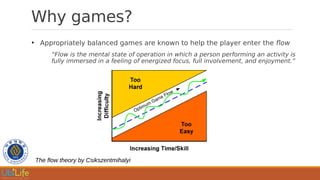
Appropriately balanced games are known to help the player enter the flow
“Flow is the mental state of operation in which a person performing an activity is
fully immersed in a feeling of energized focus, full involvement, and enjoyment.”
The flow theory by Csikszentmihalyi
Why exercise?
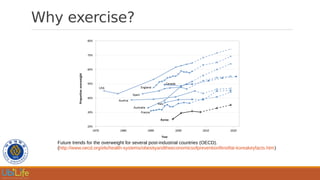
Future trends for the overweight for several post-industrial countries (OECD).
(http://www.oecd.org/els/health-systems/obesityandtheeconomicsofpreventionfitnotfat-koreakeyfacts.htm)
Why exercise?
* Children, Adolescents, and the Media. American Academy of Pediatrics, 2013.
** Zero to Eight – Children’s media use in America. Common Sense Media, 2013.
*** Obesity and overweight – Fact sheet no 311. World Health Organization, 2012.
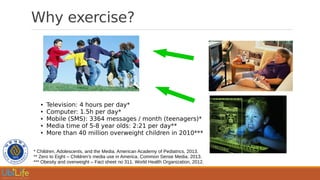
● Television: 4 hours per day*
● Computer: 1.5h per day*
● Mobile (SMS): 3364 messages / month (teenagers)*
● Media time of 5-8 year olds: 2:21 per day**
● More than 40 million overweight children in 2010***
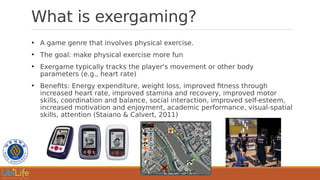
What is exergaming?
●
A game genre that involves physical exercise.
●
The goal: make physical exercise more fun
●
Exergame typically tracks the player's movement or other body
parameters (e.g., heart rate)
●
Benefits: Energy expenditure, weight loss, improved fitness through
increased heart rate, improved stamina and recovery, improved motor
skills, coordination and balance, social interaction, improved self-esteem,
increased motivation and enjoyment, academic performance, visual-spatial
skills, attention (Staiano & Calvert, 2011)
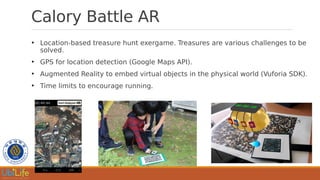
Calory Battle AR
●
Location-based treasure hunt exergame. Treasures are various challenges to be
solved.
●
GPS for location detection (Google Maps API).
●
Augmented Reality to embed virtual objects in the physical world (Vuforia SDK).
●
Time limits to encourage running.
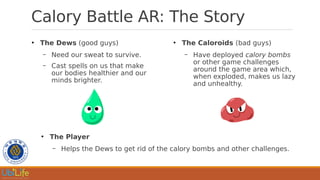
Calory Battle AR: The Story
●
The Dews (good guys)
– Need our sweat to survive.
– Cast spells on us that make
our bodies healthier and our
minds brighter.
●
The Caloroids (bad guys)
– Have deployed calory bombs
or other game challenges
around the game area which,
when exploded, makes us lazy
and unhealthy.
●
The Player
– Helps the Dews to get rid of the calory bombs and other challenges.
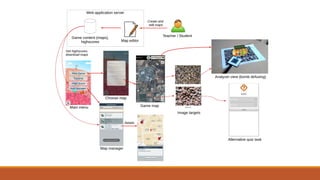
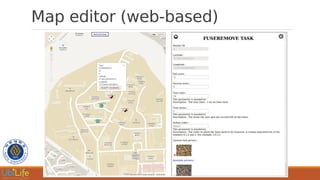
Map editor (web-based)
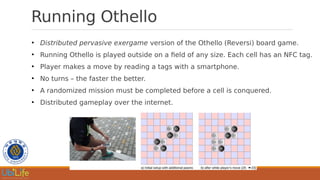
Running Othello
●
Distributed pervasive exergame version of the Othello (Reversi) board game.
●
Running Othello is played outside on a field of any size. Each cell has an NFC tag.
●
Player makes a move by reading a tags with a smartphone.
●
No turns – the faster the better.
●
A randomized mission must be completed before a cell is conquered.
●
Distributed gameplay over the internet.
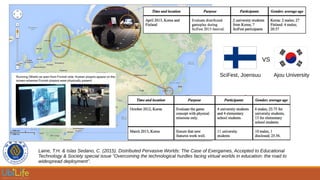
Laine, T.H. & Islas Sedano, C. (2015). Distributed Pervasive Worlds: The Case of Exergames, Accepted to Educational
Technology & Society special issue “Overcoming the technological hurdles facing virtual worlds in education: the road to
widespread deployment”.
VS
SciFest, Joensuu Ajou University
ScienceSpots AR
●
Children's interest in science has been declining* because of:
– Lack of relevance to the real world
– Lack of motivation
●
Context-awareness and augmented reality can solve the real world
relevance problem.
●
Games can solve the motivation problem.
●
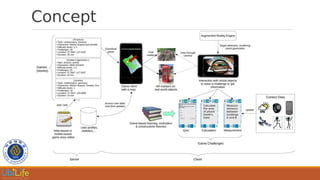
ScienceSpots AR: a platform for story-based context-aware games
for science learning.
*Osborne et al. “Attitudes towards science: A review of the literature and its implications,” Int. J. Sci.
Educ., vol. 25, no. 9, pp. 1049–1079, Sep. 2003.
*C. Porter and J. Parvin, “Learning to Love Science: Harnessing children’s scientific imagination,” 2008.
Concept
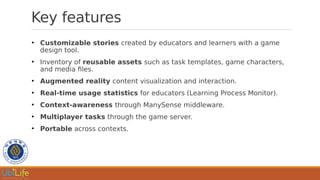
Key features
●
Customizable stories created by educators and learners with a game
design tool.
●
Inventory of reusable assets such as task templates, game characters,
and media files.
●
Augmented reality content visualization and interaction.
●
Real-time usage statistics for educators (Learning Process Monitor).
●
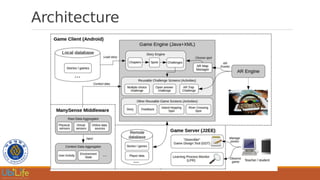
Context-awareness through ManySense middleware.
●
Multiplayer tasks through the game server.
●
Portable across contexts.
Architecture
Leometry
●
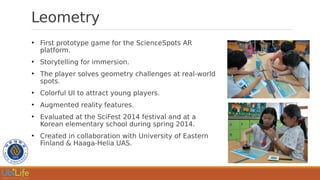
First prototype game for the ScienceSpots AR
platform.
●
Storytelling for immersion.
●
The player solves geometry challenges at real-world
spots.
●
Colorful UI to attract young players.
●
Augmented reality features.
●
Evaluated at the SciFest 2014 festival and at a
Korean elementary school during spring 2014.
●
Created in collaboration with University of Eastern
Finland & Haaga-Helia UAS.
Game content
●
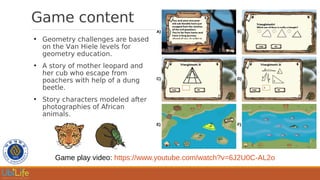
Geometry challenges are based
on the Van Hiele levels for
geometry education.
●
A story of mother leopard and
her cub who escape from
poachers with help of a dung
beetle.
●
Story characters modeled after
photographies of African
animals.
Game play video: https://www.youtube.com/watch?v=6J2U0C-AL2o
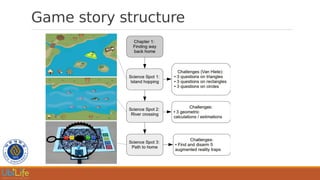
Game story structure
Augmented reality features
●
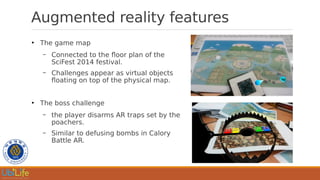
The game map
– Connected to the floor plan of the
SciFest 2014 festival.
– Challenges appear as virtual objects
floating on top of the physical map.
●
The boss challenge
– the player disarms AR traps set by the
poachers.
– Similar to defusing bombs in Calory
Battle AR.
Q&A
Thank you!
Feel free to contact later at any time: teemu@ubilife.net, www.ubilife.net
Videos
● Calory Battle AR: UI & Game play
https://www.youtube.com/watch?v=J6-fxiNpkwE
● Calory Battle AR: Test with Korean elementary school children
https://www.youtube.com/watch?v=j1N_C2GIrqc
● Calory Battle AR: Unity 3D version
https://www.youtube.com/watch?v=jNkDP2CRCHs
● Leometry: game play
https://www.youtube.com/watch?v=8f-0FUIo7Vc
● Running Othello: players
https://www.youtube.com/watch?v=HOFzHEFv_d4
Related articles
●
Calory Battle AR
– Laine, T.H. & Suk, H.J. (2015). Designing mobile augmented reality exergames, Accepted to Games & Culture.
– Westlin, J. and Laine, T.H. (2014). Short paper: Calory Battle AR: An Extensible Mobile Augmented Reality
Exergame Platform. Proceedings of the IEEE World Forum on Internet of Things, Seoul, Korea.
– Kim, S.L., Laine, T.H. Suk. H.J., Westlin, J., Kang, J.H. and Jung, J.M. (2014). Using Unity 3D to Facilitate Mobile
Augmented Reality Game Development. Proceedings of the IEEE World Forum on Internet of Things, Seoul,
Korea.
●
Running Othello
– Laine, T.H. & Islas Sedano, C. (2015). Distributed Pervasive Worlds: The Case of Exergames, Accepted to
Educational Technology & Society.
●
Leometry / ScienceSpots AR
– Article submitted to IEEE Transactions on Learning Technologies
More publications: http://www.ubilife.net/?page_id=108

Context-Aware Games for Education and Wellbeing

  • 1.
    Context-Aware Games for Educationand Wellbeing Teemu H. Laine UbiLife lab, Dept. of Information and Computer Engineering Ajou University teemu@ubilife.net (www.ubilife.net)
  • 2.
    Mission: foster researchon ubiquitous (context-aware) technologies, applications and services in the fields of education and wellbeing Focus: context-aware platforms, applications and games Approach: combine ubiquitous and interactive technologies to connect virtual world to the real world Team: international experts from various fields Prof. Teemu Laine (context-awareness, educational technology, e-wellbeing, games) Prof. Haejung Suk (digital media, 3D modeling, animation) Prof. Adil Khan (human activity recognition, machine learning) Jungryul Seo, PhD student (context- awareness, human activity recognition) + more at www.ubilife.net Joonas Westlin, Master Student (context-awareness, augmented reality)
  • 3.
    Context-awareness ● Detecting the user’ssituation (context): where, what, when, with whom, etc. ● Providing context-sensitive content to the user (usually via a mobile device). ● Context data are utilized in applications which connect to the real world objects.
  • 4.
    Reality vs Virtuality Basedon Milgram’s virtuality continuum
  • 5.
    Why games? ● Games areknown to be engaging and motivating Game Advancement Autonomy Challenge Clear goals Competition Competence Concentration Control CooperationCuriosity Customization Discovery Escapism Fantasy Feedback Immersion Mechanics Mystery Player skills Recognition Relatedness Relationship Role-playing Rules/goals Sensory stimuli Social interaction Socializing Teamwork
  • 6.
    Why games? ● Appropriately balancedgames are known to help the player enter the flow “Flow is the mental state of operation in which a person performing an activity is fully immersed in a feeling of energized focus, full involvement, and enjoyment.” The flow theory by Csikszentmihalyi
  • 7.
    Why exercise? Future trendsfor the overweight for several post-industrial countries (OECD). (http://www.oecd.org/els/health-systems/obesityandtheeconomicsofpreventionfitnotfat-koreakeyfacts.htm)
  • 8.
    Why exercise? * Children,Adolescents, and the Media. American Academy of Pediatrics, 2013. ** Zero to Eight – Children’s media use in America. Common Sense Media, 2013. *** Obesity and overweight – Fact sheet no 311. World Health Organization, 2012. ● Television: 4 hours per day* ● Computer: 1.5h per day* ● Mobile (SMS): 3364 messages / month (teenagers)* ● Media time of 5-8 year olds: 2:21 per day** ● More than 40 million overweight children in 2010***
  • 9.
    What is exergaming? ● Agame genre that involves physical exercise. ● The goal: make physical exercise more fun ● Exergame typically tracks the player's movement or other body parameters (e.g., heart rate) ● Benefits: Energy expenditure, weight loss, improved fitness through increased heart rate, improved stamina and recovery, improved motor skills, coordination and balance, social interaction, improved self-esteem, increased motivation and enjoyment, academic performance, visual-spatial skills, attention (Staiano & Calvert, 2011)
  • 10.
    Calory Battle AR ● Location-basedtreasure hunt exergame. Treasures are various challenges to be solved. ● GPS for location detection (Google Maps API). ● Augmented Reality to embed virtual objects in the physical world (Vuforia SDK). ● Time limits to encourage running.
  • 11.
    Calory Battle AR:The Story ● The Dews (good guys) – Need our sweat to survive. – Cast spells on us that make our bodies healthier and our minds brighter. ● The Caloroids (bad guys) – Have deployed calory bombs or other game challenges around the game area which, when exploded, makes us lazy and unhealthy. ● The Player – Helps the Dews to get rid of the calory bombs and other challenges.
  • 13.
  • 14.
    Running Othello ● Distributed pervasiveexergame version of the Othello (Reversi) board game. ● Running Othello is played outside on a field of any size. Each cell has an NFC tag. ● Player makes a move by reading a tags with a smartphone. ● No turns – the faster the better. ● A randomized mission must be completed before a cell is conquered. ● Distributed gameplay over the internet.
  • 16.
    Laine, T.H. &Islas Sedano, C. (2015). Distributed Pervasive Worlds: The Case of Exergames, Accepted to Educational Technology & Society special issue “Overcoming the technological hurdles facing virtual worlds in education: the road to widespread deployment”. VS SciFest, Joensuu Ajou University
  • 17.
    ScienceSpots AR ● Children's interestin science has been declining* because of: – Lack of relevance to the real world – Lack of motivation ● Context-awareness and augmented reality can solve the real world relevance problem. ● Games can solve the motivation problem. ● ScienceSpots AR: a platform for story-based context-aware games for science learning. *Osborne et al. “Attitudes towards science: A review of the literature and its implications,” Int. J. Sci. Educ., vol. 25, no. 9, pp. 1049–1079, Sep. 2003. *C. Porter and J. Parvin, “Learning to Love Science: Harnessing children’s scientific imagination,” 2008.
  • 18.
  • 19.
    Key features ● Customizable storiescreated by educators and learners with a game design tool. ● Inventory of reusable assets such as task templates, game characters, and media files. ● Augmented reality content visualization and interaction. ● Real-time usage statistics for educators (Learning Process Monitor). ● Context-awareness through ManySense middleware. ● Multiplayer tasks through the game server. ● Portable across contexts.
  • 20.
  • 21.
    Leometry ● First prototype gamefor the ScienceSpots AR platform. ● Storytelling for immersion. ● The player solves geometry challenges at real-world spots. ● Colorful UI to attract young players. ● Augmented reality features. ● Evaluated at the SciFest 2014 festival and at a Korean elementary school during spring 2014. ● Created in collaboration with University of Eastern Finland & Haaga-Helia UAS.
  • 22.
    Game content ● Geometry challengesare based on the Van Hiele levels for geometry education. ● A story of mother leopard and her cub who escape from poachers with help of a dung beetle. ● Story characters modeled after photographies of African animals. Game play video: https://www.youtube.com/watch?v=6J2U0C-AL2o
  • 23.
  • 24.
    Augmented reality features ● Thegame map – Connected to the floor plan of the SciFest 2014 festival. – Challenges appear as virtual objects floating on top of the physical map. ● The boss challenge – the player disarms AR traps set by the poachers. – Similar to defusing bombs in Calory Battle AR.
  • 25.
    Q&A Thank you! Feel freeto contact later at any time: teemu@ubilife.net, www.ubilife.net
  • 26.
    Videos ● Calory BattleAR: UI & Game play https://www.youtube.com/watch?v=J6-fxiNpkwE ● Calory Battle AR: Test with Korean elementary school children https://www.youtube.com/watch?v=j1N_C2GIrqc ● Calory Battle AR: Unity 3D version https://www.youtube.com/watch?v=jNkDP2CRCHs ● Leometry: game play https://www.youtube.com/watch?v=8f-0FUIo7Vc ● Running Othello: players https://www.youtube.com/watch?v=HOFzHEFv_d4
  • 27.
    Related articles ● Calory BattleAR – Laine, T.H. & Suk, H.J. (2015). Designing mobile augmented reality exergames, Accepted to Games & Culture. – Westlin, J. and Laine, T.H. (2014). Short paper: Calory Battle AR: An Extensible Mobile Augmented Reality Exergame Platform. Proceedings of the IEEE World Forum on Internet of Things, Seoul, Korea. – Kim, S.L., Laine, T.H. Suk. H.J., Westlin, J., Kang, J.H. and Jung, J.M. (2014). Using Unity 3D to Facilitate Mobile Augmented Reality Game Development. Proceedings of the IEEE World Forum on Internet of Things, Seoul, Korea. ● Running Othello – Laine, T.H. & Islas Sedano, C. (2015). Distributed Pervasive Worlds: The Case of Exergames, Accepted to Educational Technology & Society. ● Leometry / ScienceSpots AR – Article submitted to IEEE Transactions on Learning Technologies More publications: http://www.ubilife.net/?page_id=108