OBJECTIVES
Understand and Differentiate Between Content Validity and Construct
Validity:
•By the end of this lesson, will be able to define content validity and
construct validity, explain the differences between the two, and
understand their significance in qualitative research.
Apply Validity Concepts in Qualitative Research:
•By the end of this lesson, will be able to assess the content validity and
construct validity of qualitative research studies, and develop strategies to
enhance the validity of their own qualitative research designs.
When conducting qualitative research,
researchers must ensure that their data is
valid and reliable. This is crucial in order to
draw accurate conclusions and make
meaningful insights. In this article, we will
discuss two types of validity that are essential
for qualitative research: content validity and
construct validity.
Quanlitative Research
Content validity refers to the extent to which a measurement instrument, such as a
survey or interview guide, covers all aspects of a particular concept or topic. In
other words, it assesses whether the data collected is relevant and comprehensive
enough to represent the entire scope of the research question. Content validity is
important because it ensures that the data collected is relevant and representative
of the research topic. (Wieringa, 2022)
What is Content Validity?
The Importance of Content Validity in Qualitative
Research
Validation
Construct validity refers to the extent to which a research study measures what it intends to measure. It assesses
whether the data collected truly reflects the theoretical constructs and concepts being studied. In other words, it
ensures that the measurements used in the study accurately represent the underlying theoretical framework.
What is Construct Validity?
Measurability of Variables
Write the Operational Definition
Example
 Conceptual: Socio-economic status is a person’s economic
standing based on lifestyle, prestige, power, and control of
resources (Liu, Ali, Soleck, Hopps, Dunston, Pickett, 2004).
 Operational: In this study, socio-economic status was defined as
participants’ self-report of their average monthly.
Measurability of Variables
Example
 Conceptual: Intrinsic motivation is defined as the
motivation for a behavior that is based on the inherent
enjoyment in the behavior itself (Ryan and Deci, 2002).
 Operational: In this study, intrinsic motivation was
measured by responses to seven items of a 5-point
Likert-scale on a self-report questionnaire.
2. Validity
Definition: The extent to which a measurement instrument measures
what it is intended to measure.
Types:
• Content Validity: Ensures the instrument covers the entire domain of the
concept.
• Construct Validity: Ensures the instrument measures the theoretical construct it
is intended to measure.
• Criterion Validity: Compares the instrument to an external criterion (concurrent
or predictive validity).
Measurability of Variables
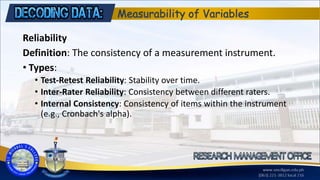
Reliability
Definition: The consistency of a measurement instrument.
• Types:
• Test-Retest Reliability: Stability over time.
• Inter-Rater Reliability: Consistency between different raters.
• Internal Consistency: Consistency of items within the instrument
(e.g., Cronbach's alpha).
Measurability of Variables
Examples of Measurability in Research
• Psychology: Measuring stress levels using a standardized
questionnaire.
• Economics: Measuring GDP growth rates.
• Health Sciences: Measuring blood pressure using a
sphygmomanometer.
Measurability of Variables
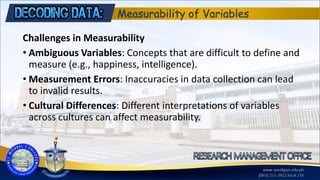
Challenges in Measurability
• Ambiguous Variables: Concepts that are difficult to define and
measure (e.g., happiness, intelligence).
• Measurement Errors: Inaccuracies in data collection can lead
to invalid results.
• Cultural Differences: Different interpretations of variables
across cultures can affect measurability.
Measurability of Variables
Sample Study
Influence of Social Media Trends on Students'
Psychological Behavior
Measurability of Variables
https://www.facebook.com/smcresearchoffice
A Guide to Appropriate Statistical
Selection

Content Validity and Construct Validiry in Qualitative.pptx

  • 2.
    OBJECTIVES Understand and DifferentiateBetween Content Validity and Construct Validity: •By the end of this lesson, will be able to define content validity and construct validity, explain the differences between the two, and understand their significance in qualitative research. Apply Validity Concepts in Qualitative Research: •By the end of this lesson, will be able to assess the content validity and construct validity of qualitative research studies, and develop strategies to enhance the validity of their own qualitative research designs.
  • 3.
    When conducting qualitativeresearch, researchers must ensure that their data is valid and reliable. This is crucial in order to draw accurate conclusions and make meaningful insights. In this article, we will discuss two types of validity that are essential for qualitative research: content validity and construct validity. Quanlitative Research
  • 4.
    Content validity refersto the extent to which a measurement instrument, such as a survey or interview guide, covers all aspects of a particular concept or topic. In other words, it assesses whether the data collected is relevant and comprehensive enough to represent the entire scope of the research question. Content validity is important because it ensures that the data collected is relevant and representative of the research topic. (Wieringa, 2022) What is Content Validity?
  • 5.
    The Importance ofContent Validity in Qualitative Research Validation
  • 6.
    Construct validity refersto the extent to which a research study measures what it intends to measure. It assesses whether the data collected truly reflects the theoretical constructs and concepts being studied. In other words, it ensures that the measurements used in the study accurately represent the underlying theoretical framework. What is Construct Validity?
  • 7.
    Measurability of Variables Writethe Operational Definition Example  Conceptual: Socio-economic status is a person’s economic standing based on lifestyle, prestige, power, and control of resources (Liu, Ali, Soleck, Hopps, Dunston, Pickett, 2004).  Operational: In this study, socio-economic status was defined as participants’ self-report of their average monthly.
  • 8.
    Measurability of Variables Example Conceptual: Intrinsic motivation is defined as the motivation for a behavior that is based on the inherent enjoyment in the behavior itself (Ryan and Deci, 2002).  Operational: In this study, intrinsic motivation was measured by responses to seven items of a 5-point Likert-scale on a self-report questionnaire.
  • 9.
    2. Validity Definition: Theextent to which a measurement instrument measures what it is intended to measure. Types: • Content Validity: Ensures the instrument covers the entire domain of the concept. • Construct Validity: Ensures the instrument measures the theoretical construct it is intended to measure. • Criterion Validity: Compares the instrument to an external criterion (concurrent or predictive validity). Measurability of Variables
  • 10.
    Reliability Definition: The consistencyof a measurement instrument. • Types: • Test-Retest Reliability: Stability over time. • Inter-Rater Reliability: Consistency between different raters. • Internal Consistency: Consistency of items within the instrument (e.g., Cronbach's alpha). Measurability of Variables
  • 11.
    Examples of Measurabilityin Research • Psychology: Measuring stress levels using a standardized questionnaire. • Economics: Measuring GDP growth rates. • Health Sciences: Measuring blood pressure using a sphygmomanometer. Measurability of Variables
  • 12.
    Challenges in Measurability •Ambiguous Variables: Concepts that are difficult to define and measure (e.g., happiness, intelligence). • Measurement Errors: Inaccuracies in data collection can lead to invalid results. • Cultural Differences: Different interpretations of variables across cultures can affect measurability. Measurability of Variables
  • 13.
    Sample Study Influence ofSocial Media Trends on Students' Psychological Behavior Measurability of Variables
  • 14.

Editor's Notes

  • #4 Understanding the differences between these two types of validity is crucial for researchers and research teams to ensure the quality of their data and the validity of their findings.
  • #5 For example, let’s say a researcher is conducting a study on the effectiveness of a new employee training program. The researcher develops a survey to gather feedback from employees who have completed the training. In order to ensure content validity, the researcher must make sure that the survey questions cover all aspects of the training program, such as the content, delivery methods, and overall satisfaction. This will ensure that the data collected is relevant and comprehensive enough to draw accurate conclusions about the effectiveness of the training program.