Designing Transcendental & Hermeneutic
Phenomenological Study
Jay Fie Luzano,Ph.D
Adopted by : Stephanie L. Colorada
Objectives
• To differentiate between hermeneutics and
transcendental phenomenology and to identify their
research designs, both hermeneutics and
transcendental phenomenology need to be examined.
Definition
Phenomenology
 “Knowledge as it appears to consciousness, the
science of describing what one perceives, senses,
and knows in one’s immediate awareness and
experience” (Hegel, as cited in Moustakas, 1994, p. 26).
 “A study of people’s conscious experience of their
life-world” (Merriam, 2009, p. 25).
Central Question/
Purpose
Central question: What is it like? The goal is to
understand what it is like to be human.
“I understand better what it is like for someone to
experience that” (Polkinghorne, 1989, p. 46).
Conscious or Lived Experience
Conscious experiences have a unique
feature: we experience them, we live
through them or perform them
(Standford Encyclopedia of Philosophy, n.d., para.
14)
Origins
 Rooted in philosophy and psychology
 Edmund Husserl – mathematician and astronomer
who embraced philosophy to understand human
beings.
 Also Ponty
 Moustakas – transcendental phenomenology
 Van Manen – hermeneutic phenomenology
TRANSCENDENTAL
PHENOMENOLOGY
Definitions –
Transcendental Phenomenology
 It “is a scientific study of the appearance of things, of
phenomena just as we see them and as they appear to us in
consciousness” (Moustakas, 1994, p. 49).
 It “studies conscious experience as experienced from the
subjective or first person point of view” (Standford Encyclopedia of
Philosophy, n.d., para. 4).
 It aims to provide descriptions of an experience, as it is
experienced freshly and purely (Brinkmann, 2018; Moustakas, 1994).
Distinctive Features
1. An emphasis on the phenomenon to be explored.
2. Exploration of this phenomenon with a group of individuals who
have all experienced the phenomenon (3-4 to 10-15).
3. A philosophical discussion.
4. Bracketing (the researcher discusses his or her experiences with the
phenomenon and partly sets them aside so that he or she can
focus on the experiences of the participants.)
5. Data collection – phenomenological interview, poems, observation,
documents
6. Data analysis – textural description, structural description
7. Essence or conclusion
Bracketing
The challenge of the Epoche is to be
transparent to ourselves, to allow whatever
is before us in consciousness to disclose
itself so that we may see with new eyes in a
naïve and completely open manner. . . . All
prior positions are put aside (Husserl, as cited
in Moustakas, 1994, p. 86).
Central Research Questions
1. What have the participants experienced in terms of the
phenomenon. (what of the experience)
2. What contexts or situations have typically influenced
the experiences of the participants in terms of the
phenomenon. (how of the experience)
For example:
1. What are the lived experiences of teen mothers?
2. What are the contexts of the lived experiences of teen
mothers?
Sample RQs
Title: The Lived Experiences of Filipino Women with
Breast Cancer
1. What was life like for Filipino women before the
onset of breast cancer?
2. What is the lifeworld of Filipino women who were
diagnosed with breast cancer?
3. How do Filipino women diagnosed with breast
cancer view life in the future?
Data Sources
Phenomenological interview (Siedman, 1998, pp. 11-
15)
First phase – Focus on past experience with the
phenomenon of interest. Participants to reconstruct
their early experiences.
Second phase – Focus on the details of the experience.
The purpose is to concentrate on the concrete details
of the participants’ experience with the phenomenon.
Third phase – Description of the future
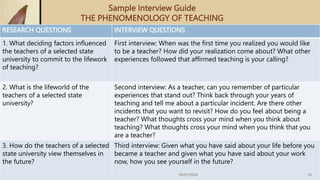
Sample Interview Guide
THE PHENOMENOLOGY OF TEACHING
RESEARCH QUESTIONS INTERVIEW QUESTIONS
1. What deciding factors influenced
the teachers of a selected state
university to commit to the lifework
of teaching?
First interview: When was the first time you realized you would like
to be a teacher? How did your realization come about? What other
experiences followed that affirmed teaching is your calling?
2. What is the lifeworld of the
teachers of a selected state
university?
Second interview: As a teacher, can you remember of particular
experiences that stand out? Think back through your years of
teaching and tell me about a particular incident. Are there other
incidents that you want to revisit? How do you feel about being a
teacher? What thoughts cross your mind when you think about
teaching? What thoughts cross your mind when you think that you
are a teacher?
3. How do the teachers of a selected
state university view themselves in
the future?
Third interview: Given what you have said about your life before you
became a teacher and given what you have said about your work
now, how you see yourself in the future?
09/07/2024 14
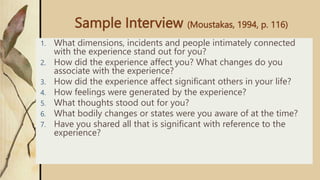
Sample Interview (Moustakas, 1994, p. 116)
1. What dimensions, incidents and people intimately connected
with the experience stand out for you?
2. How did the experience affect you? What changes do you
associate with the experience?
3. How did the experience affect significant others in your life?
4. How feelings were generated by the experience?
5. What thoughts stood out for you?
6. What bodily changes or states were you aware of at the time?
7. Have you shared all that is significant with reference to the
experience?
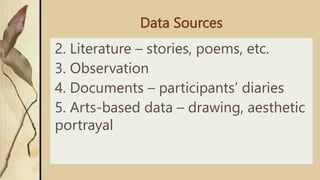
Data Sources
2. Literature – stories, poems, etc.
3. Observation
4. Documents – participants’ diaries
5. Arts-based data – drawing, aesthetic
portrayal
Sampling Strategies
1. Purposive or purposeful sampling
2. Snowball sampling
Data Analysis
(Moustakas, 1994)
1. Horizonalization – Extracting significant
statements, putting them parallel to each
other, removing overlaps and repetitions
2. Clustering the horizons into themes
Data Analysis
3. Writing the textural description – This is the “what”
of the experience; the textural qualities—rough and
smooth, small and large, quiet and loud, colorful and
bland, etc.; descriptions that present varying
intensities, ranges of shapes, sizes, and spatial
qualities, time references, and colors all within an
experiential context (p. 91).
Data Analysis
4. Writing the structural description – The context or
setting that influenced how the participants
experienced the phenomenon. How the experience of
the phenomenon come to be? What are the
conditions that must exist for something to appear?
Imagine possible structures of time, space, materiality,
causality, and relationships to self and to others. (p.
99)
Data Analysis
5. Finding the essence – A descriptive
passage (a paragraph or two) focusing on
the common experiences of the
participants, a blend of the textural and the
structural descriptions.
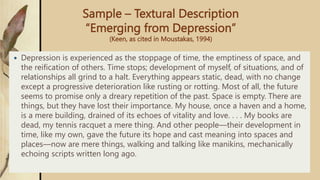
Sample – Textural Description
“Emerging from Depression”
(Keen, as cited in Moustakas, 1994)
 Depression is experienced as the stoppage of time, the emptiness of space, and
the reification of others. Time stops; development of myself, of situations, and of
relationships all grind to a halt. Everything appears static, dead, with no change
except a progressive deterioration like rusting or rotting. Most of all, the future
seems to promise only a dreary repetition of the past. Space is empty. There are
things, but they have lost their importance. My house, once a haven and a home,
is a mere building, drained of its echoes of vitality and love. . . . My books are
dead, my tennis racquet a mere thing. And other people—their development in
time, like my own, gave the future its hope and cast meaning into spaces and
places—now are mere things, walking and talking like manikins, mechanically
echoing scripts written long ago.
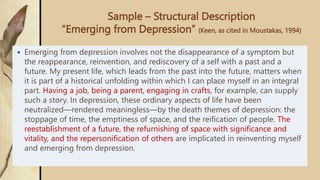
Sample – Structural Description
“Emerging from Depression” (Keen, as cited in Moustakas, 1994)
 Emerging from depression involves not the disappearance of a symptom but
the reappearance, reinvention, and rediscovery of a self with a past and a
future. My present life, which leads from the past into the future, matters when
it is part of a historical unfolding within which I can place myself in an integral
part. Having a job, being a parent, engaging in crafts, for example, can supply
such a story. In depression, these ordinary aspects of life have been
neutralized—rendered meaningless—by the death themes of depression: the
stoppage of time, the emptiness of space, and the reification of people. The
reestablishment of a future, the refurnishing of space with significance and
vitality, and the repersonification of others are implicated in reinventing myself
and emerging from depression.
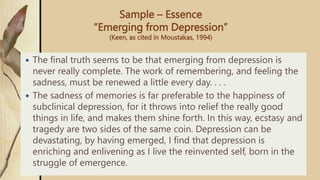
Sample – Essence
“Emerging from Depression”
(Keen, as cited in Moustakas, 1994)
 The final truth seems to be that emerging from depression is
never really complete. The work of remembering, and feeling the
sadness, must be renewed a little every day. . . .
 The sadness of memories is far preferable to the happiness of
subclinical depression, for it throws into relief the really good
things in life, and makes them shine forth. In this way, ecstasy and
tragedy are two sides of the same coin. Depression can be
devastating, by having emerged, I find that depression is
enriching and enlivening as I live the reinvented self, born in the
struggle of emergence.
HERMENEUTIC
PHENOMENOLOGY
Definition
Hermeneutic phenomenology focuses
on the description and interpretation
of participants’ experiences (Kafle, 2011).
Hermeneutical Research Activities
1. Turning to the nature of lived experience – “Commitment of turning to
an abiding concern,”. . . “of thinking a single thought more deeply,” . . .
“a deep questioning of something” . . . “in the context of particular
individual, social, and historical life circumstances” (p. 31).
2. Investigating the experience as lived – “The researcher actively
explores the category of lived experience in all its modalities and
aspects” (p. 32).
3. Reflecting on essential themes – “Reflective[ly] grasping what it is that
renders this or that particular experience its special significance” . . .
“bringing into nearness that which tends to be obscure, that which
tends to evade the intelligibility of our natural attitude of everyday life.
(p. 32).
Hermeneutical Research Activities
4. Describing the phenomenon through writing and rewriting – “To do research in a
phenomenological sense is already and immediately and always a bringing to
speech of something. And this thoughtfully bringing to speech is most commonly a
writing activity” (p. 32).
5. Maintaining and strong and oriented relations – “To be oriented to an object
means that we are animated by the object in a full and human sense. To be strong in
our orientation means that we will not settle for superficialities and falsities” (p. 33).
6. Balancing the research context by considering the parts and whole – The
researcher considers how the study is grounded and interrelated with the context
and the “current forms of knowledge” (p. 34).
(van Manen, 2016, pp. 31-34)
Sampling Strategies
1. Purposive or purposeful sampling
2. Snowball sampling
Central Research Questions
1. What is like to experience the phenomenon.
2. What is the meaning of the experiences of the
participants.
For example:
1. What is it like to be a teen mother?
2. What meaning do teen mothers ascribe to their
experiences?
Data Sources
1. Phenomenological interview
2. Observing lived experience
3. Experiential descriptions in literature
(novels, stories, movies, biography,
diaries)
4. Art-based data
Data Sources
Phenomenological interview (Siedman, 1998, pp. 11-15)
First phase – Focus on past experience with the phenomenon of
interest. Participants to reconstruct their early experiences.
(Description of the past experience)
Second phase – Focus on the details of the experience. The
purpose is to concentrate on the concrete details of the
participants’ experience with the phenomenon. (Description of
the present experience)
Third phase – Reflection on the meaning. It addresses the
intellectual and emotional connections between the participants’
work and life.
Sample of Interview Questions
 KEEPING A SECRET
1. Can you remember the earliest time when you began to keep a secret
from your father or mother? Think back to these early years and try to
remember a particular incident or moment.
2. What did you hide? A thought? An object? Something you did? Try to
remember a single instance or event.
3. Did you have a secret place where you hid or stashed things? Can you
describe that place?
4. How did this experience of keeping something secret make you feel?
For example, how did your body feel? How did you feel toward your
mother or father? Please give examples.
5. What did you do? What did you say? What did you think? What
happened?
(van Manen, 214, p. 299)
Is This a Good Phenomenological Data?
I don’t like keeping secrets because it is really a form of lying. Sometimes I
notice that someone is keeping something secret from me and then I
instantly begin to distrust this person. If people cannot be honest and
open with me, then I would rather not associate with them. For example, I
could never love someone who keeps secrets from me, and I would not
really love someone if I would do to the same. Most secrets that people
keep have to do with things that are morally reprehensible. And so, when
someone is telling me something that I am supposed to keep a secret, then
I know that I am either going to hear some bad stuff or gossip about
someone else, or, if the secret is about the person him- or herself, then I
will hear something sordid that I would rather not know. (AN)
Is This a Good Phenomenological Data?
As a child I loved going out on hunting and fishing trips with my dad or grandpa.
The freshness of the forest was a delight to all my senses—the pungent aroma of fall, the
warm tones and hues as the earth blended toward an ash-blue sky, the early morning bite
of coolness on my cheeks and the silence of the woods as we waited.
This day of memories was all these things until it happened.
The silence was fractured by the invading crack of a rifle: a deer was killed. I was five.
When we returned home, I ran to my grandmother and, caught up in the excitement
of the event, exclaimed, “Bang, down goes the deer and blood comes out of it!” I was
suppose to rejoice with the rest of the family about this great happening, but in my deepest
soul I knew I could not share it. I pretended to be happy, but I was sickened. Why was I so
different? Why did I grieve for the deer and the forest and the silence?
Perhaps this is the conscious moment of my knowing of the profound schism
between myself and the men in my immediate family. This would remain my secret until my
adolescence.
Phenomenological Interview Guide
Research Question Interview Questions
1. What is it like to
be a teacher,
specifically to the
baby boomer
generation, during
the COVID-19
crisis?
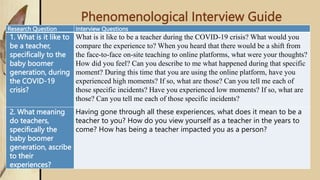
What is it like to be a teacher during the COVID-19 crisis? What would you
compare the experience to? When you heard that there would be a shift from
the face-to-face on-site teaching to online platforms, what were your thoughts?
How did you feel? Can you describe to me what happened during that specific
moment? During this time that you are using the online platform, have you
experienced high moments? If so, what are those? Can you tell me each of
those specific incidents? Have you experienced low moments? If so, what are
those? Can you tell me each of those specific incidents?
2. What meaning
do teachers,
specifically the
baby boomer
generation, ascribe
to their
experiences?
Having gone through all these experiences, what does it mean to be a
teacher to you? How do you view yourself as a teacher in the years to
come? How has being a teacher impacted you as a person?
Work-Life Balance of Women University Presidents:
A Hermeneutic Phenomenological Study (Marinas, ongoing
dissertation)
 Watch the movies “The Devil Wears Prada” and “Grace of Monaco.”
 Viewing these movies may serve as a relaxation from your busy schedule. The synopsis/summary
of each film may be accessed from the corresponding link:
 “The Devil Wears Prada (2006)” https://www.imdb.com/title/tt0458352/plotsummary
 “Grace of Monaco (2014)”
 https://www.imdb.com/title/tt2095649/plotsummary
 The session three interview will be related to your reflection from watching the movies.
 Interview Guide

 What are the most significant lines that you find in the movie? Why do you find them
significant?
 What are the scenes that speak to you the most regarding work-life balance? Why?
Work-Life Balance of Women University Presidents:
A Hermeneutic Phenomenological Study (Marinas, ongoing
dissertation)
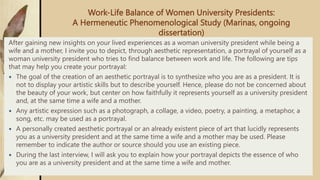
After gaining new insights on your lived experiences as a woman university president while being a
wife and a mother, I invite you to depict, through aesthetic representation, a portrayal of yourself as a
woman university president who tries to find balance between work and life. The following are tips
that may help you create your portrayal:
 The goal of the creation of an aesthetic portrayal is to synthesize who you are as a president. It is
not to display your artistic skills but to describe yourself. Hence, please do not be concerned about
the beauty of your work, but center on how faithfully it represents yourself as a university president
and, at the same time a wife and a mother.
 Any artistic expression such as a photograph, a collage, a video, poetry, a painting, a metaphor, a
song, etc. may be used as a portrayal.
 A personally created aesthetic portrayal or an already existent piece of art that lucidly represents
you as a university president and at the same time a wife and a mother may be used. Please
remember to indicate the author or source should you use an existing piece.
 During the last interview, I will ask you to explain how your portrayal depicts the essence of who
you are as a university president and at the same time a wife and mother.
Data Analysis
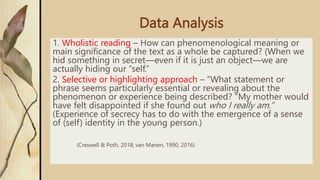
1. Wholistic reading – How can phenomenological meaning or
main significance of the text as a whole be captured? (When we
hid something in secret—even if it is just an object—we are
actually hiding our “self.”
2. Selective or highlighting approach – “What statement or
phrase seems particularly essential or revealing about the
phenomenon or experience being described? “My mother would
have felt disappointed if she found out who I really am.”
(Experience of secrecy has to do with the emergence of a sense
of (self) identity in the young person.)
(Creswell & Poth, 2018; van Manen, 1990, 2016)
Data Analysis
3. Detailed or line-by-line approach or coding – What may this sentence
or sentence cluster been seen to reveal about the phenomenon or
experience being described? “I must have been about twelve, when I
hid a bottle of liquor outside under a fire wood stack for a get-together
some kids were organizing.” (Secrecy involves hiding something.)
4. Analyzing data by themes. Organizing the themes according to the
essential elements of a lifeworld (corporeality, materiality, spatiality,
temporality, and relationality.
5. Coming up with an explicit structure of the meaning of the lived
experience or essence.
(Creswell & Poth, 2018; van Manen, 1990, 2016)
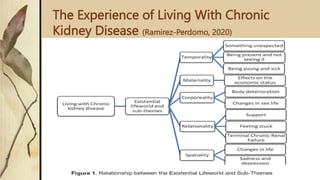
The Experience of Living With Chronic
Kidney Disease (Ramirez-Perdomo, 2020)
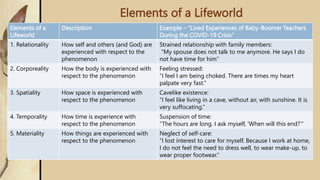
Elements of a Lifeworld
Elements of a
Lifeworld
Description Example – “Lived Experiences of Baby-Boomer Teachers
During the COVID-19 Crisis”
1. Relationality How self and others (and God) are
experienced with respect to the
phenomenon
Strained relationship with family members:
“My spouse does not talk to me anymore. He says I do
not have time for him”
2. Corporeality How the body is experienced with
respect to the phenomenon
Feeling stressed:
“I feel I am being choked. There are times my heart
palpate very fast.”
3. Spatiality How space is experienced with
respect to the phenomenon
Cavelike existence:
“I feel like living in a cave, without air, with sunshine. It is
very suffocating.”
4. Temporality How time is experience with
respect to the phenomenon
Suspension of time:
“The hours are long. I ask myself, ‘When will this end?’”
5. Materiality How things are experienced with
respect to the phenomenon
Neglect of self-care:
“I lost interest to care for myself. Because I work at home,
I do not feel the need to dress well, to wear make-up, to
wear proper footwear.”
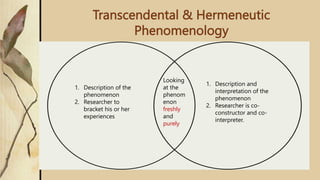
Transcendental & Hermeneutic
Phenomenology
1. Description of the
phenomenon
2. Researcher to
bracket his or her
experiences
1. Description and
interpretation of the
phenomenon
2. Researcher is co-
constructor and co-
interpreter.
Looking
at the
phenom
enon
freshly
and
purely
Recommended Readings
 Moustakas, C. (1994). Phenomenological research
methods. Sage.
 van Manen, M. (1990). Researching lived
experiences: Human science for an action sensitive
pedagogy. State University of New York Press.
 van Manen, M. (2014). Phenomenology of practice:
Meaning-giving methods in phenomenological
research and writing. Left Coast Press.

SMC_Designing-a-Phenomenological-Study-3.pptx

  • 1.
    Designing Transcendental &Hermeneutic Phenomenological Study Jay Fie Luzano,Ph.D Adopted by : Stephanie L. Colorada
  • 2.
    Objectives • To differentiatebetween hermeneutics and transcendental phenomenology and to identify their research designs, both hermeneutics and transcendental phenomenology need to be examined.
  • 3.
    Definition Phenomenology  “Knowledge asit appears to consciousness, the science of describing what one perceives, senses, and knows in one’s immediate awareness and experience” (Hegel, as cited in Moustakas, 1994, p. 26).  “A study of people’s conscious experience of their life-world” (Merriam, 2009, p. 25).
  • 4.
    Central Question/ Purpose Central question:What is it like? The goal is to understand what it is like to be human. “I understand better what it is like for someone to experience that” (Polkinghorne, 1989, p. 46).
  • 5.
    Conscious or LivedExperience Conscious experiences have a unique feature: we experience them, we live through them or perform them (Standford Encyclopedia of Philosophy, n.d., para. 14)
  • 6.
    Origins  Rooted inphilosophy and psychology  Edmund Husserl – mathematician and astronomer who embraced philosophy to understand human beings.  Also Ponty  Moustakas – transcendental phenomenology  Van Manen – hermeneutic phenomenology
  • 7.
  • 8.
    Definitions – Transcendental Phenomenology It “is a scientific study of the appearance of things, of phenomena just as we see them and as they appear to us in consciousness” (Moustakas, 1994, p. 49).  It “studies conscious experience as experienced from the subjective or first person point of view” (Standford Encyclopedia of Philosophy, n.d., para. 4).  It aims to provide descriptions of an experience, as it is experienced freshly and purely (Brinkmann, 2018; Moustakas, 1994).
  • 9.
    Distinctive Features 1. Anemphasis on the phenomenon to be explored. 2. Exploration of this phenomenon with a group of individuals who have all experienced the phenomenon (3-4 to 10-15). 3. A philosophical discussion. 4. Bracketing (the researcher discusses his or her experiences with the phenomenon and partly sets them aside so that he or she can focus on the experiences of the participants.) 5. Data collection – phenomenological interview, poems, observation, documents 6. Data analysis – textural description, structural description 7. Essence or conclusion
  • 10.
    Bracketing The challenge ofthe Epoche is to be transparent to ourselves, to allow whatever is before us in consciousness to disclose itself so that we may see with new eyes in a naïve and completely open manner. . . . All prior positions are put aside (Husserl, as cited in Moustakas, 1994, p. 86).
  • 11.
    Central Research Questions 1.What have the participants experienced in terms of the phenomenon. (what of the experience) 2. What contexts or situations have typically influenced the experiences of the participants in terms of the phenomenon. (how of the experience) For example: 1. What are the lived experiences of teen mothers? 2. What are the contexts of the lived experiences of teen mothers?
  • 12.
    Sample RQs Title: TheLived Experiences of Filipino Women with Breast Cancer 1. What was life like for Filipino women before the onset of breast cancer? 2. What is the lifeworld of Filipino women who were diagnosed with breast cancer? 3. How do Filipino women diagnosed with breast cancer view life in the future?
  • 13.
    Data Sources Phenomenological interview(Siedman, 1998, pp. 11- 15) First phase – Focus on past experience with the phenomenon of interest. Participants to reconstruct their early experiences. Second phase – Focus on the details of the experience. The purpose is to concentrate on the concrete details of the participants’ experience with the phenomenon. Third phase – Description of the future
  • 14.
    Sample Interview Guide THEPHENOMENOLOGY OF TEACHING RESEARCH QUESTIONS INTERVIEW QUESTIONS 1. What deciding factors influenced the teachers of a selected state university to commit to the lifework of teaching? First interview: When was the first time you realized you would like to be a teacher? How did your realization come about? What other experiences followed that affirmed teaching is your calling? 2. What is the lifeworld of the teachers of a selected state university? Second interview: As a teacher, can you remember of particular experiences that stand out? Think back through your years of teaching and tell me about a particular incident. Are there other incidents that you want to revisit? How do you feel about being a teacher? What thoughts cross your mind when you think about teaching? What thoughts cross your mind when you think that you are a teacher? 3. How do the teachers of a selected state university view themselves in the future? Third interview: Given what you have said about your life before you became a teacher and given what you have said about your work now, how you see yourself in the future? 09/07/2024 14
  • 15.
    Sample Interview (Moustakas,1994, p. 116) 1. What dimensions, incidents and people intimately connected with the experience stand out for you? 2. How did the experience affect you? What changes do you associate with the experience? 3. How did the experience affect significant others in your life? 4. How feelings were generated by the experience? 5. What thoughts stood out for you? 6. What bodily changes or states were you aware of at the time? 7. Have you shared all that is significant with reference to the experience?
  • 16.
    Data Sources 2. Literature– stories, poems, etc. 3. Observation 4. Documents – participants’ diaries 5. Arts-based data – drawing, aesthetic portrayal
  • 17.
    Sampling Strategies 1. Purposiveor purposeful sampling 2. Snowball sampling
  • 18.
    Data Analysis (Moustakas, 1994) 1.Horizonalization – Extracting significant statements, putting them parallel to each other, removing overlaps and repetitions 2. Clustering the horizons into themes
  • 19.
    Data Analysis 3. Writingthe textural description – This is the “what” of the experience; the textural qualities—rough and smooth, small and large, quiet and loud, colorful and bland, etc.; descriptions that present varying intensities, ranges of shapes, sizes, and spatial qualities, time references, and colors all within an experiential context (p. 91).
  • 20.
    Data Analysis 4. Writingthe structural description – The context or setting that influenced how the participants experienced the phenomenon. How the experience of the phenomenon come to be? What are the conditions that must exist for something to appear? Imagine possible structures of time, space, materiality, causality, and relationships to self and to others. (p. 99)
  • 21.
    Data Analysis 5. Findingthe essence – A descriptive passage (a paragraph or two) focusing on the common experiences of the participants, a blend of the textural and the structural descriptions.
  • 22.
    Sample – TexturalDescription “Emerging from Depression” (Keen, as cited in Moustakas, 1994)  Depression is experienced as the stoppage of time, the emptiness of space, and the reification of others. Time stops; development of myself, of situations, and of relationships all grind to a halt. Everything appears static, dead, with no change except a progressive deterioration like rusting or rotting. Most of all, the future seems to promise only a dreary repetition of the past. Space is empty. There are things, but they have lost their importance. My house, once a haven and a home, is a mere building, drained of its echoes of vitality and love. . . . My books are dead, my tennis racquet a mere thing. And other people—their development in time, like my own, gave the future its hope and cast meaning into spaces and places—now are mere things, walking and talking like manikins, mechanically echoing scripts written long ago.
  • 23.
    Sample – StructuralDescription “Emerging from Depression” (Keen, as cited in Moustakas, 1994)  Emerging from depression involves not the disappearance of a symptom but the reappearance, reinvention, and rediscovery of a self with a past and a future. My present life, which leads from the past into the future, matters when it is part of a historical unfolding within which I can place myself in an integral part. Having a job, being a parent, engaging in crafts, for example, can supply such a story. In depression, these ordinary aspects of life have been neutralized—rendered meaningless—by the death themes of depression: the stoppage of time, the emptiness of space, and the reification of people. The reestablishment of a future, the refurnishing of space with significance and vitality, and the repersonification of others are implicated in reinventing myself and emerging from depression.
  • 24.
    Sample – Essence “Emergingfrom Depression” (Keen, as cited in Moustakas, 1994)  The final truth seems to be that emerging from depression is never really complete. The work of remembering, and feeling the sadness, must be renewed a little every day. . . .  The sadness of memories is far preferable to the happiness of subclinical depression, for it throws into relief the really good things in life, and makes them shine forth. In this way, ecstasy and tragedy are two sides of the same coin. Depression can be devastating, by having emerged, I find that depression is enriching and enlivening as I live the reinvented self, born in the struggle of emergence.
  • 25.
  • 26.
    Definition Hermeneutic phenomenology focuses onthe description and interpretation of participants’ experiences (Kafle, 2011).
  • 27.
    Hermeneutical Research Activities 1.Turning to the nature of lived experience – “Commitment of turning to an abiding concern,”. . . “of thinking a single thought more deeply,” . . . “a deep questioning of something” . . . “in the context of particular individual, social, and historical life circumstances” (p. 31). 2. Investigating the experience as lived – “The researcher actively explores the category of lived experience in all its modalities and aspects” (p. 32). 3. Reflecting on essential themes – “Reflective[ly] grasping what it is that renders this or that particular experience its special significance” . . . “bringing into nearness that which tends to be obscure, that which tends to evade the intelligibility of our natural attitude of everyday life. (p. 32).
  • 28.
    Hermeneutical Research Activities 4.Describing the phenomenon through writing and rewriting – “To do research in a phenomenological sense is already and immediately and always a bringing to speech of something. And this thoughtfully bringing to speech is most commonly a writing activity” (p. 32). 5. Maintaining and strong and oriented relations – “To be oriented to an object means that we are animated by the object in a full and human sense. To be strong in our orientation means that we will not settle for superficialities and falsities” (p. 33). 6. Balancing the research context by considering the parts and whole – The researcher considers how the study is grounded and interrelated with the context and the “current forms of knowledge” (p. 34). (van Manen, 2016, pp. 31-34)
  • 29.
    Sampling Strategies 1. Purposiveor purposeful sampling 2. Snowball sampling
  • 30.
    Central Research Questions 1.What is like to experience the phenomenon. 2. What is the meaning of the experiences of the participants. For example: 1. What is it like to be a teen mother? 2. What meaning do teen mothers ascribe to their experiences?
  • 31.
    Data Sources 1. Phenomenologicalinterview 2. Observing lived experience 3. Experiential descriptions in literature (novels, stories, movies, biography, diaries) 4. Art-based data
  • 32.
    Data Sources Phenomenological interview(Siedman, 1998, pp. 11-15) First phase – Focus on past experience with the phenomenon of interest. Participants to reconstruct their early experiences. (Description of the past experience) Second phase – Focus on the details of the experience. The purpose is to concentrate on the concrete details of the participants’ experience with the phenomenon. (Description of the present experience) Third phase – Reflection on the meaning. It addresses the intellectual and emotional connections between the participants’ work and life.
  • 33.
    Sample of InterviewQuestions  KEEPING A SECRET 1. Can you remember the earliest time when you began to keep a secret from your father or mother? Think back to these early years and try to remember a particular incident or moment. 2. What did you hide? A thought? An object? Something you did? Try to remember a single instance or event. 3. Did you have a secret place where you hid or stashed things? Can you describe that place? 4. How did this experience of keeping something secret make you feel? For example, how did your body feel? How did you feel toward your mother or father? Please give examples. 5. What did you do? What did you say? What did you think? What happened? (van Manen, 214, p. 299)
  • 34.
    Is This aGood Phenomenological Data? I don’t like keeping secrets because it is really a form of lying. Sometimes I notice that someone is keeping something secret from me and then I instantly begin to distrust this person. If people cannot be honest and open with me, then I would rather not associate with them. For example, I could never love someone who keeps secrets from me, and I would not really love someone if I would do to the same. Most secrets that people keep have to do with things that are morally reprehensible. And so, when someone is telling me something that I am supposed to keep a secret, then I know that I am either going to hear some bad stuff or gossip about someone else, or, if the secret is about the person him- or herself, then I will hear something sordid that I would rather not know. (AN)
  • 35.
    Is This aGood Phenomenological Data? As a child I loved going out on hunting and fishing trips with my dad or grandpa. The freshness of the forest was a delight to all my senses—the pungent aroma of fall, the warm tones and hues as the earth blended toward an ash-blue sky, the early morning bite of coolness on my cheeks and the silence of the woods as we waited. This day of memories was all these things until it happened. The silence was fractured by the invading crack of a rifle: a deer was killed. I was five. When we returned home, I ran to my grandmother and, caught up in the excitement of the event, exclaimed, “Bang, down goes the deer and blood comes out of it!” I was suppose to rejoice with the rest of the family about this great happening, but in my deepest soul I knew I could not share it. I pretended to be happy, but I was sickened. Why was I so different? Why did I grieve for the deer and the forest and the silence? Perhaps this is the conscious moment of my knowing of the profound schism between myself and the men in my immediate family. This would remain my secret until my adolescence.
  • 36.
    Phenomenological Interview Guide ResearchQuestion Interview Questions 1. What is it like to be a teacher, specifically to the baby boomer generation, during the COVID-19 crisis? What is it like to be a teacher during the COVID-19 crisis? What would you compare the experience to? When you heard that there would be a shift from the face-to-face on-site teaching to online platforms, what were your thoughts? How did you feel? Can you describe to me what happened during that specific moment? During this time that you are using the online platform, have you experienced high moments? If so, what are those? Can you tell me each of those specific incidents? Have you experienced low moments? If so, what are those? Can you tell me each of those specific incidents? 2. What meaning do teachers, specifically the baby boomer generation, ascribe to their experiences? Having gone through all these experiences, what does it mean to be a teacher to you? How do you view yourself as a teacher in the years to come? How has being a teacher impacted you as a person?
  • 37.
    Work-Life Balance ofWomen University Presidents: A Hermeneutic Phenomenological Study (Marinas, ongoing dissertation)  Watch the movies “The Devil Wears Prada” and “Grace of Monaco.”  Viewing these movies may serve as a relaxation from your busy schedule. The synopsis/summary of each film may be accessed from the corresponding link:  “The Devil Wears Prada (2006)” https://www.imdb.com/title/tt0458352/plotsummary  “Grace of Monaco (2014)”  https://www.imdb.com/title/tt2095649/plotsummary  The session three interview will be related to your reflection from watching the movies.  Interview Guide   What are the most significant lines that you find in the movie? Why do you find them significant?  What are the scenes that speak to you the most regarding work-life balance? Why?
  • 38.
    Work-Life Balance ofWomen University Presidents: A Hermeneutic Phenomenological Study (Marinas, ongoing dissertation) After gaining new insights on your lived experiences as a woman university president while being a wife and a mother, I invite you to depict, through aesthetic representation, a portrayal of yourself as a woman university president who tries to find balance between work and life. The following are tips that may help you create your portrayal:  The goal of the creation of an aesthetic portrayal is to synthesize who you are as a president. It is not to display your artistic skills but to describe yourself. Hence, please do not be concerned about the beauty of your work, but center on how faithfully it represents yourself as a university president and, at the same time a wife and a mother.  Any artistic expression such as a photograph, a collage, a video, poetry, a painting, a metaphor, a song, etc. may be used as a portrayal.  A personally created aesthetic portrayal or an already existent piece of art that lucidly represents you as a university president and at the same time a wife and a mother may be used. Please remember to indicate the author or source should you use an existing piece.  During the last interview, I will ask you to explain how your portrayal depicts the essence of who you are as a university president and at the same time a wife and mother.
  • 39.
    Data Analysis 1. Wholisticreading – How can phenomenological meaning or main significance of the text as a whole be captured? (When we hid something in secret—even if it is just an object—we are actually hiding our “self.” 2. Selective or highlighting approach – “What statement or phrase seems particularly essential or revealing about the phenomenon or experience being described? “My mother would have felt disappointed if she found out who I really am.” (Experience of secrecy has to do with the emergence of a sense of (self) identity in the young person.) (Creswell & Poth, 2018; van Manen, 1990, 2016)
  • 40.
    Data Analysis 3. Detailedor line-by-line approach or coding – What may this sentence or sentence cluster been seen to reveal about the phenomenon or experience being described? “I must have been about twelve, when I hid a bottle of liquor outside under a fire wood stack for a get-together some kids were organizing.” (Secrecy involves hiding something.) 4. Analyzing data by themes. Organizing the themes according to the essential elements of a lifeworld (corporeality, materiality, spatiality, temporality, and relationality. 5. Coming up with an explicit structure of the meaning of the lived experience or essence. (Creswell & Poth, 2018; van Manen, 1990, 2016)
  • 41.
    The Experience ofLiving With Chronic Kidney Disease (Ramirez-Perdomo, 2020)
  • 42.
    Elements of aLifeworld Elements of a Lifeworld Description Example – “Lived Experiences of Baby-Boomer Teachers During the COVID-19 Crisis” 1. Relationality How self and others (and God) are experienced with respect to the phenomenon Strained relationship with family members: “My spouse does not talk to me anymore. He says I do not have time for him” 2. Corporeality How the body is experienced with respect to the phenomenon Feeling stressed: “I feel I am being choked. There are times my heart palpate very fast.” 3. Spatiality How space is experienced with respect to the phenomenon Cavelike existence: “I feel like living in a cave, without air, with sunshine. It is very suffocating.” 4. Temporality How time is experience with respect to the phenomenon Suspension of time: “The hours are long. I ask myself, ‘When will this end?’” 5. Materiality How things are experienced with respect to the phenomenon Neglect of self-care: “I lost interest to care for myself. Because I work at home, I do not feel the need to dress well, to wear make-up, to wear proper footwear.”
  • 43.
    Transcendental & Hermeneutic Phenomenology 1.Description of the phenomenon 2. Researcher to bracket his or her experiences 1. Description and interpretation of the phenomenon 2. Researcher is co- constructor and co- interpreter. Looking at the phenom enon freshly and purely
  • 44.
    Recommended Readings  Moustakas,C. (1994). Phenomenological research methods. Sage.  van Manen, M. (1990). Researching lived experiences: Human science for an action sensitive pedagogy. State University of New York Press.  van Manen, M. (2014). Phenomenology of practice: Meaning-giving methods in phenomenological research and writing. Left Coast Press.

Editor's Notes

  • #15 Let us use this for practice (by groups). Each group will choose who to interview. The rest will do other roles such as main interviewer and co-interviewer, audio recorder, note taker.
  • #16 Intense experience – student mothers, novice teachers, first-time researchers, topping a board exam, being a teen mother
  • #23 One’s relation to time, space, and other people
  • #35 This is a study on children keeping secrets. This is not a good phenomenological data. Why? Because it does not describe a lived experience as it happened—in its fresh and pure state.
  • #36 This is a good phenomenological data. It describes the experience as it happened—in its fresh and pure state.