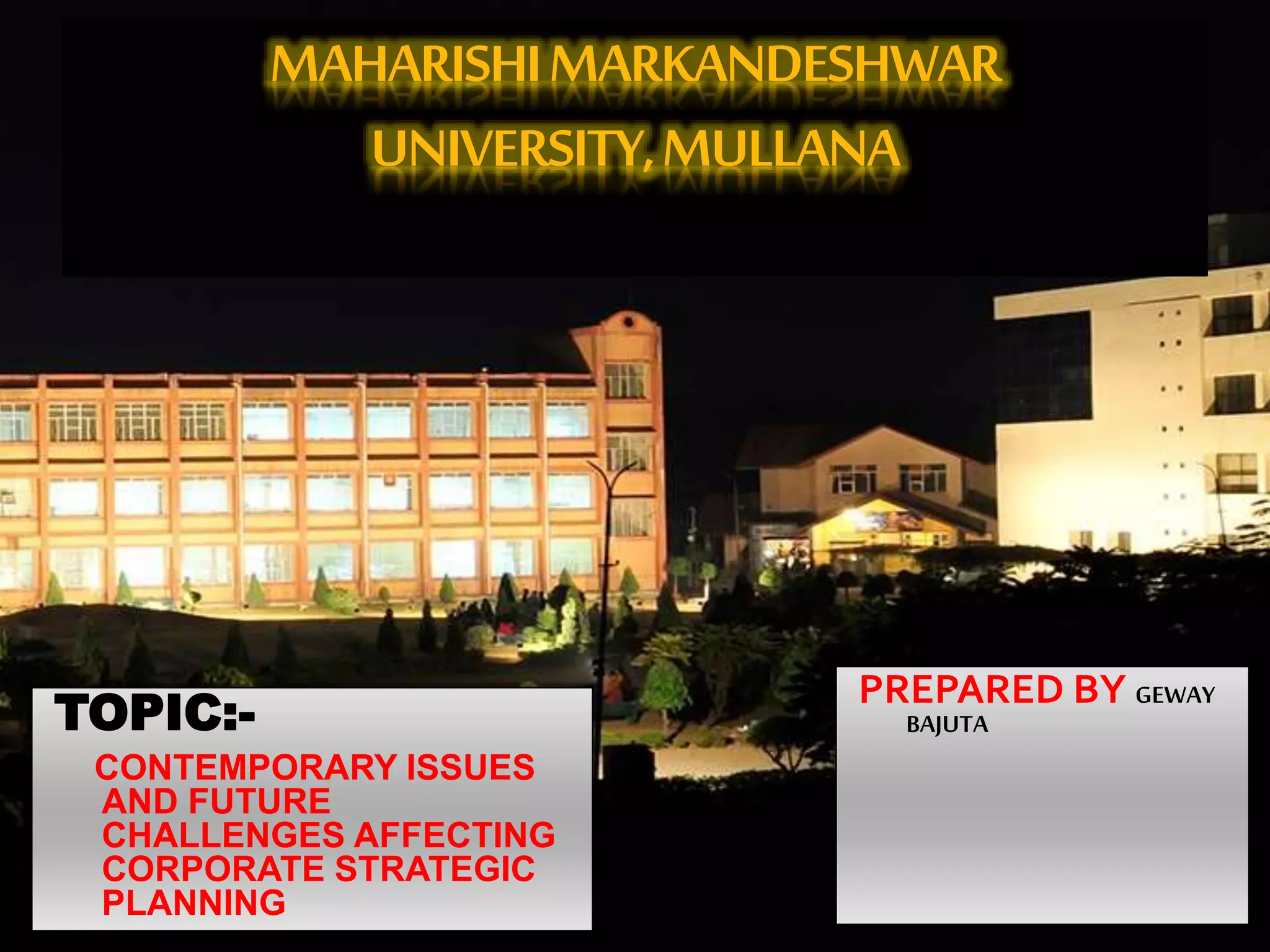
MAHARISHIMARKANDESHWAR
UNIVERSITY,MULLANA
TOPIC:-
CONTEMPORARY ISSUES
AND FUTURE
CHALLENGES AFFECTING
CORPORATE STRATEGIC
PLANNING
PREPARED BY GEWAY
BAJUTA
WHAT ARE CONTEMPORARY ISSUES
?
Contemporary issues can be defined as any
events, ideas, opinions or topics in the
given subjects that are relevant to the
present day. Contemporary issues can be
found in almost any matter of interest.
What is STRATEGIC PLANNING
?
This is a systematic process of
envisioning a desired future, and
translating this vision into broadly
defined goals or objectives and a
sequence of steps to achieve them.
WHAT IS CORPORATE STRATEGIC
PLANNING ?
Is a systematic process of determining goals to
be achieved in the foreseeable future of;
1. Management’s fundamental assumptions
about the future economic, technological,
and competitive environment
2. Setting of goals to be achieved within a
specified timeframe
3. Performance of SWOT Analysis
4. Selecting main and alternative strategies to
achieve the goals
STRATEGIC PLANNING
PROCESS MODEL
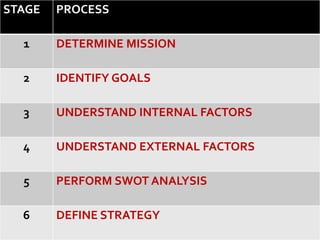
STAGE PROCESS
1 DETERMINE MISSION
2 IDENTIFY GOALS
3 UNDERSTAND INTERNAL FACTORS
4 UNDERSTAND EXTERNAL FACTORS
5 PERFORM SWOT ANALYSIS
6 DEFINE STRATEGY
WHAT ARE CONTEMPORARY
ISSUES AND CHALLANGES
AFFECTING CORPORATE
STRATEGIC PLANNING ?
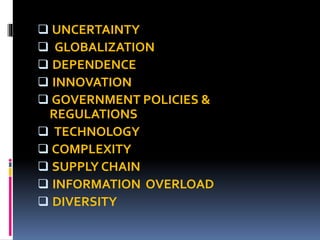
 UNCERTAINTY
 GLOBALIZATION
 DEPENDENCE
 INNOVATION
 GOVERNMENT POLICIES &
REGULATIONS
 TECHNOLOGY
 COMPLEXITY
 SUPPLY CHAIN
 INFORMATION OVERLOAD
 DIVERSITY
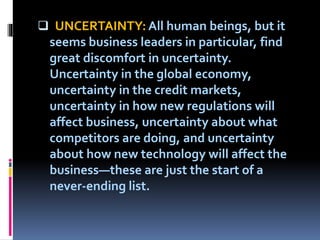
 UNCERTAINTY: All human beings, but it
seems business leaders in particular, find
great discomfort in uncertainty.
Uncertainty in the global economy,
uncertainty in the credit markets,
uncertainty in how new regulations will
affect business, uncertainty about what
competitors are doing, and uncertainty
about how new technology will affect the
business—these are just the start of a
never-ending list.
 GLOBALIZATION: This is
the process by which
businesses or other
organizations develop
international influence or
start operating on an
international scale.
 DEPENDENCE: This is a state of
relying on or being controlled by
someone or something else.
 INNOVATION: The process
of translating an idea or
invention into a good or
service that creates value
or for which customers will
pay.
 GOVERNMENT POLICIES &
REGULATIONS: A changing
regulatory environment is always of
concern in certain industries, but
uncertain energy, environmental and
financial policy is complicating
the decision making for nearly all
companies today.
 TECHNOLOGY: The pace of technological
improvement is running at an
exponentially increasing rate. While this
has been true for several decades, the
pace today makes capital investment in
technology as much an asset as a handicap
because a competitor may wait for the
next-generation technology, which may
only be a year away, and then use it to
achieve an advantage.
 COMPLEXITY: There’s no doubt that
life and business will get more complex,
even as certain tasks and activities have
become easier due to information
technology. The global economy is
becoming still more connected, creating a
much larger and more diverse population
of customers and suppliers. Manufacturing
and services are increasingly targeted at
smaller, specialized markets due to the
flexibility that IT provides in these
areas. The 3D printing revolution is a
perfect example.
 SUPPLY CHAINS: Because of
uncertainty in demand and the need
to stay lean, companies are
carrying smaller inventories than
ever. At the same time, uncertainty
in supply, driven by wildly
changing commodity prices, an
apparent increase in weather-
related disruptions, and increasing
competition for raw materials makes
supply chain planning more
challenging than ever.
 INFORMATION OVERLOAD: It is said that the only
true constant is change, and in today’s world
nothing is changing more, or growing faster,
than information.
A March 2010 estimate put global Internet traffic at 21
exabytes—21 million terabytes. By 2016, global traffic will
reach 1.3 zettabytes, according to a report released in May
2012. Every day, 2.5 quintillion bytes of data are created.
The ability of companies, much less individuals, to consume
and make sense of the information that is available (and
necessary) to make good decisions is becoming a nearly
insurmountable challenge. The problem to be solved is
to deal with this mountain of information with both
technology and human know-how, then to convert this
information into valuable knowledge
 DIVERSITY : A particular subset of
human capital planning is found so often
in our research that it is worth its own
mention. Diversity brings many
challenges, as it makes it far more
likely that people do not agree, and the
lack of agreement makes running a
business very difficult. At the same
time, the lack of diversity within many
large company leadership teams leads to a
narrow view of an ever-changing and
diverse world—contributing to groupthink,
stale culture and a tendency to live with
the status quo for too long.
CONTEMPORARY ISSUES AND FUTURE CHALLENGES AFFECTING CORPORATE STRATEGIC PLANNING

CONTEMPORARY ISSUES AND FUTURE CHALLENGES AFFECTING CORPORATE STRATEGIC PLANNING

  • 1.
    MAHARISHIMARKANDESHWAR UNIVERSITY,MULLANA TOPIC:- CONTEMPORARY ISSUES AND FUTURE CHALLENGESAFFECTING CORPORATE STRATEGIC PLANNING PREPARED BY GEWAY BAJUTA
  • 3.
  • 4.
    Contemporary issues canbe defined as any events, ideas, opinions or topics in the given subjects that are relevant to the present day. Contemporary issues can be found in almost any matter of interest.
  • 5.
  • 6.
    This is asystematic process of envisioning a desired future, and translating this vision into broadly defined goals or objectives and a sequence of steps to achieve them.
  • 7.
    WHAT IS CORPORATESTRATEGIC PLANNING ?
  • 8.
    Is a systematicprocess of determining goals to be achieved in the foreseeable future of; 1. Management’s fundamental assumptions about the future economic, technological, and competitive environment 2. Setting of goals to be achieved within a specified timeframe 3. Performance of SWOT Analysis 4. Selecting main and alternative strategies to achieve the goals
  • 9.
  • 10.
    STAGE PROCESS 1 DETERMINEMISSION 2 IDENTIFY GOALS 3 UNDERSTAND INTERNAL FACTORS 4 UNDERSTAND EXTERNAL FACTORS 5 PERFORM SWOT ANALYSIS 6 DEFINE STRATEGY
  • 11.
    WHAT ARE CONTEMPORARY ISSUESAND CHALLANGES AFFECTING CORPORATE STRATEGIC PLANNING ?
  • 12.
     UNCERTAINTY  GLOBALIZATION DEPENDENCE  INNOVATION  GOVERNMENT POLICIES & REGULATIONS  TECHNOLOGY  COMPLEXITY  SUPPLY CHAIN  INFORMATION OVERLOAD  DIVERSITY
  • 13.
     UNCERTAINTY: Allhuman beings, but it seems business leaders in particular, find great discomfort in uncertainty. Uncertainty in the global economy, uncertainty in the credit markets, uncertainty in how new regulations will affect business, uncertainty about what competitors are doing, and uncertainty about how new technology will affect the business—these are just the start of a never-ending list.
  • 14.
     GLOBALIZATION: Thisis the process by which businesses or other organizations develop international influence or start operating on an international scale.
  • 15.
     DEPENDENCE: Thisis a state of relying on or being controlled by someone or something else.
  • 16.
     INNOVATION: Theprocess of translating an idea or invention into a good or service that creates value or for which customers will pay.
  • 17.
     GOVERNMENT POLICIES& REGULATIONS: A changing regulatory environment is always of concern in certain industries, but uncertain energy, environmental and financial policy is complicating the decision making for nearly all companies today.
  • 18.
     TECHNOLOGY: Thepace of technological improvement is running at an exponentially increasing rate. While this has been true for several decades, the pace today makes capital investment in technology as much an asset as a handicap because a competitor may wait for the next-generation technology, which may only be a year away, and then use it to achieve an advantage.
  • 19.
     COMPLEXITY: There’sno doubt that life and business will get more complex, even as certain tasks and activities have become easier due to information technology. The global economy is becoming still more connected, creating a much larger and more diverse population of customers and suppliers. Manufacturing and services are increasingly targeted at smaller, specialized markets due to the flexibility that IT provides in these areas. The 3D printing revolution is a perfect example.
  • 20.
     SUPPLY CHAINS:Because of uncertainty in demand and the need to stay lean, companies are carrying smaller inventories than ever. At the same time, uncertainty in supply, driven by wildly changing commodity prices, an apparent increase in weather- related disruptions, and increasing competition for raw materials makes supply chain planning more challenging than ever.
  • 21.
     INFORMATION OVERLOAD:It is said that the only true constant is change, and in today’s world nothing is changing more, or growing faster, than information. A March 2010 estimate put global Internet traffic at 21 exabytes—21 million terabytes. By 2016, global traffic will reach 1.3 zettabytes, according to a report released in May 2012. Every day, 2.5 quintillion bytes of data are created. The ability of companies, much less individuals, to consume and make sense of the information that is available (and necessary) to make good decisions is becoming a nearly insurmountable challenge. The problem to be solved is to deal with this mountain of information with both technology and human know-how, then to convert this information into valuable knowledge
  • 22.
     DIVERSITY :A particular subset of human capital planning is found so often in our research that it is worth its own mention. Diversity brings many challenges, as it makes it far more likely that people do not agree, and the lack of agreement makes running a business very difficult. At the same time, the lack of diversity within many large company leadership teams leads to a narrow view of an ever-changing and diverse world—contributing to groupthink, stale culture and a tendency to live with the status quo for too long.