ENG 116: CONTEMPORARY,
POPULAR, and EMERGENT
LITERATURE
Poetry
LEARNING OBJECTIVES:
01 analyze elements of contemporary
poetry and;
02
trace the history, characteristics, and
famous personality in contemporary
poetry.
At the end of the lesson, the students
should be able to:
What is
poetry?
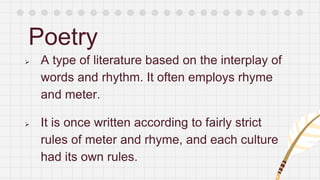
Poetry
 A type of literature based on the interplay of
words and rhythm. It often employs rhyme
and meter.
 It is once written according to fairly strict
rules of meter and rhyme, and each culture
had its own rules.
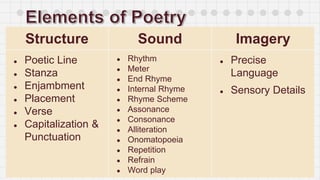
Structure Sound Imagery
● Poetic Line
● Stanza
● Enjambment
● Placement
● Verse
● Capitalization &
Punctuation
● Rhythm
● Meter
● End Rhyme
● Internal Rhyme
● Rhyme Scheme
● Assonance
● Consonance
● Alliteration
● Onomatopoeia
● Repetition
● Refrain
● Word play
● Precise
Language
● Sensory Details
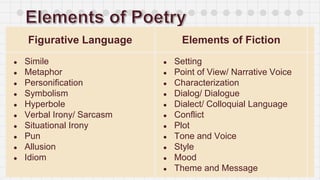
Figurative Language Elements of Fiction
● Simile
● Metaphor
● Personification
● Symbolism
● Hyperbole
● Verbal Irony/ Sarcasm
● Situational Irony
● Pun
● Allusion
● Idiom
● Setting
● Point of View/ Narrative Voice
● Characterization
● Dialog/ Dialogue
● Dialect/ Colloquial Language
● Conflict
● Plot
● Tone and Voice
● Style
● Mood
● Theme and Message
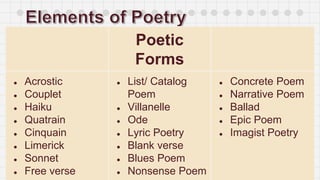
Poetic
Forms
● Acrostic
● Couplet
● Haiku
● Quatrain
● Cinquain
● Limerick
● Sonnet
● Free verse
● List/ Catalog
Poem
● Villanelle
● Ode
● Lyric Poetry
● Blank verse
● Blues Poem
● Nonsense Poem
● Concrete Poem
● Narrative Poem
● Ballad
● Epic Poem
● Imagist Poetry
01
Structure
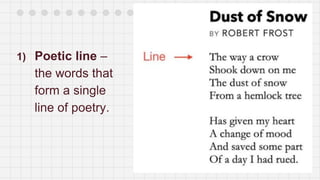
1) Poetic line –
the words that
form a single
line of poetry.
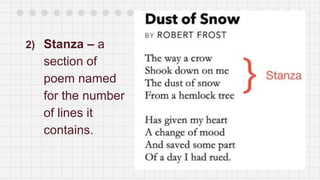
2) Stanza – a
section of
poem named
for the number
of lines it
contains.
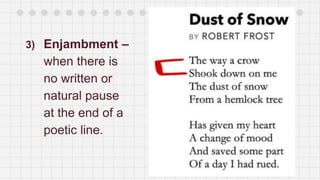
3) Enjambment –
when there is
no written or
natural pause
at the end of a
poetic line.
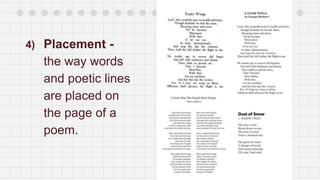
4) Placement -
the way words
and poetic lines
are placed on
the page of a
poem.
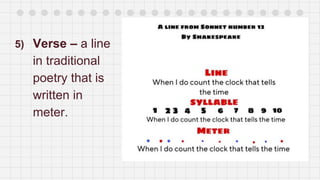
5) Verse – a line
in traditional
poetry that is
written in
meter.
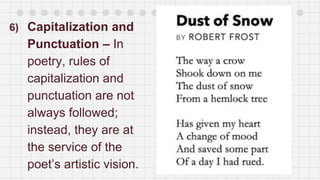
6) Capitalization and
Punctuation – In
poetry, rules of
capitalization and
punctuation are not
always followed;
instead, they are at
the service of the
poet’s artistic vision.
02
Sounds
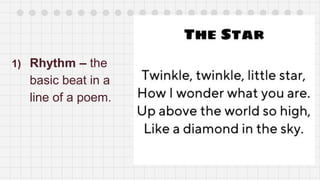
1) Rhythm – the
basic beat in a
line of a poem.
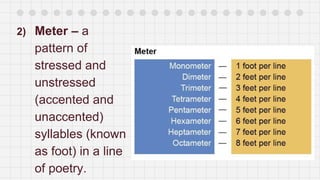
2) Meter – a
pattern of
stressed and
unstressed
(accented and
unaccented)
syllables (known
as foot) in a line
of poetry.
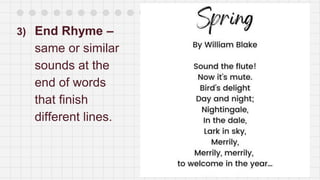
3) End Rhyme –
same or similar
sounds at the
end of words
that finish
different lines.
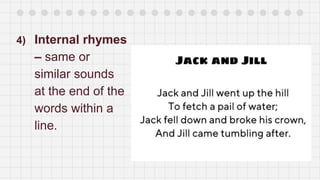
4) Internal rhymes
– same or
similar sounds
at the end of the
words within a
line.
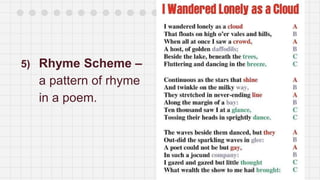
5) Rhyme Scheme –
a pattern of rhyme
in a poem.
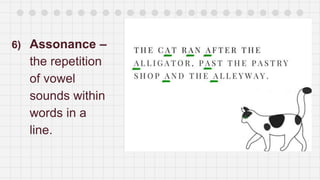
6) Assonance –
the repetition
of vowel
sounds within
words in a
line.
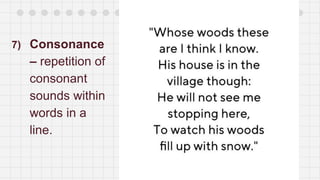
7) Consonance
– repetition of
consonant
sounds within
words in a
line.
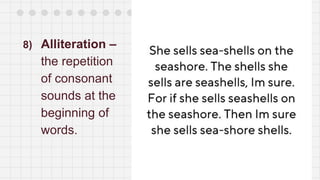
8) Alliteration –
the repetition
of consonant
sounds at the
beginning of
words.
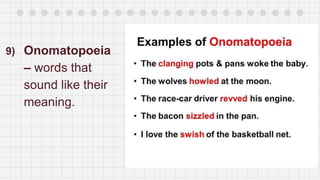
9) Onomatopoeia
– words that
sound like their
meaning.
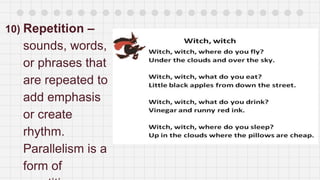
10) Repetition –
sounds, words,
or phrases that
are repeated to
add emphasis
or create
rhythm.
Parallelism is a
form of
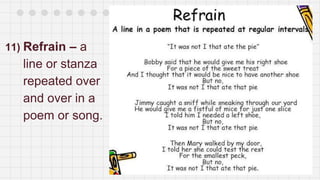
11) Refrain – a
line or stanza
repeated over
and over in a
poem or song.
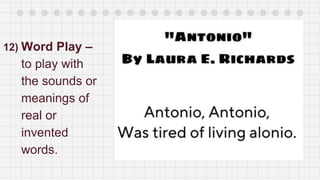
12) Word Play –
to play with
the sounds or
meanings of
real or
invented
words.
03
Imagery
1) Precise Language – the use of specific words to
describe a person, place, thing, or action.
Example:
When the elders said she was too old,
Reverend Mona surrendered her
tabernacle next to Fast Frankie’s Pawn
Shop
2) Sensory Details – the use of descriptive details
that appeal to one or more of the five senses.
Example: Notice the sensory details in the following
lines from “ The Sea” by James Reeves:
■ The giant see dog moans, Licking his
greasy paws.
Figurative
Language
04
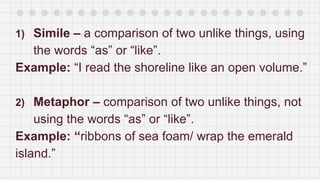
1) Simile – a comparison of two unlike things, using
the words “as” or “like”.
Example: “I read the shoreline like an open volume.”
2) Metaphor – comparison of two unlike things, not
using the words “as” or “like”.
Example: “ribbons of sea foam/ wrap the emerald
island.”
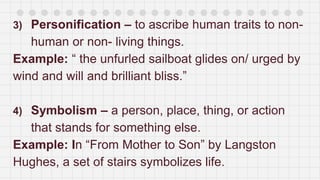
3) Personification – to ascribe human traits to non-
human or non- living things.
Example: “ the unfurled sailboat glides on/ urged by
wind and will and brilliant bliss.”
4) Symbolism – a person, place, thing, or action
that stands for something else.
Example: In “From Mother to Son” by Langston
Hughes, a set of stairs symbolizes life.
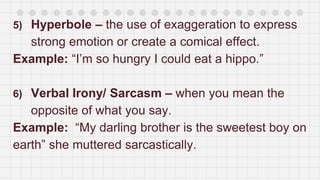
5) Hyperbole – the use of exaggeration to express
strong emotion or create a comical effect.
Example: “I’m so hungry I could eat a hippo.”
6) Verbal Irony/ Sarcasm – when you mean the
opposite of what you say.
Example: “My darling brother is the sweetest boy on
earth” she muttered sarcastically.
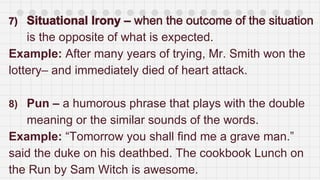
is the opposite of what is expected.
Example: After many years of trying, Mr. Smith won the
lottery– and immediately died of heart attack.
8) Pun – a humorous phrase that plays with the double
meaning or the similar sounds of the words.
Example: “Tomorrow you shall find me a grave man.”
said the duke on his deathbed. The cookbook Lunch on
the Run by Sam Witch is awesome.
9) Allusion – a reference to a familiar person, place
or event.
Example: The following two lines from the poem “My
Muse” contain an allusion to Pandora’s Box: hunched
over from carrying that old familiar box.
10) Idiom – a cultural expression that cannot be taken
literally.
Example: She is the apple of his eye. He drives me up
the wall.
Elements of
Fiction
05
1) Setting – the time and place where a story or
poem takes place.
2) Point of View/ Narrative Voice – the person
narrating a story or poem, it could be in first
person (I, we), second person (you), third person
limited or omniscient (he/she, they).
3) Characterization - the development of the
characters in a story or poem (what they look like,
what they say and do, their personalities, what
they think and feel, and how they’re referred to or
4) Dialog/ Dialogue – the conversation between the
characters in a story or poem.
5) Dialect/ Colloquial Language – the particular
style of speaking of the narrator and the character
in a story or poem (according to their time period,
region, and social expectations).
6) Conflict – the problem or situation a character/
characters face in a story or poem.
7) Plot – the series of events in a story or poem.
8) Tone and voice – the distinctive, idiosyncratic
way a narrator has of telling a story or poem (
tone and voice depend on the intended audience,
the purpose of writing, and the way the writer or
the poem feels about hi/ her subject).
9) Style – the way a writer uses words to craft a
story or poem.
10) Mood – the feelings and emotions the writer
wants the reader to experience.
11) Theme and Message – the main topic of a story
or poem, and the message the author or poet
wants to convey about that topic.
06
Poetic Forms
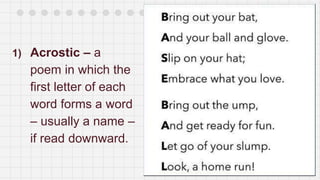
1) Acrostic – a
poem in which the
first letter of each
word forms a word
– usually a name –
if read downward.
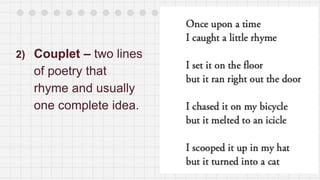
2) Couplet – two lines
of poetry that
rhyme and usually
one complete idea.
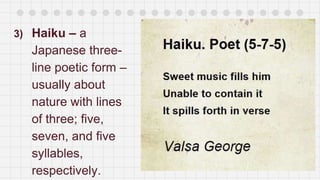
3) Haiku – a
Japanese three-
line poetic form –
usually about
nature with lines
of three; five,
seven, and five
syllables,
respectively.
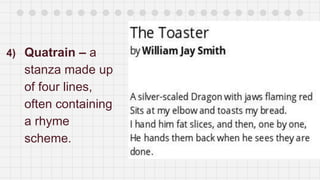
4) Quatrain – a
stanza made up
of four lines,
often containing
a rhyme
scheme.
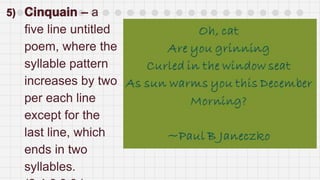
– a
five line untitled
poem, where the
syllable pattern
increases by two
per each line
except for the
last line, which
ends in two
syllables.
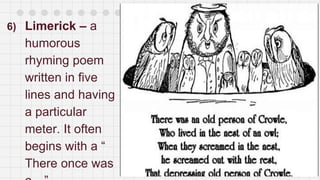
6) Limerick – a
humorous
rhyming poem
written in five
lines and having
a particular
meter. It often
begins with a “
There once was
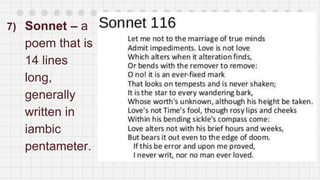
7) Sonnet – a
poem that is
14 lines
long,
generally
written in
iambic
pentameter.
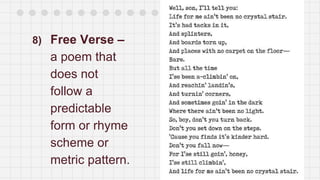
8) Free Verse –
a poem that
does not
follow a
predictable
form or rhyme
scheme or
metric pattern.
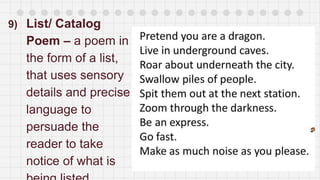
9) List/ Catalog
Poem – a poem in
the form of a list,
that uses sensory
details and precise
language to
persuade the
reader to take
notice of what is
10) Villanelle – a challenging poetic form that
includes five tercets (aba rhyme) followed by a
quatrain (abaa rhyme) and a pattern of
repetition of lines 1 and 3 of first stanza.
Example: “Is there a Villain in your Villanelle?” by
Joan Bransfield Graham.
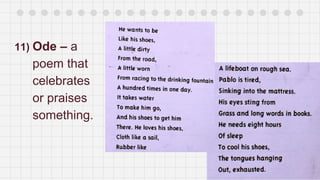
11) Ode – a
poem that
celebrates
or praises
something.
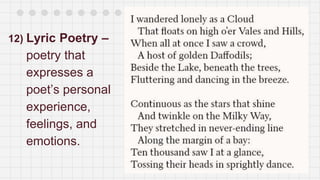
12) Lyric Poetry –
poetry that
expresses a
poet’s personal
experience,
feelings, and
emotions.
13) Blank Verse – a poem written in iambic
pentameter, but with no rhyme.
Example: verses in Romeo and Juliet by William
Shakespeare.
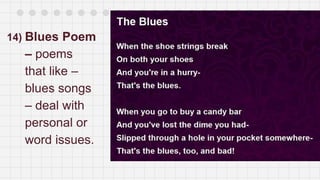
14) Blues Poem
– poems
that like –
blues songs
– deal with
personal or
word issues.
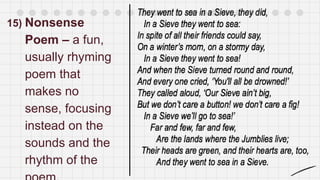
15) Nonsense
Poem – a fun,
usually rhyming
poem that
makes no
sense, focusing
instead on the
sounds and the
rhythm of the
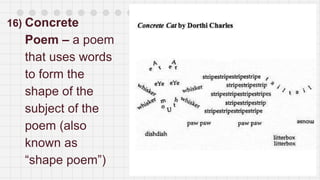
16) Concrete
Poem – a poem
that uses words
to form the
shape of the
subject of the
poem (also
known as
“shape poem”)
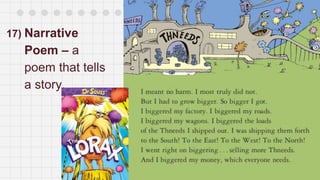
17) Narrative
Poem – a
poem that tells
a story.
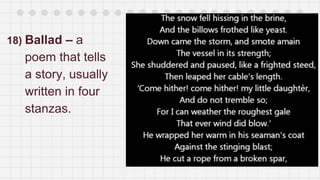
18) Ballad – a
poem that tells
a story, usually
written in four
stanzas.
19) Epic Poem – a long and heroic narrative
poem.
Example: “The Odyssey” by Homer
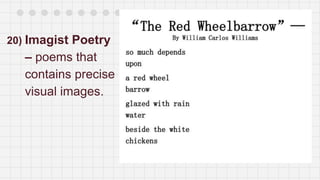
20) Imagist Poetry
– poems that
contains precise
visual images.
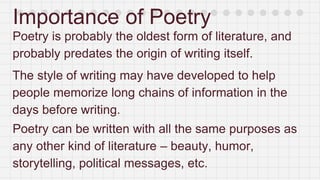
Importance of Poetry
Poetry is probably the oldest form of literature, and
probably predates the origin of writing itself.
The style of writing may have developed to help
people memorize long chains of information in the
days before writing.
Poetry can be written with all the same purposes as
any other kind of literature – beauty, humor,
storytelling, political messages, etc.
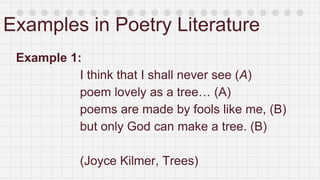
Examples in Poetry Literature
Example 1:
I think that I shall never see (A)
poem lovely as a tree… (A)
poems are made by fools like me, (B)
but only God can make a tree. (B)
(Joyce Kilmer, Trees)
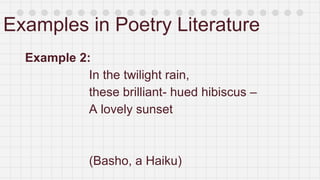
Examples in Poetry Literature
Example 2:
In the twilight rain,
these brilliant- hued hibiscus –
A lovely sunset
(Basho, a Haiku)
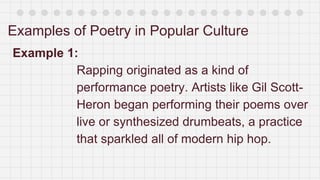
Examples of Poetry in Popular Culture
Example 1:
Rapping originated as a kind of
performance poetry. Artists like Gil Scott-
Heron began performing their poems over
live or synthesized drumbeats, a practice
that sparkled all of modern hip hop.
Examples of Poetry in Popular Culture
Example 2:
Some of the most famous historical poems
have been turned into movies or inspired
episodes of television shows such as
Beowulf an Anglo-Saxon epic poem and
The Raven by Edgar Allan Poe.
End of
Discussion

Contempo-POETRY-edited.pptx

  • 1.
    ENG 116: CONTEMPORARY, POPULAR,and EMERGENT LITERATURE
  • 2.
  • 3.
    LEARNING OBJECTIVES: 01 analyzeelements of contemporary poetry and; 02 trace the history, characteristics, and famous personality in contemporary poetry. At the end of the lesson, the students should be able to:
  • 4.
  • 5.
    Poetry  A typeof literature based on the interplay of words and rhythm. It often employs rhyme and meter.  It is once written according to fairly strict rules of meter and rhyme, and each culture had its own rules.
  • 6.
    Structure Sound Imagery ●Poetic Line ● Stanza ● Enjambment ● Placement ● Verse ● Capitalization & Punctuation ● Rhythm ● Meter ● End Rhyme ● Internal Rhyme ● Rhyme Scheme ● Assonance ● Consonance ● Alliteration ● Onomatopoeia ● Repetition ● Refrain ● Word play ● Precise Language ● Sensory Details
  • 7.
    Figurative Language Elementsof Fiction ● Simile ● Metaphor ● Personification ● Symbolism ● Hyperbole ● Verbal Irony/ Sarcasm ● Situational Irony ● Pun ● Allusion ● Idiom ● Setting ● Point of View/ Narrative Voice ● Characterization ● Dialog/ Dialogue ● Dialect/ Colloquial Language ● Conflict ● Plot ● Tone and Voice ● Style ● Mood ● Theme and Message
  • 8.
    Poetic Forms ● Acrostic ● Couplet ●Haiku ● Quatrain ● Cinquain ● Limerick ● Sonnet ● Free verse ● List/ Catalog Poem ● Villanelle ● Ode ● Lyric Poetry ● Blank verse ● Blues Poem ● Nonsense Poem ● Concrete Poem ● Narrative Poem ● Ballad ● Epic Poem ● Imagist Poetry
  • 9.
  • 10.
    1) Poetic line– the words that form a single line of poetry.
  • 11.
    2) Stanza –a section of poem named for the number of lines it contains.
  • 12.
    3) Enjambment – whenthere is no written or natural pause at the end of a poetic line.
  • 13.
    4) Placement - theway words and poetic lines are placed on the page of a poem.
  • 14.
    5) Verse –a line in traditional poetry that is written in meter.
  • 15.
    6) Capitalization and Punctuation– In poetry, rules of capitalization and punctuation are not always followed; instead, they are at the service of the poet’s artistic vision.
  • 16.
  • 17.
    1) Rhythm –the basic beat in a line of a poem.
  • 18.
    2) Meter –a pattern of stressed and unstressed (accented and unaccented) syllables (known as foot) in a line of poetry.
  • 19.
    3) End Rhyme– same or similar sounds at the end of words that finish different lines.
  • 20.
    4) Internal rhymes –same or similar sounds at the end of the words within a line.
  • 21.
    5) Rhyme Scheme– a pattern of rhyme in a poem.
  • 22.
    6) Assonance – therepetition of vowel sounds within words in a line.
  • 23.
    7) Consonance – repetitionof consonant sounds within words in a line.
  • 24.
    8) Alliteration – therepetition of consonant sounds at the beginning of words.
  • 25.
    9) Onomatopoeia – wordsthat sound like their meaning.
  • 26.
    10) Repetition – sounds,words, or phrases that are repeated to add emphasis or create rhythm. Parallelism is a form of
  • 27.
    11) Refrain –a line or stanza repeated over and over in a poem or song.
  • 28.
    12) Word Play– to play with the sounds or meanings of real or invented words.
  • 29.
  • 30.
    1) Precise Language– the use of specific words to describe a person, place, thing, or action. Example: When the elders said she was too old, Reverend Mona surrendered her tabernacle next to Fast Frankie’s Pawn Shop
  • 31.
    2) Sensory Details– the use of descriptive details that appeal to one or more of the five senses. Example: Notice the sensory details in the following lines from “ The Sea” by James Reeves: ■ The giant see dog moans, Licking his greasy paws.
  • 32.
  • 33.
    1) Simile –a comparison of two unlike things, using the words “as” or “like”. Example: “I read the shoreline like an open volume.” 2) Metaphor – comparison of two unlike things, not using the words “as” or “like”. Example: “ribbons of sea foam/ wrap the emerald island.”
  • 34.
    3) Personification –to ascribe human traits to non- human or non- living things. Example: “ the unfurled sailboat glides on/ urged by wind and will and brilliant bliss.” 4) Symbolism – a person, place, thing, or action that stands for something else. Example: In “From Mother to Son” by Langston Hughes, a set of stairs symbolizes life.
  • 35.
    5) Hyperbole –the use of exaggeration to express strong emotion or create a comical effect. Example: “I’m so hungry I could eat a hippo.” 6) Verbal Irony/ Sarcasm – when you mean the opposite of what you say. Example: “My darling brother is the sweetest boy on earth” she muttered sarcastically.
  • 36.
    is the oppositeof what is expected. Example: After many years of trying, Mr. Smith won the lottery– and immediately died of heart attack. 8) Pun – a humorous phrase that plays with the double meaning or the similar sounds of the words. Example: “Tomorrow you shall find me a grave man.” said the duke on his deathbed. The cookbook Lunch on the Run by Sam Witch is awesome.
  • 37.
    9) Allusion –a reference to a familiar person, place or event. Example: The following two lines from the poem “My Muse” contain an allusion to Pandora’s Box: hunched over from carrying that old familiar box. 10) Idiom – a cultural expression that cannot be taken literally. Example: She is the apple of his eye. He drives me up the wall.
  • 38.
  • 39.
    1) Setting –the time and place where a story or poem takes place. 2) Point of View/ Narrative Voice – the person narrating a story or poem, it could be in first person (I, we), second person (you), third person limited or omniscient (he/she, they). 3) Characterization - the development of the characters in a story or poem (what they look like, what they say and do, their personalities, what they think and feel, and how they’re referred to or
  • 40.
    4) Dialog/ Dialogue– the conversation between the characters in a story or poem. 5) Dialect/ Colloquial Language – the particular style of speaking of the narrator and the character in a story or poem (according to their time period, region, and social expectations). 6) Conflict – the problem or situation a character/ characters face in a story or poem.
  • 41.
    7) Plot –the series of events in a story or poem. 8) Tone and voice – the distinctive, idiosyncratic way a narrator has of telling a story or poem ( tone and voice depend on the intended audience, the purpose of writing, and the way the writer or the poem feels about hi/ her subject). 9) Style – the way a writer uses words to craft a story or poem.
  • 42.
    10) Mood –the feelings and emotions the writer wants the reader to experience. 11) Theme and Message – the main topic of a story or poem, and the message the author or poet wants to convey about that topic.
  • 43.
  • 44.
    1) Acrostic –a poem in which the first letter of each word forms a word – usually a name – if read downward.
  • 45.
    2) Couplet –two lines of poetry that rhyme and usually one complete idea.
  • 46.
    3) Haiku –a Japanese three- line poetic form – usually about nature with lines of three; five, seven, and five syllables, respectively.
  • 47.
    4) Quatrain –a stanza made up of four lines, often containing a rhyme scheme.
  • 48.
    – a five lineuntitled poem, where the syllable pattern increases by two per each line except for the last line, which ends in two syllables.
  • 49.
    6) Limerick –a humorous rhyming poem written in five lines and having a particular meter. It often begins with a “ There once was
  • 50.
    7) Sonnet –a poem that is 14 lines long, generally written in iambic pentameter.
  • 51.
    8) Free Verse– a poem that does not follow a predictable form or rhyme scheme or metric pattern.
  • 52.
    9) List/ Catalog Poem– a poem in the form of a list, that uses sensory details and precise language to persuade the reader to take notice of what is
  • 53.
    10) Villanelle –a challenging poetic form that includes five tercets (aba rhyme) followed by a quatrain (abaa rhyme) and a pattern of repetition of lines 1 and 3 of first stanza. Example: “Is there a Villain in your Villanelle?” by Joan Bransfield Graham.
  • 54.
    11) Ode –a poem that celebrates or praises something.
  • 55.
    12) Lyric Poetry– poetry that expresses a poet’s personal experience, feelings, and emotions.
  • 56.
    13) Blank Verse– a poem written in iambic pentameter, but with no rhyme. Example: verses in Romeo and Juliet by William Shakespeare.
  • 57.
    14) Blues Poem –poems that like – blues songs – deal with personal or word issues.
  • 58.
    15) Nonsense Poem –a fun, usually rhyming poem that makes no sense, focusing instead on the sounds and the rhythm of the
  • 59.
    16) Concrete Poem –a poem that uses words to form the shape of the subject of the poem (also known as “shape poem”)
  • 60.
    17) Narrative Poem –a poem that tells a story.
  • 61.
    18) Ballad –a poem that tells a story, usually written in four stanzas.
  • 62.
    19) Epic Poem– a long and heroic narrative poem. Example: “The Odyssey” by Homer
  • 63.
    20) Imagist Poetry –poems that contains precise visual images.
  • 64.
    Importance of Poetry Poetryis probably the oldest form of literature, and probably predates the origin of writing itself. The style of writing may have developed to help people memorize long chains of information in the days before writing. Poetry can be written with all the same purposes as any other kind of literature – beauty, humor, storytelling, political messages, etc.
  • 65.
    Examples in PoetryLiterature Example 1: I think that I shall never see (A) poem lovely as a tree… (A) poems are made by fools like me, (B) but only God can make a tree. (B) (Joyce Kilmer, Trees)
  • 66.
    Examples in PoetryLiterature Example 2: In the twilight rain, these brilliant- hued hibiscus – A lovely sunset (Basho, a Haiku)
  • 67.
    Examples of Poetryin Popular Culture Example 1: Rapping originated as a kind of performance poetry. Artists like Gil Scott- Heron began performing their poems over live or synthesized drumbeats, a practice that sparkled all of modern hip hop.
  • 68.
    Examples of Poetryin Popular Culture Example 2: Some of the most famous historical poems have been turned into movies or inspired episodes of television shows such as Beowulf an Anglo-Saxon epic poem and The Raven by Edgar Allan Poe.
  • 69.