Chef Ashokkumar
1. Foodborne illnesses are mostly caused
by physical hazards, such as fingernails,
glass, etc. getting into food.
2. Young children are more susceptible to
foodborne illnesses than adults.
3. Improperly cooled foods can lead to
foodborne illnesses.
2Chef Ashokkumar
4. Time and temperature controls are the
best methods to prevent
microorganisms from growing in food.
5. The best way to prevent hazards from
causing foodborne illness is to have
good sanitation and personal hygiene
programs.
3Chef Ashokkumar
Be able to:
• Explain what a foodborne illness is
• Explain the dangers of foodborne illness
• Explain why young children are at risk
for foodborne illnesses
• Identify some of the most important
causes of foodborne illness
4Chef Ashokkumar
• List several implications of foodborne
illness
• Explain what biological, chemical, and
physical hazards are
• List some microorganisms of greatest
concern
• Identify key practices for preventing
food hazards from contaminating food
5Chef Ashokkumar
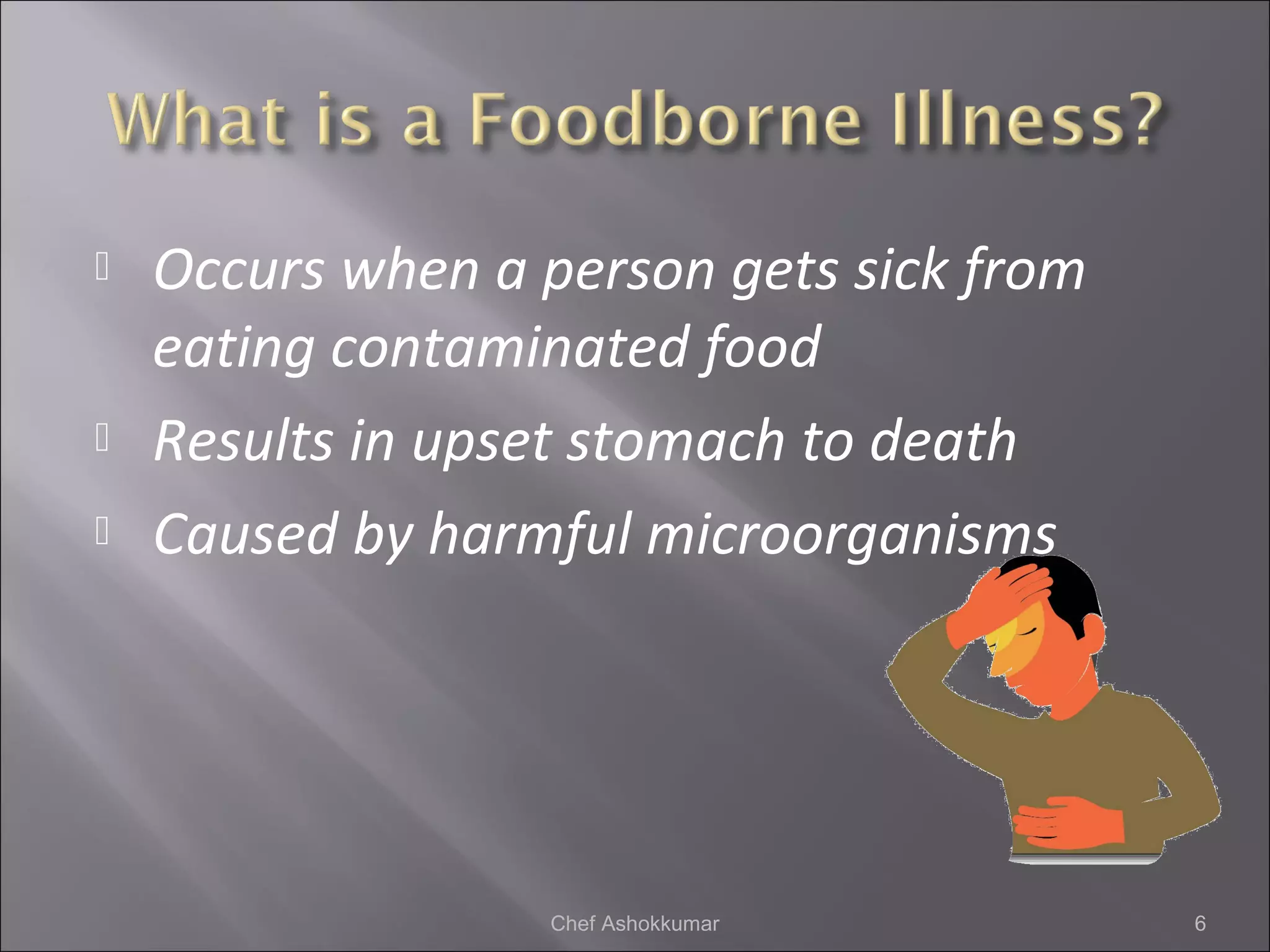
 Occurs when a person gets sick from
eating contaminated food
 Results in upset stomach to death
 Caused by harmful microorganisms
6Chef Ashokkumar
Centers for Disease Control and Prevention
 76 million illnesses
 325,000 hospitalizations
 5,000 deaths
7Chef Ashokkumar
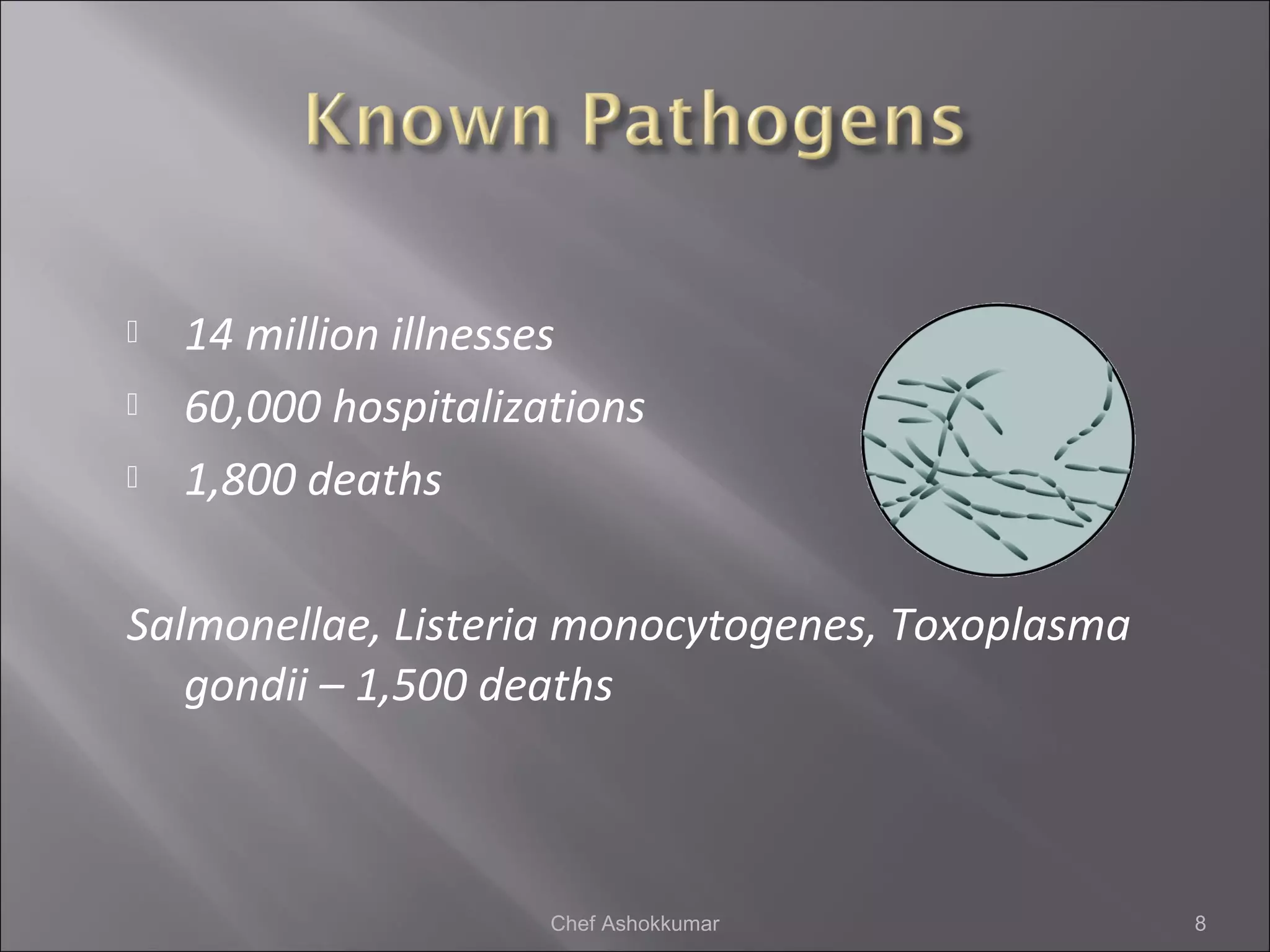
 14 million illnesses
 60,000 hospitalizations
 1,800 deaths
Salmonellae, Listeria monocytogenes, Toxoplasma
gondii – 1,500 deaths
8Chef Ashokkumar
 “At-Risk People”
 New microbes
 New research findings
 Use of fresh produce
9Chef Ashokkumar
 Food prepared away from home
 International marketing and travel
 Consolidation of food production/ processing
 Food industry employees
 Employee turnover rates
10Chef Ashokkumar
 Flu-like symptoms
 Children: may be life threatening
 Chronic illnesses
Hemolytic uremic syndrome, Guillain-
Barre syndrome, or reactive arthritis
11Chef Ashokkumar
 Legal fees
 Medical claims
 Lost wages
 Cleaning and sanitizing costs
 Food that must be discarded
12Chef Ashokkumar
 Bad publicity
 Loss of confidence in facility
 Embarrassment/remorse
 Closing of facility
13Chef Ashokkumar
 Holding food too long in temperature zone
(41o
F to 140o
F)
 Not heating or cooking to proper
temperature
 Not cooling properly (to 70o
F or lower
within 2 hours, and from 70o
F to 41o
F
within 4 hours)
14Chef Ashokkumar
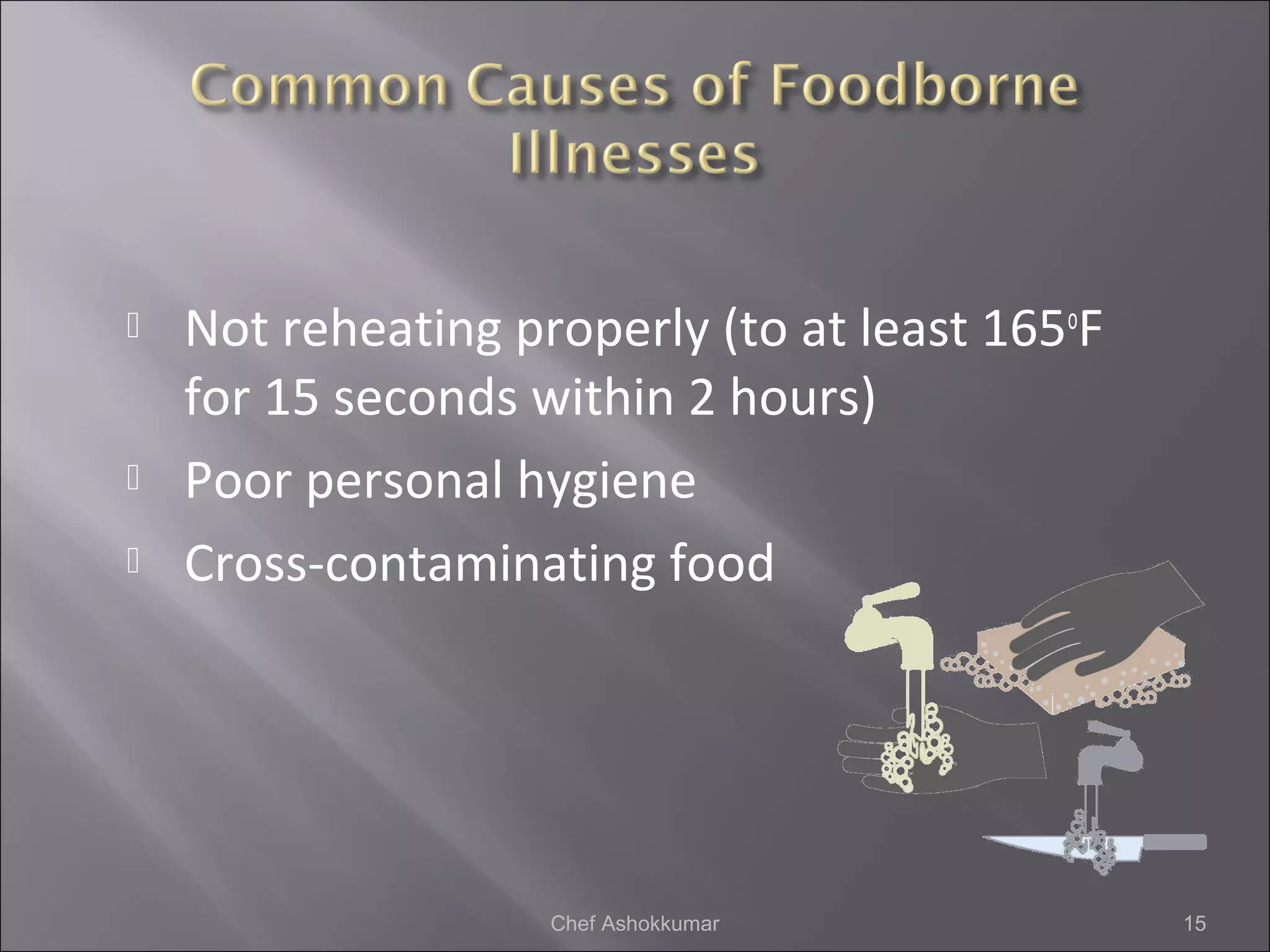
 Not reheating properly (to at least 165o
F
for 15 seconds within 2 hours)
 Poor personal hygiene
 Cross-contaminating food
15Chef Ashokkumar
 The transfer of harmful substances or
microorganisms to food by other food,
equipment and/or utensils, and people
 Causes
Improper food handling practices
Poor employee personal hygiene
Improper cleaning and sanitizing of
equipment/utensils
16Chef Ashokkumar
People are main agents of cross-
contamination
So, it is important to:
 Follow practices to prevent cross-contamination
 Follow time/temp control to prevent the growth
of microorganisms in food
17Chef Ashokkumar
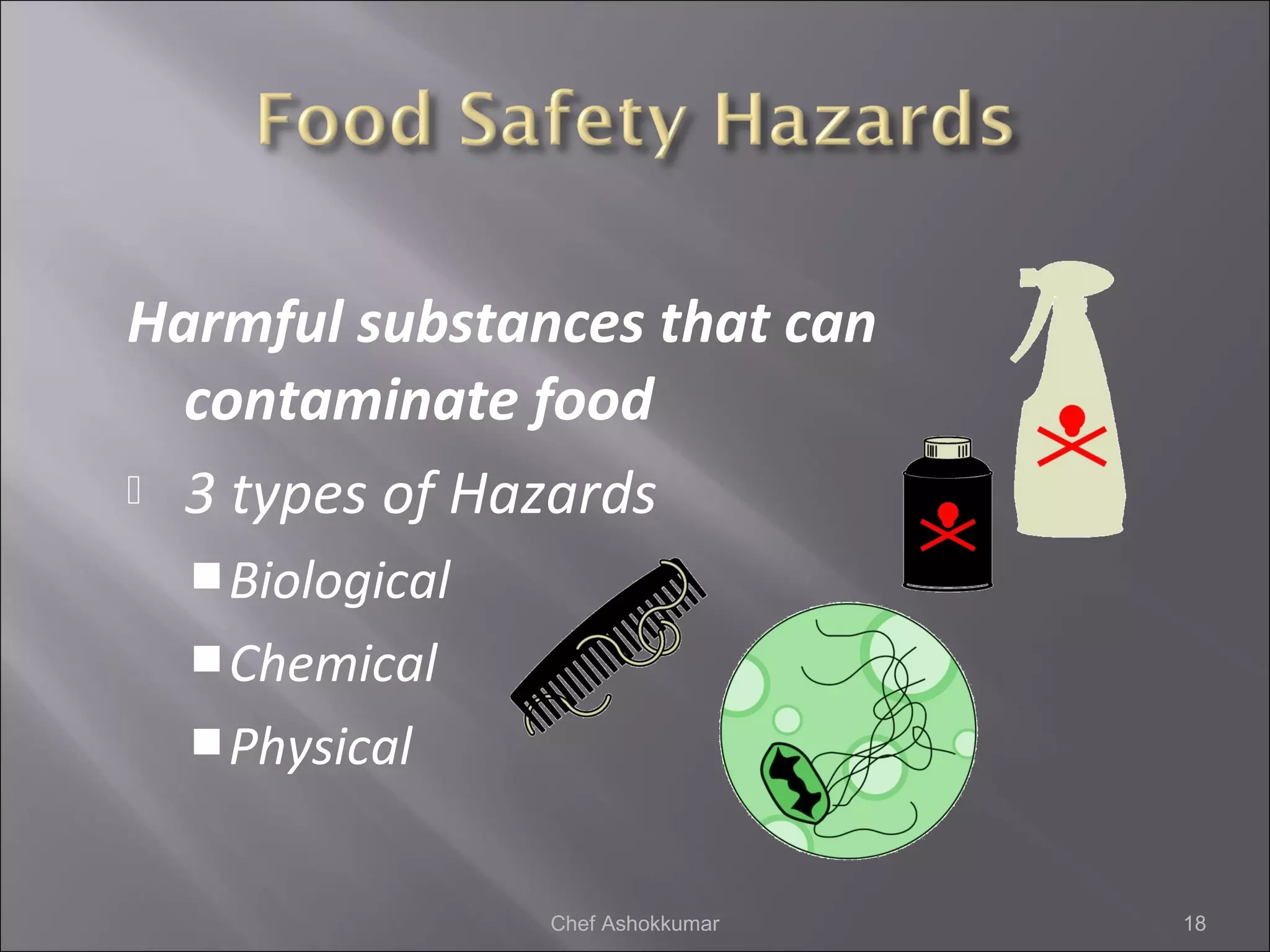
Harmful substances that can
contaminate food
 3 types of Hazards
Biological
Chemical
Physical
18Chef Ashokkumar
 Include bacteria, viruses, parasites, and
fungi that can cause illness
 Are present in natural environment where
food is grown
 Cause more food borne illnesses than other
hazards
19Chef Ashokkumar
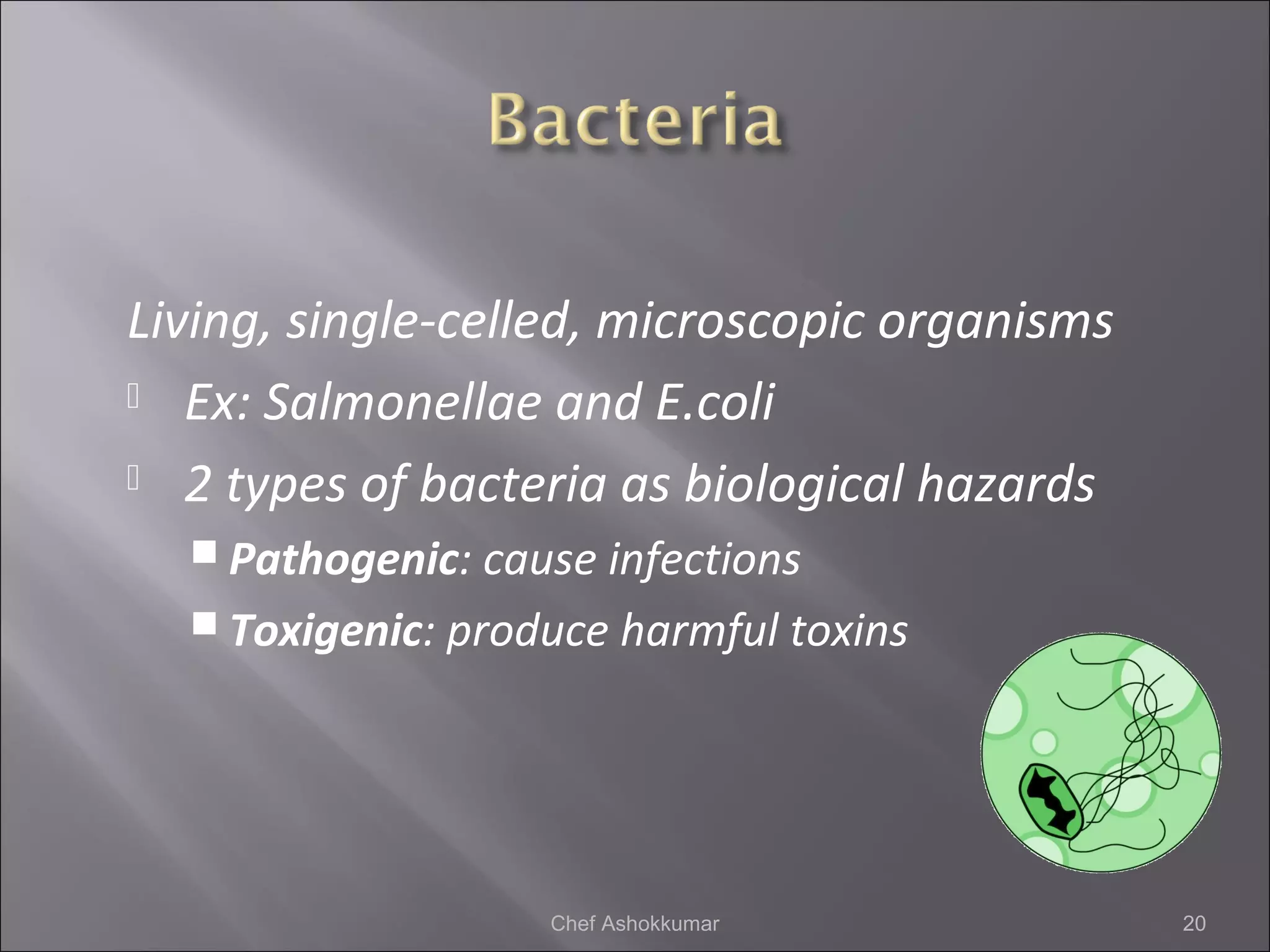
Living, single-celled, microscopic organisms
 Ex: Salmonellae and E.coli
 2 types of bacteria as biological hazards
 Pathogenic: cause infections
 Toxigenic: produce harmful toxins
20Chef Ashokkumar
Can be transmitted by
 Water
 Wind
 Insects
 Plants
 Animals
 People
21Chef Ashokkumar
Thrive in
 Scabs and wounds
 The mouth, nose, throat
 Intestines
 Foods from plants and animals that are
 Warm, moist, rich in protein, and neutral or low
in acid
22Chef Ashokkumar
 Can survive on clothes, skin, and hair
 Some survive freezing, or high temperatures
 Can be prevented from causing foodborne
illnesses by proper time/temperature
controls
23Chef Ashokkumar
Small, simple, incomplete particles
- Ex: Hepatitis A virus
 Transmitted by
Water and food
People and animals
Utensils and equipment
Food-contact areas
24Chef Ashokkumar
 May survive freezing and cooking
 Need living host cells
 Cannot
Live by themselves
Grow and multiply on food
25Chef Ashokkumar
To keep viruses from causing foodborne
illnesses
 Prevent cross-contamination
 Practice proper personal hygiene
 Realize the importance of handwashing
26Chef Ashokkumar
A group of organisms that range from
microscopic, single-celled to very
large multicellular organisms
 Ex: molds, yeasts, and mushrooms
27Chef Ashokkumar
Grow as a tangled, fuzzy mass; can spread
rapidly
 Grow on most foods at most storage
temperatures
 Some, on cheeses, are a natural part of the
food
 Molds can spoil food by discoloration and
unpleasant smell and taste
28Chef Ashokkumar
Some produce toxins linked to cancer
in animals
• Cause serious infections and
allergies
• Discard moldy foods where mold is
not a natural part of the food
29Chef Ashokkumar
 Spoil food by consuming them
 Require sugar and moisture to survive
 Produce carbon dioxide and alcohol
 Cause pink discoloration or sliminess
 Cause food to bubble
 No evidence that yeasts cause foodborne
illness
 Spoiled food should be discarded
30Chef Ashokkumar
Organisms that need a host to survive
 Hosts are people, animals, or plants
 Ex: Toxoplasma gondii and Trichinella
spiralis
31Chef Ashokkumar
 Infections are caused by
 Undercooked meats, fish
 Cross-contamination
 Eliminate parasites from causing
foodborne illnesses
 Cook foods to proper internal temperatures
 Prevent cross-contamination
 Use frozen foods
32Chef Ashokkumar
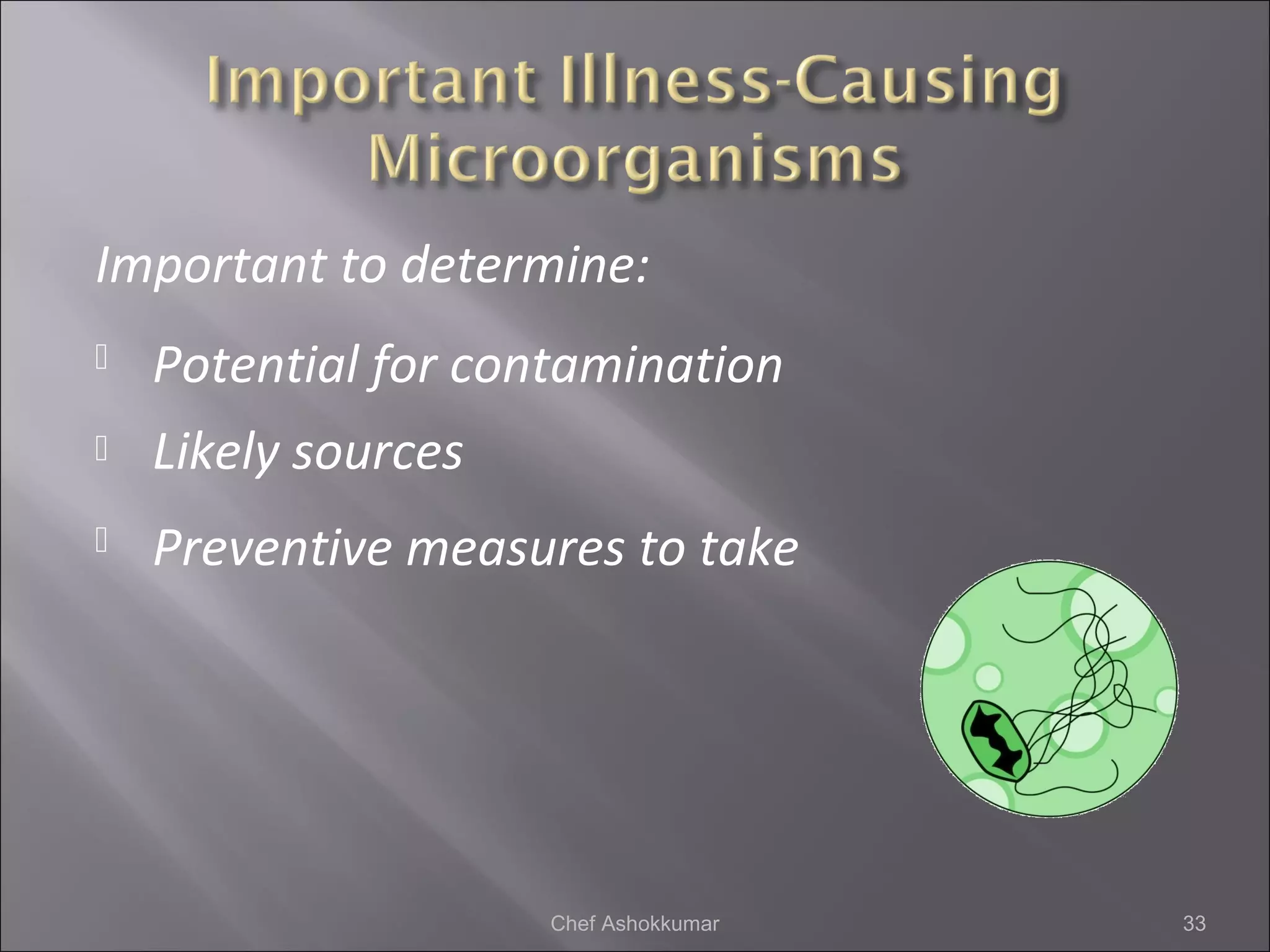
Important to determine:
 Potential for contamination
 Likely sources
 Preventive measures to take
33Chef Ashokkumar
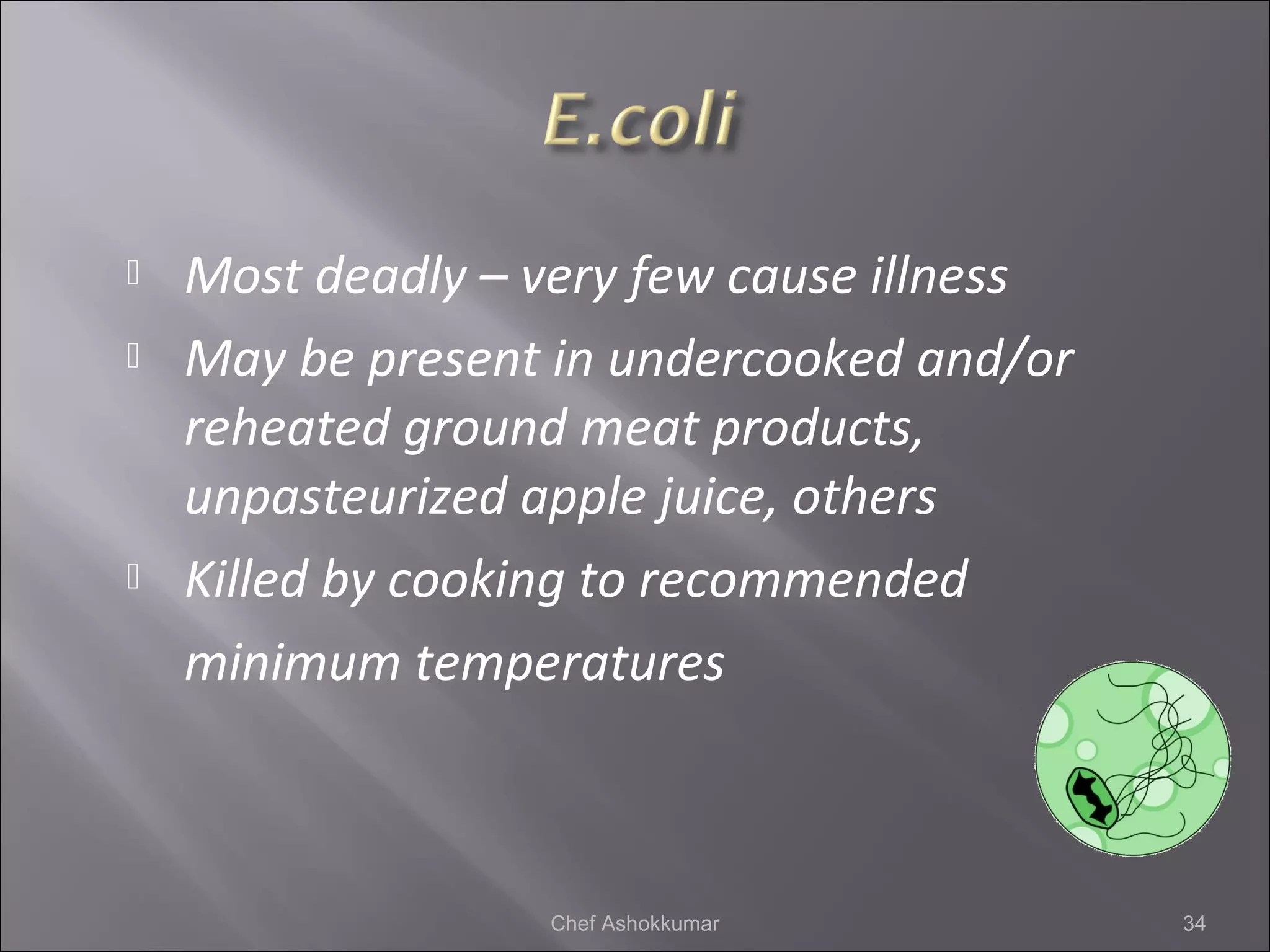
 Most deadly – very few cause illness
 May be present in undercooked and/or
reheated ground meat products,
unpasteurized apple juice, others
 Killed by cooking to recommended
minimum temperatures
34Chef Ashokkumar
 Very dangerous to children
 Responsible for thousands of illnesses
each year
 Found in raw or undercooked foods:
poultry, eggs, and meat
 Killed by properly cooking foods
35Chef Ashokkumar
 Especially harmful to pregnant women and
the unborn
 Grow slowly under refrigeration
 Found in high moisture areas
 Killed by pasteurization and cooking
 Controlled by
 Cold storage temperature and time
 Keeping facility clean and dry
 Proper reheating of cold-stored foods
36Chef Ashokkumar
 Transmitted through contaminated
water, raw milk, raw or undercooked
meat, poultry, and shellfish
 Killed by proper cooking
 Cause many cases of illness, but not
large outbreaks
37Chef Ashokkumar
 Associated with grain foods
 Spores become active after cooking if
cooled slowly or if held too cool
(<140o
F)
 Controlled by hot holding at 140o
F or
higher
38Chef Ashokkumar
 “the cafeteria germ”
 Growth results from improper cooling,
reheating, holding
 Found in soil, dust, sewage, and
intestinal tracts of humans and animals
 Controlled by proper
cooking/cooling/reheating
39Chef Ashokkumar
 Transmitted by humans
 Found in cuts, skin, pimples, noses, and
throats
 Produce harmful toxin if contaminated food
out of temperature
 Controlled by personal hygiene and by
holding procedures
 Killed by proper cooking – but, toxin, once
formed, is NOT affected by heat
40Chef Ashokkumar
 Produce toxin - affect nervous system
 May be fatal if not treated
 Have been found in improperly canned
foods, garlic in oil, vacuum-packed food,
hazelnut yogurt, salsa, cheese sauce
 Controlled by proper hot and cold holding
temps
 AND, do NOT vacuum pack food in your
facility
41Chef Ashokkumar
 Cause inflammation of the liver
 Often transferred by an infected employee
 May be carried in cold cuts, sandwiches,
fruits, vegetables, and milk products
 Controlled by sanitation and good personal
hygiene
42Chef Ashokkumar
 Harmful parasites, outdoor cats are hosts
 May live in undercooked meat
 Cause toxoplasmosis; an infection of the
central nervous system
 Children/pregnant women “at risk”
 Transmitted by cross-contamination
 Controlled by proper cooking, hygiene, and
sanitation – keep cats off home countertops
43Chef Ashokkumar
Meat and poultry products; plants
 Main sources of organisms
 Contaminated through growing conditions,
slaughter and processing or cross-
contamination
 Controls needed from farm to table to
prevent food borne illness
44Chef Ashokkumar
 New illness-causing microorganisms
“Emerging” and “re-emerging”
organisms
 HACCP reduces likelihood of
foodborne illness
45Chef Ashokkumar
 Raw food may contain organisms
 Improper cooking, holding, etc. allow growth
 New contamination may occur during
preparation, holding, etc
 People may contaminate
 Unsanitary facilities and equipment may
contaminate
 Pests may contaminate
46Chef Ashokkumar
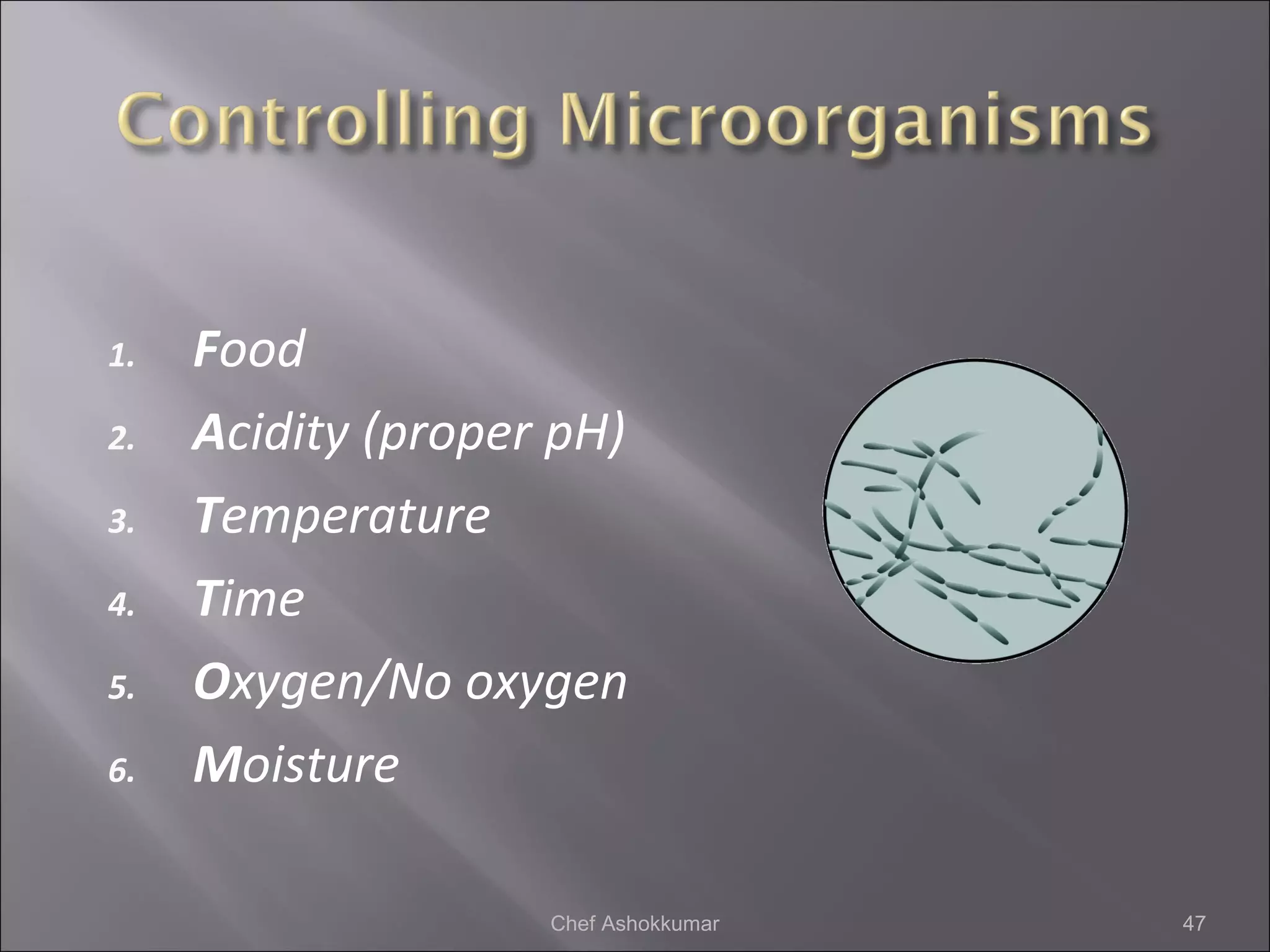
1. Food
2. Acidity (proper pH)
3. Temperature
4. Time
5. Oxygen/No oxygen
6. Moisture
47Chef Ashokkumar
 Limit amount of time food is in
temperature zone (41o
F to 140o
F)
 Use hot and cold temperature controls
 Dry food
 Add vinegar, lemon juice, lactic acid, or
citric acid to make food more acidic
Food services focus on time and
temperature
48Chef Ashokkumar
Through:
 Foundation of prerequisite
programs
 HACCP implementation
49Chef Ashokkumar
Chemicals that may contaminate food:
 Naturally occurring chemicals
 Chemicals added during processing
 Chemicals used for cleaning,
sanitizing, and pest control
 Toxic metal in cookware
 Personal products
50Chef Ashokkumar
3 Categories:
 Natural toxicants
 Added chemicals
 Food additives
51Chef Ashokkumar
 Sanitizers and cleaners
 Detergents
 Polishes
 Caustics
 Cleaning and drying agents
 Pesticides
 Lubricants
52Chef Ashokkumar
 Keep cleaners/sanitizers in original
containers with clear labels
 Store cleaners/sanitizers separately
from food
 Use proper amount of chemicals
 Wash hands when through with
chemicals
53Chef Ashokkumar
 Wash fresh produce with plain water, brush
 Monitor pest control operators
 Keep food covered during pesticide
applications
 Clean and sanitize equipment that may
have come into contact with pesticide
 Limit access to chemicals
54Chef Ashokkumar
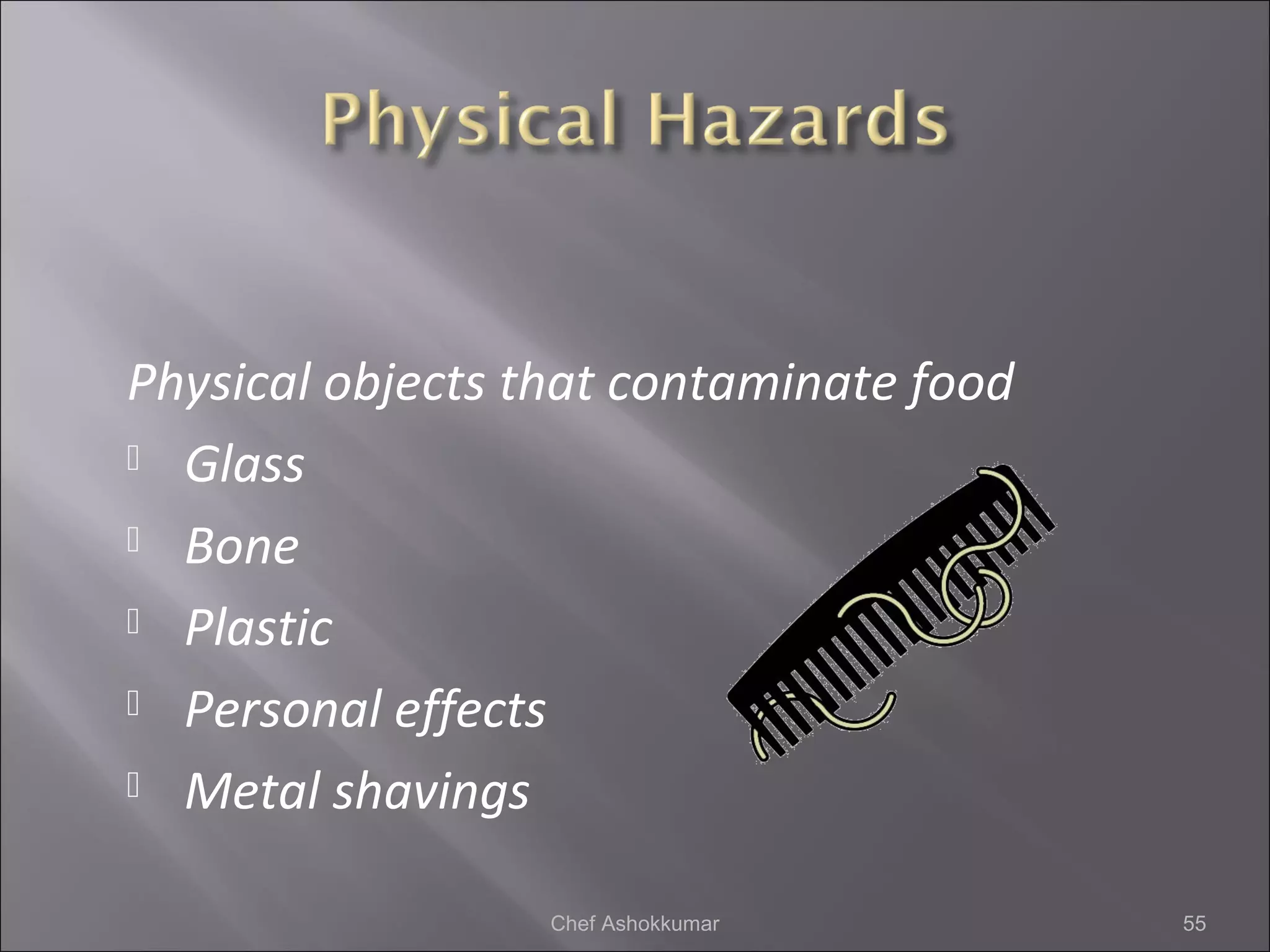
Physical objects that contaminate food
 Glass
 Bone
 Plastic
 Personal effects
 Metal shavings
55Chef Ashokkumar
• Inspect equipment
• Avoid temporary “make-shift” repairs
• Remove staples from food boxes
• Use razor blades in secure devices
• Inspect raw materials
• Wear proper attire
• Avoid loose jewelry, acrylic nails, polish
• Use proper hair restraints
56Chef Ashokkumar
• Store food in approved containers and bags
• Use commercial scoops to scoop ice
• Use separate ice for storage and for
beverages
• Store toothpicks and non-edibles away
from prep area
• Cover glass bulbs in preparation area
• Regularly clean can openers
• Throw away broken or chipped tableware
57Chef Ashokkumar
 Establish sound prerequisite programs
 Know food hazards: biological,
chemical and physical
 Implement regular employee training
program
58Chef Ashokkumar
 Develop and implement sound HACCP
program based on seven principles
 Be committed to safe food – safe
customers
59Chef Ashokkumar
John cuts up uncooked chicken on a cutting
board and then rinses the knife and the
cutting board in warm water. Then, he
uses the same board to slice melons. What
is wrong with what he did? What
microorganisms could contaminate the
food because of this practice?
60Chef Ashokkumar
Your waiter served macaroni and cheese,
salad, and fresh apples for lunch. Two
children became sick. Their mothers
claim that it was from the food they ate
at lunch. The food service director says
that could not be possible because there
was no meat on the menu. Is this food
service director correct? Explain.
61Chef Ashokkumar
Jagan, a new employee, is unloading
some packets of raw materials that
have just arrived. The cover of one
box is torn. It is not known where the
tear occurred. What should he do with
the box of materials ?
62Chef Ashokkumar
Joy is putting some ingredients in the
refrigerator. He puts the lettuce salad
for today’s lunch under a pan of some
uncooked chicken. What is wrong
with what he did? Why?
63Chef Ashokkumar
Rajan is cooking some hamburger
patties for lunch. he cooks them
until they are brown and the juices
run clear. Then he puts them in a
warmer until they are ready to be
served. What is wrong with what
she did?
64Chef Ashokkumar
Biju is serving tuna noodle casserole for
lunch. He needs another pan of it but he
just started to reheat it. He needs to
serve it in a hurry. He touches the side of
the pan and it seems hot. He decides to
serve it as is. What is wrong with what
he did?
65Chef Ashokkumar
Maya is serving macaroni and cheese.
She is wearing gloves. Her eyes begin
to water and tear so she wipes away a
tear with the back of her hand. She
continues serving the macaroni and
cheese. What is wrong with what she
did?
66Chef Ashokkumar
Chicken Roast has been delivered to the
School from the Main kitchen. The delivery
truck was late and the maid needs to
serve the food right away. The containers
feel hot, so she does not check the
temperature before serving. What is
wrong with that?
67Chef Ashokkumar
Chicken fajitas have been delivered to the
ladies and Gentlemen at the cafeteria from
the Main kitchen. They are supposed to
arrive cold and the food service assistant is
to reheat them. When he takes the chicken
out of the boxes, the containers feel like
they are at room temperature. He reheats
the chicken for five minutes and then serves
it. What is wrong with what he did?
68Chef Ashokkumar
Ajit has just finished cutting up chicken. He
wipes that area he used with a clean cloth
and then rinses the cloth thoroughly. Later
he uses the same cloth to wipe out the
salad bowl before the lettuce salad is put
in it to be served for lunch. What is wrong
with what he did?
69Chef Ashokkumar
Anita has just finished cutting up melon. She
wipes the area she used with a clean cloth
and rinses the cloth thoroughly. She uses
the same cloth to wipe out the bowl before
the cut melon is put in it to be served for
lunch. What is wrong with what she did?
70Chef Ashokkumar

Contamination hazards and control

  • 1.
  • 2.
    1. Foodborne illnessesare mostly caused by physical hazards, such as fingernails, glass, etc. getting into food. 2. Young children are more susceptible to foodborne illnesses than adults. 3. Improperly cooled foods can lead to foodborne illnesses. 2Chef Ashokkumar
  • 3.
    4. Time andtemperature controls are the best methods to prevent microorganisms from growing in food. 5. The best way to prevent hazards from causing foodborne illness is to have good sanitation and personal hygiene programs. 3Chef Ashokkumar
  • 4.
    Be able to: •Explain what a foodborne illness is • Explain the dangers of foodborne illness • Explain why young children are at risk for foodborne illnesses • Identify some of the most important causes of foodborne illness 4Chef Ashokkumar
  • 5.
    • List severalimplications of foodborne illness • Explain what biological, chemical, and physical hazards are • List some microorganisms of greatest concern • Identify key practices for preventing food hazards from contaminating food 5Chef Ashokkumar
  • 6.
     Occurs whena person gets sick from eating contaminated food  Results in upset stomach to death  Caused by harmful microorganisms 6Chef Ashokkumar
  • 7.
    Centers for DiseaseControl and Prevention  76 million illnesses  325,000 hospitalizations  5,000 deaths 7Chef Ashokkumar
  • 8.
     14 millionillnesses  60,000 hospitalizations  1,800 deaths Salmonellae, Listeria monocytogenes, Toxoplasma gondii – 1,500 deaths 8Chef Ashokkumar
  • 9.
     “At-Risk People” New microbes  New research findings  Use of fresh produce 9Chef Ashokkumar
  • 10.
     Food preparedaway from home  International marketing and travel  Consolidation of food production/ processing  Food industry employees  Employee turnover rates 10Chef Ashokkumar
  • 11.
     Flu-like symptoms Children: may be life threatening  Chronic illnesses Hemolytic uremic syndrome, Guillain- Barre syndrome, or reactive arthritis 11Chef Ashokkumar
  • 12.
     Legal fees Medical claims  Lost wages  Cleaning and sanitizing costs  Food that must be discarded 12Chef Ashokkumar
  • 13.
     Bad publicity Loss of confidence in facility  Embarrassment/remorse  Closing of facility 13Chef Ashokkumar
  • 14.
     Holding foodtoo long in temperature zone (41o F to 140o F)  Not heating or cooking to proper temperature  Not cooling properly (to 70o F or lower within 2 hours, and from 70o F to 41o F within 4 hours) 14Chef Ashokkumar
  • 15.
     Not reheatingproperly (to at least 165o F for 15 seconds within 2 hours)  Poor personal hygiene  Cross-contaminating food 15Chef Ashokkumar
  • 16.
     The transferof harmful substances or microorganisms to food by other food, equipment and/or utensils, and people  Causes Improper food handling practices Poor employee personal hygiene Improper cleaning and sanitizing of equipment/utensils 16Chef Ashokkumar
  • 17.
    People are mainagents of cross- contamination So, it is important to:  Follow practices to prevent cross-contamination  Follow time/temp control to prevent the growth of microorganisms in food 17Chef Ashokkumar
  • 18.
    Harmful substances thatcan contaminate food  3 types of Hazards Biological Chemical Physical 18Chef Ashokkumar
  • 19.
     Include bacteria,viruses, parasites, and fungi that can cause illness  Are present in natural environment where food is grown  Cause more food borne illnesses than other hazards 19Chef Ashokkumar
  • 20.
    Living, single-celled, microscopicorganisms  Ex: Salmonellae and E.coli  2 types of bacteria as biological hazards  Pathogenic: cause infections  Toxigenic: produce harmful toxins 20Chef Ashokkumar
  • 21.
    Can be transmittedby  Water  Wind  Insects  Plants  Animals  People 21Chef Ashokkumar
  • 22.
    Thrive in  Scabsand wounds  The mouth, nose, throat  Intestines  Foods from plants and animals that are  Warm, moist, rich in protein, and neutral or low in acid 22Chef Ashokkumar
  • 23.
     Can surviveon clothes, skin, and hair  Some survive freezing, or high temperatures  Can be prevented from causing foodborne illnesses by proper time/temperature controls 23Chef Ashokkumar
  • 24.
    Small, simple, incompleteparticles - Ex: Hepatitis A virus  Transmitted by Water and food People and animals Utensils and equipment Food-contact areas 24Chef Ashokkumar
  • 25.
     May survivefreezing and cooking  Need living host cells  Cannot Live by themselves Grow and multiply on food 25Chef Ashokkumar
  • 26.
    To keep virusesfrom causing foodborne illnesses  Prevent cross-contamination  Practice proper personal hygiene  Realize the importance of handwashing 26Chef Ashokkumar
  • 27.
    A group oforganisms that range from microscopic, single-celled to very large multicellular organisms  Ex: molds, yeasts, and mushrooms 27Chef Ashokkumar
  • 28.
    Grow as atangled, fuzzy mass; can spread rapidly  Grow on most foods at most storage temperatures  Some, on cheeses, are a natural part of the food  Molds can spoil food by discoloration and unpleasant smell and taste 28Chef Ashokkumar
  • 29.
    Some produce toxinslinked to cancer in animals • Cause serious infections and allergies • Discard moldy foods where mold is not a natural part of the food 29Chef Ashokkumar
  • 30.
     Spoil foodby consuming them  Require sugar and moisture to survive  Produce carbon dioxide and alcohol  Cause pink discoloration or sliminess  Cause food to bubble  No evidence that yeasts cause foodborne illness  Spoiled food should be discarded 30Chef Ashokkumar
  • 31.
    Organisms that needa host to survive  Hosts are people, animals, or plants  Ex: Toxoplasma gondii and Trichinella spiralis 31Chef Ashokkumar
  • 32.
     Infections arecaused by  Undercooked meats, fish  Cross-contamination  Eliminate parasites from causing foodborne illnesses  Cook foods to proper internal temperatures  Prevent cross-contamination  Use frozen foods 32Chef Ashokkumar
  • 33.
    Important to determine: Potential for contamination  Likely sources  Preventive measures to take 33Chef Ashokkumar
  • 34.
     Most deadly– very few cause illness  May be present in undercooked and/or reheated ground meat products, unpasteurized apple juice, others  Killed by cooking to recommended minimum temperatures 34Chef Ashokkumar
  • 35.
     Very dangerousto children  Responsible for thousands of illnesses each year  Found in raw or undercooked foods: poultry, eggs, and meat  Killed by properly cooking foods 35Chef Ashokkumar
  • 36.
     Especially harmfulto pregnant women and the unborn  Grow slowly under refrigeration  Found in high moisture areas  Killed by pasteurization and cooking  Controlled by  Cold storage temperature and time  Keeping facility clean and dry  Proper reheating of cold-stored foods 36Chef Ashokkumar
  • 37.
     Transmitted throughcontaminated water, raw milk, raw or undercooked meat, poultry, and shellfish  Killed by proper cooking  Cause many cases of illness, but not large outbreaks 37Chef Ashokkumar
  • 38.
     Associated withgrain foods  Spores become active after cooking if cooled slowly or if held too cool (<140o F)  Controlled by hot holding at 140o F or higher 38Chef Ashokkumar
  • 39.
     “the cafeteriagerm”  Growth results from improper cooling, reheating, holding  Found in soil, dust, sewage, and intestinal tracts of humans and animals  Controlled by proper cooking/cooling/reheating 39Chef Ashokkumar
  • 40.
     Transmitted byhumans  Found in cuts, skin, pimples, noses, and throats  Produce harmful toxin if contaminated food out of temperature  Controlled by personal hygiene and by holding procedures  Killed by proper cooking – but, toxin, once formed, is NOT affected by heat 40Chef Ashokkumar
  • 41.
     Produce toxin- affect nervous system  May be fatal if not treated  Have been found in improperly canned foods, garlic in oil, vacuum-packed food, hazelnut yogurt, salsa, cheese sauce  Controlled by proper hot and cold holding temps  AND, do NOT vacuum pack food in your facility 41Chef Ashokkumar
  • 42.
     Cause inflammationof the liver  Often transferred by an infected employee  May be carried in cold cuts, sandwiches, fruits, vegetables, and milk products  Controlled by sanitation and good personal hygiene 42Chef Ashokkumar
  • 43.
     Harmful parasites,outdoor cats are hosts  May live in undercooked meat  Cause toxoplasmosis; an infection of the central nervous system  Children/pregnant women “at risk”  Transmitted by cross-contamination  Controlled by proper cooking, hygiene, and sanitation – keep cats off home countertops 43Chef Ashokkumar
  • 44.
    Meat and poultryproducts; plants  Main sources of organisms  Contaminated through growing conditions, slaughter and processing or cross- contamination  Controls needed from farm to table to prevent food borne illness 44Chef Ashokkumar
  • 45.
     New illness-causingmicroorganisms “Emerging” and “re-emerging” organisms  HACCP reduces likelihood of foodborne illness 45Chef Ashokkumar
  • 46.
     Raw foodmay contain organisms  Improper cooking, holding, etc. allow growth  New contamination may occur during preparation, holding, etc  People may contaminate  Unsanitary facilities and equipment may contaminate  Pests may contaminate 46Chef Ashokkumar
  • 47.
    1. Food 2. Acidity(proper pH) 3. Temperature 4. Time 5. Oxygen/No oxygen 6. Moisture 47Chef Ashokkumar
  • 48.
     Limit amountof time food is in temperature zone (41o F to 140o F)  Use hot and cold temperature controls  Dry food  Add vinegar, lemon juice, lactic acid, or citric acid to make food more acidic Food services focus on time and temperature 48Chef Ashokkumar
  • 49.
    Through:  Foundation ofprerequisite programs  HACCP implementation 49Chef Ashokkumar
  • 50.
    Chemicals that maycontaminate food:  Naturally occurring chemicals  Chemicals added during processing  Chemicals used for cleaning, sanitizing, and pest control  Toxic metal in cookware  Personal products 50Chef Ashokkumar
  • 51.
    3 Categories:  Naturaltoxicants  Added chemicals  Food additives 51Chef Ashokkumar
  • 52.
     Sanitizers andcleaners  Detergents  Polishes  Caustics  Cleaning and drying agents  Pesticides  Lubricants 52Chef Ashokkumar
  • 53.
     Keep cleaners/sanitizersin original containers with clear labels  Store cleaners/sanitizers separately from food  Use proper amount of chemicals  Wash hands when through with chemicals 53Chef Ashokkumar
  • 54.
     Wash freshproduce with plain water, brush  Monitor pest control operators  Keep food covered during pesticide applications  Clean and sanitize equipment that may have come into contact with pesticide  Limit access to chemicals 54Chef Ashokkumar
  • 55.
    Physical objects thatcontaminate food  Glass  Bone  Plastic  Personal effects  Metal shavings 55Chef Ashokkumar
  • 56.
    • Inspect equipment •Avoid temporary “make-shift” repairs • Remove staples from food boxes • Use razor blades in secure devices • Inspect raw materials • Wear proper attire • Avoid loose jewelry, acrylic nails, polish • Use proper hair restraints 56Chef Ashokkumar
  • 57.
    • Store foodin approved containers and bags • Use commercial scoops to scoop ice • Use separate ice for storage and for beverages • Store toothpicks and non-edibles away from prep area • Cover glass bulbs in preparation area • Regularly clean can openers • Throw away broken or chipped tableware 57Chef Ashokkumar
  • 58.
     Establish soundprerequisite programs  Know food hazards: biological, chemical and physical  Implement regular employee training program 58Chef Ashokkumar
  • 59.
     Develop andimplement sound HACCP program based on seven principles  Be committed to safe food – safe customers 59Chef Ashokkumar
  • 60.
    John cuts upuncooked chicken on a cutting board and then rinses the knife and the cutting board in warm water. Then, he uses the same board to slice melons. What is wrong with what he did? What microorganisms could contaminate the food because of this practice? 60Chef Ashokkumar
  • 61.
    Your waiter servedmacaroni and cheese, salad, and fresh apples for lunch. Two children became sick. Their mothers claim that it was from the food they ate at lunch. The food service director says that could not be possible because there was no meat on the menu. Is this food service director correct? Explain. 61Chef Ashokkumar
  • 62.
    Jagan, a newemployee, is unloading some packets of raw materials that have just arrived. The cover of one box is torn. It is not known where the tear occurred. What should he do with the box of materials ? 62Chef Ashokkumar
  • 63.
    Joy is puttingsome ingredients in the refrigerator. He puts the lettuce salad for today’s lunch under a pan of some uncooked chicken. What is wrong with what he did? Why? 63Chef Ashokkumar
  • 64.
    Rajan is cookingsome hamburger patties for lunch. he cooks them until they are brown and the juices run clear. Then he puts them in a warmer until they are ready to be served. What is wrong with what she did? 64Chef Ashokkumar
  • 65.
    Biju is servingtuna noodle casserole for lunch. He needs another pan of it but he just started to reheat it. He needs to serve it in a hurry. He touches the side of the pan and it seems hot. He decides to serve it as is. What is wrong with what he did? 65Chef Ashokkumar
  • 66.
    Maya is servingmacaroni and cheese. She is wearing gloves. Her eyes begin to water and tear so she wipes away a tear with the back of her hand. She continues serving the macaroni and cheese. What is wrong with what she did? 66Chef Ashokkumar
  • 67.
    Chicken Roast hasbeen delivered to the School from the Main kitchen. The delivery truck was late and the maid needs to serve the food right away. The containers feel hot, so she does not check the temperature before serving. What is wrong with that? 67Chef Ashokkumar
  • 68.
    Chicken fajitas havebeen delivered to the ladies and Gentlemen at the cafeteria from the Main kitchen. They are supposed to arrive cold and the food service assistant is to reheat them. When he takes the chicken out of the boxes, the containers feel like they are at room temperature. He reheats the chicken for five minutes and then serves it. What is wrong with what he did? 68Chef Ashokkumar
  • 69.
    Ajit has justfinished cutting up chicken. He wipes that area he used with a clean cloth and then rinses the cloth thoroughly. Later he uses the same cloth to wipe out the salad bowl before the lettuce salad is put in it to be served for lunch. What is wrong with what he did? 69Chef Ashokkumar
  • 70.
    Anita has justfinished cutting up melon. She wipes the area she used with a clean cloth and rinses the cloth thoroughly. She uses the same cloth to wipe out the bowl before the cut melon is put in it to be served for lunch. What is wrong with what she did? 70Chef Ashokkumar

Editor's Notes

  • #10 Children-More likely to become seriously ill that adults Inadequate immune systems Evolving- Pathogens unknown to humans Research- New practices for controlling and eliminating microorganisms Produce- Contaminated water, production chemicals Improper handling
  • #11 Reliance-Mishandling 50 billion meals away from home per day International- Different food traditions and handling practices Increased exposure Consolidation- Magnified mistakes in large production Employee- Difficult to be effective
  • #18 CNP employees must: Follow prevention practices Know common causes of foodborne illness Do all that is possible to eliminate them