ℂ𝕃𝔼𝔸ℕ𝕃𝕀ℕ𝔼𝕊𝕊
&
𝔽𝕆𝕆𝔻 𝕊𝔸𝔽𝔼𝕋𝕐
𝚂𝚊𝚗𝚒𝚝𝚊𝚝𝚒𝚘𝚗
• Creation and maintenance of conditions that will
prevent food contamination or food-borne illness.
𝙲𝚘𝚗𝚝𝚊𝚖𝚒𝚗𝚊𝚝𝚒𝚘𝚗
• Refers to the presence, generally unintended, of
harmful organisms or substances.
• Contaminants can be biological, chemical or
physical.
• When consume in sufficient quantities, food-borne
contaminants can cause illness/injury, long lasting
disease or even deaths.
Contamination occur in 2 ways,
1. Direct Contamination
- contamination of raw foods, plants or animals from
which they come, in their natural settings or
habitats.
Figure 2.2> Most bacteria reproduce by binary
fission. Each bacterium can divide every 15-30 min.
within 12hrs. One bacterium can become a colony of
72 billion bacteria more than enough. That's why it
takes only a very short time for one bacterium to
produce millions more that may cause serious illness.
• Putrefectives- a human consumption bacteria.
Rod-shaped bacteria (bacillus)- capable of forming
spores. Spores is a thick-walled structures used as
protection against a hostile environment.
• Pathogen- bacteria that are dangerous when
consumed by humans. It must be destroyed or
controlled in a food service operation because it can
cause illness in one of three ways by intoxication,
infection or toxin-mediated infection.
2. Infection
- Salmonella is a well known example
- Occurs when live pathogenic bacteria are
ingested.
- Bacteria will live in consumer's intestinal tract.
- It is a living bacteria, not their waste products,
that cause illness.
- Fortunately, it can be destroyed by cooking foods
to sufficiently high temperatures, usually 165°F
(74°C) or higher.
3. Toxin-mediated infection
- Both intoxication & infection
- Clostridium perfringens and Escbericbia coli are well
known example
- When these living organisms ingested, they establish
colonies in human or animal intestinal tracts, where
they then produce toxins.
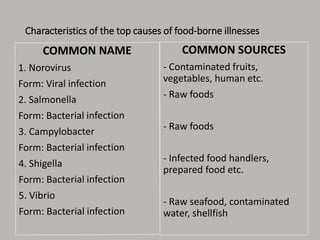
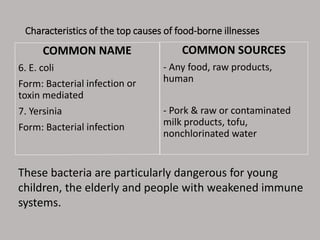
Characteristics of the top causes of food-borne illnesses
COMMON SOURCES
- Contaminated fruits,
vegetables, human etc.
- Raw foods
- Raw foods
- Infected food handlers,
prepared food etc.
- Raw seafood, contaminated
water, shellfish
Characteristics of the top causes of food-borne illnesses
COMMON SOURCES
- Any food, raw products,
human
- Pork & raw or contaminated
milk products, tofu,
nonchlorinated water
These bacteria are particularly dangerous for young
children, the elderly and people with weakened immune
systems.
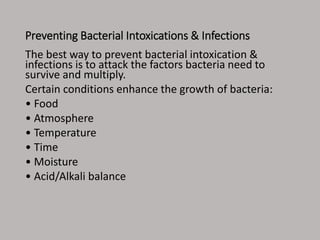
Preventing Bacterial Intoxications & Infections
The best way to prevent bacterial intoxication &
infections is to attack the factors bacteria need to
survive and multiply.
Certain conditions enhance the growth of bacteria:
• Food
• Atmosphere
• Temperature
• Time
• Moisture
• Acid/Alkali balance
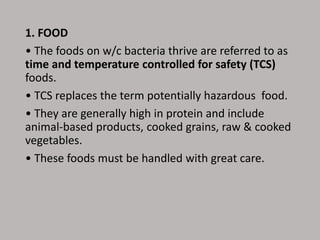
1. FOOD
• The foods on w/c bacteria thrive are referred to as
time and temperature controlled for safety (TCS)
foods.
• TCS replaces the term potentially hazardous food.
• They are generally high in protein and include
animal-based products, cooked grains, raw & cooked
vegetables.
• These foods must be handled with great care.
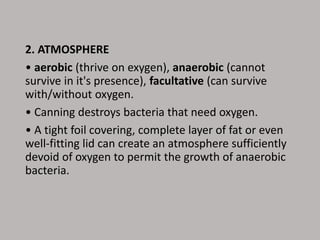
2. ATMOSPHERE
• aerobic (thrive on exygen), anaerobic (cannot
survive in it's presence), facultative (can survive
with/without oxygen.
• Canning destroys bacteria that need oxygen.
• A tight foil covering, complete layer of fat or even
well-fitting lid can create an atmosphere sufficiently
devoid of oxygen to permit the growth of anaerobic
bacteria.
PARASITES
- tiny organisms that depend on nutrients from a
living host to complete their life cycle.
TRICHINOSIS
- caused by eating undercooked meat.
- Scientists have now determined that trichina larvae
are killed if held at 137°F (58°C) for 10 seconds.
ANISAKIASIS
- another illness caused by parasitic roundworms.
- raw or undercooked fish are most often implicated
in anisakiasis.
- Through cooking to a minimum internal
temperature of 135°F (57°C) is the only way to
destroy the larvae, as they can survive even highly
acidic marinades.
CYCLOSPORA
- infections caused by a single-celled parasite found
in water or food contaminated by infected feces.
VIRUSES
- cause other biologically based food-borne illness
such as Hepatitis A & Norovirus.
- smallest known forms of life.
- They invade the living cells of a host, take over
those cells' genetic material and cause the cells to
produce more viruses.
- destroyed by temperatures higher than 176°F
(80°C).
- Basically, one way to prevent food-borne viral
ilnesses is to prevent contamination.
HEPATITIS A
- often enters the food supply through shellfish
harvested from polluted water.
- the virus is carried by humans, some of whom may
never know they are infected and is transmitted by
poor personal hygiene & cross contamination.
NOROVIRUS
- found in human feces, contaminated water or
vegetables fertilized by manure.
- has even been found in ice cubes
- destroyed by high cooking temperature.
FUNGI
- large group of plants ranging from single-celled
organisms to giant mushrooms.
- everywhere in the soil, air & water.
- Poisonous mushrooms, a type of fungus, can cause
illness or death if consumed.
- most common fungi: molds & yeasts
1. Molds- form long filaments or strands.
-Foods that develop mold should be discarded, and
any container or storage area cleaned & sanitized.
2. Yeasts- require water & carbohydrates for survival.
Fermentation- great benefit in making breads &
alcoholic beverages.
- haven't been proven to be harmful to humans.
However, it can cause foods to spoil, and develop off-
flavors, odors & discoloration.
CHEMICAL CONTAMINANTS
> Contamination of foods by a wide variety of
chemicals is a very real and serious danger in which
the public has shown a strong interest.
> usually inadvertent and invisible
Chemical hazards include contamination with the
following:
1. Residual Chemicals
2. Food Service Chemicals
3. Toxic Metals
1. Residual Chemicals
- used in growing food supply.
- such as antibiotics, fertilizers, insecticides &
herbicides
2. Food Service Chemicals
- Cleaners, polishes, pesticides & abrasives are often
poisonous to humans.
- All cleaning chemicals should clearly labeled and
stored well away from food preparation.
3. Toxic Metals
- when metals are dispersed in food & water.
- consuming any metals can cause poisoning.
PHYSICAL CONTAMINANTS
> Include foreign objects that find their way into
foods by mistake.
> metal shavings created by worn can openers,
pieces of glass from a broken container, hair and dirt.
> Most likely the result of poor safety and sanitation
practices or a lack of training.
2. Cross Contamination- the process by which bacteria
or other microorganisms are unintentionally
transferred from one substance or object to another,
with harmful effect.
Reducing Cross-Contamination
1. Personal Cleanliness
To produce clean, sanitary food, all food handlers must
maintain high standards of personal cleanliness &
hygiene. This begins with good grooming.
2. Dish & Equipment Cleanliness
One of the requirements for any food service facility is
cleanability.
That's all!
Thank you for listening :)

week 2.1.pptx

  • 1.
  • 2.
    𝚂𝚊𝚗𝚒𝚝𝚊𝚝𝚒𝚘𝚗 • Creation andmaintenance of conditions that will prevent food contamination or food-borne illness. 𝙲𝚘𝚗𝚝𝚊𝚖𝚒𝚗𝚊𝚝𝚒𝚘𝚗 • Refers to the presence, generally unintended, of harmful organisms or substances. • Contaminants can be biological, chemical or physical. • When consume in sufficient quantities, food-borne contaminants can cause illness/injury, long lasting disease or even deaths.
  • 3.
    Contamination occur in2 ways, 1. Direct Contamination - contamination of raw foods, plants or animals from which they come, in their natural settings or habitats. Figure 2.2> Most bacteria reproduce by binary fission. Each bacterium can divide every 15-30 min. within 12hrs. One bacterium can become a colony of 72 billion bacteria more than enough. That's why it takes only a very short time for one bacterium to produce millions more that may cause serious illness.
  • 4.
    • Putrefectives- ahuman consumption bacteria. Rod-shaped bacteria (bacillus)- capable of forming spores. Spores is a thick-walled structures used as protection against a hostile environment. • Pathogen- bacteria that are dangerous when consumed by humans. It must be destroyed or controlled in a food service operation because it can cause illness in one of three ways by intoxication, infection or toxin-mediated infection.
  • 6.
    2. Infection - Salmonellais a well known example - Occurs when live pathogenic bacteria are ingested. - Bacteria will live in consumer's intestinal tract. - It is a living bacteria, not their waste products, that cause illness. - Fortunately, it can be destroyed by cooking foods to sufficiently high temperatures, usually 165°F (74°C) or higher.
  • 7.
    3. Toxin-mediated infection -Both intoxication & infection - Clostridium perfringens and Escbericbia coli are well known example - When these living organisms ingested, they establish colonies in human or animal intestinal tracts, where they then produce toxins.
  • 8.
    Characteristics of thetop causes of food-borne illnesses COMMON SOURCES - Contaminated fruits, vegetables, human etc. - Raw foods - Raw foods - Infected food handlers, prepared food etc. - Raw seafood, contaminated water, shellfish
  • 9.
    Characteristics of thetop causes of food-borne illnesses COMMON SOURCES - Any food, raw products, human - Pork & raw or contaminated milk products, tofu, nonchlorinated water These bacteria are particularly dangerous for young children, the elderly and people with weakened immune systems.
  • 10.
    Preventing Bacterial Intoxications& Infections The best way to prevent bacterial intoxication & infections is to attack the factors bacteria need to survive and multiply. Certain conditions enhance the growth of bacteria: • Food • Atmosphere • Temperature • Time • Moisture • Acid/Alkali balance
  • 11.
    1. FOOD • Thefoods on w/c bacteria thrive are referred to as time and temperature controlled for safety (TCS) foods. • TCS replaces the term potentially hazardous food. • They are generally high in protein and include animal-based products, cooked grains, raw & cooked vegetables. • These foods must be handled with great care.
  • 12.
    2. ATMOSPHERE • aerobic(thrive on exygen), anaerobic (cannot survive in it's presence), facultative (can survive with/without oxygen. • Canning destroys bacteria that need oxygen. • A tight foil covering, complete layer of fat or even well-fitting lid can create an atmosphere sufficiently devoid of oxygen to permit the growth of anaerobic bacteria.
  • 13.
    PARASITES - tiny organismsthat depend on nutrients from a living host to complete their life cycle. TRICHINOSIS - caused by eating undercooked meat. - Scientists have now determined that trichina larvae are killed if held at 137°F (58°C) for 10 seconds. ANISAKIASIS - another illness caused by parasitic roundworms. - raw or undercooked fish are most often implicated in anisakiasis.
  • 14.
    - Through cookingto a minimum internal temperature of 135°F (57°C) is the only way to destroy the larvae, as they can survive even highly acidic marinades. CYCLOSPORA - infections caused by a single-celled parasite found in water or food contaminated by infected feces.
  • 15.
    VIRUSES - cause otherbiologically based food-borne illness such as Hepatitis A & Norovirus. - smallest known forms of life. - They invade the living cells of a host, take over those cells' genetic material and cause the cells to produce more viruses. - destroyed by temperatures higher than 176°F (80°C). - Basically, one way to prevent food-borne viral ilnesses is to prevent contamination.
  • 16.
    HEPATITIS A - oftenenters the food supply through shellfish harvested from polluted water. - the virus is carried by humans, some of whom may never know they are infected and is transmitted by poor personal hygiene & cross contamination. NOROVIRUS - found in human feces, contaminated water or vegetables fertilized by manure. - has even been found in ice cubes - destroyed by high cooking temperature.
  • 17.
    FUNGI - large groupof plants ranging from single-celled organisms to giant mushrooms. - everywhere in the soil, air & water. - Poisonous mushrooms, a type of fungus, can cause illness or death if consumed. - most common fungi: molds & yeasts
  • 18.
    1. Molds- formlong filaments or strands. -Foods that develop mold should be discarded, and any container or storage area cleaned & sanitized. 2. Yeasts- require water & carbohydrates for survival. Fermentation- great benefit in making breads & alcoholic beverages. - haven't been proven to be harmful to humans. However, it can cause foods to spoil, and develop off- flavors, odors & discoloration.
  • 19.
    CHEMICAL CONTAMINANTS > Contaminationof foods by a wide variety of chemicals is a very real and serious danger in which the public has shown a strong interest. > usually inadvertent and invisible Chemical hazards include contamination with the following: 1. Residual Chemicals 2. Food Service Chemicals 3. Toxic Metals
  • 20.
    1. Residual Chemicals -used in growing food supply. - such as antibiotics, fertilizers, insecticides & herbicides 2. Food Service Chemicals - Cleaners, polishes, pesticides & abrasives are often poisonous to humans. - All cleaning chemicals should clearly labeled and stored well away from food preparation. 3. Toxic Metals - when metals are dispersed in food & water. - consuming any metals can cause poisoning.
  • 21.
    PHYSICAL CONTAMINANTS > Includeforeign objects that find their way into foods by mistake. > metal shavings created by worn can openers, pieces of glass from a broken container, hair and dirt. > Most likely the result of poor safety and sanitation practices or a lack of training.
  • 22.
    2. Cross Contamination-the process by which bacteria or other microorganisms are unintentionally transferred from one substance or object to another, with harmful effect. Reducing Cross-Contamination 1. Personal Cleanliness To produce clean, sanitary food, all food handlers must maintain high standards of personal cleanliness & hygiene. This begins with good grooming. 2. Dish & Equipment Cleanliness One of the requirements for any food service facility is cleanability.
  • 23.
    That's all! Thank youfor listening :)