Containerize All The
(Multi-Platform) Things!
Phil Estes
IBM Cloud, Open Technology
Twitter: @estesp
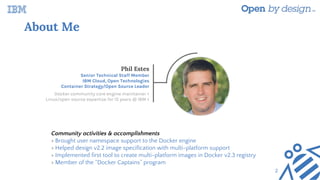
About Me
Phil Estes
Senior Technical Staff Member
IBM Cloud, Open Technologies
Container Strategy/Open Source Leader
Docker community core engine maintainer <
Linux/open source expertise for 15 years @ IBM <
Community activities & accomplishments
> Brought user namespace support to the Docker engine
> Helped design v2.2 image specification with multi-platform support
> Implemented first tool to create multi-platform images in Docker v2.3 registry
> Member of the “Docker Captains” program
2
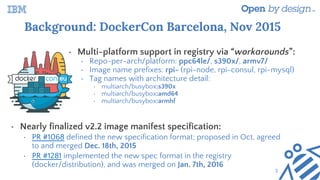
Background: DockerCon Barcelona, Nov 2015
• Multi-platform support in registry via “workarounds”:
• Repo-per-arch/platform: ppc64le/, s390x/, armv7/
• Image name prefixes: rpi- (rpi-node, rpi-consul, rpi-mysql)
• Tag names with architecture detail:
• multiarch/busybox:s390x
• multiarch/busybox:amd64
• multiarch/busybox:armhf
• Nearly finalized v2.2 image manifest specification:
• PR #1068 defined the new specification format; proposed in Oct, agreed
to and merged Dec. 18th, 2015
• PR #1281 implemented the new spec format in the registry
(docker/distribution), and was merged on Jan. 7th, 2016
3
The manifest list Registry Object Type
• How does the v2.2 image manifest spec support multi-platform?
• Via a new registry manifest type: the manifest list
• A manifest list contains pointers to existing manifest objects
• A manifest list contains a platform specification associated with each pointer to an
existing manifest
• What is a platform specification?
"platform": { // example with *all* fields
"architecture": "amd64",
"os": "linux",
"os.version": "10.0.10586",
"os.features": [
"win32k"
],
"variant": "armv6l"
"features": [
"sse4", "aes"
]
}
"platform": {
"architecture": "ppc64le",
"os": "linux",
}
Could be very simple:
4
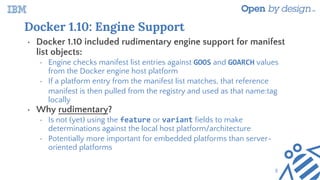
Docker 1.10: Engine Support
• Docker 1.10 included rudimentary engine support for manifest
list objects:
• Engine checks manifest list entries against GOOS and GOARCH values
from the Docker engine host platform
• If a platform entry from the manifest list matches, that reference
manifest is then pulled from the registry and used as that name:tag
locally
• Why rudimentary?
• Is not (yet) using the feature or variant fields to make
determinations against the local host platform/architecture
• Potentially more important for embedded platforms than server-
oriented platforms
5
Creating a Manifest List
• Registry v2.3 and above support manifest lists
• DockerHub now supports pushing manifest list objects
• Open source “docker/distribution” v2.3 and above (this includes the
official DockerHub “registry” image, now at v2.4.1)
• Official tooling still under discussion
• Discussion: Where does it fit? (e.g. extend “docker push”)
• Details, details (how to specify inputs, image signing/trust, etc.)
• Proof of concept tool available today for testing
• https://github.com/estesp/manifest-tool
• Can inspect (list) or push manifest lists to private registry or DockerHub
• Read more about it here: https://integratedcode.us/2016/04/22/a-step-towards-
multi-platform-docker-images/
6
The Manifest Tool
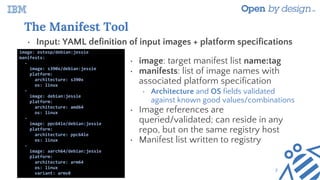
• Input: YAML definition of input images + platform specifications
image: estesp/debian:jessie
manifests:
-
image: s390x/debian:jessie
platform:
architecture: s390x
os: linux
-
image: debian:jessie
platform:
architecture: amd64
os: linux
-
image: ppc64le/debian:jessie
platform:
architecture: ppc64le
os: linux
-
image: aarch64/debian:jessie
platform:
architecture: arm64
os: linux
variant: armv8 7
• image: target manifest list name:tag
• manifests: list of image names with
associated platform specification
• Architecture and OS fields validated
against known good values/combinations
• Image references are
queried/validated; can reside in any
repo, but on the same registry host
• Manifest list written to registry
Let’s Demo
8
What’s Left?
• Engine: Full Support for ‘platform’ Definition
• Windows will exploit os.version and os.features entries for full platform
matching
• Linux-based engines need to determine how to “understand” features
and variant with standardized definitions (e.g. /proc/cpuinfo)
• Official tooling for manifest list push/inspection
• Requires full support for Docker Content Trust/image signing
• Content publishers/creators need to be informed of capabilities
• DockerHub/UI Updates
• Currently no visibility into “manifest list” entries
• Platform information: a visual representation for consumers to find
supported platforms for a given manifest list-based image
• Workflow details (automated builds?)
9
Thank you!
@estesp
github.com/estesp
estesp@gmail.com
https://integratedcode.us
IRC: estesp

Containerize All the (Multi-Platform) Things! by Phil Estes

  • 1.
    Containerize All The (Multi-Platform)Things! Phil Estes IBM Cloud, Open Technology Twitter: @estesp
  • 2.
    About Me Phil Estes SeniorTechnical Staff Member IBM Cloud, Open Technologies Container Strategy/Open Source Leader Docker community core engine maintainer < Linux/open source expertise for 15 years @ IBM < Community activities & accomplishments > Brought user namespace support to the Docker engine > Helped design v2.2 image specification with multi-platform support > Implemented first tool to create multi-platform images in Docker v2.3 registry > Member of the “Docker Captains” program 2
  • 3.
    Background: DockerCon Barcelona,Nov 2015 • Multi-platform support in registry via “workarounds”: • Repo-per-arch/platform: ppc64le/, s390x/, armv7/ • Image name prefixes: rpi- (rpi-node, rpi-consul, rpi-mysql) • Tag names with architecture detail: • multiarch/busybox:s390x • multiarch/busybox:amd64 • multiarch/busybox:armhf • Nearly finalized v2.2 image manifest specification: • PR #1068 defined the new specification format; proposed in Oct, agreed to and merged Dec. 18th, 2015 • PR #1281 implemented the new spec format in the registry (docker/distribution), and was merged on Jan. 7th, 2016 3
  • 4.
    The manifest listRegistry Object Type • How does the v2.2 image manifest spec support multi-platform? • Via a new registry manifest type: the manifest list • A manifest list contains pointers to existing manifest objects • A manifest list contains a platform specification associated with each pointer to an existing manifest • What is a platform specification? "platform": { // example with *all* fields "architecture": "amd64", "os": "linux", "os.version": "10.0.10586", "os.features": [ "win32k" ], "variant": "armv6l" "features": [ "sse4", "aes" ] } "platform": { "architecture": "ppc64le", "os": "linux", } Could be very simple: 4
  • 5.
    Docker 1.10: EngineSupport • Docker 1.10 included rudimentary engine support for manifest list objects: • Engine checks manifest list entries against GOOS and GOARCH values from the Docker engine host platform • If a platform entry from the manifest list matches, that reference manifest is then pulled from the registry and used as that name:tag locally • Why rudimentary? • Is not (yet) using the feature or variant fields to make determinations against the local host platform/architecture • Potentially more important for embedded platforms than server- oriented platforms 5
  • 6.
    Creating a ManifestList • Registry v2.3 and above support manifest lists • DockerHub now supports pushing manifest list objects • Open source “docker/distribution” v2.3 and above (this includes the official DockerHub “registry” image, now at v2.4.1) • Official tooling still under discussion • Discussion: Where does it fit? (e.g. extend “docker push”) • Details, details (how to specify inputs, image signing/trust, etc.) • Proof of concept tool available today for testing • https://github.com/estesp/manifest-tool • Can inspect (list) or push manifest lists to private registry or DockerHub • Read more about it here: https://integratedcode.us/2016/04/22/a-step-towards- multi-platform-docker-images/ 6
  • 7.
    The Manifest Tool •Input: YAML definition of input images + platform specifications image: estesp/debian:jessie manifests: - image: s390x/debian:jessie platform: architecture: s390x os: linux - image: debian:jessie platform: architecture: amd64 os: linux - image: ppc64le/debian:jessie platform: architecture: ppc64le os: linux - image: aarch64/debian:jessie platform: architecture: arm64 os: linux variant: armv8 7 • image: target manifest list name:tag • manifests: list of image names with associated platform specification • Architecture and OS fields validated against known good values/combinations • Image references are queried/validated; can reside in any repo, but on the same registry host • Manifest list written to registry
  • 8.
  • 9.
    What’s Left? • Engine:Full Support for ‘platform’ Definition • Windows will exploit os.version and os.features entries for full platform matching • Linux-based engines need to determine how to “understand” features and variant with standardized definitions (e.g. /proc/cpuinfo) • Official tooling for manifest list push/inspection • Requires full support for Docker Content Trust/image signing • Content publishers/creators need to be informed of capabilities • DockerHub/UI Updates • Currently no visibility into “manifest list” entries • Platform information: a visual representation for consumers to find supported platforms for a given manifest list-based image • Workflow details (automated builds?) 9
  • 10.