Consumer Perspective
Understanding the end user
Brain-Computer Interface Devices for People with Paralysis and Amputation,
November 21, 2014
Focusing	
  on	
  educa-on	
  of	
  and	
  
advocacy	
  to	
  access	
  neurotechnology	
  
devices,	
  therapies	
  and	
  treatments	
  for	
  
people	
  living	
  with	
  impairments,	
  their	
  
care-­‐givers	
  and	
  medical	
  
professionals.	


Free	
  Resources:	
  
Ø Free	
  Condi-on	
  Educa-onal	
  Pages	
  
Ø Network	
  of	
  Technology	
  Users	
  
Ø Educa-onal	
  sessions/webinars	
  
Ø Publica-ons	
  &	
  e-­‐NewsleGers	
  
Ø Website/Social	
  Media	
  
Helping people regain life thru neurotechnology
www.NeurotechNetwork.org	
  
Neurotech Network and The Society to Increase Mobility, Inc. and its representatives do not rate, sell,
distribute, endorse, recommend or prescribe any products, procedures or services.
No other options?
Clinicians’ perceptions of their patients include:
§  […] in despair[..]
§  [...]exhausted other resources […]
§  […] don’t really have any other option[…]
§  […]all quite desperate[…]
Bell E, Maxwell B, McAndrews MP, Sadikot A, Racine E, Hope and
Patients’ Expectations in Deep Brain Stimulation: Healthcare Providers’
Perspectives and Approaches, Journal of Clinical Ethics, Summer 2010:
21(2): 112-124.
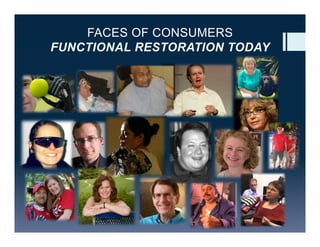
FACES OF CONSUMERS
FUNCTIONAL RESTORATION TODAY
What do people really want?
“In order to make devices that will actually be
used by the population for whom they are
intended, it is imperative to address the
priorities of that population”
- Hochberg LR, Anderson KD (2012) Chapter 19 “BCI Users and Their Needs”. In: Brain-
Computer Interfaces: Principles and Practices. Wolpaw J, Wolpaw L. Editors. Oxford University
Press.
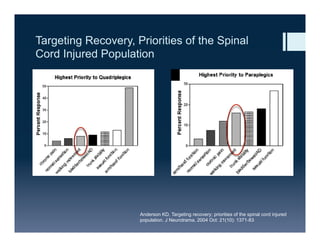
Targeting Recovery, Priorities of the Spinal
Cord Injured Population
Anderson KD, Targeting recovery; priorities of the spinal cord injured
population. J Neurotrama. 2004 Oct: 21(10): 1371-83
What do people really want?
Shah SG, Robinson I, AlShawi S.’ Developing medical device
technologies from users' perspectives: a theoretical framework for
involving users in the development process.’Int J Technol Assess
Health Care. 2009 Oct;25(4):514-21.
Evidence shows that consumers will
quickly discard or not use devices that do
not fulfill their personal expectations, even
though clinical professionals may view the
consumer needs met.
The Need for Consumer Education
“My girlfriend read an
article in the paper” –
Jan Scheuermann, BCI
participant
“I was on a routine visit
to my doctor” – Ian
Burkhart, BCI
participant
“It was my girlfriend who
learned about the project.
She persisted until she
found the right connections”
– Cathy Hutchinson, BCI
participant
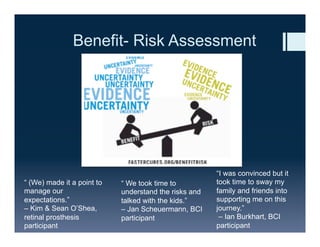
Benefit- Risk Assessment
“ (We) made it a point to
manage our
expectations.”
– Kim & Sean O’Shea,
retinal prosthesis
participant
“ We took time to
understand the risks and
talked with the kids.”
– Jan Scheuermann, BCI
participant
“I was convinced but it
took time to sway my
family and friends into
supporting me on this
journey.”
– Ian Burkhart, BCI
participant
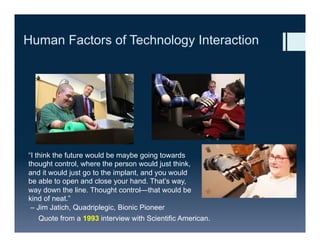
Human Factors of Technology Interaction
“I think the future would be maybe going towards
thought control, where the person would just think,
and it would just go to the implant, and you would
be able to open and close your hand. That’s way,
way down the line. Thought control—that would be
kind of neat.”
– Jim Jatich, Quadriplegic, Bionic Pioneer
Quote from a 1993 interview with Scientific American.
Real People Real Stories
“She was now optimistic about the what the future
may hold for her” – Bionic Pioneers, Cathy
Hutchinson
“One Day (years from now), I’ll be able to
take it home…” – Ian Burkhart
“This was meant for me.” – Jan
Scheuermann
DATA + HUMAN EXPERIENCE
ARE WE ASKING THE
RIGHT QUESTIONS?

Consumer Perspective: Understanding the End User @ FDA BCI Workshop 2014

  • 1.
    Consumer Perspective Understanding theend user Brain-Computer Interface Devices for People with Paralysis and Amputation, November 21, 2014
  • 2.
    Focusing  on  educa-on  of  and   advocacy  to  access  neurotechnology   devices,  therapies  and  treatments  for   people  living  with  impairments,  their   care-­‐givers  and  medical   professionals.     Free  Resources:   Ø Free  Condi-on  Educa-onal  Pages   Ø Network  of  Technology  Users   Ø Educa-onal  sessions/webinars   Ø Publica-ons  &  e-­‐NewsleGers   Ø Website/Social  Media   Helping people regain life thru neurotechnology www.NeurotechNetwork.org   Neurotech Network and The Society to Increase Mobility, Inc. and its representatives do not rate, sell, distribute, endorse, recommend or prescribe any products, procedures or services.
  • 3.
    No other options? Clinicians’perceptions of their patients include: §  […] in despair[..] §  [...]exhausted other resources […] §  […] don’t really have any other option[…] §  […]all quite desperate[…] Bell E, Maxwell B, McAndrews MP, Sadikot A, Racine E, Hope and Patients’ Expectations in Deep Brain Stimulation: Healthcare Providers’ Perspectives and Approaches, Journal of Clinical Ethics, Summer 2010: 21(2): 112-124.
  • 4.
  • 5.
    What do peoplereally want? “In order to make devices that will actually be used by the population for whom they are intended, it is imperative to address the priorities of that population” - Hochberg LR, Anderson KD (2012) Chapter 19 “BCI Users and Their Needs”. In: Brain- Computer Interfaces: Principles and Practices. Wolpaw J, Wolpaw L. Editors. Oxford University Press.
  • 6.
    Targeting Recovery, Prioritiesof the Spinal Cord Injured Population Anderson KD, Targeting recovery; priorities of the spinal cord injured population. J Neurotrama. 2004 Oct: 21(10): 1371-83
  • 7.
    What do peoplereally want? Shah SG, Robinson I, AlShawi S.’ Developing medical device technologies from users' perspectives: a theoretical framework for involving users in the development process.’Int J Technol Assess Health Care. 2009 Oct;25(4):514-21. Evidence shows that consumers will quickly discard or not use devices that do not fulfill their personal expectations, even though clinical professionals may view the consumer needs met.
  • 8.
    The Need forConsumer Education “My girlfriend read an article in the paper” – Jan Scheuermann, BCI participant “I was on a routine visit to my doctor” – Ian Burkhart, BCI participant “It was my girlfriend who learned about the project. She persisted until she found the right connections” – Cathy Hutchinson, BCI participant
  • 9.
    Benefit- Risk Assessment “(We) made it a point to manage our expectations.” – Kim & Sean O’Shea, retinal prosthesis participant “ We took time to understand the risks and talked with the kids.” – Jan Scheuermann, BCI participant “I was convinced but it took time to sway my family and friends into supporting me on this journey.” – Ian Burkhart, BCI participant
  • 10.
    Human Factors ofTechnology Interaction “I think the future would be maybe going towards thought control, where the person would just think, and it would just go to the implant, and you would be able to open and close your hand. That’s way, way down the line. Thought control—that would be kind of neat.” – Jim Jatich, Quadriplegic, Bionic Pioneer Quote from a 1993 interview with Scientific American.
  • 11.
    Real People RealStories “She was now optimistic about the what the future may hold for her” – Bionic Pioneers, Cathy Hutchinson “One Day (years from now), I’ll be able to take it home…” – Ian Burkhart “This was meant for me.” – Jan Scheuermann DATA + HUMAN EXPERIENCE
  • 12.
    ARE WE ASKINGTHE RIGHT QUESTIONS?