ACCESS TO IMPLANTED PROSTHESIS: 
WHAT YOU NEED TO KNOW AND 
HOW TECHNOLOGY IS USED TO RESTORE FUNCTION 
Webinar, July 9, 2014 
Ø Kim Anderson-Erisman PhD, Director Of Education, University Of Miami & Miami Project To 
Cure Paralysis 
Ø Jennifer French, MBA, Executive Director, Neurotech Network 
Ø Megan Moynahan, MS, Executive Director, Institute For Functional Restoration
HAVE A QUESTION?
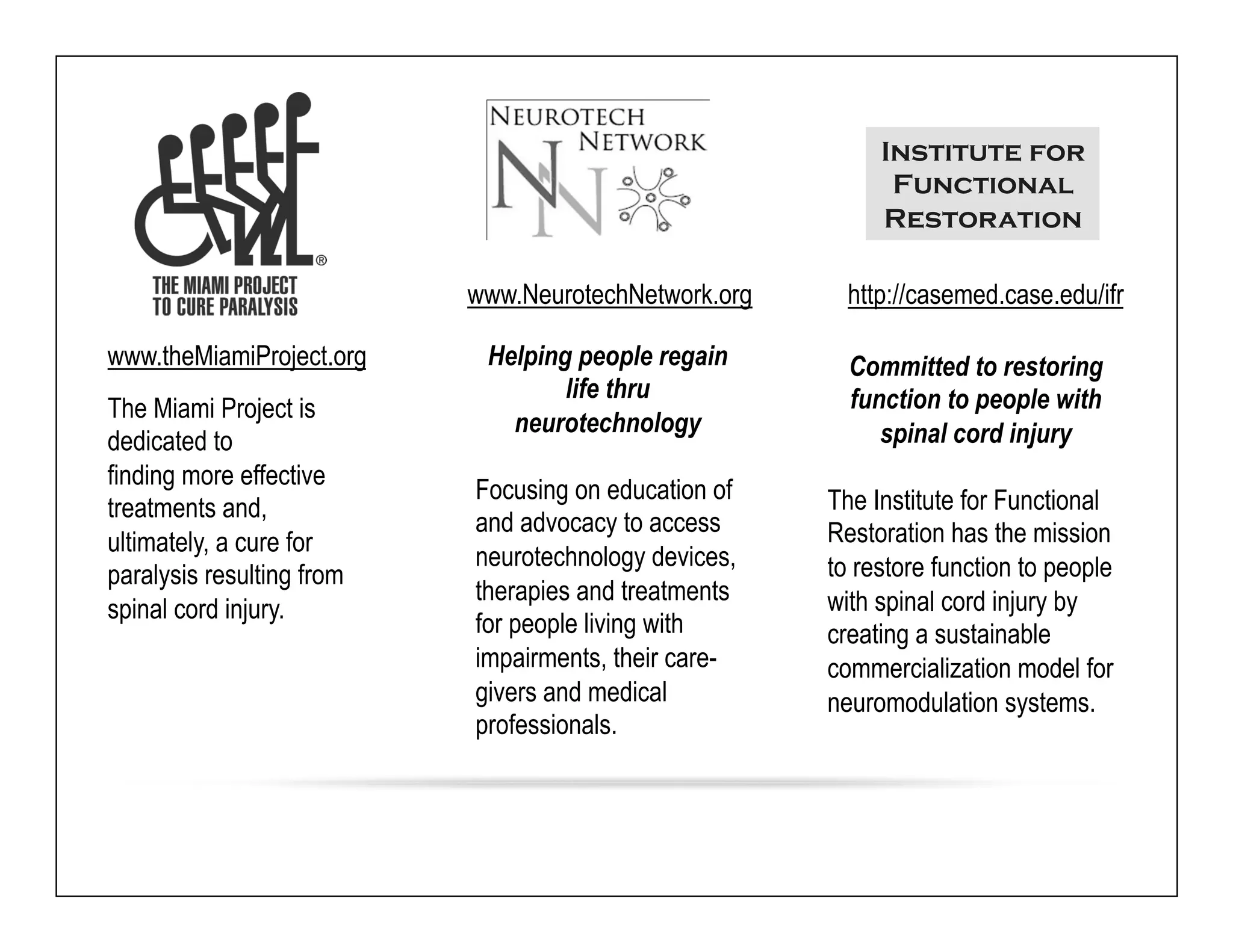
www.NeurotechNetwork.org 
Helping people regain 
life thru 
neurotechnology 
Focusing on education of 
and advocacy to access 
neurotechnology devices, 
therapies and treatments 
for people living with 
impairments, their care-givers 
and medical 
professionals. 
www.theMiamiProject.org 
The Miami Project is 
dedicated to 
finding more effective 
treatments and, 
ultimately, a cure for 
paralysis resulting from 
spinal cord injury. 
Institute for 
Functional 
Restoration 
http://casemed.case.edu/ifr 
Committed to restoring 
function to people with 
spinal cord injury 
The Institute for Functional 
Restoration has the mission 
to restore function to people 
with spinal cord injury by 
creating a sustainable 
commercialization model for 
neuromodulation systems.
DISCLAIMER PAGE 
The information presented in this session is not meant to replace the advice from a 
medical professional. You should consult a health care professional familiar with 
your specific case, concerns and condition. We highly suggest for you to take 
information to a trained medical professional familiar with your case to discuss 
options that are best for you.
AGENDA 
• What are implanted neural prosthetics? 
• Therapeutic vs. Prosthetic Application 
• Neuro-stimulation & BCI/BMI Applications 
• General Pros vs Cons of these systems 
• Basics of Clinical Trials 
• How do you get plugged in? 
Polling question 1
WHAT ARE IMPLANTED NEURAL PROSTHETICS? 
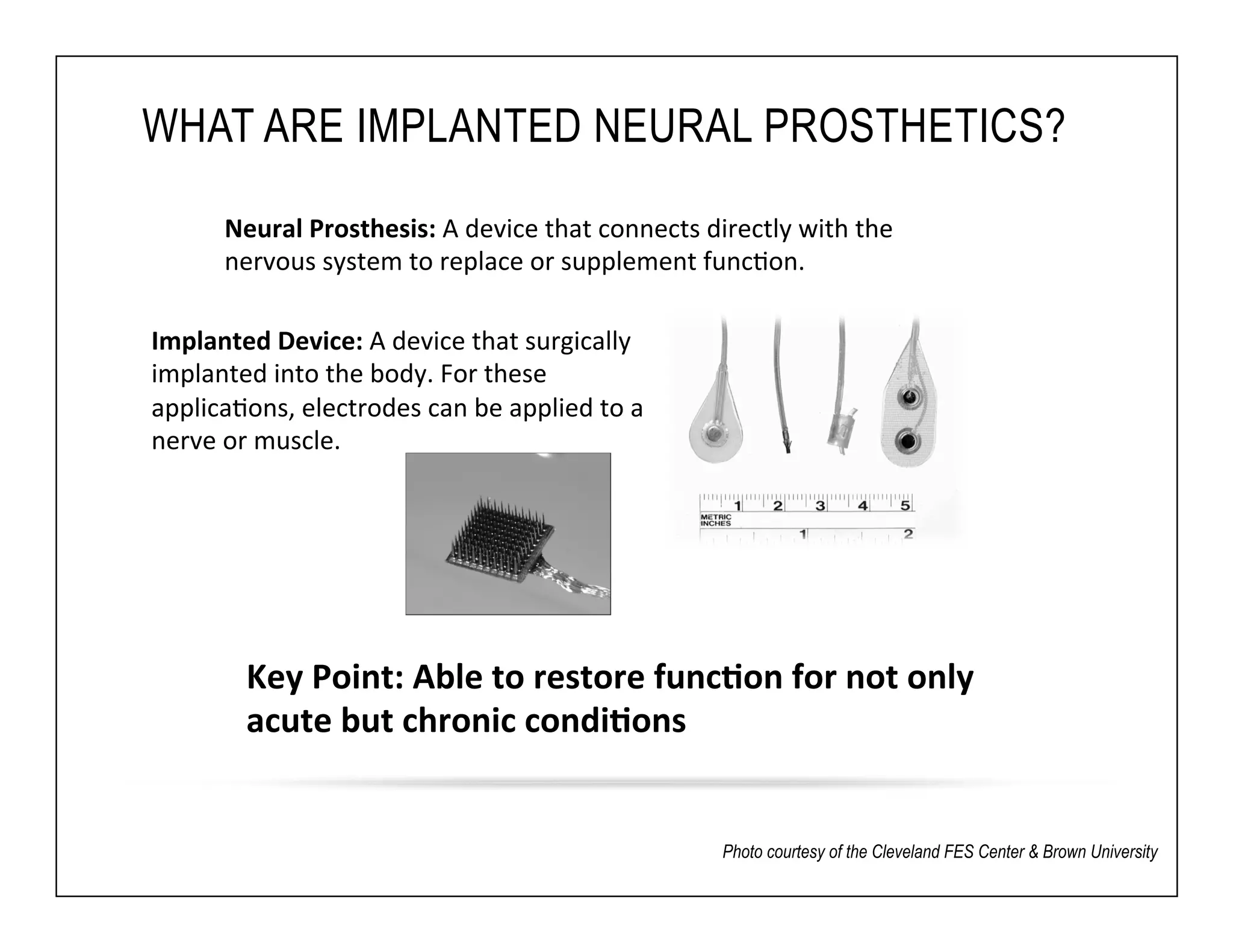
Neural 
Prosthesis: 
A 
device 
that 
connects 
directly 
with 
the 
nervous 
system 
to 
replace 
or 
supplement 
func6on. 
Key 
Point: 
Able 
to 
restore 
func6on 
for 
not 
only 
acute 
but 
chronic 
condi6ons 
Photo courtesy of the Cleveland FES Center & Brown University 
Implanted 
Device: 
A 
device 
that 
surgically 
implanted 
into 
the 
body. 
For 
these 
applica6ons, 
electrodes 
can 
be 
applied 
to 
a 
nerve 
or 
muscle.
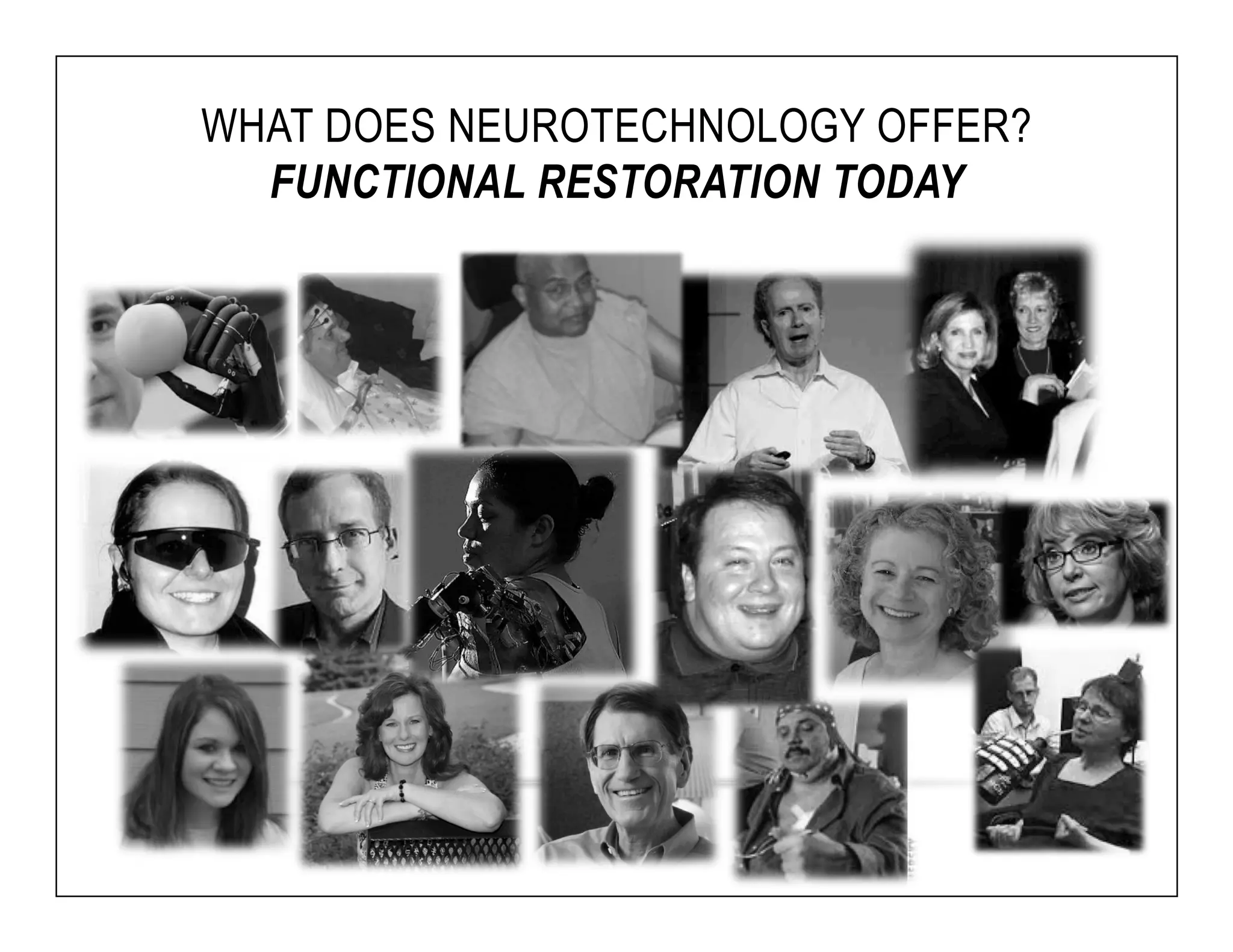
WHAT DOES NEUROTECHNOLOGY OFFER? 
FUNCTIONAL RESTORATION TODAY
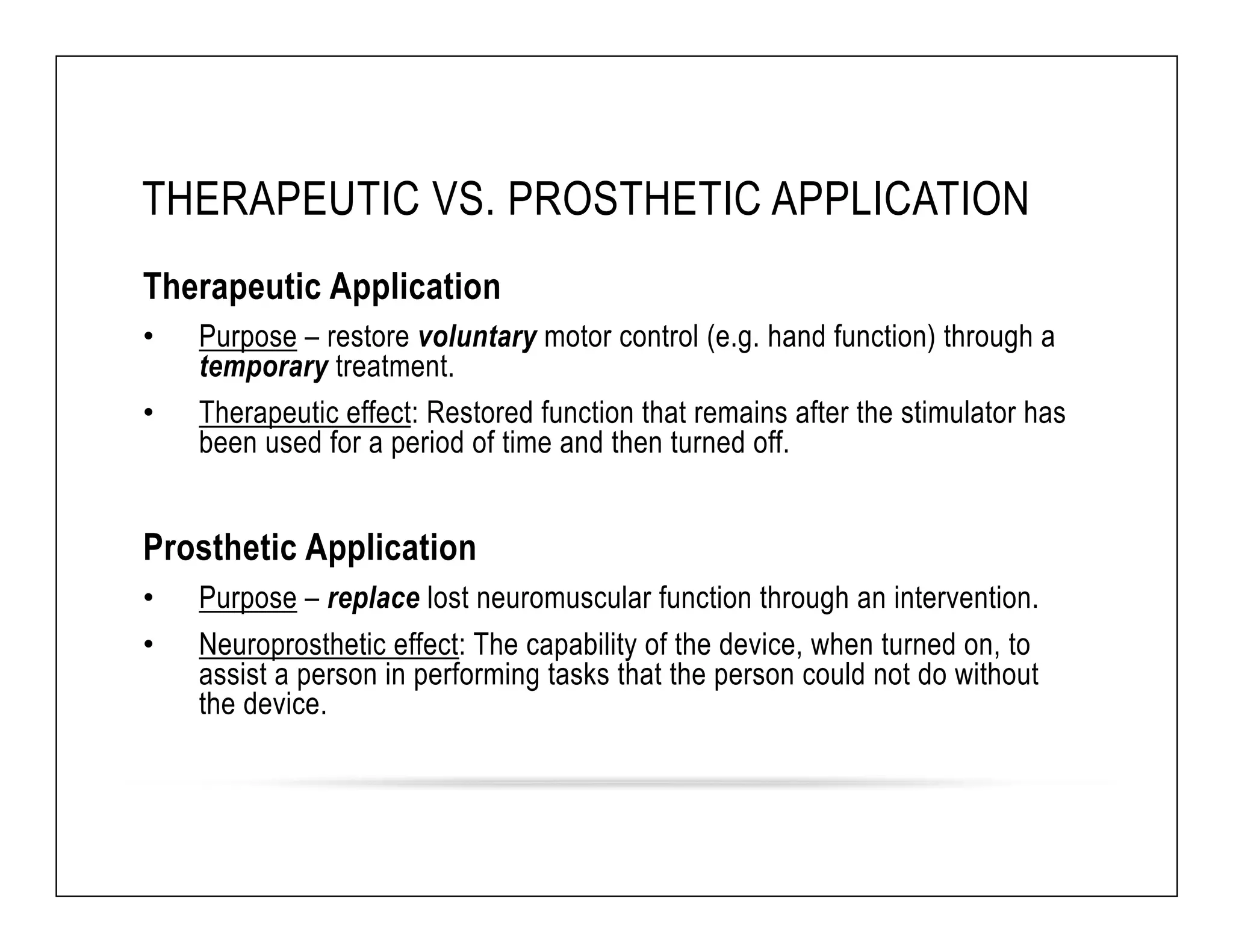
THERAPEUTIC VS. PROSTHETIC APPLICATION 
Therapeutic Application 
• Purpose – restore voluntary motor control (e.g. hand function) through a 
temporary treatment. 
• Therapeutic effect: Restored function that remains after the stimulator has 
been used for a period of time and then turned off. 
Prosthetic Application 
• Purpose – replace lost neuromuscular function through an intervention. 
• Neuroprosthetic effect: The capability of the device, when turned on, to 
assist a person in performing tasks that the person could not do without 
the device.
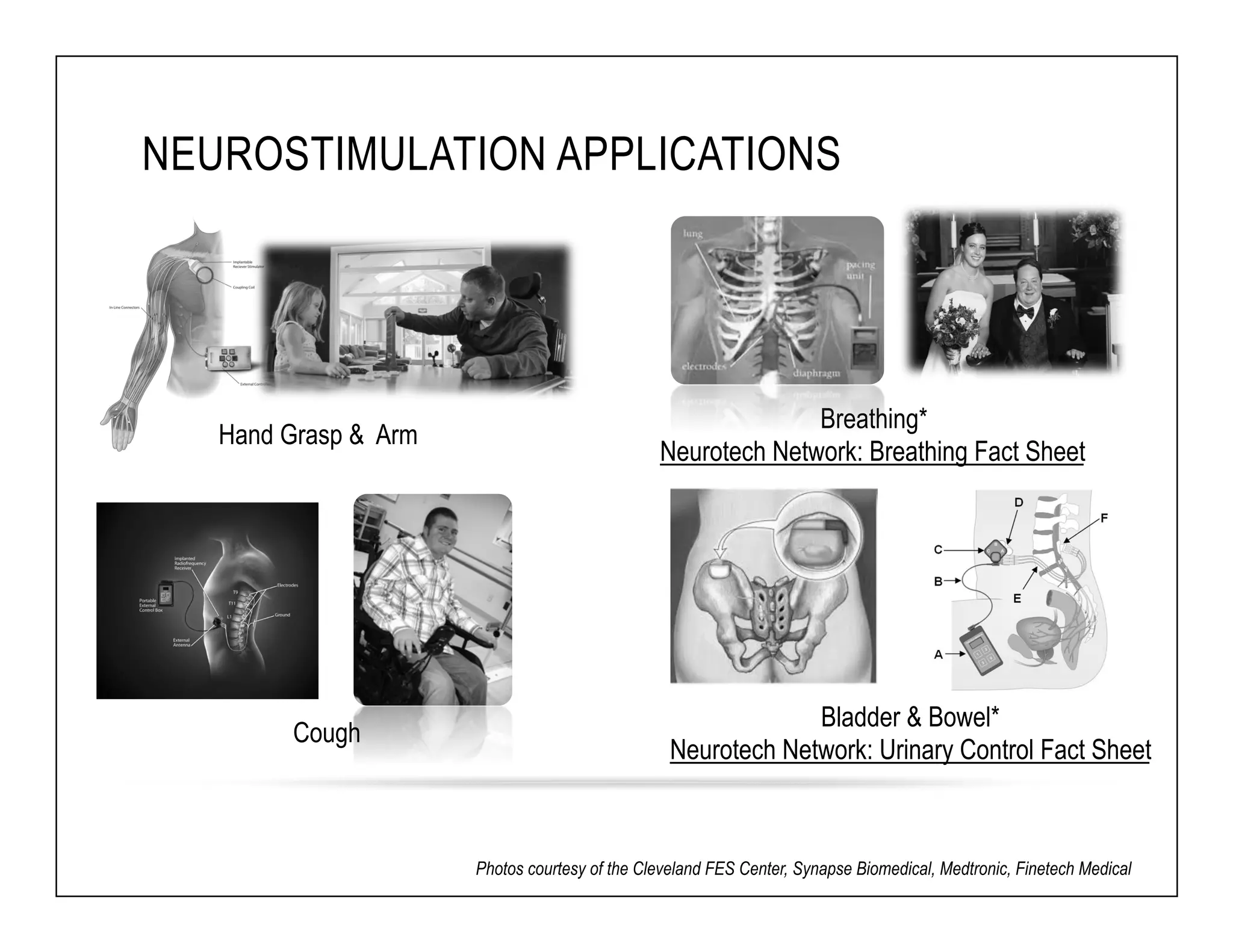
NEUROSTIMULATION APPLICATIONS 
Breathing* 
Neurotech Network: B Hand Grasp & Arm reathing Fact Sheet 
Bladder & Bowel* 
Neurotech Network: Urinary Control Fact Sheet 
Cough 
Photos courtesy of the Cleveland FES Center, Synapse Biomedical, Medtronic, Finetech Medical
NEUROSTIMULATION APPLICATIONS 
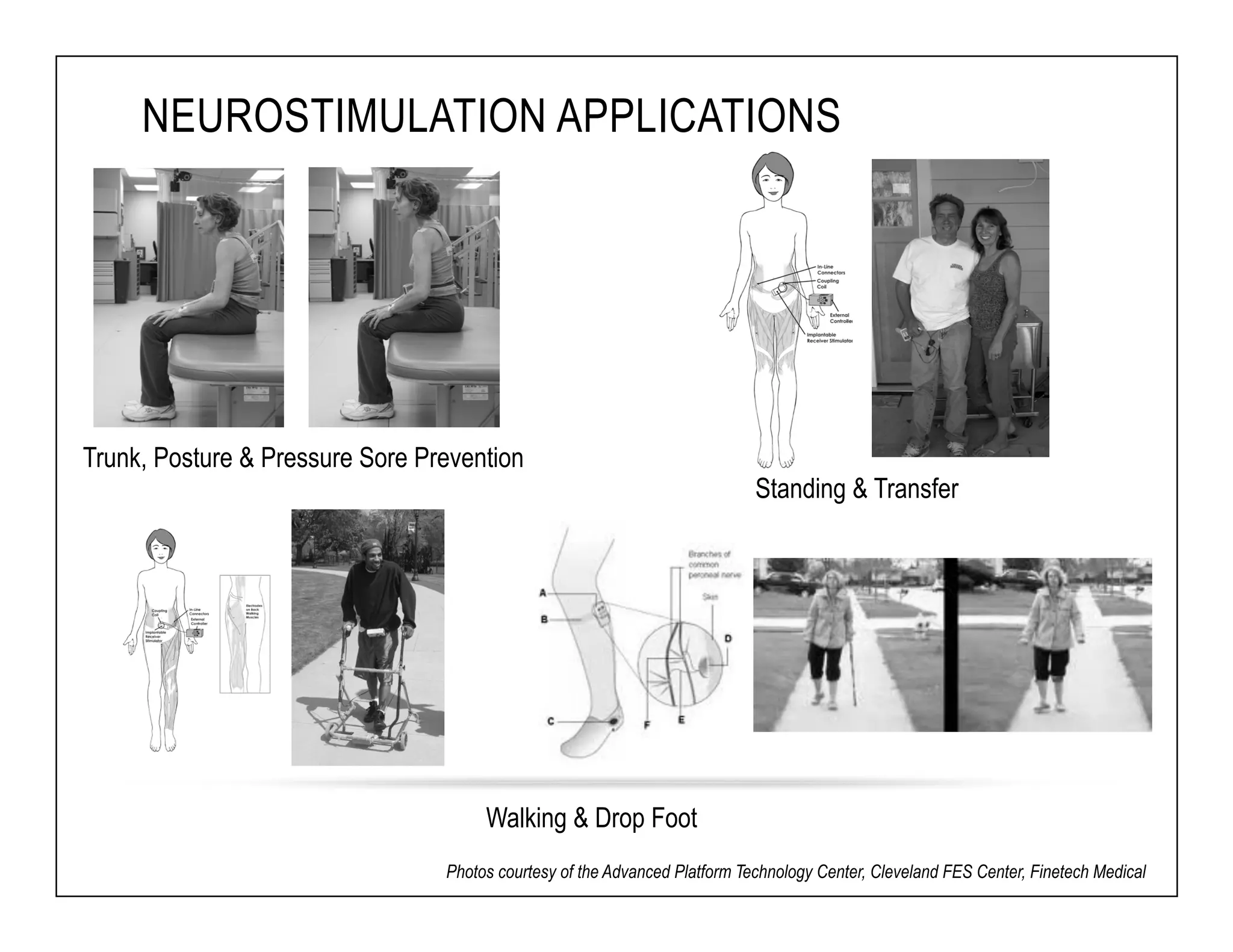
Trunk, Posture & Pressure Sore Prevention 
Standing & Transfer 
Walking & Drop Foot 
Photos courtesy of the Advanced Platform Technology Center, Cleveland FES Center, Finetech Medical
BRAIN COMPUTER INTERFACE/BRAIN MACHINE 
INTERFACE (DR. HOCHBERG) 
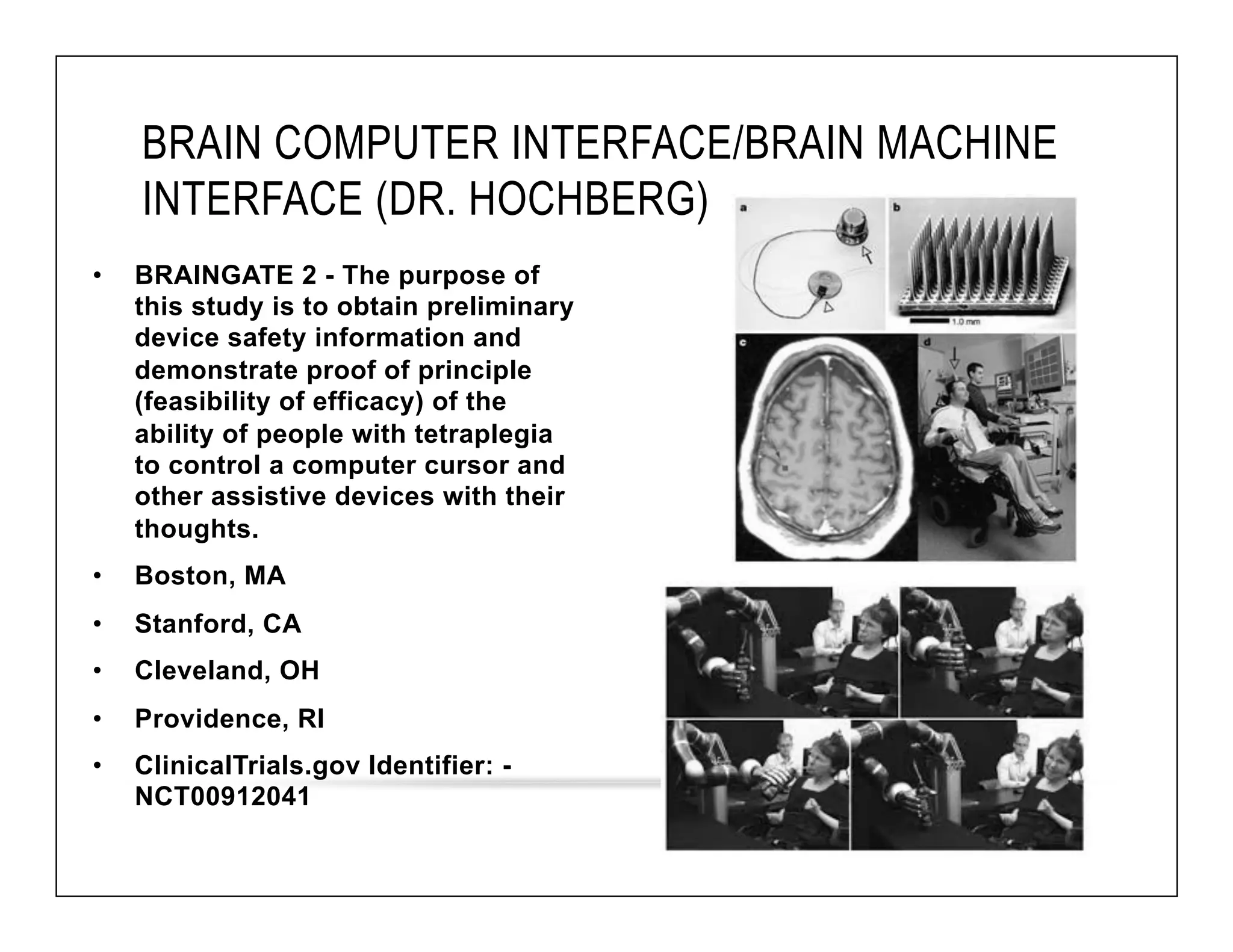
• BRAINGATE 2 - The purpose of 
this study is to obtain preliminary 
device safety information and 
demonstrate proof of principle 
(feasibility of efficacy) of the 
ability of people with tetraplegia 
to control a computer cursor and 
other assistive devices with their 
thoughts. 
• Boston, MA 
• Stanford, CA 
• Cleveland, OH 
• Providence, RI 
• ClinicalTrials.gov Identifier: - 
NCT00912041
BRAIN COMPUTER INTERFACE/BRAIN MACHINE 
INTERFACE (DR. BONNINGER - UPMC) 
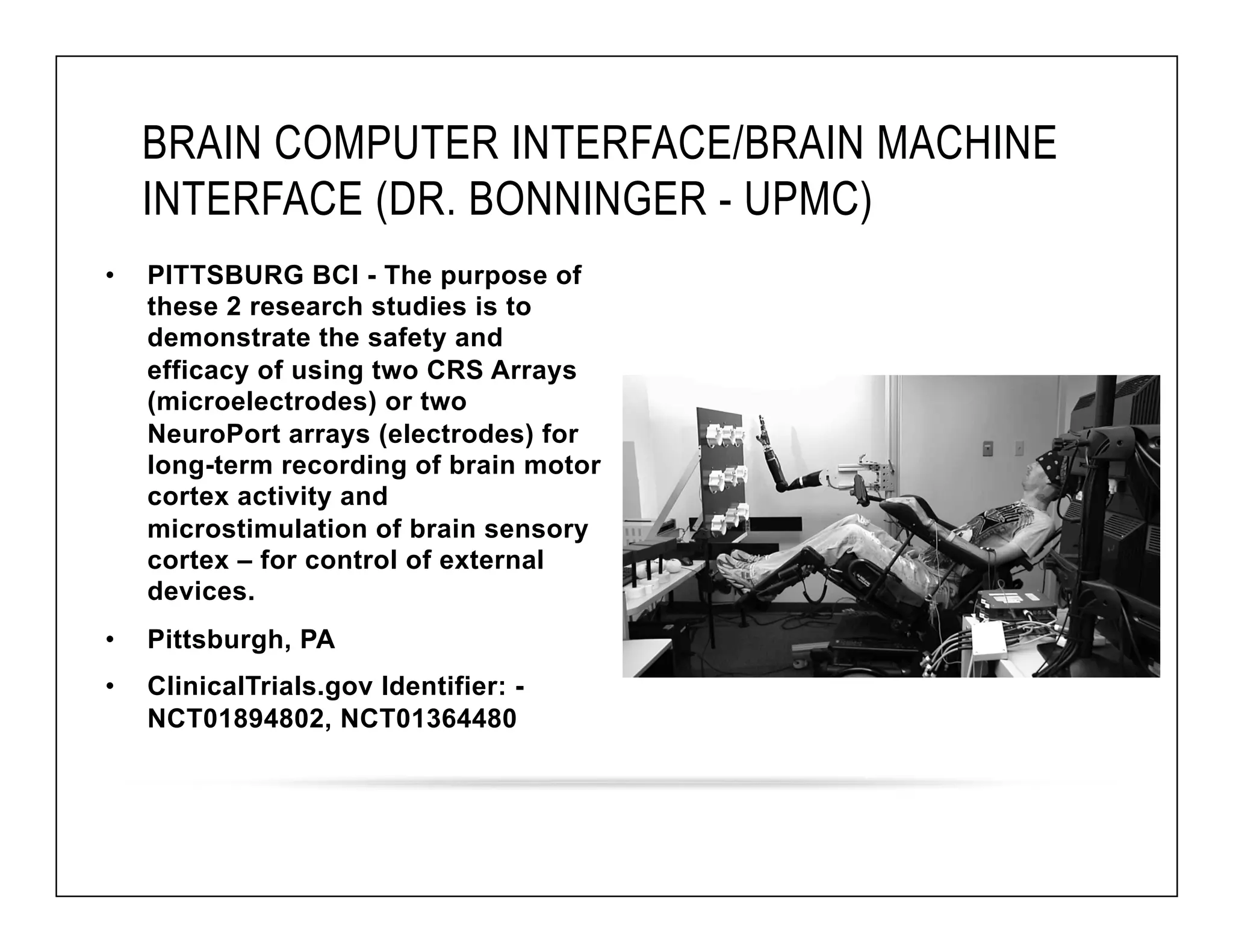
• PITTSBURG BCI - The purpose of 
these 2 research studies is to 
demonstrate the safety and 
efficacy of using two CRS Arrays 
(microelectrodes) or two 
NeuroPort arrays (electrodes) for 
long-term recording of brain motor 
cortex activity and 
microstimulation of brain sensory 
cortex – for control of external 
devices. 
• Pittsburgh, PA 
• ClinicalTrials.gov Identifier: - 
NCT01894802, NCT01364480
OTHER BCI CONTROLLING EXTERNAL DEVICES 
• Computer – California Institute of Technology/Casa Colinas 
Rehabilitation Center – NCS; ClinicalTrials.gov Identifier: 
NCT01958086 
• Robot – California Institute of Technology/Rancho los Amigos 
Rehabilitation Center – NPS2; ClinicalTrials.gov Identifier: 
NCT01964261
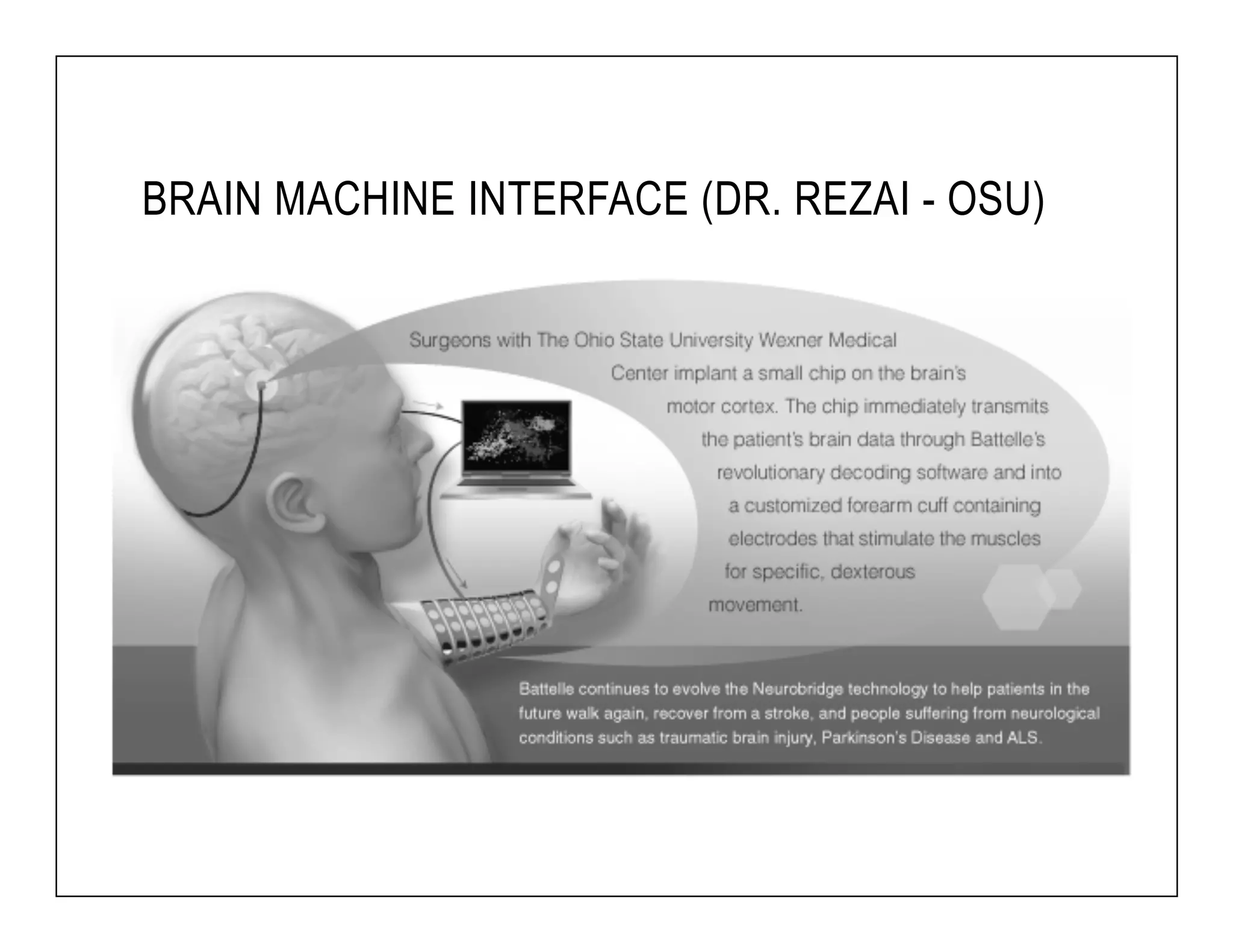
BRAIN MACHINE INTERFACE (DR. REZAI - OSU)
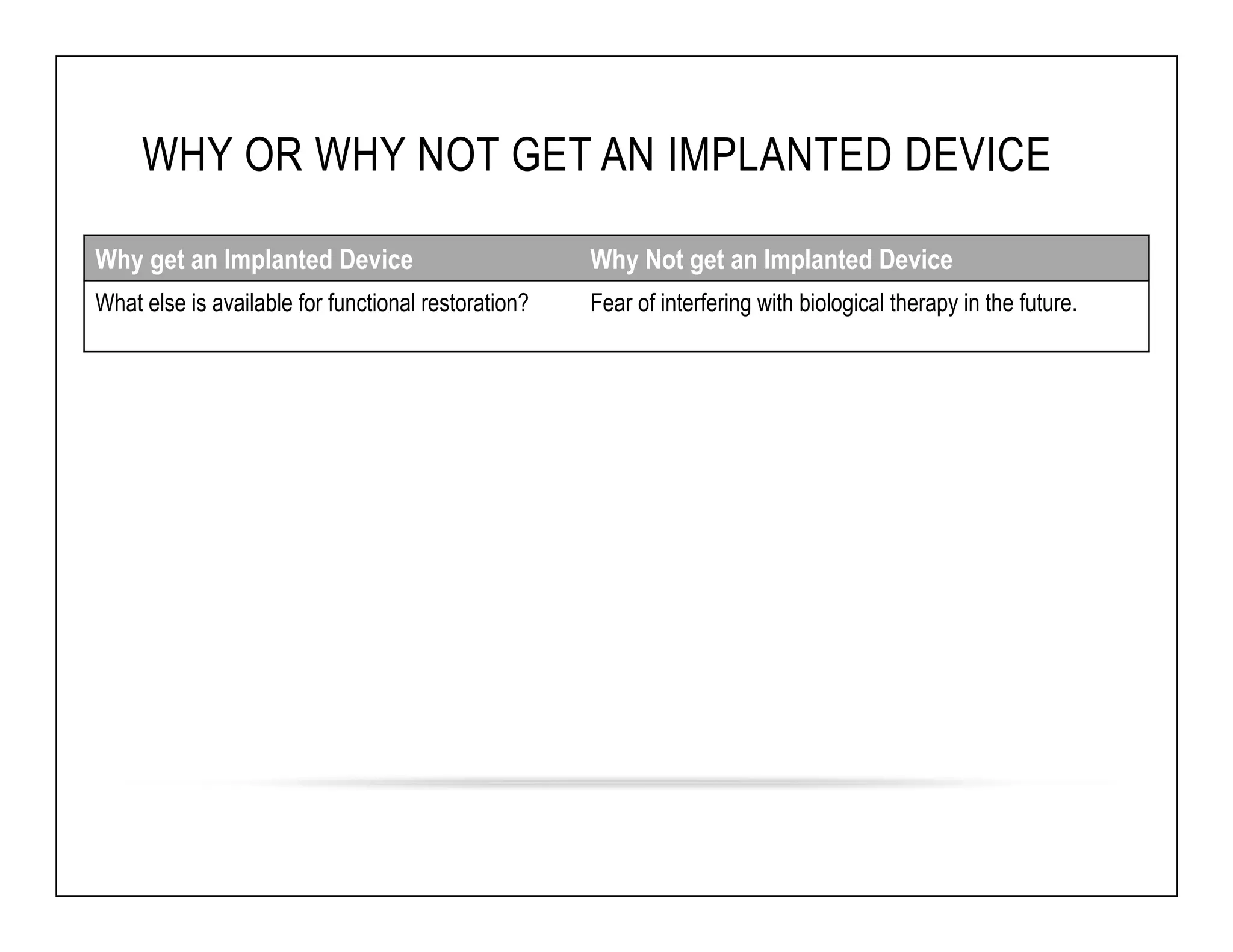
WHY OR WHY NOT GET AN IMPLANTED DEVICE 
Why get an Implanted Device Why Not get an Implanted Device 
What else is available for functional restoration? Fear of interfering with biological therapy in the future.
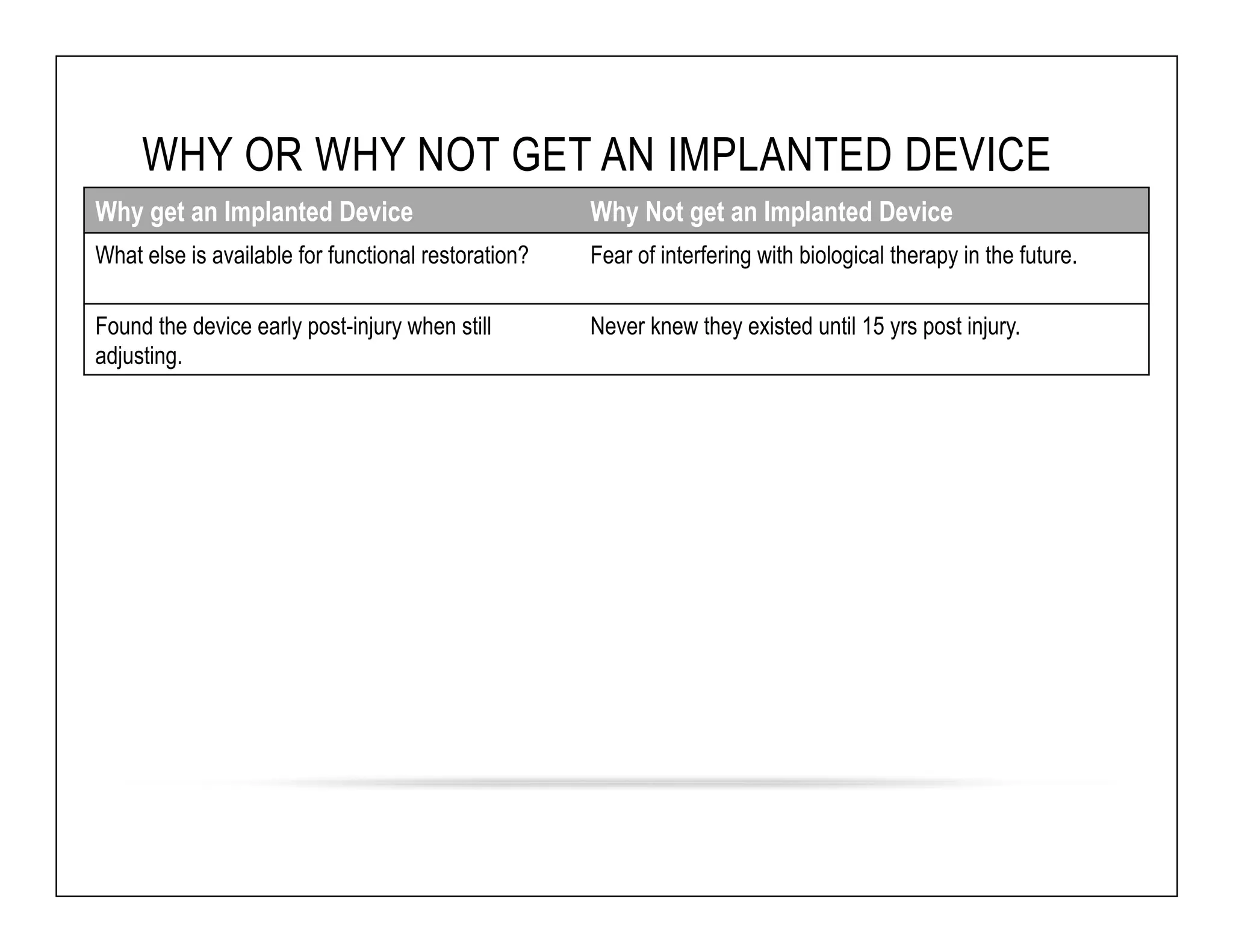
WHY OR WHY NOT GET AN IMPLANTED DEVICE 
Why get an Implanted Device Why Not get an Implanted Device 
What else is available for functional restoration? Fear of interfering with biological therapy in the future. 
Found the device early post-injury when still 
adjusting. 
Never knew they existed until 15 yrs post injury.
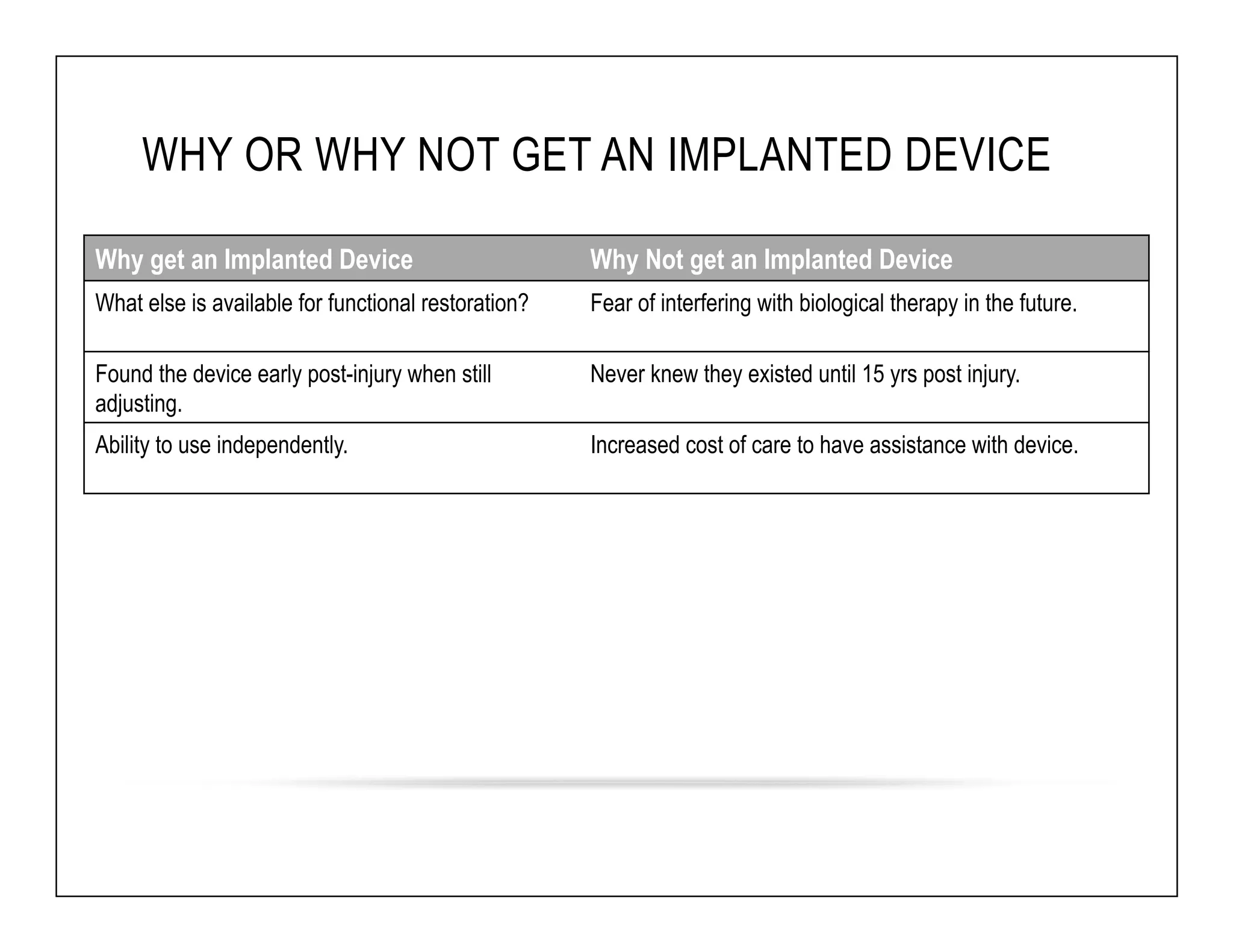
WHY OR WHY NOT GET AN IMPLANTED DEVICE 
Why get an Implanted Device Why Not get an Implanted Device 
What else is available for functional restoration? Fear of interfering with biological therapy in the future. 
Found the device early post-injury when still 
adjusting. 
Never knew they existed until 15 yrs post injury. 
Ability to use independently. Increased cost of care to have assistance with device.
WHY OR WHY NOT GET AN IMPLANTED DEVICE 
Why get an Implanted Device Why Not get an Implanted Device 
What else is available for functional restoration? Fear of interfering with biological therapy in the future. 
Found the device early post-injury when still 
adjusting. 
Never knew they existed until 15 yrs post injury. 
Ability to use independently. Increased cost of care to have assistance with device. 
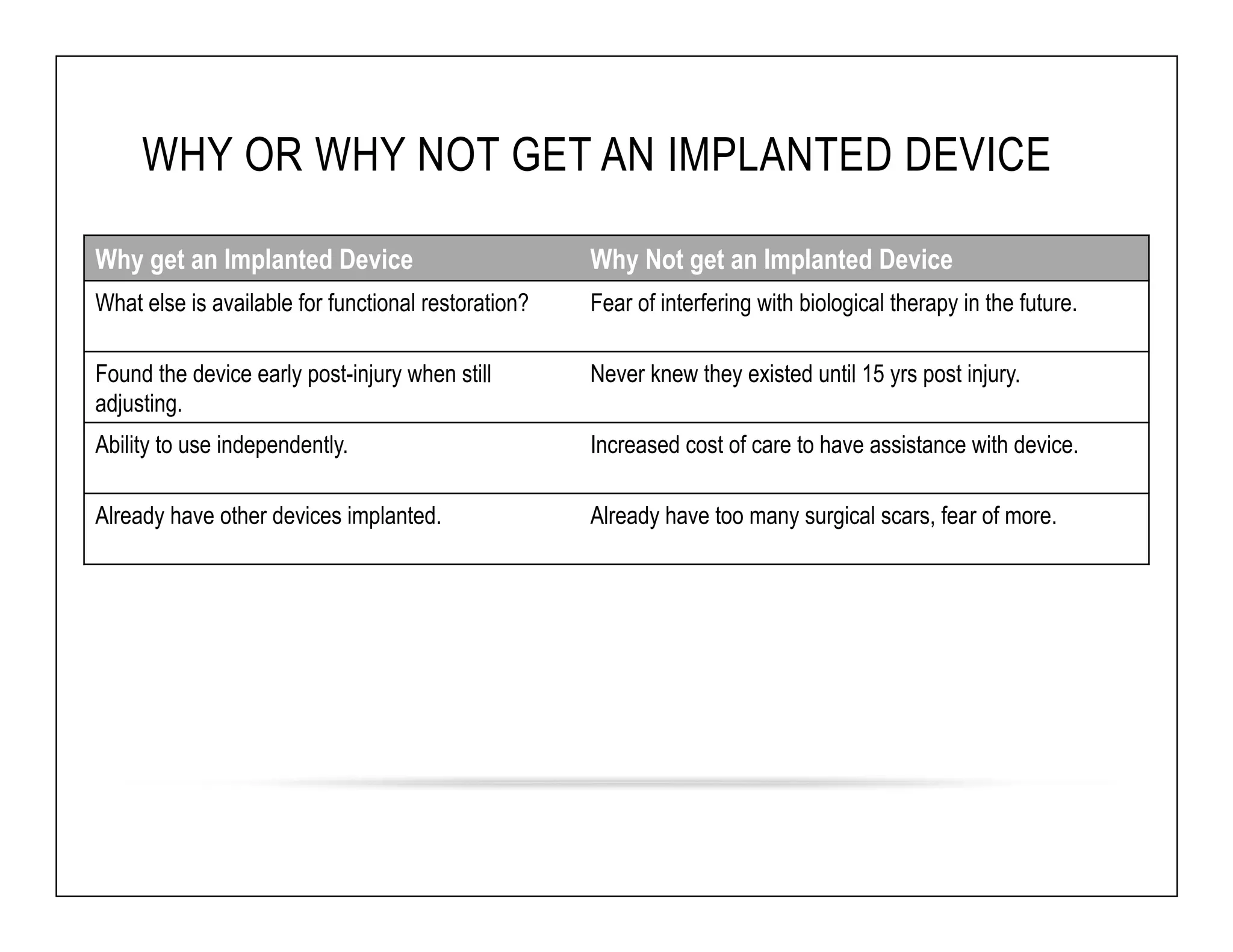
Already have other devices implanted. Already have too many surgical scars, fear of more.
WHY OR WHY NOT GET AN IMPLANTED DEVICE 
Why get an Implanted Device Why Not get an Implanted Device 
What else is available for functional restoration? Fear of interfering with biological therapy in the future. 
Found the device early post-injury when still 
adjusting. 
Never knew they existed until 15 yrs post injury. 
Ability to use independently. Increased cost of care to have assistance with device. 
Already have other devices implanted. Already have too many surgical scars, fear of more. 
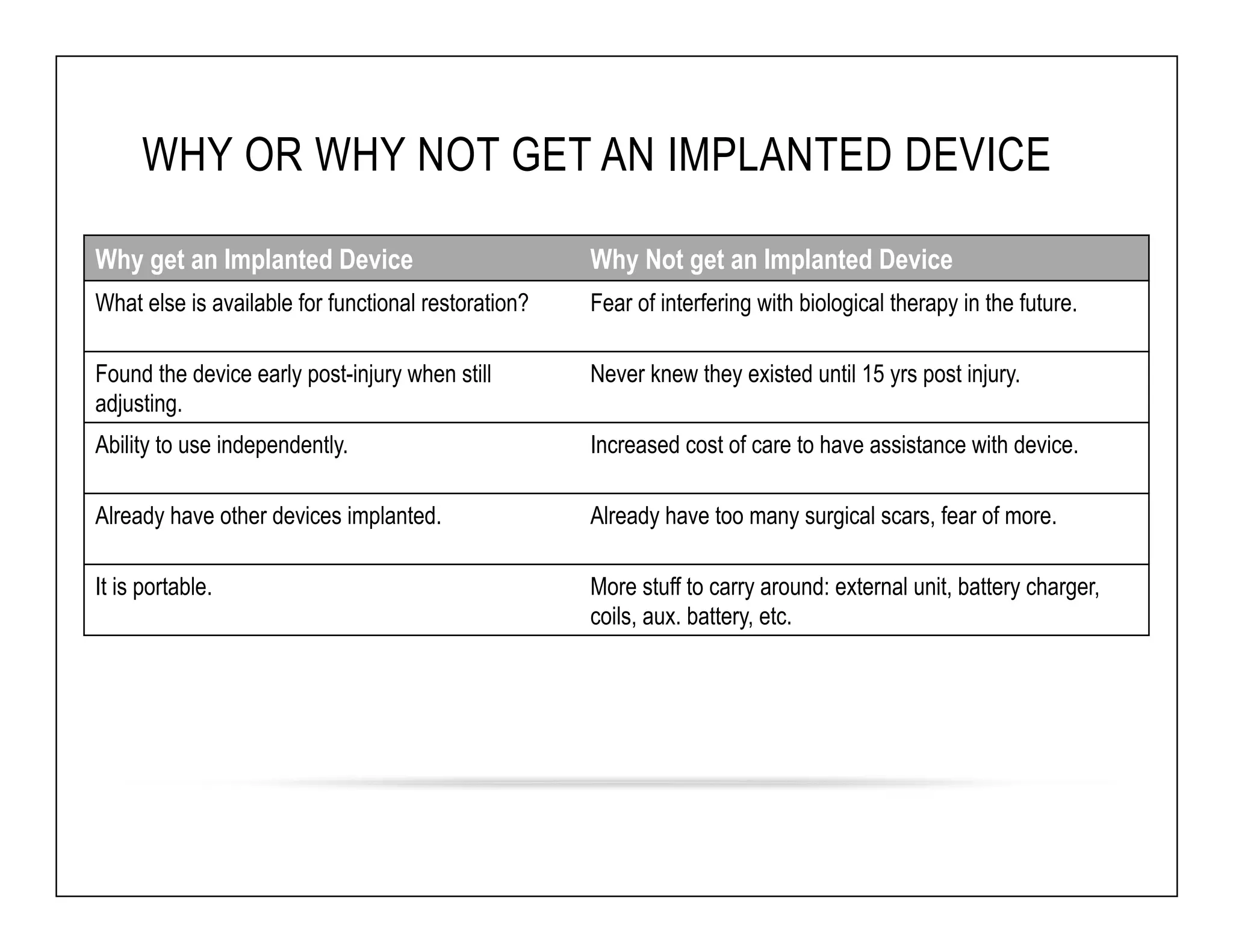
It is portable. More stuff to carry around: external unit, battery charger, 
coils, aux. battery, etc.
WHY OR WHY NOT GET AN IMPLANTED DEVICE 
Why get an Implanted Device Why Not get an Implanted Device 
What else is available for functional restoration? Fear of interfering with biological therapy in the future. 
Found the device early post-injury when still 
adjusting. 
Never knew they existed until 15 yrs post injury. 
Ability to use independently. Increased cost of care to have assistance with device. 
Already have other devices implanted. Already have too many surgical scars, fear of more. 
It is portable. More stuff to carry around: external unit, battery charger, 
coils, aux. battery, etc. 
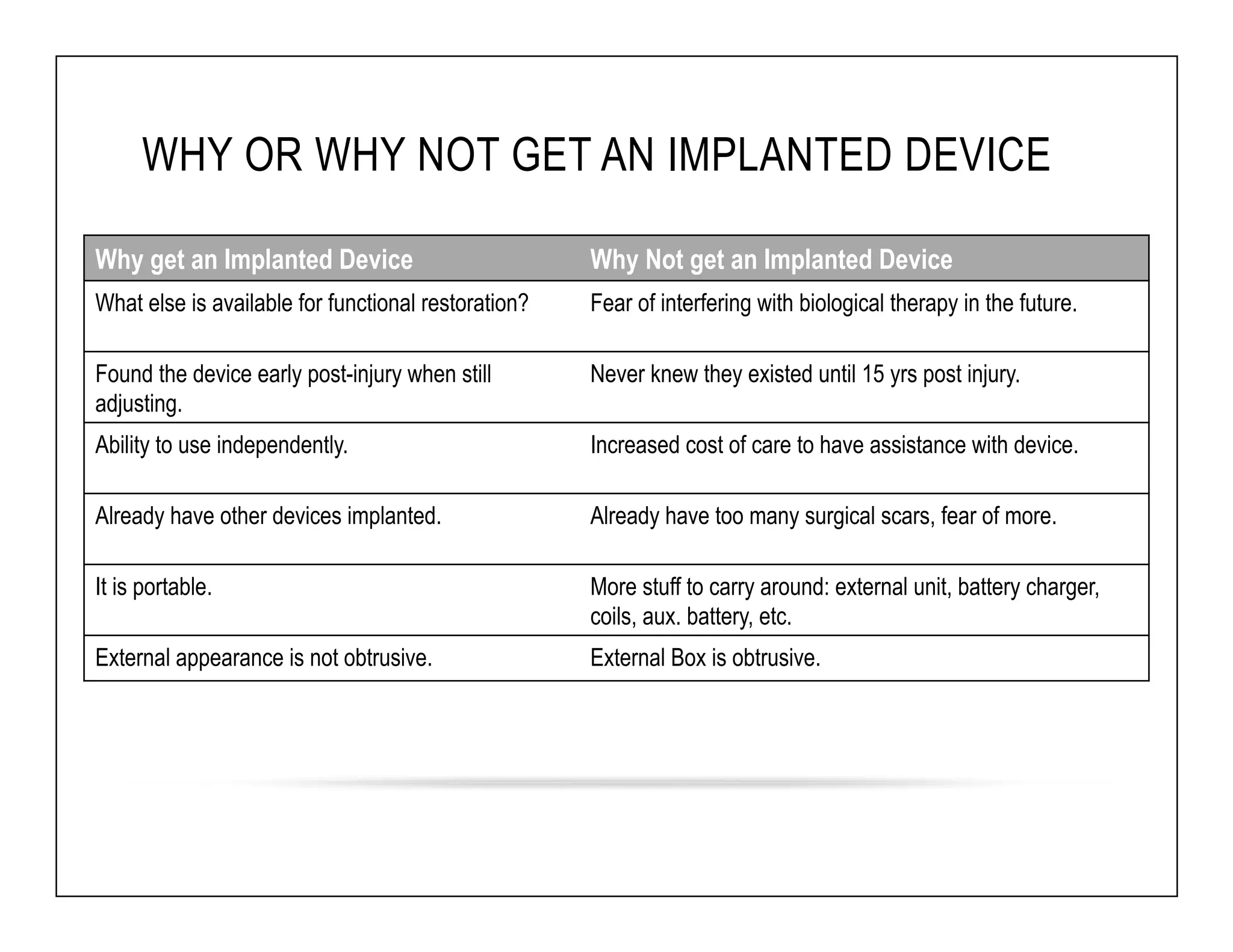
External appearance is not obtrusive. External Box is obtrusive.
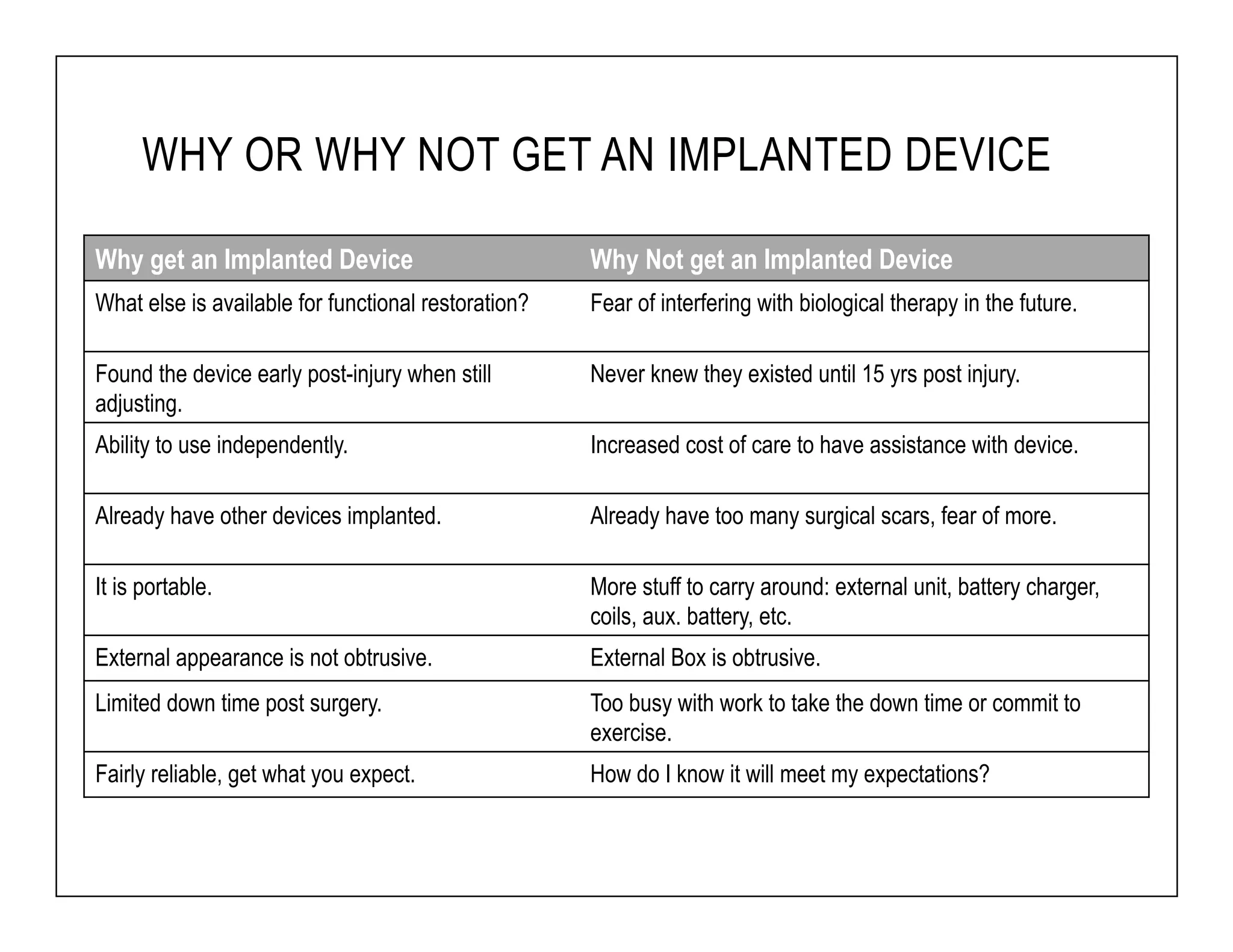
WHY OR WHY NOT GET AN IMPLANTED DEVICE 
Why get an Implanted Device Why Not get an Implanted Device 
What else is available for functional restoration? Fear of interfering with biological therapy in the future. 
Found the device early post-injury when still 
adjusting. 
Never knew they existed until 15 yrs post injury. 
Ability to use independently. Increased cost of care to have assistance with device. 
Already have other devices implanted. Already have too many surgical scars, fear of more. 
It is portable. More stuff to carry around: external unit, battery charger, 
coils, aux. battery, etc. 
External appearance is not obtrusive. External Box is obtrusive. 
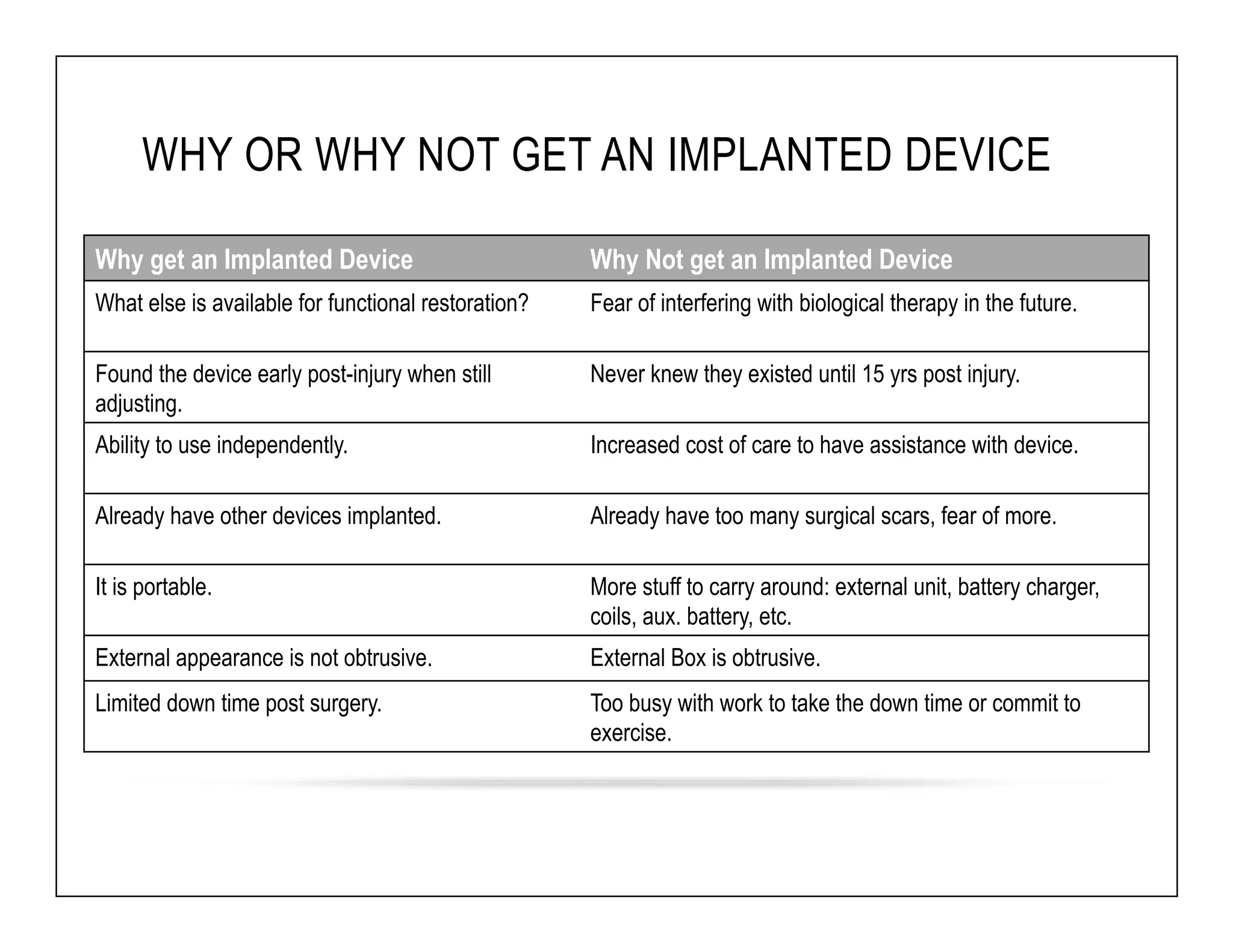
Limited down time post surgery. Too busy with work to take the down time or commit to 
exercise.
WHY OR WHY NOT GET AN IMPLANTED DEVICE 
Why get an Implanted Device Why Not get an Implanted Device 
What else is available for functional restoration? Fear of interfering with biological therapy in the future. 
Found the device early post-injury when still 
adjusting. 
Never knew they existed until 15 yrs post injury. 
Ability to use independently. Increased cost of care to have assistance with device. 
Already have other devices implanted. Already have too many surgical scars, fear of more. 
It is portable. More stuff to carry around: external unit, battery charger, 
coils, aux. battery, etc. 
External appearance is not obtrusive. External Box is obtrusive. 
Limited down time post surgery. Too busy with work to take the down time or commit to 
exercise. 
Fairly reliable, get what you expect. How do I know it will meet my expectations?
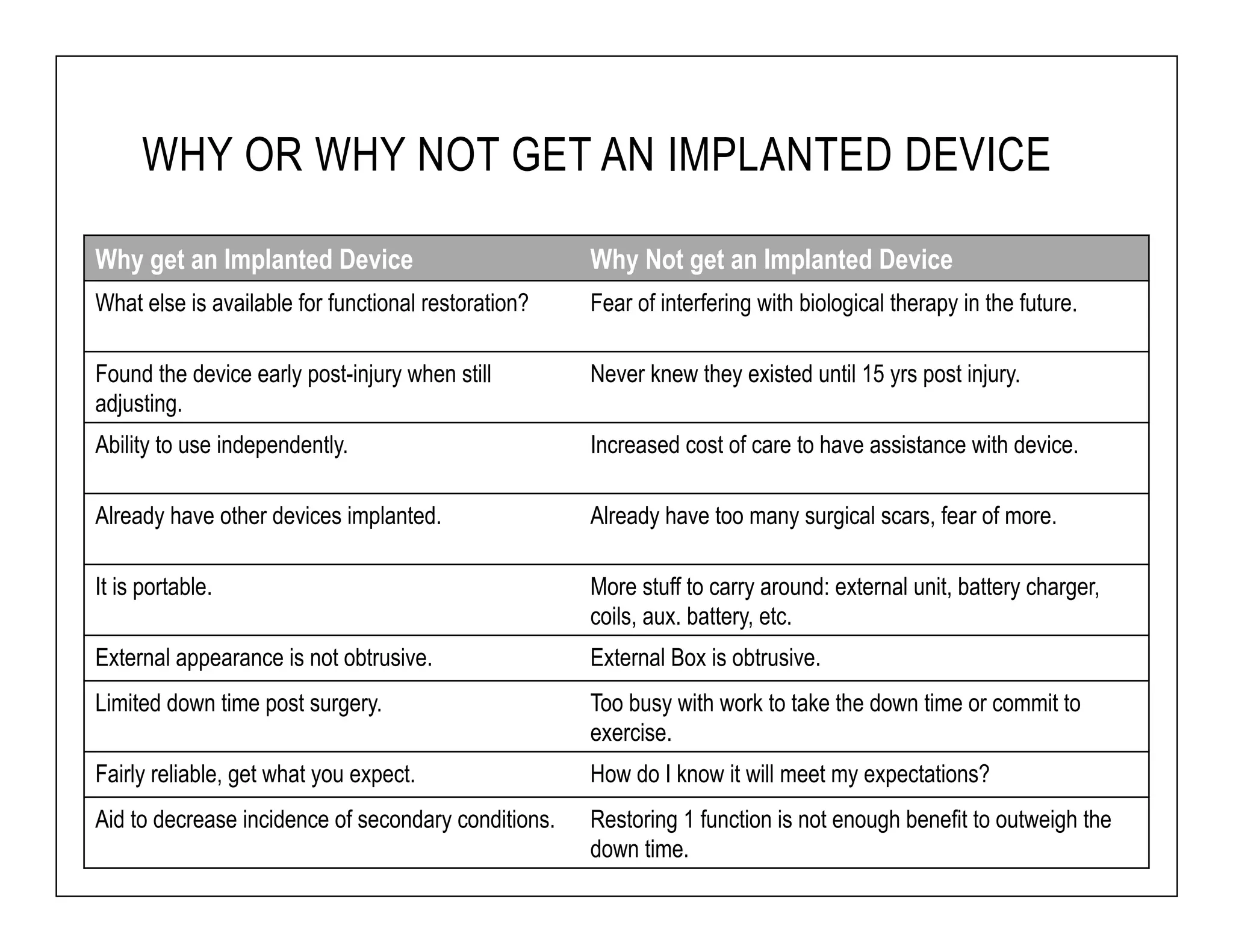
WHY OR WHY NOT GET AN IMPLANTED DEVICE 
Why get an Implanted Device Why Not get an Implanted Device 
What else is available for functional restoration? Fear of interfering with biological therapy in the future. 
Found the device early post-injury when still 
adjusting. 
Never knew they existed until 15 yrs post injury. 
Ability to use independently. Increased cost of care to have assistance with device. 
Already have other devices implanted. Already have too many surgical scars, fear of more. 
It is portable. More stuff to carry around: external unit, battery charger, 
coils, aux. battery, etc. 
External appearance is not obtrusive. External Box is obtrusive. 
Limited down time post surgery. Too busy with work to take the down time or commit to 
exercise. 
Fairly reliable, get what you expect. How do I know it will meet my expectations? 
Aid to decrease incidence of secondary conditions. Restoring 1 function is not enough benefit to outweigh the 
down time.
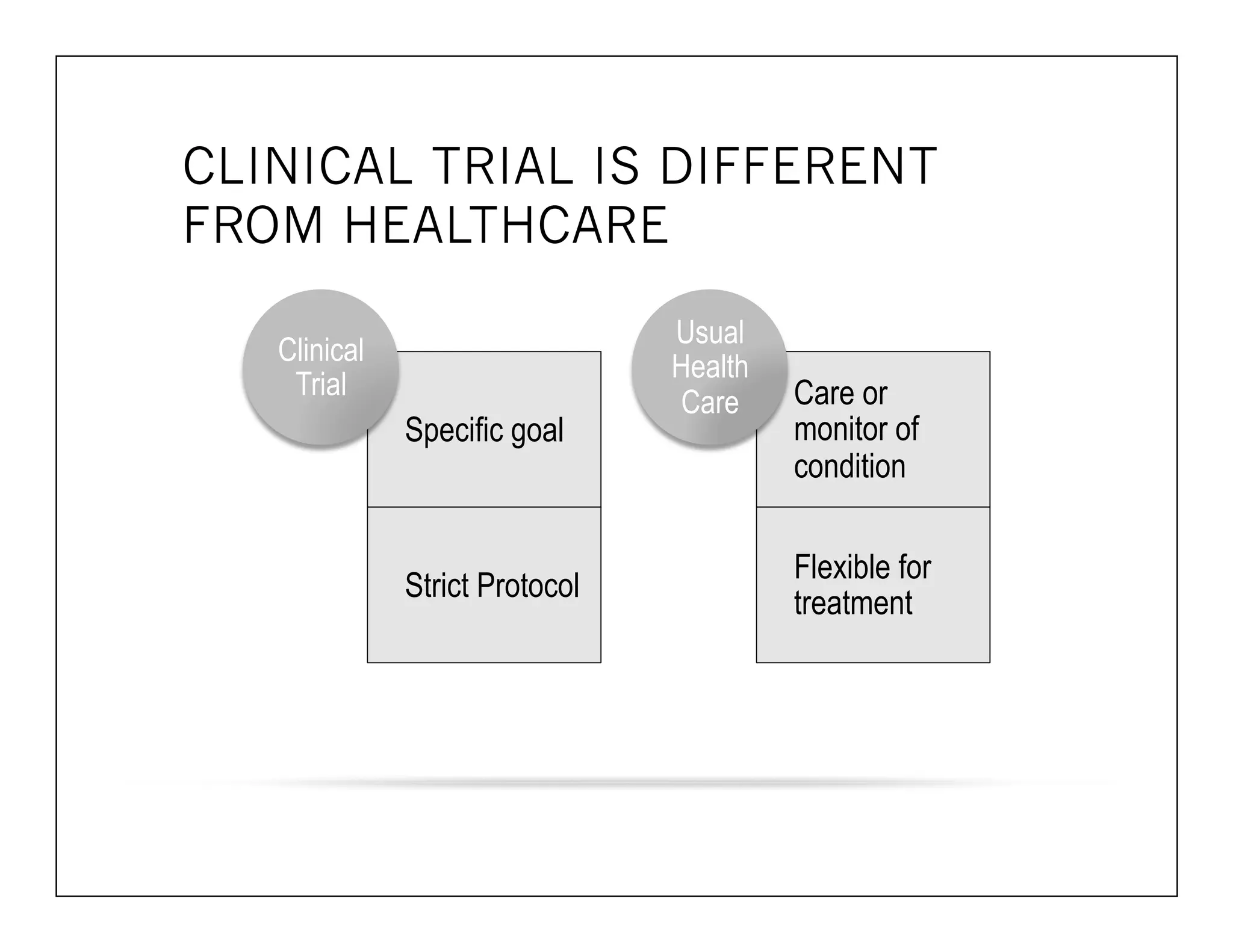
CLINICAL TRIAL IS DIFFERENT 
FROM HEALTHCARE 
Clinical 
Trial Care or 
Specific goal 
Strict Protocol 
monitor of 
condition 
Flexible for 
treatment 
Usual 
Health 
Care
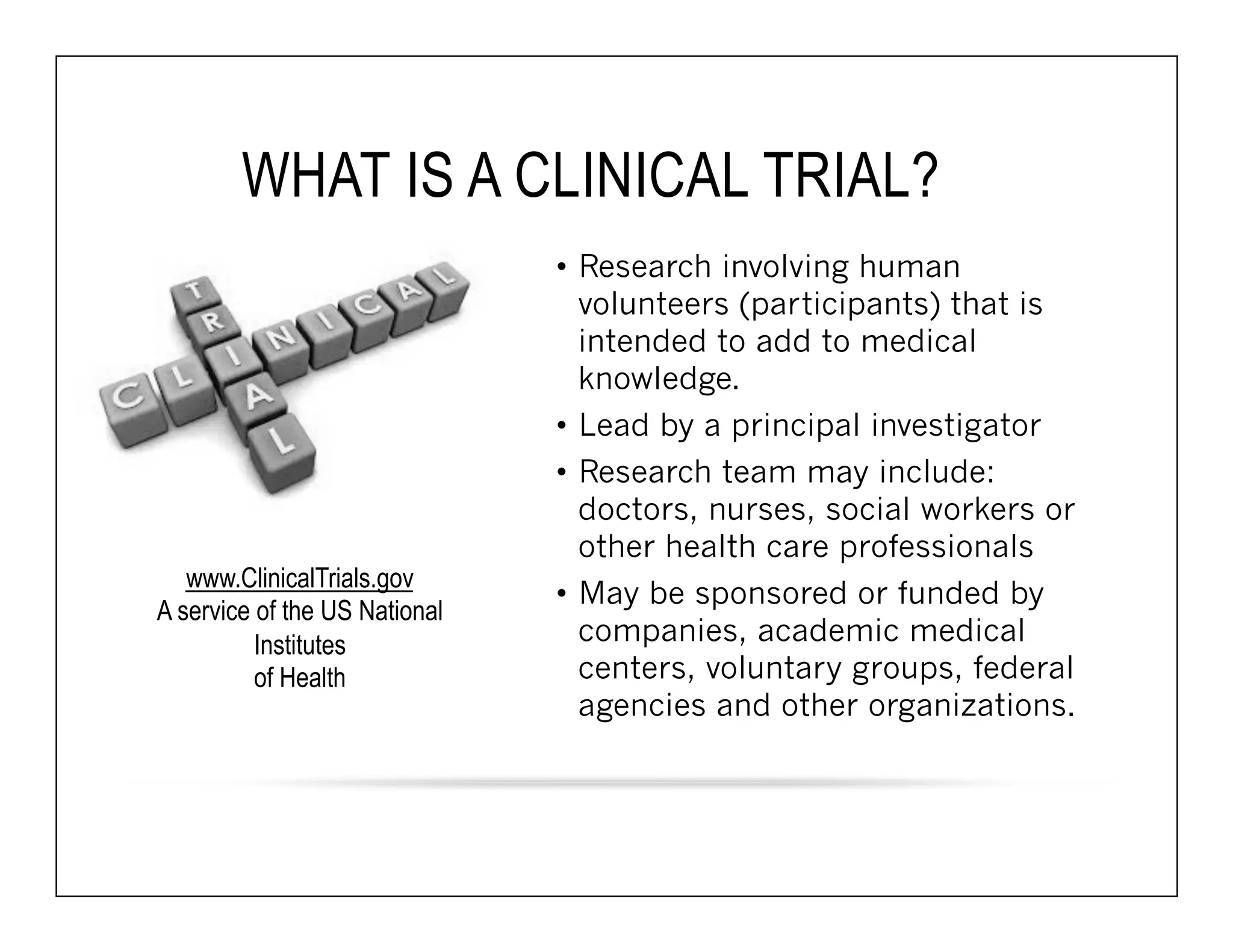
WHAT IS A CLINICAL TRIAL? 
• Research involving human 
volunteers (participants) that is 
intended to add to medical 
knowledge. 
• Lead by a principal investigator 
• Research team may include: 
doctors, nurses, social workers or 
other health care professionals 
• May be sponsored or funded by 
companies, academic medical 
centers, voluntary groups, federal 
agencies and other organizations. 
www.ClinicalTrials.gov 
A service of the US National 
Institutes 
of Health
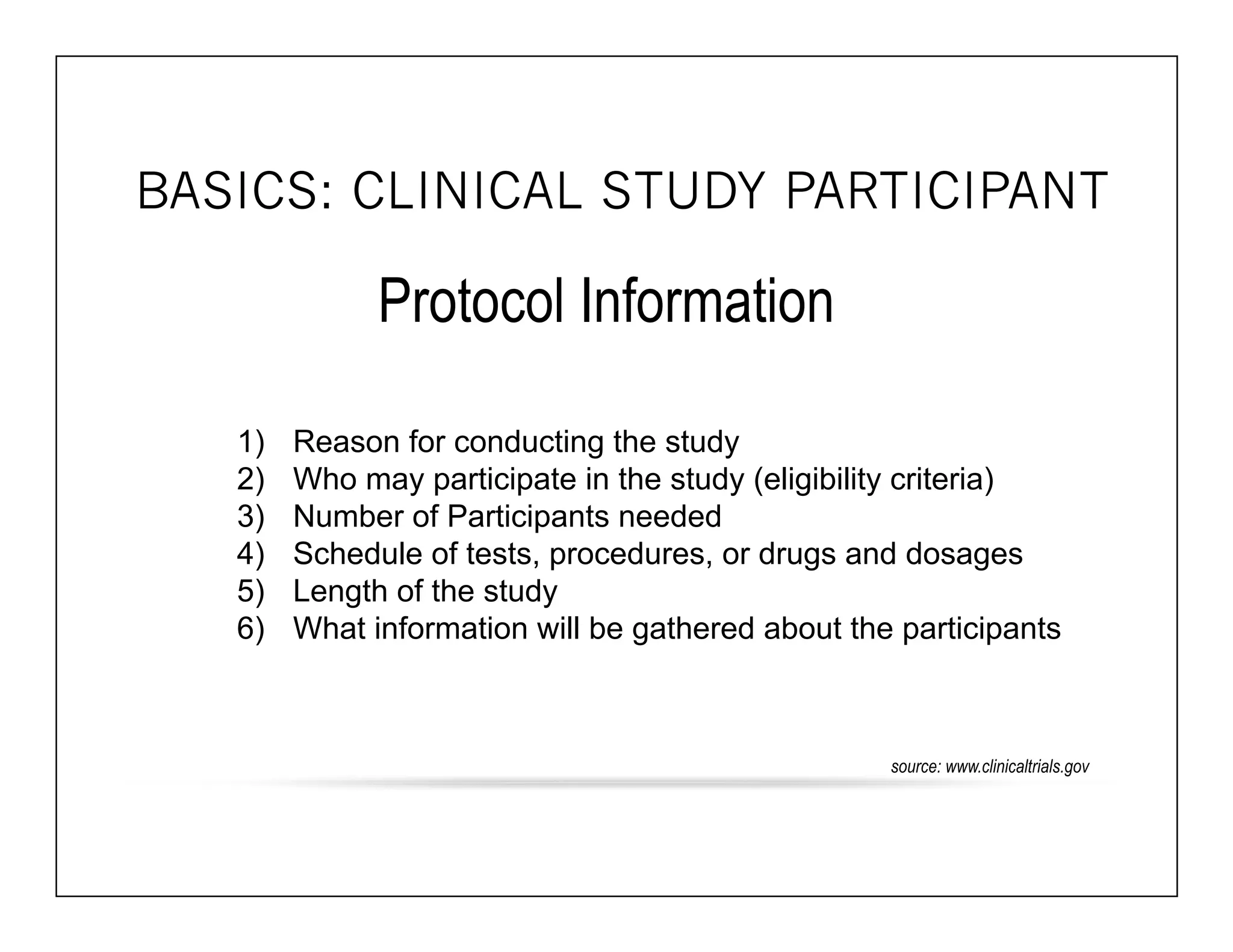
BASICS: CLINICAL STUDY PARTICIPANT 
Protocol Information 
1) Reason for conducting the study 
2) Who may participate in the study (eligibility criteria) 
3) Number of Participants needed 
4) Schedule of tests, procedures, or drugs and dosages 
5) Length of the study 
6) What information will be gathered about the participants 
source: www.clinicaltrials.gov
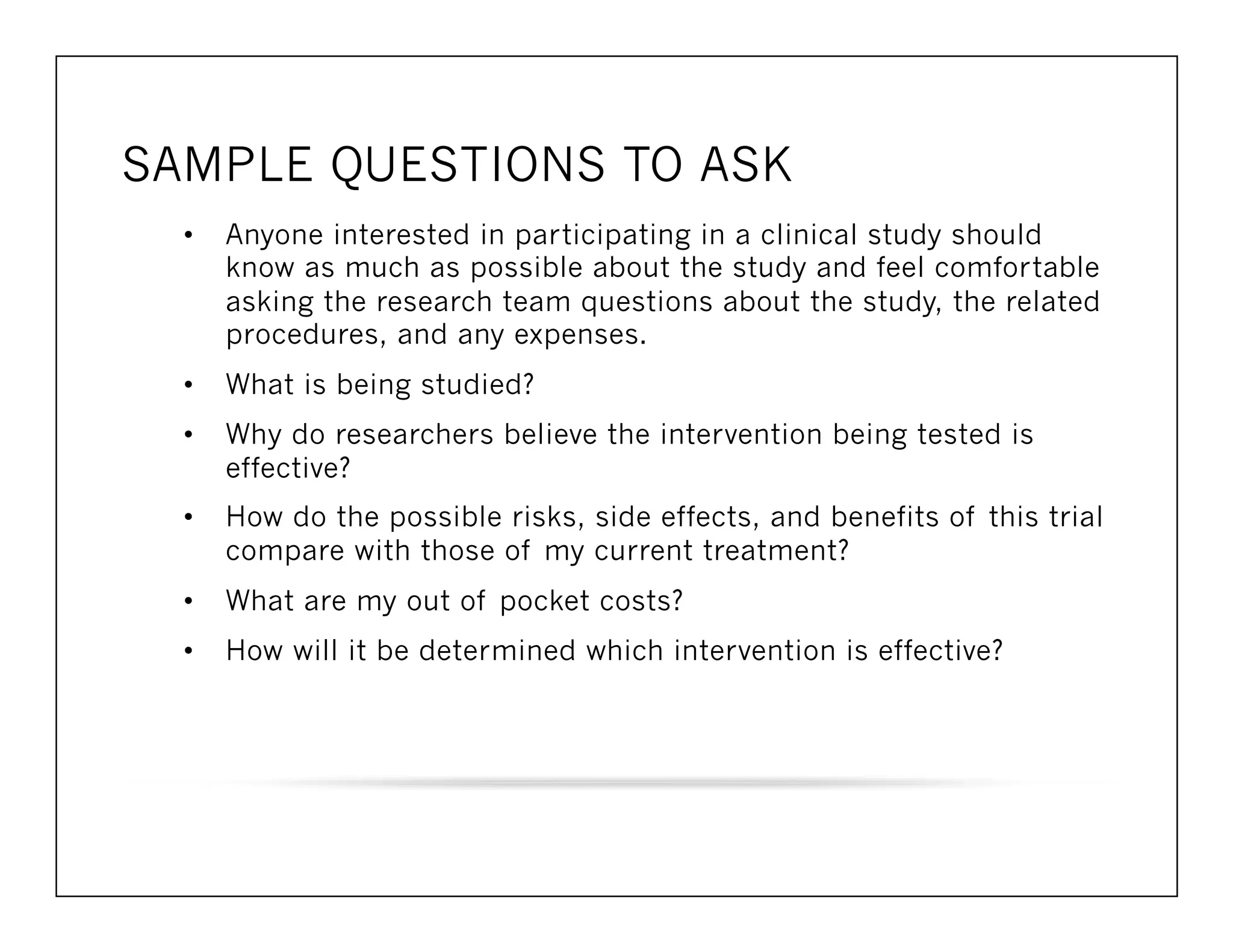
SAMPLE QUESTIONS TO ASK 
• Anyone interested in participating in a clinical study should 
know as much as possible about the study and feel comfortable 
asking the research team questions about the study, the related 
procedures, and any expenses. 
• What is being studied? 
• Why do researchers believe the intervention being tested is 
effective? 
• How do the possible risks, side effects, and benefits of this trial 
compare with those of my current treatment? 
• What are my out of pocket costs? 
• How will it be determined which intervention is effective?
HOW TO GET PLUGGED IN 
www.ClinicalTrials.gov 
Na6onal 
Library 
of 
Medicine 
& 
Na6onal 
Ins6tutes 
of 
Health 
Possible Clinical Trial Search Terms Plus ‘condition’ such as SCI, TBI, MS 
• Implanted prosthesis 
• Stimulation 
• Neurostimulation 
• Neuromodulation
Institute for Functional Restoration 
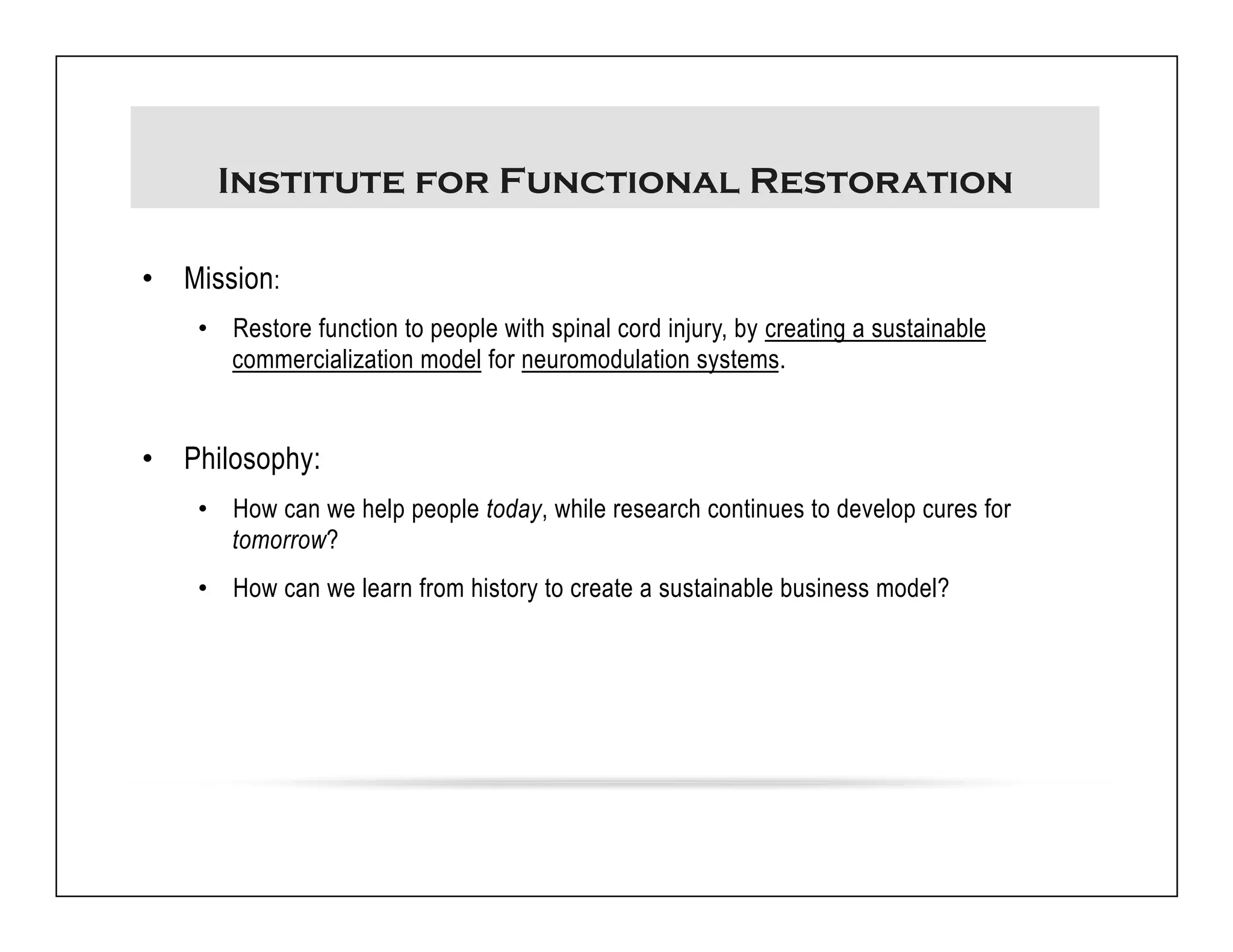
• Mission: 
• Restore function to people with spinal cord injury, by creating a sustainable 
commercialization model for neuromodulation systems. 
• Philosophy: 
• How can we help people today, while research continues to develop cures for 
tomorrow? 
• How can we learn from history to create a sustainable business model?
Institute for Functional Restoration 
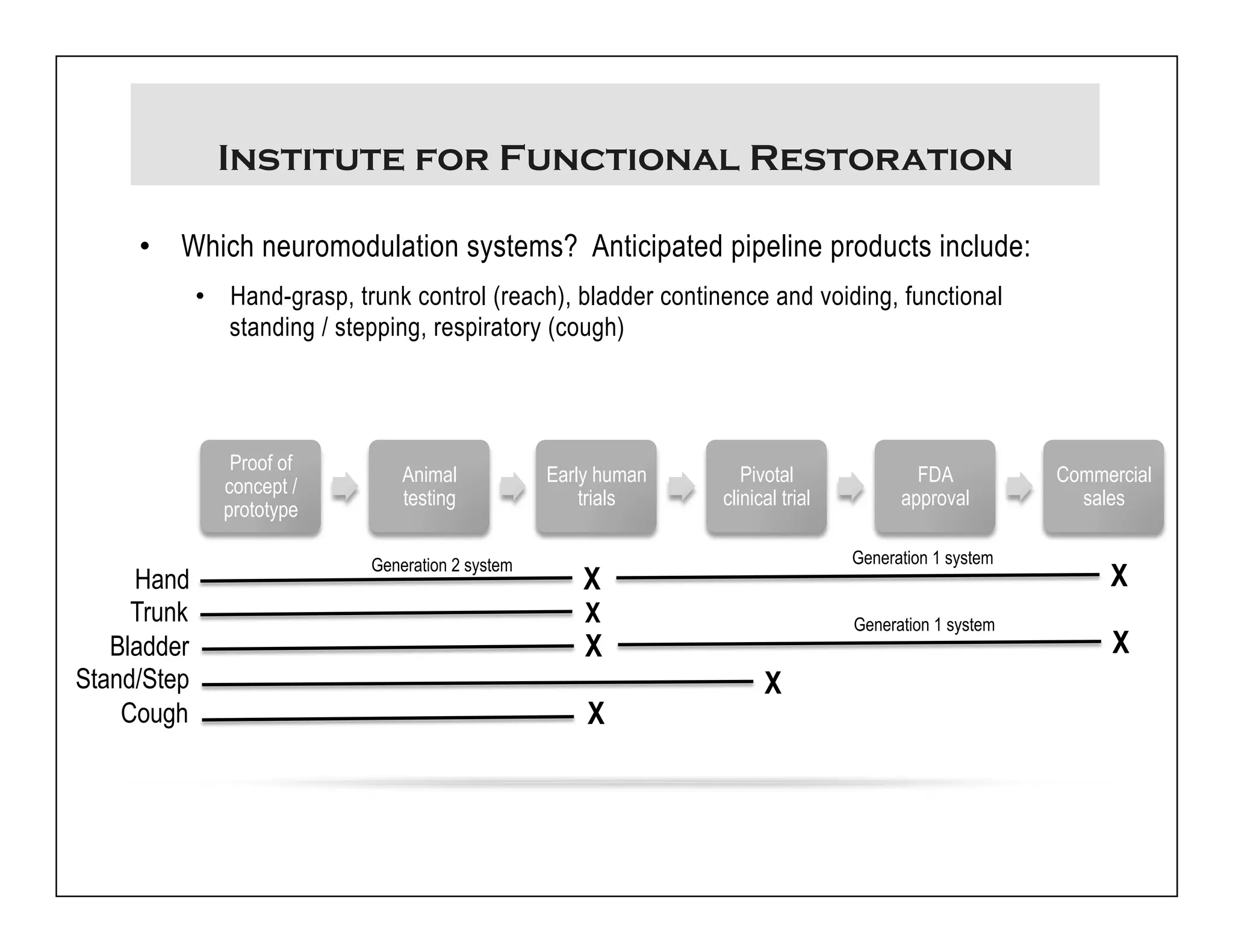
• Which neuromodulation systems? Anticipated pipeline products include: 
• Hand-grasp, trunk control (reach), bladder continence and voiding, functional 
standing / stepping, respiratory (cough) 
Proof of 
concept / 
prototype 
Animal 
testing 
Early human 
trials 
Pivotal 
clinical trial 
FDA 
approval 
Commercial 
sales 
Hand 
Trunk 
Bladder 
Stand/Step 
Cough 
Generation 2 system Generation 1 system X 
X 
X 
X 
X 
X 
X Generation 1 system
Institute for Functional Restoration 
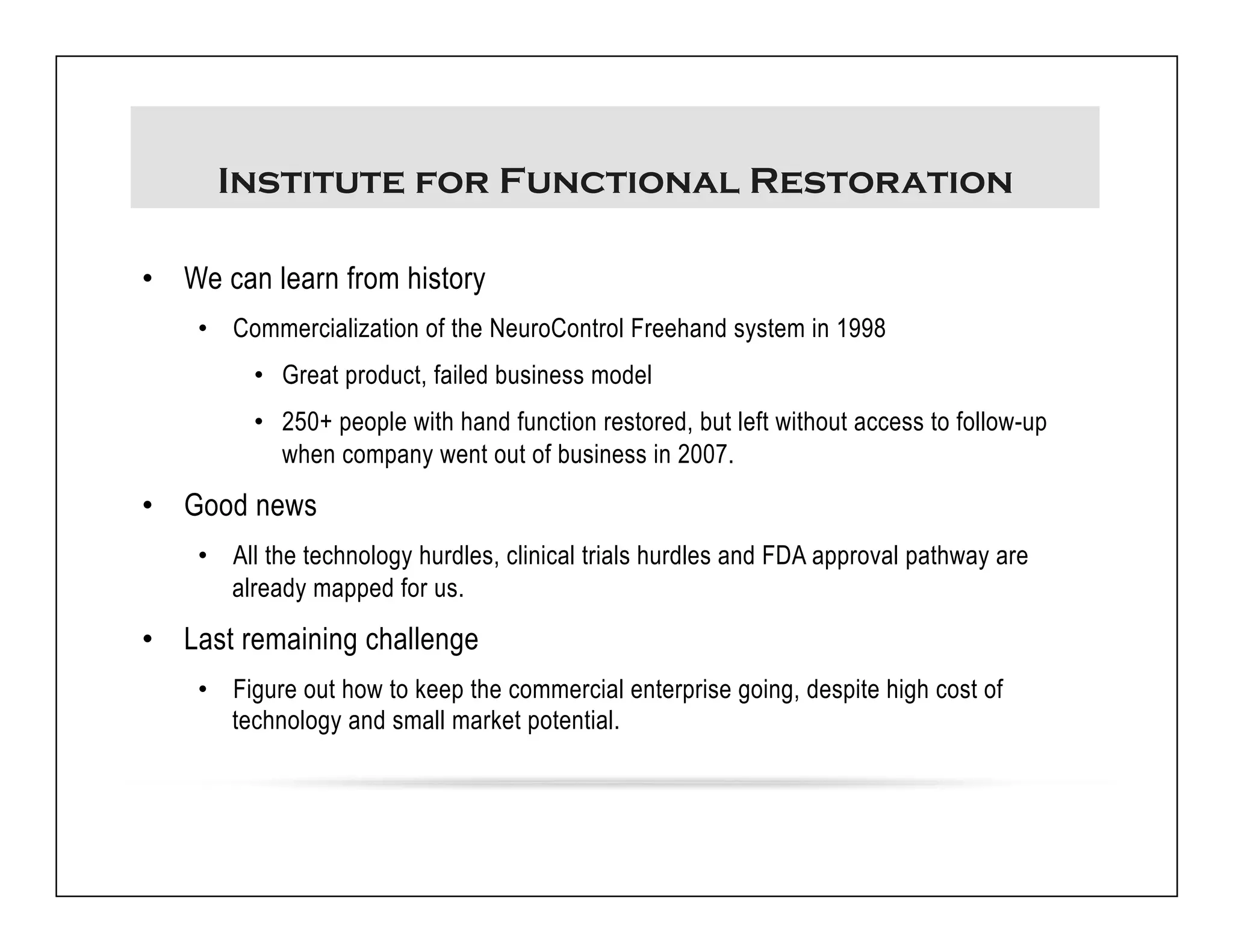
• We can learn from history 
• Commercialization of the NeuroControl Freehand system in 1998 
• Great product, failed business model 
• 250+ people with hand function restored, but left without access to follow-up 
when company went out of business in 2007. 
• Good news 
• All the technology hurdles, clinical trials hurdles and FDA approval pathway are 
already mapped for us. 
• Last remaining challenge 
• Figure out how to keep the commercial enterprise going, despite high cost of 
technology and small market potential.
Institute for Functional Restoration 
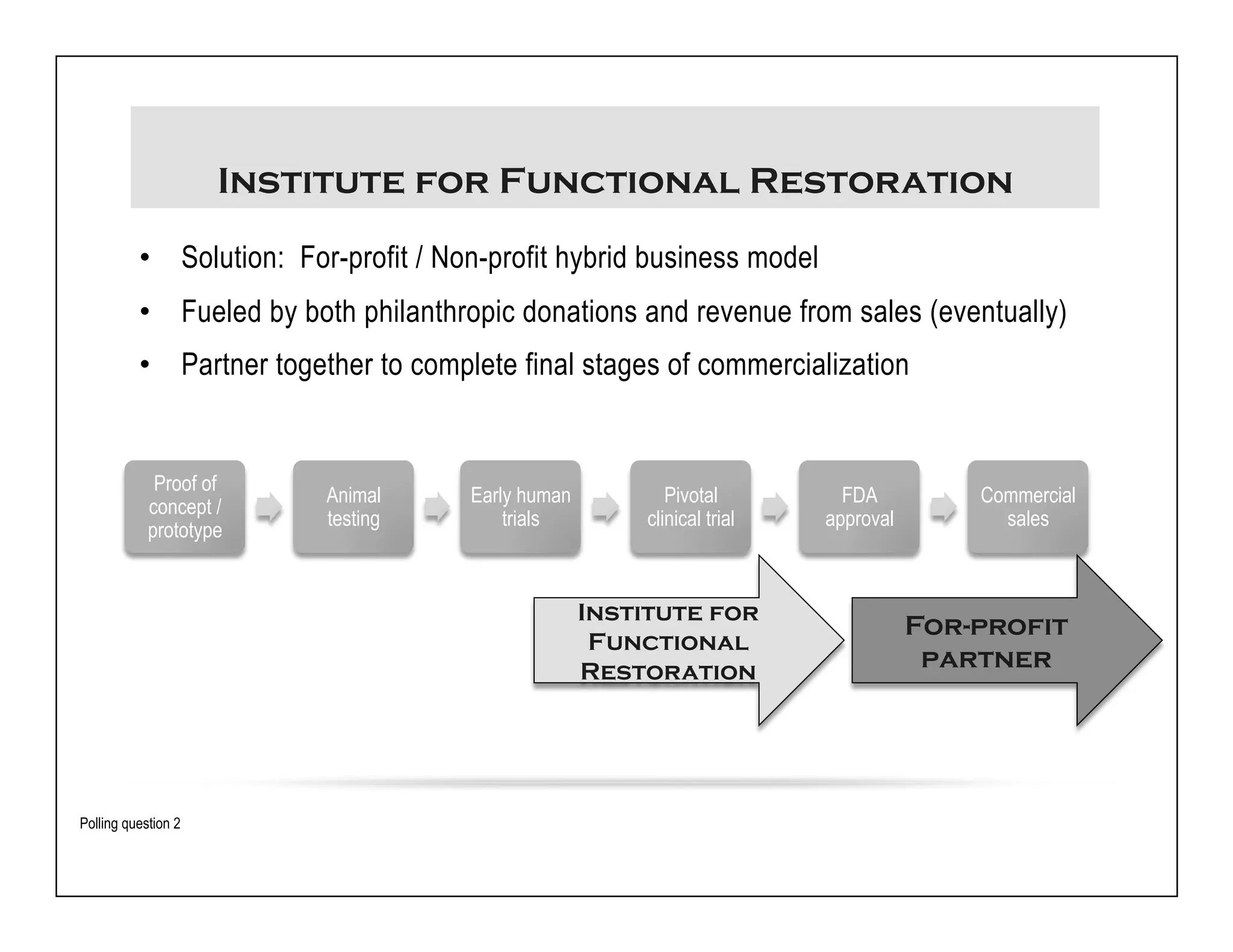
• Solution: For-profit / Non-profit hybrid business model 
• Fueled by both philanthropic donations and revenue from sales (eventually) 
• Partner together to complete final stages of commercialization 
Proof of 
concept / 
prototype 
Animal 
testing 
Early human 
trials 
Pivotal 
clinical trial 
FDA 
approval 
Commercial 
sales 
Institute for 
Functional 
Restoration 
For-profit 
partner 
Polling question 2
RESOURCES TO LEARN MORE 
• Neurotech Network, Spinal Cord Injury Education 
http://www.neurotechnetwork.org/education/educate_spinal_cord_injury.php 
• Miami Project to Cure Paralysis Education: www.theMiamiProject.org 
• Institute for Functional Restoration: http://casemed.case.edu/ifr 
• TEDx Talk about Implanted Neural Prosthesis by Megan & Jen: 
https://www.youtube.com/watch?v=ykJ0YYhvFDc 
• Cleveland FES Center: http://fescenter.org/index.php 
• Salisbury FES Research Center: http://www.salisburyfes.com/index.htm 
• Commercially available devices 
• Breathing: Neurotech Network, Breathing Assistance: 
http://www.neurotechnetwork.org/education/educate_breathing.php 
• Avery Biomedical: http://www.averybiomedical.com/breathing-pacemakers/ 
• AtroTech: http://www.atrotech.com 
• Synapse Biomedical: http://www.synapsebiomedical.com 
• Bladder & Bowel: Neurotech Network, Urinary Incontinence: 
http://www.neurotechnetwork.org/education/educate_urinary_control_resources.php 
• Medtronic Interstim: http://www.medtronic.com/patients/overactive-bladder/index.htm 
• Finetech Medical: 
http://finetech-medical.co.uk/Products/BladderControlSystem/tabid/81/language/en-US/ 
Default.aspx

Introduction to Implanted Neural Prosthesis

  • 1.
    ACCESS TO IMPLANTEDPROSTHESIS: WHAT YOU NEED TO KNOW AND HOW TECHNOLOGY IS USED TO RESTORE FUNCTION Webinar, July 9, 2014 Ø Kim Anderson-Erisman PhD, Director Of Education, University Of Miami & Miami Project To Cure Paralysis Ø Jennifer French, MBA, Executive Director, Neurotech Network Ø Megan Moynahan, MS, Executive Director, Institute For Functional Restoration
  • 2.
  • 3.
    www.NeurotechNetwork.org Helping peopleregain life thru neurotechnology Focusing on education of and advocacy to access neurotechnology devices, therapies and treatments for people living with impairments, their care-givers and medical professionals. www.theMiamiProject.org The Miami Project is dedicated to finding more effective treatments and, ultimately, a cure for paralysis resulting from spinal cord injury. Institute for Functional Restoration http://casemed.case.edu/ifr Committed to restoring function to people with spinal cord injury The Institute for Functional Restoration has the mission to restore function to people with spinal cord injury by creating a sustainable commercialization model for neuromodulation systems.
  • 4.
    DISCLAIMER PAGE Theinformation presented in this session is not meant to replace the advice from a medical professional. You should consult a health care professional familiar with your specific case, concerns and condition. We highly suggest for you to take information to a trained medical professional familiar with your case to discuss options that are best for you.
  • 5.
    AGENDA • Whatare implanted neural prosthetics? • Therapeutic vs. Prosthetic Application • Neuro-stimulation & BCI/BMI Applications • General Pros vs Cons of these systems • Basics of Clinical Trials • How do you get plugged in? Polling question 1
  • 6.
    WHAT ARE IMPLANTEDNEURAL PROSTHETICS? Neural Prosthesis: A device that connects directly with the nervous system to replace or supplement func6on. Key Point: Able to restore func6on for not only acute but chronic condi6ons Photo courtesy of the Cleveland FES Center & Brown University Implanted Device: A device that surgically implanted into the body. For these applica6ons, electrodes can be applied to a nerve or muscle.
  • 7.
    WHAT DOES NEUROTECHNOLOGYOFFER? FUNCTIONAL RESTORATION TODAY
  • 8.
    THERAPEUTIC VS. PROSTHETICAPPLICATION Therapeutic Application • Purpose – restore voluntary motor control (e.g. hand function) through a temporary treatment. • Therapeutic effect: Restored function that remains after the stimulator has been used for a period of time and then turned off. Prosthetic Application • Purpose – replace lost neuromuscular function through an intervention. • Neuroprosthetic effect: The capability of the device, when turned on, to assist a person in performing tasks that the person could not do without the device.
  • 9.
    NEUROSTIMULATION APPLICATIONS Breathing* Neurotech Network: B Hand Grasp & Arm reathing Fact Sheet Bladder & Bowel* Neurotech Network: Urinary Control Fact Sheet Cough Photos courtesy of the Cleveland FES Center, Synapse Biomedical, Medtronic, Finetech Medical
  • 10.
    NEUROSTIMULATION APPLICATIONS Trunk,Posture & Pressure Sore Prevention Standing & Transfer Walking & Drop Foot Photos courtesy of the Advanced Platform Technology Center, Cleveland FES Center, Finetech Medical
  • 11.
    BRAIN COMPUTER INTERFACE/BRAINMACHINE INTERFACE (DR. HOCHBERG) • BRAINGATE 2 - The purpose of this study is to obtain preliminary device safety information and demonstrate proof of principle (feasibility of efficacy) of the ability of people with tetraplegia to control a computer cursor and other assistive devices with their thoughts. • Boston, MA • Stanford, CA • Cleveland, OH • Providence, RI • ClinicalTrials.gov Identifier: - NCT00912041
  • 12.
    BRAIN COMPUTER INTERFACE/BRAINMACHINE INTERFACE (DR. BONNINGER - UPMC) • PITTSBURG BCI - The purpose of these 2 research studies is to demonstrate the safety and efficacy of using two CRS Arrays (microelectrodes) or two NeuroPort arrays (electrodes) for long-term recording of brain motor cortex activity and microstimulation of brain sensory cortex – for control of external devices. • Pittsburgh, PA • ClinicalTrials.gov Identifier: - NCT01894802, NCT01364480
  • 13.
    OTHER BCI CONTROLLINGEXTERNAL DEVICES • Computer – California Institute of Technology/Casa Colinas Rehabilitation Center – NCS; ClinicalTrials.gov Identifier: NCT01958086 • Robot – California Institute of Technology/Rancho los Amigos Rehabilitation Center – NPS2; ClinicalTrials.gov Identifier: NCT01964261
  • 14.
    BRAIN MACHINE INTERFACE(DR. REZAI - OSU)
  • 15.
    WHY OR WHYNOT GET AN IMPLANTED DEVICE Why get an Implanted Device Why Not get an Implanted Device What else is available for functional restoration? Fear of interfering with biological therapy in the future.
  • 16.
    WHY OR WHYNOT GET AN IMPLANTED DEVICE Why get an Implanted Device Why Not get an Implanted Device What else is available for functional restoration? Fear of interfering with biological therapy in the future. Found the device early post-injury when still adjusting. Never knew they existed until 15 yrs post injury.
  • 17.
    WHY OR WHYNOT GET AN IMPLANTED DEVICE Why get an Implanted Device Why Not get an Implanted Device What else is available for functional restoration? Fear of interfering with biological therapy in the future. Found the device early post-injury when still adjusting. Never knew they existed until 15 yrs post injury. Ability to use independently. Increased cost of care to have assistance with device.
  • 18.
    WHY OR WHYNOT GET AN IMPLANTED DEVICE Why get an Implanted Device Why Not get an Implanted Device What else is available for functional restoration? Fear of interfering with biological therapy in the future. Found the device early post-injury when still adjusting. Never knew they existed until 15 yrs post injury. Ability to use independently. Increased cost of care to have assistance with device. Already have other devices implanted. Already have too many surgical scars, fear of more.
  • 19.
    WHY OR WHYNOT GET AN IMPLANTED DEVICE Why get an Implanted Device Why Not get an Implanted Device What else is available for functional restoration? Fear of interfering with biological therapy in the future. Found the device early post-injury when still adjusting. Never knew they existed until 15 yrs post injury. Ability to use independently. Increased cost of care to have assistance with device. Already have other devices implanted. Already have too many surgical scars, fear of more. It is portable. More stuff to carry around: external unit, battery charger, coils, aux. battery, etc.
  • 20.
    WHY OR WHYNOT GET AN IMPLANTED DEVICE Why get an Implanted Device Why Not get an Implanted Device What else is available for functional restoration? Fear of interfering with biological therapy in the future. Found the device early post-injury when still adjusting. Never knew they existed until 15 yrs post injury. Ability to use independently. Increased cost of care to have assistance with device. Already have other devices implanted. Already have too many surgical scars, fear of more. It is portable. More stuff to carry around: external unit, battery charger, coils, aux. battery, etc. External appearance is not obtrusive. External Box is obtrusive.
  • 21.
    WHY OR WHYNOT GET AN IMPLANTED DEVICE Why get an Implanted Device Why Not get an Implanted Device What else is available for functional restoration? Fear of interfering with biological therapy in the future. Found the device early post-injury when still adjusting. Never knew they existed until 15 yrs post injury. Ability to use independently. Increased cost of care to have assistance with device. Already have other devices implanted. Already have too many surgical scars, fear of more. It is portable. More stuff to carry around: external unit, battery charger, coils, aux. battery, etc. External appearance is not obtrusive. External Box is obtrusive. Limited down time post surgery. Too busy with work to take the down time or commit to exercise.
  • 22.
    WHY OR WHYNOT GET AN IMPLANTED DEVICE Why get an Implanted Device Why Not get an Implanted Device What else is available for functional restoration? Fear of interfering with biological therapy in the future. Found the device early post-injury when still adjusting. Never knew they existed until 15 yrs post injury. Ability to use independently. Increased cost of care to have assistance with device. Already have other devices implanted. Already have too many surgical scars, fear of more. It is portable. More stuff to carry around: external unit, battery charger, coils, aux. battery, etc. External appearance is not obtrusive. External Box is obtrusive. Limited down time post surgery. Too busy with work to take the down time or commit to exercise. Fairly reliable, get what you expect. How do I know it will meet my expectations?
  • 23.
    WHY OR WHYNOT GET AN IMPLANTED DEVICE Why get an Implanted Device Why Not get an Implanted Device What else is available for functional restoration? Fear of interfering with biological therapy in the future. Found the device early post-injury when still adjusting. Never knew they existed until 15 yrs post injury. Ability to use independently. Increased cost of care to have assistance with device. Already have other devices implanted. Already have too many surgical scars, fear of more. It is portable. More stuff to carry around: external unit, battery charger, coils, aux. battery, etc. External appearance is not obtrusive. External Box is obtrusive. Limited down time post surgery. Too busy with work to take the down time or commit to exercise. Fairly reliable, get what you expect. How do I know it will meet my expectations? Aid to decrease incidence of secondary conditions. Restoring 1 function is not enough benefit to outweigh the down time.
  • 24.
    CLINICAL TRIAL ISDIFFERENT FROM HEALTHCARE Clinical Trial Care or Specific goal Strict Protocol monitor of condition Flexible for treatment Usual Health Care
  • 25.
    WHAT IS ACLINICAL TRIAL? • Research involving human volunteers (participants) that is intended to add to medical knowledge. • Lead by a principal investigator • Research team may include: doctors, nurses, social workers or other health care professionals • May be sponsored or funded by companies, academic medical centers, voluntary groups, federal agencies and other organizations. www.ClinicalTrials.gov A service of the US National Institutes of Health
  • 26.
    BASICS: CLINICAL STUDYPARTICIPANT Protocol Information 1) Reason for conducting the study 2) Who may participate in the study (eligibility criteria) 3) Number of Participants needed 4) Schedule of tests, procedures, or drugs and dosages 5) Length of the study 6) What information will be gathered about the participants source: www.clinicaltrials.gov
  • 27.
    SAMPLE QUESTIONS TOASK • Anyone interested in participating in a clinical study should know as much as possible about the study and feel comfortable asking the research team questions about the study, the related procedures, and any expenses. • What is being studied? • Why do researchers believe the intervention being tested is effective? • How do the possible risks, side effects, and benefits of this trial compare with those of my current treatment? • What are my out of pocket costs? • How will it be determined which intervention is effective?
  • 30.
    HOW TO GETPLUGGED IN www.ClinicalTrials.gov Na6onal Library of Medicine & Na6onal Ins6tutes of Health Possible Clinical Trial Search Terms Plus ‘condition’ such as SCI, TBI, MS • Implanted prosthesis • Stimulation • Neurostimulation • Neuromodulation
  • 31.
    Institute for FunctionalRestoration • Mission: • Restore function to people with spinal cord injury, by creating a sustainable commercialization model for neuromodulation systems. • Philosophy: • How can we help people today, while research continues to develop cures for tomorrow? • How can we learn from history to create a sustainable business model?
  • 32.
    Institute for FunctionalRestoration • Which neuromodulation systems? Anticipated pipeline products include: • Hand-grasp, trunk control (reach), bladder continence and voiding, functional standing / stepping, respiratory (cough) Proof of concept / prototype Animal testing Early human trials Pivotal clinical trial FDA approval Commercial sales Hand Trunk Bladder Stand/Step Cough Generation 2 system Generation 1 system X X X X X X X Generation 1 system
  • 33.
    Institute for FunctionalRestoration • We can learn from history • Commercialization of the NeuroControl Freehand system in 1998 • Great product, failed business model • 250+ people with hand function restored, but left without access to follow-up when company went out of business in 2007. • Good news • All the technology hurdles, clinical trials hurdles and FDA approval pathway are already mapped for us. • Last remaining challenge • Figure out how to keep the commercial enterprise going, despite high cost of technology and small market potential.
  • 34.
    Institute for FunctionalRestoration • Solution: For-profit / Non-profit hybrid business model • Fueled by both philanthropic donations and revenue from sales (eventually) • Partner together to complete final stages of commercialization Proof of concept / prototype Animal testing Early human trials Pivotal clinical trial FDA approval Commercial sales Institute for Functional Restoration For-profit partner Polling question 2
  • 35.
    RESOURCES TO LEARNMORE • Neurotech Network, Spinal Cord Injury Education http://www.neurotechnetwork.org/education/educate_spinal_cord_injury.php • Miami Project to Cure Paralysis Education: www.theMiamiProject.org • Institute for Functional Restoration: http://casemed.case.edu/ifr • TEDx Talk about Implanted Neural Prosthesis by Megan & Jen: https://www.youtube.com/watch?v=ykJ0YYhvFDc • Cleveland FES Center: http://fescenter.org/index.php • Salisbury FES Research Center: http://www.salisburyfes.com/index.htm • Commercially available devices • Breathing: Neurotech Network, Breathing Assistance: http://www.neurotechnetwork.org/education/educate_breathing.php • Avery Biomedical: http://www.averybiomedical.com/breathing-pacemakers/ • AtroTech: http://www.atrotech.com • Synapse Biomedical: http://www.synapsebiomedical.com • Bladder & Bowel: Neurotech Network, Urinary Incontinence: http://www.neurotechnetwork.org/education/educate_urinary_control_resources.php • Medtronic Interstim: http://www.medtronic.com/patients/overactive-bladder/index.htm • Finetech Medical: http://finetech-medical.co.uk/Products/BladderControlSystem/tabid/81/language/en-US/ Default.aspx