Webinar title: Pain & Spasticity Management Without the Pills
Presenter/presenters:
Kimberly Anderson-Erisman, PhD
Director of Education
University of Miami & Miami Project to Cure Paralysis
Jennifer French, MBA
Executive Director
Neurotech Network
Want	
  to	
  Ask	
  a	
  Ques-on?	
  
Disclaimer	
  page	
  
The	
  informa,on	
  presented	
  in	
  this	
  webinar	
  is	
  not	
  meant	
  to	
  replace	
  the	
  advice	
  
from	
  a	
  medical	
  professional.	
  You	
  should	
  consult	
  a	
  health	
  care	
  professional	
  
familiar	
  with	
  your	
  specific	
  case,	
  concerns	
  and	
  condi,on.	
  
Neurotech	
  Network	
  and	
  its	
  representa,ves	
  do	
  not	
  endorse,	
  rate,	
  sell,	
  
distribute,	
  prescribe,	
  administer	
  or	
  recommend	
  any	
  products,	
  procedures	
  
or	
  services.	
  We	
  highly	
  suggest	
  for	
  you	
  to	
  take	
  informa,on	
  to	
  a	
  trained	
  
medical	
  professional	
  familiar	
  with	
  your	
  case	
  to	
  discuss	
  op,ons	
  that	
  are	
  
best	
  for	
  you.	
  
www.NeurotechNetwork.org	
  
Helping	
  people	
  regain	
  life	
  thru	
  
neurotechnology	


Focusing	
  on	
  educa-on	
  of	
  and	
  
advocacy	
  to	
  access	
  neurotechnology	
  
devices,	
  therapies	
  and	
  treatments	
  for	
  
people	
  living	
  with	
  impairments,	
  their	
  
care-­‐givers	
  and	
  medical	
  professionals.	
  
www.themiamiproject.org	
  
The	
  Miami	
  Project	
  is	
  dedicated	
  to	
  	
  
finding	
  more	
  effec-ve	
  treatments	
  
and,	
  ul-mately,	
  a	
  cure	
  for	
  paralysis	
  
resul-ng	
  from	
  spinal	
  cord	
  injury.	
  
Objec-ves	
  
•  Understanding	
  the	
  Pain	
  
•  Op-ons	
  for	
  pain	
  management	
  
•  Alterna-ve	
  Therapies	
  
•  Technology	
  integra-on	
  
•  Resource	
  to	
  learn	
  more	
  
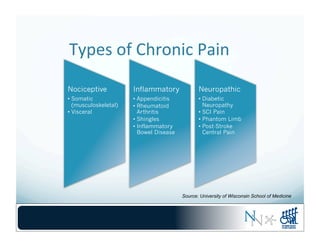
Types	
  of	
  Chronic	
  Pain	
  
Nociceptive
• Somatic
(musculoskeletal)
• Visceral
Inflammatory
• Appendicitis
• Rheumatoid
Arthritis
• Shingles
• Inflammatory
Bowel Disease
Neuropathic
• Diabetic
Neuropathy
• SCI Pain
• Phantom Limb
• Post-Stroke
Central Pain
Source: University of Wisconsin School of Medicine
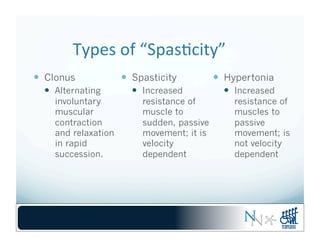
Types	
  of	
  “Spas-city”	
  
—  Clonus
—  Alternating
involuntary
muscular
contraction
and relaxation
in rapid
succession.
—  Hypertonia
—  Increased
resistance of
muscles to
passive
movement; is
not velocity
dependent
—  Spasticity
—  Increased
resistance of
muscle to
sudden, passive
movement; it is
velocity
dependent
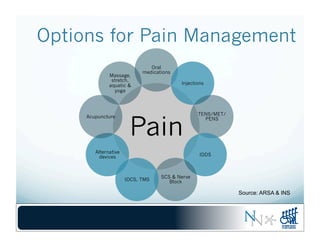
Options for Pain Management
Pain
Oral
medications
Injections
TENS/MET/
PENS
IDDS
SCS & Nerve
BlocktDCS, TMS
Alternative
devices
Acupuncture
Massage,
stretch,
aquatic &
yoga
Source: ARSA & INS
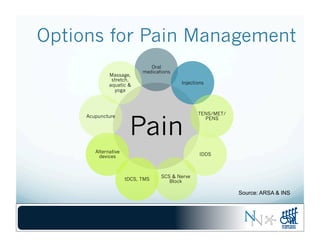
Options for Pain Management
Pain
Oral
medications
Injections
TENS/MET/
PENS
IDDS
SCS & Nerve
BlocktDCS, TMS
Alternative
devices
Acupuncture
Massage,
stretch,
aquatic &
yoga
Source: ARSA & INS
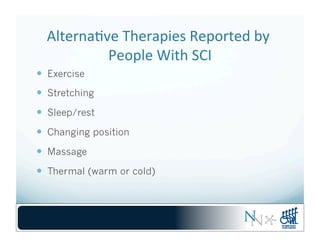
Alterna-ve	
  Therapies	
  Reported	
  by	
  
People	
  With	
  SCI	
  
—  Exercise
—  Stretching
—  Sleep/rest
—  Changing position
—  Massage
—  Thermal (warm or cold)
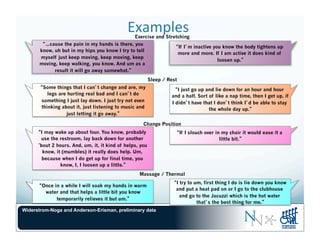
Examples	
  	
  
“…cause the pain in my hands is there, you
know, uh but in my hips you know I try to tell
myself just keep moving, keep moving, keep
moving, keep walking, you know. And um as a
result it will go away somewhat.”
Exercise and Stretching
“If I’m inactive you know the body tightens up
more and more. If I am active it does kind of
loosen up.”
Sleep / Rest
“Some things that I can’t change and are, my
legs are hurting real bad and I can’t do
something I just lay down. I just try not even
thinking about it, just listening to music and
just letting it go away.”	
  
“I just go up and lie down for an hour and hour
and a half. Sort of like a nap time, then I get up, if
I didn’t have that I don’t think I’d be able to stay
the whole day up.”
“I may wake up about four. You know, probably
use the restroom, lay back down for another
‘bout 2 hours. And, um, it, it kind of helps, you
know, it (mumbles) it really does help. Um,
because when I do get up for final time, you
know, I, I loosen up a little.”
“If I slouch over in my chair it would ease it a
little bit.”
Massage / Thermal
“Once in a while I will soak my hands in warm
water and that helps a little bit you know
temporarily relieves it but um.”
“I try to um, first thing I do is lie down you know
and put a heat pad on or I go to the clubhouse
and go to the Jacuzzi which is the hot water
that’s the best thing for me.”
Change Position
Widerstrom-Noga and Anderson-Erisman, preliminary data
Coping	
  Strategies	
  that	
  Help	
  With	
  Pain	
  
—  Resilience/minimizing
—  Learning over time
—  Distraction
—  Optimism/humor
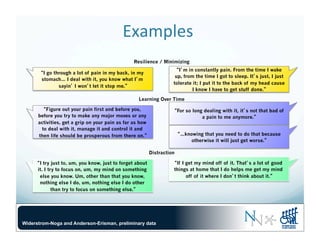
Examples	
  	
  
Resilience / Minimizing
“I go through a lot of pain in my back, in my
stomach… I deal with it, you know what I’m
sayin’ I won’t let it stop me.”
“I’m in constantly pain. From the time I wake
up, from the time I got to sleep. It’s just, I just
tolerate it; I put it to the back of my head cause
I know I have to get stuff done.”
Learning Over Time
“Figure out your pain first and before you,
before you try to make any major moves or any
activities, get a grip on your pain as far as how
to deal with it, manage it and control it and
then life should be prosperous from there on.”
“For so long dealing with it, it’s not that bad of
a pain to me anymore.”
Distraction
“I try just to, um, you know, just to forget about
it. I try to focus on, um, my mind on something
else you know. Um, other than that you know,
nothing else I do, um, nothing else I do other
than try to focus on something else.”
“lf I get my mind off of it. That’s a lot of good
things at home that I do helps me get my mind
off of it where I don’t think about it.”
“…knowing that you need to do that because
otherwise it will just get worse.”
Widerstrom-Noga and Anderson-Erisman, preliminary data
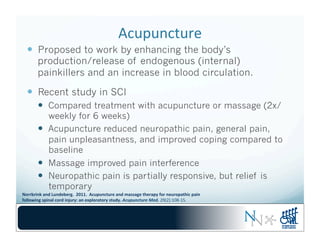
Acupuncture	
  
—  Proposed to work by enhancing the body’s
production/release of endogenous (internal)
painkillers and an increase in blood circulation.
—  Recent study in SCI
—  Compared treatment with acupuncture or massage (2x/
weekly for 6 weeks)
—  Acupuncture reduced neuropathic pain, general pain,
pain unpleasantness, and improved coping compared to
baseline
—  Massage improved pain interference
—  Neuropathic pain is partially responsive, but relief is
temporary
Norrbrink	
  and	
  Lundeberg.	
  	
  2011.	
  	
  Acupuncture	
  and	
  massage	
  therapy	
  for	
  neuropathic	
  pain	
  	
  
following	
  spinal	
  cord	
  injury:	
  an	
  exploratory	
  study.	
  Acupuncture	
  Med.	
  29(2):108-­‐15.	
  	
  
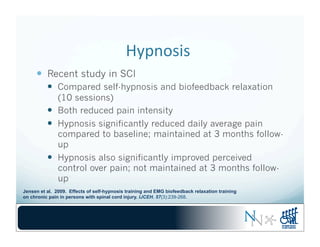
Hypnosis	
  	
  
—  Recent study in SCI
—  Compared self-hypnosis and biofeedback relaxation
(10 sessions)
—  Both reduced pain intensity
—  Hypnosis significantly reduced daily average pain
compared to baseline; maintained at 3 months follow-
up
—  Hypnosis also significantly improved perceived
control over pain; not maintained at 3 months follow-
up
Jensen et al. 2009. Effects of self-hypnosis training and EMG biofeedback relaxation training
on chronic pain in persons with spinal cord injury. IJCEH. 57(3):239-268.
Technology	
  Integra-on	
  
— TENS/MET/PENS	
  
— IDDS	
  
— SCS	
  &	
  Nerve	
  Block	
  
— tDCS	
  or	
  TMS	
  	
  
— Alterna-ve	
  Devices	
  
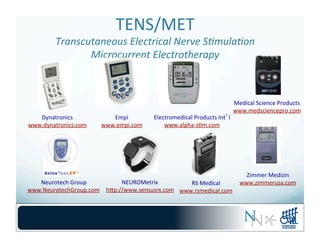
TENS/MET	
  
Transcutaneous	
  Electrical	
  Nerve	
  S,mula,on	
  
Microcurrent	
  Electrotherapy	
  
Dynatronics	
  
www.dynatronics.com	
  
Empi	
  
www.empi.com	
  
Electromedical	
  Products	
  Int’l	
  
www.alpha-­‐s-m.com	
  
Medical	
  Science	
  Products	
  
www.medsciencepro.com	
  
RS	
  Medical	
  
www.rsmedical.com	
  
Neurotech	
  Group	
  
www.NeurotechGroup.com	
  
NEUROMetrix	
  
hbp://www.sensusrx.com	
  
Zimmer	
  Medizin	
  
www.zimmerusa.com	
  
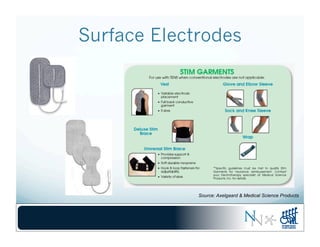
Surface Electrodes
Source: Axelgaard & Medical Science Products
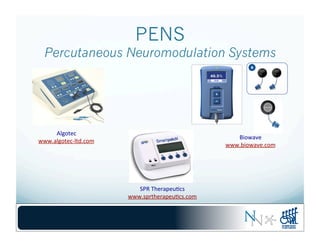
PENS
Percutaneous Neuromodulation Systems
Algotec	
  
www.algotec-­‐ltd.com	
  
Biowave	
  
www.biowave.com	
  
SPR	
  Therapeu-cs	
  
www.sprtherapeu-cs.com	
  
IDDS
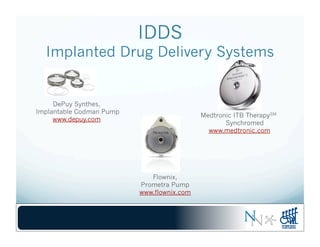
Implanted Drug Delivery Systems
DePuy Synthes,
Implantable Codman Pump
www.depuy.com
Medtronic ITB TherapySM
Synchromed
www.medtronic.com
Flownix,
Prometra Pump
www.flownix.com
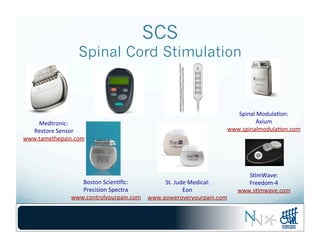
SCS
Spinal Cord Stimulation
Boston	
  Scien-fic:	
  	
  
Precision	
  Spectra	
  
www.controlyourpain.com	
  
Medtronic:	
  	
  
Restore	
  Sensor	
  
www.tamethepain.com	
  
St.	
  Jude	
  Medical:	
  	
  
Eon	
  
www.poweroveryourpain.com	
  
Spinal	
  Modula-on:	
  	
  
Axium	
  
www.spinalmodula-on.com	
  
S-mWave:	
  	
  
Freedom-­‐4	
  
www.s-mwave.com	
  
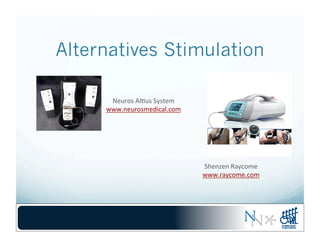
Alternatives Stimulation
Neuros	
  Al-us	
  System	
  
www.neurosmedical.com	
  
Shenzen	
  Raycome	
  
www.raycome.com	
  
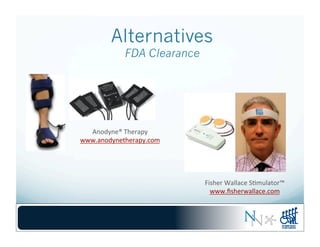
Alternatives
FDA Clearance
Anodyne®	
  Therapy	
  
www.anodynetherapy.com	
  
Fisher	
  Wallace	
  S-mulator™	
  
www.fisherwallace.com	
  
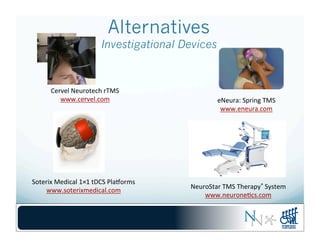
Alternatives
Investigational Devices
NeuroStar	
  TMS	
  Therapy®	
  System	
  
www.neurone-cs.com	
  
Soterix	
  Medical	
  1×1	
  tDCS	
  Plajorms	
  
www.soterixmedical.com	
  
Cervel	
  Neurotech	
  rTMS	
  
www.cervel.com	
   eNeura:	
  Spring	
  TMS	
  
www.eneura.com	
  
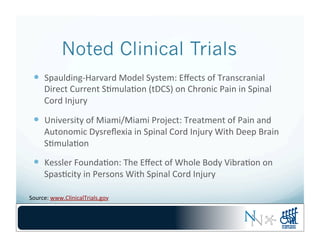
Noted Clinical Trials
—  Spaulding-­‐Harvard	
  Model	
  System:	
  Effects	
  of	
  Transcranial	
  
Direct	
  Current	
  S-mula-on	
  (tDCS)	
  on	
  Chronic	
  Pain	
  in	
  Spinal	
  
Cord	
  Injury	
  
—  University	
  of	
  Miami/Miami	
  Project:	
  Treatment	
  of	
  Pain	
  and	
  
Autonomic	
  Dysreflexia	
  in	
  Spinal	
  Cord	
  Injury	
  With	
  Deep	
  Brain	
  
S-mula-on	
  
—  Kessler	
  Founda-on:	
  The	
  Effect	
  of	
  Whole	
  Body	
  Vibra-on	
  on	
  
Spas-city	
  in	
  Persons	
  With	
  Spinal	
  Cord	
  Injury	
  
Source:	
  www.ClinicalTrials.gov	
  
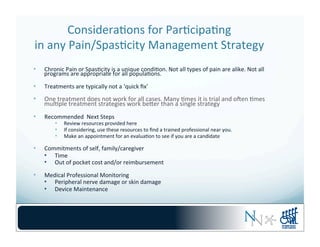
Considera-ons	
  for	
  Par-cipa-ng	
  	
  
in	
  any	
  Pain/Spas-city	
  Management	
  Strategy	
  
•  Chronic	
  Pain	
  or	
  Spas-city	
  is	
  a	
  unique	
  condi-on.	
  Not	
  all	
  types	
  of	
  pain	
  are	
  alike.	
  Not	
  all	
  
programs	
  are	
  appropriate	
  for	
  all	
  popula-ons.	
  
•  Treatments	
  are	
  typically	
  not	
  a	
  ‘quick	
  fix’	
  
•  One	
  treatment	
  does	
  not	
  work	
  for	
  all	
  cases.	
  Many	
  -mes	
  it	
  is	
  trial	
  and	
  oqen	
  -mes	
  
mul-ple	
  treatment	
  strategies	
  work	
  beber	
  than	
  a	
  single	
  strategy	
  	
  
•  Recommended	
  	
  Next	
  Steps	
  
•  Review	
  resources	
  provided	
  here	
  
•  If	
  considering,	
  use	
  these	
  resources	
  to	
  find	
  a	
  trained	
  professional	
  near	
  you.	
  
•  Make	
  an	
  appointment	
  for	
  an	
  evalua-on	
  to	
  see	
  if	
  you	
  are	
  a	
  candidate	
  
•  Commitments	
  of	
  self,	
  family/caregiver	
  
•  Time	
  
•  Out	
  of	
  pocket	
  cost	
  and/or	
  reimbursement	
  
•  Medical	
  Professional	
  Monitoring	
  
•  Peripheral	
  nerve	
  damage	
  or	
  skin	
  damage	
  
•  Device	
  Maintenance	
  
Addi-onal	
  Resources	
  
—  Neurotech Network: Pain Management Fact Sheet
—  American Academy of Pain Management
—  American Chronic Pain Association
—  American Pain Foundation
—  National Chronic Pain Outreach Association
—  The Mayday Pain Project
—  NIH Neurological Disorders and Stroke—Chronic
Pain - NINDS Chronic Pain Information Pages	
  
Ø  Kim Anderson-Erisman PhD, Director Of
Education, University Of Miami & Miami
Project To Cure Paralysis
Ø  kanderson3@med.miami.edu
Ø  Jennifer French, MBA, Executive
Director, Neurotech Network
Ø  jfrench@neurotechnetwork.org
Next Webinar is June 17, 2015: Direct Nerve Stimulation

Pain & Spasticity Management without the Pills

  • 1.
    Webinar title: Pain& Spasticity Management Without the Pills Presenter/presenters: Kimberly Anderson-Erisman, PhD Director of Education University of Miami & Miami Project to Cure Paralysis Jennifer French, MBA Executive Director Neurotech Network
  • 2.
    Want  to  Ask  a  Ques-on?  
  • 3.
    Disclaimer  page   The  informa,on  presented  in  this  webinar  is  not  meant  to  replace  the  advice   from  a  medical  professional.  You  should  consult  a  health  care  professional   familiar  with  your  specific  case,  concerns  and  condi,on.   Neurotech  Network  and  its  representa,ves  do  not  endorse,  rate,  sell,   distribute,  prescribe,  administer  or  recommend  any  products,  procedures   or  services.  We  highly  suggest  for  you  to  take  informa,on  to  a  trained   medical  professional  familiar  with  your  case  to  discuss  op,ons  that  are   best  for  you.  
  • 4.
    www.NeurotechNetwork.org   Helping  people  regain  life  thru   neurotechnology     Focusing  on  educa-on  of  and   advocacy  to  access  neurotechnology   devices,  therapies  and  treatments  for   people  living  with  impairments,  their   care-­‐givers  and  medical  professionals.   www.themiamiproject.org   The  Miami  Project  is  dedicated  to     finding  more  effec-ve  treatments   and,  ul-mately,  a  cure  for  paralysis   resul-ng  from  spinal  cord  injury.  
  • 5.
    Objec-ves   •  Understanding  the  Pain   •  Op-ons  for  pain  management   •  Alterna-ve  Therapies   •  Technology  integra-on   •  Resource  to  learn  more  
  • 6.
    Types  of  Chronic  Pain   Nociceptive • Somatic (musculoskeletal) • Visceral Inflammatory • Appendicitis • Rheumatoid Arthritis • Shingles • Inflammatory Bowel Disease Neuropathic • Diabetic Neuropathy • SCI Pain • Phantom Limb • Post-Stroke Central Pain Source: University of Wisconsin School of Medicine
  • 7.
    Types  of  “Spas-city”   —  Clonus —  Alternating involuntary muscular contraction and relaxation in rapid succession. —  Hypertonia —  Increased resistance of muscles to passive movement; is not velocity dependent —  Spasticity —  Increased resistance of muscle to sudden, passive movement; it is velocity dependent
  • 8.
    Options for PainManagement Pain Oral medications Injections TENS/MET/ PENS IDDS SCS & Nerve BlocktDCS, TMS Alternative devices Acupuncture Massage, stretch, aquatic & yoga Source: ARSA & INS
  • 9.
    Options for PainManagement Pain Oral medications Injections TENS/MET/ PENS IDDS SCS & Nerve BlocktDCS, TMS Alternative devices Acupuncture Massage, stretch, aquatic & yoga Source: ARSA & INS
  • 10.
    Alterna-ve  Therapies  Reported  by   People  With  SCI   —  Exercise —  Stretching —  Sleep/rest —  Changing position —  Massage —  Thermal (warm or cold)
  • 11.
    Examples     “…causethe pain in my hands is there, you know, uh but in my hips you know I try to tell myself just keep moving, keep moving, keep moving, keep walking, you know. And um as a result it will go away somewhat.” Exercise and Stretching “If I’m inactive you know the body tightens up more and more. If I am active it does kind of loosen up.” Sleep / Rest “Some things that I can’t change and are, my legs are hurting real bad and I can’t do something I just lay down. I just try not even thinking about it, just listening to music and just letting it go away.”   “I just go up and lie down for an hour and hour and a half. Sort of like a nap time, then I get up, if I didn’t have that I don’t think I’d be able to stay the whole day up.” “I may wake up about four. You know, probably use the restroom, lay back down for another ‘bout 2 hours. And, um, it, it kind of helps, you know, it (mumbles) it really does help. Um, because when I do get up for final time, you know, I, I loosen up a little.” “If I slouch over in my chair it would ease it a little bit.” Massage / Thermal “Once in a while I will soak my hands in warm water and that helps a little bit you know temporarily relieves it but um.” “I try to um, first thing I do is lie down you know and put a heat pad on or I go to the clubhouse and go to the Jacuzzi which is the hot water that’s the best thing for me.” Change Position Widerstrom-Noga and Anderson-Erisman, preliminary data
  • 12.
    Coping  Strategies  that  Help  With  Pain   —  Resilience/minimizing —  Learning over time —  Distraction —  Optimism/humor
  • 13.
    Examples     Resilience/ Minimizing “I go through a lot of pain in my back, in my stomach… I deal with it, you know what I’m sayin’ I won’t let it stop me.” “I’m in constantly pain. From the time I wake up, from the time I got to sleep. It’s just, I just tolerate it; I put it to the back of my head cause I know I have to get stuff done.” Learning Over Time “Figure out your pain first and before you, before you try to make any major moves or any activities, get a grip on your pain as far as how to deal with it, manage it and control it and then life should be prosperous from there on.” “For so long dealing with it, it’s not that bad of a pain to me anymore.” Distraction “I try just to, um, you know, just to forget about it. I try to focus on, um, my mind on something else you know. Um, other than that you know, nothing else I do, um, nothing else I do other than try to focus on something else.” “lf I get my mind off of it. That’s a lot of good things at home that I do helps me get my mind off of it where I don’t think about it.” “…knowing that you need to do that because otherwise it will just get worse.” Widerstrom-Noga and Anderson-Erisman, preliminary data
  • 14.
    Acupuncture   —  Proposedto work by enhancing the body’s production/release of endogenous (internal) painkillers and an increase in blood circulation. —  Recent study in SCI —  Compared treatment with acupuncture or massage (2x/ weekly for 6 weeks) —  Acupuncture reduced neuropathic pain, general pain, pain unpleasantness, and improved coping compared to baseline —  Massage improved pain interference —  Neuropathic pain is partially responsive, but relief is temporary Norrbrink  and  Lundeberg.    2011.    Acupuncture  and  massage  therapy  for  neuropathic  pain     following  spinal  cord  injury:  an  exploratory  study.  Acupuncture  Med.  29(2):108-­‐15.    
  • 15.
    Hypnosis     — Recent study in SCI —  Compared self-hypnosis and biofeedback relaxation (10 sessions) —  Both reduced pain intensity —  Hypnosis significantly reduced daily average pain compared to baseline; maintained at 3 months follow- up —  Hypnosis also significantly improved perceived control over pain; not maintained at 3 months follow- up Jensen et al. 2009. Effects of self-hypnosis training and EMG biofeedback relaxation training on chronic pain in persons with spinal cord injury. IJCEH. 57(3):239-268.
  • 16.
    Technology  Integra-on   — TENS/MET/PENS   — IDDS   — SCS  &  Nerve  Block   — tDCS  or  TMS     — Alterna-ve  Devices  
  • 17.
    TENS/MET   Transcutaneous  Electrical  Nerve  S,mula,on   Microcurrent  Electrotherapy   Dynatronics   www.dynatronics.com   Empi   www.empi.com   Electromedical  Products  Int’l   www.alpha-­‐s-m.com   Medical  Science  Products   www.medsciencepro.com   RS  Medical   www.rsmedical.com   Neurotech  Group   www.NeurotechGroup.com   NEUROMetrix   hbp://www.sensusrx.com   Zimmer  Medizin   www.zimmerusa.com  
  • 18.
    Surface Electrodes Source: Axelgaard& Medical Science Products
  • 19.
    PENS Percutaneous Neuromodulation Systems Algotec   www.algotec-­‐ltd.com   Biowave   www.biowave.com   SPR  Therapeu-cs   www.sprtherapeu-cs.com  
  • 20.
    IDDS Implanted Drug DeliverySystems DePuy Synthes, Implantable Codman Pump www.depuy.com Medtronic ITB TherapySM Synchromed www.medtronic.com Flownix, Prometra Pump www.flownix.com
  • 21.
    SCS Spinal Cord Stimulation Boston  Scien-fic:     Precision  Spectra   www.controlyourpain.com   Medtronic:     Restore  Sensor   www.tamethepain.com   St.  Jude  Medical:     Eon   www.poweroveryourpain.com   Spinal  Modula-on:     Axium   www.spinalmodula-on.com   S-mWave:     Freedom-­‐4   www.s-mwave.com  
  • 22.
    Alternatives Stimulation Neuros  Al-us  System   www.neurosmedical.com   Shenzen  Raycome   www.raycome.com  
  • 23.
    Alternatives FDA Clearance Anodyne®  Therapy   www.anodynetherapy.com   Fisher  Wallace  S-mulator™   www.fisherwallace.com  
  • 24.
    Alternatives Investigational Devices NeuroStar  TMS  Therapy®  System   www.neurone-cs.com   Soterix  Medical  1×1  tDCS  Plajorms   www.soterixmedical.com   Cervel  Neurotech  rTMS   www.cervel.com   eNeura:  Spring  TMS   www.eneura.com  
  • 25.
    Noted Clinical Trials — Spaulding-­‐Harvard  Model  System:  Effects  of  Transcranial   Direct  Current  S-mula-on  (tDCS)  on  Chronic  Pain  in  Spinal   Cord  Injury   —  University  of  Miami/Miami  Project:  Treatment  of  Pain  and   Autonomic  Dysreflexia  in  Spinal  Cord  Injury  With  Deep  Brain   S-mula-on   —  Kessler  Founda-on:  The  Effect  of  Whole  Body  Vibra-on  on   Spas-city  in  Persons  With  Spinal  Cord  Injury   Source:  www.ClinicalTrials.gov  
  • 26.
    Considera-ons  for  Par-cipa-ng     in  any  Pain/Spas-city  Management  Strategy   •  Chronic  Pain  or  Spas-city  is  a  unique  condi-on.  Not  all  types  of  pain  are  alike.  Not  all   programs  are  appropriate  for  all  popula-ons.   •  Treatments  are  typically  not  a  ‘quick  fix’   •  One  treatment  does  not  work  for  all  cases.  Many  -mes  it  is  trial  and  oqen  -mes   mul-ple  treatment  strategies  work  beber  than  a  single  strategy     •  Recommended    Next  Steps   •  Review  resources  provided  here   •  If  considering,  use  these  resources  to  find  a  trained  professional  near  you.   •  Make  an  appointment  for  an  evalua-on  to  see  if  you  are  a  candidate   •  Commitments  of  self,  family/caregiver   •  Time   •  Out  of  pocket  cost  and/or  reimbursement   •  Medical  Professional  Monitoring   •  Peripheral  nerve  damage  or  skin  damage   •  Device  Maintenance  
  • 27.
    Addi-onal  Resources   — Neurotech Network: Pain Management Fact Sheet —  American Academy of Pain Management —  American Chronic Pain Association —  American Pain Foundation —  National Chronic Pain Outreach Association —  The Mayday Pain Project —  NIH Neurological Disorders and Stroke—Chronic Pain - NINDS Chronic Pain Information Pages  
  • 28.
    Ø  Kim Anderson-ErismanPhD, Director Of Education, University Of Miami & Miami Project To Cure Paralysis Ø  kanderson3@med.miami.edu Ø  Jennifer French, MBA, Executive Director, Neurotech Network Ø  jfrench@neurotechnetwork.org Next Webinar is June 17, 2015: Direct Nerve Stimulation