Webinar title: Direct Nerve Stimulation
What is it really and what is the potential?
Presenter/presenters:
Kimberly Anderson-Erisman, PhD
Director of Education
University of Miami & Miami Project to Cure Paralysis
Jennifer French, MBA
Executive Director
Neurotech Network
Want	
  to	
  Ask	
  a	
  Ques-on?	
  
Disclaimer	
  page	
  
The	
  informa,on	
  presented	
  in	
  this	
  webinar	
  is	
  not	
  meant	
  to	
  replace	
  the	
  advice	
  
from	
  a	
  medical	
  professional.	
  You	
  should	
  consult	
  a	
  health	
  care	
  professional	
  
familiar	
  with	
  your	
  specific	
  case,	
  concerns	
  and	
  condi,on.	
  
Neurotech	
  Network	
  and	
  its	
  representa,ves	
  do	
  not	
  endorse,	
  rate,	
  sell,	
  
distribute,	
  prescribe,	
  administer	
  or	
  recommend	
  any	
  products,	
  procedures	
  
or	
  services.	
  We	
  highly	
  suggest	
  for	
  you	
  to	
  take	
  informa,on	
  to	
  a	
  trained	
  
medical	
  professional	
  familiar	
  with	
  your	
  case	
  to	
  discuss	
  op,ons	
  that	
  are	
  
best	
  for	
  you.	
  
www.NeurotechNetwork.org	
  
Helping	
  people	
  regain	
  life	
  thru	
  
neurotechnology	


Focusing	
  on	
  educa-on	
  of	
  and	
  
advocacy	
  to	
  access	
  neurotechnology	
  
devices,	
  therapies	
  and	
  treatments	
  for	
  
people	
  living	
  with	
  impairments,	
  their	
  
care-­‐givers	
  and	
  medical	
  professionals.	
  
www.themiamiproject.org	
  
The	
  Miami	
  Project	
  is	
  dedicated	
  to	
  	
  
finding	
  more	
  effec-ve	
  treatments	
  
and,	
  ul-mately,	
  a	
  cure	
  for	
  paralysis	
  
resul-ng	
  from	
  spinal	
  cord	
  injury.	
  
Objec-ves	
  
•  Understanding	
  the	
  Human	
  Nervous	
  System	
  
•  Introduce	
  various	
  purposes	
  of	
  s-mula-on	
  to	
  
a	
  nerve	
  
•  Differen-ate	
  implanted	
  from	
  external	
  
s-mula-on	
  
•  Technology	
  applica-ons	
  
•  Peripheral	
  
•  Brain	
  
•  Spinal	
  Cord	
  	
  
•  Resources	
  to	
  learn	
  more	
  
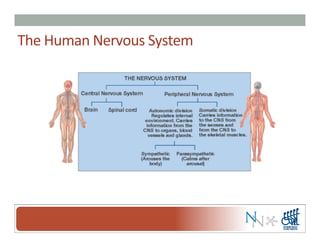
The	
  Human	
  Nervous	
  System	
  
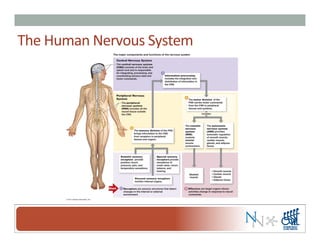
The	
  Human	
  Nervous	
  System	
  
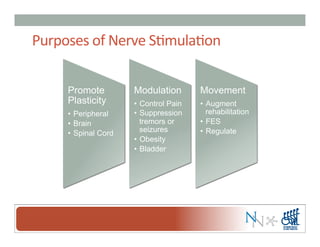
Purposes	
  of	
  Nerve	
  S-mula-on	
  
Promote
Plasticity
•  Peripheral
•  Brain
•  Spinal Cord
Modulation
•  Control Pain
•  Suppression
tremors or
seizures
•  Obesity
•  Bladder
Movement
•  Augment
rehabilitation
•  FES
•  Regulate
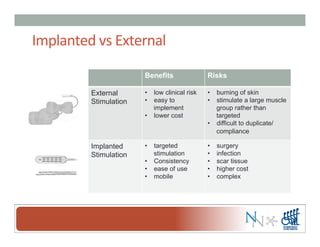
Implanted	
  vs	
  External	
  
Benefits Risks
External
Stimulation
•  low clinical risk
•  easy to
implement
•  lower cost
•  burning of skin
•  stimulate a large muscle
group rather than
targeted
•  difficult to duplicate/
compliance
Implanted
Stimulation
•  targeted
stimulation
•  Consistency
•  ease of use
•  mobile
•  surgery
•  infection
•  scar tissue
•  higher cost
•  complex
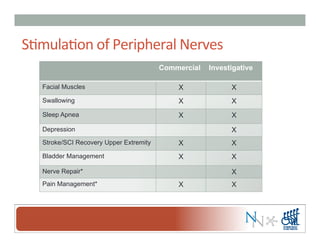
S-mula-on	
  of	
  Peripheral	
  Nerves	
  
Commercial Investigative
Facial Muscles X X
Swallowing X X
Sleep Apnea X X
Depression X
Stroke/SCI Recovery Upper Extremity X X
Bladder Management X X
Nerve Repair* X
Pain Management* X X
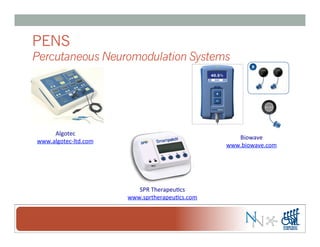
PENS
Percutaneous Neuromodulation Systems
Algotec	
  
www.algotec-­‐ltd.com	
  
Biowave	
  
www.biowave.com	
  
SPR	
  Therapeu-cs	
  
www.sprtherapeu-cs.com	
  
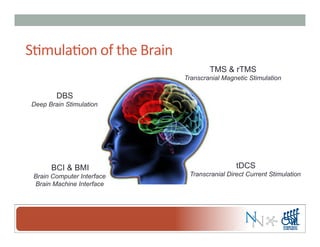
S-mula-on	
  of	
  the	
  Brain	
  
TMS & rTMS
Transcranial Magnetic Stimulation
tDCS
Transcranial Direct Current Stimulation
DBS
Deep Brain Stimulation
BCI & BMI
Brain Computer Interface
Brain Machine Interface
S-mula-on	
  of	
  the	
  Brain	
  -­‐	
  External	
  
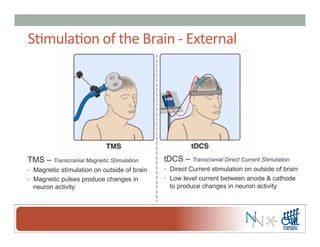
TMS – Transcranial Magnetic Stimulation
•  Magnetic stimulation on outside of brain
•  Magnetic pulses produce changes in
neuron activity
tDCS – Transcranial Direct Current Stimulation
•  Direct Current stimulation on outside of brain
•  Low level current between anode & cathode
to produce changes in neuron activity
S-mula-on	
  of	
  the	
  Brain	
  -­‐	
  Internal	
  
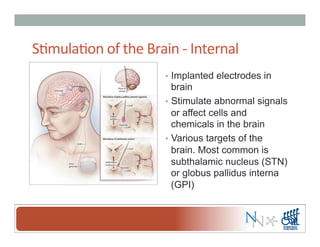
•  Implanted electrodes in
brain
•  Stimulate abnormal signals
or affect cells and
chemicals in the brain
•  Various targets of the
brain. Most common is
subthalamic nucleus (STN)
or globus pallidus interna
(GPI)
S-mula-on	
  of	
  the	
  Brain:	
  Commercial	
  
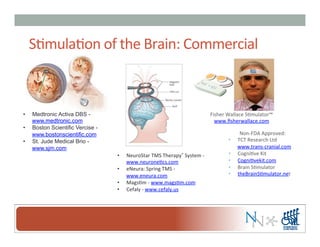
Fisher	
  Wallace	
  S-mulator™	
  
www.fisherwallace.com	
  
•  NeuroStar	
  TMS	
  Therapy®	
  System	
  -­‐	
  
www.neurone-cs.com	
  
•  eNeura:	
  Spring	
  TMS	
  -­‐	
  
www.eneura.com	
  
•  Mags-m	
  -­‐	
  www.mags-m.com	
  
•  Cefaly	
  -­‐	
  www.cefaly.us	


•  Medtronic Activa DBS -
www.medtronic.com
•  Boston Scientific Vercise -
www.bostonscientific.com
•  St. Jude Medical Brio -
www.sjm.com
Non-­‐FDA	
  Approved:	
  
•  TCT	
  Research	
  Ltd	
  
www.trans-­‐cranial.com	
  
•  Cogni-ve	
  Kit	
  
•  Cogni-vekit.com	
  
•  Brain	
  S-mulator	
  
•  theBrainS-mulator.net	
  
S-mula-on	
  of	
  the	
  Brain:	
  Inves-ga-onal	
  
Cervel	
  Neurotech	
  rTMS	
  
www.cervel.com	
  
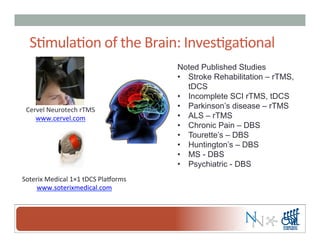
Noted Published Studies
•  Stroke Rehabilitation – rTMS,
tDCS
•  Incomplete SCI rTMS, tDCS
•  Parkinson’s disease – rTMS
•  ALS – rTMS
•  Chronic Pain – DBS
•  Tourette’s – DBS
•  Huntington’s – DBS
•  MS - DBS
•  Psychiatric - DBS
Soterix	
  Medical	
  1×1	
  tDCS	
  Pla[orms	
  
www.soterixmedical.com	
  
Soterix	
  Medical	
  1×1	
  tDCS	
  Pla[orms	
  
www.soterixmedical.com	
  
S-mula-on	
  of	
  the	
  Brain:	
  Inves-ga-onal	
  
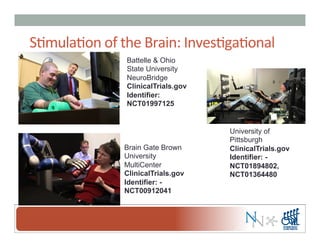
University of
Pittsburgh
ClinicalTrials.gov
Identifier: -
NCT01894802,
NCT01364480
Brain Gate Brown
University
MultiCenter
ClinicalTrials.gov
Identifier: -
NCT00912041
Battelle & Ohio
State University
NeuroBridge
ClinicalTrials.gov
Identifier:
NCT01997125
S-mula-on	
  of	
  the	
  Spinal	
  Cord	
  	
  
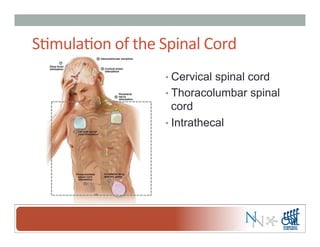
• Cervical spinal cord
• Thoracolumbar spinal
cord
• Intrathecal
SCS - Spinal Cord Stimulation
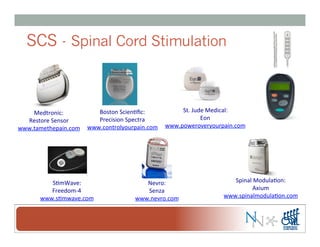
Boston	
  Scien-fic:	
  	
  
Precision	
  Spectra	
  
www.controlyourpain.com	
  
Medtronic:	
  	
  
Restore	
  Sensor	
  
www.tamethepain.com	
  
St.	
  Jude	
  Medical:	
  	
  
Eon	
  
www.poweroveryourpain.com	
  
Spinal	
  Modula-on:	
  	
  
Axium	
  
www.spinalmodula-on.com	
  
S-mWave:	
  	
  
Freedom-­‐4	
  
www.s-mwave.com	
  
Nevro:	
  	
  
Senza	
  
www.nevro.com	
  
Epidural Stimulation
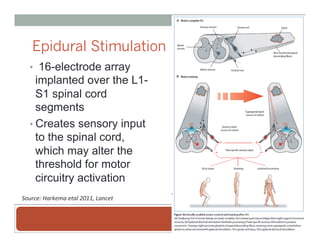
•  16-electrode array
implanted over the L1-
S1 spinal cord
segments
• Creates sensory input
to the spinal cord,
which may alter the
threshold for motor
circuitry activation
Source:	
  Harkema	
  etal	
  2011,	
  Lancet	
  
Noted Clinical Trials
•  Epi Stim to Facilitate Standing and Stepping,
NCT02339233
•  The overall aim is to assess whether task specific locomotor
training and spinal cord electrical stimulation (SCES) can induce
neural reorganization of the functionally isolated human spinal cord
to improve standing and stepping in individuals with functionally
complete SCI.
•  Univ. Louisville; Cervical and Thoracic SCI
•  Spinal Cord Neuromodulation for SCI, NCT02313194
•  This study is designed to assess the strategy of using spinal cord
stimulation to improve the ability to move in spinal cord injured
humans.
•  UCLA; Cervical SCI Source:	
  www.ClinicalTrials.gov	
  
Considera-ons	
  for	
  Par-cipa-ng	
  	
  
in	
  any	
  Clinical	
  Trial	
  
-  Know your rights & risks: Informed Consent, Read the fine print
-  Understand your commitments
-  Manage your expectations
-  Beware – of “trials” that are unapproved, even in the US – just
because a US doctor is doing it does not mean it is legitimate
-  Do your research – get a second or third opinion from a
research center or hospital
-  Never pay for experimental treatments
-  Expect Follow Up
-  Refer to ClinicalTrials.gov
(https://clinicaltrials.gov/ct2/about-studies/learn )
Addi-onal	
  Resources	
  
•  Search Terms ClinicalTrials.gov
•  “spinal cord injury”, “tetraplegia”, “paraplegia”
AND
•  “stimulation”, “epidural”, “neuromodulation”, “brain
interface”, “TMS”, “tDCS”
•  Miami Project: www.miamiproject.org
•  Link study for treatment of pain & AD for
SCI using DBS
•  Neurotech Network Condition Fact
Sheets: www.NeurotechNetwork.org
including spinal cord injury, brain injury, stroke, multiple
sclerosis, Parkinson’s and more
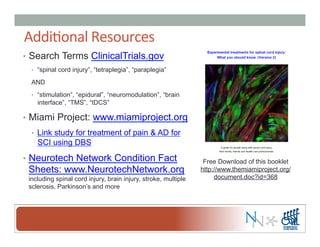
Free Download of this booklet
http://www.themiamiproject.org/
document.doc?id=368
Ø  Kim Anderson-Erisman PhD, Director Of
Education, University Of Miami & Miami
Project To Cure Paralysis
Ø  kanderson3@med.miami.edu
Ø  Jennifer French, MBA, Executive
Director, Neurotech Network
Ø  jfrench@neurotechnetwork.org
Next Webinar is September 30, 2015: Vibration Therapy

Direct Nerve Stimulation Slides from Webinar June 2015

  • 1.
    Webinar title: DirectNerve Stimulation What is it really and what is the potential? Presenter/presenters: Kimberly Anderson-Erisman, PhD Director of Education University of Miami & Miami Project to Cure Paralysis Jennifer French, MBA Executive Director Neurotech Network
  • 2.
    Want  to  Ask  a  Ques-on?  
  • 3.
    Disclaimer  page   The  informa,on  presented  in  this  webinar  is  not  meant  to  replace  the  advice   from  a  medical  professional.  You  should  consult  a  health  care  professional   familiar  with  your  specific  case,  concerns  and  condi,on.   Neurotech  Network  and  its  representa,ves  do  not  endorse,  rate,  sell,   distribute,  prescribe,  administer  or  recommend  any  products,  procedures   or  services.  We  highly  suggest  for  you  to  take  informa,on  to  a  trained   medical  professional  familiar  with  your  case  to  discuss  op,ons  that  are   best  for  you.  
  • 4.
    www.NeurotechNetwork.org   Helping  people  regain  life  thru   neurotechnology     Focusing  on  educa-on  of  and   advocacy  to  access  neurotechnology   devices,  therapies  and  treatments  for   people  living  with  impairments,  their   care-­‐givers  and  medical  professionals.   www.themiamiproject.org   The  Miami  Project  is  dedicated  to     finding  more  effec-ve  treatments   and,  ul-mately,  a  cure  for  paralysis   resul-ng  from  spinal  cord  injury.  
  • 5.
    Objec-ves   •  Understanding  the  Human  Nervous  System   •  Introduce  various  purposes  of  s-mula-on  to   a  nerve   •  Differen-ate  implanted  from  external   s-mula-on   •  Technology  applica-ons   •  Peripheral   •  Brain   •  Spinal  Cord     •  Resources  to  learn  more  
  • 6.
  • 7.
  • 8.
    Purposes  of  Nerve  S-mula-on   Promote Plasticity •  Peripheral •  Brain •  Spinal Cord Modulation •  Control Pain •  Suppression tremors or seizures •  Obesity •  Bladder Movement •  Augment rehabilitation •  FES •  Regulate
  • 9.
    Implanted  vs  External   Benefits Risks External Stimulation •  low clinical risk •  easy to implement •  lower cost •  burning of skin •  stimulate a large muscle group rather than targeted •  difficult to duplicate/ compliance Implanted Stimulation •  targeted stimulation •  Consistency •  ease of use •  mobile •  surgery •  infection •  scar tissue •  higher cost •  complex
  • 10.
    S-mula-on  of  Peripheral  Nerves   Commercial Investigative Facial Muscles X X Swallowing X X Sleep Apnea X X Depression X Stroke/SCI Recovery Upper Extremity X X Bladder Management X X Nerve Repair* X Pain Management* X X
  • 11.
    PENS Percutaneous Neuromodulation Systems Algotec   www.algotec-­‐ltd.com   Biowave   www.biowave.com   SPR  Therapeu-cs   www.sprtherapeu-cs.com  
  • 12.
    S-mula-on  of  the  Brain   TMS & rTMS Transcranial Magnetic Stimulation tDCS Transcranial Direct Current Stimulation DBS Deep Brain Stimulation BCI & BMI Brain Computer Interface Brain Machine Interface
  • 13.
    S-mula-on  of  the  Brain  -­‐  External   TMS – Transcranial Magnetic Stimulation •  Magnetic stimulation on outside of brain •  Magnetic pulses produce changes in neuron activity tDCS – Transcranial Direct Current Stimulation •  Direct Current stimulation on outside of brain •  Low level current between anode & cathode to produce changes in neuron activity
  • 14.
    S-mula-on  of  the  Brain  -­‐  Internal   •  Implanted electrodes in brain •  Stimulate abnormal signals or affect cells and chemicals in the brain •  Various targets of the brain. Most common is subthalamic nucleus (STN) or globus pallidus interna (GPI)
  • 15.
    S-mula-on  of  the  Brain:  Commercial   Fisher  Wallace  S-mulator™   www.fisherwallace.com   •  NeuroStar  TMS  Therapy®  System  -­‐   www.neurone-cs.com   •  eNeura:  Spring  TMS  -­‐   www.eneura.com   •  Mags-m  -­‐  www.mags-m.com   •  Cefaly  -­‐  www.cefaly.us     •  Medtronic Activa DBS - www.medtronic.com •  Boston Scientific Vercise - www.bostonscientific.com •  St. Jude Medical Brio - www.sjm.com Non-­‐FDA  Approved:   •  TCT  Research  Ltd   www.trans-­‐cranial.com   •  Cogni-ve  Kit   •  Cogni-vekit.com   •  Brain  S-mulator   •  theBrainS-mulator.net  
  • 16.
    S-mula-on  of  the  Brain:  Inves-ga-onal   Cervel  Neurotech  rTMS   www.cervel.com   Noted Published Studies •  Stroke Rehabilitation – rTMS, tDCS •  Incomplete SCI rTMS, tDCS •  Parkinson’s disease – rTMS •  ALS – rTMS •  Chronic Pain – DBS •  Tourette’s – DBS •  Huntington’s – DBS •  MS - DBS •  Psychiatric - DBS Soterix  Medical  1×1  tDCS  Pla[orms   www.soterixmedical.com   Soterix  Medical  1×1  tDCS  Pla[orms   www.soterixmedical.com  
  • 17.
    S-mula-on  of  the  Brain:  Inves-ga-onal   University of Pittsburgh ClinicalTrials.gov Identifier: - NCT01894802, NCT01364480 Brain Gate Brown University MultiCenter ClinicalTrials.gov Identifier: - NCT00912041 Battelle & Ohio State University NeuroBridge ClinicalTrials.gov Identifier: NCT01997125
  • 18.
    S-mula-on  of  the  Spinal  Cord     • Cervical spinal cord • Thoracolumbar spinal cord • Intrathecal
  • 19.
    SCS - SpinalCord Stimulation Boston  Scien-fic:     Precision  Spectra   www.controlyourpain.com   Medtronic:     Restore  Sensor   www.tamethepain.com   St.  Jude  Medical:     Eon   www.poweroveryourpain.com   Spinal  Modula-on:     Axium   www.spinalmodula-on.com   S-mWave:     Freedom-­‐4   www.s-mwave.com   Nevro:     Senza   www.nevro.com  
  • 20.
    Epidural Stimulation •  16-electrodearray implanted over the L1- S1 spinal cord segments • Creates sensory input to the spinal cord, which may alter the threshold for motor circuitry activation Source:  Harkema  etal  2011,  Lancet  
  • 21.
    Noted Clinical Trials • Epi Stim to Facilitate Standing and Stepping, NCT02339233 •  The overall aim is to assess whether task specific locomotor training and spinal cord electrical stimulation (SCES) can induce neural reorganization of the functionally isolated human spinal cord to improve standing and stepping in individuals with functionally complete SCI. •  Univ. Louisville; Cervical and Thoracic SCI •  Spinal Cord Neuromodulation for SCI, NCT02313194 •  This study is designed to assess the strategy of using spinal cord stimulation to improve the ability to move in spinal cord injured humans. •  UCLA; Cervical SCI Source:  www.ClinicalTrials.gov  
  • 22.
    Considera-ons  for  Par-cipa-ng     in  any  Clinical  Trial   -  Know your rights & risks: Informed Consent, Read the fine print -  Understand your commitments -  Manage your expectations -  Beware – of “trials” that are unapproved, even in the US – just because a US doctor is doing it does not mean it is legitimate -  Do your research – get a second or third opinion from a research center or hospital -  Never pay for experimental treatments -  Expect Follow Up -  Refer to ClinicalTrials.gov (https://clinicaltrials.gov/ct2/about-studies/learn )
  • 23.
    Addi-onal  Resources   • Search Terms ClinicalTrials.gov •  “spinal cord injury”, “tetraplegia”, “paraplegia” AND •  “stimulation”, “epidural”, “neuromodulation”, “brain interface”, “TMS”, “tDCS” •  Miami Project: www.miamiproject.org •  Link study for treatment of pain & AD for SCI using DBS •  Neurotech Network Condition Fact Sheets: www.NeurotechNetwork.org including spinal cord injury, brain injury, stroke, multiple sclerosis, Parkinson’s and more Free Download of this booklet http://www.themiamiproject.org/ document.doc?id=368
  • 24.
    Ø  Kim Anderson-ErismanPhD, Director Of Education, University Of Miami & Miami Project To Cure Paralysis Ø  kanderson3@med.miami.edu Ø  Jennifer French, MBA, Executive Director, Neurotech Network Ø  jfrench@neurotechnetwork.org Next Webinar is September 30, 2015: Vibration Therapy