Consumer Markets: Consumer Buying Behavior
Principles of Marketing
Session: 04
By: Qasim Ali Shah
https://heylink.me/iamqasimsyed
Model of Consumer Behavior
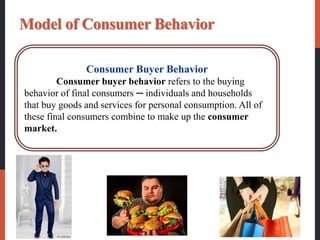
Consumer Buyer Behavior
Consumer buyer behavior refers to the buying
behavior of final consumers ─ individuals and households
that buy goods and services for personal consumption. All of
these final consumers combine to make up the consumer
market.
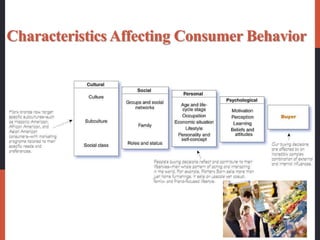
Characteristics Affecting Consumer Behavior
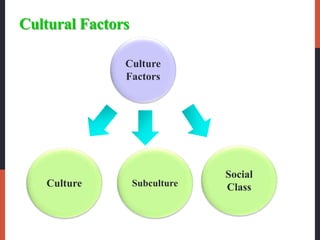
Cultural Factors
Culture
Factors
Culture Subculture
Social
Class
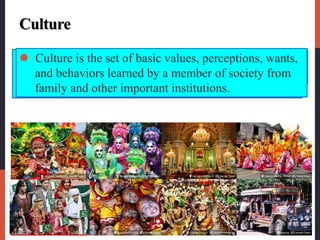
Culture
 Every group or society has a culture, and cultural
influences on buying behavior may vary greatly
from both country to county and country to country.
 Marketers are always trying to spot cultural shifts so
as to discover new products that might be wanted.
 Culture is the set of basic values, perceptions, wants,
and behaviors learned by a member of society from
family and other important institutions.
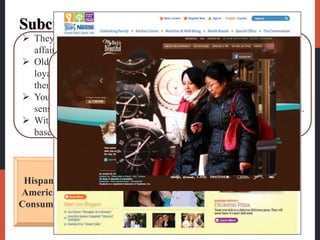
Subculture
 Each culture contains smaller subcultures, or
groups of people with shared value systems based
on common life experiences and situations.
African
American
Consumers
Hispanic
American
Consumers
Asian
American
Consumers
Cross
Cultural
Marketing
 They tend to be deeply family oriented and make shipping a family
affair ─ children have a big say in what brands they buy.
 Older, first-generation Hispanic consumers tend to be very brand
loyal and to favor brands and sellers who show special interest in
them.
 Younger Hispanics, however, have shown increasing price
sensitivity in recent years and a willingness to switch to store brands.
 Within the Hispanic market, there exist many distinct subsegments
based on nationality, age, income, and other factors.
 Although more price conscious than other
segments, blacks are also strongly motivated
by quality and selection.
 Brands are important.
 In recent years, many companies have
developed special products, appeals, and
marketing programs for them.
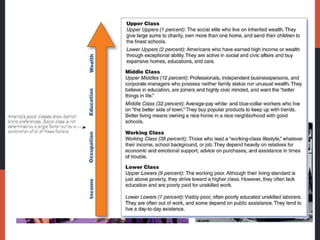
Social Class
 Social classes are society’s relatively permanent
and ordered divisions whose members share
similar values, interests, and behaviors.
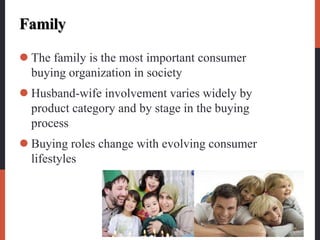
Family
 The family is the most important consumer
buying organization in society
 Husband-wife involvement varies widely by
product category and by stage in the buying
process
 Buying roles change with evolving consumer
lifestyles
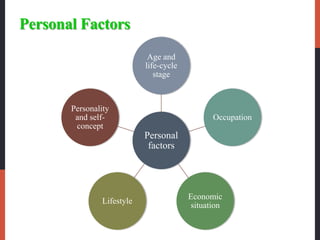
Personal Factors
Personal
factors
Age and
life-cycle
stage
Occupation
Economic
situation
Lifestyle
Personality
and self-
concept
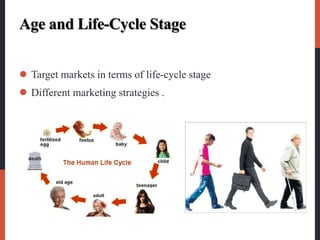
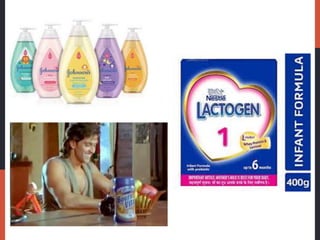
Age and Life-Cycle Stage
 Target markets in terms of life-cycle stage
 Different marketing strategies .
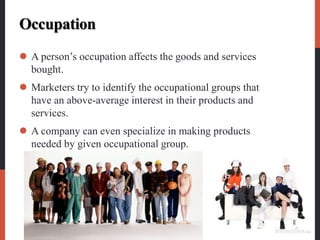
Occupation
 A person’s occupation affects the goods and services
bought.
 Marketers try to identify the occupational groups that
have an above-average interest in their products and
services.
 A company can even specialize in making products
needed by given occupational group.
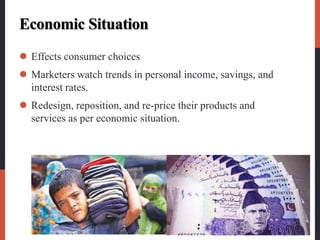
Economic Situation
 Effects consumer choices
 Marketers watch trends in personal income, savings, and
interest rates.
 Redesign, reposition, and re-price their products and
services as per economic situation.
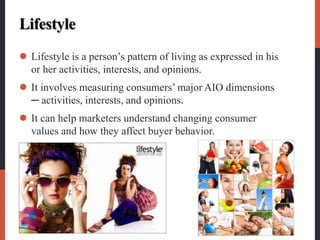
Lifestyle
 Lifestyle is a person’s pattern of living as expressed in his
or her activities, interests, and opinions.
 It involves measuring consumers’ major AIO dimensions
─ activities, interests, and opinions.
 It can help marketers understand changing consumer
values and how they affect buyer behavior.
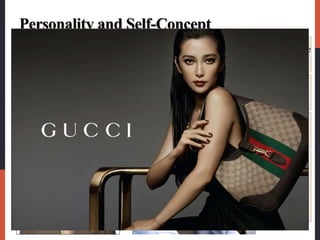
Personality and Self-Concept
 Personality refers to the unique psychological
characteristics that distinguish a person or group.
 Personality is usually described in terms of traits such as
self-confidence, dominance, sociability, autonomy,
defensiveness, adaptability, and aggressiveness.
 Brand personality is the specific mix of human traits that
may be attributed to a particular brand.
One researcher
identified five
brand personality
traits:
Sincerity (down-to-earth, honest, wholesome
, and cheerful)
Excitement (daring, spirited, imaginative,
and up-to-date)
Competence (reliable, intelligent, and
successful)
Sophistication (upper class and charming)
Ruggedness (outdoorsy and tough)
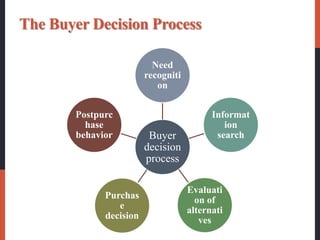
The Buyer Decision Process
Buyer
decision
process
Need
recogniti
on
Informat
ion
search
Evaluati
on of
alternati
ves
Purchas
e
decision
Postpurc
hase
behavior
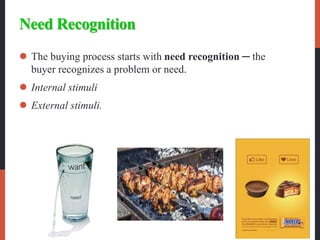
Need Recognition
 The buying process starts with need recognition ─ the
buyer recognizes a problem or need.
 Internal stimuli
 External stimuli.
Information Search
 Information search is the stage of the buyer decision
process in which the consumer is motivated to search for
more information.
 Commercial sources that controlled by the marketer.
 Personal sources.
Evaluation of Alternatives
 The alternative evaluation is the stage of the
buyer decision process in which the consumer
uses information to evaluate alternative brands in
the choice set.
 Marketers should study buyers to find out how
they actually evaluate brand alternatives.
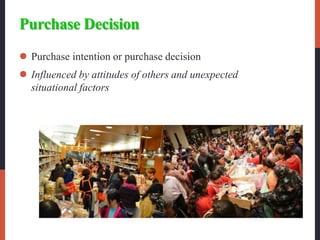
Purchase Decision
 Purchase intention or purchase decision
 Influenced by attitudes of others and unexpected
situational factors
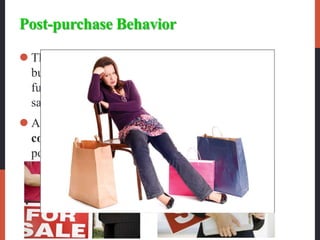
Post-purchase Behavior
 The postpurchase behavior is the stage of the
buyer decision process in which consumers take
further action after purchase, based on their
satisfaction or dissatisfaction.
 Almost all major purchases, however, result in
cognitive dissonance, or discomfort caused by
postpurchase conflict.
TASK FOR NEXT SESSION: GROUP ASSIGNMENT
• Select a local company / brand of your choice
• Describe in detail how environmental factors may effect it
• Submit a hard copy and deliver a short presentation of it in
the next class
qasim_297_3039_1_PoM Session 04.pptx

qasim_297_3039_1_PoM Session 04.pptx

  • 1.
    Consumer Markets: ConsumerBuying Behavior Principles of Marketing Session: 04 By: Qasim Ali Shah https://heylink.me/iamqasimsyed
  • 2.
    Model of ConsumerBehavior Consumer Buyer Behavior Consumer buyer behavior refers to the buying behavior of final consumers ─ individuals and households that buy goods and services for personal consumption. All of these final consumers combine to make up the consumer market.
  • 3.
  • 4.
  • 5.
    Culture  Every groupor society has a culture, and cultural influences on buying behavior may vary greatly from both country to county and country to country.  Marketers are always trying to spot cultural shifts so as to discover new products that might be wanted.  Culture is the set of basic values, perceptions, wants, and behaviors learned by a member of society from family and other important institutions.
  • 6.
    Subculture  Each culturecontains smaller subcultures, or groups of people with shared value systems based on common life experiences and situations. African American Consumers Hispanic American Consumers Asian American Consumers Cross Cultural Marketing  They tend to be deeply family oriented and make shipping a family affair ─ children have a big say in what brands they buy.  Older, first-generation Hispanic consumers tend to be very brand loyal and to favor brands and sellers who show special interest in them.  Younger Hispanics, however, have shown increasing price sensitivity in recent years and a willingness to switch to store brands.  Within the Hispanic market, there exist many distinct subsegments based on nationality, age, income, and other factors.  Although more price conscious than other segments, blacks are also strongly motivated by quality and selection.  Brands are important.  In recent years, many companies have developed special products, appeals, and marketing programs for them.
  • 7.
    Social Class  Socialclasses are society’s relatively permanent and ordered divisions whose members share similar values, interests, and behaviors.
  • 8.
    Family  The familyis the most important consumer buying organization in society  Husband-wife involvement varies widely by product category and by stage in the buying process  Buying roles change with evolving consumer lifestyles
  • 9.
  • 10.
    Age and Life-CycleStage  Target markets in terms of life-cycle stage  Different marketing strategies .
  • 12.
    Occupation  A person’soccupation affects the goods and services bought.  Marketers try to identify the occupational groups that have an above-average interest in their products and services.  A company can even specialize in making products needed by given occupational group.
  • 14.
    Economic Situation  Effectsconsumer choices  Marketers watch trends in personal income, savings, and interest rates.  Redesign, reposition, and re-price their products and services as per economic situation.
  • 15.
    Lifestyle  Lifestyle isa person’s pattern of living as expressed in his or her activities, interests, and opinions.  It involves measuring consumers’ major AIO dimensions ─ activities, interests, and opinions.  It can help marketers understand changing consumer values and how they affect buyer behavior.
  • 16.
    Personality and Self-Concept Personality refers to the unique psychological characteristics that distinguish a person or group.  Personality is usually described in terms of traits such as self-confidence, dominance, sociability, autonomy, defensiveness, adaptability, and aggressiveness.  Brand personality is the specific mix of human traits that may be attributed to a particular brand. One researcher identified five brand personality traits: Sincerity (down-to-earth, honest, wholesome , and cheerful) Excitement (daring, spirited, imaginative, and up-to-date) Competence (reliable, intelligent, and successful) Sophistication (upper class and charming) Ruggedness (outdoorsy and tough)
  • 18.
    The Buyer DecisionProcess Buyer decision process Need recogniti on Informat ion search Evaluati on of alternati ves Purchas e decision Postpurc hase behavior
  • 19.
    Need Recognition  Thebuying process starts with need recognition ─ the buyer recognizes a problem or need.  Internal stimuli  External stimuli.
  • 23.
    Information Search  Informationsearch is the stage of the buyer decision process in which the consumer is motivated to search for more information.  Commercial sources that controlled by the marketer.  Personal sources.
  • 24.
    Evaluation of Alternatives The alternative evaluation is the stage of the buyer decision process in which the consumer uses information to evaluate alternative brands in the choice set.  Marketers should study buyers to find out how they actually evaluate brand alternatives.
  • 25.
    Purchase Decision  Purchaseintention or purchase decision  Influenced by attitudes of others and unexpected situational factors
  • 26.
    Post-purchase Behavior  Thepostpurchase behavior is the stage of the buyer decision process in which consumers take further action after purchase, based on their satisfaction or dissatisfaction.  Almost all major purchases, however, result in cognitive dissonance, or discomfort caused by postpurchase conflict.
  • 27.
    TASK FOR NEXTSESSION: GROUP ASSIGNMENT • Select a local company / brand of your choice • Describe in detail how environmental factors may effect it • Submit a hard copy and deliver a short presentation of it in the next class