Session 1
Introduction to Consumer; Significance & Essentials of
                                  Consumer Behavior
                      CONSUMER BEHAVIOR
AGENDA POINTS

   Why so much focus on this entity called the “Consumer”: what is
    her/his significance to Marketing?
   Consumer Behavior Essentials: what does it comprise?
   What do we mean by buzz-phrases like “Customer Orientation”,
    “Understanding Consumer Needs”, “Customer Value”, “Customer
    Satisfaction”, “Life-time Value”
   Is understanding the consumer a complex process? If so, why?
   What do we mean by Diversity of Consumer Behavior? What do
    we mean by Market Segmentation?
WHO IS A CONSUMER?

   General Discussion
   “All those who buy or could potentially buy & use any good or
    service generated in the economy”
       Individuals
       Households
       Organizations
   Therein also lies the subtle difference between Consumer &
    Customer
WHY SO MUCH CONSUMER FOCUS?

   General Discussion
   Consumer at the very heart of the Marketing concept that
    evolved in the late 1950s
       Production of only those goods & services that the consumers would buy
   Hence, consumer understanding began assuming huge
    significance for businesses at large
   Terms such as Understanding Consumer Needs, Customer
    Orientation & Customer Value started becoming buzzwords
       Customer Needs: Understanding what Consumers want
       Customer Orientation: Thinking “Consumer” at all times & orienting one’s
        business accordingly to deliver as per Consumer & Customer Needs
       Customer Value: Difference between a Customer’s perceived benefits &
        the resources used to obtain those benefits
WHY SO MUCH CONSUMER FOCUS?

   Further, in the context of Brand Marketing, Brands are valuable to
    companies because they are valuable to consumers
       People will pay more for a branded product than a generic one & more for
        a favored brand than the alternatives
   Obvious then that a brand that has forged a strong, enduring
    bond with consumers should provide a financial advantage to a
    company
       Particularly in the context of increasing competitiveness
   Hence, terms such as Customer Satisfaction & Customer
    Retention an integral part of Marketing lexicon today
       Customer Satisfaction: Customer’s perception of the performance of a
        product in relation to his/her expectation
       Customer Retention: Retaining satisfied customers
   In short, our Consumption related behavior impacts New Product
    Development & Success/Failure of Businesses
QUESTIONS MARKETERS FACE?

   WHAT products & brands do people buy?
   WHY do people buy the products & brands that they do?
   WHEN do they buy them?
   WHERE do they buy them?
   HOW OFTEN do they buy them?
   HOW do they actually use them?
   HOW OFTEN do they use them?
   HOW do they evaluate them after the purchase? What do
    consumers think about our products & those of our competitors?
    What do they think about possible improvements in our
    products?
   WHAT are their attitudes towards our products & our
    promotional efforts?
CONSUMER BEHAVIOR?

“The Behavior that people display in searching
 for, purchasing, using, evaluating & disposing of products & services
 that they expect will satisfy their needs.”
“The mental & emotional processes & the physical activities of
 people who purchase & use goods & services to satisfy particular
 needs & wants.”
“The mental & emotional processes & the observable behavior of
 people during searching, purchasing & post consumption of a
 product or service.”

In short, the term “Consumer Behavior” subsumes the entire
process…
From Planning to Acquire something, to Actual Consumption
through till Post Consumption & even Disposal
CONSUMER BEHAVIOR?

Discuss Consumer Behavior across Products & Services

Car / Motor Bike
Toilet Soap
Casual Shirt
Formal Shoes
Refrigerator
House
Career choice
Insurance
Music System
Eating Out
Vacation
CONSUMER BEHAVIOR?

Study of Consumer Behavior for a product/service will reveal
answers to critical questions such as:

   What kinds of consumers buy that product/service?
   Why do they buy it? What do they look for in it? What benefits do
    they seek?
   How much are they willing to pay?
   How many are likely to buy now?
   Do they wait for prices to come down? Do they look for some
    freebies?

These have a DIRECT bearing on Marketing - designing the product
as well as the marketing mix
SO, IS CONSUMER UNDERSTANDING COMPLEX ?

Discuss
 Is it really a complex process at all?

 If so, in what way is it complex?

 What makes it so complex?
NEEDS

   All of us have different kind of needs:
       Physiological / Biological Needs: Air, Water, Food, Clothing, Shelter, Sex
       Acquired / Psychological Needs: Self-Esteem, Prestige, Affection, Power,
        Achievement
   Broadly similar Biological Needs: however, vastly different
    Acquired Needs
DIVERSITY OF CONSUMER BEHAVIOR

   All of us consumers are unique
   Different Attitudes & Beliefs about Life in general
   Different things that drive us, interest us, engage us
   Different Needs & Wants
   Different Roles that we play in life & in the entire Consumption
    process – varies from one product to another
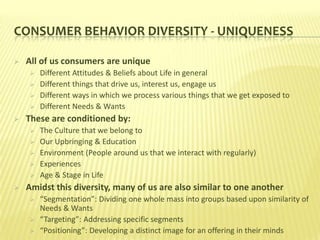
CONSUMER BEHAVIOR DIVERSITY - UNIQUENESS

   All of us consumers are unique
        Different Attitudes & Beliefs about Life in general
        Different things that drive us, interest us, engage us
        Different ways in which we process various things that we get exposed to
        Different Needs & Wants
   These are conditioned by:
        The Culture that we belong to
        Our Upbringing & Education
        Environment (People around us that we interact with regularly)
        Experiences
        Age & Stage in Life
   Amidst this diversity, many of us are also similar to one another
        “Segmentation”: Dividing one whole mass into groups based upon similarity of
         Needs & Wants
        “Targeting”: Addressing specific segments
        “Positioning”: Developing a distinct image for an offering in their minds
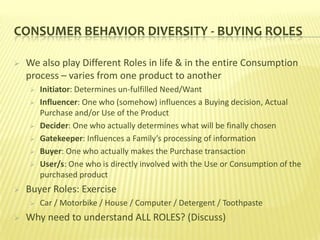
CONSUMER BEHAVIOR DIVERSITY - BUYING ROLES

   We also play Different Roles in life & in the entire Consumption
    process – varies from one product to another
       Initiator: Determines un-fulfilled Need/Want
       Influencer: One who (somehow) influences a Buying decision, Actual
        Purchase and/or Use of the Product
       Decider: One who actually determines what will be finally chosen
       Gatekeeper: Influences a Family’s processing of information
       Buyer: One who actually makes the Purchase transaction
       User/s: One who is directly involved with the Use or Consumption of the
        purchased product
   Buyer Roles: Exercise
       Car / Motorbike / House / Computer / Detergent / Toothpaste
   Why need to understand ALL ROLES? (Discuss)
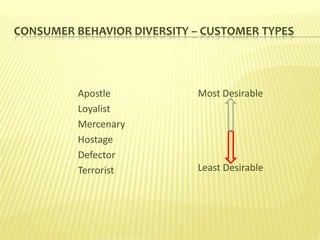
CONSUMER BEHAVIOR DIVERSITY – CUSTOMER TYPES

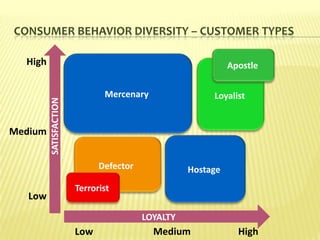
   There are also different Customers Types – according to Usage
       Loyalists: Highly Satisfied & Highly Loyal
       Apostles: Experiences exceed Expectations & who actively spread the word
       Defectors: Low Satisfaction & Low Loyalty; Neutral but likely to shift
       Terrorists: Defectors with negative experiences & who will spread the word
       Hostages: Unhappy, but who stay due to either lack of competition or price
       Mercenaries: Highly satisfied, but Low Loyalty & may defect due to lower
        price elsewhere or on impulse
CONSUMER BEHAVIOR DIVERSITY – CUSTOMER TYPES

  High                                                       Apostle

                               Mercenary                Loyalist
         SATISFACTION


Medium


                              Defector             Hostage
                        Terrorist
   Low
                                         LOYALTY
                        Low                Medium              High
CONSUMER BEHAVIOR DIVERSITY – CUSTOMER TYPES


          Apostle           Most Desirable
          Loyalist
          Mercenary
          Hostage
          Defector
          Terrorist         Least Desirable
CB IMPLICATION ON MARKETING

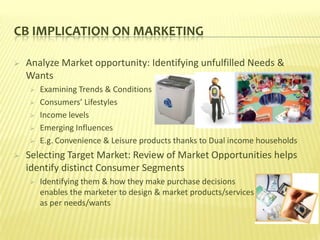
   Analyze Market opportunity: Identifying unfulfilled Needs &
    Wants
       Examining Trends & Conditions
       Consumers’ Lifestyles
       Income levels
       Emerging Influences
       E.g. Convenience & Leisure products thanks to Dual income households
   Selecting Target Market: Review of Market Opportunities helps
    identify distinct Consumer Segments
       Identifying them & how they make purchase decisions
        enables the marketer to design & market products/services
        as per needs/wants
CB IMPLICATION ON MARKETING

   Marketing-mix Decisions: Once unsatisfied needs/wants
    identified, determining the right mix of the 4 Ps
       Product:
         Specific decisions w.r.t. Shape, Size, Variants, Features..

         Also Packaging, key aspects of Service, Warranties..

       Price:
         What Price to charge? Is the consumer price-sensitive?

         Should Discounts be given?

         Do consumer equate lower price with lower quality?

       Distribution:
         Should one sell through all retail outlets or selected ones?

         Existing multi-brand outlets or create Exclusive ones?

         Is location a key criterion?

         Is there a case for Direct marketing?
CB IMPLICATION ON MARKETING

   Marketing-mix Decisions: Once unsatisfied needs/wants
    identified, determining the right mix of the 4 Ps
       Promotion:
         Which among Advertising, Personal Selling, Sales Promotion & Direct
          Marketing most suitable to effectively reach consumers?
         Should it be one approach alone or a combination?

         Understanding Consumer habits in the context of the Category the key
          (Industrial products v/s Consumer products v/s Pharma v/s Insurance)
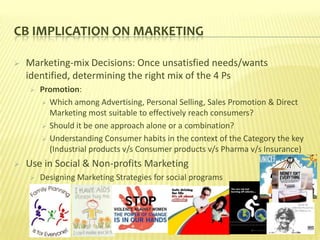
   Use in Social & Non-profits Marketing
       Designing Marketing Strategies for social programs
CHALLENGE TODAY

   Consumers hold more power
   Have access to more information
   Exchange between Marketers & Customers increasingly
    interactive & instantaneous
   Marketers can gather more information about consumers more
    quickly & easily
   Impact reaches beyond PC-based connection to the Web
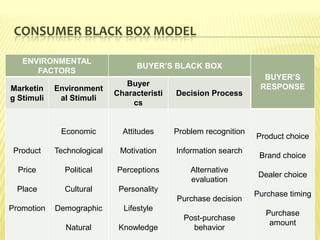
CONSUMER BLACK BOX MODEL

   ENVIRONMENTAL
                                  BUYER’S BLACK BOX
      FACTORS
                                                                    BUYER’S
                               Buyer                               RESPONSE
Marketin    Environment
                            Characteristi   Decision Process
g Stimuli    al Stimuli
                                cs


             Economic         Attitudes     Problem recognition
                                                                  Product choice
 Product    Technological    Motivation     Information search
                                                                   Brand choice
  Price       Political     Perceptions         Alternative
                                                                   Dealer choice
                                                evaluation
  Place       Cultural       Personality
                                                                  Purchase timing
                                            Purchase decision
Promotion   Demographic       Lifestyle
                                                                     Purchase
                                              Post-purchase
                                                                      amount
               Natural       Knowledge          behavior
Session 1
Introduction to Consumer; Significance & Essentials of
                                  Consumer Behavior

                   CONSUMER BEHAVIOR
Session 1
Introduction to Consumer; Significance & Essentials of
                                  Consumer Behavior

                   CONSUMER BEHAVIOR
Session 1
Introduction to Consumer; Significance & Essentials of
                                  Consumer Behavior

                   CONSUMER BEHAVIOR

Consumer behavior _ introduction

  • 1.
    Session 1 Introduction toConsumer; Significance & Essentials of Consumer Behavior CONSUMER BEHAVIOR
  • 2.
    AGENDA POINTS  Why so much focus on this entity called the “Consumer”: what is her/his significance to Marketing?  Consumer Behavior Essentials: what does it comprise?  What do we mean by buzz-phrases like “Customer Orientation”, “Understanding Consumer Needs”, “Customer Value”, “Customer Satisfaction”, “Life-time Value”  Is understanding the consumer a complex process? If so, why?  What do we mean by Diversity of Consumer Behavior? What do we mean by Market Segmentation?
  • 3.
    WHO IS ACONSUMER?  General Discussion  “All those who buy or could potentially buy & use any good or service generated in the economy”  Individuals  Households  Organizations  Therein also lies the subtle difference between Consumer & Customer
  • 4.
    WHY SO MUCHCONSUMER FOCUS?  General Discussion  Consumer at the very heart of the Marketing concept that evolved in the late 1950s  Production of only those goods & services that the consumers would buy  Hence, consumer understanding began assuming huge significance for businesses at large  Terms such as Understanding Consumer Needs, Customer Orientation & Customer Value started becoming buzzwords  Customer Needs: Understanding what Consumers want  Customer Orientation: Thinking “Consumer” at all times & orienting one’s business accordingly to deliver as per Consumer & Customer Needs  Customer Value: Difference between a Customer’s perceived benefits & the resources used to obtain those benefits
  • 5.
    WHY SO MUCHCONSUMER FOCUS?  Further, in the context of Brand Marketing, Brands are valuable to companies because they are valuable to consumers  People will pay more for a branded product than a generic one & more for a favored brand than the alternatives  Obvious then that a brand that has forged a strong, enduring bond with consumers should provide a financial advantage to a company  Particularly in the context of increasing competitiveness  Hence, terms such as Customer Satisfaction & Customer Retention an integral part of Marketing lexicon today  Customer Satisfaction: Customer’s perception of the performance of a product in relation to his/her expectation  Customer Retention: Retaining satisfied customers  In short, our Consumption related behavior impacts New Product Development & Success/Failure of Businesses
  • 6.
    QUESTIONS MARKETERS FACE?  WHAT products & brands do people buy?  WHY do people buy the products & brands that they do?  WHEN do they buy them?  WHERE do they buy them?  HOW OFTEN do they buy them?  HOW do they actually use them?  HOW OFTEN do they use them?  HOW do they evaluate them after the purchase? What do consumers think about our products & those of our competitors? What do they think about possible improvements in our products?  WHAT are their attitudes towards our products & our promotional efforts?
  • 7.
    CONSUMER BEHAVIOR? “The Behaviorthat people display in searching for, purchasing, using, evaluating & disposing of products & services that they expect will satisfy their needs.” “The mental & emotional processes & the physical activities of people who purchase & use goods & services to satisfy particular needs & wants.” “The mental & emotional processes & the observable behavior of people during searching, purchasing & post consumption of a product or service.” In short, the term “Consumer Behavior” subsumes the entire process… From Planning to Acquire something, to Actual Consumption through till Post Consumption & even Disposal
  • 8.
    CONSUMER BEHAVIOR? Discuss ConsumerBehavior across Products & Services Car / Motor Bike Toilet Soap Casual Shirt Formal Shoes Refrigerator House Career choice Insurance Music System Eating Out Vacation
  • 9.
    CONSUMER BEHAVIOR? Study ofConsumer Behavior for a product/service will reveal answers to critical questions such as:  What kinds of consumers buy that product/service?  Why do they buy it? What do they look for in it? What benefits do they seek?  How much are they willing to pay?  How many are likely to buy now?  Do they wait for prices to come down? Do they look for some freebies? These have a DIRECT bearing on Marketing - designing the product as well as the marketing mix
  • 10.
    SO, IS CONSUMERUNDERSTANDING COMPLEX ? Discuss  Is it really a complex process at all?  If so, in what way is it complex?  What makes it so complex?
  • 11.
    NEEDS  All of us have different kind of needs:  Physiological / Biological Needs: Air, Water, Food, Clothing, Shelter, Sex  Acquired / Psychological Needs: Self-Esteem, Prestige, Affection, Power, Achievement  Broadly similar Biological Needs: however, vastly different Acquired Needs
  • 12.
    DIVERSITY OF CONSUMERBEHAVIOR  All of us consumers are unique  Different Attitudes & Beliefs about Life in general  Different things that drive us, interest us, engage us  Different Needs & Wants  Different Roles that we play in life & in the entire Consumption process – varies from one product to another
  • 13.
    CONSUMER BEHAVIOR DIVERSITY- UNIQUENESS  All of us consumers are unique  Different Attitudes & Beliefs about Life in general  Different things that drive us, interest us, engage us  Different ways in which we process various things that we get exposed to  Different Needs & Wants  These are conditioned by:  The Culture that we belong to  Our Upbringing & Education  Environment (People around us that we interact with regularly)  Experiences  Age & Stage in Life  Amidst this diversity, many of us are also similar to one another  “Segmentation”: Dividing one whole mass into groups based upon similarity of Needs & Wants  “Targeting”: Addressing specific segments  “Positioning”: Developing a distinct image for an offering in their minds
  • 14.
    CONSUMER BEHAVIOR DIVERSITY- BUYING ROLES  We also play Different Roles in life & in the entire Consumption process – varies from one product to another  Initiator: Determines un-fulfilled Need/Want  Influencer: One who (somehow) influences a Buying decision, Actual Purchase and/or Use of the Product  Decider: One who actually determines what will be finally chosen  Gatekeeper: Influences a Family’s processing of information  Buyer: One who actually makes the Purchase transaction  User/s: One who is directly involved with the Use or Consumption of the purchased product  Buyer Roles: Exercise  Car / Motorbike / House / Computer / Detergent / Toothpaste  Why need to understand ALL ROLES? (Discuss)
  • 15.
    CONSUMER BEHAVIOR DIVERSITY– CUSTOMER TYPES  There are also different Customers Types – according to Usage  Loyalists: Highly Satisfied & Highly Loyal  Apostles: Experiences exceed Expectations & who actively spread the word  Defectors: Low Satisfaction & Low Loyalty; Neutral but likely to shift  Terrorists: Defectors with negative experiences & who will spread the word  Hostages: Unhappy, but who stay due to either lack of competition or price  Mercenaries: Highly satisfied, but Low Loyalty & may defect due to lower price elsewhere or on impulse
  • 16.
    CONSUMER BEHAVIOR DIVERSITY– CUSTOMER TYPES High Apostle Mercenary Loyalist SATISFACTION Medium Defector Hostage Terrorist Low LOYALTY Low Medium High
  • 17.
    CONSUMER BEHAVIOR DIVERSITY– CUSTOMER TYPES Apostle Most Desirable Loyalist Mercenary Hostage Defector Terrorist Least Desirable
  • 18.
    CB IMPLICATION ONMARKETING  Analyze Market opportunity: Identifying unfulfilled Needs & Wants  Examining Trends & Conditions  Consumers’ Lifestyles  Income levels  Emerging Influences  E.g. Convenience & Leisure products thanks to Dual income households  Selecting Target Market: Review of Market Opportunities helps identify distinct Consumer Segments  Identifying them & how they make purchase decisions enables the marketer to design & market products/services as per needs/wants
  • 19.
    CB IMPLICATION ONMARKETING  Marketing-mix Decisions: Once unsatisfied needs/wants identified, determining the right mix of the 4 Ps  Product:  Specific decisions w.r.t. Shape, Size, Variants, Features..  Also Packaging, key aspects of Service, Warranties..  Price:  What Price to charge? Is the consumer price-sensitive?  Should Discounts be given?  Do consumer equate lower price with lower quality?  Distribution:  Should one sell through all retail outlets or selected ones?  Existing multi-brand outlets or create Exclusive ones?  Is location a key criterion?  Is there a case for Direct marketing?
  • 20.
    CB IMPLICATION ONMARKETING  Marketing-mix Decisions: Once unsatisfied needs/wants identified, determining the right mix of the 4 Ps  Promotion:  Which among Advertising, Personal Selling, Sales Promotion & Direct Marketing most suitable to effectively reach consumers?  Should it be one approach alone or a combination?  Understanding Consumer habits in the context of the Category the key (Industrial products v/s Consumer products v/s Pharma v/s Insurance)  Use in Social & Non-profits Marketing  Designing Marketing Strategies for social programs
  • 21.
    CHALLENGE TODAY  Consumers hold more power  Have access to more information  Exchange between Marketers & Customers increasingly interactive & instantaneous  Marketers can gather more information about consumers more quickly & easily  Impact reaches beyond PC-based connection to the Web
  • 22.
    CONSUMER BLACK BOXMODEL ENVIRONMENTAL BUYER’S BLACK BOX FACTORS BUYER’S Buyer RESPONSE Marketin Environment Characteristi Decision Process g Stimuli al Stimuli cs Economic Attitudes Problem recognition Product choice Product Technological Motivation Information search Brand choice Price Political Perceptions Alternative Dealer choice evaluation Place Cultural Personality Purchase timing Purchase decision Promotion Demographic Lifestyle Purchase Post-purchase amount Natural Knowledge behavior
  • 23.
    Session 1 Introduction toConsumer; Significance & Essentials of Consumer Behavior CONSUMER BEHAVIOR
  • 24.
    Session 1 Introduction toConsumer; Significance & Essentials of Consumer Behavior CONSUMER BEHAVIOR
  • 25.
    Session 1 Introduction toConsumer; Significance & Essentials of Consumer Behavior CONSUMER BEHAVIOR