z
Translation
studies
RUKIYA LAKHAN
6/22/2021
1
z
Albert Camus as a novelist
6/22/2021
2
z
reason
 This topic will give information about albert Camus and his main
works from novels, as it is related to 20thc literature modern
world.
6/22/2021
3
z
outlines
 Biography of albert Camus
 his Literary works
 As a novelist
6/22/2021
4
Albert Camus
 In the year 1913, the great literary artist, Albert Camus, was born in Algeria.
 Camus spent his life in Algeria and France contemplating the difficult questions of life.
 He has been known as a philosopher, existentialist, journalist, politician, husband, and
father; however, by those people whom Camus touched personally, he was regarded
as a warm, sensitive, yet ordinary man.
6/22/2021
5
 In Algeria, Camus was a high school scholarship student under the influence of Louis
Germain.
 He continued to study literature and philosophy at the University of Algeria under his
mentor, Jean Grenier. From the age of seventeen until his death, Camus was plagued
with tuberculosis
6/22/2021
6
Literary career
 Camus did not write about desire, love, or sex. they are novels of moral and topical
import, the central figure of Camus’s first novel, The Outsider, picks up a girl and
spends the night with her – but the episode is narrated as a matter of routine.
 In Camus' literary works, he discusses that Absurd condition of man's existence.
 his writings are intended to console man so that he will not be misled by any hopes of
myths or deities
6/22/2021
7
novels
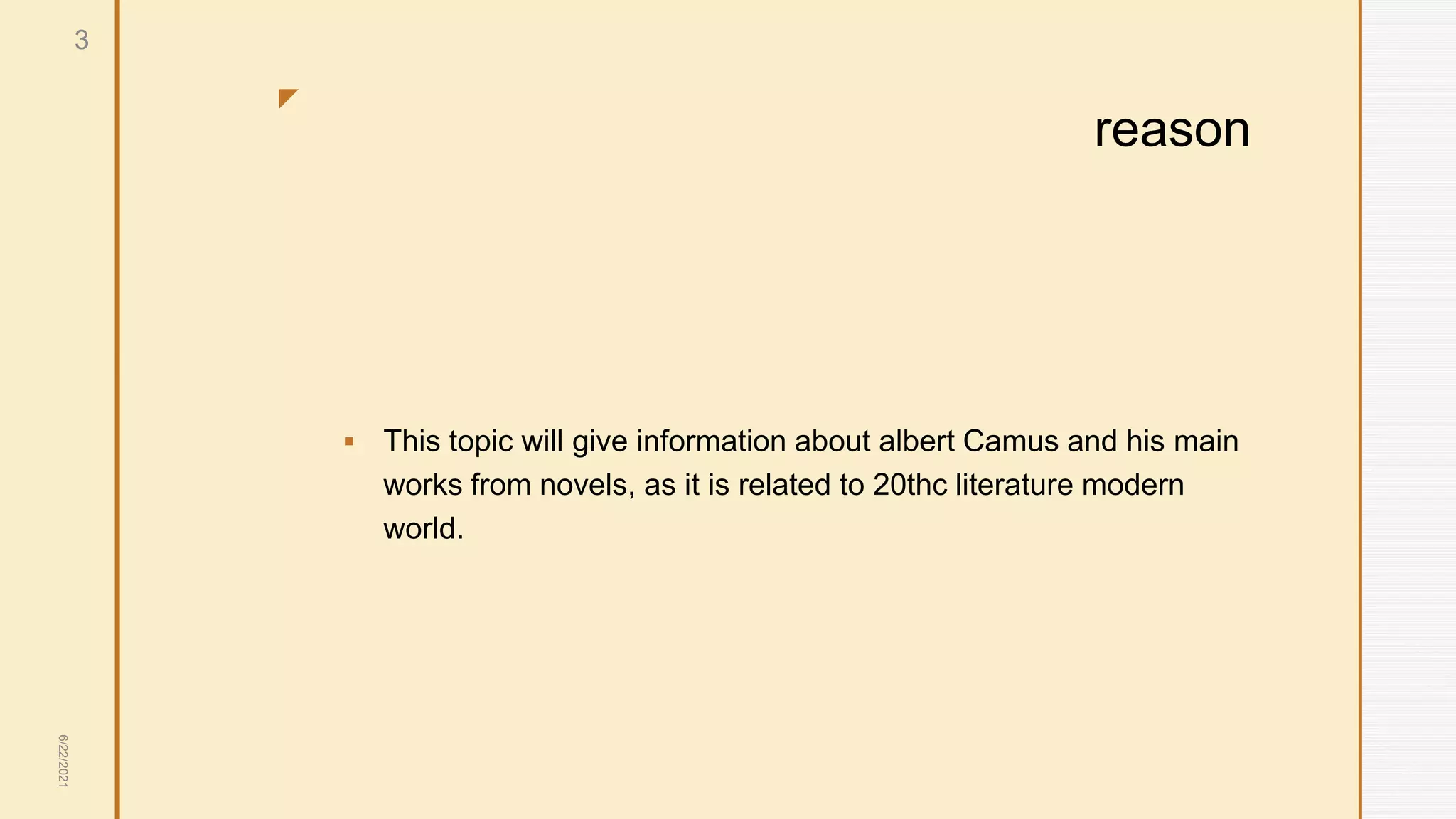
 L’Étranger (1942; The Stranger),
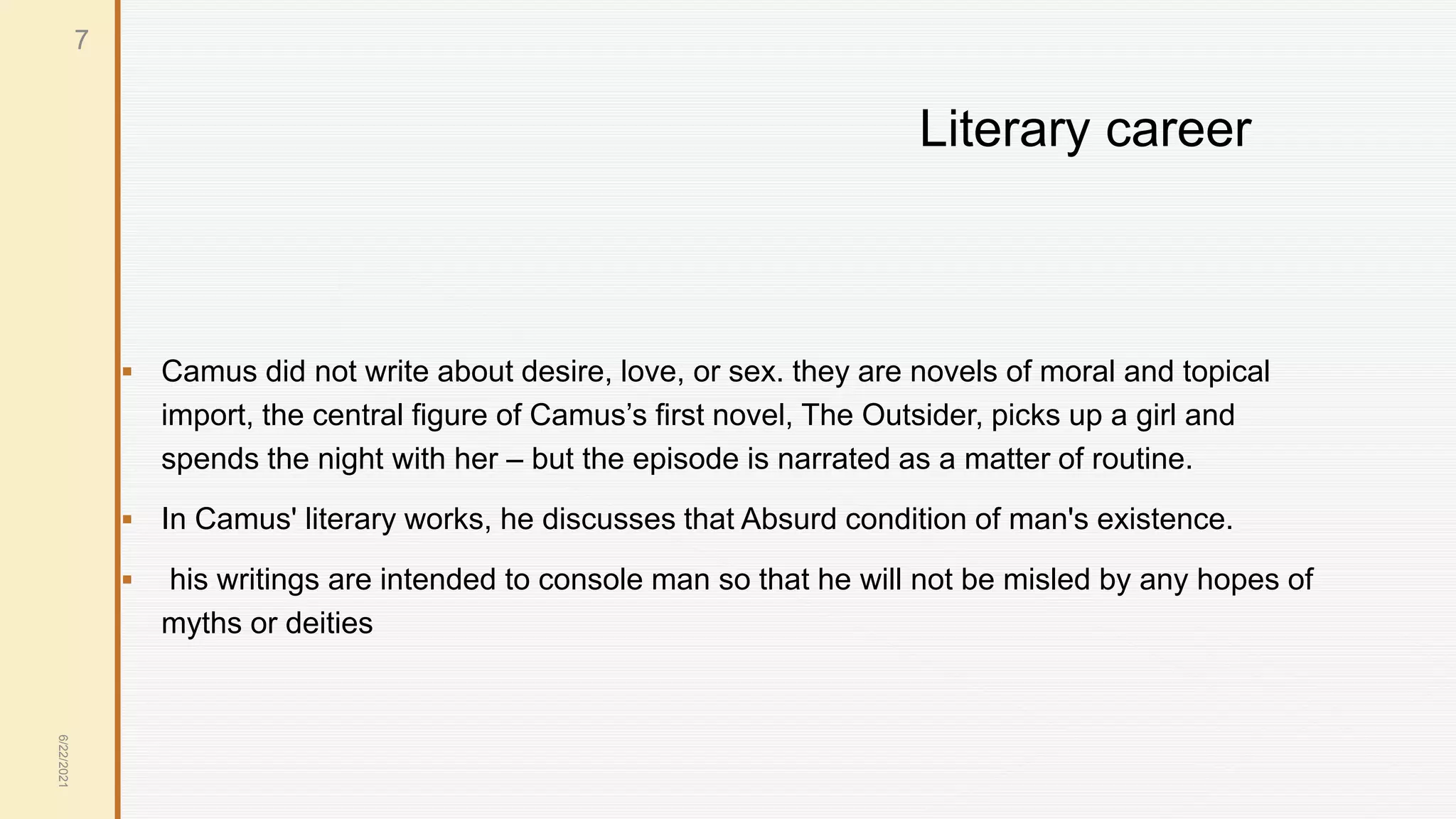
 La Peste (1947; The Plague),
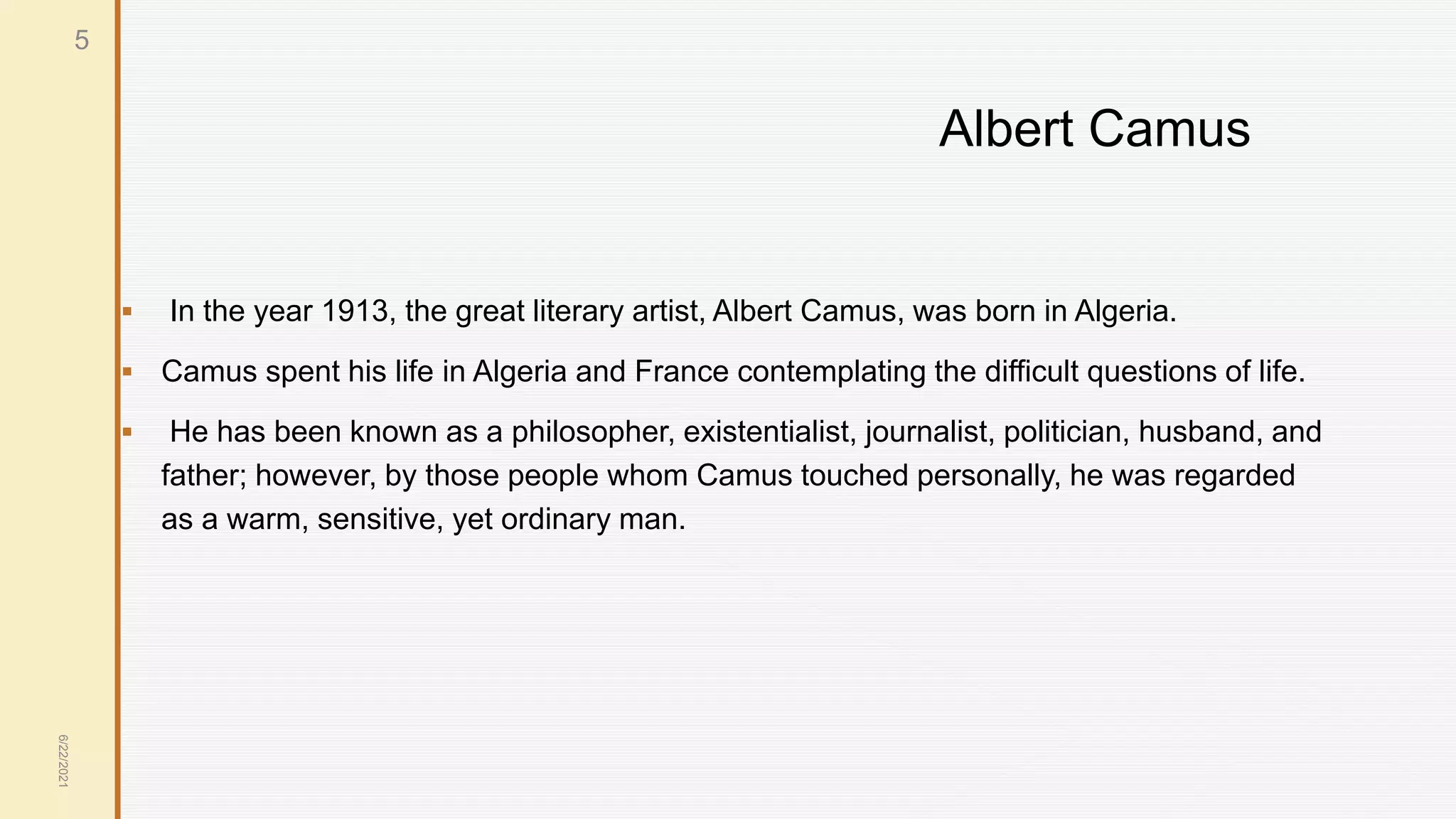
 La Chute (1956; The Fall)
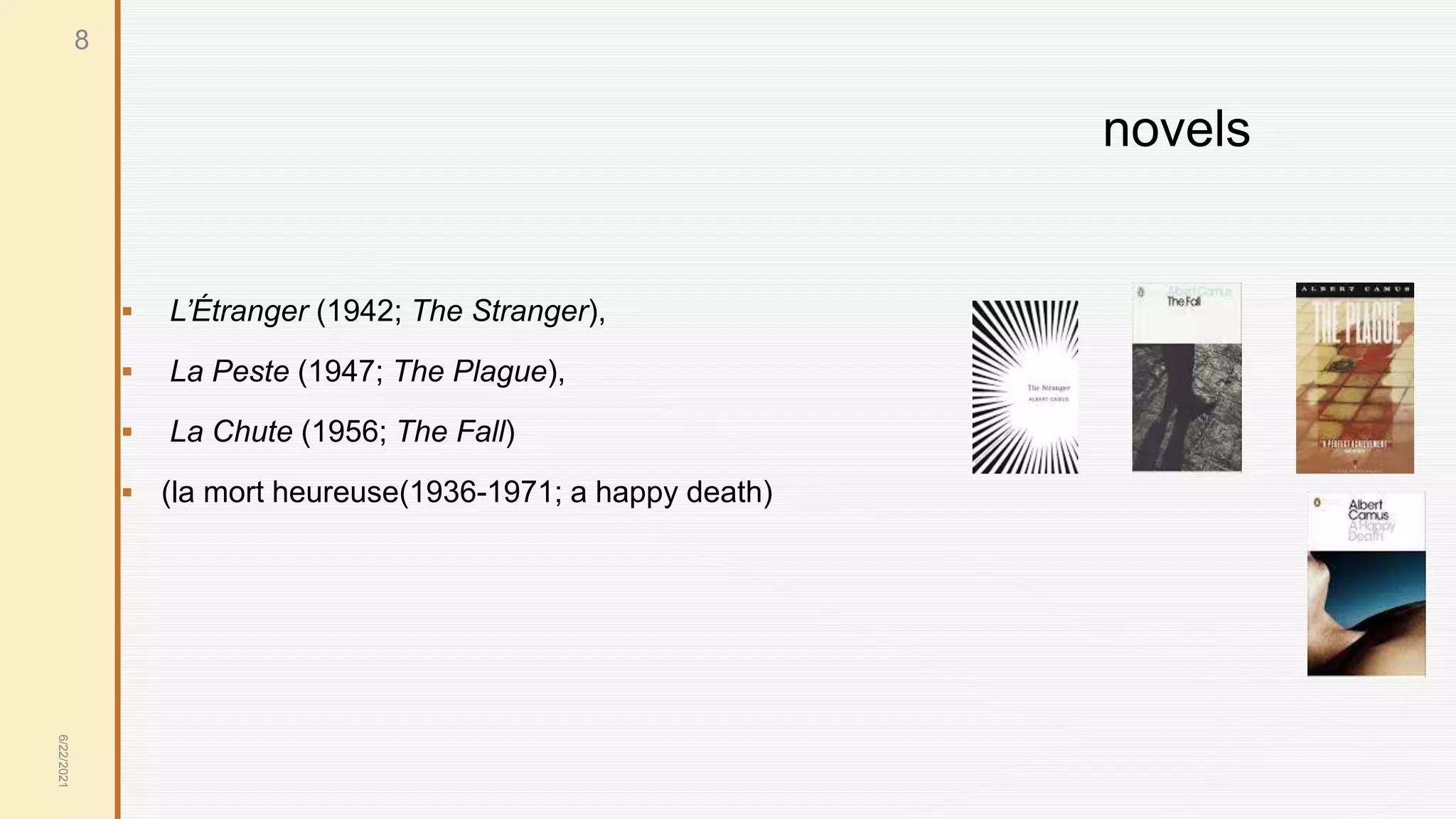
 (la mort heureuse(1936-1971; a happy death)
6/22/2021
8
essays
 Le Mythe de Sisyphe (The Myth of Sisyphus),
 L homme revolte ( the rebel 1951)
 Noces (1938; “Nuptials”), A second collection of essays contains intensely lyrical
meditations on the Algerian countryside and presents natural beauty as a form of
wealth that even the very poor can enjoy.
6/22/2021
9
plays
 Le Malentendu (Cross Purpose)
 Caligula, in 1944 and 1945
 A collection of short stories is l’exil et le rovaume (1957, exile and the kingdom)
6/22/2021
10
Myth of Sisyphus
 Camus uses the Greek legend of Sisyphus, who is condemned by the gods for
eternity to repeatedly roll a boulder up a hill only to have it roll down again once he got
it to the top,
 as a metaphor for the individual's persistent struggle against the essential absurdity of
life.
 (The Myth of Sisyphus), in which Camus, with considerable sympathy, analyzed
contemporary nihilism and a sense of the “absurd.”
6/22/2021
11
 Camus begins the first essay with the question of whether or not life is worth living The
Myth of Sisyphus is the actual work that explains the philosophy of the Absurd.
 Sisyphus is bound to roll a rock up a hill that inevitably returns to the ground.
 This monotonous cycle is a parallel to man's struggle for greatness during his life.
 Like Sisyphus, man makes his own destiny or fate from day to day, that climb up the
hill as he pushes his rock.
 Man and Sisyphus are content as they strive to reach the top,
6/22/2021
12
 Man and Sisyphus are content as they strive to reach the top, but toward the end of the
journey both realize that they are not going to reach their goals.
 This persistent quest for the meaning in life which always ends without a reward causes
man to feel incomplete and unfulfilled.
 Camus writes that "the workman of today works everyday in his life at the same tasks,
and this fate is no less absurd.
6/22/2021
13
L, etranger
(U.S. title, The Stranger; British title, The
Outsider)
 a brilliant first novel begun before the war and published in 1942,
 is a study of 20th-century alienation with a portrait of an “outsider” condemned to death
less for shooting an Arab than for the fact that he never says more than he genuinely
feels and refuses to conform to society’s demands
6/22/2021
14
Cont…..
 the novel is actually a refreshing attempt to place a philosophical idea into action - the
action of everyday living.
 Camus creates a situation with which all of his readers can identify: a character with a
banal job, who occupies his time in his apartment and at a local cafe. Friends come,
visit, and leave. Sleep ensues after dining.
 The next day, the character works again, dines again, and sleeps. Simplistically,
 this description outlines a common human being's everyday life, but amidst the ordinary
living, humans tend to fill their days with purpose, goals, and significance.
6/22/2021
15
 However, in The stranger Albert Camus attempts to portray a being who fills his days
with common diversions while obliterating all meaning and significance of every activity.
 Camus' character does not willfully choose to exclude meaning and purpose in his
actions, because purpose and meaning are alien to him.
 He does not know why he does something or what is the significance of his actions'
ramifications.
6/22/2021
16
 He does not even entertain feelings or ideas that most people enjoy.
 This protagonist subscribes wholly to the notion of the Absurd Camus abruptly
presents the world of the Absurd, and
 he intends for man to come to his own conclusion about the existence of the Absurd by
the end of the novel.
6/22/2021
17
La peste (1947; The Plague),
 is a symbolical account of the fight against an epidemic in Oran by characters whose
importance lies less in the (doubtful) success with which they oppose the epidemic than
in their determined assertion of human dignity and fraternity.
 The subjects and protagonists of Albert Camus' The Plague greatly differ from those of
The stranger.
 In The Plague, Camus continues to explore his philosophy on the Absurd, but as the
themes in the novel indicate, he discusses different aspects and reaches new
conclusions regarding the Absurd
6/22/2021
18
 The Plague, are a dramatization of the era in his life when Camus was separated from
his family in Algiers. Due to the Resistance/Occupation Group in Europe during the
second world war, Camus was detained in France for several years.
 This period of separation probably led him to discuss the theme of isolation and
separation throughout his novel.
6/22/2021
19
6/22/2021
20

Albert camus bio and works

  • 1.
  • 2.
    z Albert Camus asa novelist 6/22/2021 2
  • 3.
    z reason  This topicwill give information about albert Camus and his main works from novels, as it is related to 20thc literature modern world. 6/22/2021 3
  • 4.
    z outlines  Biography ofalbert Camus  his Literary works  As a novelist 6/22/2021 4
  • 5.
    Albert Camus  Inthe year 1913, the great literary artist, Albert Camus, was born in Algeria.  Camus spent his life in Algeria and France contemplating the difficult questions of life.  He has been known as a philosopher, existentialist, journalist, politician, husband, and father; however, by those people whom Camus touched personally, he was regarded as a warm, sensitive, yet ordinary man. 6/22/2021 5
  • 6.
     In Algeria,Camus was a high school scholarship student under the influence of Louis Germain.  He continued to study literature and philosophy at the University of Algeria under his mentor, Jean Grenier. From the age of seventeen until his death, Camus was plagued with tuberculosis 6/22/2021 6
  • 7.
    Literary career  Camusdid not write about desire, love, or sex. they are novels of moral and topical import, the central figure of Camus’s first novel, The Outsider, picks up a girl and spends the night with her – but the episode is narrated as a matter of routine.  In Camus' literary works, he discusses that Absurd condition of man's existence.  his writings are intended to console man so that he will not be misled by any hopes of myths or deities 6/22/2021 7
  • 8.
    novels  L’Étranger (1942;The Stranger),  La Peste (1947; The Plague),  La Chute (1956; The Fall)  (la mort heureuse(1936-1971; a happy death) 6/22/2021 8
  • 9.
    essays  Le Mythede Sisyphe (The Myth of Sisyphus),  L homme revolte ( the rebel 1951)  Noces (1938; “Nuptials”), A second collection of essays contains intensely lyrical meditations on the Algerian countryside and presents natural beauty as a form of wealth that even the very poor can enjoy. 6/22/2021 9
  • 10.
    plays  Le Malentendu(Cross Purpose)  Caligula, in 1944 and 1945  A collection of short stories is l’exil et le rovaume (1957, exile and the kingdom) 6/22/2021 10
  • 11.
    Myth of Sisyphus Camus uses the Greek legend of Sisyphus, who is condemned by the gods for eternity to repeatedly roll a boulder up a hill only to have it roll down again once he got it to the top,  as a metaphor for the individual's persistent struggle against the essential absurdity of life.  (The Myth of Sisyphus), in which Camus, with considerable sympathy, analyzed contemporary nihilism and a sense of the “absurd.” 6/22/2021 11
  • 12.
     Camus beginsthe first essay with the question of whether or not life is worth living The Myth of Sisyphus is the actual work that explains the philosophy of the Absurd.  Sisyphus is bound to roll a rock up a hill that inevitably returns to the ground.  This monotonous cycle is a parallel to man's struggle for greatness during his life.  Like Sisyphus, man makes his own destiny or fate from day to day, that climb up the hill as he pushes his rock.  Man and Sisyphus are content as they strive to reach the top, 6/22/2021 12
  • 13.
     Man andSisyphus are content as they strive to reach the top, but toward the end of the journey both realize that they are not going to reach their goals.  This persistent quest for the meaning in life which always ends without a reward causes man to feel incomplete and unfulfilled.  Camus writes that "the workman of today works everyday in his life at the same tasks, and this fate is no less absurd. 6/22/2021 13
  • 14.
    L, etranger (U.S. title,The Stranger; British title, The Outsider)  a brilliant first novel begun before the war and published in 1942,  is a study of 20th-century alienation with a portrait of an “outsider” condemned to death less for shooting an Arab than for the fact that he never says more than he genuinely feels and refuses to conform to society’s demands 6/22/2021 14
  • 15.
    Cont…..  the novelis actually a refreshing attempt to place a philosophical idea into action - the action of everyday living.  Camus creates a situation with which all of his readers can identify: a character with a banal job, who occupies his time in his apartment and at a local cafe. Friends come, visit, and leave. Sleep ensues after dining.  The next day, the character works again, dines again, and sleeps. Simplistically,  this description outlines a common human being's everyday life, but amidst the ordinary living, humans tend to fill their days with purpose, goals, and significance. 6/22/2021 15
  • 16.
     However, inThe stranger Albert Camus attempts to portray a being who fills his days with common diversions while obliterating all meaning and significance of every activity.  Camus' character does not willfully choose to exclude meaning and purpose in his actions, because purpose and meaning are alien to him.  He does not know why he does something or what is the significance of his actions' ramifications. 6/22/2021 16
  • 17.
     He doesnot even entertain feelings or ideas that most people enjoy.  This protagonist subscribes wholly to the notion of the Absurd Camus abruptly presents the world of the Absurd, and  he intends for man to come to his own conclusion about the existence of the Absurd by the end of the novel. 6/22/2021 17
  • 18.
    La peste (1947;The Plague),  is a symbolical account of the fight against an epidemic in Oran by characters whose importance lies less in the (doubtful) success with which they oppose the epidemic than in their determined assertion of human dignity and fraternity.  The subjects and protagonists of Albert Camus' The Plague greatly differ from those of The stranger.  In The Plague, Camus continues to explore his philosophy on the Absurd, but as the themes in the novel indicate, he discusses different aspects and reaches new conclusions regarding the Absurd 6/22/2021 18
  • 19.
     The Plague,are a dramatization of the era in his life when Camus was separated from his family in Algiers. Due to the Resistance/Occupation Group in Europe during the second world war, Camus was detained in France for several years.  This period of separation probably led him to discuss the theme of isolation and separation throughout his novel. 6/22/2021 19
  • 20.