CENTERLINING

What is it?
Why do I want it?
How do I do it?
What Is Centerlining?
 Centerlining is a program or methodology that a Plant can
  use to reduce variability in a process.
Why do I want Centerlining?
   Would you rather build good quality into a Process or
      inspect bad quality out?
     Centerlining helps a Plant build quality into the
      process.
     If a Process is out of control, the quality of the finished
      product is a random event.
     A Process that is Centerlined reduces the randomness
      of the quality of the finished product. You consistently
      make good quality product.
     Reduce Waste = $
     Improve Machine Operating Efficiency = $
How Do I Do It?
 To ensure a consistent outcome, you must ensure
  consistent raw materials, consistent operating conditions
  and consistent parameters.
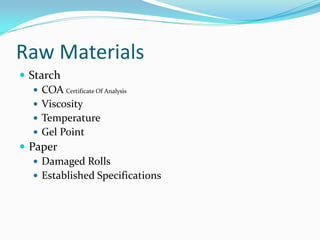
   Raw Materials
        Starch
        Paper
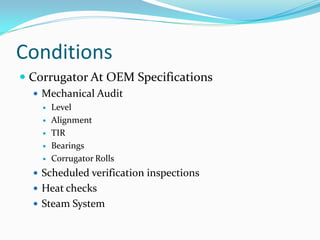
   Conditions
        Corrugator
        Heat
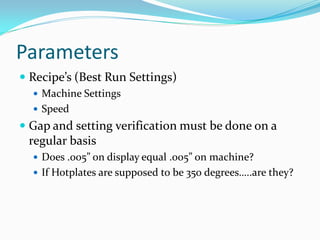
   Parameters
        Recipes
        Gaps
Raw Materials
 Starch
    COA Certificate Of Analysis
    Viscosity
    Temperature
    Gel Point
 Paper
    Damaged Rolls
    Established Specifications
Conditions
 Corrugator At OEM Specifications
   Mechanical Audit
     Level

     Alignment

     TIR

     Bearings

     Corrugator Rolls

   Scheduled verification inspections
   Heat checks
   Steam System
Parameters
 Recipe’s (Best Run Settings)
   Machine Settings
   Speed
 Gap and setting verification must be done on a
 regular basis
   Does .005” on display equal .005” on machine?
   If Hotplates are supposed to be 350 degrees…..are they?
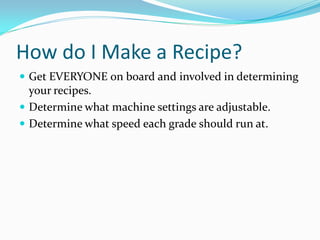
How do I Make a Recipe?
 Get EVERYONE on board and involved in determining
  your recipes.
 Determine what machine settings are adjustable.
 Determine what speed each grade should run at.
Expected Speed
 Must be established by incremental speed trials
 Must be done in conjunction with the entire crew
 Must be recorded
 The expected speed from the data must be agreed to by the
  crews
 All crews must participate plus the starch man and roll
  stock man
 The expected speed should be listed on the recipe on the
  schedule or set automatically by the corrugator computer
 Any reason for not meeting the expected speed must be
  recorded
What Is Good Board?
 You only want to record recipes when you are
 running good board at the right speed.
   What is good board?
   Each Plant will have different resources available to
    measure good board.
       Visual – Is it flat? (+/- ¼” per 2’)
       Manual – Is it stuck together?
           Rip Bond Test
           Pin Test
       Dimensions
       Moisture
       ECT
Continuous Improvement
– What and When To Record
 Basic approach - only record when the centerlined
  conditions cannot be met.
 When the Expected speed cannot be achieved the
  cause must be recorded
 When bad paper is the cause the roll is best
  removed and held aside for mill inspection
 Running slow to save the extra effort of a roll
  change is a bad practice
 Adopt this practice and increase productivity and
  decrease waste
RESPONSIBILITIES
 Before this can be started, the corrugator must be brought
    up to a sound mechanical condition
   A simple planned maintenance program needs to be
    started
   Crews must be trained and checked out under the new
    procedures
   Management is responsible for organizing the speed trials
   Expected speeds must be committed to by the crews - all
    shifts
   The production manager must review the results daily
   Solutions must be sought to overcome all causes of slow
    downs in future runs. Regularly reviewed
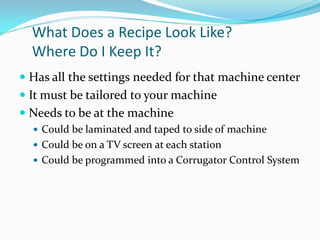
What Does a Recipe Look Like?
  Where Do I Keep It?
 Has all the settings needed for that machine center
 It must be tailored to your machine
 Needs to be at the machine
   Could be laminated and taped to side of machine
   Could be on a TV screen at each station
   Could be programmed into a Corrugator Control System
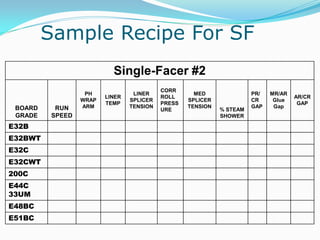
Sample Recipe For SF
                           Single-Facer #2
                                           CORR
                   PH             LINER              MED               PR/   MR/AR
                         LINER             ROLL                                      AR/CR
                  WRAP           SPLICER           SPLICER             CR     Glue
                         TEMP              PRESS                                      GAP
 BOARD     RUN    ARM            TENSION           TENSION             GAP    Gap
                                           URE               % STEAM
 GRADE    SPEED                                              SHOWER

E32B
E32BWT
E32C
E32CWT
200C
E44C
33UM
E48BC
E51BC
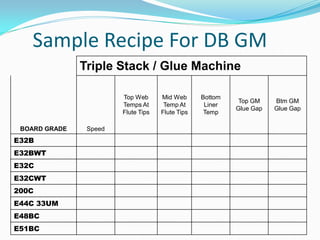
Sample Recipe For DB GM
               Triple Stack / Glue Machine

                        Top Web      Mid Web      Bottom
                                                            Top GM    Btm GM
                        Temps At      Temp At      Liner
                                                           Glue Gap   Glue Gap
                        Flute Tips   Flute Tips    Temp

 BOARD GRADE    Speed
E32B
E32BWT
E32C
E32CWT
200C
E44C 33UM
E48BC
E51BC
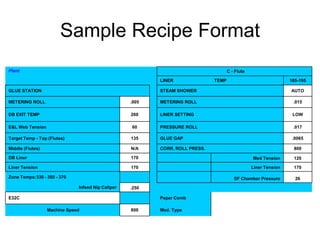
Sample Recipe Format
Plant                                                                                C - Flute

                                                          LINER               TEMP                               185-195

GLUE STATION                                              STEAM SHOWER                                           AUTO

METERING ROLL                                      .005   METERING ROLL                                           .015

DB EXIT TEMP                                       260    LINER SETTING                                           LOW

E&L Web Tension                                    60     PRESSURE ROLL                                           .017

Target Temp - Top (Flutes)                         135    GLUE GAP                                                .0065

Middle (Flutes)                                    N/A    CORR. ROLL PRESS.                                       800

DB Liner                                           170                                           Med Tension      120

Liner Tension                                      170                                           Liner Tension    170

Zone Temps:330 - 350 - 370                                                              SF Chamber Pressure        26
                              Infeed Nip Caliper   .250

E32C                                                      Paper Comb

                  Machine Speed                    800    Med. Type

Aicc 2012 meeting_centerlining_croker

  • 1.
    CENTERLINING What is it? Whydo I want it? How do I do it?
  • 2.
    What Is Centerlining? Centerlining is a program or methodology that a Plant can use to reduce variability in a process.
  • 3.
    Why do Iwant Centerlining?  Would you rather build good quality into a Process or inspect bad quality out?  Centerlining helps a Plant build quality into the process.  If a Process is out of control, the quality of the finished product is a random event.  A Process that is Centerlined reduces the randomness of the quality of the finished product. You consistently make good quality product.  Reduce Waste = $  Improve Machine Operating Efficiency = $
  • 4.
    How Do IDo It?  To ensure a consistent outcome, you must ensure consistent raw materials, consistent operating conditions and consistent parameters.  Raw Materials  Starch  Paper  Conditions  Corrugator  Heat  Parameters  Recipes  Gaps
  • 5.
    Raw Materials  Starch  COA Certificate Of Analysis  Viscosity  Temperature  Gel Point  Paper  Damaged Rolls  Established Specifications
  • 6.
    Conditions  Corrugator AtOEM Specifications  Mechanical Audit  Level  Alignment  TIR  Bearings  Corrugator Rolls  Scheduled verification inspections  Heat checks  Steam System
  • 7.
    Parameters  Recipe’s (BestRun Settings)  Machine Settings  Speed  Gap and setting verification must be done on a regular basis  Does .005” on display equal .005” on machine?  If Hotplates are supposed to be 350 degrees…..are they?
  • 8.
    How do IMake a Recipe?  Get EVERYONE on board and involved in determining your recipes.  Determine what machine settings are adjustable.  Determine what speed each grade should run at.
  • 9.
    Expected Speed  Mustbe established by incremental speed trials  Must be done in conjunction with the entire crew  Must be recorded  The expected speed from the data must be agreed to by the crews  All crews must participate plus the starch man and roll stock man  The expected speed should be listed on the recipe on the schedule or set automatically by the corrugator computer  Any reason for not meeting the expected speed must be recorded
  • 10.
    What Is GoodBoard?  You only want to record recipes when you are running good board at the right speed.  What is good board?  Each Plant will have different resources available to measure good board.  Visual – Is it flat? (+/- ¼” per 2’)  Manual – Is it stuck together?  Rip Bond Test  Pin Test  Dimensions  Moisture  ECT
  • 11.
    Continuous Improvement – Whatand When To Record  Basic approach - only record when the centerlined conditions cannot be met.  When the Expected speed cannot be achieved the cause must be recorded  When bad paper is the cause the roll is best removed and held aside for mill inspection  Running slow to save the extra effort of a roll change is a bad practice  Adopt this practice and increase productivity and decrease waste
  • 12.
    RESPONSIBILITIES  Before thiscan be started, the corrugator must be brought up to a sound mechanical condition  A simple planned maintenance program needs to be started  Crews must be trained and checked out under the new procedures  Management is responsible for organizing the speed trials  Expected speeds must be committed to by the crews - all shifts  The production manager must review the results daily  Solutions must be sought to overcome all causes of slow downs in future runs. Regularly reviewed
  • 13.
    What Does aRecipe Look Like? Where Do I Keep It?  Has all the settings needed for that machine center  It must be tailored to your machine  Needs to be at the machine  Could be laminated and taped to side of machine  Could be on a TV screen at each station  Could be programmed into a Corrugator Control System
  • 14.
    Sample Recipe ForSF Single-Facer #2 CORR PH LINER MED PR/ MR/AR LINER ROLL AR/CR WRAP SPLICER SPLICER CR Glue TEMP PRESS GAP BOARD RUN ARM TENSION TENSION GAP Gap URE % STEAM GRADE SPEED SHOWER E32B E32BWT E32C E32CWT 200C E44C 33UM E48BC E51BC
  • 15.
    Sample Recipe ForDB GM Triple Stack / Glue Machine Top Web Mid Web Bottom Top GM Btm GM Temps At Temp At Liner Glue Gap Glue Gap Flute Tips Flute Tips Temp BOARD GRADE Speed E32B E32BWT E32C E32CWT 200C E44C 33UM E48BC E51BC
  • 16.
    Sample Recipe Format Plant C - Flute LINER TEMP 185-195 GLUE STATION STEAM SHOWER AUTO METERING ROLL .005 METERING ROLL .015 DB EXIT TEMP 260 LINER SETTING LOW E&L Web Tension 60 PRESSURE ROLL .017 Target Temp - Top (Flutes) 135 GLUE GAP .0065 Middle (Flutes) N/A CORR. ROLL PRESS. 800 DB Liner 170 Med Tension 120 Liner Tension 170 Liner Tension 170 Zone Temps:330 - 350 - 370 SF Chamber Pressure 26 Infeed Nip Caliper .250 E32C Paper Comb Machine Speed 800 Med. Type