Department of civil Engineering
1
•Introduction to Solid waste management Definition,
•Classification,
•Need and Global perspective of solid waste management.
•Policies and legislative frameworks
•Government initiatives on Solid waste management.
•Integrated solid waste management and concept of 3R’s
•Role of stakeholders.
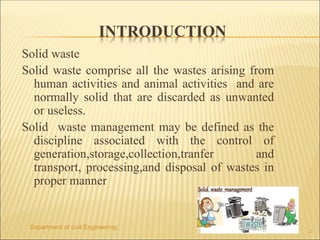
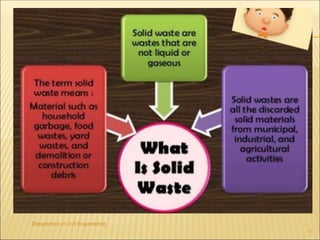
Solid waste
Solid waste comprise all the wastes arising from
human activities and animal activities and are
normally solid that are discarded as unwanted
or useless.
Solid waste management may be defined as the
discipline associated with the control of
generation,storage,collection,tranfer and
transport, processing,and disposal of wastes in
proper manner
Department of civil Engineering
2
Department of civil Engineering
3
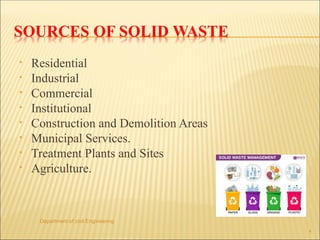
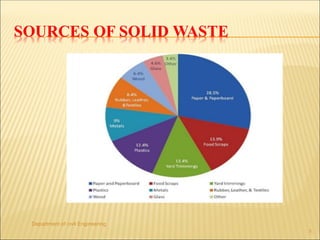
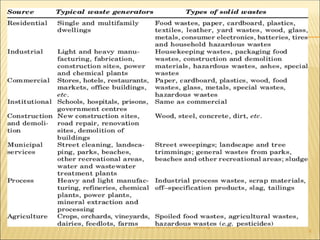
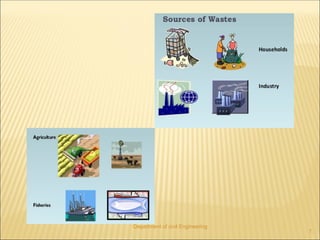
• Residential
• Industrial
• Commercial
• Institutional
• Construction and Demolition Areas
• Municipal Services.
• Treatment Plants and Sites
• Agriculture.
Department of civil Engineering
4
Department of civil Engineering
5
Department of civil engineering
6
Department of civil Engineering
7
 Refuse
 Rubbish
 Food waste
 Ashes and residue
 Demolition and construction waste
 Special waste
Department of civil Engineering
8
• Rubbish: Combustible and non combustible solid waste, excluding
food waste or other putrescible materials. Typically combustible
waste consist of materials such as paper, cardboard, plastics,
textiles, rubber leather, wood and garden trimmings. Non
combustible includes items such as glass, crockery, tincans, and
aluminum, ferrous and nonferrous metals.
• Refuse :All nonhazardous solid waste from a community that
requires collection and transport to a processing or disposal site is
called refuse
• Ashes and residues – materials remaining from burning of food
coke and other combustible wastes. Residues from power plants
normally are not included in this category. Ashes and residues are
normally composed of fine powdery materials, cinders cum
clinkers and small amount of burnt and unburnt materials.
Department of civil Engineering
9
• Construction and demolition waste: Wastes from residential
building and other structures are classified as demolition waste.
Waste from remodeling and repairing of residential and
commercial and industrial building and similar structures are
classified as construction waste. These waste includes dirt,
stones,concrete, bricks, plasters and plumbering, heating and
electrical parts.
• Special wastes : Wastes such as street sweepings, road side
litters, catch basin debris, dead animals and abundant vehicles
are classified as special waste.
• Treatment plant waste: The solid and semi solid waste water,
waste water from industrial areas is included in this
classification.
Department of civil Engineering
10
Department of civil Engineering
11
Department of civil Engineering
12
Department of civil Engineering
13
Department of civil Engineering
14
 The global average waste collection rate is 75 per
cent, the report titled Turning rubbish into a
resource:
 Global Waste Management Outlook 2024
(GWMO 2024) revealed.
 It also predicted that waste generated was set to
grow in volumes — from 2.3 billion tonnes in
2023 to 3.8 billion tonnes by 2050.
Department of civil Engineering
15
 Solid waste management (SWM) is a critical
environmental and public health issue worldwide,
with varying challenges and strategies across
different regions. Here's a global perspective on
SWM:
Department of civil Engineering
16
 Key Statistics:
 1. Global waste generation:
 2 billion tons/year (expected to increase to 3.4
billion tons by 2050)2. Waste per capita: 0.74
kg/day (varies from 0.3 kg/day in low-income to
4.4 kg/day in high-income countries)
 3. Waste composition: 44% organic, 31%
recyclables, 15% hazardous, 10% inert
Department of civil Engineering
17
 Regional Challenges:1. Developing Countries: Inadequate
infrastructure, lack of regulations, and informal waste
management practices lead to open dumping and
environmental pollution
 .2. Developed Countries: High waste generation rates,
limited landfill space, and increasing public awareness
drive advanced recycling and waste-to-energy technologies.
 3. Small Island Nations: Limited land availability and
vulnerability to climate change exacerbate waste
management difficulties.
Department of civil Engineering
18
 Global Best Practices:1. Integrated Waste
Management (IWM): Combines waste reduction,
recycling, composting, and disposal.
 2. Circular Economy: Encourages waste reduction,
reuse, and recycling.
 3. Waste-to-Energy: Converts waste into electricity,
heat, or biofuels.
 4. Extended Producer Responsibility (EPR): Makes
manufacturers responsible for product waste.
Department of civil Engineering
19
 International Cooperation and Policies:
 1. United Nations' Sustainable Development Goals
(SDGs): Goal 11 (Sustainable Cities and
Communities) and Goal 12 (Responsible
Consumption and Production) address SWM.
 2. Basel Convention: Regulates trans boundary
movement of hazardous waste.
 3. European Union's Waste Framework Directive:
Sets recycling targets and waste reduction guidelines.
Department of civil Engineering
20
 Emerging Trends:
 1. Digitalization: Leverages technology for waste tracking,
optimization, and citizen engagement.
 2. Biodegradable Materials: Develops biodegradable alternatives
to plastics.
 3. Climate Change Mitigation: Recognizes waste management's
role in reducing greenhouse gas emissions.
 Effective solid waste management requires a collaborative effort
from governments, industries, and individuals to adopt
sustainable practices, reduce waste generation, and promote a
circular economy.
Department of civil Engineering
21
 Landfilling: The most common disposal method, though it can
lead to land and groundwater contamination.
 Incineration: Reduces waste volume but can produce harmful
emissions if not properly controlled.
 Recycling and Composting: Increasingly emphasized to reduce
waste and recover materials. Countries like Germany and Sweden
have robust recycling systems.
 Circular Economy: Promotes sustainability by designing systems
that minimize waste and encourage the reuse of materials.
Department of civil Engineering
22
 International Policies and Agreements:
 1. Basel Convention (1989): Regulates transboundary
movement of hazardous waste.
 2. Stockholm Convention (2001): Aims to eliminate
persistent organic pollutants (POPs).
 3. United Nations' Sustainable Development Goals (SDGs)
(2015): - Goal 11: Sustainable Cities and Communities -
Goal 12: Responsible Consumption and Production
 4. Paris Agreement (2015): Addresses climate change
mitigation, including waste management.
Department of civil Engineering
23
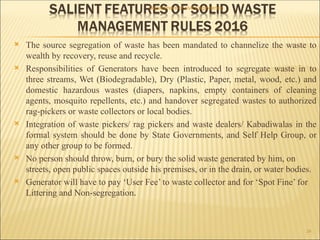
 The source segregation of waste has been mandated to channelize the waste to
wealth by recovery, reuse and recycle.
 Responsibilities of Generators have been introduced to segregate waste in to
three streams, Wet (Biodegradable), Dry (Plastic, Paper, metal, wood, etc.) and
domestic hazardous wastes (diapers, napkins, empty containers of cleaning
agents, mosquito repellents, etc.) and handover segregated wastes to authorized
rag-pickers or waste collectors or local bodies.
 Integration of waste pickers/ rag pickers and waste dealers/ Kabadiwalas in the
formal system should be done by State Governments, and Self Help Group, or
any other group to be formed.
 No person should throw, burn, or bury the solid waste generated by him, on
streets, open public spaces outside his premises, or in the drain, or water bodies.
 Generator will have to pay ‘User Fee’ to waste collector and for ‘Spot Fine’ for
Littering and Non-segregation.
Department of civil Engineering
24
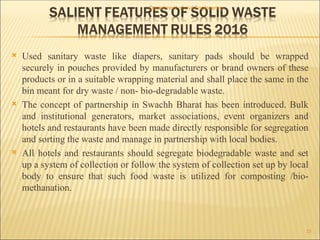
 Used sanitary waste like diapers, sanitary pads should be wrapped
securely in pouches provided by manufacturers or brand owners of these
products or in a suitable wrapping material and shall place the same in the
bin meant for dry waste / non- bio-degradable waste.
 The concept of partnership in Swachh Bharat has been introduced. Bulk
and institutional generators, market associations, event organizers and
hotels and restaurants have been made directly responsible for segregation
and sorting the waste and manage in partnership with local bodies.
 All hotels and restaurants should segregate biodegradable waste and set
up a system of collection or follow the system of collection set up by local
body to ensure that such food waste is utilized for composting /bio-
methanation.
Department of civil Engineering
25
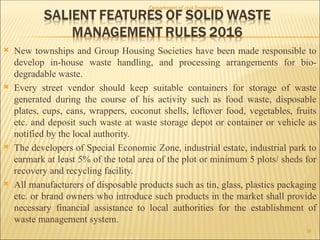
 New townships and Group Housing Societies have been made responsible to
develop in-house waste handling, and processing arrangements for bio-
degradable waste.
 Every street vendor should keep suitable containers for storage of waste
generated during the course of his activity such as food waste, disposable
plates, cups, cans, wrappers, coconut shells, leftover food, vegetables, fruits
etc. and deposit such waste at waste storage depot or container or vehicle as
notified by the local authority.
 The developers of Special Economic Zone, industrial estate, industrial park to
earmark at least 5% of the total area of the plot or minimum 5 plots/ sheds for
recovery and recycling facility.
 All manufacturers of disposable products such as tin, glass, plastics packaging
etc. or brand owners who introduce such products in the market shall provide
necessary financial assistance to local authorities for the establishment of
waste management system.
Department of civil Engineering
26
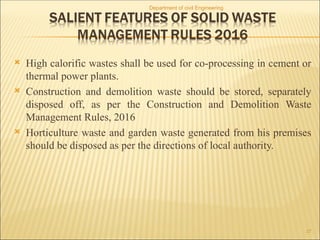
 High calorific wastes shall be used for co-processing in cement or
thermal power plants.
 Construction and demolition waste should be stored, separately
disposed off, as per the Construction and Demolition Waste
Management Rules, 2016
 Horticulture waste and garden waste generated from his premises
should be disposed as per the directions of local authority.
Department of civil Engineering
27
 The Indian government has launched several initiatives to tackle solid waste
management.
 Key Initiatives:- Swachh Bharat Mission: Launched in 2014, this nationwide cleanup
effort aims to make India clean and free of open defecation
 Solid Waste Management Rules (2016): These rules mandate waste segregation at
source, inclusion of informal waste pickers, and responsible electronic waste
disposal
 Waste to Wealth Mission: This initiative promotes waste recycling and reuse, aiming
to convert waste into valuable resources
 Swaccha Survekshan: An annual survey ranking cities based on cleanliness and
waste management
 Swachhata Hi Sewa Campaign: A campaign promoting community involvement in
waste management
 Compost Program: Encourages composting of organic waste to reduce landfill waste
Department of civil Engineering
28
 The 3R concept is a principle of solid waste management
that involves reducing, reusing, and recycling resources
and products
 Integrated solid waste management is a tool for
sustainable waste management practices.
 Exploring the three Rs of waste management — Reduce,
Reuse, Recycle. In order to keep as much material out of
the landfill as possible, it's important for each of us to do
our part.
Department of civil Engineering
29
 Integrated Solid Waste Management (ISWM) is a
comprehensive approach to managing solid waste in a
way that minimizes environmental impacts, conserves
natural resources, and promotes sustainable development
Department of civil Engineering
30
 ISWM Principles:
1. Waste Hierarchy: Prioritize waste reduction, reuse, recycling, and
energy recovery over landfilling.
2. Polluter Pays Principle: Generators of waste bear the costs of
management.
3. Public-Private Partnerships: Collaborative efforts between
government, private sector, and communities.
4. Community Engagement: Educate and involve stakeholders in
waste management decisions.5. Economic Efficiency: Optimize
waste management costs and benefits.
Department of civil Engineering
31
 Benefits:
1. Environmental Protection: Reduces pollution, greenhouse gas
emissions, and conserves natural resources.
2. Public Health: Decreases disease transmission and improves
sanitation.
3. Economic Benefits: Creates jobs, stimulates innovation, and saves
resources.
4. Social Benefits: Enhances community well-being, quality of life,
and social justice.ISWM
Department of civil Engineering
32
 Strategies:
1. Source Separation: Separate waste at generation point.
2. Door-to-Door Collection: Regular waste collection from
households.
3. Waste-to-Energy: Convert waste to electricity, heat, or biofuels.
4. Recycling Programs: Implement curbside recycling, drop-off
centers, and recycling facilities.
5. Composting: Convert organic waste to nutrient-rich soil
amendments.
6. Landfill Design: Engineer landfills to minimize environmental
impacts.
Department of civil Engineering
33
 Stakeholders play a crucial role in solid waste management (SWM) by
contributing to the planning, implementation, and monitoring of waste
management activities. Here's an overview of the roles and responsibilities of
various stakeholders:
 Government:
1. Policy-making and regulation
2. Infrastructure development (landfills, recycling facilities)
3. Enforcement of waste management laws
4. Public education and awareness
5. Funding allocation
Department of civil Engineering
34
 Private Sector:
1. Waste collection and transportation services
2. Recycling and composting operations
3. Waste-to-energy facilities
4. Technology innovation and investment
5. Partnership with government and communities
Department of civil Engineering
35
 Communities and Residents:
 1. Waste reduction and segregation
 2. Participation in recycling programs
 3. Proper waste disposal practices
 4. Community-based waste management initiatives
 5. Feedback and participation in decision-making
Department of civil Engineering
36
 Civil Society Organizations (CSOs):
1. Advocacy and awareness campaigns
2. Community engagement and education
3. Waste management research and analysis
4. Policy influence and lobbying
5. Collaboration with government and private
sector
Department of civil Engineering
37

Solid Waste Management subject MODULE 1.ppt

  • 1.
    Department of civilEngineering 1 •Introduction to Solid waste management Definition, •Classification, •Need and Global perspective of solid waste management. •Policies and legislative frameworks •Government initiatives on Solid waste management. •Integrated solid waste management and concept of 3R’s •Role of stakeholders.
  • 2.
    Solid waste Solid wastecomprise all the wastes arising from human activities and animal activities and are normally solid that are discarded as unwanted or useless. Solid waste management may be defined as the discipline associated with the control of generation,storage,collection,tranfer and transport, processing,and disposal of wastes in proper manner Department of civil Engineering 2
  • 3.
    Department of civilEngineering 3
  • 4.
    • Residential • Industrial •Commercial • Institutional • Construction and Demolition Areas • Municipal Services. • Treatment Plants and Sites • Agriculture. Department of civil Engineering 4
  • 5.
    Department of civilEngineering 5
  • 6.
    Department of civilengineering 6
  • 7.
    Department of civilEngineering 7
  • 8.
     Refuse  Rubbish Food waste  Ashes and residue  Demolition and construction waste  Special waste Department of civil Engineering 8
  • 9.
    • Rubbish: Combustibleand non combustible solid waste, excluding food waste or other putrescible materials. Typically combustible waste consist of materials such as paper, cardboard, plastics, textiles, rubber leather, wood and garden trimmings. Non combustible includes items such as glass, crockery, tincans, and aluminum, ferrous and nonferrous metals. • Refuse :All nonhazardous solid waste from a community that requires collection and transport to a processing or disposal site is called refuse • Ashes and residues – materials remaining from burning of food coke and other combustible wastes. Residues from power plants normally are not included in this category. Ashes and residues are normally composed of fine powdery materials, cinders cum clinkers and small amount of burnt and unburnt materials. Department of civil Engineering 9
  • 10.
    • Construction anddemolition waste: Wastes from residential building and other structures are classified as demolition waste. Waste from remodeling and repairing of residential and commercial and industrial building and similar structures are classified as construction waste. These waste includes dirt, stones,concrete, bricks, plasters and plumbering, heating and electrical parts. • Special wastes : Wastes such as street sweepings, road side litters, catch basin debris, dead animals and abundant vehicles are classified as special waste. • Treatment plant waste: The solid and semi solid waste water, waste water from industrial areas is included in this classification. Department of civil Engineering 10
  • 11.
    Department of civilEngineering 11
  • 12.
    Department of civilEngineering 12
  • 13.
    Department of civilEngineering 13
  • 14.
    Department of civilEngineering 14
  • 15.
     The globalaverage waste collection rate is 75 per cent, the report titled Turning rubbish into a resource:  Global Waste Management Outlook 2024 (GWMO 2024) revealed.  It also predicted that waste generated was set to grow in volumes — from 2.3 billion tonnes in 2023 to 3.8 billion tonnes by 2050. Department of civil Engineering 15
  • 16.
     Solid wastemanagement (SWM) is a critical environmental and public health issue worldwide, with varying challenges and strategies across different regions. Here's a global perspective on SWM: Department of civil Engineering 16
  • 17.
     Key Statistics: 1. Global waste generation:  2 billion tons/year (expected to increase to 3.4 billion tons by 2050)2. Waste per capita: 0.74 kg/day (varies from 0.3 kg/day in low-income to 4.4 kg/day in high-income countries)  3. Waste composition: 44% organic, 31% recyclables, 15% hazardous, 10% inert Department of civil Engineering 17
  • 18.
     Regional Challenges:1.Developing Countries: Inadequate infrastructure, lack of regulations, and informal waste management practices lead to open dumping and environmental pollution  .2. Developed Countries: High waste generation rates, limited landfill space, and increasing public awareness drive advanced recycling and waste-to-energy technologies.  3. Small Island Nations: Limited land availability and vulnerability to climate change exacerbate waste management difficulties. Department of civil Engineering 18
  • 19.
     Global BestPractices:1. Integrated Waste Management (IWM): Combines waste reduction, recycling, composting, and disposal.  2. Circular Economy: Encourages waste reduction, reuse, and recycling.  3. Waste-to-Energy: Converts waste into electricity, heat, or biofuels.  4. Extended Producer Responsibility (EPR): Makes manufacturers responsible for product waste. Department of civil Engineering 19
  • 20.
     International Cooperationand Policies:  1. United Nations' Sustainable Development Goals (SDGs): Goal 11 (Sustainable Cities and Communities) and Goal 12 (Responsible Consumption and Production) address SWM.  2. Basel Convention: Regulates trans boundary movement of hazardous waste.  3. European Union's Waste Framework Directive: Sets recycling targets and waste reduction guidelines. Department of civil Engineering 20
  • 21.
     Emerging Trends: 1. Digitalization: Leverages technology for waste tracking, optimization, and citizen engagement.  2. Biodegradable Materials: Develops biodegradable alternatives to plastics.  3. Climate Change Mitigation: Recognizes waste management's role in reducing greenhouse gas emissions.  Effective solid waste management requires a collaborative effort from governments, industries, and individuals to adopt sustainable practices, reduce waste generation, and promote a circular economy. Department of civil Engineering 21
  • 22.
     Landfilling: Themost common disposal method, though it can lead to land and groundwater contamination.  Incineration: Reduces waste volume but can produce harmful emissions if not properly controlled.  Recycling and Composting: Increasingly emphasized to reduce waste and recover materials. Countries like Germany and Sweden have robust recycling systems.  Circular Economy: Promotes sustainability by designing systems that minimize waste and encourage the reuse of materials. Department of civil Engineering 22
  • 23.
     International Policiesand Agreements:  1. Basel Convention (1989): Regulates transboundary movement of hazardous waste.  2. Stockholm Convention (2001): Aims to eliminate persistent organic pollutants (POPs).  3. United Nations' Sustainable Development Goals (SDGs) (2015): - Goal 11: Sustainable Cities and Communities - Goal 12: Responsible Consumption and Production  4. Paris Agreement (2015): Addresses climate change mitigation, including waste management. Department of civil Engineering 23
  • 24.
     The sourcesegregation of waste has been mandated to channelize the waste to wealth by recovery, reuse and recycle.  Responsibilities of Generators have been introduced to segregate waste in to three streams, Wet (Biodegradable), Dry (Plastic, Paper, metal, wood, etc.) and domestic hazardous wastes (diapers, napkins, empty containers of cleaning agents, mosquito repellents, etc.) and handover segregated wastes to authorized rag-pickers or waste collectors or local bodies.  Integration of waste pickers/ rag pickers and waste dealers/ Kabadiwalas in the formal system should be done by State Governments, and Self Help Group, or any other group to be formed.  No person should throw, burn, or bury the solid waste generated by him, on streets, open public spaces outside his premises, or in the drain, or water bodies.  Generator will have to pay ‘User Fee’ to waste collector and for ‘Spot Fine’ for Littering and Non-segregation. Department of civil Engineering 24
  • 25.
     Used sanitarywaste like diapers, sanitary pads should be wrapped securely in pouches provided by manufacturers or brand owners of these products or in a suitable wrapping material and shall place the same in the bin meant for dry waste / non- bio-degradable waste.  The concept of partnership in Swachh Bharat has been introduced. Bulk and institutional generators, market associations, event organizers and hotels and restaurants have been made directly responsible for segregation and sorting the waste and manage in partnership with local bodies.  All hotels and restaurants should segregate biodegradable waste and set up a system of collection or follow the system of collection set up by local body to ensure that such food waste is utilized for composting /bio- methanation. Department of civil Engineering 25
  • 26.
     New townshipsand Group Housing Societies have been made responsible to develop in-house waste handling, and processing arrangements for bio- degradable waste.  Every street vendor should keep suitable containers for storage of waste generated during the course of his activity such as food waste, disposable plates, cups, cans, wrappers, coconut shells, leftover food, vegetables, fruits etc. and deposit such waste at waste storage depot or container or vehicle as notified by the local authority.  The developers of Special Economic Zone, industrial estate, industrial park to earmark at least 5% of the total area of the plot or minimum 5 plots/ sheds for recovery and recycling facility.  All manufacturers of disposable products such as tin, glass, plastics packaging etc. or brand owners who introduce such products in the market shall provide necessary financial assistance to local authorities for the establishment of waste management system. Department of civil Engineering 26
  • 27.
     High calorificwastes shall be used for co-processing in cement or thermal power plants.  Construction and demolition waste should be stored, separately disposed off, as per the Construction and Demolition Waste Management Rules, 2016  Horticulture waste and garden waste generated from his premises should be disposed as per the directions of local authority. Department of civil Engineering 27
  • 28.
     The Indiangovernment has launched several initiatives to tackle solid waste management.  Key Initiatives:- Swachh Bharat Mission: Launched in 2014, this nationwide cleanup effort aims to make India clean and free of open defecation  Solid Waste Management Rules (2016): These rules mandate waste segregation at source, inclusion of informal waste pickers, and responsible electronic waste disposal  Waste to Wealth Mission: This initiative promotes waste recycling and reuse, aiming to convert waste into valuable resources  Swaccha Survekshan: An annual survey ranking cities based on cleanliness and waste management  Swachhata Hi Sewa Campaign: A campaign promoting community involvement in waste management  Compost Program: Encourages composting of organic waste to reduce landfill waste Department of civil Engineering 28
  • 29.
     The 3Rconcept is a principle of solid waste management that involves reducing, reusing, and recycling resources and products  Integrated solid waste management is a tool for sustainable waste management practices.  Exploring the three Rs of waste management — Reduce, Reuse, Recycle. In order to keep as much material out of the landfill as possible, it's important for each of us to do our part. Department of civil Engineering 29
  • 30.
     Integrated SolidWaste Management (ISWM) is a comprehensive approach to managing solid waste in a way that minimizes environmental impacts, conserves natural resources, and promotes sustainable development Department of civil Engineering 30
  • 31.
     ISWM Principles: 1.Waste Hierarchy: Prioritize waste reduction, reuse, recycling, and energy recovery over landfilling. 2. Polluter Pays Principle: Generators of waste bear the costs of management. 3. Public-Private Partnerships: Collaborative efforts between government, private sector, and communities. 4. Community Engagement: Educate and involve stakeholders in waste management decisions.5. Economic Efficiency: Optimize waste management costs and benefits. Department of civil Engineering 31
  • 32.
     Benefits: 1. EnvironmentalProtection: Reduces pollution, greenhouse gas emissions, and conserves natural resources. 2. Public Health: Decreases disease transmission and improves sanitation. 3. Economic Benefits: Creates jobs, stimulates innovation, and saves resources. 4. Social Benefits: Enhances community well-being, quality of life, and social justice.ISWM Department of civil Engineering 32
  • 33.
     Strategies: 1. SourceSeparation: Separate waste at generation point. 2. Door-to-Door Collection: Regular waste collection from households. 3. Waste-to-Energy: Convert waste to electricity, heat, or biofuels. 4. Recycling Programs: Implement curbside recycling, drop-off centers, and recycling facilities. 5. Composting: Convert organic waste to nutrient-rich soil amendments. 6. Landfill Design: Engineer landfills to minimize environmental impacts. Department of civil Engineering 33
  • 34.
     Stakeholders playa crucial role in solid waste management (SWM) by contributing to the planning, implementation, and monitoring of waste management activities. Here's an overview of the roles and responsibilities of various stakeholders:  Government: 1. Policy-making and regulation 2. Infrastructure development (landfills, recycling facilities) 3. Enforcement of waste management laws 4. Public education and awareness 5. Funding allocation Department of civil Engineering 34
  • 35.
     Private Sector: 1.Waste collection and transportation services 2. Recycling and composting operations 3. Waste-to-energy facilities 4. Technology innovation and investment 5. Partnership with government and communities Department of civil Engineering 35
  • 36.
     Communities andResidents:  1. Waste reduction and segregation  2. Participation in recycling programs  3. Proper waste disposal practices  4. Community-based waste management initiatives  5. Feedback and participation in decision-making Department of civil Engineering 36
  • 37.
     Civil SocietyOrganizations (CSOs): 1. Advocacy and awareness campaigns 2. Community engagement and education 3. Waste management research and analysis 4. Policy influence and lobbying 5. Collaboration with government and private sector Department of civil Engineering 37