SPEECH ACT THEORY:
FROM AUSTIN AND SEARLE
Napoleon M. Mabaquiao, Jr.
De La Salle University, Manila
DISCUSSANT: CHERRYLL MAY S. DE GUZMAN
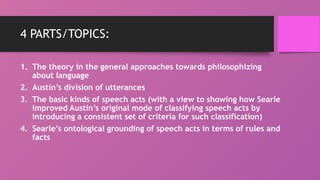
4 PARTS/TOPICS:
1. The theory in the general approaches towards philosophizing
about language
2. Austin’s division of utterances
3. The basic kinds of speech acts (with a view to showing how Searle
improved Austin’s original mode of classifying speech acts by
introducing a consistent set of criteria for such classification)
4. Searle’s ontological grounding of speech acts in terms of rules and
facts
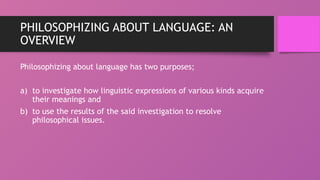
PHILOSOPHIZING ABOUT LANGUAGE: AN
OVERVIEW
Philosophizing about language has two purposes;
a) to investigate how linguistic expressions of various kinds acquire
their meanings and
b) to use the results of the said investigation to resolve
philosophical issues.
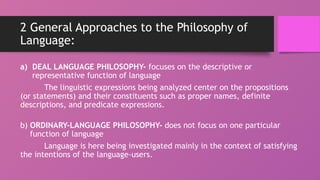
2 General Approaches to the Philosophy of
Language:
a) DEAL LANGUAGE PHILOSOPHY- focuses on the descriptive or
representative function of language
The linguistic expressions being analyzed center on the propositions
(or statements) and their constituents such as proper names, definite
descriptions, and predicate expressions.
b) ORDINARY-LANGUAGE PHILOSOPHY- does not focus on one particular
function of language
Language is here being investigated mainly in the context of satisfying
the intentions of the language-users.
Generally, linguistic philosophers of the ideal-language persuasion
would point out that philosophical issues arise when the descriptive
function of language is confused with its other functions, or, better, when
the other functions of language, due to grammar, are mistaken to be
descriptive.
On the other hand, linguistic philosophers of the ordinary-language
persuasion would generally point out that philosophical issues are results
of using language outside of their ordinary contexts.
The speech act theory is classified under the ordinary-language
philosophy because it aims to accommodate a wide variety of
linguistic functions.
AUSTIN ON TWO GENERAL KINDS OF
UTTERANCES
a) Constatives refer to linguistic expressions that are either true or
false, and are often used to describe facts or states of affairs in
the world.
b) Performatives refer to linguistic expressions that are used to
perform certain actions. They are the kind of expressions
wherein we perform certain actions while saying them.
Example:
“I advise you to seek permission from your parents”.
The conditions of success (or “conditions of satisfaction,” as Searle
preferred to put it) for constatives are indicated by the values of
truth and falsity.
For this reason, he proposed the expressions “happy” and
“unhappy” to indicate, respectively, success and failure of
performatives.
Austin’s three conditions in the mode of making a
performative unhappy:
1. The appropriateness of the persons involved in the performative
and the circumstance in which the performative is uttered.
If such persons and circumstance are inappropriate, the
performative is unhappy. In particular, the performative, in this
case, is null and void.
“I now pronounce you husband and wife.”
Austin’s three conditions in the mode of making a
performative unhappy:
2. The insincerity of the person uttering a performative.
In this case, the failure of the performative takes the form of
abuse of the performative.
“I promise to attend your birthday party.”
Austin’s three conditions in the mode of making a
performative unhappy:
3. The failure to perform future actions entailed by performatives.
In this case, the failure of a performative takes the form of a
breach of commitment.
“You are welcome.”
After identifying and explicating the conditions of success or failure
of performatives, Austin realized that the conditions of success of
constatives could actually be explained in terms of the conditions
of success of performatives.
In short, Austin wanted to show that the falsity of constatives is just
a feature of the unhappiness of performatives. To do this, Austin
considered the following statements:
1. All John’s children are bald.
2. The cat is on the mat.
3. All the guests are French.
Austin eventually arrived at the conclusion that a clear
distinction could not be made between constatives and performatives
as constatives proved to be just a kind of performatives.
Given this, Austin then embarked on the task of analyzing the
logical structure of performatives. Two of the significant realizations
of Austin in doing so were the following.
First, performatives can be explicit or implicit. An explicit
performative is one where it is clear from the utterance of the
performatives, like in the case of the performatives “I promise…,”
and “I advise you…” what actions are being performed.
On the other hand, an implicit performative is one where it is
not clear from the utterance what kind of action is being
performed.
In this case, it is the context that determines what kind of
action is being performed. For instance, my utterance of “I will be
there” may mean that I am making a promise, expressing an
intention of being there, or simply making a prediction of some
future event.
Second, the actions performed in uttering performatives can be broken down
into three kinds:
1. LOCUTIONARY ACT which refers to the mere utterance of the performatives.
a. the phatic act, referring to the act of producing mere noises or sounds;
b. the phonetic act, referring to the act of producing sounds that are recognizable as words
from a certain vocabulary and grammar; and
c. the rhetic act, referring to the act of using words to convey meanings (using words with
sense and reference).
2. ILLOCUTIONARY ACT which refers to the act that is being done in
uttering a performative.
3. PERLOCUTIONARY ACT which refers to the act of the speaker in
eliciting a certain response from the hearer, or in making an effect on the
hearer.
Searle’s analysis (1971), consider the following sentences:
1. John leaves the room.
2. I hope John left the room.
3. John, please leave the room.
4. Has John left the room?
The first is used to make an assertion; the second, to express hope;
the third, to make a request; and the fourth, to ask a question. But all of
them are the same in having what Searle called the propositional content,
which refers to the fact that all of them have “John” as the subject which
identifies a certain individual, and “leaves the room” as the predicate which
attributes a certain property to the individual named “John.”
Searle (1977: 43-44) explained:
“From a semantical point of view, we can distinguish between the
propositional indicator in the sentence and the indicator of illocutionary
force. That is, for a large class of sentences used to perform illocutionary
acts, we can say for the purpose of our analysis that the sentence has two
(not necessarily separate) parts, the proposition-indicating element and
function-indicating device. The function-indicating device shows how the
proposition is to be taken, or, to put it in another way, what illocutionary
force that utterance is to have, that is, what illocutionary act the
speaker is performing in the utterance of the sentence.”
“I promise to attend your birthday party tomorrow.”
The phrase “I promise” is the illocutionary force indicator while the
phrase “to attend your birthday tomorrow” is the propositional
indicator.
The illocutionary force indicators are based on the word order,
stress, intonation contour, punctuation, the mood of the verb, and
the so-called performative verbs.
The propositional content refers to the subject and the
predicate of a sentence used to perform an illocutionary act. But in
the context of performing an illocutionary act, the subject and the
predicate are not simply expressed. Rather, the subject of the
sentence is used to perform the act of referring to an individual;
and the predicate of the sentence is used to perform the act of
attributing a property to the individual.
This propositional act further divides into:
a. the referring act (the act of identifying the reference of the
subject of a sentence) and;
b. the predicating act (the act of attributing a property to the
reference of the subject of a sentence).
CLASSIFYING SPEECH ACTS
Austin came up with the following five basic types of performatives:
(1) Commissives. Their whole point “is to commit the speaker to a certain action” (Austin
1989: 157). E.g.: promise, undertake, covenant, bind myself, contract, propose
to, and give my word.
(2) Expositives. They “are used in acts of exposition involving the expounding of views,
the
conducting of arguments and the clarifying of usages and of references” (Austin
1989:
161). E.g.: “I turn next to,” “I quote,” “I cite,” “I recapitulate,” “I repeat that,” and “I
mention that.”
CLASSIFYING SPEECH ACTS
Austin came up with the following five basic types of performatives:
(3) Exercitives. They have to do with “the giving of a decision in
favour of or against a certain course of action, or advocacy of it”
(Austin 1989: 155). E.g.: appoint, dismiss, degrade,
excommunicate, demote, and name.
(4) Behavabitives. They “include the notion of reaction to other
people’s behavior and fortunes and of attitudes and
expressions of attitudes to someone else’s past conduct or
imminent conduct” (Austin 1989: 160). E.g.: apologize, thank,
deplore, criticize, commiserate, compliment, condole,
congratulate, and sympathize.
CLASSIFYING SPEECH ACTS
Austin came up with the following five basic types of performatives:
(5) Verdictives. They “consist in the delivering of a finding, official or
unofficial, upon evidence or reasons as to value or fact, so
far as these are distinguishable. A verdictive is a judicial act as
distinct from legislative or executive acts…” (Austin 1989:
153). E.g.: acquit, convict, read it as, reckon, place, grade, assess,
characterize, rule, and estimate.
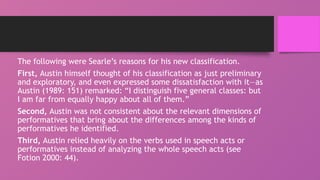
The following were Searle’s reasons for his new classification.
First, Austin himself thought of his classification as just preliminary
and exploratory, and even expressed some dissatisfaction with it—as
Austin (1989: 151) remarked: “I distinguish five general classes: but
I am far from equally happy about all of them.”
Second, Austin was not consistent about the relevant dimensions of
performatives that bring about the differences among the kinds of
performatives he identified.
Third, Austin relied heavily on the verbs used in speech acts or
performatives instead of analyzing the whole speech acts (see
Fotion 2000: 44).
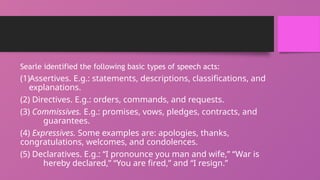
Searle identified the following basic types of speech acts:
(1)Assertives. E.g.: statements, descriptions, classifications, and
explanations.
(2) Directives. E.g.: orders, commands, and requests.
(3) Commissives. E.g.: promises, vows, pledges, contracts, and
guarantees.
(4) Expressives. Some examples are: apologies, thanks,
congratulations, welcomes, and condolences.
(5) Declaratives. E.g.: “I pronounce you man and wife,” “War is
hereby declared,” “You are fired,” and “I resign.”
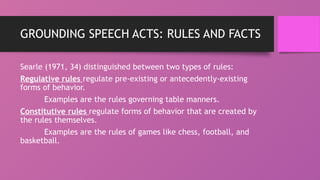
GROUNDING SPEECH ACTS: RULES AND FACTS
Searle (1971, 34) distinguished between two types of rules:
Regulative rules regulate pre-existing or antecedently-existing
forms of behavior.
Examples are the rules governing table manners.
Constitutive rules regulate forms of behavior that are created by
the rules themselves.
Examples are the rules of games like chess, football, and
basketball.
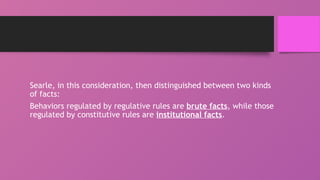
Searle, in this consideration, then distinguished between two kinds
of facts:
Behaviors regulated by regulative rules are brute facts, while those
regulated by constitutive rules are institutional facts.
Thank You!

Speech Act Theory_Report_Applied Linguistics.pptx

  • 1.
    SPEECH ACT THEORY: FROMAUSTIN AND SEARLE Napoleon M. Mabaquiao, Jr. De La Salle University, Manila DISCUSSANT: CHERRYLL MAY S. DE GUZMAN
  • 2.
    4 PARTS/TOPICS: 1. Thetheory in the general approaches towards philosophizing about language 2. Austin’s division of utterances 3. The basic kinds of speech acts (with a view to showing how Searle improved Austin’s original mode of classifying speech acts by introducing a consistent set of criteria for such classification) 4. Searle’s ontological grounding of speech acts in terms of rules and facts
  • 3.
    PHILOSOPHIZING ABOUT LANGUAGE:AN OVERVIEW Philosophizing about language has two purposes; a) to investigate how linguistic expressions of various kinds acquire their meanings and b) to use the results of the said investigation to resolve philosophical issues.
  • 4.
    2 General Approachesto the Philosophy of Language: a) DEAL LANGUAGE PHILOSOPHY- focuses on the descriptive or representative function of language The linguistic expressions being analyzed center on the propositions (or statements) and their constituents such as proper names, definite descriptions, and predicate expressions. b) ORDINARY-LANGUAGE PHILOSOPHY- does not focus on one particular function of language Language is here being investigated mainly in the context of satisfying the intentions of the language-users.
  • 5.
    Generally, linguistic philosophersof the ideal-language persuasion would point out that philosophical issues arise when the descriptive function of language is confused with its other functions, or, better, when the other functions of language, due to grammar, are mistaken to be descriptive. On the other hand, linguistic philosophers of the ordinary-language persuasion would generally point out that philosophical issues are results of using language outside of their ordinary contexts.
  • 6.
    The speech acttheory is classified under the ordinary-language philosophy because it aims to accommodate a wide variety of linguistic functions.
  • 7.
    AUSTIN ON TWOGENERAL KINDS OF UTTERANCES a) Constatives refer to linguistic expressions that are either true or false, and are often used to describe facts or states of affairs in the world. b) Performatives refer to linguistic expressions that are used to perform certain actions. They are the kind of expressions wherein we perform certain actions while saying them. Example: “I advise you to seek permission from your parents”.
  • 8.
    The conditions ofsuccess (or “conditions of satisfaction,” as Searle preferred to put it) for constatives are indicated by the values of truth and falsity. For this reason, he proposed the expressions “happy” and “unhappy” to indicate, respectively, success and failure of performatives.
  • 9.
    Austin’s three conditionsin the mode of making a performative unhappy: 1. The appropriateness of the persons involved in the performative and the circumstance in which the performative is uttered. If such persons and circumstance are inappropriate, the performative is unhappy. In particular, the performative, in this case, is null and void. “I now pronounce you husband and wife.”
  • 10.
    Austin’s three conditionsin the mode of making a performative unhappy: 2. The insincerity of the person uttering a performative. In this case, the failure of the performative takes the form of abuse of the performative. “I promise to attend your birthday party.”
  • 11.
    Austin’s three conditionsin the mode of making a performative unhappy: 3. The failure to perform future actions entailed by performatives. In this case, the failure of a performative takes the form of a breach of commitment. “You are welcome.”
  • 12.
    After identifying andexplicating the conditions of success or failure of performatives, Austin realized that the conditions of success of constatives could actually be explained in terms of the conditions of success of performatives.
  • 13.
    In short, Austinwanted to show that the falsity of constatives is just a feature of the unhappiness of performatives. To do this, Austin considered the following statements: 1. All John’s children are bald. 2. The cat is on the mat. 3. All the guests are French.
  • 14.
    Austin eventually arrivedat the conclusion that a clear distinction could not be made between constatives and performatives as constatives proved to be just a kind of performatives. Given this, Austin then embarked on the task of analyzing the logical structure of performatives. Two of the significant realizations of Austin in doing so were the following. First, performatives can be explicit or implicit. An explicit performative is one where it is clear from the utterance of the performatives, like in the case of the performatives “I promise…,” and “I advise you…” what actions are being performed.
  • 15.
    On the otherhand, an implicit performative is one where it is not clear from the utterance what kind of action is being performed. In this case, it is the context that determines what kind of action is being performed. For instance, my utterance of “I will be there” may mean that I am making a promise, expressing an intention of being there, or simply making a prediction of some future event.
  • 16.
    Second, the actionsperformed in uttering performatives can be broken down into three kinds: 1. LOCUTIONARY ACT which refers to the mere utterance of the performatives. a. the phatic act, referring to the act of producing mere noises or sounds; b. the phonetic act, referring to the act of producing sounds that are recognizable as words from a certain vocabulary and grammar; and c. the rhetic act, referring to the act of using words to convey meanings (using words with sense and reference). 2. ILLOCUTIONARY ACT which refers to the act that is being done in uttering a performative. 3. PERLOCUTIONARY ACT which refers to the act of the speaker in eliciting a certain response from the hearer, or in making an effect on the hearer.
  • 17.
    Searle’s analysis (1971),consider the following sentences: 1. John leaves the room. 2. I hope John left the room. 3. John, please leave the room. 4. Has John left the room? The first is used to make an assertion; the second, to express hope; the third, to make a request; and the fourth, to ask a question. But all of them are the same in having what Searle called the propositional content, which refers to the fact that all of them have “John” as the subject which identifies a certain individual, and “leaves the room” as the predicate which attributes a certain property to the individual named “John.”
  • 18.
    Searle (1977: 43-44)explained: “From a semantical point of view, we can distinguish between the propositional indicator in the sentence and the indicator of illocutionary force. That is, for a large class of sentences used to perform illocutionary acts, we can say for the purpose of our analysis that the sentence has two (not necessarily separate) parts, the proposition-indicating element and function-indicating device. The function-indicating device shows how the proposition is to be taken, or, to put it in another way, what illocutionary force that utterance is to have, that is, what illocutionary act the speaker is performing in the utterance of the sentence.”
  • 19.
    “I promise toattend your birthday party tomorrow.” The phrase “I promise” is the illocutionary force indicator while the phrase “to attend your birthday tomorrow” is the propositional indicator. The illocutionary force indicators are based on the word order, stress, intonation contour, punctuation, the mood of the verb, and the so-called performative verbs.
  • 20.
    The propositional contentrefers to the subject and the predicate of a sentence used to perform an illocutionary act. But in the context of performing an illocutionary act, the subject and the predicate are not simply expressed. Rather, the subject of the sentence is used to perform the act of referring to an individual; and the predicate of the sentence is used to perform the act of attributing a property to the individual.
  • 21.
    This propositional actfurther divides into: a. the referring act (the act of identifying the reference of the subject of a sentence) and; b. the predicating act (the act of attributing a property to the reference of the subject of a sentence).
  • 22.
    CLASSIFYING SPEECH ACTS Austincame up with the following five basic types of performatives: (1) Commissives. Their whole point “is to commit the speaker to a certain action” (Austin 1989: 157). E.g.: promise, undertake, covenant, bind myself, contract, propose to, and give my word. (2) Expositives. They “are used in acts of exposition involving the expounding of views, the conducting of arguments and the clarifying of usages and of references” (Austin 1989: 161). E.g.: “I turn next to,” “I quote,” “I cite,” “I recapitulate,” “I repeat that,” and “I mention that.”
  • 23.
    CLASSIFYING SPEECH ACTS Austincame up with the following five basic types of performatives: (3) Exercitives. They have to do with “the giving of a decision in favour of or against a certain course of action, or advocacy of it” (Austin 1989: 155). E.g.: appoint, dismiss, degrade, excommunicate, demote, and name. (4) Behavabitives. They “include the notion of reaction to other people’s behavior and fortunes and of attitudes and expressions of attitudes to someone else’s past conduct or imminent conduct” (Austin 1989: 160). E.g.: apologize, thank, deplore, criticize, commiserate, compliment, condole, congratulate, and sympathize.
  • 24.
    CLASSIFYING SPEECH ACTS Austincame up with the following five basic types of performatives: (5) Verdictives. They “consist in the delivering of a finding, official or unofficial, upon evidence or reasons as to value or fact, so far as these are distinguishable. A verdictive is a judicial act as distinct from legislative or executive acts…” (Austin 1989: 153). E.g.: acquit, convict, read it as, reckon, place, grade, assess, characterize, rule, and estimate.
  • 25.
    The following wereSearle’s reasons for his new classification. First, Austin himself thought of his classification as just preliminary and exploratory, and even expressed some dissatisfaction with it—as Austin (1989: 151) remarked: “I distinguish five general classes: but I am far from equally happy about all of them.” Second, Austin was not consistent about the relevant dimensions of performatives that bring about the differences among the kinds of performatives he identified. Third, Austin relied heavily on the verbs used in speech acts or performatives instead of analyzing the whole speech acts (see Fotion 2000: 44).
  • 26.
    Searle identified thefollowing basic types of speech acts: (1)Assertives. E.g.: statements, descriptions, classifications, and explanations. (2) Directives. E.g.: orders, commands, and requests. (3) Commissives. E.g.: promises, vows, pledges, contracts, and guarantees. (4) Expressives. Some examples are: apologies, thanks, congratulations, welcomes, and condolences. (5) Declaratives. E.g.: “I pronounce you man and wife,” “War is hereby declared,” “You are fired,” and “I resign.”
  • 27.
    GROUNDING SPEECH ACTS:RULES AND FACTS Searle (1971, 34) distinguished between two types of rules: Regulative rules regulate pre-existing or antecedently-existing forms of behavior. Examples are the rules governing table manners. Constitutive rules regulate forms of behavior that are created by the rules themselves. Examples are the rules of games like chess, football, and basketball.
  • 28.
    Searle, in thisconsideration, then distinguished between two kinds of facts: Behaviors regulated by regulative rules are brute facts, while those regulated by constitutive rules are institutional facts.
  • 29.