Consistent Hashing:
Algorithmic Tradeoffs
Evan Lin
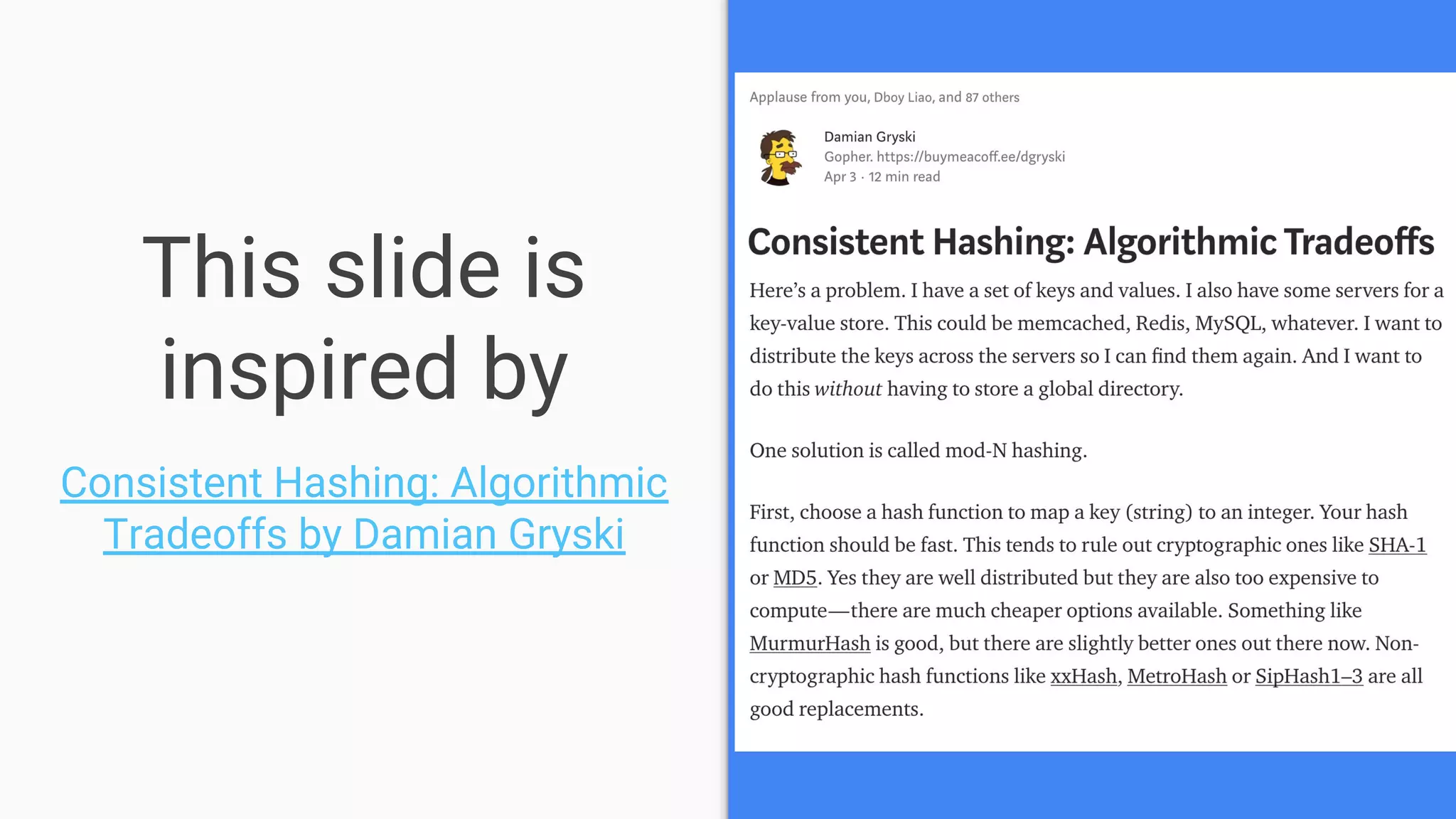
This slide is
inspired by
Consistent Hashing: Algorithmic
Tradeoffs by Damian Gryski
Agenda
● Original problems
● Mod-N Hashing
● Consistent Hashing
● Jump Hashing
● Maglev Hashing
● Consistent Hashing with bounded load
● Benchmarks
● Conclusion
Problems
● Some keys and values
● Need a way to store those key-value
● Distributed caching usage
● Don’t want a global directory
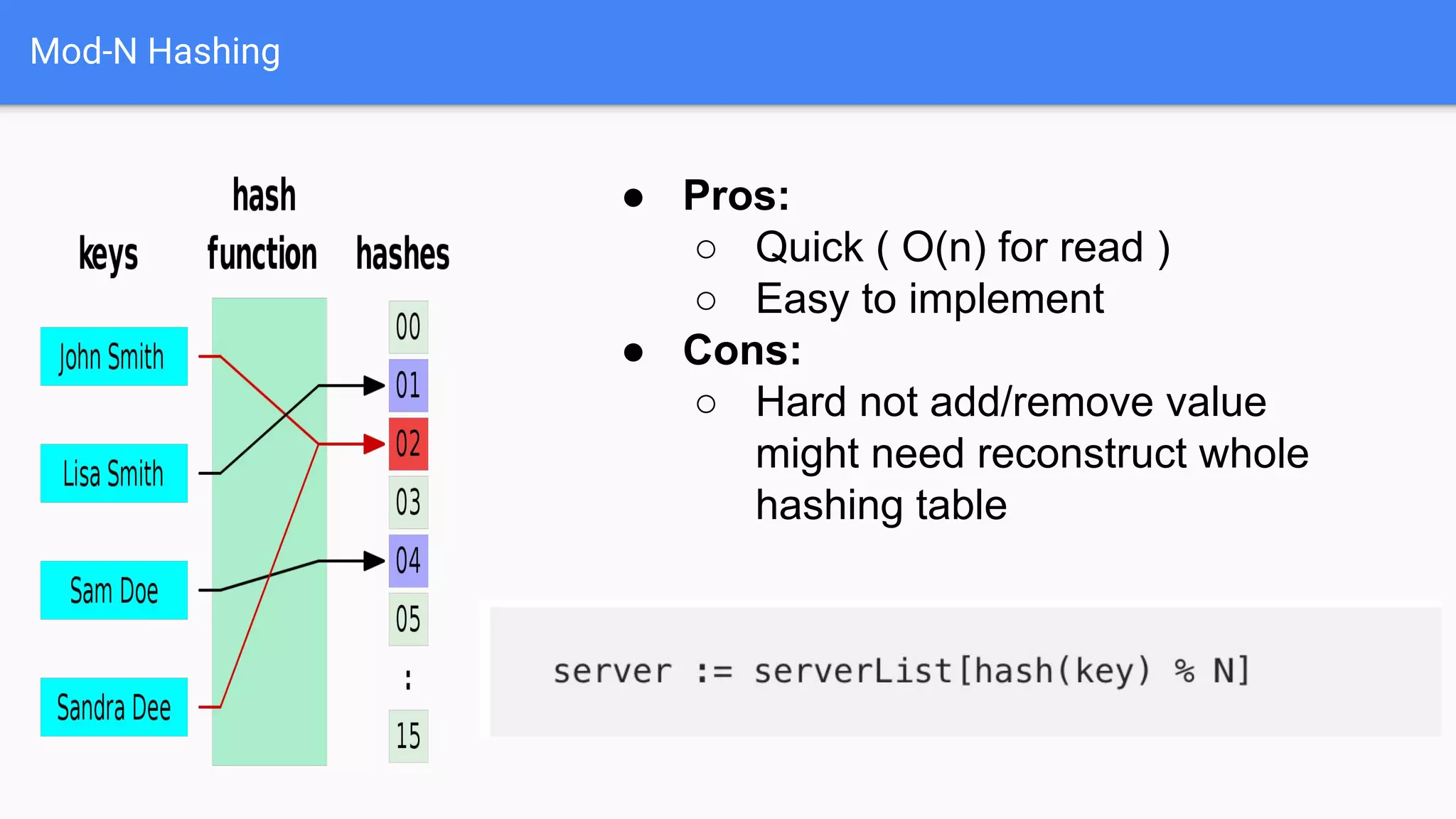
Mod-N Hashing
● Pros:
○ Quick ( O(n) for read )
○ Easy to implement
● Cons:
○ Hard not add/remove value
might need reconstruct whole
hashing table
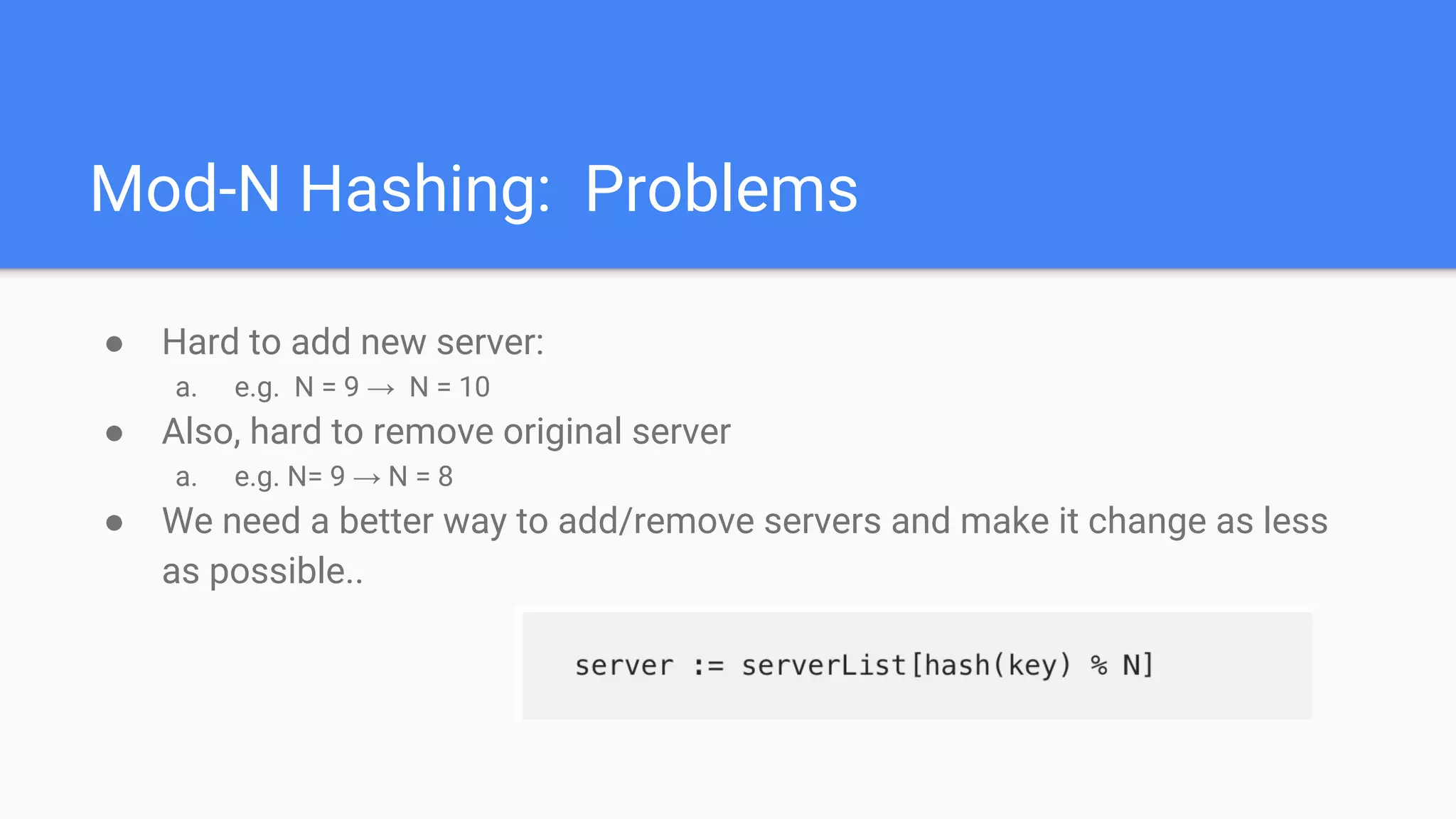
Mod-N Hashing: Problems
● Hard to add new server:
a. e.g. N = 9 → N = 10
● Also, hard to remove original server
a. e.g. N= 9 → N = 8
● We need a better way to add/remove servers and make it change as less
as possible..
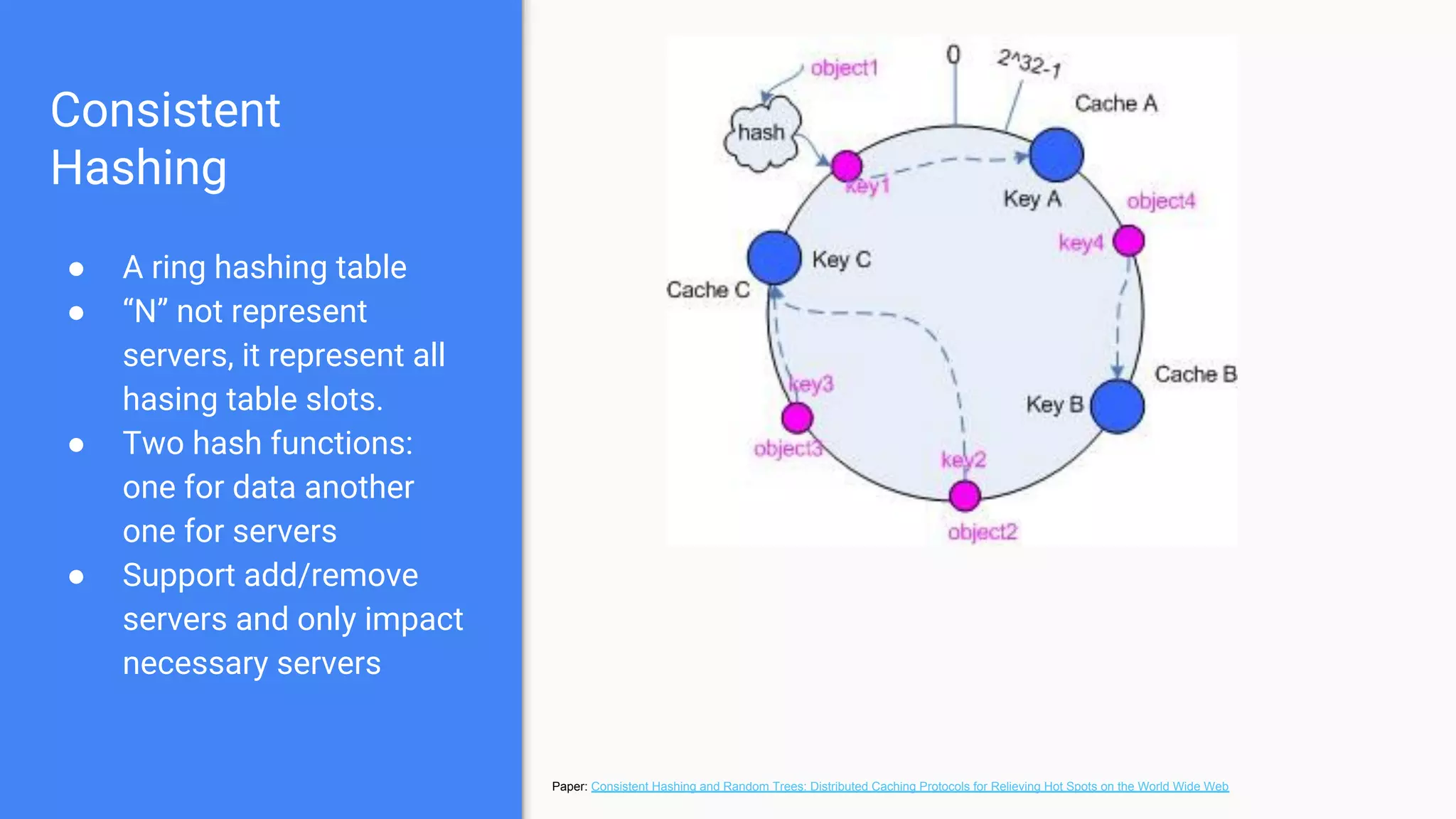
Consistent
Hashing
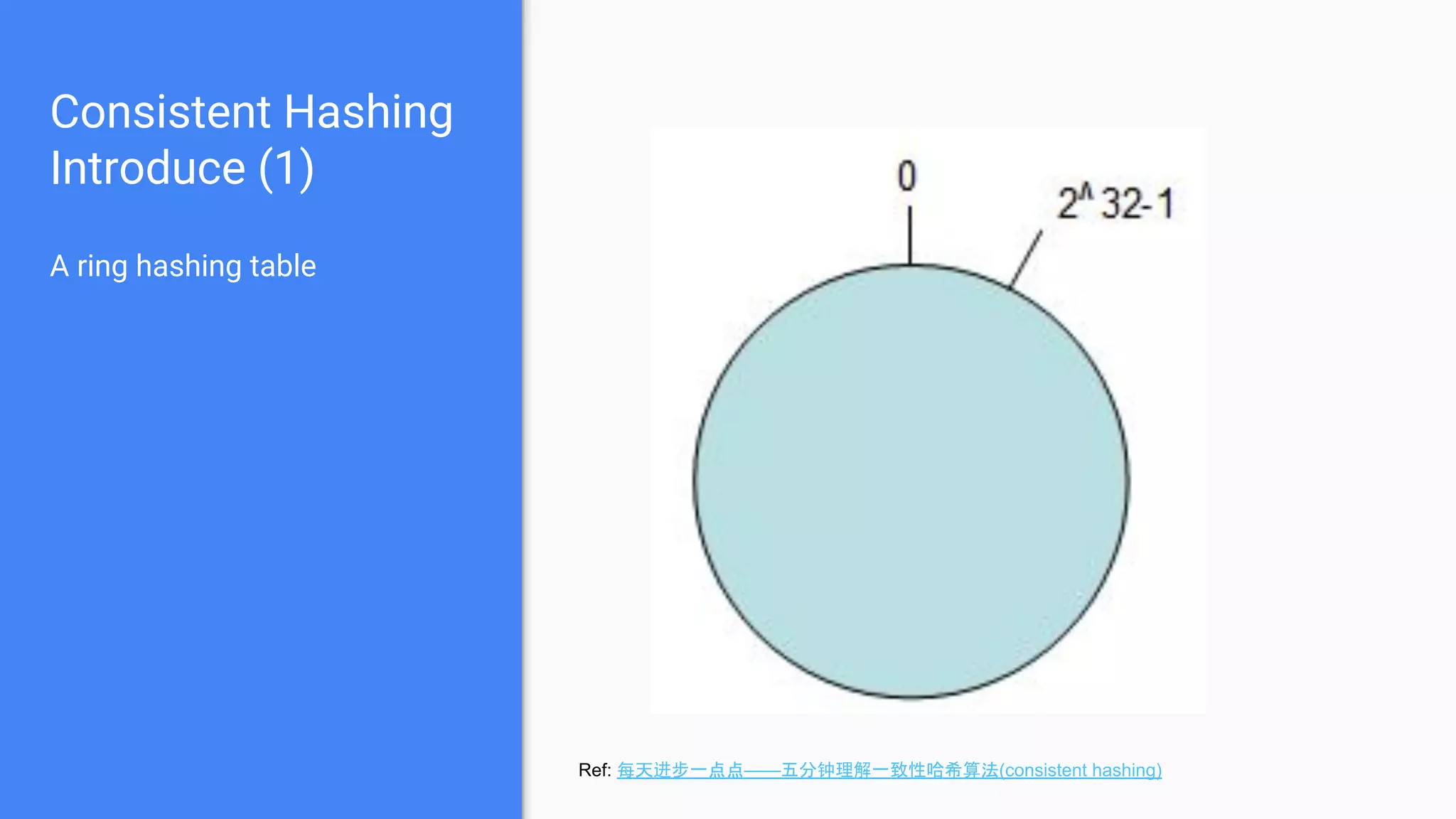
● A ring hashing table
● “N” not represent
servers, it represent all
hasing table slots.
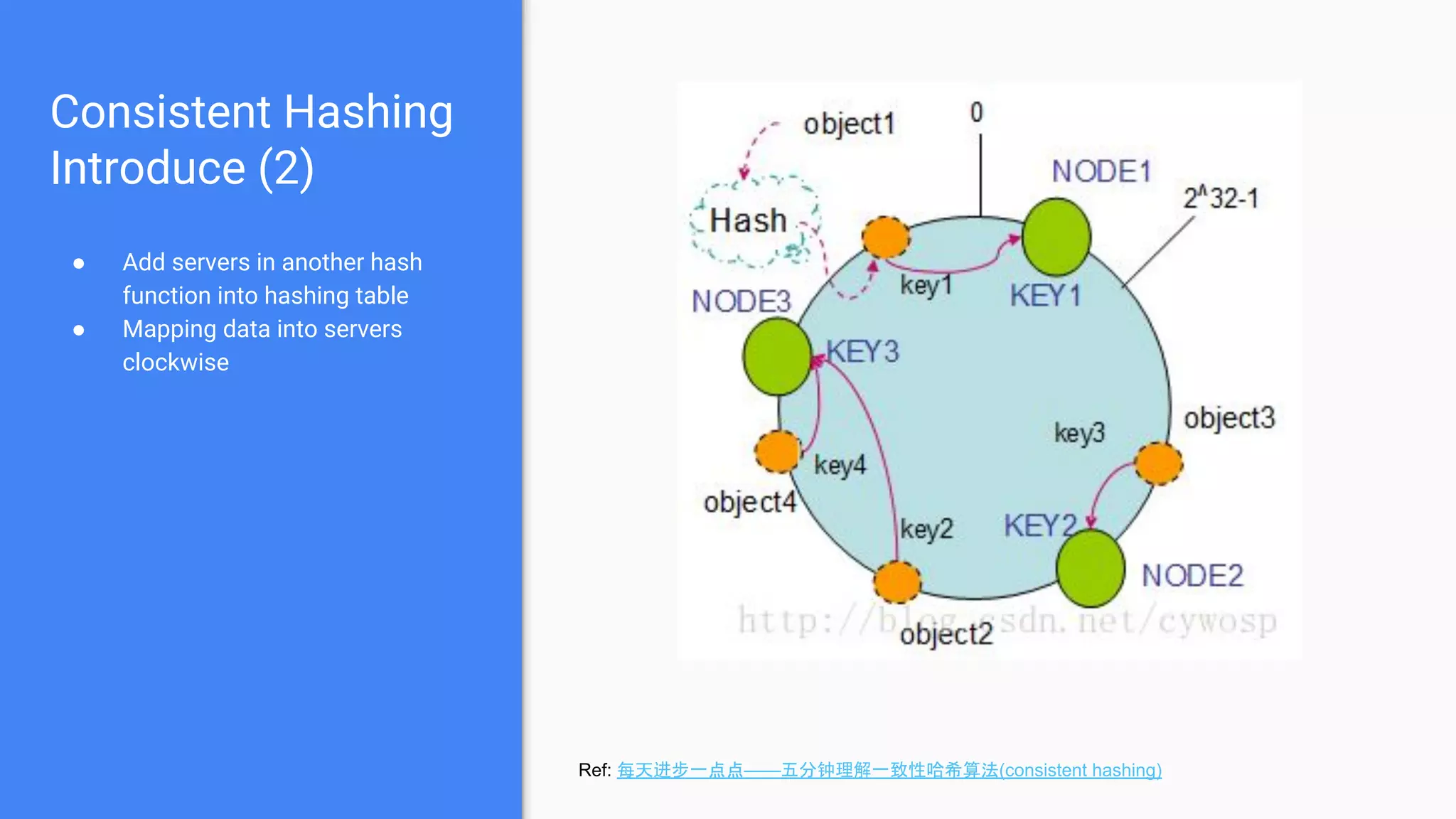
● Two hash functions:
one for data another
one for servers
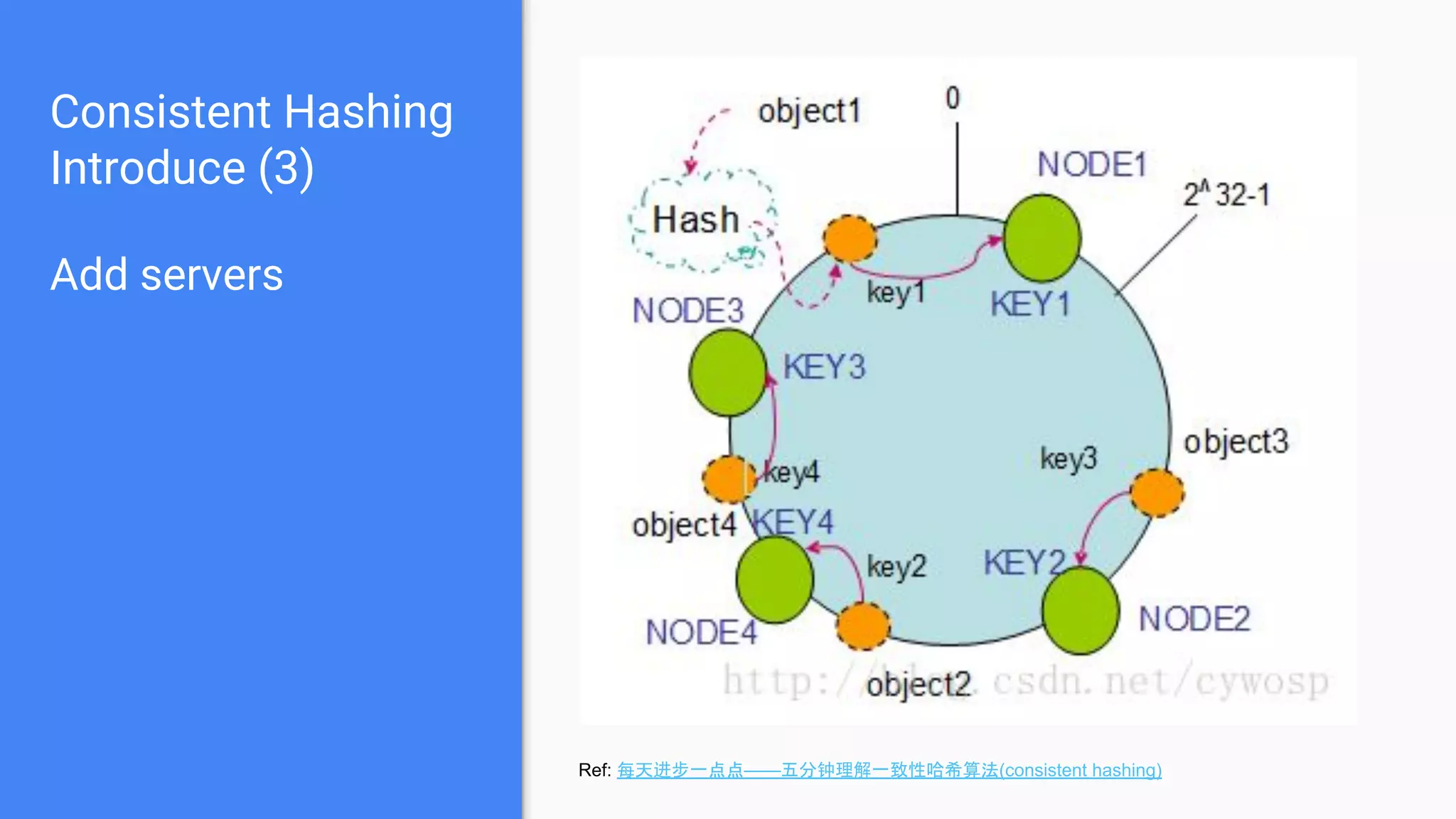
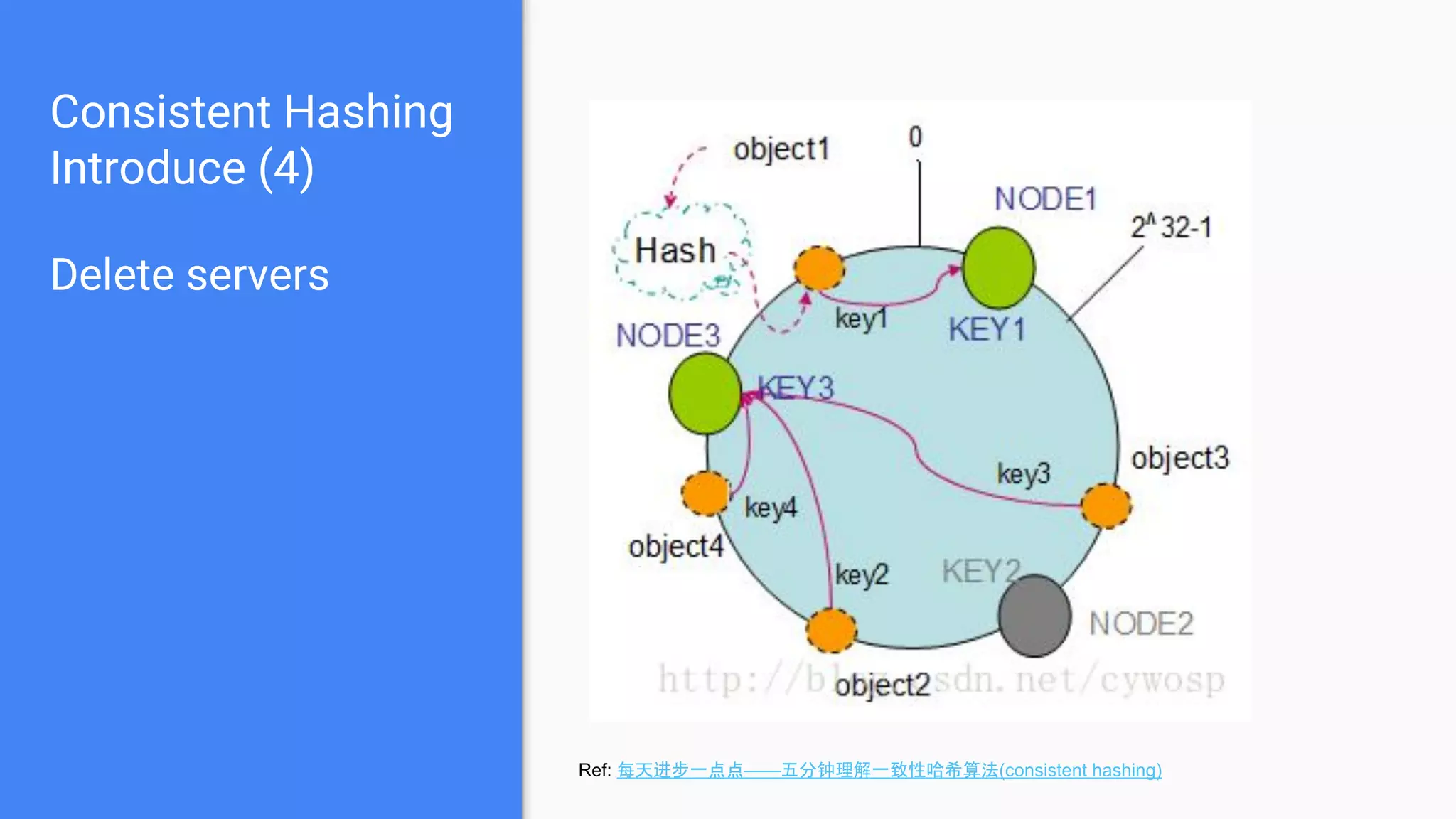
● Support add/remove
servers and only impact
necessary servers
Paper: Consistent Hashing and Random Trees: Distributed Caching Protocols for Relieving Hot Spots on the World Wide Web
Consistent Hashing
Introduce (1)
A ring hashing table
Ref: 每天进步一点点——五分钟理解一致性哈希算法(consistent hashing)
Consistent Hashing
Introduce (2)
● Add servers in another hash
function into hashing table
● Mapping data into servers
clockwise
Ref: 每天进步一点点——五分钟理解一致性哈希算法(consistent hashing)
Consistent Hashing
Introduce (3)
Add servers
Ref: 每天进步一点点——五分钟理解一致性哈希算法(consistent hashing)
Consistent Hashing
Introduce (4)
Delete servers
Ref: 每天进步一点点——五分钟理解一致性哈希算法(consistent hashing)
Consistent Hashing
Introduce (5)
● Virtual Nodes
○ Make more server
replica address in
hashing talbe
○ Usually use “server1-1”,
“server1-2” …
○ More virtual nodes
means load balance
but waste address
● This reduces the load
variance among servers
Ref: 每天进步一点点——五分钟理解一致性哈希算法(consistent hashing)
Examples of use
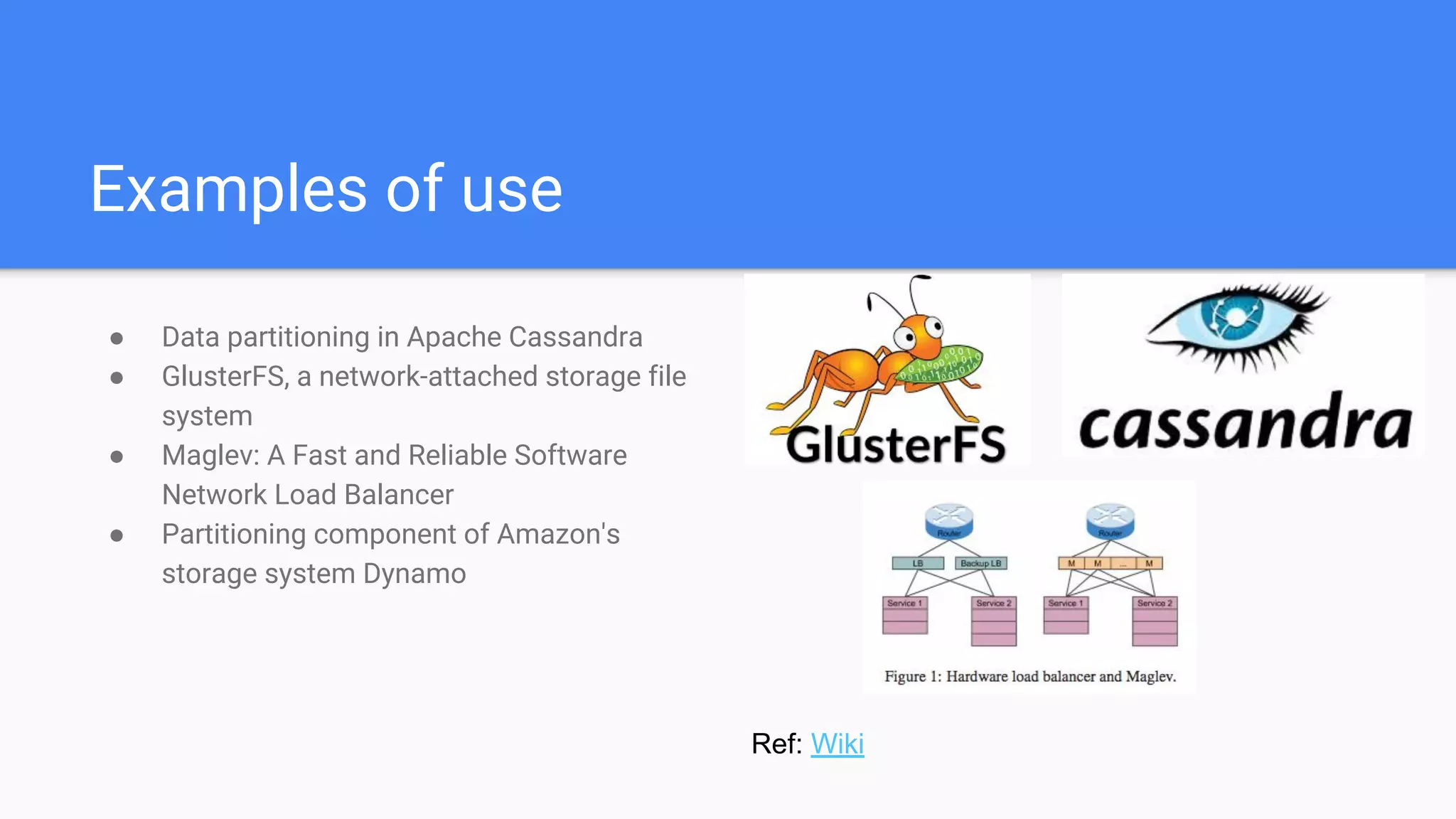
● Data partitioning in Apache Cassandra
● GlusterFS, a network-attached storage file
system
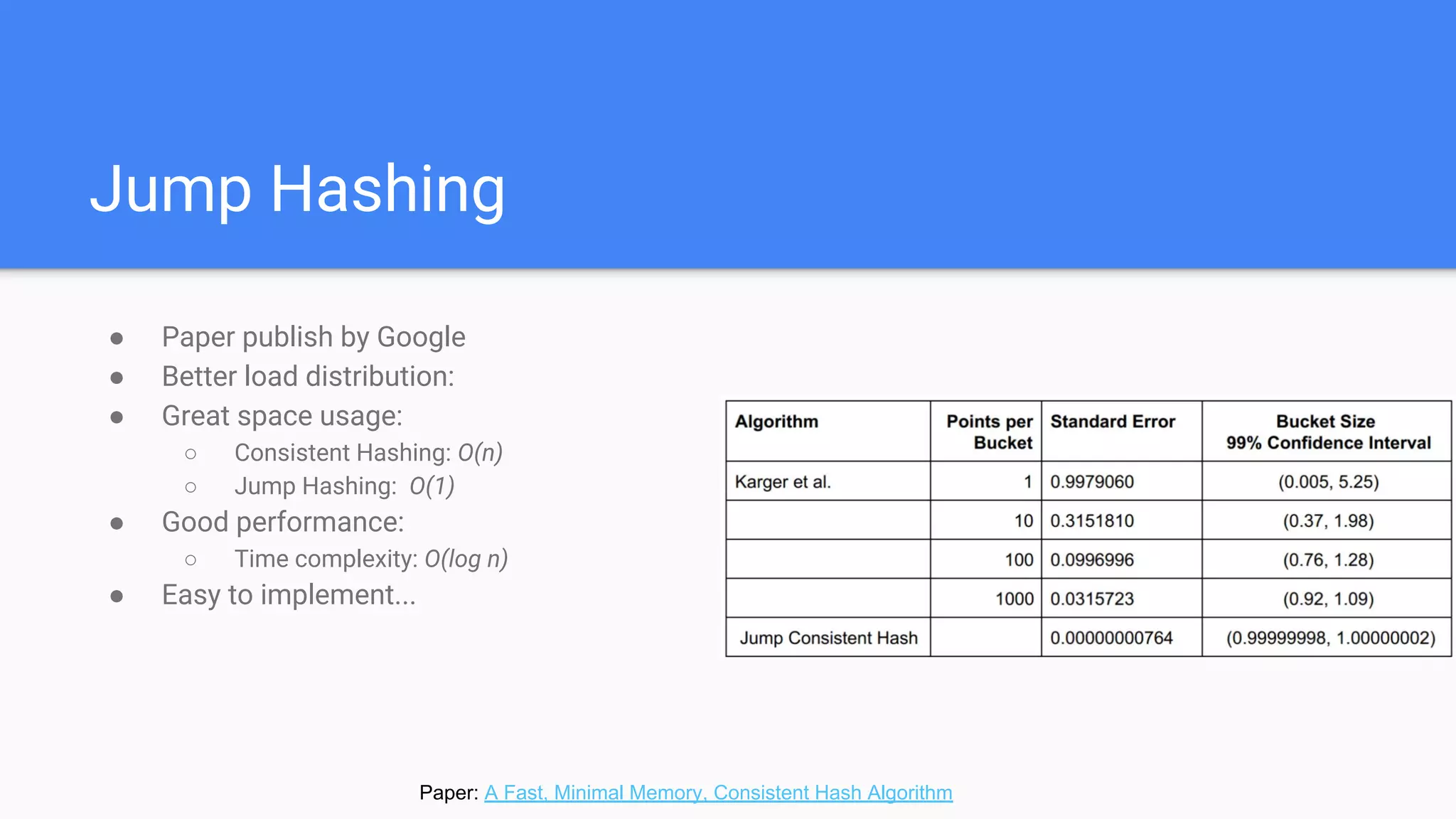
● Maglev: A Fast and Reliable Software
Network Load Balancer
● Partitioning component of Amazon's
storage system Dynamo
Ref: Wiki
Are we done?
● Load Distribution across the nodes can still be uneven
○ With 100 replicas (“vnodes”) per server, the standard deviation of load is about 10%.
○ The 99% confidence interval for bucket sizes is 0.76 to 1.28 of the average load (i.e., total
keys / number of servers).
● Space Cost
○ For 1000 nodes, this is 4MB of data, with O(log n) searches (for n=1e6) all of which are
processor cache misses even with nothing else competing for the cache.
Jump Hashing
● Paper publish by Google
● Better load distribution:
● Great space usage:
○ Consistent Hashing: O(n)
○ Jump Hashing: O(1)
● Good performance:
○ Time complexity: O(log n)
● Easy to implement...
Paper: A Fast, Minimal Memory, Consistent Hash Algorithm
Jump Hashing implementation code
magic number
Ref: Consistent Hashing: Algorithmic Tradeoffs Google 提出的 Jump Consistent Hash
The time complexity of the algorithm is
determined by the number of iterations
of the while loop. [...] So the expected
number of iterations is less than ln(n) +
1.
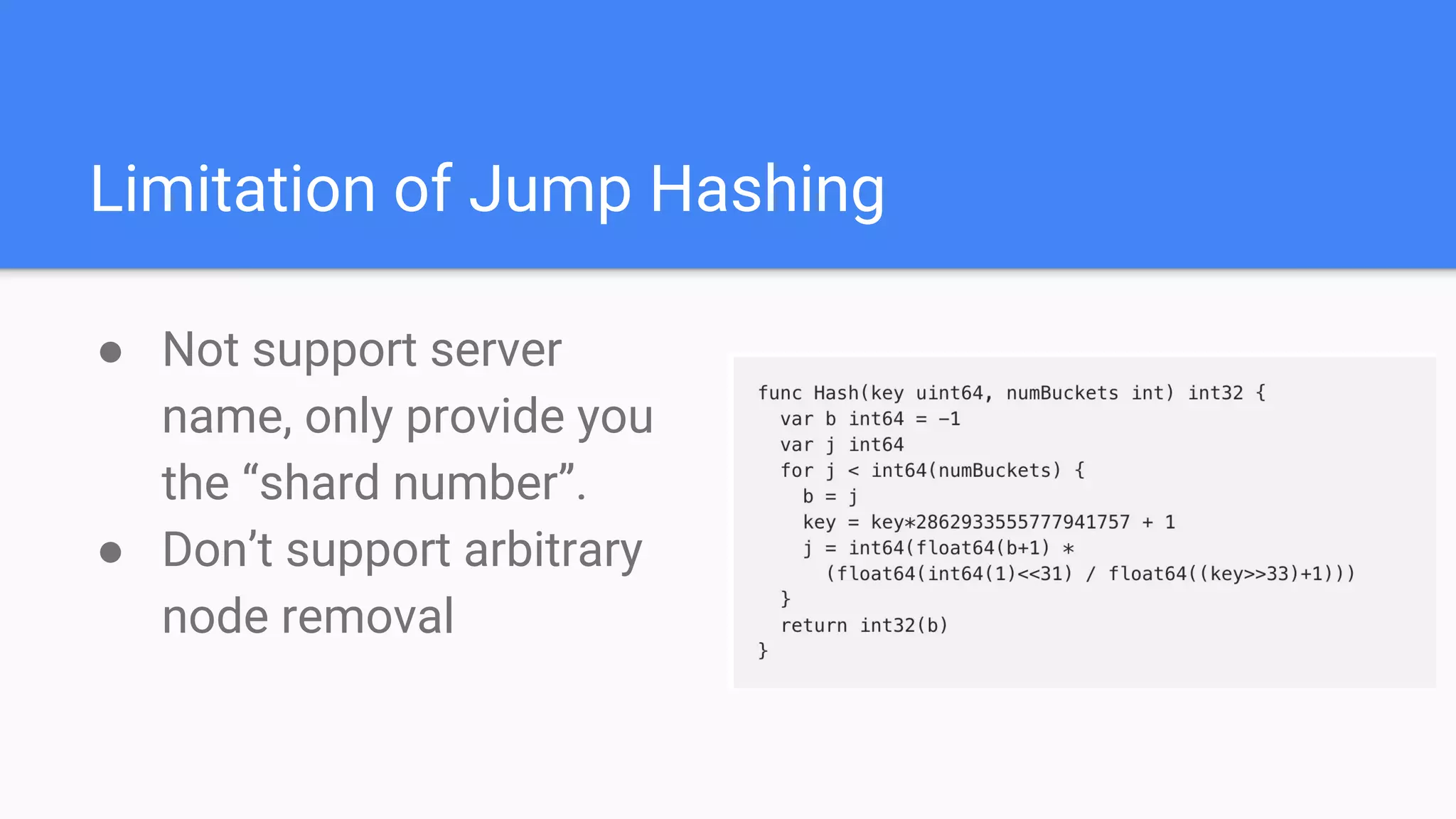
Limitation of Jump Hashing
● Not support server
name, only provide you
the “shard number”.
● Don’t support arbitrary
node removal
Why Is This Still a Research Topic?
● Ring Hashing:
○ Arbitrary bucket addition and removal
○ High memory usage
● Jump Hashing:
○ Eeffectively perfect load splitting
○ Reduced flexibility
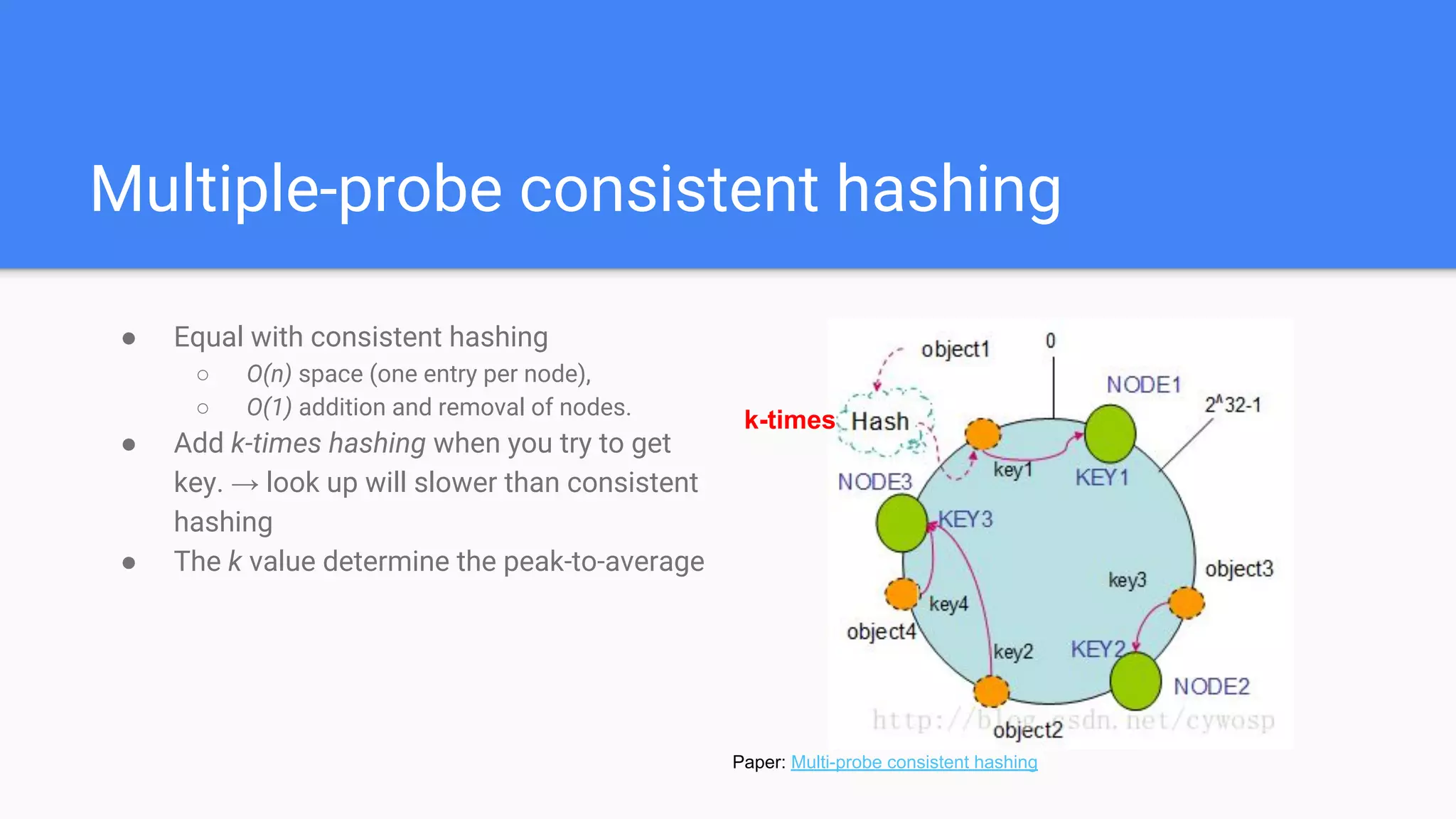
Multiple-probe consistent hashing
● Equal with consistent hashing
○ O(n) space (one entry per node),
○ O(1) addition and removal of nodes.
● Add k-times hashing when you try to get
key. → look up will slower than consistent
hashing
● The k value determine the peak-to-average
Paper: Multi-probe consistent hashing
k-times
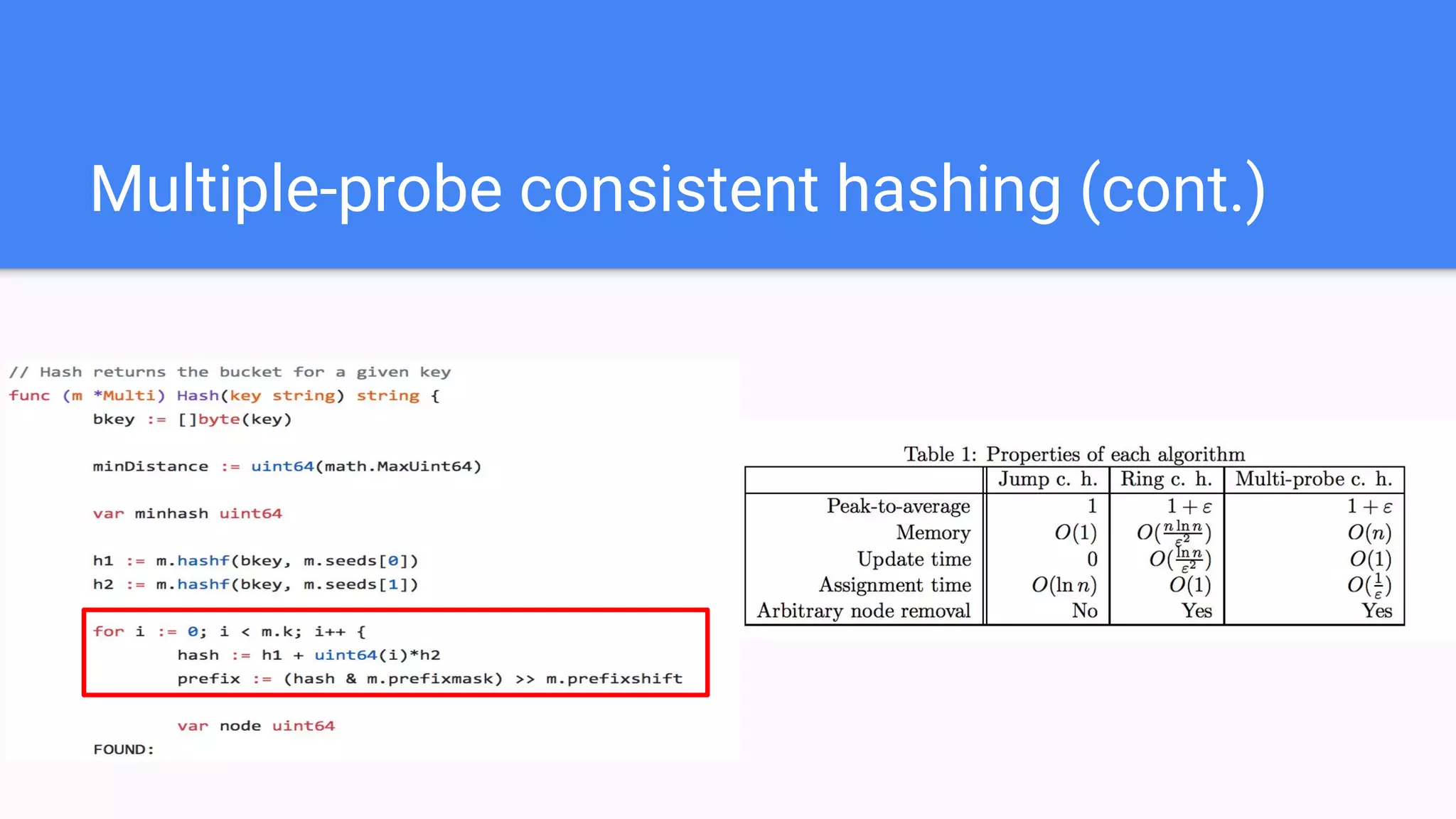
Multiple-probe consistent hashing (cont.)
Another approach:
Rendezvous Hashing
● Hash the node and the key together and
use the node that provides the highest
hash value.
● Lookup cost will raise to O(n)
● Because the inner loop doesn’t cost a lot,
so if the number of node is not big we
could consider using this hashing.
Paper: Rendezvous Hashing
Google:
Maglev Hashing
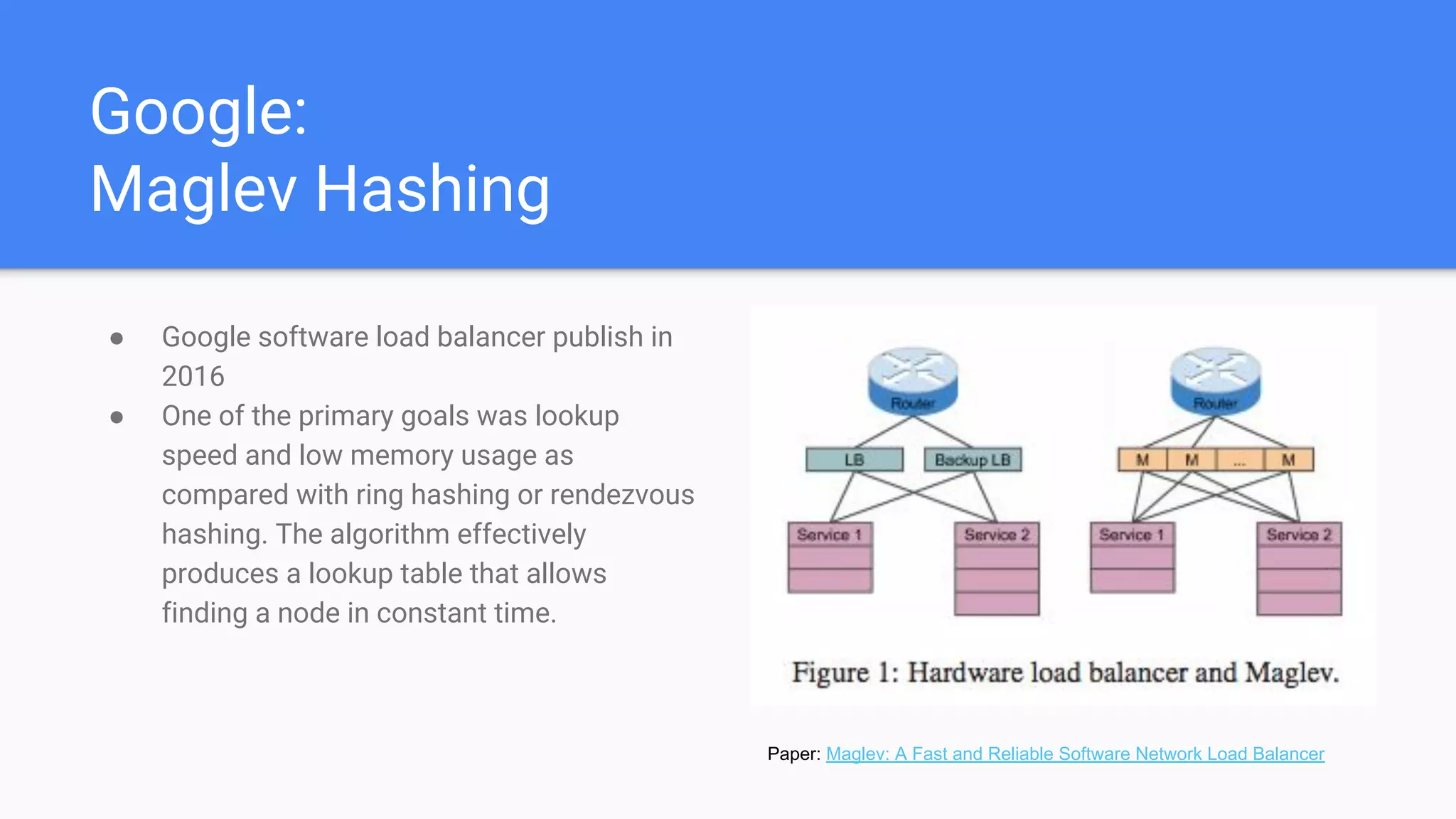
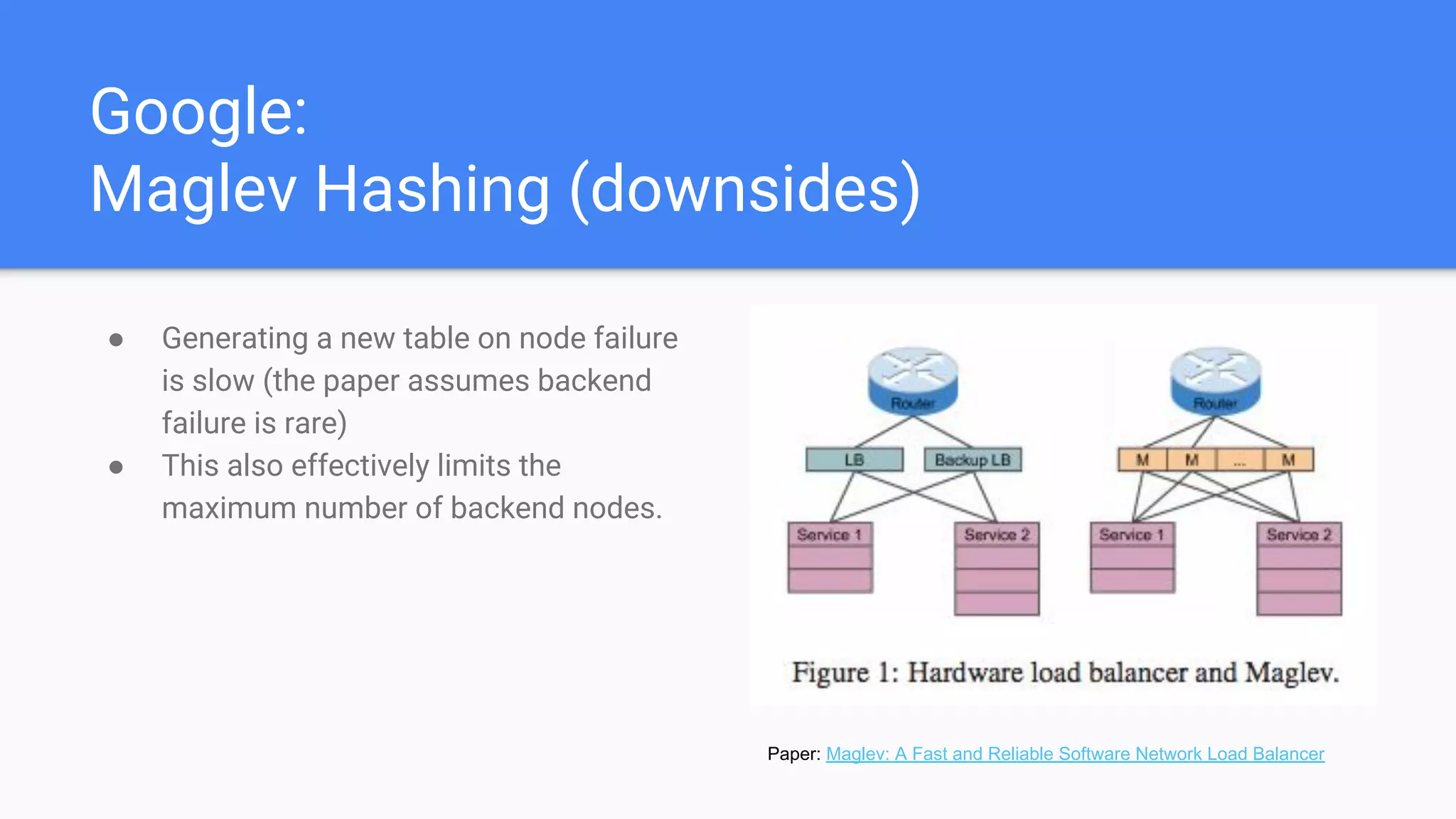
● Google software load balancer publish in
2016
● One of the primary goals was lookup
speed and low memory usage as
compared with ring hashing or rendezvous
hashing. The algorithm effectively
produces a lookup table that allows
finding a node in constant time.
Paper: Maglev: A Fast and Reliable Software Network Load Balancer
Google:
Maglev Hashing (downsides)
● Generating a new table on node failure
is slow (the paper assumes backend
failure is rare)
● This also effectively limits the
maximum number of backend nodes.
Paper: Maglev: A Fast and Reliable Software Network Load Balancer
Google:
Maglev Hashing
Paper: Maglev: A Fast and Reliable Software Network Load Balancer
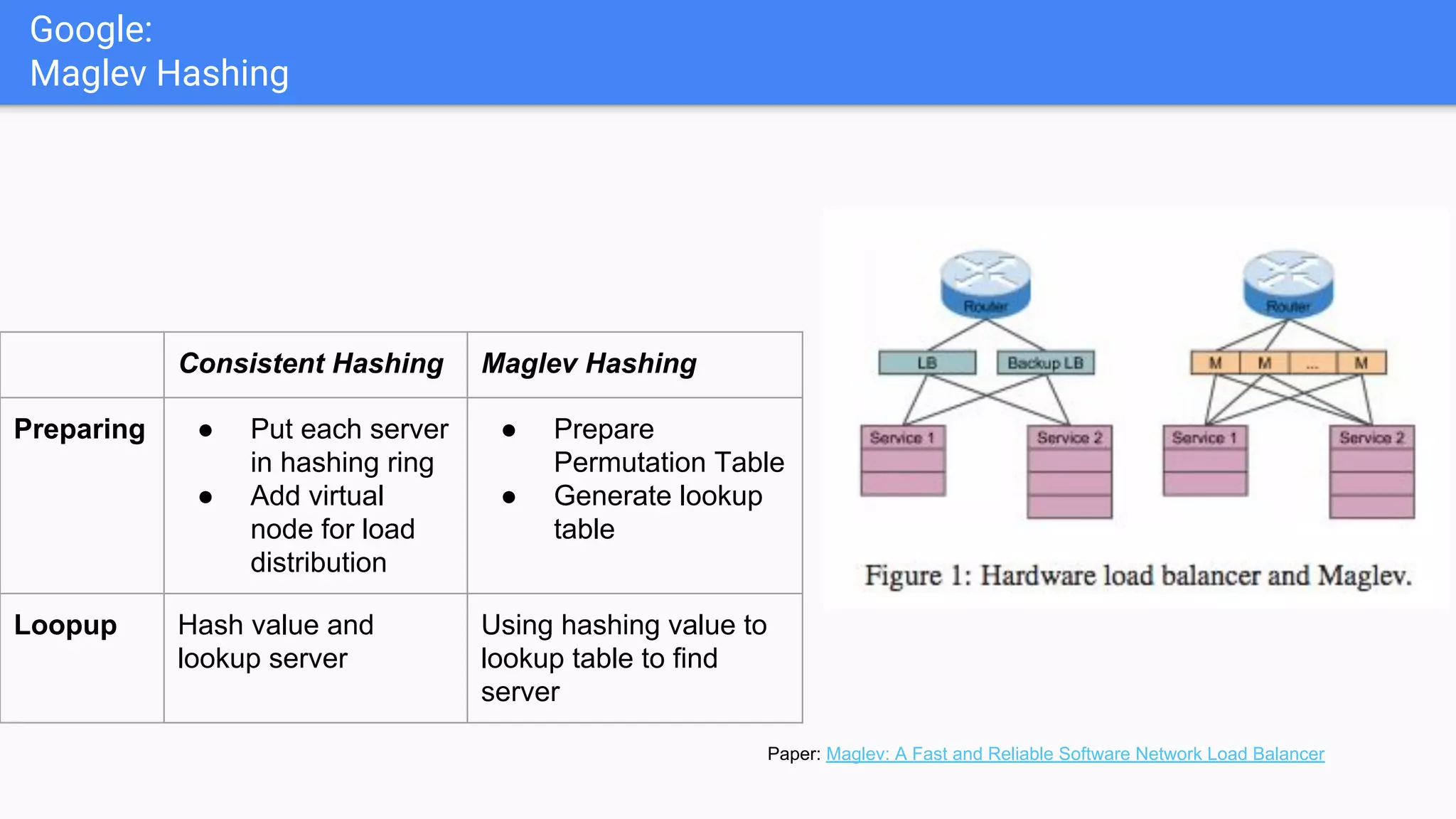
Consistent Hashing Maglev Hashing
Preparing ● Put each server
in hashing ring
● Add virtual
node for load
distribution
● Prepare
Permutation Table
● Generate lookup
table
Loopup Hash value and
lookup server
Using hashing value to
lookup table to find
server
Consistent Hashing with bounded load
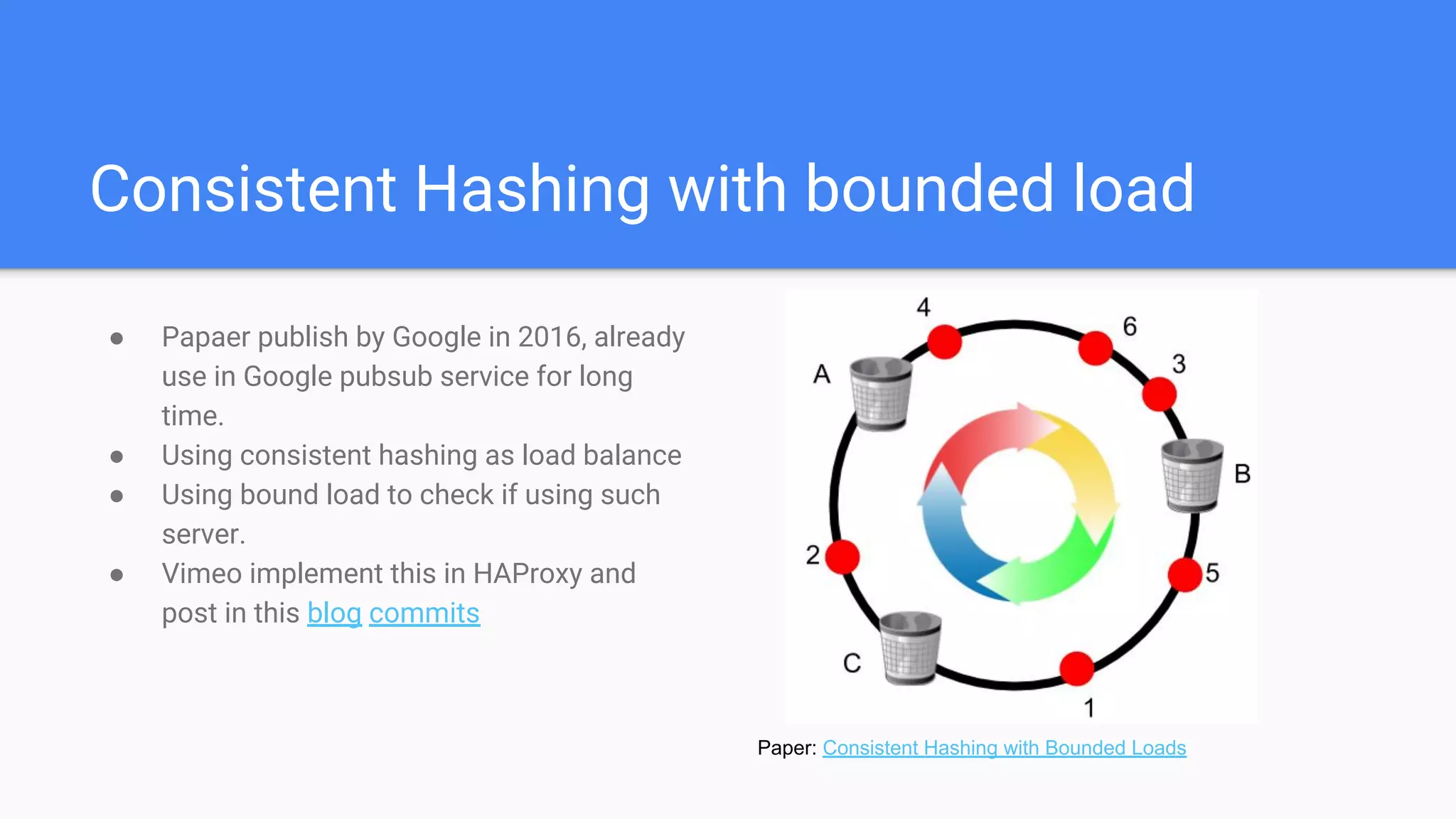
● Papaer publish by Google in 2016, already
use in Google pubsub service for long
time.
● Using consistent hashing as load balance
● Using bound load to check if using such
server.
● Vimeo implement this in HAProxy and
post in this blog commits
Paper: Consistent Hashing with Bounded Loads
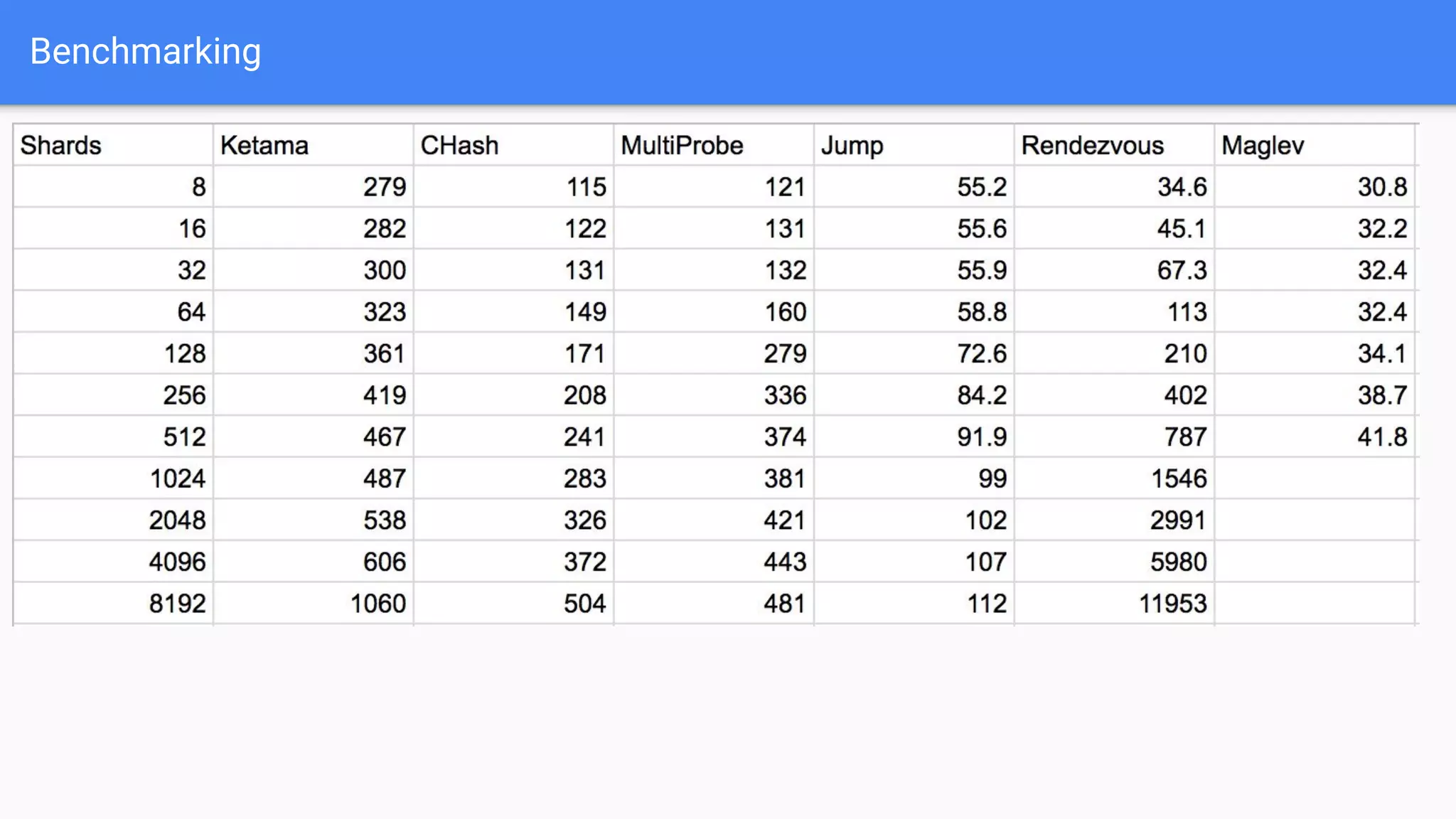
Benchmarking
Conclusion
● No perfect consistent hashing algorithm
● They have their tradeoffs
○ balance distribution,
○ memory usage,
○ lookup time
○ construction time (including node addition and removal cost).
Q&A

Consistent hashing algorithmic tradeoffs

  • 1.
  • 2.
    This slide is inspiredby Consistent Hashing: Algorithmic Tradeoffs by Damian Gryski
  • 3.
    Agenda ● Original problems ●Mod-N Hashing ● Consistent Hashing ● Jump Hashing ● Maglev Hashing ● Consistent Hashing with bounded load ● Benchmarks ● Conclusion
  • 4.
    Problems ● Some keysand values ● Need a way to store those key-value ● Distributed caching usage ● Don’t want a global directory
  • 5.
    Mod-N Hashing ● Pros: ○Quick ( O(n) for read ) ○ Easy to implement ● Cons: ○ Hard not add/remove value might need reconstruct whole hashing table
  • 6.
    Mod-N Hashing: Problems ●Hard to add new server: a. e.g. N = 9 → N = 10 ● Also, hard to remove original server a. e.g. N= 9 → N = 8 ● We need a better way to add/remove servers and make it change as less as possible..
  • 7.
    Consistent Hashing ● A ringhashing table ● “N” not represent servers, it represent all hasing table slots. ● Two hash functions: one for data another one for servers ● Support add/remove servers and only impact necessary servers Paper: Consistent Hashing and Random Trees: Distributed Caching Protocols for Relieving Hot Spots on the World Wide Web
  • 8.
    Consistent Hashing Introduce (1) Aring hashing table Ref: 每天进步一点点——五分钟理解一致性哈希算法(consistent hashing)
  • 9.
    Consistent Hashing Introduce (2) ●Add servers in another hash function into hashing table ● Mapping data into servers clockwise Ref: 每天进步一点点——五分钟理解一致性哈希算法(consistent hashing)
  • 10.
    Consistent Hashing Introduce (3) Addservers Ref: 每天进步一点点——五分钟理解一致性哈希算法(consistent hashing)
  • 11.
    Consistent Hashing Introduce (4) Deleteservers Ref: 每天进步一点点——五分钟理解一致性哈希算法(consistent hashing)
  • 12.
    Consistent Hashing Introduce (5) ●Virtual Nodes ○ Make more server replica address in hashing talbe ○ Usually use “server1-1”, “server1-2” … ○ More virtual nodes means load balance but waste address ● This reduces the load variance among servers Ref: 每天进步一点点——五分钟理解一致性哈希算法(consistent hashing)
  • 13.
    Examples of use ●Data partitioning in Apache Cassandra ● GlusterFS, a network-attached storage file system ● Maglev: A Fast and Reliable Software Network Load Balancer ● Partitioning component of Amazon's storage system Dynamo Ref: Wiki
  • 14.
    Are we done? ●Load Distribution across the nodes can still be uneven ○ With 100 replicas (“vnodes”) per server, the standard deviation of load is about 10%. ○ The 99% confidence interval for bucket sizes is 0.76 to 1.28 of the average load (i.e., total keys / number of servers). ● Space Cost ○ For 1000 nodes, this is 4MB of data, with O(log n) searches (for n=1e6) all of which are processor cache misses even with nothing else competing for the cache.
  • 15.
    Jump Hashing ● Paperpublish by Google ● Better load distribution: ● Great space usage: ○ Consistent Hashing: O(n) ○ Jump Hashing: O(1) ● Good performance: ○ Time complexity: O(log n) ● Easy to implement... Paper: A Fast, Minimal Memory, Consistent Hash Algorithm
  • 16.
    Jump Hashing implementationcode magic number Ref: Consistent Hashing: Algorithmic Tradeoffs Google 提出的 Jump Consistent Hash The time complexity of the algorithm is determined by the number of iterations of the while loop. [...] So the expected number of iterations is less than ln(n) + 1.
  • 17.
    Limitation of JumpHashing ● Not support server name, only provide you the “shard number”. ● Don’t support arbitrary node removal
  • 18.
    Why Is ThisStill a Research Topic? ● Ring Hashing: ○ Arbitrary bucket addition and removal ○ High memory usage ● Jump Hashing: ○ Eeffectively perfect load splitting ○ Reduced flexibility
  • 19.
    Multiple-probe consistent hashing ●Equal with consistent hashing ○ O(n) space (one entry per node), ○ O(1) addition and removal of nodes. ● Add k-times hashing when you try to get key. → look up will slower than consistent hashing ● The k value determine the peak-to-average Paper: Multi-probe consistent hashing k-times
  • 20.
  • 21.
    Another approach: Rendezvous Hashing ●Hash the node and the key together and use the node that provides the highest hash value. ● Lookup cost will raise to O(n) ● Because the inner loop doesn’t cost a lot, so if the number of node is not big we could consider using this hashing. Paper: Rendezvous Hashing
  • 22.
    Google: Maglev Hashing ● Googlesoftware load balancer publish in 2016 ● One of the primary goals was lookup speed and low memory usage as compared with ring hashing or rendezvous hashing. The algorithm effectively produces a lookup table that allows finding a node in constant time. Paper: Maglev: A Fast and Reliable Software Network Load Balancer
  • 23.
    Google: Maglev Hashing (downsides) ●Generating a new table on node failure is slow (the paper assumes backend failure is rare) ● This also effectively limits the maximum number of backend nodes. Paper: Maglev: A Fast and Reliable Software Network Load Balancer
  • 24.
    Google: Maglev Hashing Paper: Maglev:A Fast and Reliable Software Network Load Balancer Consistent Hashing Maglev Hashing Preparing ● Put each server in hashing ring ● Add virtual node for load distribution ● Prepare Permutation Table ● Generate lookup table Loopup Hash value and lookup server Using hashing value to lookup table to find server
  • 25.
    Consistent Hashing withbounded load ● Papaer publish by Google in 2016, already use in Google pubsub service for long time. ● Using consistent hashing as load balance ● Using bound load to check if using such server. ● Vimeo implement this in HAProxy and post in this blog commits Paper: Consistent Hashing with Bounded Loads
  • 26.
  • 27.
    Conclusion ● No perfectconsistent hashing algorithm ● They have their tradeoffs ○ balance distribution, ○ memory usage, ○ lookup time ○ construction time (including node addition and removal cost).
  • 28.