

Pulumi
Modern Infrastructure as Code. Open source,
any cloud, any language.
What is Pulumi?
Pulumi is an open source infrastructure as code tool for creating, deploying, and
managing cloud infrastructure. Pulumi works with traditional infrastructure like VMs,
networks, and databases, in addition to modern architectures, including containers,
Kubernetes clusters, and serverless functions.
Pulumi enables developers to write code in their favorite language, such as
TypeScript, JavaScript, Python, Go and .NET (C#, F#, VB). This enables modern
approaches to cloud applications and infrastructure without needing to learn yet-
another YAML or DSL dialect. This unlocks abstractions and reuse as well as access to
your favorite IDEs, refactoring, and testing tools. Master one toolchain and set of
frameworks, and go to any cloud — AWS, Azure, GCP, or Kubernetes — with ease.
Who Develops It?
Pulumi is developed by venture backed startup in Seattle whose mission is to enable
every person to harness the power of the cloud. First preview release was in 2018 and
v1.0 was debuted only in September of 2019.
Pulumi founder and CEO is Joe Duffy, who has
extensive open-source experience (he built the team at
Microsoft that took .NET open source), so it’s no surprise
that Pulumi, too, has a number of open-source
components.
The service has the backing of Madrona Venture
Group and Tola Capital, with Madrona’s S. Somasegar
joining its board of directors.
How Pulumi Works?
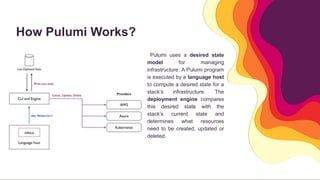
Pulumi uses a desired state
model for managing
infrastructure. A Pulumi program
is executed by a language host
to compute a desired state for a
stack’s infrastructure. The
deployment engine compares
this desired state with the
stack’s current state and
determines what resources
need to be created, updated or
deleted.
Pulumi Program Structure
 Pulumi programs are structured as projects and stacks. The distinction between
them is:

 Program: a collection of files written in your chosen programming language
 Project: a directory containing a program, with metadata, so Pulumi knows how
to run it
 Stack: an instance of your project, each often corresponding to a different cloud
environment
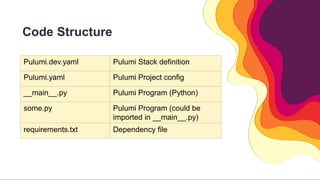
Code Structure
Pulumi.dev.yaml Pulumi Stack definition
Pulumi.yaml Pulumi Project config
__main__.py Pulumi Program (Python)
some.py Pulumi Program (could be
imported in __main__.py)
requirements.txt Dependency file
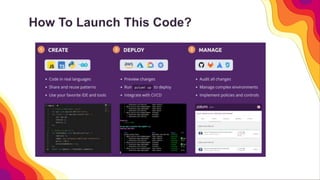
How To Launch This Code?
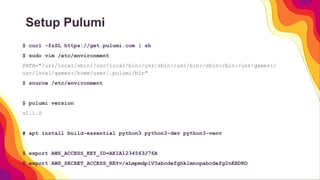
Setup Pulumi
$ curl -fsSL https://get.pulumi.com | sh
$ sudo vim /etc/environment
PATH="/usr/local/sbin:/usr/local/bin:/usr/sbin:/usr/bin:/sbin:/bin:/usr/games:/
usr/local/games:/home/user/.pulumi/bin"
$ source /etc/environment
$ pulumi version
v2.1.0
# apt install build-essential python3 python3-dev python3-venv
$ export AWS_ACCESS_KEY_ID=AKIA1234563J76A
$ export AWS_SECRET_ACCESS_KEY=/xLmpmdp1V3abcdefghklmnopabcdefg2nKRDKO
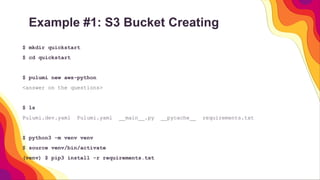
Example #1: S3 Bucket Creating
$ mkdir quickstart
$ cd quickstart
$ pulumi new aws-python
<answer on the questions>
$ ls
Pulumi.dev.yaml Pulumi.yaml __main__.py __pycache__ requirements.txt
$ python3 -m venv venv
$ source venv/bin/activate
(venv) $ pip3 install -r requirements.txt
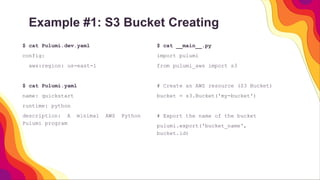
Example #1: S3 Bucket Creating
$ cat __main__.py
import pulumi
from pulumi_aws import s3
# Create an AWS resource (S3 Bucket)
bucket = s3.Bucket('my-bucket')
# Export the name of the bucket
pulumi.export('bucket_name',
bucket.id)
$ cat Pulumi.dev.yaml
config:
aws:region: us-east-1
$ cat Pulumi.yaml
name: quickstart
runtime: python
description: A minimal AWS Python
Pulumi program
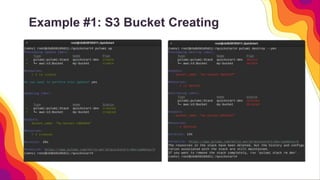
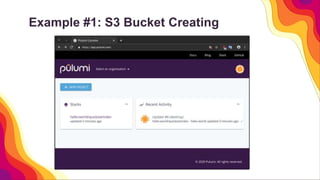
Example #1: S3 Bucket Creating
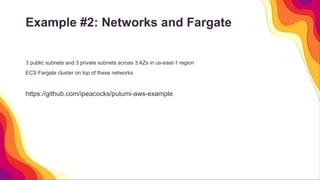
Example #2: Networks and Fargate
3 public subnets and 3 private subnets across 3 AZs in us-east-1 region
ECS Fargate cluster on top of these networks
https://github.com/ipeacocks/pulumi-aws-example
I like it. When to migrate?
It’s really quite promising product and I wish it good luck…but take into consideration next
facts:
* it’s very young product: first public version was presented in 2018 only!
* not enough documentation. Good examples your can find in GitHub repositories but
very often on JavaScript/TypeScript only. It’s really hard to find how to use Pulumi or how
to organize code/dir structure with it.
* no locks with 3rd-party storage for states. Those locks which help you to avoid running
the same code at the same time. But maybe it’s not a huge problem because it’s a general
purpose language and you can use mature libraries for doing that by yourself.
* as Pulumi uses general purpose languages your teammates could create a real
monster even worse than with Terraform! So you definitely need to have rules how code
needs to look in your team.
* your team needs to know any normal language and its structures. But its learning
definitely worth time investment.
Example #2: Networks and Fargate
https://medium.com/@_ipeacocks/pulumi-vpc-and-fargate-configuration-fd60f1b053ea
https://www.pulumi.com/docs/get-started/aws/install-pulumi/
https://www.reddit.com/r/devops/comments/bcdwsn/pulumi/
https://www.pulumi.com/docs/intro/concepts/programming-model/
https://techcrunch.com/2018/06/18/pulumi-wants-to-let-you-manage-your-infrastructure-with-code/
http://joeduffyblog.com/2018/06/18/hello-pulumi/
https://thenewstack.io/pulumi-uses-real-programming-languages-to-enforce-cloud-best-practices/
https://medium.com/@kscloud/how-to-program-infrastructure-with-pulumi-part-1-a47d5edb913f
https://medium.com/@kscloud/how-to-program-infrastructure-with-pulumi-part-2-3d7d64e69146
https://itnext.io/infrastructure-as-code-using-pulumi-to-provision-and-bootstrap-a-gcp-instance-318f06c61a03
Thank you!
Any Questions?

Pulumi. Modern Infrastructure as Code.

  • 1.
    Pulumi Modern Infrastructure asCode. Open source, any cloud, any language.
  • 2.
    What is Pulumi? Pulumiis an open source infrastructure as code tool for creating, deploying, and managing cloud infrastructure. Pulumi works with traditional infrastructure like VMs, networks, and databases, in addition to modern architectures, including containers, Kubernetes clusters, and serverless functions. Pulumi enables developers to write code in their favorite language, such as TypeScript, JavaScript, Python, Go and .NET (C#, F#, VB). This enables modern approaches to cloud applications and infrastructure without needing to learn yet- another YAML or DSL dialect. This unlocks abstractions and reuse as well as access to your favorite IDEs, refactoring, and testing tools. Master one toolchain and set of frameworks, and go to any cloud — AWS, Azure, GCP, or Kubernetes — with ease.
  • 3.
    Who Develops It? Pulumiis developed by venture backed startup in Seattle whose mission is to enable every person to harness the power of the cloud. First preview release was in 2018 and v1.0 was debuted only in September of 2019. Pulumi founder and CEO is Joe Duffy, who has extensive open-source experience (he built the team at Microsoft that took .NET open source), so it’s no surprise that Pulumi, too, has a number of open-source components. The service has the backing of Madrona Venture Group and Tola Capital, with Madrona’s S. Somasegar joining its board of directors.
  • 4.
    How Pulumi Works? Pulumiuses a desired state model for managing infrastructure. A Pulumi program is executed by a language host to compute a desired state for a stack’s infrastructure. The deployment engine compares this desired state with the stack’s current state and determines what resources need to be created, updated or deleted.
  • 5.
    Pulumi Program Structure Pulumi programs are structured as projects and stacks. The distinction between them is:   Program: a collection of files written in your chosen programming language  Project: a directory containing a program, with metadata, so Pulumi knows how to run it  Stack: an instance of your project, each often corresponding to a different cloud environment
  • 6.
    Code Structure Pulumi.dev.yaml PulumiStack definition Pulumi.yaml Pulumi Project config __main__.py Pulumi Program (Python) some.py Pulumi Program (could be imported in __main__.py) requirements.txt Dependency file
  • 7.
    How To LaunchThis Code?
  • 8.
    Setup Pulumi $ curl-fsSL https://get.pulumi.com | sh $ sudo vim /etc/environment PATH="/usr/local/sbin:/usr/local/bin:/usr/sbin:/usr/bin:/sbin:/bin:/usr/games:/ usr/local/games:/home/user/.pulumi/bin" $ source /etc/environment $ pulumi version v2.1.0 # apt install build-essential python3 python3-dev python3-venv $ export AWS_ACCESS_KEY_ID=AKIA1234563J76A $ export AWS_SECRET_ACCESS_KEY=/xLmpmdp1V3abcdefghklmnopabcdefg2nKRDKO
  • 9.
    Example #1: S3Bucket Creating $ mkdir quickstart $ cd quickstart $ pulumi new aws-python <answer on the questions> $ ls Pulumi.dev.yaml Pulumi.yaml __main__.py __pycache__ requirements.txt $ python3 -m venv venv $ source venv/bin/activate (venv) $ pip3 install -r requirements.txt
  • 10.
    Example #1: S3Bucket Creating $ cat __main__.py import pulumi from pulumi_aws import s3 # Create an AWS resource (S3 Bucket) bucket = s3.Bucket('my-bucket') # Export the name of the bucket pulumi.export('bucket_name', bucket.id) $ cat Pulumi.dev.yaml config: aws:region: us-east-1 $ cat Pulumi.yaml name: quickstart runtime: python description: A minimal AWS Python Pulumi program
  • 11.
    Example #1: S3Bucket Creating
  • 12.
    Example #1: S3Bucket Creating
  • 13.
    Example #2: Networksand Fargate 3 public subnets and 3 private subnets across 3 AZs in us-east-1 region ECS Fargate cluster on top of these networks https://github.com/ipeacocks/pulumi-aws-example
  • 14.
    I like it.When to migrate? It’s really quite promising product and I wish it good luck…but take into consideration next facts: * it’s very young product: first public version was presented in 2018 only! * not enough documentation. Good examples your can find in GitHub repositories but very often on JavaScript/TypeScript only. It’s really hard to find how to use Pulumi or how to organize code/dir structure with it. * no locks with 3rd-party storage for states. Those locks which help you to avoid running the same code at the same time. But maybe it’s not a huge problem because it’s a general purpose language and you can use mature libraries for doing that by yourself. * as Pulumi uses general purpose languages your teammates could create a real monster even worse than with Terraform! So you definitely need to have rules how code needs to look in your team. * your team needs to know any normal language and its structures. But its learning definitely worth time investment.
  • 15.
    Example #2: Networksand Fargate https://medium.com/@_ipeacocks/pulumi-vpc-and-fargate-configuration-fd60f1b053ea https://www.pulumi.com/docs/get-started/aws/install-pulumi/ https://www.reddit.com/r/devops/comments/bcdwsn/pulumi/ https://www.pulumi.com/docs/intro/concepts/programming-model/ https://techcrunch.com/2018/06/18/pulumi-wants-to-let-you-manage-your-infrastructure-with-code/ http://joeduffyblog.com/2018/06/18/hello-pulumi/ https://thenewstack.io/pulumi-uses-real-programming-languages-to-enforce-cloud-best-practices/ https://medium.com/@kscloud/how-to-program-infrastructure-with-pulumi-part-1-a47d5edb913f https://medium.com/@kscloud/how-to-program-infrastructure-with-pulumi-part-2-3d7d64e69146 https://itnext.io/infrastructure-as-code-using-pulumi-to-provision-and-bootstrap-a-gcp-instance-318f06c61a03
  • 16.