



Open source, high performance database


Data Distribution Theory

Will LaForest
Senior Director of 10gen Federal
will@10gen.com
@WLaForest


                                         1
• I will be talking about distributing data across
  machines connected by reliable network
• I will NOT be talking about on disk arrangements
  (well maybe a little)
• I will NOT be talking replication
   – This has some overlaps but in most respects can be
     considered orthogonally


• There is a ton of implementation minutia from
  technology to technology that I will try to avoid

                                                          2
• Need to scale for more
• Cost effective to scale horizontally by distributing
• Fundamentally limited by some resource
   –   Memory
   –   IO Capacity
   –   Disk
   –   CPU
• Lots of systems need to distribute
   –   Web servers/app servers
   –   File systems
   –   Databases
   –   Caches
                                                         3
• Its always been this way
   – From time to time people forget
        • Stateful MTS Objects
        • Stateful EJB

• Concurrent access of data not as simple
   – We will set aside fencing/locking for another day
• RDBMS not built for distributed computing
   –   Not surprising since theory was from 40 years ago
   –   Model works because joins fast
   –   BUT generically efficient distributed joins difficult
   –   Ditto for distributed transaction

                                                               4
• Given a data record what node do I store it on?
• Round robin/ ”random”
   –   Evenly distribute across set severs
   –   Doesn’t take into account rebalancing
   –   Expiring a lot of data? Not too bad (MVCC, expiring cache)
   –   MarkLogic
• Hash based (not talking the pipe)
   – Many search engines & caches
   – Amazon Dynamo (Cassandra*)
• Range based
   – BigTable (HBase)
   – MongoDB
                                                                    5
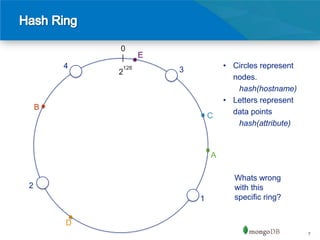
• Distribute on the hash of some attribute
• Simple way is hash(att) mod N
   – What happens when N changes (we add a node)?
• The industry standard is consistent hashing
• Pros
   – Evenly distributes across nodes
   – Avoid hot spots
   – Great for high write throughput
• Cons
   – No data locality
   – Scattered reads on each node
   – Scatter gather on all queries
                                                    6
0
            |     E
        4   128                   • Circles represent
            2         3
                                    nodes.
                                     hash(hostname)
                                  • Letters represent
    B
                              C     data points
                                     hash(attribute)


                              A

                                    Whats wrong
2                                   with this
                          1         specific ring?


        D
                                                        7
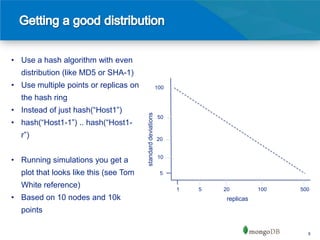
• Use a hash algorithm with even
  distribution (like MD5 or SHA-1)
• Use multiple points or replicas on                         100

  the hash ring
• Instead of just hash(“Host1”)


                                       standard deviations
                                                             50
• hash(“Host1-1”) .. hash(“Host1-
  r”)                                                        20


                                                             10
• Running simulations you get a
  plot that looks like this (see Tom                          5

  White reference)                                                 1   5   20          100   500
• Based on 10 nodes and 10k                                                 replicas
  points

                                                                                               8
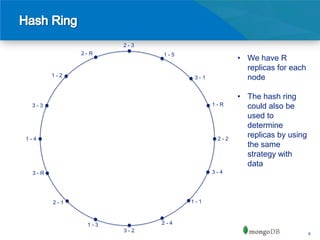
2-3
             2-R          1-5
                                              • We have R
                                                replicas for each
       1-2                       3-1            node

                                              • The hash ring
 3-3                                   1-R      could also be
                                                used to
                                                determine
1-4                                     2-2
                                                replicas by using
                                                the same
                                                strategy with
                                                data
 3-R                                   3-4


       2-1                      1-1


              1-3         2-4
                    3-2
                                                                    9
• Also known as sharding
• Distribute based upon an attribute (the key)
   – Or multiple keys (compound)
• Pros
   – Better for reads
   – Data locality so…
   – Querying/reads with shard attribute terms avoid scatter
   – Data can be arranged in contiguous blocks
   – If hash based indexing only allow for range queries on key


                                                                  10
• Cons
  – Requires more consideration a-priori
  – Pick the right shard key
  – Can develop hot spots
  – Leads to more data balancing activities
• Chunking can be done on many levels
  – BigTable breaks into tablets
  – MongoDB uses “chunks”


                                              11
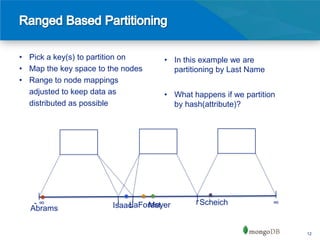
• Pick a key(s) to partition on    • In this example we are
• Map the key space to the nodes     partitioning by Last Name
• Range to node mappings
  adjusted to keep data as         • What happens if we partition
  distributed as possible            by hash(attribute)?


   -∞                   Isaacj
                          i LaForest
                                Meyer      r Scheich             ∞
  Abrams


                                                                     12
• Use a key with a high cardinality
   – Sufficient granularity to your “chunks”
• What are your write vs read requirements
• Read and query king?
   1. Shard key should be something most of your queries use
   2. Also something that distributes reads evenly (avoiding
      read hotspots)
   3. Reading scaling can sometimes be accommodated by
      replication
• Write throughput biggest concern?
   1. You may want to consider partitioning on hash
   2. Avoid hot spots
   3. What happens if shard on systematically increasing key?

                                                                13
• Consistent Hashing and Random Trees
  – One of the original papers on consistent hashing
• Tom White: Consistent Hashing
  – Great blog post on consistent hashing


                                                       14

Data Distribution Theory

  • 1.
    Open source, highperformance database Data Distribution Theory Will LaForest Senior Director of 10gen Federal will@10gen.com @WLaForest 1
  • 2.
    • I willbe talking about distributing data across machines connected by reliable network • I will NOT be talking about on disk arrangements (well maybe a little) • I will NOT be talking replication – This has some overlaps but in most respects can be considered orthogonally • There is a ton of implementation minutia from technology to technology that I will try to avoid 2
  • 3.
    • Need toscale for more • Cost effective to scale horizontally by distributing • Fundamentally limited by some resource – Memory – IO Capacity – Disk – CPU • Lots of systems need to distribute – Web servers/app servers – File systems – Databases – Caches 3
  • 4.
    • Its alwaysbeen this way – From time to time people forget • Stateful MTS Objects • Stateful EJB • Concurrent access of data not as simple – We will set aside fencing/locking for another day • RDBMS not built for distributed computing – Not surprising since theory was from 40 years ago – Model works because joins fast – BUT generically efficient distributed joins difficult – Ditto for distributed transaction 4
  • 5.
    • Given adata record what node do I store it on? • Round robin/ ”random” – Evenly distribute across set severs – Doesn’t take into account rebalancing – Expiring a lot of data? Not too bad (MVCC, expiring cache) – MarkLogic • Hash based (not talking the pipe) – Many search engines & caches – Amazon Dynamo (Cassandra*) • Range based – BigTable (HBase) – MongoDB 5
  • 6.
    • Distribute onthe hash of some attribute • Simple way is hash(att) mod N – What happens when N changes (we add a node)? • The industry standard is consistent hashing • Pros – Evenly distributes across nodes – Avoid hot spots – Great for high write throughput • Cons – No data locality – Scattered reads on each node – Scatter gather on all queries 6
  • 7.
    0 | E 4 128 • Circles represent 2 3 nodes. hash(hostname) • Letters represent B C data points hash(attribute) A Whats wrong 2 with this 1 specific ring? D 7
  • 8.
    • Use ahash algorithm with even distribution (like MD5 or SHA-1) • Use multiple points or replicas on 100 the hash ring • Instead of just hash(“Host1”) standard deviations 50 • hash(“Host1-1”) .. hash(“Host1- r”) 20 10 • Running simulations you get a plot that looks like this (see Tom 5 White reference) 1 5 20 100 500 • Based on 10 nodes and 10k replicas points 8
  • 9.
    2-3 2-R 1-5 • We have R replicas for each 1-2 3-1 node • The hash ring 3-3 1-R could also be used to determine 1-4 2-2 replicas by using the same strategy with data 3-R 3-4 2-1 1-1 1-3 2-4 3-2 9
  • 10.
    • Also knownas sharding • Distribute based upon an attribute (the key) – Or multiple keys (compound) • Pros – Better for reads – Data locality so… – Querying/reads with shard attribute terms avoid scatter – Data can be arranged in contiguous blocks – If hash based indexing only allow for range queries on key 10
  • 11.
    • Cons – Requires more consideration a-priori – Pick the right shard key – Can develop hot spots – Leads to more data balancing activities • Chunking can be done on many levels – BigTable breaks into tablets – MongoDB uses “chunks” 11
  • 12.
    • Pick akey(s) to partition on • In this example we are • Map the key space to the nodes partitioning by Last Name • Range to node mappings adjusted to keep data as • What happens if we partition distributed as possible by hash(attribute)? -∞ Isaacj i LaForest Meyer r Scheich ∞ Abrams 12
  • 13.
    • Use akey with a high cardinality – Sufficient granularity to your “chunks” • What are your write vs read requirements • Read and query king? 1. Shard key should be something most of your queries use 2. Also something that distributes reads evenly (avoiding read hotspots) 3. Reading scaling can sometimes be accommodated by replication • Write throughput biggest concern? 1. You may want to consider partitioning on hash 2. Avoid hot spots 3. What happens if shard on systematically increasing key? 13
  • 14.
    • Consistent Hashingand Random Trees – One of the original papers on consistent hashing • Tom White: Consistent Hashing – Great blog post on consistent hashing 14