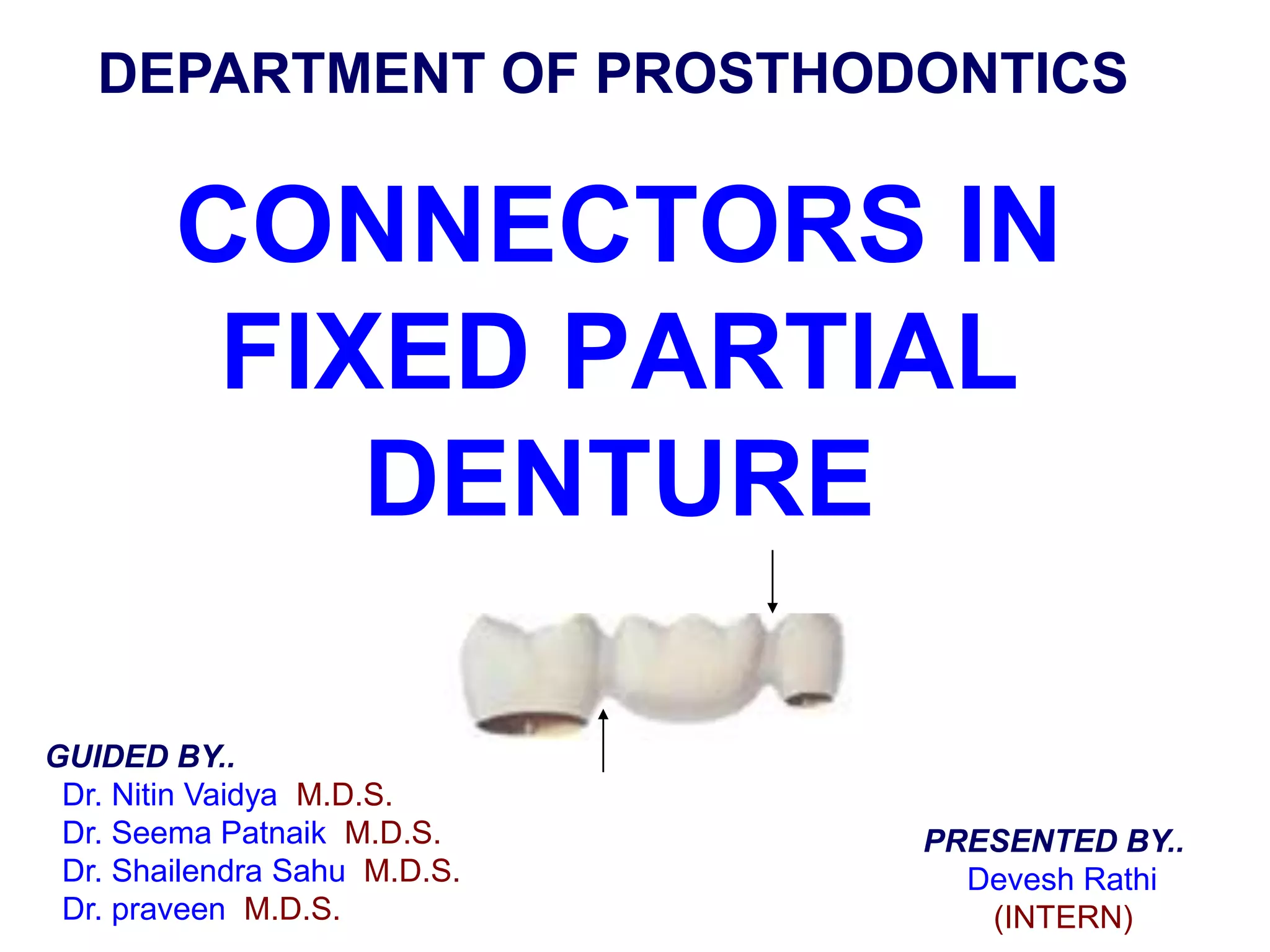
CONNECTORS IN
FIXED PARTIAL
DENTURE
GUIDED BY..
Dr. Nitin Vaidya M.D.S.
Dr. Seema Patnaik M.D.S.
Dr. Shailendra Sahu M.D.S.
Dr. praveen M.D.S.
PRESENTED BY..
Devesh Rathi
(INTERN)
DEPARTMENT OF PROSTHODONTICS
DEFINITION:-
“Connector is that part of a fixed partial denture or splint
that joins the individual retainer and pontic together.”
Types of connector:-
1) Rigid connector:- a cast, soldered, or
fused union between the retainer (s) and
pontic (s).
2) Nonrigid connector:-any connector that
permits limited movement between,
otherwise independent members of a fixed
dental prosthesis.
CONNECTOR DESIGN:-
SIZE:- Must be sufficiently large to prevent distortion
during function, but not too large; otherwise they will
interfere with effective plaque control.
2 X 3 mm (metal connector).
4 X 4 mm (all ceramic connector).
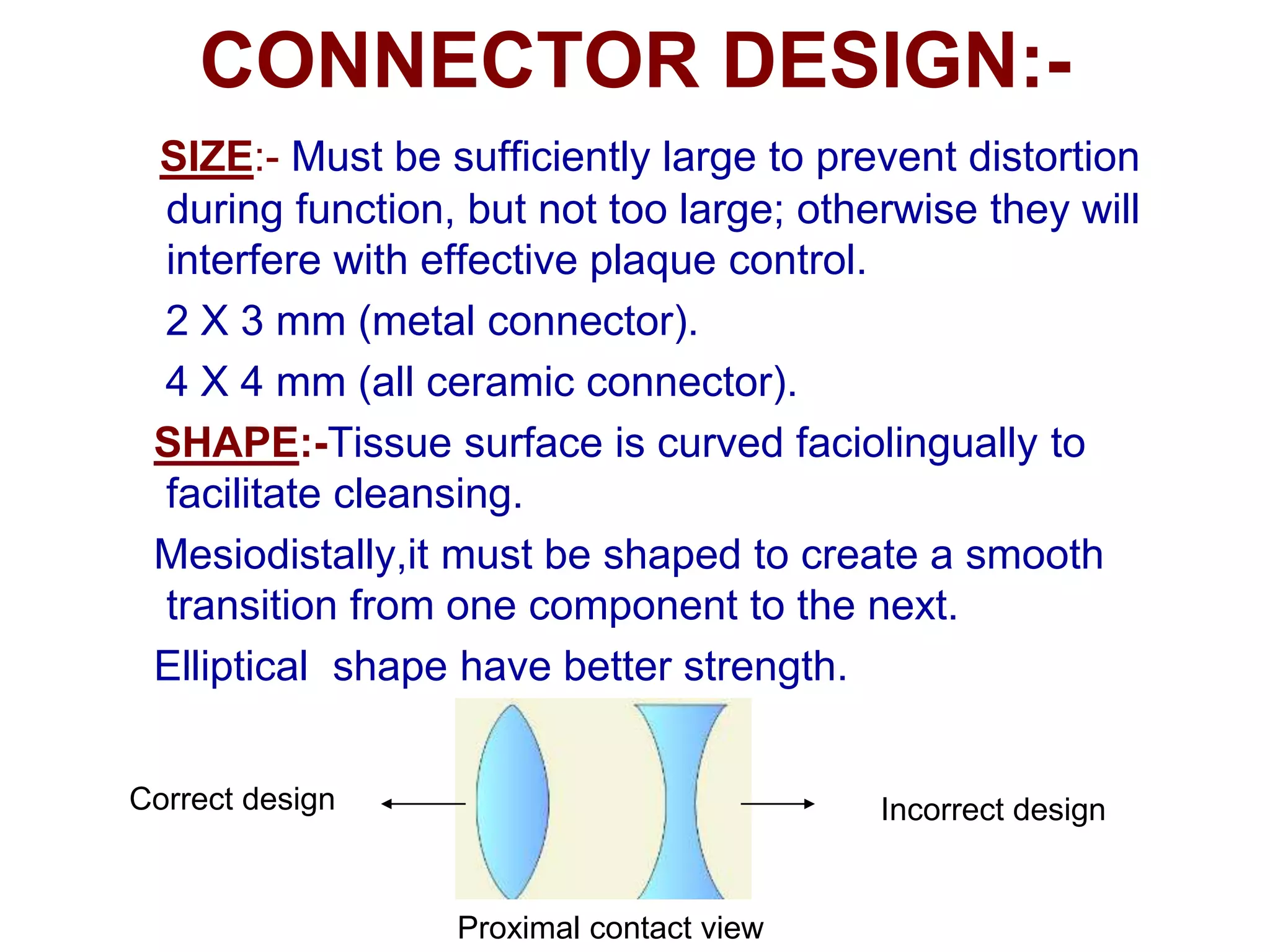
SHAPE:-Tissue surface is curved faciolingually to
facilitate cleansing.
Mesiodistally,it must be shaped to create a smooth
transition from one component to the next.
Elliptical shape have better strength.
Incorrect design
Correct design
Proximal contact view
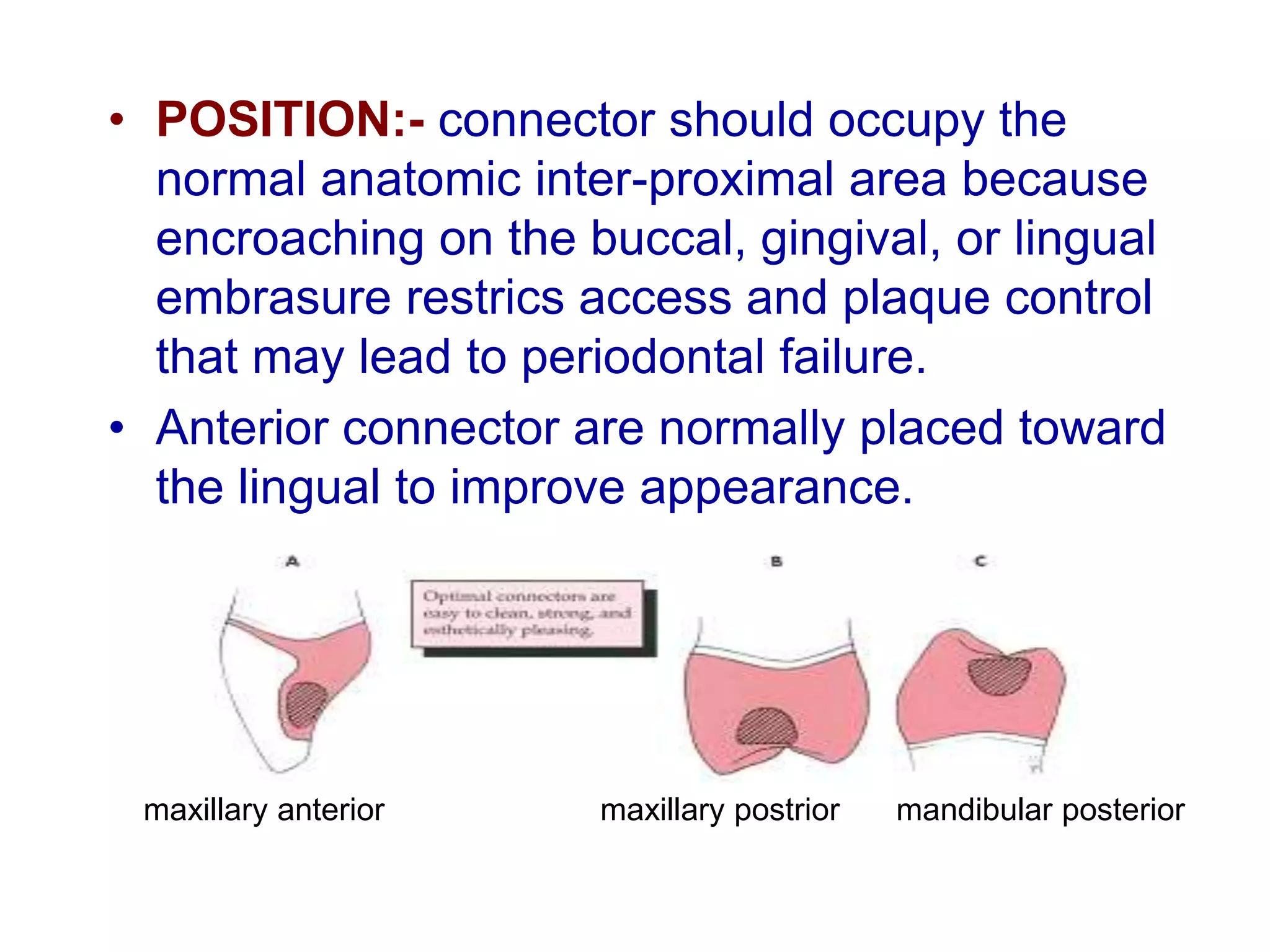
• POSITION:- connector should occupy the
normal anatomic inter-proximal area because
encroaching on the buccal, gingival, or lingual
embrasure restrics access and plaque control
that may lead to periodontal failure.
• Anterior connector are normally placed toward
the lingual to improve appearance.
maxillary anterior maxillary postrior mandibular posterior
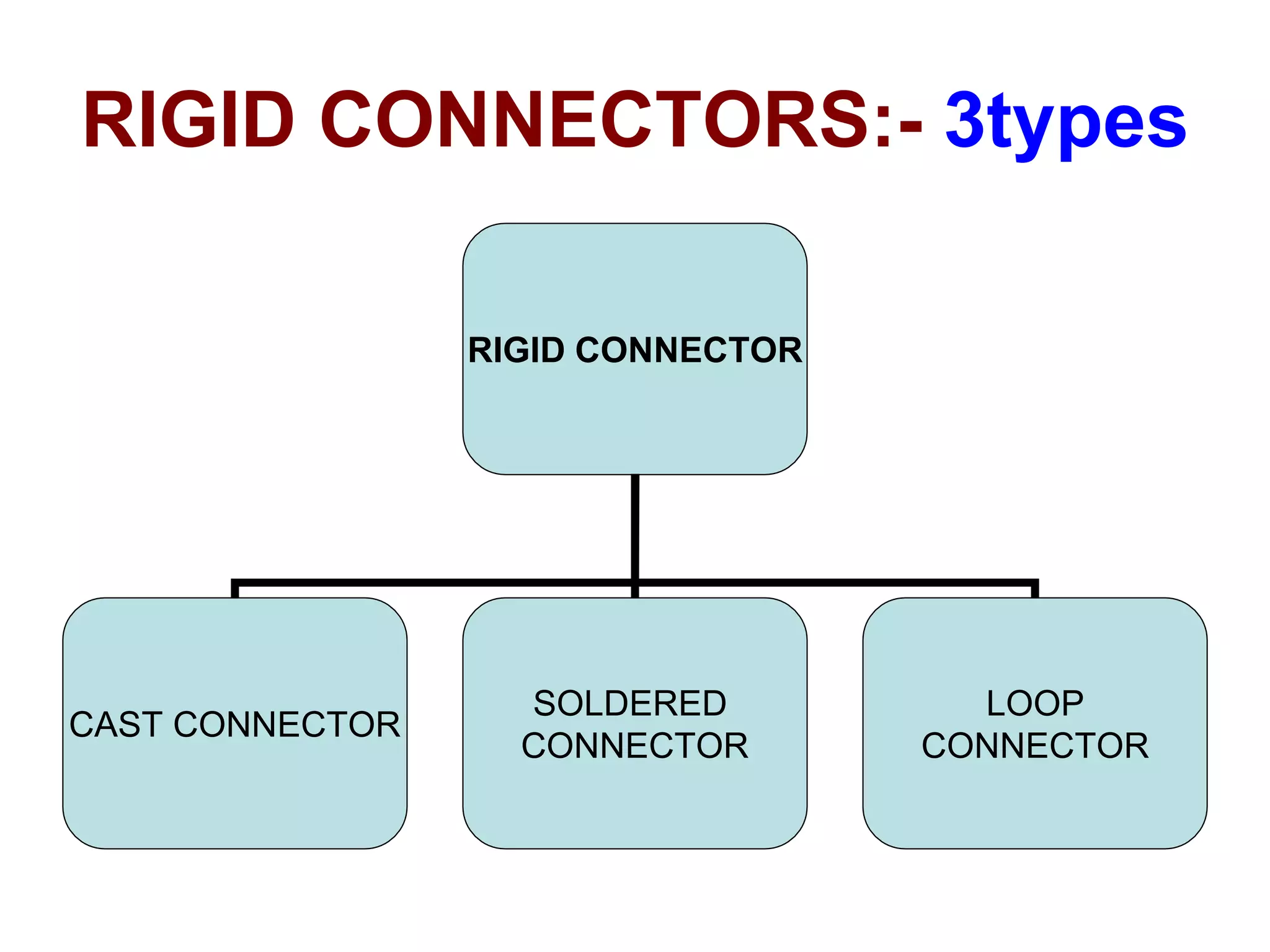
RIGID CONNECTORS:- 3types
RIGID CONNECTOR
CAST CONNECTOR
SOLDERED
CONNECTOR
LOOP
CONNECTOR
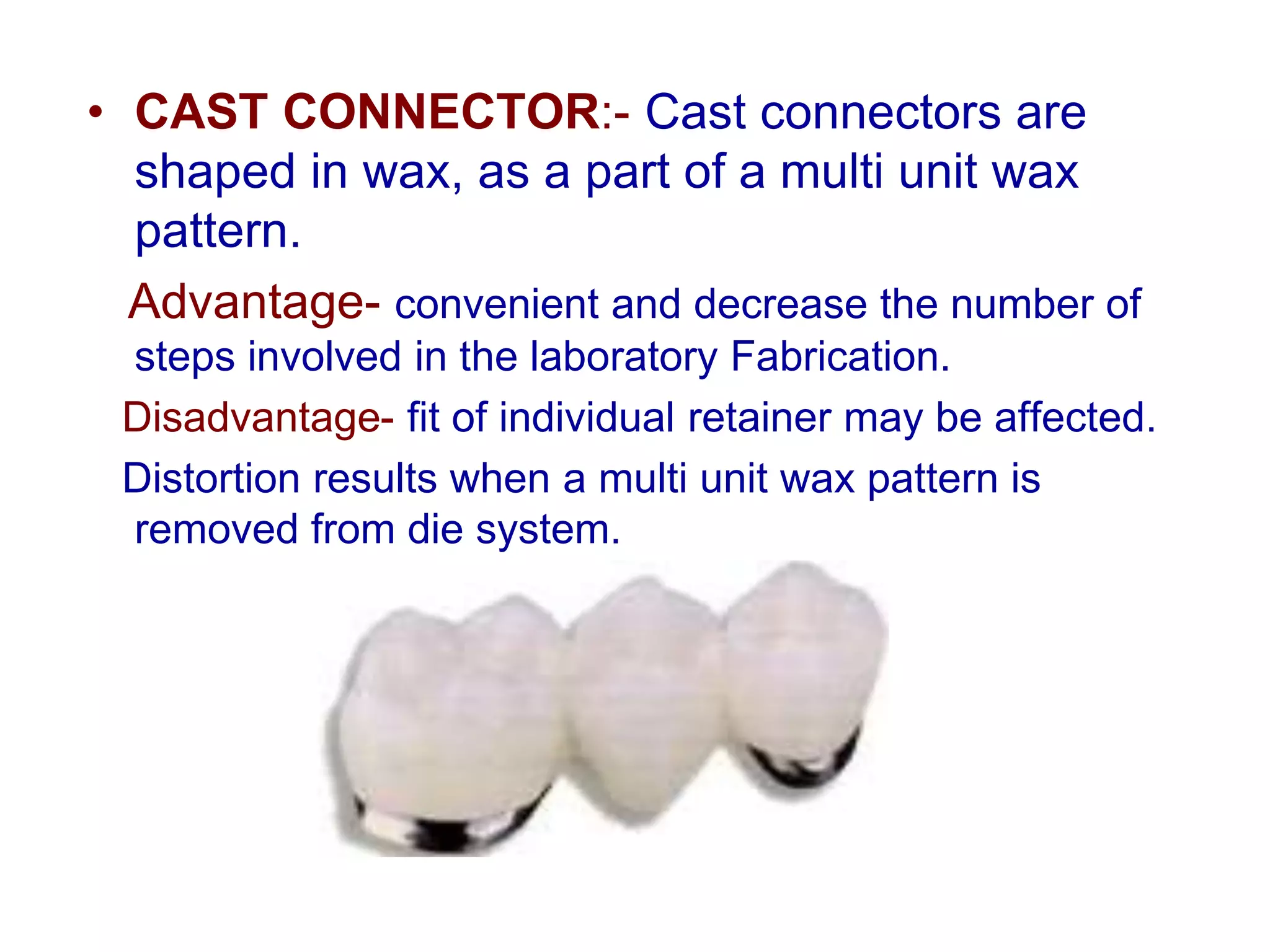
• CAST CONNECTOR:- Cast connectors are
shaped in wax, as a part of a multi unit wax
pattern.
Advantage- convenient and decrease the number of
steps involved in the laboratory Fabrication.
Disadvantage- fit of individual retainer may be affected.
Distortion results when a multi unit wax pattern is
removed from die system.
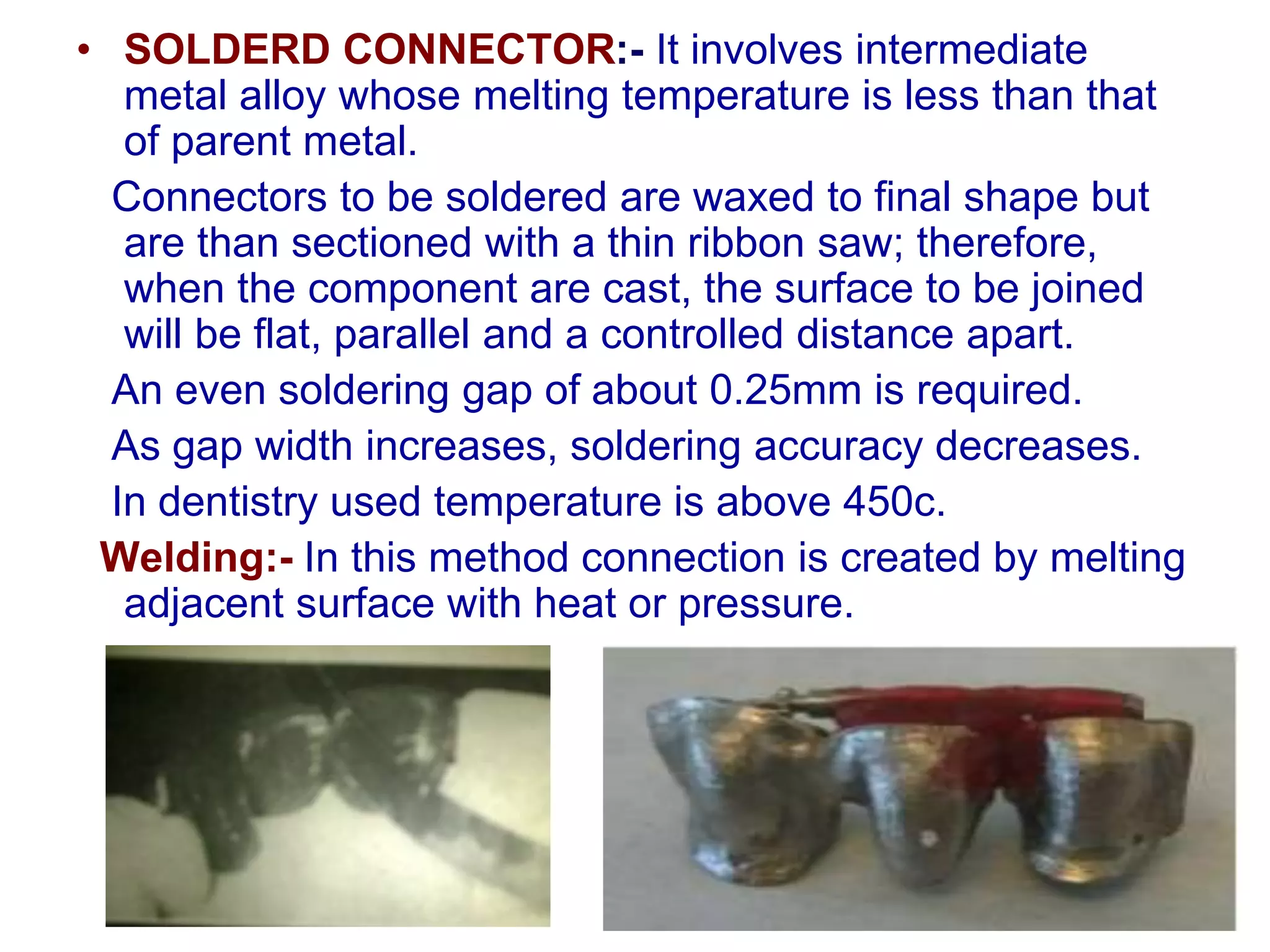
• SOLDERD CONNECTOR:- It involves intermediate
metal alloy whose melting temperature is less than that
of parent metal.
Connectors to be soldered are waxed to final shape but
are than sectioned with a thin ribbon saw; therefore,
when the component are cast, the surface to be joined
will be flat, parallel and a controlled distance apart.
An even soldering gap of about 0.25mm is required.
As gap width increases, soldering accuracy decreases.
In dentistry used temperature is above 450c.
Welding:- In this method connection is created by melting
adjacent surface with heat or pressure.
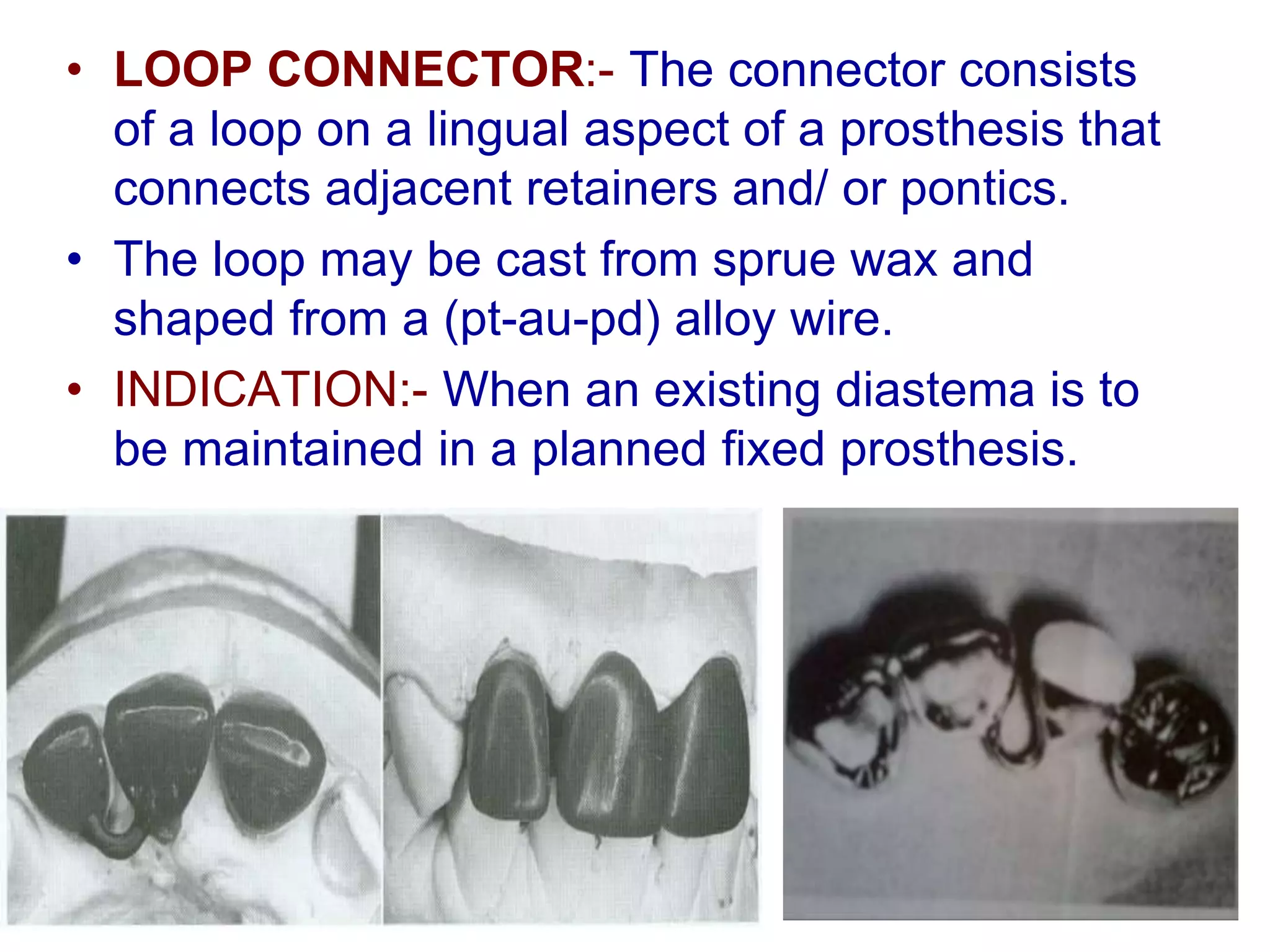
• LOOP CONNECTOR:- The connector consists
of a loop on a lingual aspect of a prosthesis that
connects adjacent retainers and/ or pontics.
• The loop may be cast from sprue wax and
shaped from a (pt-au-pd) alloy wire.
• INDICATION:- When an existing diastema is to
be maintained in a planned fixed prosthesis.
NON-RIGID CONNECTOR:-
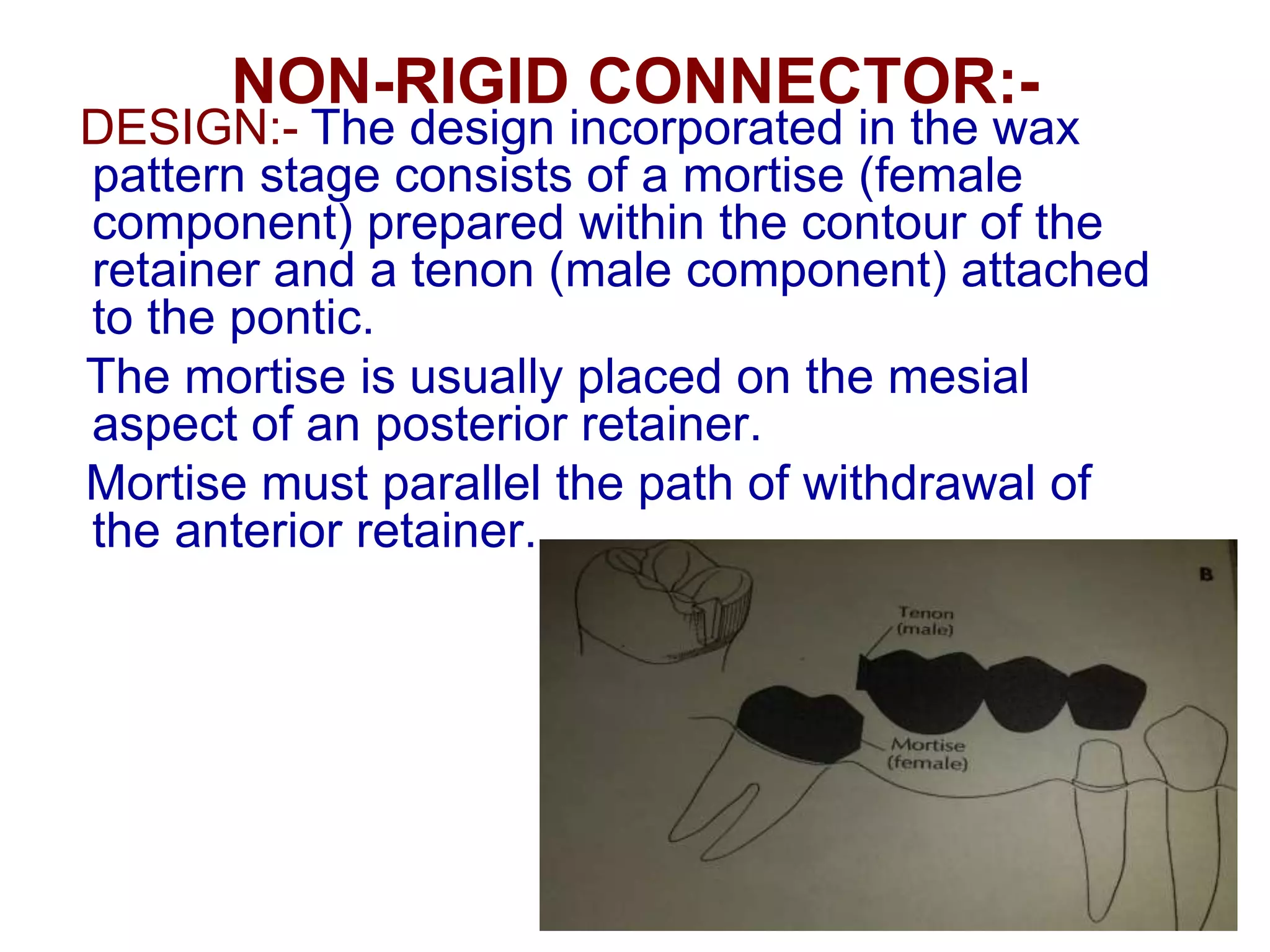
DESIGN:- The design incorporated in the wax
pattern stage consists of a mortise (female
component) prepared within the contour of the
retainer and a tenon (male component) attached
to the pontic.
The mortise is usually placed on the mesial
aspect of an posterior retainer.
Mortise must parallel the path of withdrawal of
the anterior retainer.
Use:- non-rigid connector is used either to
relieve stress or to accommodate malaligned
abutment.
Advantage:- segmenting the design of large
complex F.P.D. into shorter component that are
easier to replace and repair.
If abutment fails only portion of F.P.D. may need
to be remade.
Indication:- In lower arch when a complex
F.P.D. consist of anterior and posterior segment.
When it is impossible to prepare a common path
of insertion for the abutment preparation for a
fixed partial denture.
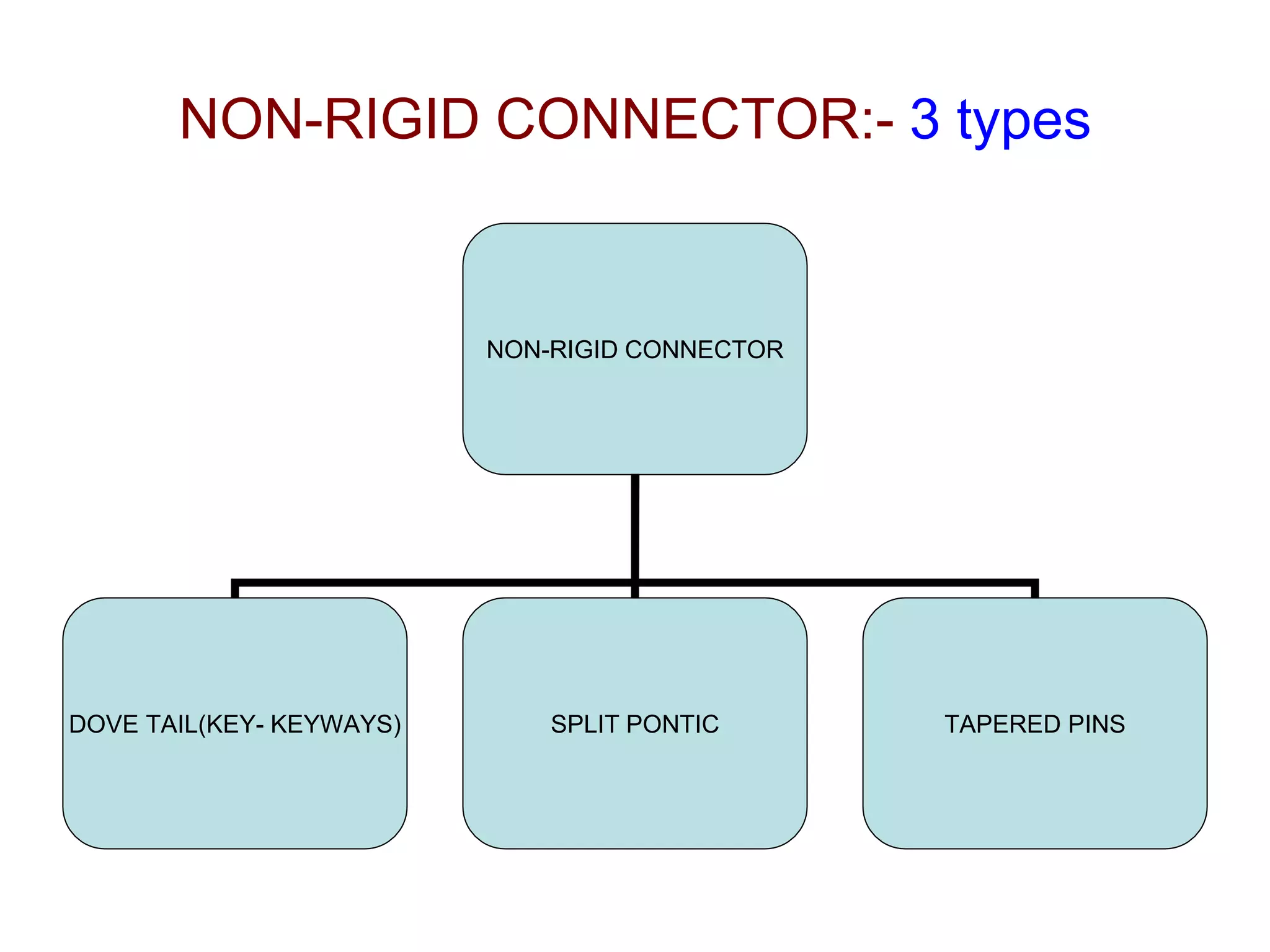
NON-RIGID CONNECTOR:- 3 types
NON-RIGID CONNECTOR
DOVE TAIL(KEY- KEYWAYS) SPLIT PONTIC TAPERED PINS
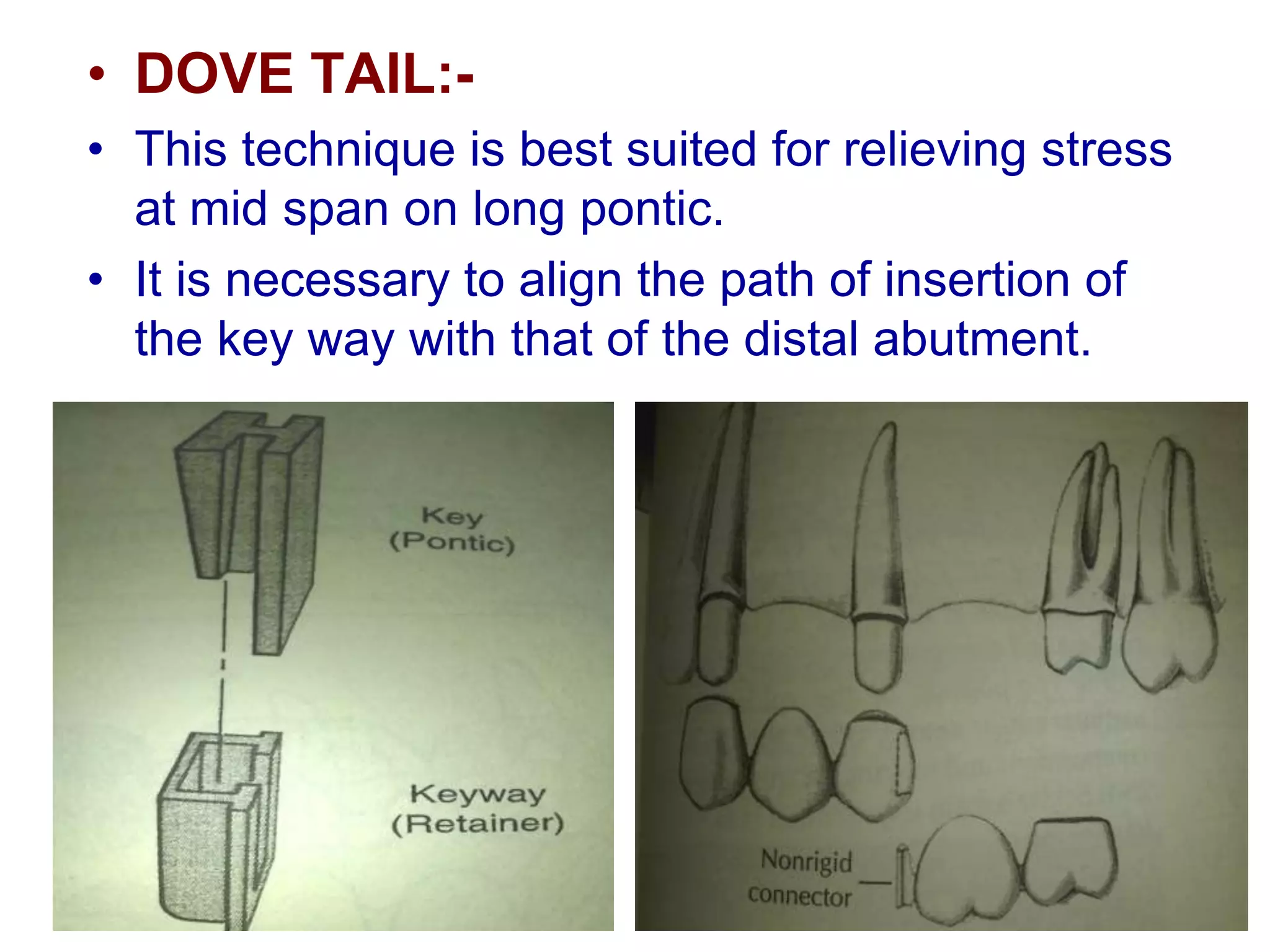
• DOVE TAIL:-
• This technique is best suited for relieving stress
at mid span on long pontic.
• It is necessary to align the path of insertion of
the key way with that of the distal abutment.
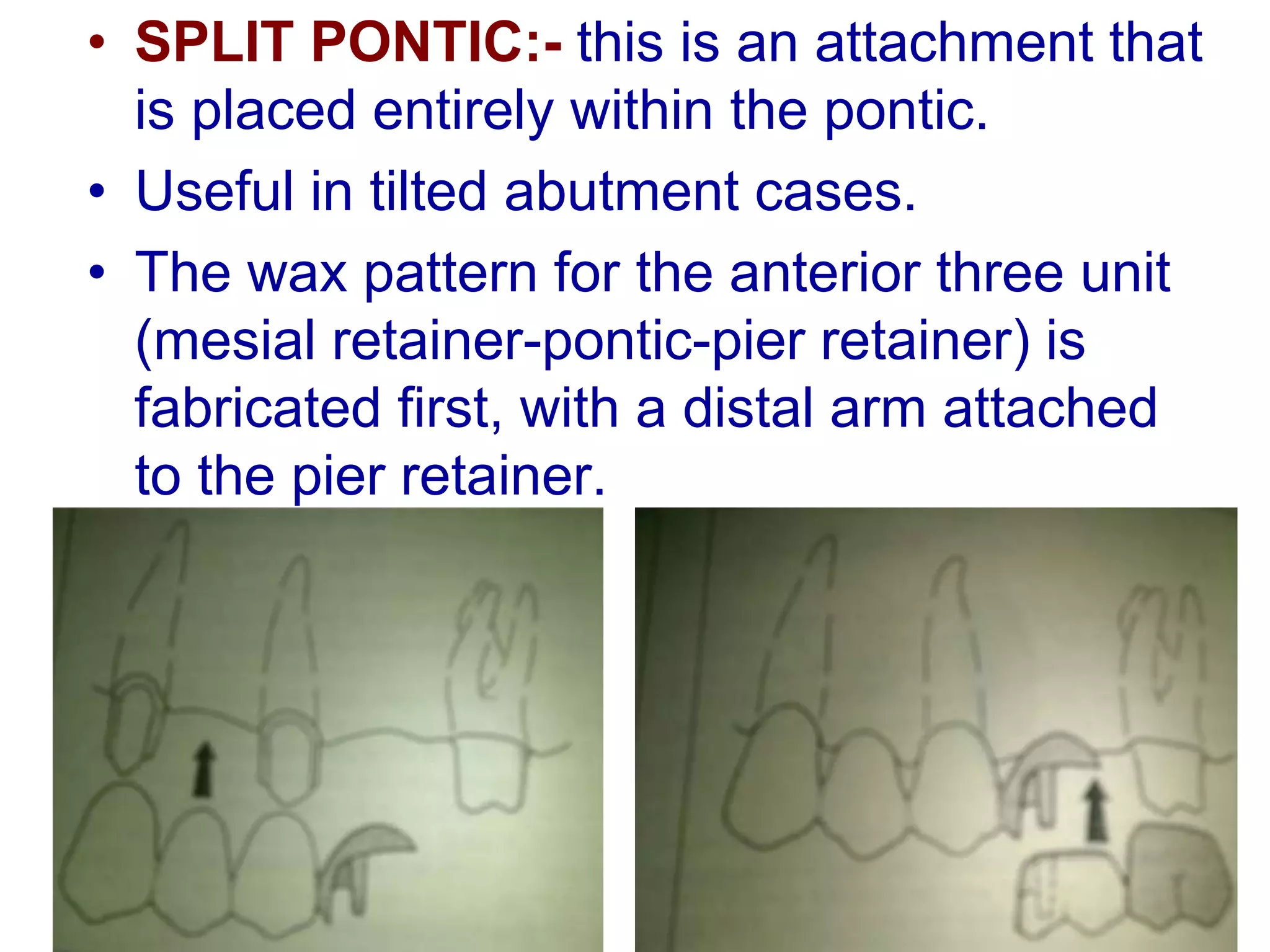
• SPLIT PONTIC:- this is an attachment that
is placed entirely within the pontic.
• Useful in tilted abutment cases.
• The wax pattern for the anterior three unit
(mesial retainer-pontic-pier retainer) is
fabricated first, with a distal arm attached
to the pier retainer.
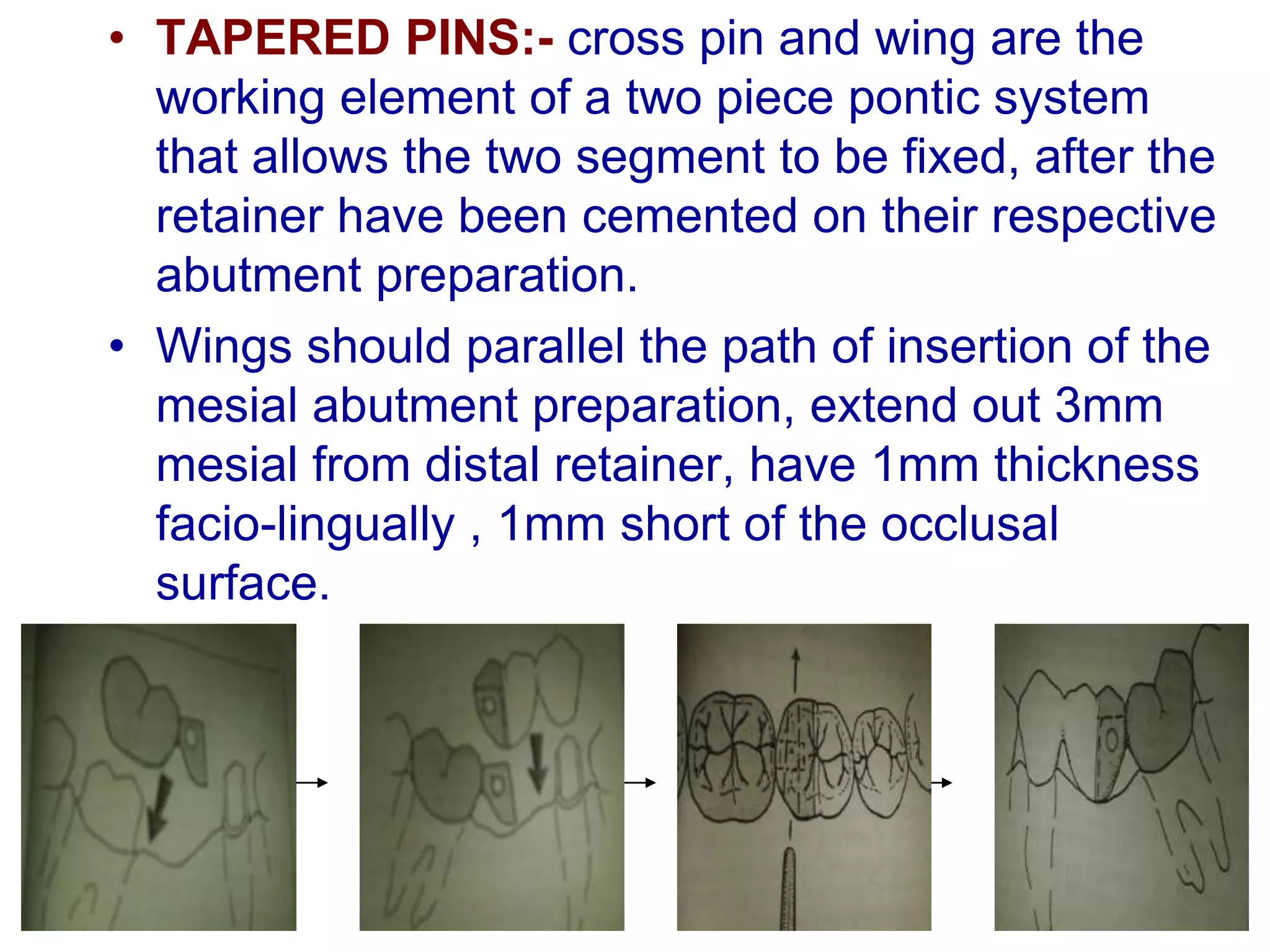
• TAPERED PINS:- cross pin and wing are the
working element of a two piece pontic system
that allows the two segment to be fixed, after the
retainer have been cemented on their respective
abutment preparation.
• Wings should parallel the path of insertion of the
mesial abutment preparation, extend out 3mm
mesial from distal retainer, have 1mm thickness
facio-lingually , 1mm short of the occlusal
surface.
THANK YOU !

CONNECTORS IN FIXED PARTIAL DENTURE(devesh rathi).ppt

  • 1.
    CONNECTORS IN FIXED PARTIAL DENTURE GUIDEDBY.. Dr. Nitin Vaidya M.D.S. Dr. Seema Patnaik M.D.S. Dr. Shailendra Sahu M.D.S. Dr. praveen M.D.S. PRESENTED BY.. Devesh Rathi (INTERN) DEPARTMENT OF PROSTHODONTICS
  • 2.
    DEFINITION:- “Connector is thatpart of a fixed partial denture or splint that joins the individual retainer and pontic together.” Types of connector:- 1) Rigid connector:- a cast, soldered, or fused union between the retainer (s) and pontic (s). 2) Nonrigid connector:-any connector that permits limited movement between, otherwise independent members of a fixed dental prosthesis.
  • 3.
    CONNECTOR DESIGN:- SIZE:- Mustbe sufficiently large to prevent distortion during function, but not too large; otherwise they will interfere with effective plaque control. 2 X 3 mm (metal connector). 4 X 4 mm (all ceramic connector). SHAPE:-Tissue surface is curved faciolingually to facilitate cleansing. Mesiodistally,it must be shaped to create a smooth transition from one component to the next. Elliptical shape have better strength. Incorrect design Correct design Proximal contact view
  • 4.
    • POSITION:- connectorshould occupy the normal anatomic inter-proximal area because encroaching on the buccal, gingival, or lingual embrasure restrics access and plaque control that may lead to periodontal failure. • Anterior connector are normally placed toward the lingual to improve appearance. maxillary anterior maxillary postrior mandibular posterior
  • 5.
    RIGID CONNECTORS:- 3types RIGIDCONNECTOR CAST CONNECTOR SOLDERED CONNECTOR LOOP CONNECTOR
  • 6.
    • CAST CONNECTOR:-Cast connectors are shaped in wax, as a part of a multi unit wax pattern. Advantage- convenient and decrease the number of steps involved in the laboratory Fabrication. Disadvantage- fit of individual retainer may be affected. Distortion results when a multi unit wax pattern is removed from die system.
  • 7.
    • SOLDERD CONNECTOR:-It involves intermediate metal alloy whose melting temperature is less than that of parent metal. Connectors to be soldered are waxed to final shape but are than sectioned with a thin ribbon saw; therefore, when the component are cast, the surface to be joined will be flat, parallel and a controlled distance apart. An even soldering gap of about 0.25mm is required. As gap width increases, soldering accuracy decreases. In dentistry used temperature is above 450c. Welding:- In this method connection is created by melting adjacent surface with heat or pressure.
  • 8.
    • LOOP CONNECTOR:-The connector consists of a loop on a lingual aspect of a prosthesis that connects adjacent retainers and/ or pontics. • The loop may be cast from sprue wax and shaped from a (pt-au-pd) alloy wire. • INDICATION:- When an existing diastema is to be maintained in a planned fixed prosthesis.
  • 9.
    NON-RIGID CONNECTOR:- DESIGN:- Thedesign incorporated in the wax pattern stage consists of a mortise (female component) prepared within the contour of the retainer and a tenon (male component) attached to the pontic. The mortise is usually placed on the mesial aspect of an posterior retainer. Mortise must parallel the path of withdrawal of the anterior retainer.
  • 10.
    Use:- non-rigid connectoris used either to relieve stress or to accommodate malaligned abutment. Advantage:- segmenting the design of large complex F.P.D. into shorter component that are easier to replace and repair. If abutment fails only portion of F.P.D. may need to be remade. Indication:- In lower arch when a complex F.P.D. consist of anterior and posterior segment. When it is impossible to prepare a common path of insertion for the abutment preparation for a fixed partial denture.
  • 11.
    NON-RIGID CONNECTOR:- 3types NON-RIGID CONNECTOR DOVE TAIL(KEY- KEYWAYS) SPLIT PONTIC TAPERED PINS
  • 12.
    • DOVE TAIL:- •This technique is best suited for relieving stress at mid span on long pontic. • It is necessary to align the path of insertion of the key way with that of the distal abutment.
  • 13.
    • SPLIT PONTIC:-this is an attachment that is placed entirely within the pontic. • Useful in tilted abutment cases. • The wax pattern for the anterior three unit (mesial retainer-pontic-pier retainer) is fabricated first, with a distal arm attached to the pier retainer.
  • 14.
    • TAPERED PINS:-cross pin and wing are the working element of a two piece pontic system that allows the two segment to be fixed, after the retainer have been cemented on their respective abutment preparation. • Wings should parallel the path of insertion of the mesial abutment preparation, extend out 3mm mesial from distal retainer, have 1mm thickness facio-lingually , 1mm short of the occlusal surface.
  • 15.