Conjunctions
and
Interjections
Mrs. Butler’s 5th Grade Class
What is a Conjunction?
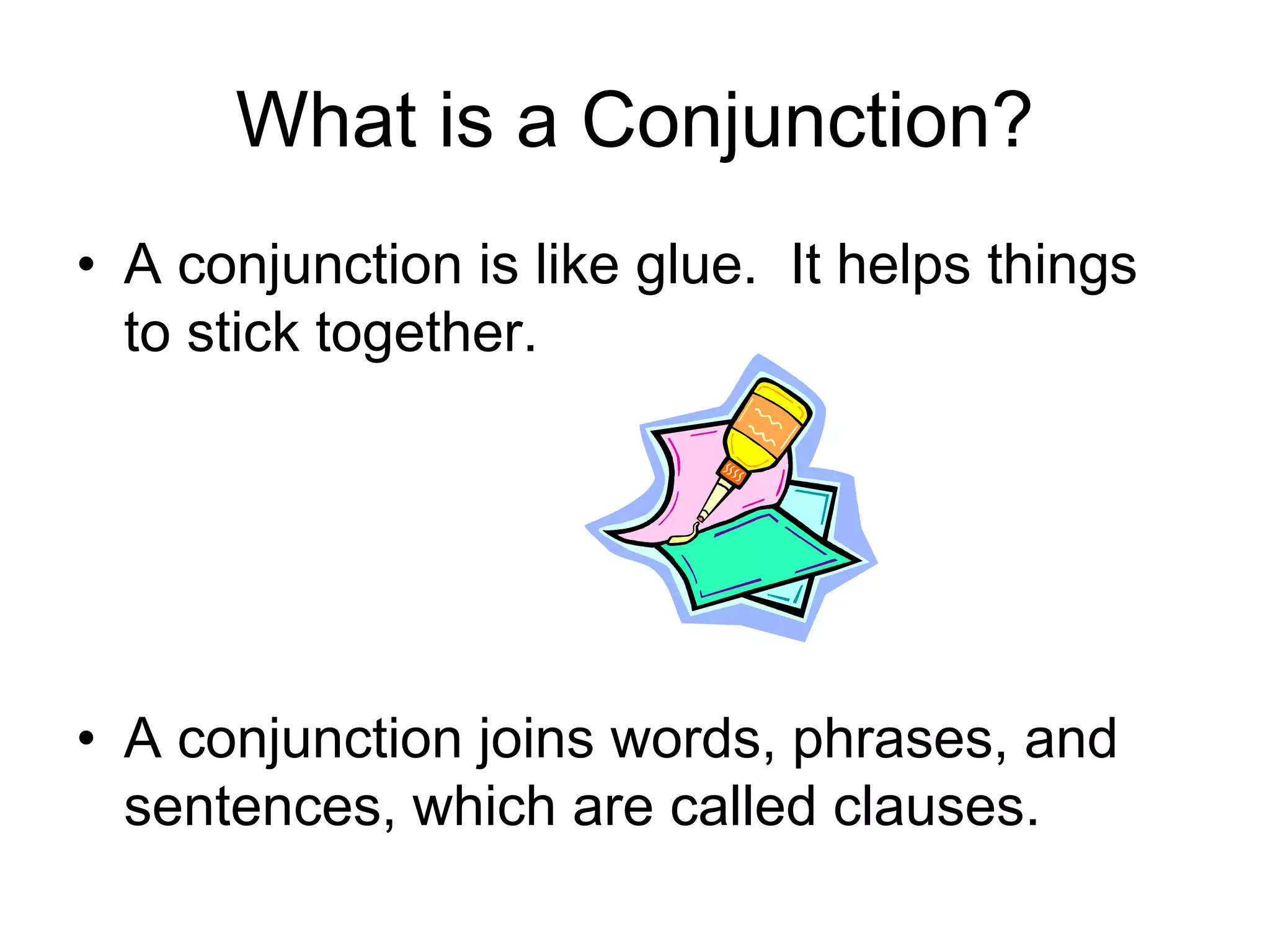
• A conjunction is like glue. It helps things
to stick together.
• A conjunction joins words, phrases, and
sentences, which are called clauses.
There Are 3 Types of
Conjunctions
1. Coordinating Conjunctions
2. Subordinating Conjunctions
3. Correlative Conjunctions
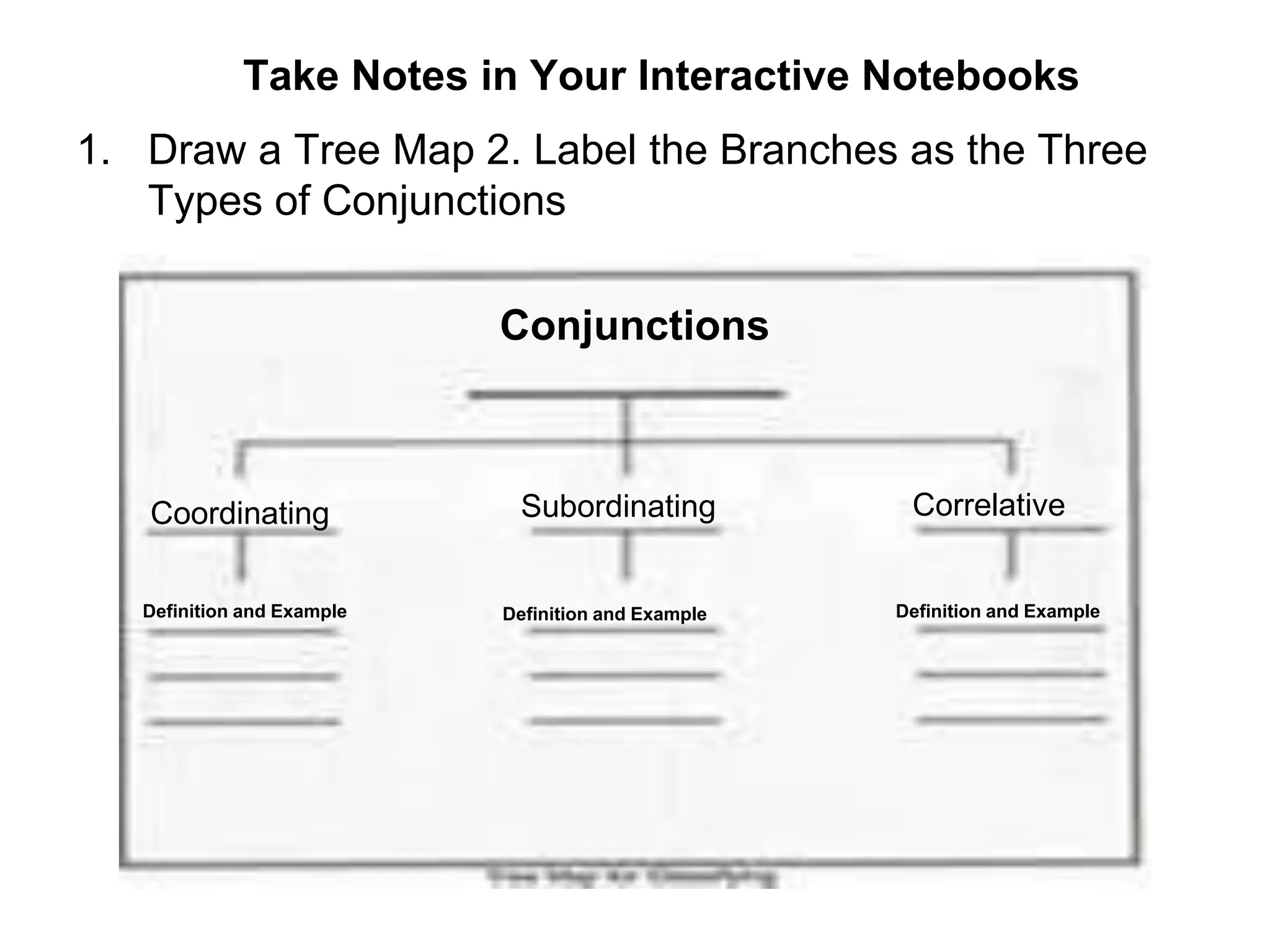
Take Notes in Your Interactive Notebooks
1. Draw a Tree Map 2. Label the Branches as the Three
Types of Conjunctions
Conjunctions
Coordinating Subordinating Correlative
Definition and Example Definition and Example Definition and Example
What is a Conjunction?
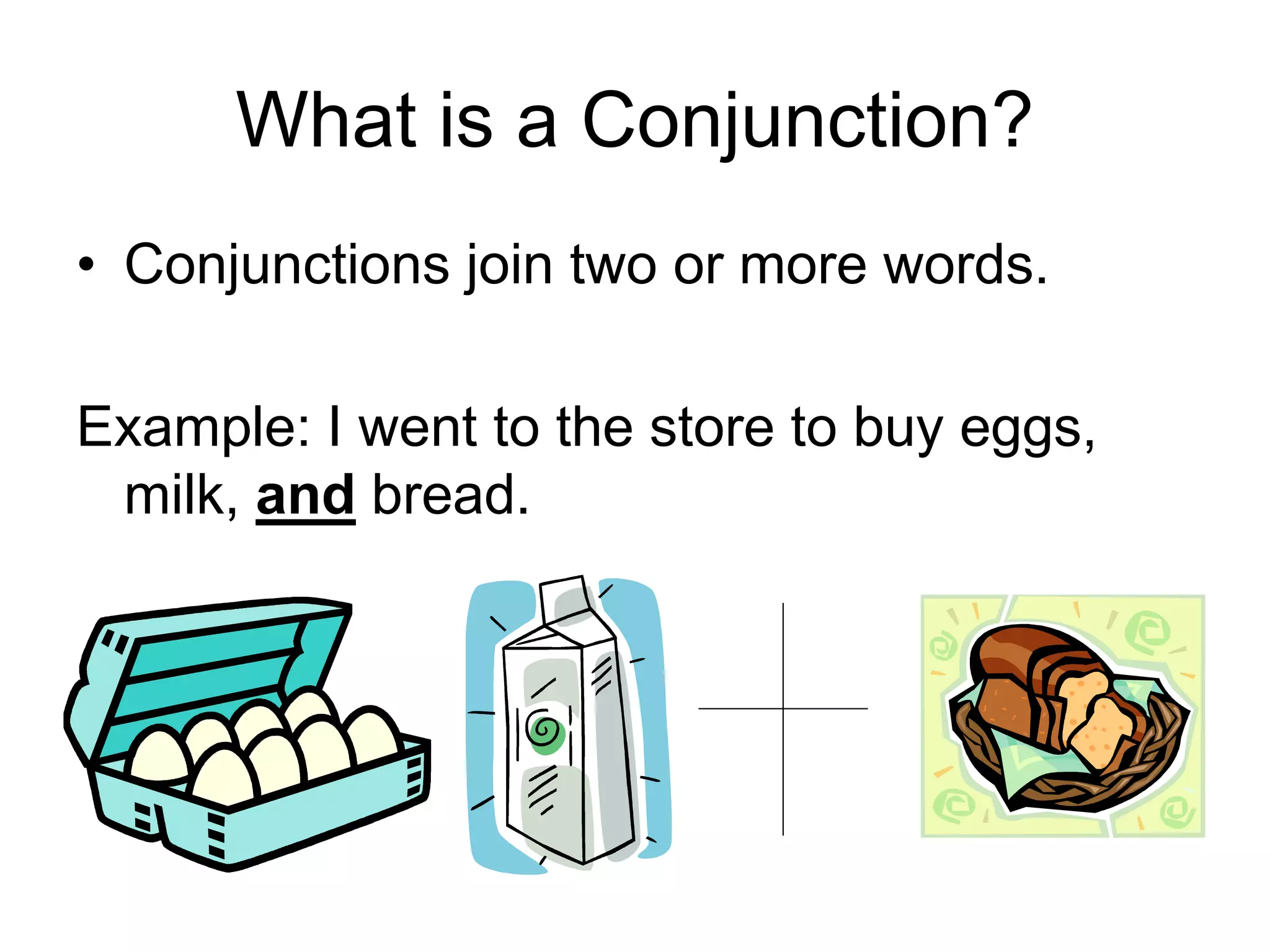
• Conjunctions join two or more words.
Example: I went to the store to buy eggs,
milk, and bread.
What is a Conjunction?
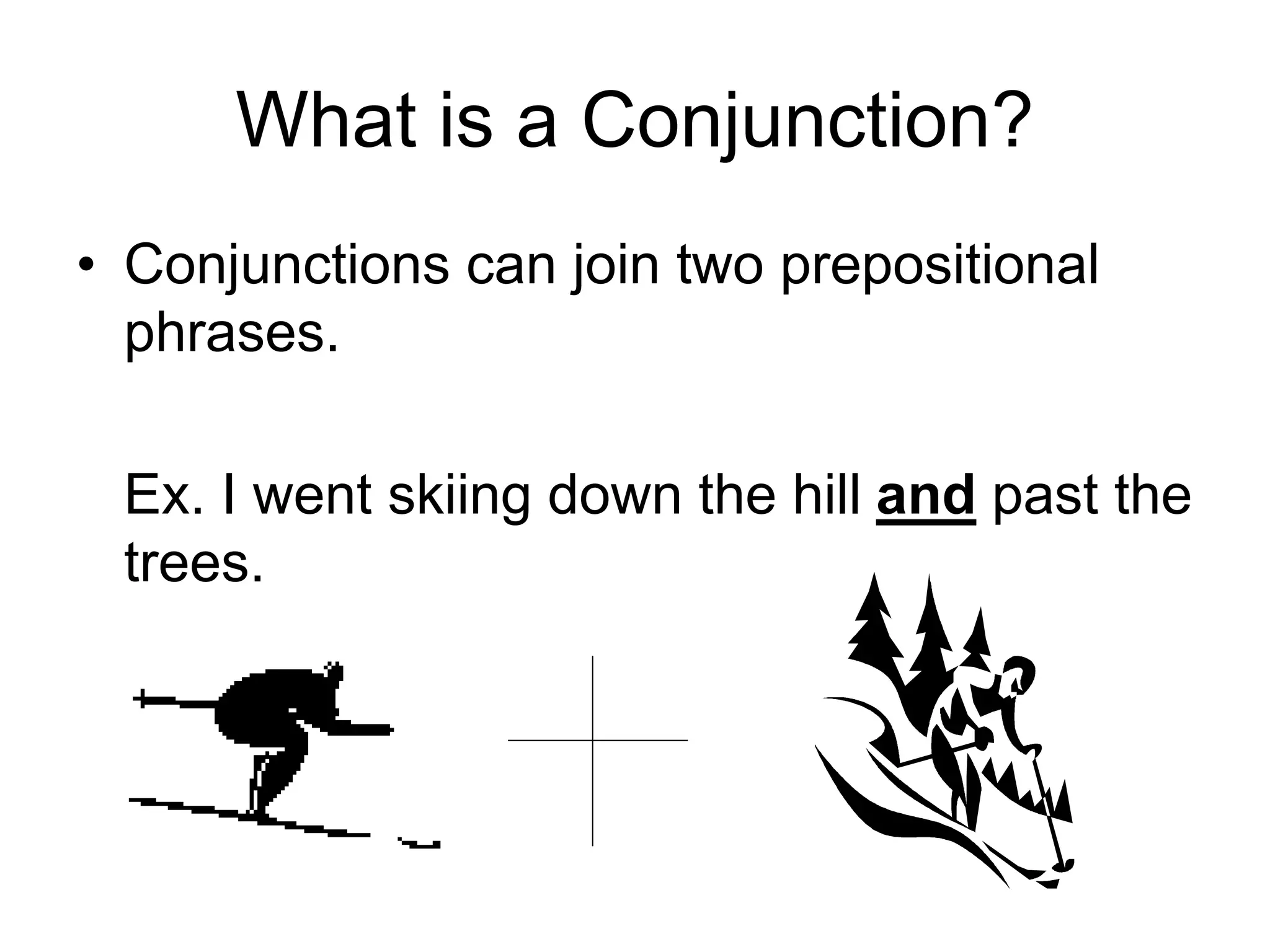
• Conjunctions can join two prepositional
phrases.
Ex. I went skiing down the hill and past the
trees.
What is a Conjunction?
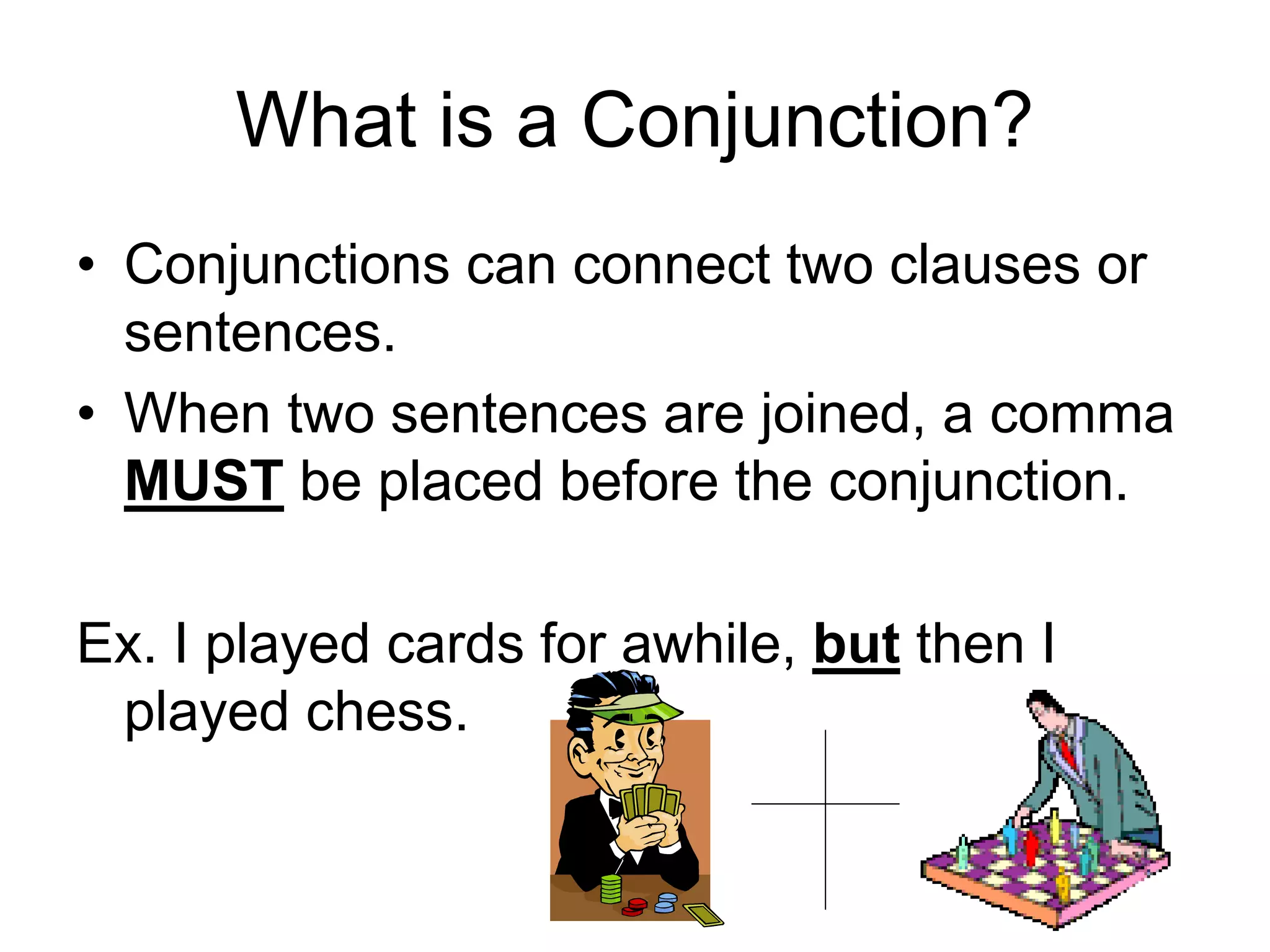
• Conjunctions can connect two clauses or
sentences.
• When two sentences are joined, a comma
MUST be placed before the conjunction.
Ex. I played cards for awhile, but then I
played chess.
Types of Conjunctions
• One type of conjunction is the coordinating
conjunction.
• They connect words, phrases, and
clauses, which are sentences.
• They connect things of equal value.
(This means that they would connect a noun with
another noun or a prepositional phrase with another
prepositional phrase.)
Types of Conjunctions
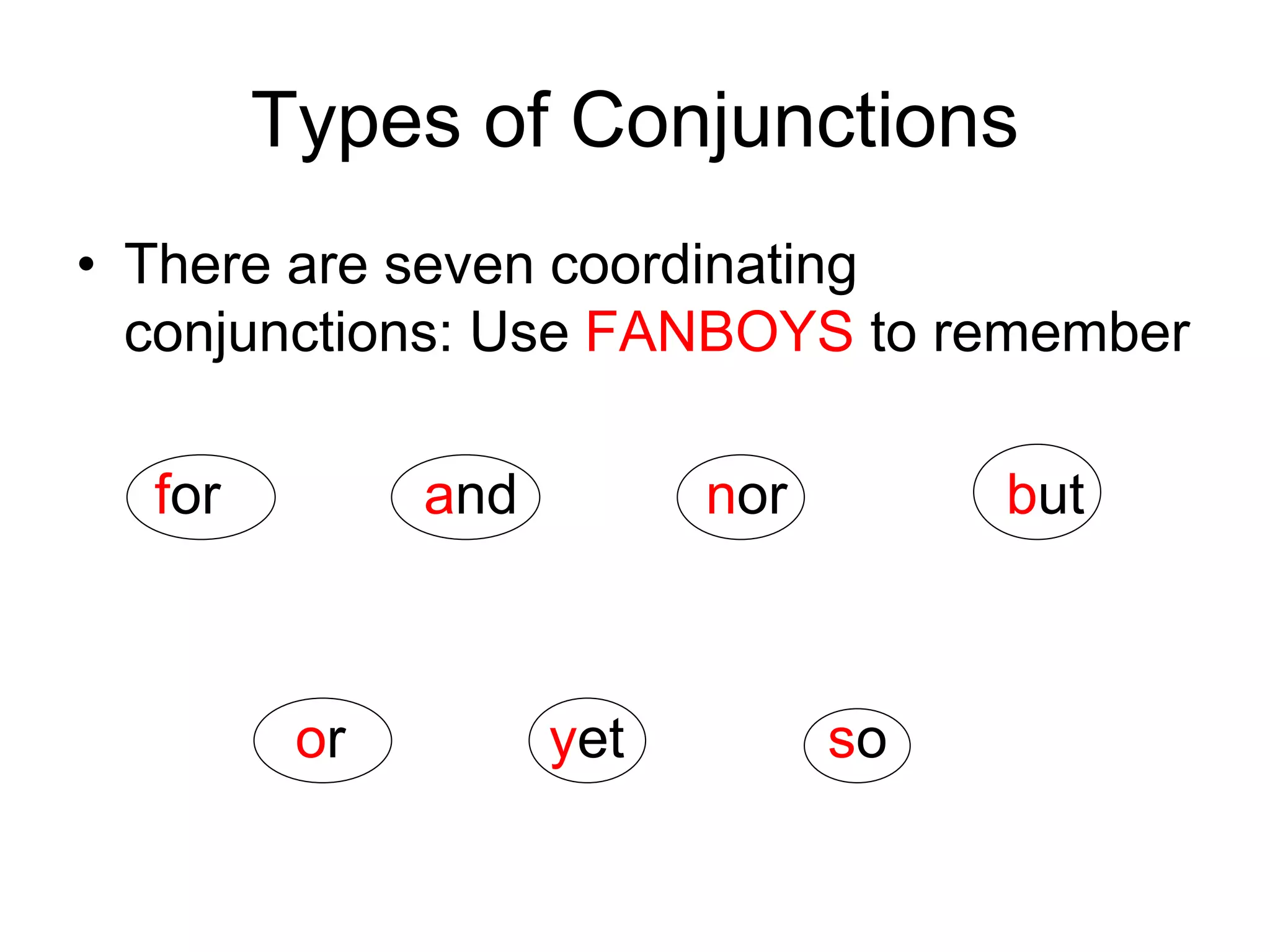
• There are seven coordinating
conjunctions: Use FANBOYS to remember
for and nor but
or yet so
Types of Conjunctions
• Coordinating conjunctions affect the
meaning of your sentence.
• “And” connects things that are alike or
joined together.
• Ex. I want popcorn and pizza.
Types of Conjunctions
• Coordinating conjunctions affect the
meaning of your sentence.
• “But” is used to connect things that are
different or separated.
• Ex. I want popcorn but not pizza.
Types of Conjunctions
• Coordinating conjunctions affect the
meaning of your sentence.
• “Or” is used to offer a choice.
• Ex. Do I want popcorn or pizza?
Types of Conjunctions
• Coordinating conjunctions affect the
meaning of your sentence.
• “Nor” is used to offer a negative choice.
• Ex. I do not want popcorn nor pizza.
Types of Conjunctions
• Coordinating conjunctions affect the
meaning of your sentence.
• “Yet” is used to show a change. When it is
used to combine two sentences, you must
put a comma before it.
• Ex. I want popcorn, yet I also want pizza.
Types of Conjunctions
• Coordinating conjunctions affect the
meaning of your sentence.
• “So” is used to show a relationship
between things. When it is used to
combine two sentences, you must put a
comma before it.
• Ex. I want popcorn, so I made some.
Types of Conjunctions
• Coordinating conjunctions affect the
meaning of your sentence.
• “For” is also used to show a relationship
between things. When it is used to
combine two sentences, you must put a
comma before it.
• Ex. I ordered a pizza, for I was hungry.
Types of Conjunctions
• Another Type of Conjunction is a
Subordinating Conjunction.
A subordinating conjunction-
-Connects a dependent clause (a clause that cannot be
written as a separate sentence) with an independent
clause.
IF, WHILE, BECAUSE, ALTHOUGH, AFTER, BEFORE,
UNLESS, WHEN, UNTIL, SINCE, THEN, AS
• We celebrated after we won the game.
• Because our train was delayed, we arrived late.
• Watson listened quietly while Holmes explained his
theory
Types of Conjunctions
• Another type of conjunction is called correlative
conjunctions.
• Correlative conjunctions connect words,
phrases, and clauses, which are sentences.
• Correlative conjunctions connect things of equal
value.
(This means that they will connect a verb with
another verb or a sentence with another
sentence.)
Types of Conjunctions
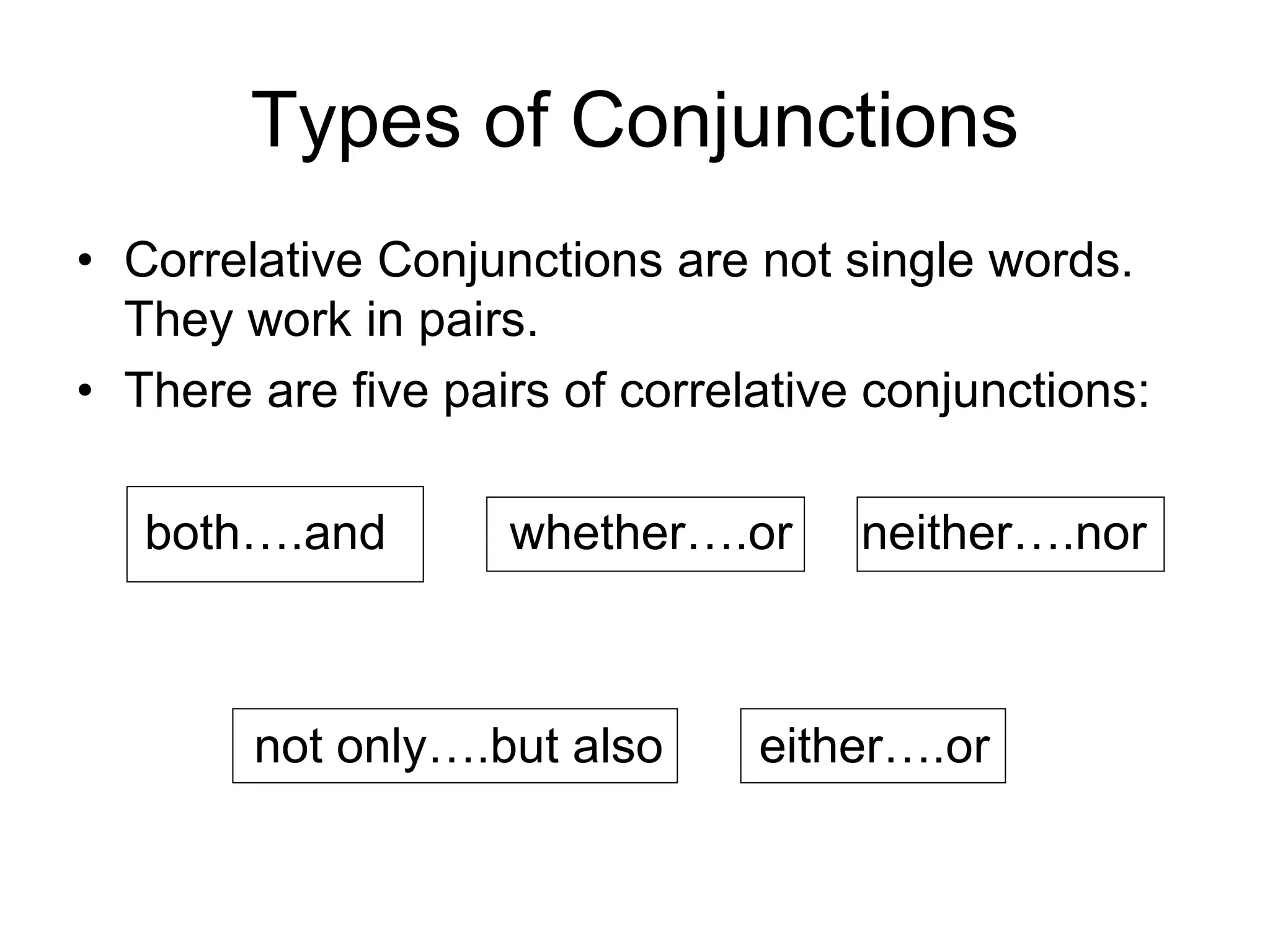
• Correlative Conjunctions are not single words.
They work in pairs.
• There are five pairs of correlative conjunctions:
both….and whether….or neither….nor
not only….but also either….or
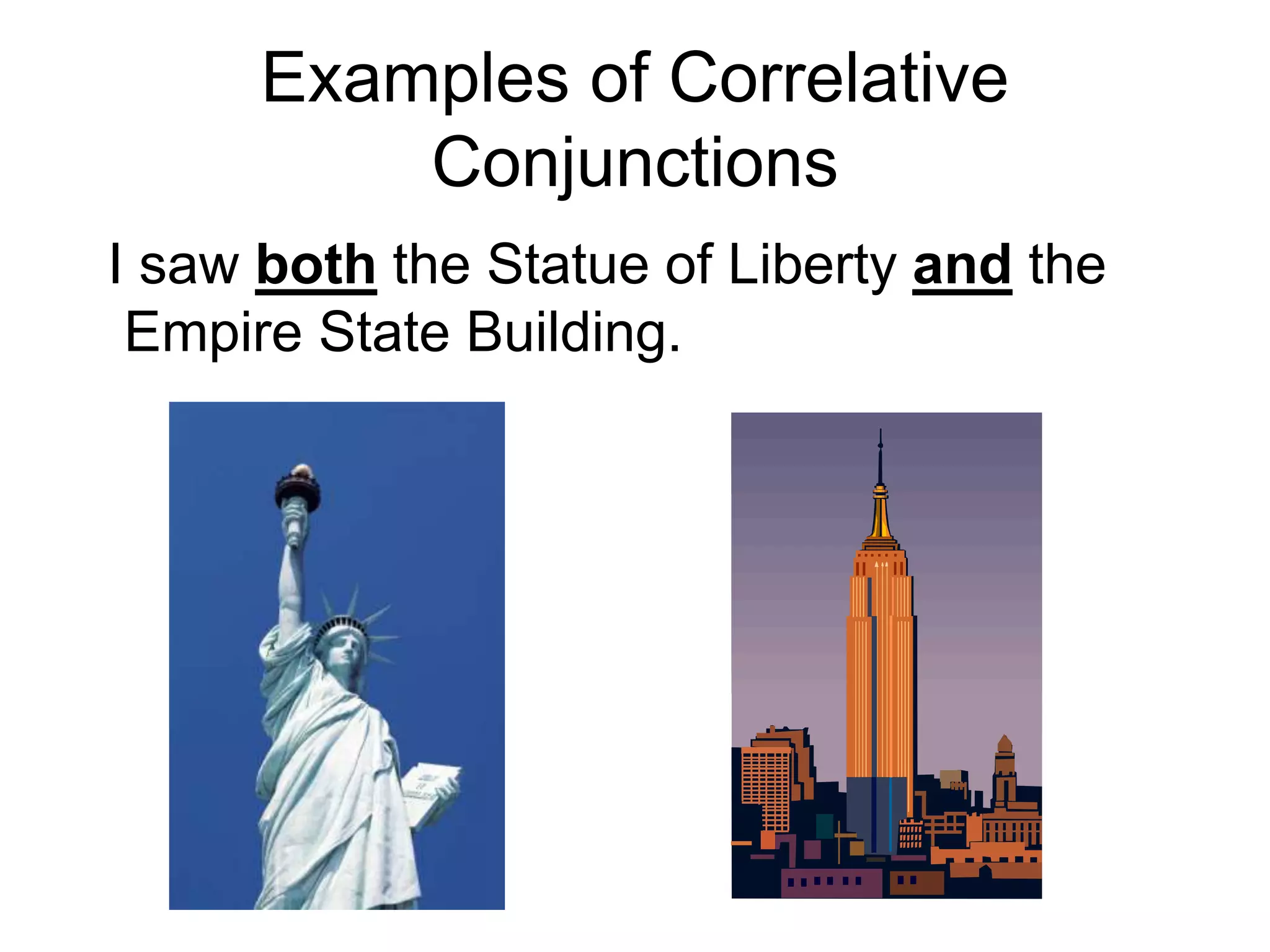
Examples of Correlative
Conjunctions
I saw both the Statue of Liberty and the
Empire State Building.
Examples of Correlative
Conjunctions
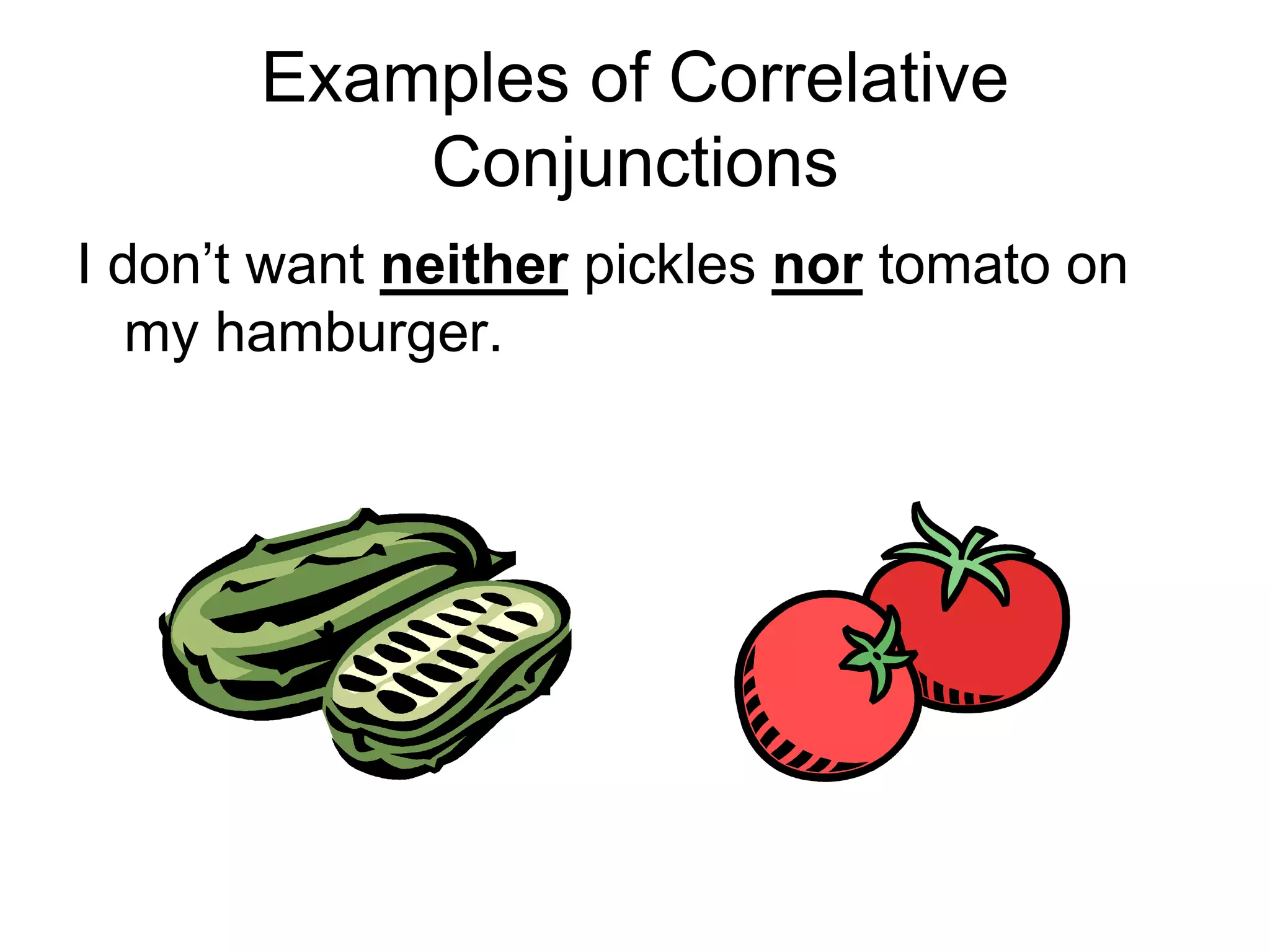
I don’t want neither pickles nor tomato on
my hamburger.
Examples of Correlative
Conjunctions
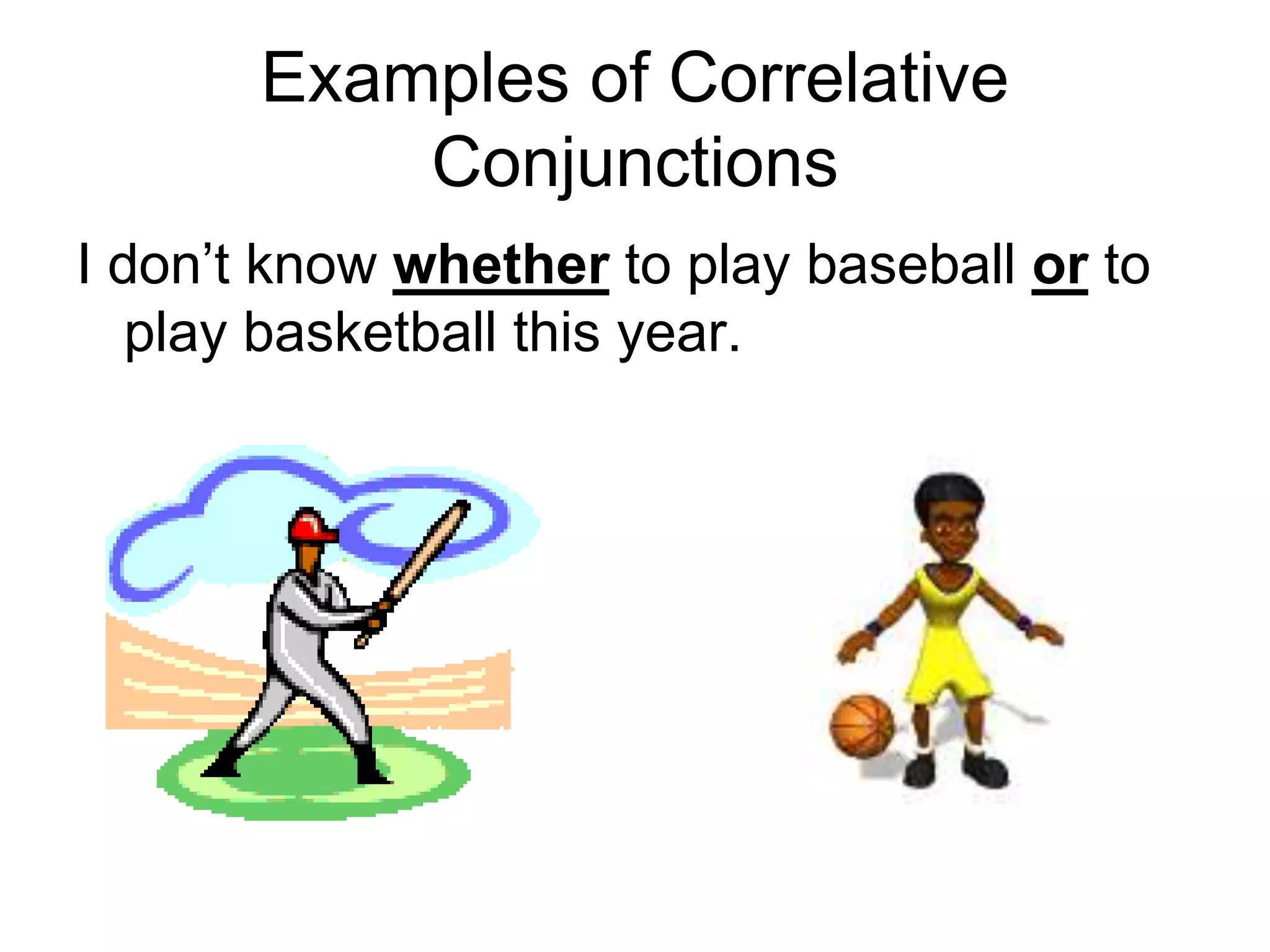
I don’t know whether to play baseball or to
play basketball this year.
Examples of Correlative
Conjunctions
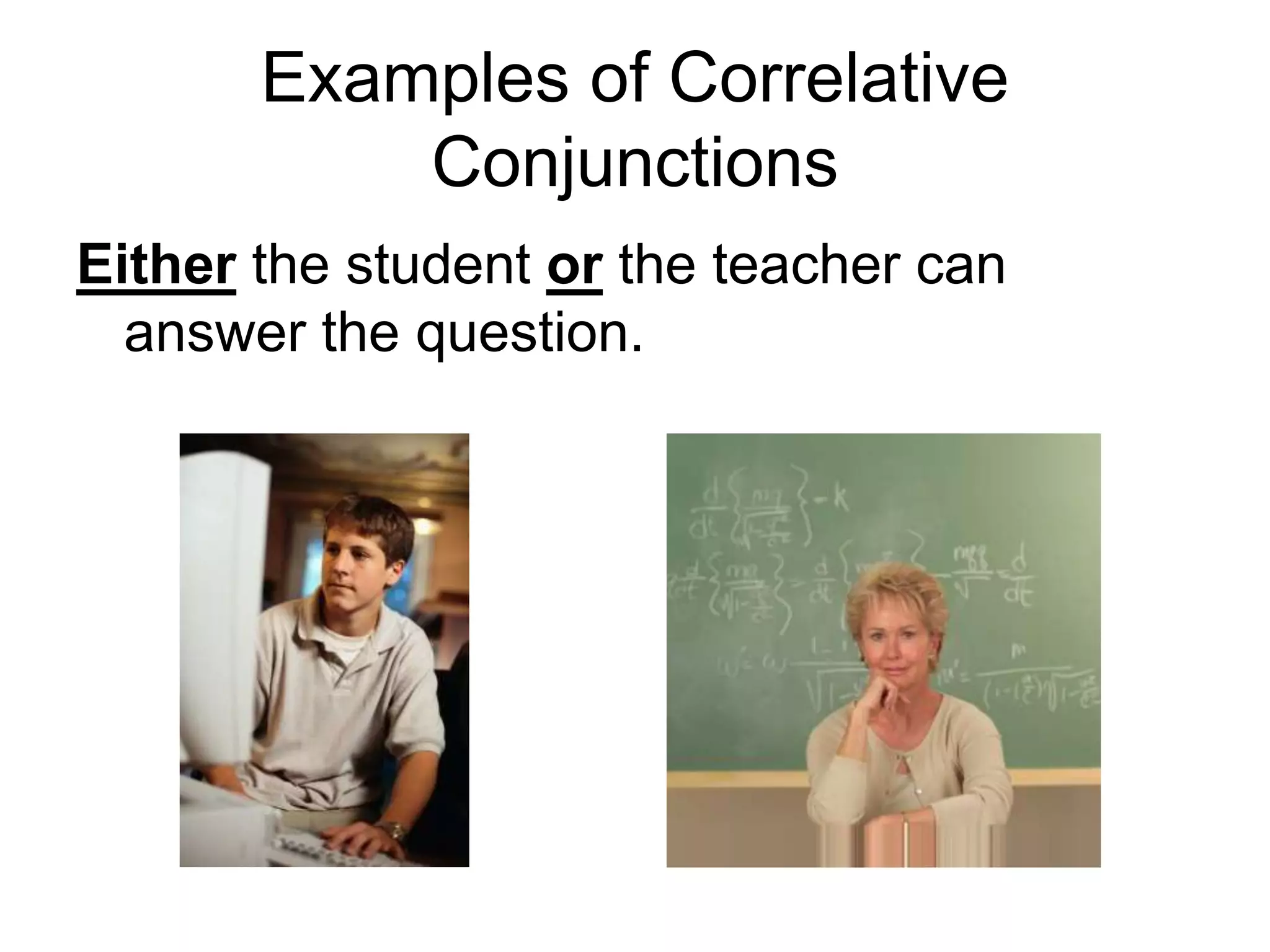
Either the student or the teacher can
answer the question.
Examples of Correlative
Conjunctions
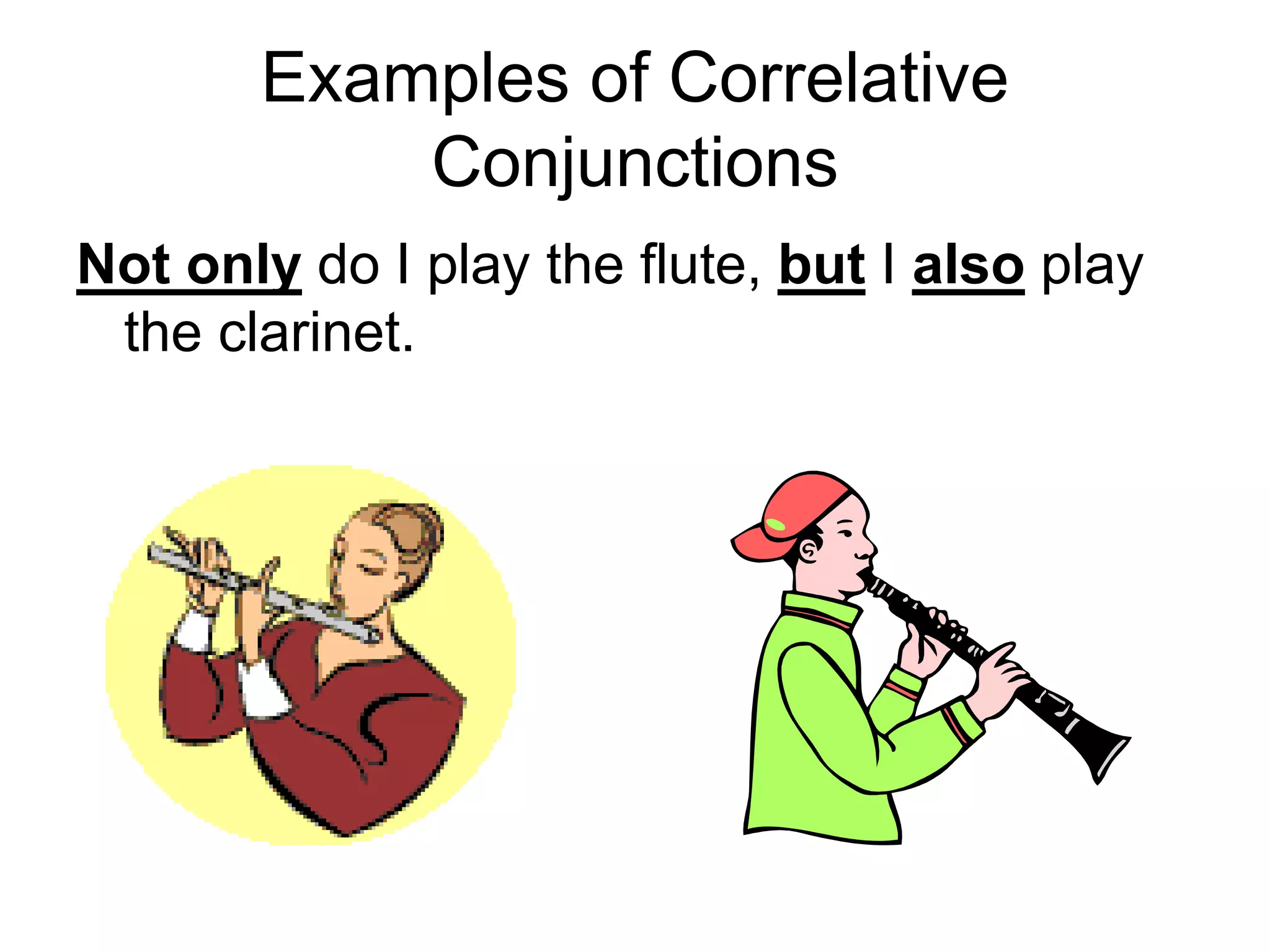
Not only do I play the flute, but I also play
the clarinet.
Conjunction Junction
• http://www.schooltube.com/video/6b265f3
478554fef993c/Conjunction-Junction
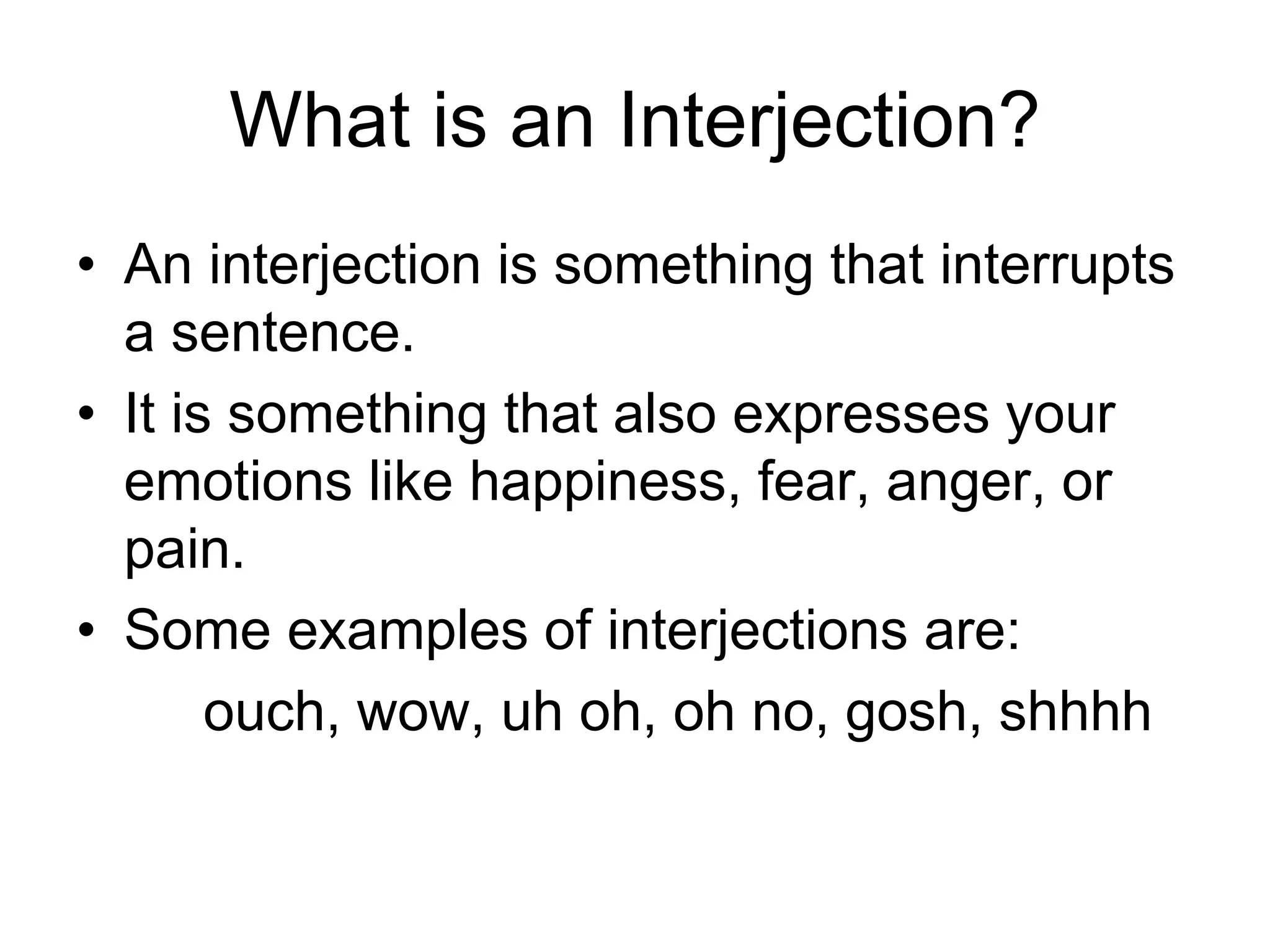
What is an Interjection?
• An interjection is something that interrupts
a sentence.
• It is something that also expresses your
emotions like happiness, fear, anger, or
pain.
• Some examples of interjections are:
ouch, wow, uh oh, oh no, gosh, shhhh
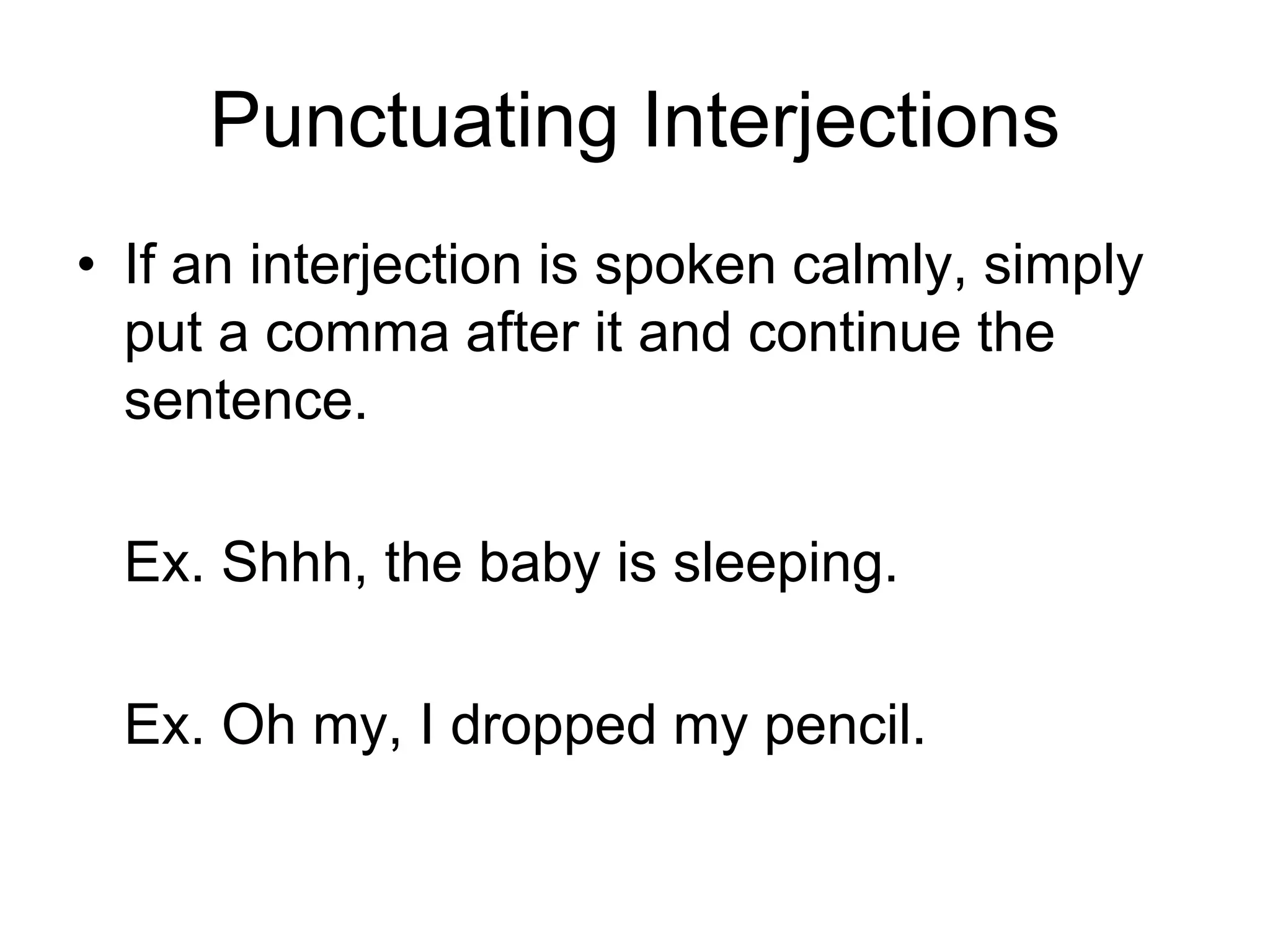
Punctuating Interjections
• If an interjection is spoken calmly, simply
put a comma after it and continue the
sentence.
Ex. Shhh, the baby is sleeping.
Ex. Oh my, I dropped my pencil.
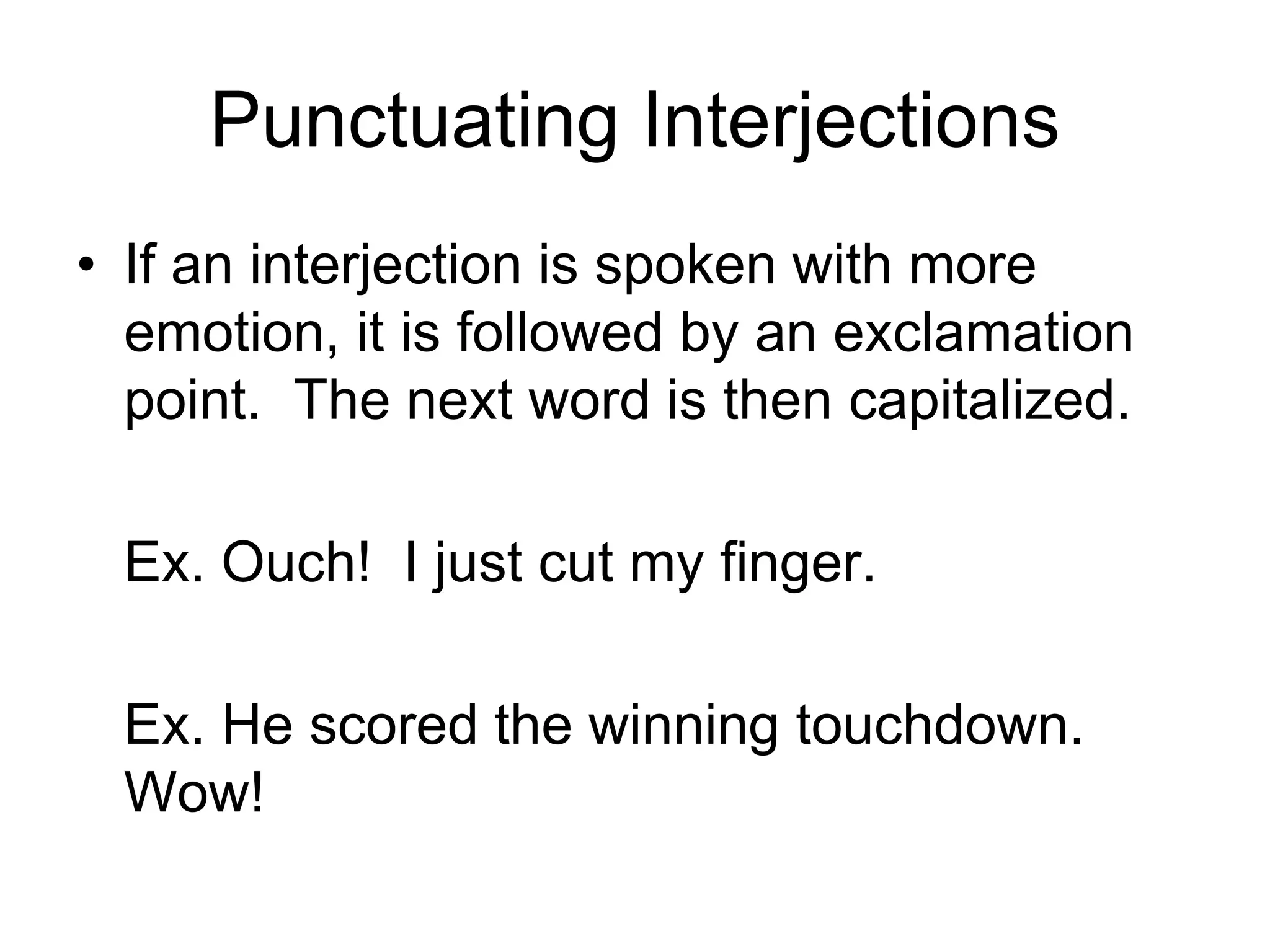
Punctuating Interjections
• If an interjection is spoken with more
emotion, it is followed by an exclamation
point. The next word is then capitalized.
Ex. Ouch! I just cut my finger.
Ex. He scored the winning touchdown.
Wow!

Conjunctions and interjections Day 3.ppt

  • 1.
  • 2.
    What is aConjunction? • A conjunction is like glue. It helps things to stick together. • A conjunction joins words, phrases, and sentences, which are called clauses.
  • 3.
    There Are 3Types of Conjunctions 1. Coordinating Conjunctions 2. Subordinating Conjunctions 3. Correlative Conjunctions
  • 4.
    Take Notes inYour Interactive Notebooks 1. Draw a Tree Map 2. Label the Branches as the Three Types of Conjunctions Conjunctions Coordinating Subordinating Correlative Definition and Example Definition and Example Definition and Example
  • 5.
    What is aConjunction? • Conjunctions join two or more words. Example: I went to the store to buy eggs, milk, and bread.
  • 6.
    What is aConjunction? • Conjunctions can join two prepositional phrases. Ex. I went skiing down the hill and past the trees.
  • 7.
    What is aConjunction? • Conjunctions can connect two clauses or sentences. • When two sentences are joined, a comma MUST be placed before the conjunction. Ex. I played cards for awhile, but then I played chess.
  • 8.
    Types of Conjunctions •One type of conjunction is the coordinating conjunction. • They connect words, phrases, and clauses, which are sentences. • They connect things of equal value. (This means that they would connect a noun with another noun or a prepositional phrase with another prepositional phrase.)
  • 9.
    Types of Conjunctions •There are seven coordinating conjunctions: Use FANBOYS to remember for and nor but or yet so
  • 10.
    Types of Conjunctions •Coordinating conjunctions affect the meaning of your sentence. • “And” connects things that are alike or joined together. • Ex. I want popcorn and pizza.
  • 11.
    Types of Conjunctions •Coordinating conjunctions affect the meaning of your sentence. • “But” is used to connect things that are different or separated. • Ex. I want popcorn but not pizza.
  • 12.
    Types of Conjunctions •Coordinating conjunctions affect the meaning of your sentence. • “Or” is used to offer a choice. • Ex. Do I want popcorn or pizza?
  • 13.
    Types of Conjunctions •Coordinating conjunctions affect the meaning of your sentence. • “Nor” is used to offer a negative choice. • Ex. I do not want popcorn nor pizza.
  • 14.
    Types of Conjunctions •Coordinating conjunctions affect the meaning of your sentence. • “Yet” is used to show a change. When it is used to combine two sentences, you must put a comma before it. • Ex. I want popcorn, yet I also want pizza.
  • 15.
    Types of Conjunctions •Coordinating conjunctions affect the meaning of your sentence. • “So” is used to show a relationship between things. When it is used to combine two sentences, you must put a comma before it. • Ex. I want popcorn, so I made some.
  • 16.
    Types of Conjunctions •Coordinating conjunctions affect the meaning of your sentence. • “For” is also used to show a relationship between things. When it is used to combine two sentences, you must put a comma before it. • Ex. I ordered a pizza, for I was hungry.
  • 17.
    Types of Conjunctions •Another Type of Conjunction is a Subordinating Conjunction. A subordinating conjunction- -Connects a dependent clause (a clause that cannot be written as a separate sentence) with an independent clause. IF, WHILE, BECAUSE, ALTHOUGH, AFTER, BEFORE, UNLESS, WHEN, UNTIL, SINCE, THEN, AS • We celebrated after we won the game. • Because our train was delayed, we arrived late. • Watson listened quietly while Holmes explained his theory
  • 18.
    Types of Conjunctions •Another type of conjunction is called correlative conjunctions. • Correlative conjunctions connect words, phrases, and clauses, which are sentences. • Correlative conjunctions connect things of equal value. (This means that they will connect a verb with another verb or a sentence with another sentence.)
  • 19.
    Types of Conjunctions •Correlative Conjunctions are not single words. They work in pairs. • There are five pairs of correlative conjunctions: both….and whether….or neither….nor not only….but also either….or
  • 20.
    Examples of Correlative Conjunctions Isaw both the Statue of Liberty and the Empire State Building.
  • 21.
    Examples of Correlative Conjunctions Idon’t want neither pickles nor tomato on my hamburger.
  • 22.
    Examples of Correlative Conjunctions Idon’t know whether to play baseball or to play basketball this year.
  • 23.
    Examples of Correlative Conjunctions Eitherthe student or the teacher can answer the question.
  • 24.
    Examples of Correlative Conjunctions Notonly do I play the flute, but I also play the clarinet.
  • 25.
  • 26.
    What is anInterjection? • An interjection is something that interrupts a sentence. • It is something that also expresses your emotions like happiness, fear, anger, or pain. • Some examples of interjections are: ouch, wow, uh oh, oh no, gosh, shhhh
  • 27.
    Punctuating Interjections • Ifan interjection is spoken calmly, simply put a comma after it and continue the sentence. Ex. Shhh, the baby is sleeping. Ex. Oh my, I dropped my pencil.
  • 28.
    Punctuating Interjections • Ifan interjection is spoken with more emotion, it is followed by an exclamation point. The next word is then capitalized. Ex. Ouch! I just cut my finger. Ex. He scored the winning touchdown. Wow!