Hanika D
Manjyot Singh
Samaj Shekhar
Security Testing - Zap It
Introduction
Manjyot Singh
QA @ Thoughtworks
manjyots@thoughtworks.com
Hanika D
QA @ Thoughtworks
hanikad@thoughtworks.com
Samaj Shekhar
App Dev @ Thoughtworks
samajs@thoughtworks.com
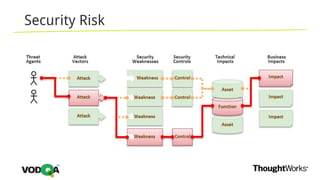
Security Risk
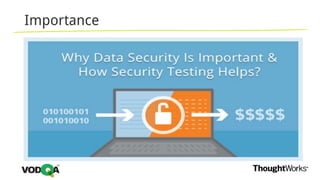
Importance
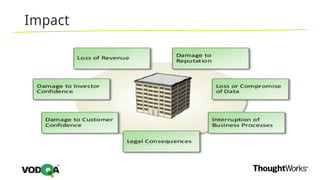
Impact
OWASP
● Open Web Application Security Project.
● Online community, which creates freely-available articles, methodologies, documentation, tools,
and technologies in the field of web application security
● Not-for-profit charitable organization.
● Focussed on improving the security of software.
● All material is available under a FOSS license.
● Currently has over 142 active projects.
OWASP Top 10
● List the 10 most critical web application security risks.
● A powerful awareness document.
● Published at regular intervals.
○ Approximately once in 3 years.
○ Last published in 2013
OWASP Top 10
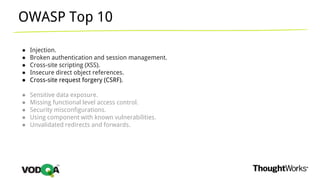
● Injection.
● Broken authentication and session management.
● Cross-site scripting (XSS).
● Insecure direct object references.
● Cross-site request forgery (CSRF).
● Sensitive data exposure.
● Missing functional level access control.
● Security misconfigurations.
● Using component with known vulnerabilities.
● Unvalidated redirects and forwards.
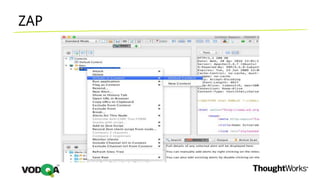
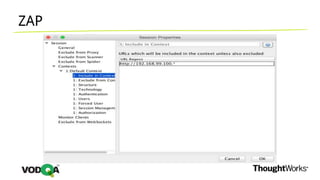
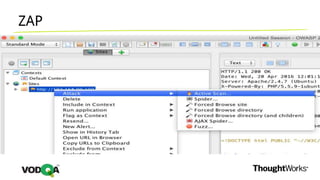
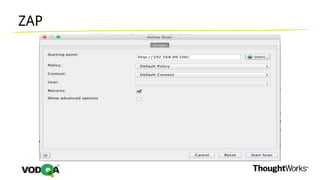
OWASP ZAP (Zed Attack Proxy)
DEMO
OWASP ZAP (Zed Attack Proxy)
● DVWA (An sample application with vulnerabilities)
● Take permission before attacking public web applications
● Bounty Programmes
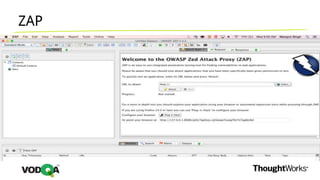
ZAP
ZAP
ZAP
ZAP
ZAP
OWASP ZAP (Zed Attack Proxy)
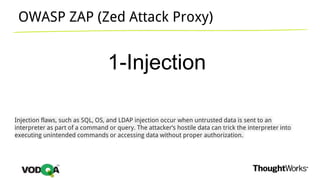
1-Injection
Injection flaws, such as SQL, OS, and LDAP injection occur when untrusted data is sent to an
interpreter as part of a command or query. The attacker’s hostile data can trick the interpreter into
executing unintended commands or accessing data without proper authorization.
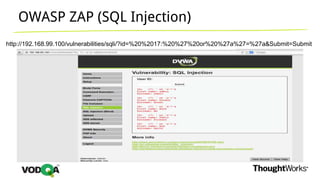
OWASP ZAP (SQL Injection)
http://192.168.99.100/vulnerabilities/sqli/?id=%20%2017:%20%27%20or%20%27a%27=%27a&Submit=Submit
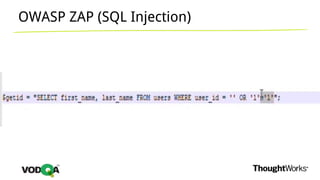
OWASP ZAP (SQL Injection)
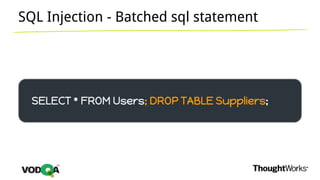
SELECT * FROM Users; DROP TABLE Suppliers;
SQL Injection - Batched sql statement
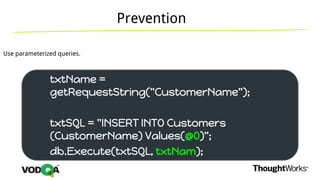
Prevention
Use parameterized queries.
txtName =
getRequestString("CustomerName");
txtSQL = "INSERT INTO Customers
(CustomerName) Values(@0)";
db.Execute(txtSQL, txtNam);
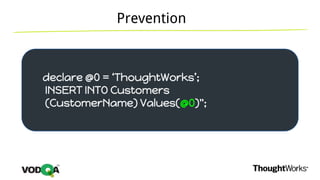
Prevention
declare @0 = ‘ThoughtWorks’;
INSERT INTO Customers
(CustomerName) Values(@0)";
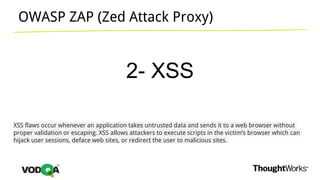
OWASP ZAP (Zed Attack Proxy)
2- XSS
XSS flaws occur whenever an application takes untrusted data and sends it to a web browser without
proper validation or escaping. XSS allows attackers to execute scripts in the victim’s browser which can
hijack user sessions, deface web sites, or redirect the user to malicious sites.
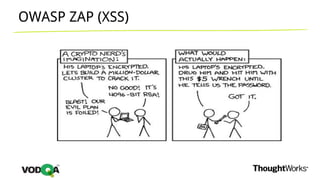
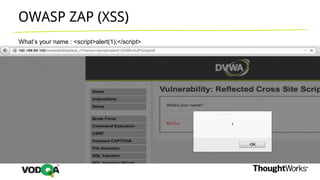
OWASP ZAP (XSS)
OWASP ZAP (XSS)
What’s your name : <script>alert(1);</script>
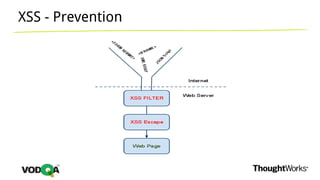
XSS - Prevention
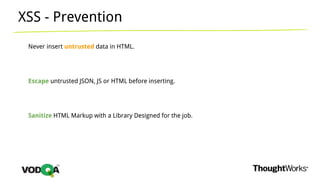
XSS - Prevention
Never insert untrusted data in HTML.
Escape untrusted JSON, JS or HTML before inserting.
Sanitize HTML Markup with a Library Designed for the job.
OWASP ZAP (Zed Attack Proxy)
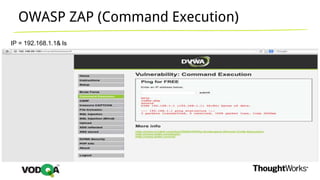
3-Command execution
Command injection is an attack in which the goal is execution of arbitrary commands on the host
operating system via a vulnerable application. Command injection attacks are possible when an
application passes unsafe user supplied data (forms, cookies, HTTP headers etc.) to a system shell.
OWASP ZAP (Command Execution)
IP = 192.168.1.1& ls
OWASP ZAP (Command Execution)
int main(char* argc, char** argv) {
char cmd[CMD_MAX] = "/usr/bin/cat ";
strcat(cmd, argv[1]);
system(cmd);
}
Command Execution - Prevention
The URL and form data needs to be sanitized for invalid characters.
A “blacklist” of characters is an option but -
- it may be difficult to think of all of the characters to validate against. Also there may be
some that were not discovered as of yet.
A “white list” containing only allowable characters should be created -
- to validate the user input. Characters that were missed, as well as undiscovered threats,
should be eliminated by this list.
OWASP ZAP (Zed Attack Proxy)
4-Brute Force
A brute force attack can manifest itself in many different ways, but primarily consists in an
attacker configuring predetermined values, making requests to a server using those values,
and then analyzing the response.
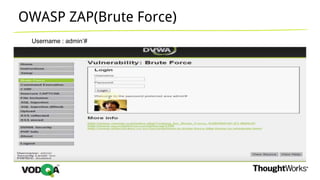
OWASP ZAP(Brute Force)
Username : admin’#
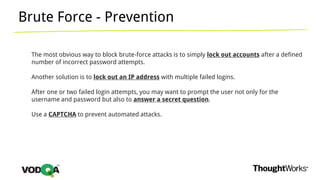
Brute Force - Prevention
The most obvious way to block brute-force attacks is to simply lock out accounts after a defined
number of incorrect password attempts.
Another solution is to lock out an IP address with multiple failed logins.
After one or two failed login attempts, you may want to prompt the user not only for the
username and password but also to answer a secret question.
Use a CAPTCHA to prevent automated attacks.
OWASP ZAP (Zed Attack Proxy)
5-Insecure Direct object
references
A direct object reference occurs when a developer exposes a reference to an internal implementation
object, such as a file, directory, or database key. Without an access control check or other protection,
attackers can manipulate these references to access unauthorized data.
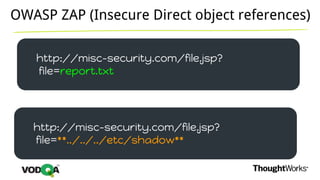
OWASP ZAP (Insecure Direct object references)
http://misc-security.com/file.jsp?
file=report.txt
http://misc-security.com/file.jsp?
file=**../../../etc/shadow**
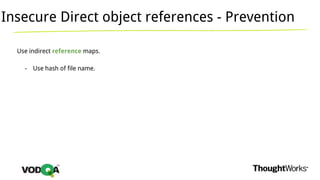
Insecure Direct object references - Prevention
Use indirect reference maps.
- Use hash of file name.
OWASP ZAP (Zed Attack Proxy)
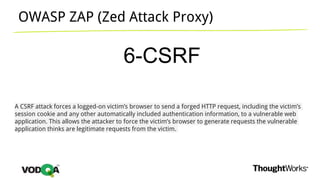
6-CSRF
A CSRF attack forces a logged-on victim’s browser to send a forged HTTP request, including the victim’s
session cookie and any other automatically included authentication information, to a vulnerable web
application. This allows the attacker to force the victim’s browser to generate requests the vulnerable
application thinks are legitimate requests from the victim.
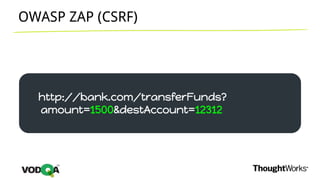
OWASP ZAP (CSRF)
http://bank.com/transferFunds?
amount=1500&destAccount=12312
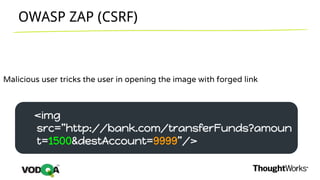
OWASP ZAP (CSRF)
Malicious user tricks the user in opening the image with forged link
<img
src=”http://bank.com/transferFunds?amoun
t=1500&destAccount=9999”/>
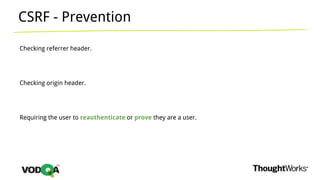
CSRF - Prevention
Checking referrer header.
Checking origin header.
Requiring the user to reauthenticate or prove they are a user.
References
https://en.wikipedia.org/wiki/OWASP
https://www.owasp.org/index.php/Top_10_2013-Top_10
http://www.slideshare.net/vodqanite/introduction-to-security-vulnerabilities
https://docs.google.com/presentation/d/16fn47AZSNxorx-
D5DkYjALeEkJ8sGCdZg3MguYrSmrM/edit?ts=56d424e8#slide=id.p
Questions

Security Testing - Zap It

  • 1.
    Hanika D Manjyot Singh SamajShekhar Security Testing - Zap It
  • 2.
    Introduction Manjyot Singh QA @Thoughtworks manjyots@thoughtworks.com Hanika D QA @ Thoughtworks hanikad@thoughtworks.com Samaj Shekhar App Dev @ Thoughtworks samajs@thoughtworks.com
  • 3.
  • 4.
  • 5.
  • 6.
    OWASP ● Open WebApplication Security Project. ● Online community, which creates freely-available articles, methodologies, documentation, tools, and technologies in the field of web application security ● Not-for-profit charitable organization. ● Focussed on improving the security of software. ● All material is available under a FOSS license. ● Currently has over 142 active projects.
  • 7.
    OWASP Top 10 ●List the 10 most critical web application security risks. ● A powerful awareness document. ● Published at regular intervals. ○ Approximately once in 3 years. ○ Last published in 2013
  • 8.
    OWASP Top 10 ●Injection. ● Broken authentication and session management. ● Cross-site scripting (XSS). ● Insecure direct object references. ● Cross-site request forgery (CSRF). ● Sensitive data exposure. ● Missing functional level access control. ● Security misconfigurations. ● Using component with known vulnerabilities. ● Unvalidated redirects and forwards.
  • 9.
    OWASP ZAP (ZedAttack Proxy) DEMO
  • 10.
    OWASP ZAP (ZedAttack Proxy) ● DVWA (An sample application with vulnerabilities) ● Take permission before attacking public web applications ● Bounty Programmes
  • 11.
  • 12.
  • 13.
  • 14.
  • 15.
  • 16.
    OWASP ZAP (ZedAttack Proxy) 1-Injection Injection flaws, such as SQL, OS, and LDAP injection occur when untrusted data is sent to an interpreter as part of a command or query. The attacker’s hostile data can trick the interpreter into executing unintended commands or accessing data without proper authorization.
  • 17.
    OWASP ZAP (SQLInjection) http://192.168.99.100/vulnerabilities/sqli/?id=%20%2017:%20%27%20or%20%27a%27=%27a&Submit=Submit
  • 18.
    OWASP ZAP (SQLInjection)
  • 19.
    SELECT * FROMUsers; DROP TABLE Suppliers; SQL Injection - Batched sql statement
  • 20.
    Prevention Use parameterized queries. txtName= getRequestString("CustomerName"); txtSQL = "INSERT INTO Customers (CustomerName) Values(@0)"; db.Execute(txtSQL, txtNam);
  • 21.
    Prevention declare @0 =‘ThoughtWorks’; INSERT INTO Customers (CustomerName) Values(@0)";
  • 22.
    OWASP ZAP (ZedAttack Proxy) 2- XSS XSS flaws occur whenever an application takes untrusted data and sends it to a web browser without proper validation or escaping. XSS allows attackers to execute scripts in the victim’s browser which can hijack user sessions, deface web sites, or redirect the user to malicious sites.
  • 23.
  • 24.
    OWASP ZAP (XSS) What’syour name : <script>alert(1);</script>
  • 25.
  • 26.
    XSS - Prevention Neverinsert untrusted data in HTML. Escape untrusted JSON, JS or HTML before inserting. Sanitize HTML Markup with a Library Designed for the job.
  • 27.
    OWASP ZAP (ZedAttack Proxy) 3-Command execution Command injection is an attack in which the goal is execution of arbitrary commands on the host operating system via a vulnerable application. Command injection attacks are possible when an application passes unsafe user supplied data (forms, cookies, HTTP headers etc.) to a system shell.
  • 28.
    OWASP ZAP (CommandExecution) IP = 192.168.1.1& ls
  • 29.
    OWASP ZAP (CommandExecution) int main(char* argc, char** argv) { char cmd[CMD_MAX] = "/usr/bin/cat "; strcat(cmd, argv[1]); system(cmd); }
  • 30.
    Command Execution -Prevention The URL and form data needs to be sanitized for invalid characters. A “blacklist” of characters is an option but - - it may be difficult to think of all of the characters to validate against. Also there may be some that were not discovered as of yet. A “white list” containing only allowable characters should be created - - to validate the user input. Characters that were missed, as well as undiscovered threats, should be eliminated by this list.
  • 31.
    OWASP ZAP (ZedAttack Proxy) 4-Brute Force A brute force attack can manifest itself in many different ways, but primarily consists in an attacker configuring predetermined values, making requests to a server using those values, and then analyzing the response.
  • 32.
  • 33.
    Brute Force -Prevention The most obvious way to block brute-force attacks is to simply lock out accounts after a defined number of incorrect password attempts. Another solution is to lock out an IP address with multiple failed logins. After one or two failed login attempts, you may want to prompt the user not only for the username and password but also to answer a secret question. Use a CAPTCHA to prevent automated attacks.
  • 34.
    OWASP ZAP (ZedAttack Proxy) 5-Insecure Direct object references A direct object reference occurs when a developer exposes a reference to an internal implementation object, such as a file, directory, or database key. Without an access control check or other protection, attackers can manipulate these references to access unauthorized data.
  • 35.
    OWASP ZAP (InsecureDirect object references) http://misc-security.com/file.jsp? file=report.txt http://misc-security.com/file.jsp? file=**../../../etc/shadow**
  • 36.
    Insecure Direct objectreferences - Prevention Use indirect reference maps. - Use hash of file name.
  • 37.
    OWASP ZAP (ZedAttack Proxy) 6-CSRF A CSRF attack forces a logged-on victim’s browser to send a forged HTTP request, including the victim’s session cookie and any other automatically included authentication information, to a vulnerable web application. This allows the attacker to force the victim’s browser to generate requests the vulnerable application thinks are legitimate requests from the victim.
  • 38.
  • 39.
    OWASP ZAP (CSRF) Malicioususer tricks the user in opening the image with forged link <img src=”http://bank.com/transferFunds?amoun t=1500&destAccount=9999”/>
  • 40.
    CSRF - Prevention Checkingreferrer header. Checking origin header. Requiring the user to reauthenticate or prove they are a user.
  • 41.
  • 42.