Presented by
                                                            Lynn Voss
                                   senior continuing education coordinator

                                                 Gina Ganahl, Ph.D.
                                                           associate dean


University of Missouri-St. Louis, Division of Continuing Education
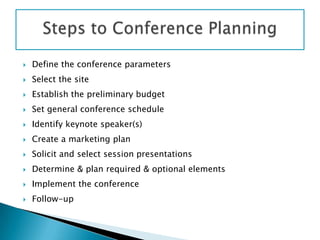
   Define the conference parameters
   Select the site
   Establish the preliminary budget
   Set general conference schedule
   Identify keynote speaker(s)
   Create a marketing plan
   Solicit and select session presentations
   Determine & plan required & optional elements
   Implement the conference
   Follow-up
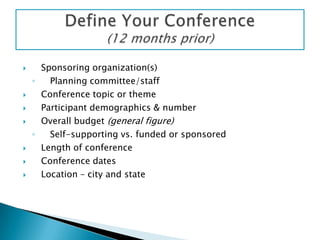
     Sponsoring organization(s)
    ◦   Planning committee/staff
     Conference topic or theme
     Participant demographics & number
     Overall budget (general figure)
    ◦   Self-supporting vs. funded or sponsored
     Length of conference
     Conference dates
     Location – city and state
   Organization’s requirements
   Ease of travel to and from, and around town
   Relative cost compared to other cities
   Weather during conference date(s)
   Availability of conference facilities
   Amenities of the city
   Location of the organization’s last conferences
   Conference center + off-site hotel
    ◦ Advantages:
       Less expensive
    ◦ Disadvantages:
       Less convenient for participants
       Shuttle service between center and hotel needed
       Fewer options available- less location flexibility

   Hotel with conference center
    ◦ Advantages:
         Convenient for participants.
         No shuttle service needed
         Better networking opportunities for participants
         More location flexibility
    ◦ Disadvantages:
       More expensive (food, meeting space, AV equipment, etc.)
   Items to consider:
    ◦ Hotel layout – flow of meeting rooms, general session
      space, meal facilities, check-in, exhibitor space, security,
      storage, speaker prep room…
    ◦ Site amenities
    ◦ Parking
    ◦ Food cost, including gratuities, & minimums
    ◦ Guest room attrition rate & penalties
    ◦ Complimentary rooms
    ◦ AV equipment cost or use of outside vendor
    ◦ Cost for exhibit amenities, i.e. pipe & drape, electric
    ◦ Flexibility for changing room block
Define Revenue Sources           Define Expenses

   Registration fees       Fixed expenses:
   Exhibitor fees           ◦   Speakers
                             ◦   Entertainment
   Meal fees
                             ◦   AV equipment
   Sponsorships             ◦   Marketing
   Grants & Gifts…          ◦   Hotel fees…
                            Variable expenses:
                             ◦ Meals
                             ◦ Program book…
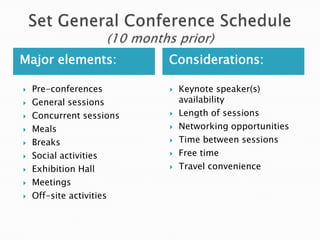
Major elements:           Considerations:

   Pre-conferences          Keynote speaker(s)
   General sessions          availability
   Concurrent sessions      Length of sessions
   Meals                    Networking opportunities
   Breaks                   Time between sessions
   Social activities        Free time
   Exhibition Hall          Travel convenience
   Meetings
   Off-site activities
   Topic
   Expertise
   Reputation
   Availability
   Cost
   Relationship to
    organization…
    Printed Materials:           Electronic Tools:
      ◦   Postcards                 o   Email blasts
      ◦   Brochures                 o   Google Word Ads
      ◦   Posters/Banners           o   Phone inquiries
      ◦   Fliers                    o   Links from other
      ◦   Booklets                      organizations’ sites
                                    o   Electronic calendar
                                        postings
   Registration Details:
                                        Web site
    ◦ Fee breakdown
                                    o

    ◦ Early reg. discounts
    ◦ Modes of registration
                              Email & mailing lists are
                              essential for a successful
                                  marketing plan.
Tell everything about the conference!

   Date & Location              City information w/ links
   Topic/theme                  Transportation information
   Schedule                     w/ links
   Pre-conference information   Awards nominations
   Keynote speakers             Podcast of speakers or
                                 committee chair
   Registration page
                                 Wiki or blog for pre-
   Call for proposals
                                 conference discussions
    Hotel information w/ link
                                 Contact information
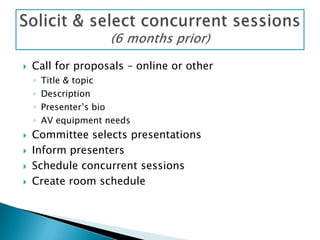
   Call for proposals – online or other
    ◦   Title & topic
    ◦   Description
    ◦   Presenter’s bio
    ◦   AV equipment needs
   Committee selects presentations
   Inform presenters
   Schedule concurrent sessions
   Create room schedule
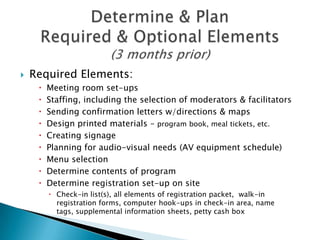
   Required Elements:
        Meeting room set-ups
        Staffing, including the selection of moderators & facilitators
        Sending confirmation letters w/directions & maps
        Design printed materials – program book, meal tickets, etc.
        Creating signage
        Planning for audio-visual needs (AV equipment schedule)
        Menu selection
        Determine contents of program
        Determine registration set-up on site
          Check-in list(s), all elements of registration packet, walk-in
           registration forms, computer hook-ups in check-in area, name
           tags, supplemental information sheets, petty cash box
   Optional Elements:
        Coordinate posters & poster materials for poster session
        Plan entertainment
        Establish giveaways
        Coordinate with exhibitors
          Exhibitor contracts & letters of solicitation
        Plan field trips
        Coordinate security for exhibitors & posters
        Directory of attendees
        CEU certificates or certificates of participation
   Monitoring all
    required &/or
    optional details of
    the previously
    mentioned plan

   Checking &
    confirming with all
    vendors and staff
   Pay bills
    ◦ Pay honoraria, travel vouchers, hotel bills, etc.
   Finalize the budget
   Collate & report conference evaluations
   Organize files for the next conference
   Send thank you notes to key volunteers
   12 Establish dates & location – reserve meeting rooms
   10 Prepare budget, establish fees, prepare proper forms
       initiating program/conference
   10 Determine clientele and identify sources for mailing lists
   10 Identify keynote speaker(s)
   8  Order/prepare mail lists
   8  First draft of brochure to Marketing
   7  Proof brochure
   6  Brochure printed
   6  Brochure and labels to mail house in in-house mail room
   6  Solicit & select concurrent sessions
   5     Identify keynote speakers
   5     Prepare confirmation letter and pre-registration materials
   3     Determine & Plan Required & Optional Planning Elements
   2-3   Order printed registration packet materials
   2-3   Course notes to your Quick Copy shop
   2     Arrange meeting room set-up, meals, breaks, etc.
   2     Arrange audio-visual equipment
   2     Make travel arrangements)
   1     Reconfirm all meeting site arrangements, assemble all
          supplies, prepare registrant list
Lynn Voss, M.A.
Senior Continuing Education Coordinator, Division of Continuing Education
University of Missouri-St. Louis
lvoss@umsl.edu
(314) 516-5972


Gina Ganahl, Ph.D.
Associate Dean, Division of Continuing Education
University of Missouri-St. Louis
ganahlg@umsl.edu
(314) 516-5925

Conference Planning Presentation

  • 1.
    Presented by Lynn Voss senior continuing education coordinator Gina Ganahl, Ph.D. associate dean University of Missouri-St. Louis, Division of Continuing Education
  • 2.
    Define the conference parameters  Select the site  Establish the preliminary budget  Set general conference schedule  Identify keynote speaker(s)  Create a marketing plan  Solicit and select session presentations  Determine & plan required & optional elements  Implement the conference  Follow-up
  • 3.
    Sponsoring organization(s) ◦ Planning committee/staff  Conference topic or theme  Participant demographics & number  Overall budget (general figure) ◦ Self-supporting vs. funded or sponsored  Length of conference  Conference dates  Location – city and state
  • 4.
    Organization’s requirements  Ease of travel to and from, and around town  Relative cost compared to other cities  Weather during conference date(s)  Availability of conference facilities  Amenities of the city  Location of the organization’s last conferences
  • 5.
    Conference center + off-site hotel ◦ Advantages:  Less expensive ◦ Disadvantages:  Less convenient for participants  Shuttle service between center and hotel needed  Fewer options available- less location flexibility  Hotel with conference center ◦ Advantages:  Convenient for participants.  No shuttle service needed  Better networking opportunities for participants  More location flexibility ◦ Disadvantages:  More expensive (food, meeting space, AV equipment, etc.)
  • 6.
    Items to consider: ◦ Hotel layout – flow of meeting rooms, general session space, meal facilities, check-in, exhibitor space, security, storage, speaker prep room… ◦ Site amenities ◦ Parking ◦ Food cost, including gratuities, & minimums ◦ Guest room attrition rate & penalties ◦ Complimentary rooms ◦ AV equipment cost or use of outside vendor ◦ Cost for exhibit amenities, i.e. pipe & drape, electric ◦ Flexibility for changing room block
  • 7.
    Define Revenue Sources Define Expenses  Registration fees  Fixed expenses:  Exhibitor fees ◦ Speakers ◦ Entertainment  Meal fees ◦ AV equipment  Sponsorships ◦ Marketing  Grants & Gifts… ◦ Hotel fees…  Variable expenses: ◦ Meals ◦ Program book…
  • 8.
    Major elements: Considerations:  Pre-conferences  Keynote speaker(s)  General sessions availability  Concurrent sessions  Length of sessions  Meals  Networking opportunities  Breaks  Time between sessions  Social activities  Free time  Exhibition Hall  Travel convenience  Meetings  Off-site activities
  • 9.
    Topic  Expertise  Reputation  Availability  Cost  Relationship to organization…
  • 10.
    Printed Materials:  Electronic Tools: ◦ Postcards o Email blasts ◦ Brochures o Google Word Ads ◦ Posters/Banners o Phone inquiries ◦ Fliers o Links from other ◦ Booklets organizations’ sites o Electronic calendar postings  Registration Details: Web site ◦ Fee breakdown o ◦ Early reg. discounts ◦ Modes of registration Email & mailing lists are essential for a successful marketing plan.
  • 11.
    Tell everything aboutthe conference!  Date & Location City information w/ links  Topic/theme Transportation information  Schedule w/ links  Pre-conference information Awards nominations  Keynote speakers Podcast of speakers or committee chair  Registration page Wiki or blog for pre-  Call for proposals conference discussions Hotel information w/ link Contact information
  • 12.
    Call for proposals – online or other ◦ Title & topic ◦ Description ◦ Presenter’s bio ◦ AV equipment needs  Committee selects presentations  Inform presenters  Schedule concurrent sessions  Create room schedule
  • 13.
    Required Elements:  Meeting room set-ups  Staffing, including the selection of moderators & facilitators  Sending confirmation letters w/directions & maps  Design printed materials – program book, meal tickets, etc.  Creating signage  Planning for audio-visual needs (AV equipment schedule)  Menu selection  Determine contents of program  Determine registration set-up on site  Check-in list(s), all elements of registration packet, walk-in registration forms, computer hook-ups in check-in area, name tags, supplemental information sheets, petty cash box
  • 14.
    Optional Elements:  Coordinate posters & poster materials for poster session  Plan entertainment  Establish giveaways  Coordinate with exhibitors  Exhibitor contracts & letters of solicitation  Plan field trips  Coordinate security for exhibitors & posters  Directory of attendees  CEU certificates or certificates of participation
  • 15.
    Monitoring all required &/or optional details of the previously mentioned plan  Checking & confirming with all vendors and staff
  • 16.
    Pay bills ◦ Pay honoraria, travel vouchers, hotel bills, etc.  Finalize the budget  Collate & report conference evaluations  Organize files for the next conference  Send thank you notes to key volunteers
  • 17.
    12 Establish dates & location – reserve meeting rooms  10 Prepare budget, establish fees, prepare proper forms initiating program/conference  10 Determine clientele and identify sources for mailing lists  10 Identify keynote speaker(s)  8 Order/prepare mail lists  8 First draft of brochure to Marketing  7 Proof brochure  6 Brochure printed  6 Brochure and labels to mail house in in-house mail room  6 Solicit & select concurrent sessions
  • 18.
    5 Identify keynote speakers  5 Prepare confirmation letter and pre-registration materials  3 Determine & Plan Required & Optional Planning Elements  2-3 Order printed registration packet materials  2-3 Course notes to your Quick Copy shop  2 Arrange meeting room set-up, meals, breaks, etc.  2 Arrange audio-visual equipment  2 Make travel arrangements)  1 Reconfirm all meeting site arrangements, assemble all supplies, prepare registrant list
  • 19.
    Lynn Voss, M.A. SeniorContinuing Education Coordinator, Division of Continuing Education University of Missouri-St. Louis lvoss@umsl.edu (314) 516-5972 Gina Ganahl, Ph.D. Associate Dean, Division of Continuing Education University of Missouri-St. Louis ganahlg@umsl.edu (314) 516-5925