Venkata Maguluri
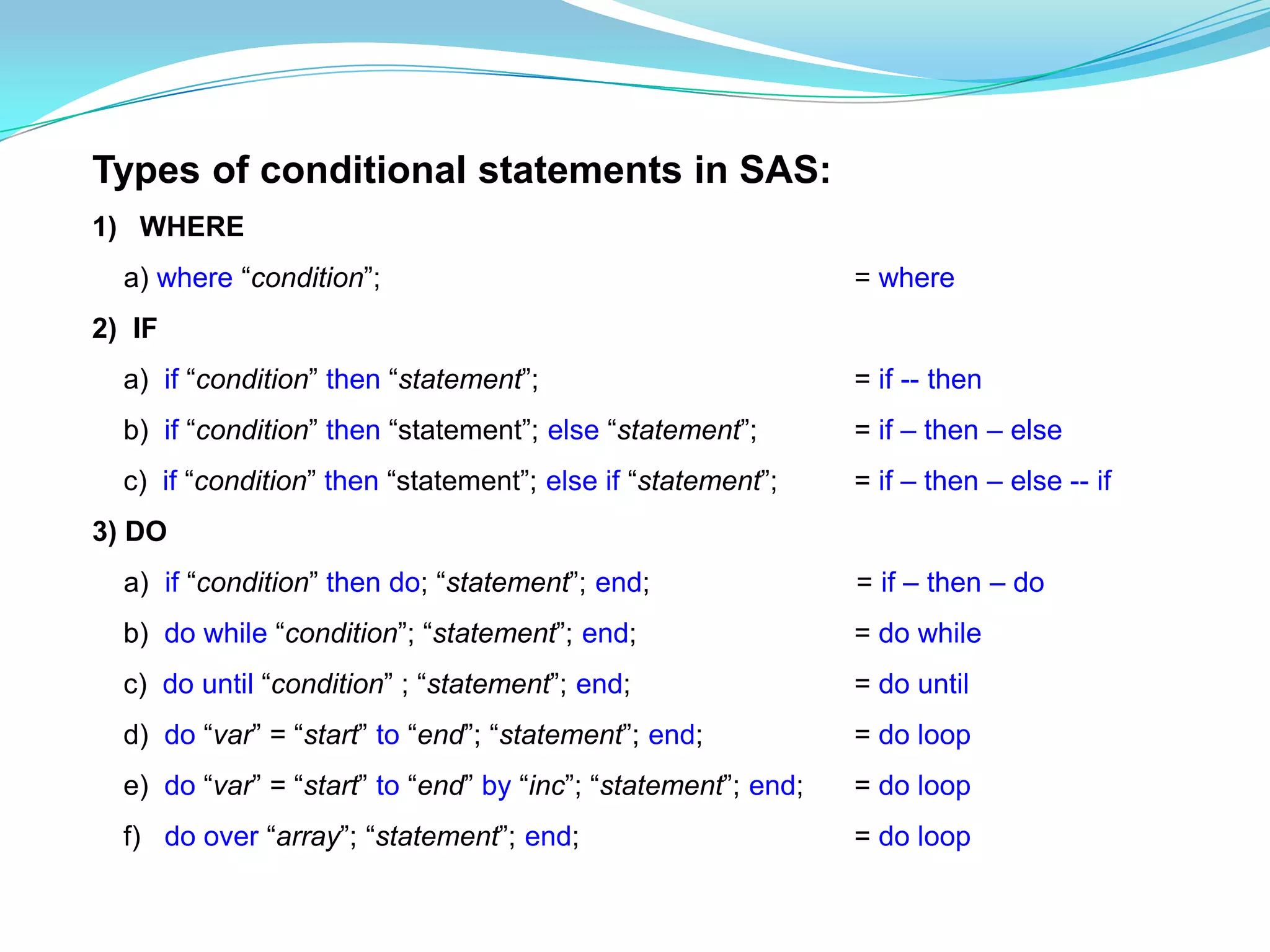
Types of conditional statements in SAS:
1) WHERE
  a) where “condition”;                                        = where
2) IF
  a) if “condition” then “statement”;                          = if -- then
  b) if “condition” then “statement”; else “statement”;        = if – then – else
  c) if “condition” then “statement”; else if “statement”;     = if – then – else -- if
3) DO
  a) if “condition” then do; “statement”; end;                 = if – then – do
  b) do while “condition”; “statement”; end;                   = do while
  c) do until “condition” ; “statement”; end;                  = do until
  d) do “var” = “start” to “end”; “statement”; end;            = do loop
  e) do “var” = “start” to “end” by “inc”; “statement”; end;   = do loop
  f) do over “array”; “statement”; end;                        = do loop
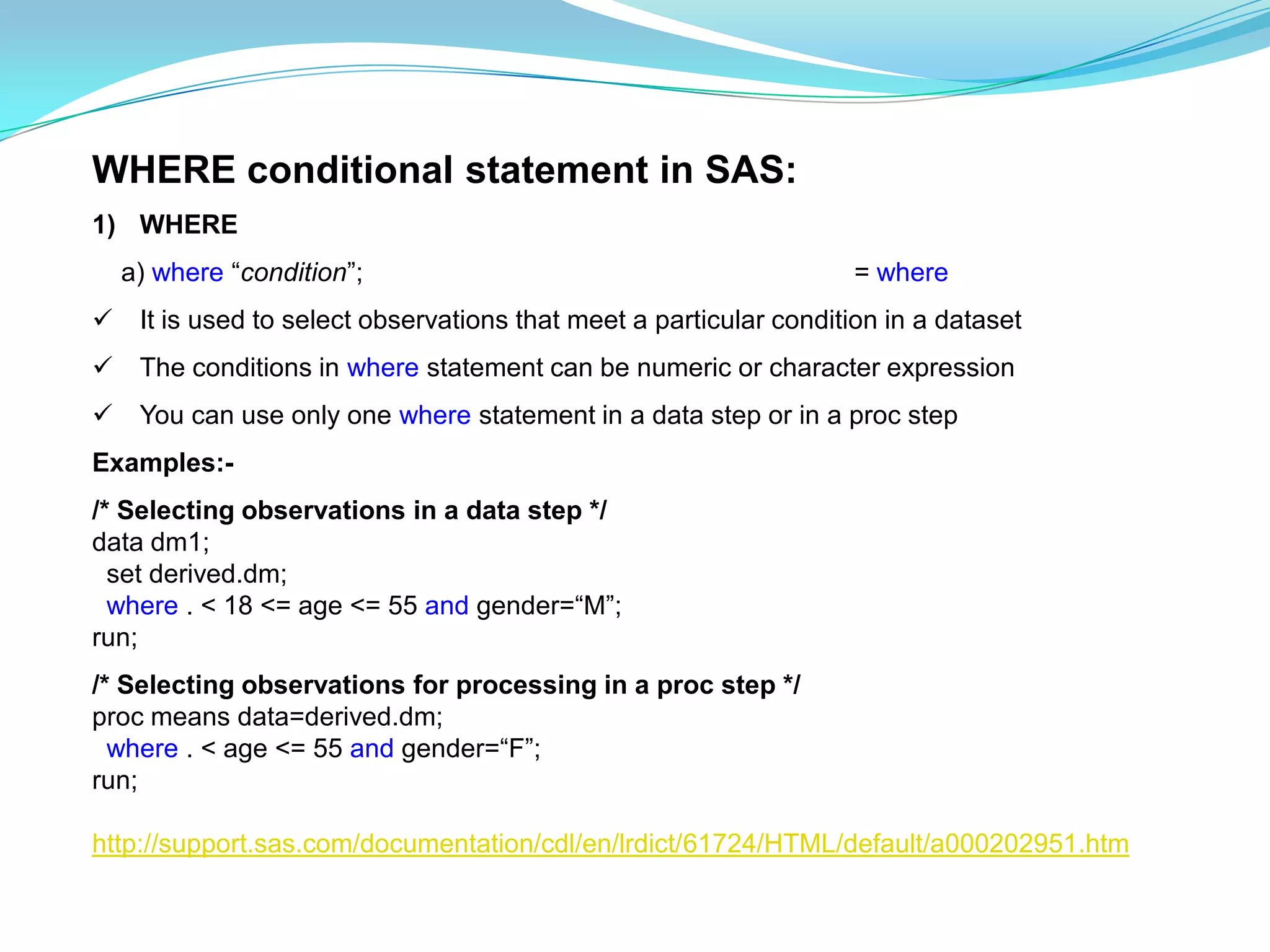
WHERE conditional statement in SAS:
1) WHERE
    a) where “condition”;                                           = where
    It is used to select observations that meet a particular condition in a dataset
    The conditions in where statement can be numeric or character expression
    You can use only one where statement in a data step or in a proc step
Examples:-
/* Selecting observations in a data step */
data dm1;
  set derived.dm;
  where . < 18 <= age <= 55 and gender=“M”;
run;
/* Selecting observations for processing in a proc step */
proc means data=derived.dm;
  where . < age <= 55 and gender=“F”;
run;

http://support.sas.com/documentation/cdl/en/lrdict/61724/HTML/default/a000202951.htm
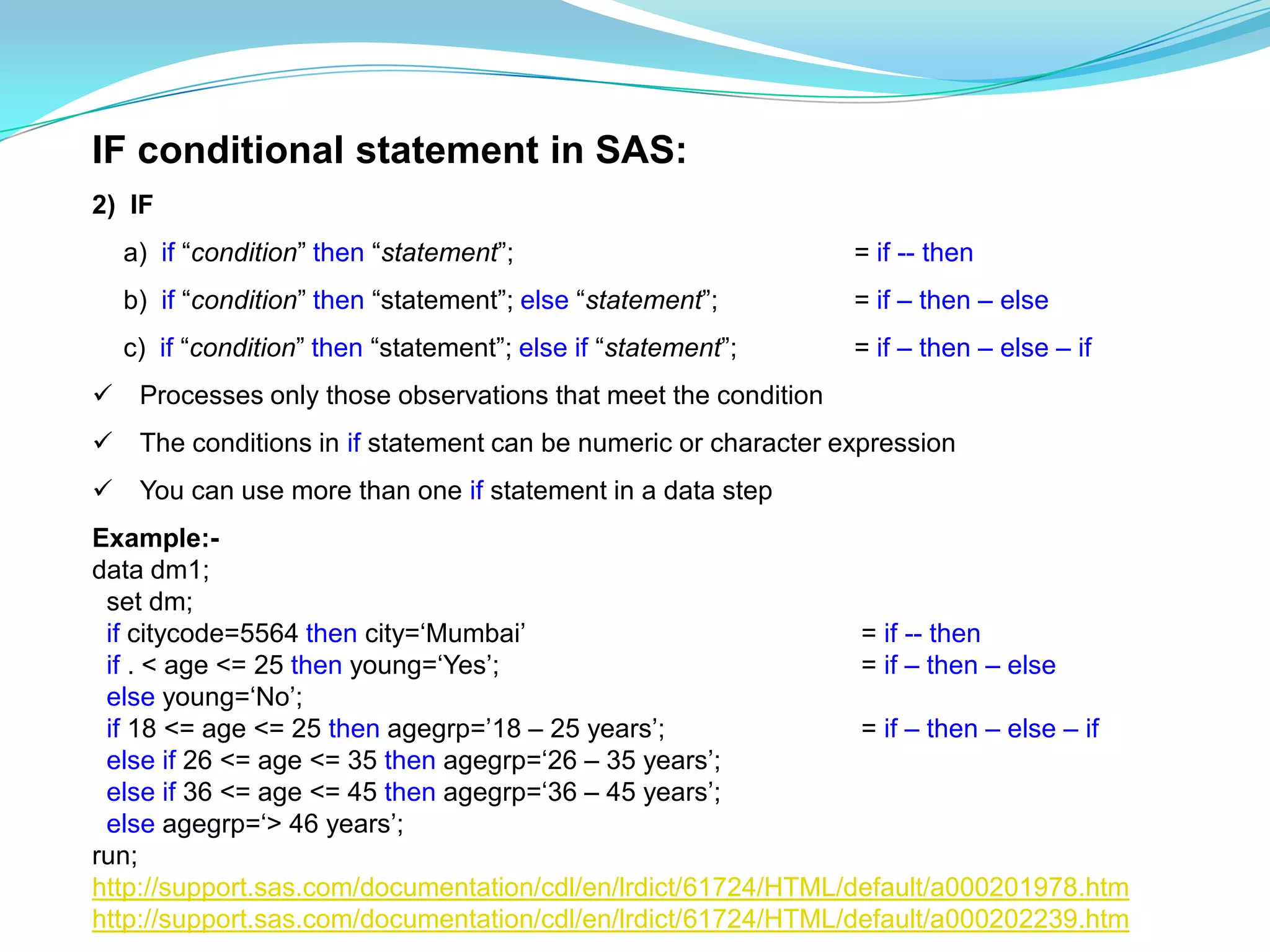
IF conditional statement in SAS:
2) IF
    a) if “condition” then “statement”;                          = if -- then
    b) if “condition” then “statement”; else “statement”;        = if – then – else
    c) if “condition” then “statement”; else if “statement”;     = if – then – else – if
    Processes only those observations that meet the condition
    The conditions in if statement can be numeric or character expression
    You can use more than one if statement in a data step
Example:-
data dm1;
 set dm;
 if citycode=5564 then city=„Mumbai‟                           = if -- then
 if . < age <= 25 then young=„Yes‟;                            = if – then – else
 else young=„No‟;
 if 18 <= age <= 25 then agegrp=‟18 – 25 years‟;               = if – then – else – if
 else if 26 <= age <= 35 then agegrp=„26 – 35 years‟;
 else if 36 <= age <= 45 then agegrp=„36 – 45 years‟;
 else agegrp=„> 46 years‟;
run;
http://support.sas.com/documentation/cdl/en/lrdict/61724/HTML/default/a000201978.htm
http://support.sas.com/documentation/cdl/en/lrdict/61724/HTML/default/a000202239.htm
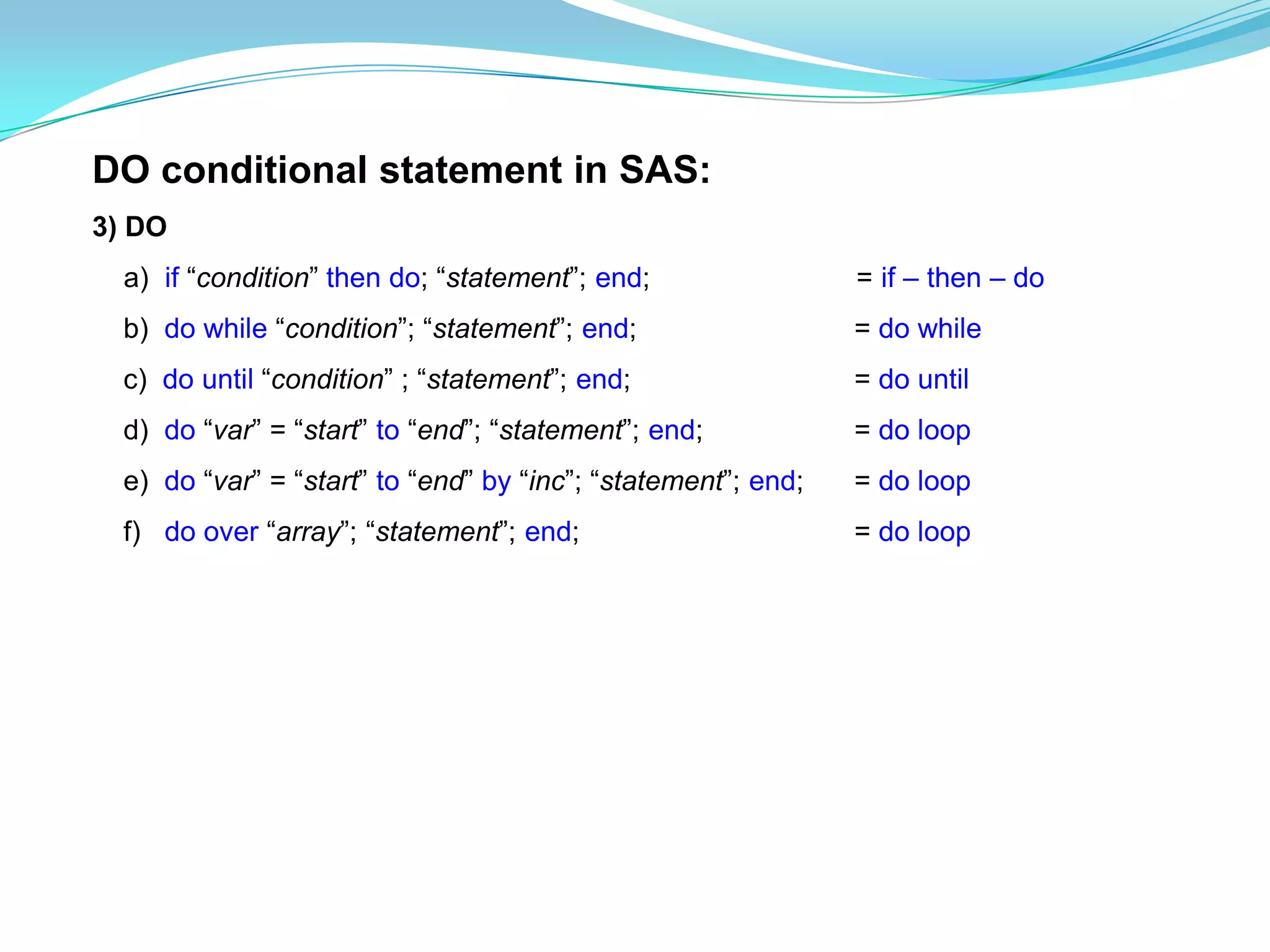
DO conditional statement in SAS:
3) DO
  a) if “condition” then do; “statement”; end;                 = if – then – do
  b) do while “condition”; “statement”; end;                   = do while
  c) do until “condition” ; “statement”; end;                  = do until
  d) do “var” = “start” to “end”; “statement”; end;            = do loop
  e) do “var” = “start” to “end” by “inc”; “statement”; end;   = do loop
  f) do over “array”; “statement”; end;                        = do loop
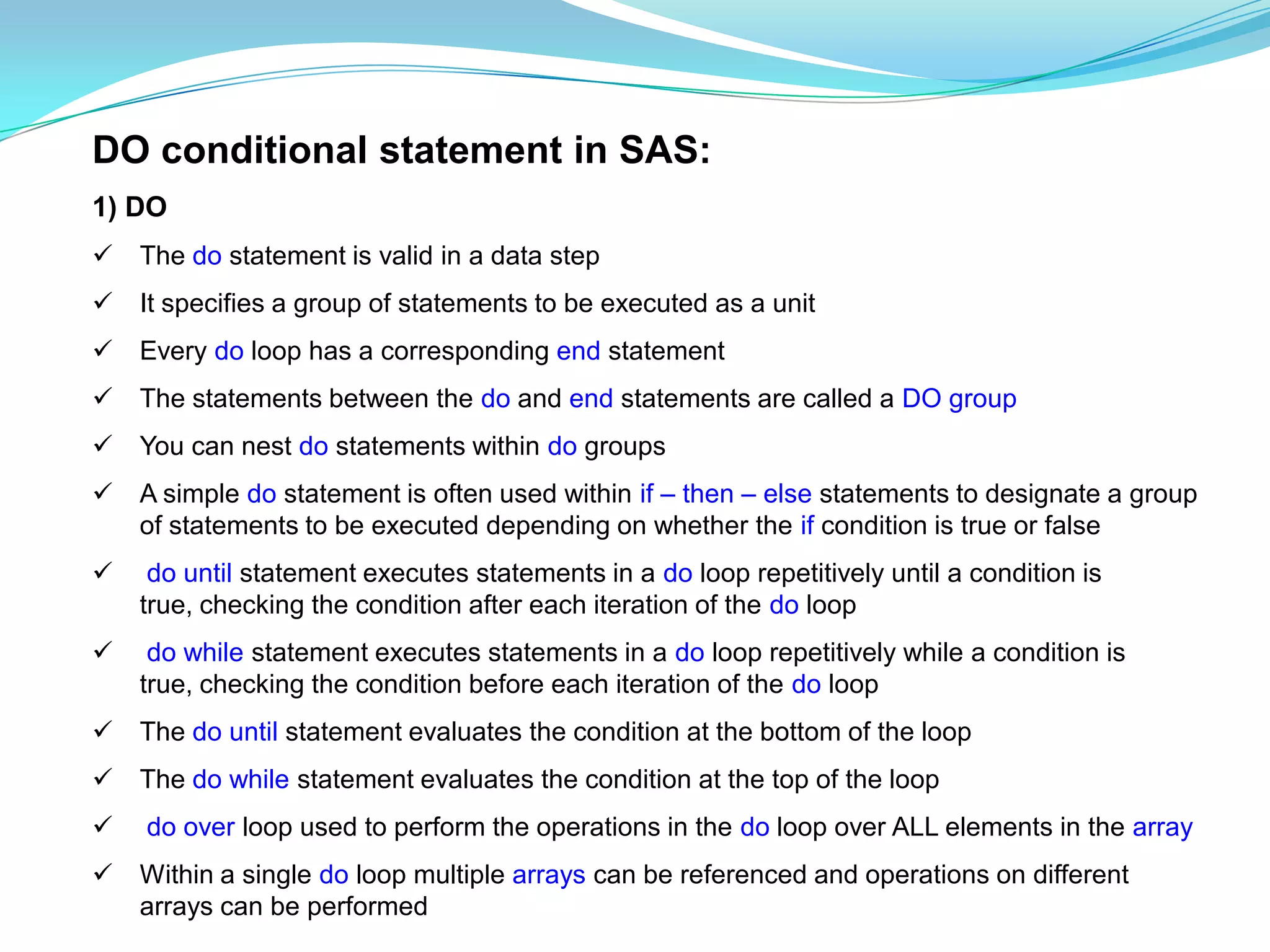
DO conditional statement in SAS:
1) DO
   The do statement is valid in a data step
   It specifies a group of statements to be executed as a unit
   Every do loop has a corresponding end statement
   The statements between the do and end statements are called a DO group
   You can nest do statements within do groups
   A simple do statement is often used within if – then – else statements to designate a group
    of statements to be executed depending on whether the if condition is true or false
    do until statement executes statements in a do loop repetitively until a condition is
    true, checking the condition after each iteration of the do loop
    do while statement executes statements in a do loop repetitively while a condition is
    true, checking the condition before each iteration of the do loop
   The do until statement evaluates the condition at the bottom of the loop
   The do while statement evaluates the condition at the top of the loop
   do over loop used to perform the operations in the do loop over ALL elements in the array
   Within a single do loop multiple arrays can be referenced and operations on different
    arrays can be performed
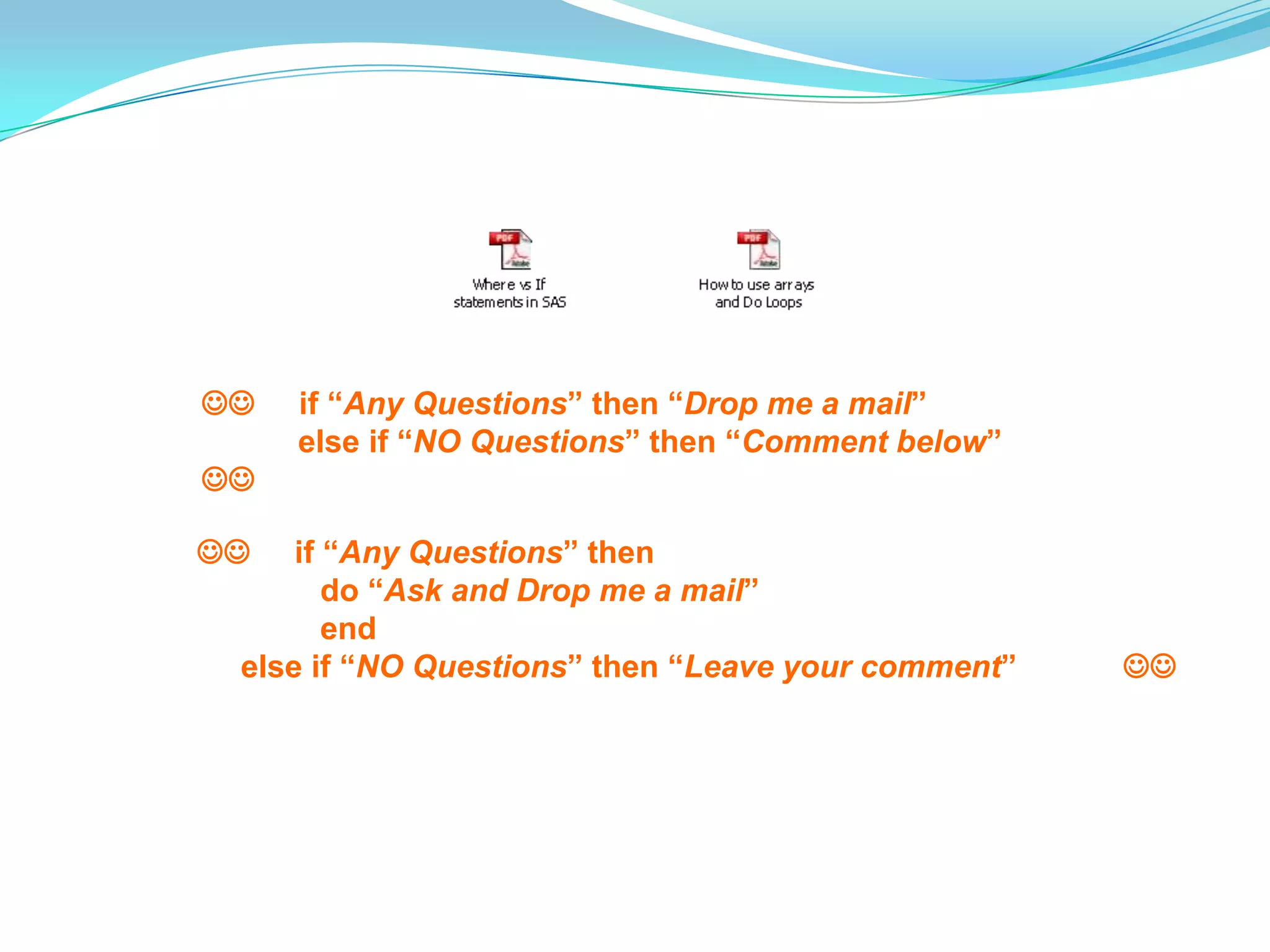
   if “Any Questions” then “Drop me a mail”
     else if “NO Questions” then “Comment below”


   if “Any Questions” then
        do “Ask and Drop me a mail”
        end
 else if “NO Questions” then “Leave your comment”   

Conditional statements in sas

  • 1.
  • 2.
    Types of conditionalstatements in SAS: 1) WHERE a) where “condition”; = where 2) IF a) if “condition” then “statement”; = if -- then b) if “condition” then “statement”; else “statement”; = if – then – else c) if “condition” then “statement”; else if “statement”; = if – then – else -- if 3) DO a) if “condition” then do; “statement”; end; = if – then – do b) do while “condition”; “statement”; end; = do while c) do until “condition” ; “statement”; end; = do until d) do “var” = “start” to “end”; “statement”; end; = do loop e) do “var” = “start” to “end” by “inc”; “statement”; end; = do loop f) do over “array”; “statement”; end; = do loop
  • 3.
    WHERE conditional statementin SAS: 1) WHERE a) where “condition”; = where  It is used to select observations that meet a particular condition in a dataset  The conditions in where statement can be numeric or character expression  You can use only one where statement in a data step or in a proc step Examples:- /* Selecting observations in a data step */ data dm1; set derived.dm; where . < 18 <= age <= 55 and gender=“M”; run; /* Selecting observations for processing in a proc step */ proc means data=derived.dm; where . < age <= 55 and gender=“F”; run; http://support.sas.com/documentation/cdl/en/lrdict/61724/HTML/default/a000202951.htm
  • 4.
    IF conditional statementin SAS: 2) IF a) if “condition” then “statement”; = if -- then b) if “condition” then “statement”; else “statement”; = if – then – else c) if “condition” then “statement”; else if “statement”; = if – then – else – if  Processes only those observations that meet the condition  The conditions in if statement can be numeric or character expression  You can use more than one if statement in a data step Example:- data dm1; set dm; if citycode=5564 then city=„Mumbai‟ = if -- then if . < age <= 25 then young=„Yes‟; = if – then – else else young=„No‟; if 18 <= age <= 25 then agegrp=‟18 – 25 years‟; = if – then – else – if else if 26 <= age <= 35 then agegrp=„26 – 35 years‟; else if 36 <= age <= 45 then agegrp=„36 – 45 years‟; else agegrp=„> 46 years‟; run; http://support.sas.com/documentation/cdl/en/lrdict/61724/HTML/default/a000201978.htm http://support.sas.com/documentation/cdl/en/lrdict/61724/HTML/default/a000202239.htm
  • 5.
    DO conditional statementin SAS: 3) DO a) if “condition” then do; “statement”; end; = if – then – do b) do while “condition”; “statement”; end; = do while c) do until “condition” ; “statement”; end; = do until d) do “var” = “start” to “end”; “statement”; end; = do loop e) do “var” = “start” to “end” by “inc”; “statement”; end; = do loop f) do over “array”; “statement”; end; = do loop
  • 6.
    DO conditional statementin SAS: 1) DO  The do statement is valid in a data step  It specifies a group of statements to be executed as a unit  Every do loop has a corresponding end statement  The statements between the do and end statements are called a DO group  You can nest do statements within do groups  A simple do statement is often used within if – then – else statements to designate a group of statements to be executed depending on whether the if condition is true or false  do until statement executes statements in a do loop repetitively until a condition is true, checking the condition after each iteration of the do loop  do while statement executes statements in a do loop repetitively while a condition is true, checking the condition before each iteration of the do loop  The do until statement evaluates the condition at the bottom of the loop  The do while statement evaluates the condition at the top of the loop  do over loop used to perform the operations in the do loop over ALL elements in the array  Within a single do loop multiple arrays can be referenced and operations on different arrays can be performed
  • 7.
     if “Any Questions” then “Drop me a mail” else if “NO Questions” then “Comment below”   if “Any Questions” then do “Ask and Drop me a mail” end else if “NO Questions” then “Leave your comment” 