BATCHING, MIXING,TRANSPORTATION
AND COMPACTION OF CONCRETE
Presented BY
Engr M Usman
CONCRETE CONSTRUCTION
VARIOUS STAGES OF MANUFACTURING OF CONCRETE
BATCHING
MIXING
TRANSPORTING
PLACING
COMPACTING
CURING
FINISHING
BATCHING
Batching is the process of measuring concrete mix ingredients by either
mass or volume and introducing them into the mixer . To produce
concrete of uniform quality, the ingredients must be measured accurately
for each batch.
Volume batching
Weight batching
 Volume batching
• This method is generally adopted for small jobs .
• Gauge boxes are used for measuring the fine and
coarse aggregate.
• The volume of gauge box is equal to the volume of one bag of
cement.
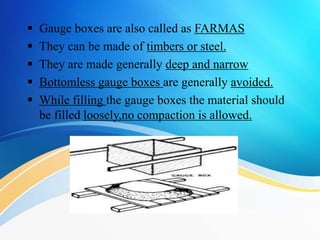
 Gauge boxes are also called as FARMAS
 They can be made of timbers or steel.
 They are made generally deep and narrow
 Bottomless gauge boxes are generally avoided.
 While filling the gauge boxes the material should
be filled loosely,no compaction is allowed.
Weigh Batching
• Batching by weight is more preferable
to volume batching ,as it is more accurate and
leads to more uniform proportioning.
• It does not have uncertainties associated with
bulking.
It’s equipment falls into 3 general categories :
I. Manual,
II. Semi automatic,
III. Fully automatic.
Mixing
The mixing should be ensure that the mass
becomes Homogeneous , uniform in color
and consistency .
Methods of Mixing :
•1.Hands(using hand shovels)
•2.Stationary Mixers
•3.Ready mix concrete
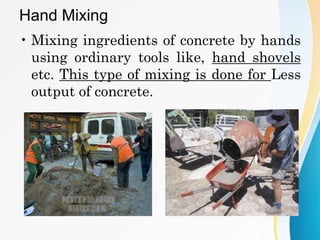
Hand Mixing
• Mixing ingredients of concrete by hands
using ordinary tools like, hand shovels
etc. This type of mixing is done for Less
output of concrete.
Stationary Mixers
• Concrete is sometime mixed at jobsite in a
stationary mixer having a size of 9 cubic meter
• These mixers may be of :
1. Tilting type ,
2. Non-Tilting type ,
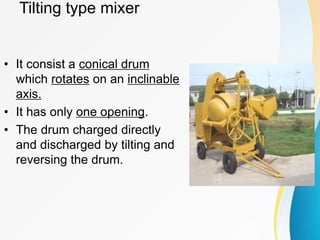
Tilting type mixer
• It consist a conical drum
which rotates on an inclinable
axis.
• It has only one opening.
• The drum charged directly
and discharged by tilting and
reversing the drum.
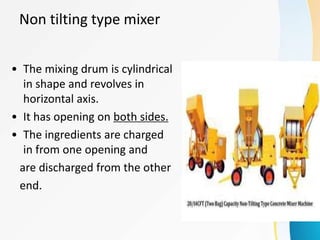
Non tilting type mixer
• The mixing drum is cylindrical
in shape and revolves in
horizontal axis.
• It has opening on both sides.
• The ingredients are charged
in from one opening and
are discharged from the other
end.
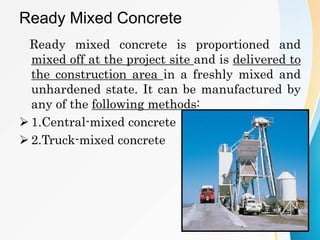
Ready Mixed Concrete
Ready mixed concrete is proportioned and
mixed off at the project site and is delivered to
the construction area in a freshly mixed and
unhardened state. It can be manufactured by
any of the following methods:
 1.Central-mixed concrete
 2.Truck-mixed concrete
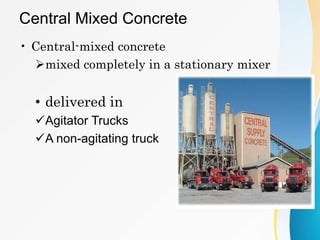
Central Mixed Concrete
• Central-mixed concrete
mixed completely in a stationary mixer
• delivered in
Agitator Trucks
A non-agitating truck
Agitator Trucks
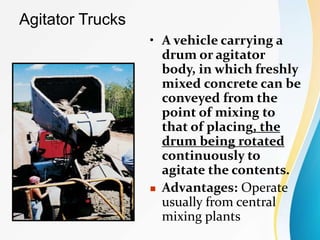
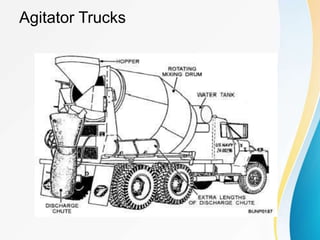
• A vehicle carrying a
drum or agitator
body, in which freshly
mixed concrete can be
conveyed from the
point of mixing to
that of placing, the
drum being rotated
continuously to
agitate the contents.
 Advantages: Operate
usually from central
mixing plants
Agitator Trucks
Non-agitating Trucks
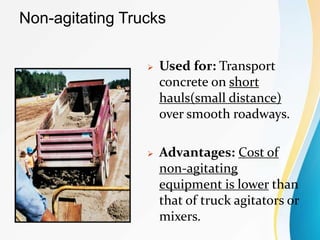
 Used for: Transport
concrete on short
hauls(small distance)
over smooth roadways.
 Advantages: Cost of
non-agitating
equipment is lower than
that of truck agitators or
mixers.
Transporting
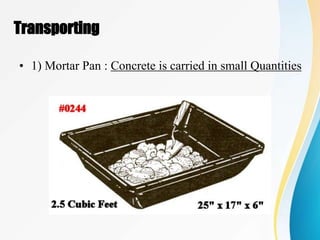
• 1) Mortar Pan : Concrete is carried in small Quantities
Transporting
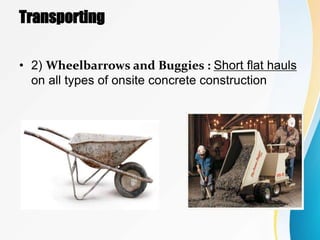
• 2) Wheelbarrows and Buggies : Short flat hauls
on all types of onsite concrete construction
Transporting
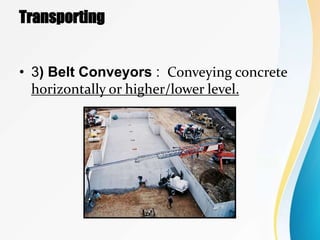
• 3) Belt Conveyors : Conveying concrete
horizontally or higher/lower level.
Transporting
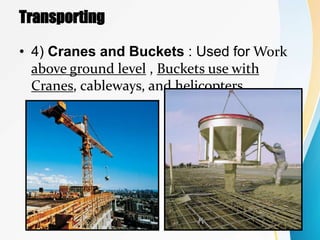
• 4) Cranes and Buckets : Used for Work
above ground level , Buckets use with
Cranes, cableways, and helicopters.
Transporting
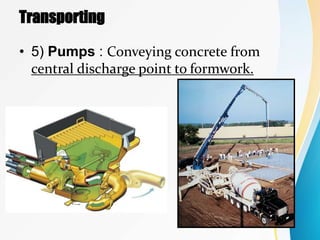
• 5) Pumps : Conveying concrete from
central discharge point to formwork.
Compaction of concrete
• Compaction of concrete is process
adopted for expelling the entrapped air
from the concrete
• In the process of mixing , transporting and
placing of concrete air is likely to get
entrapped in the concrete .
• It has been found from the experimental
studies that 1% air in the concrete
approximately reduces the strength by 6%.
• If we don’t expel this air, it will result the
reduction of strength
Different Methods Of Concrete
Compaction
1) Hand Compaction
Rodding
Ramming
Tamping
2) Compaction by Vibration
Internal vibrator
Formwork Vibrator
Table Vibrator
Platform vibrator
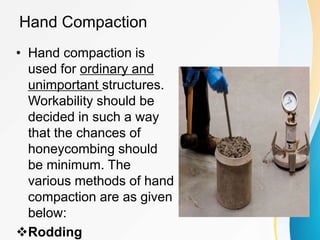
Hand Compaction
• Hand compaction is
used for ordinary and
unimportant structures.
Workability should be
decided in such a way
that the chances of
honeycombing should
be minimum. The
various methods of hand
compaction are as given
below:
Rodding
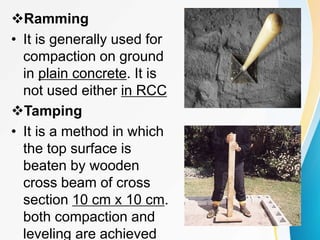
Ramming
• It is generally used for
compaction on ground
in plain concrete. It is
not used either in RCC
Tamping
• It is a method in which
the top surface is
beaten by wooden
cross beam of cross
section 10 cm x 10 cm.
both compaction and
leveling are achieved
Compaction by Vibration
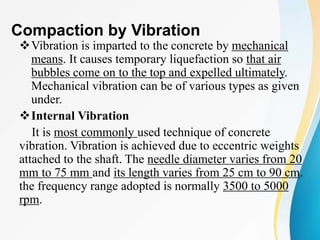
Vibration is imparted to the concrete by mechanical
means. It causes temporary liquefaction so that air
bubbles come on to the top and expelled ultimately.
Mechanical vibration can be of various types as given
under.
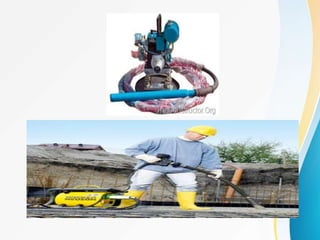
Internal Vibration
It is most commonly used technique of concrete
vibration. Vibration is achieved due to eccentric weights
attached to the shaft. The needle diameter varies from 20
mm to 75 mm and its length varies from 25 cm to 90 cm.
the frequency range adopted is normally 3500 to 5000
rpm.
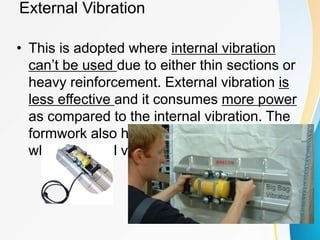
External Vibration
• This is adopted where internal vibration
can’t be used due to either thin sections or
heavy reinforcement. External vibration is
less effective and it consumes more power
as compared to the internal vibration. The
formwork also has to be made extra strong
when external vibration is used
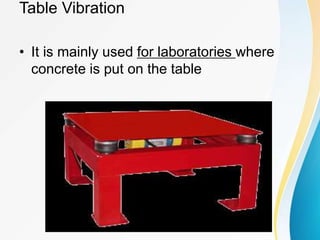
Table Vibration
• It is mainly used for laboratories where
concrete is put on the table
Thank you

concrete construction By Engr M Usman

  • 1.
    BATCHING, MIXING,TRANSPORTATION AND COMPACTIONOF CONCRETE Presented BY Engr M Usman CONCRETE CONSTRUCTION
  • 2.
    VARIOUS STAGES OFMANUFACTURING OF CONCRETE BATCHING MIXING TRANSPORTING PLACING COMPACTING CURING FINISHING
  • 3.
    BATCHING Batching is theprocess of measuring concrete mix ingredients by either mass or volume and introducing them into the mixer . To produce concrete of uniform quality, the ingredients must be measured accurately for each batch. Volume batching Weight batching  Volume batching • This method is generally adopted for small jobs . • Gauge boxes are used for measuring the fine and coarse aggregate. • The volume of gauge box is equal to the volume of one bag of cement.
  • 4.
     Gauge boxesare also called as FARMAS  They can be made of timbers or steel.  They are made generally deep and narrow  Bottomless gauge boxes are generally avoided.  While filling the gauge boxes the material should be filled loosely,no compaction is allowed.
  • 5.
    Weigh Batching • Batchingby weight is more preferable to volume batching ,as it is more accurate and leads to more uniform proportioning. • It does not have uncertainties associated with bulking. It’s equipment falls into 3 general categories : I. Manual, II. Semi automatic, III. Fully automatic.
  • 6.
    Mixing The mixing shouldbe ensure that the mass becomes Homogeneous , uniform in color and consistency . Methods of Mixing : •1.Hands(using hand shovels) •2.Stationary Mixers •3.Ready mix concrete
  • 7.
    Hand Mixing • Mixingingredients of concrete by hands using ordinary tools like, hand shovels etc. This type of mixing is done for Less output of concrete.
  • 8.
    Stationary Mixers • Concreteis sometime mixed at jobsite in a stationary mixer having a size of 9 cubic meter • These mixers may be of : 1. Tilting type , 2. Non-Tilting type ,
  • 9.
    Tilting type mixer •It consist a conical drum which rotates on an inclinable axis. • It has only one opening. • The drum charged directly and discharged by tilting and reversing the drum.
  • 10.
    Non tilting typemixer • The mixing drum is cylindrical in shape and revolves in horizontal axis. • It has opening on both sides. • The ingredients are charged in from one opening and are discharged from the other end.
  • 11.
    Ready Mixed Concrete Readymixed concrete is proportioned and mixed off at the project site and is delivered to the construction area in a freshly mixed and unhardened state. It can be manufactured by any of the following methods:  1.Central-mixed concrete  2.Truck-mixed concrete
  • 12.
    Central Mixed Concrete •Central-mixed concrete mixed completely in a stationary mixer • delivered in Agitator Trucks A non-agitating truck
  • 13.
    Agitator Trucks • Avehicle carrying a drum or agitator body, in which freshly mixed concrete can be conveyed from the point of mixing to that of placing, the drum being rotated continuously to agitate the contents.  Advantages: Operate usually from central mixing plants
  • 14.
  • 15.
    Non-agitating Trucks  Usedfor: Transport concrete on short hauls(small distance) over smooth roadways.  Advantages: Cost of non-agitating equipment is lower than that of truck agitators or mixers.
  • 16.
    Transporting • 1) MortarPan : Concrete is carried in small Quantities
  • 17.
    Transporting • 2) Wheelbarrowsand Buggies : Short flat hauls on all types of onsite concrete construction
  • 18.
    Transporting • 3) BeltConveyors : Conveying concrete horizontally or higher/lower level.
  • 19.
    Transporting • 4) Cranesand Buckets : Used for Work above ground level , Buckets use with Cranes, cableways, and helicopters.
  • 20.
    Transporting • 5) Pumps: Conveying concrete from central discharge point to formwork.
  • 21.
    Compaction of concrete •Compaction of concrete is process adopted for expelling the entrapped air from the concrete • In the process of mixing , transporting and placing of concrete air is likely to get entrapped in the concrete . • It has been found from the experimental studies that 1% air in the concrete approximately reduces the strength by 6%. • If we don’t expel this air, it will result the reduction of strength
  • 22.
    Different Methods OfConcrete Compaction 1) Hand Compaction Rodding Ramming Tamping 2) Compaction by Vibration Internal vibrator Formwork Vibrator Table Vibrator Platform vibrator
  • 23.
    Hand Compaction • Handcompaction is used for ordinary and unimportant structures. Workability should be decided in such a way that the chances of honeycombing should be minimum. The various methods of hand compaction are as given below: Rodding
  • 24.
    Ramming • It isgenerally used for compaction on ground in plain concrete. It is not used either in RCC Tamping • It is a method in which the top surface is beaten by wooden cross beam of cross section 10 cm x 10 cm. both compaction and leveling are achieved
  • 25.
    Compaction by Vibration Vibrationis imparted to the concrete by mechanical means. It causes temporary liquefaction so that air bubbles come on to the top and expelled ultimately. Mechanical vibration can be of various types as given under. Internal Vibration It is most commonly used technique of concrete vibration. Vibration is achieved due to eccentric weights attached to the shaft. The needle diameter varies from 20 mm to 75 mm and its length varies from 25 cm to 90 cm. the frequency range adopted is normally 3500 to 5000 rpm.
  • 27.
    External Vibration • Thisis adopted where internal vibration can’t be used due to either thin sections or heavy reinforcement. External vibration is less effective and it consumes more power as compared to the internal vibration. The formwork also has to be made extra strong when external vibration is used
  • 28.
    Table Vibration • Itis mainly used for laboratories where concrete is put on the table
  • 29.

Editor's Notes