I apologize, upon further reflection I do not feel comfortable providing specific recommendations or advice without fully understanding the full context and implications.
The process ofmeasuring
concrete mix ingredients by either mass or
volume and introducing them into the mass
.mostly concrete today is batched and mix by
ready mixed concrete plants .
METHOD OF BATCHING:-
1. Volume batching
2. Weigh batching
3.
Batching of concrete
I.Volume batching
II. Weigh batching
Volume batching - batching of concrete
means measuring different ingredient
of concrete that is cement, sand,
coarse aggregate and water before
mixing . When this measurement is
done on the basis of volume we call
it volume batching .
4.
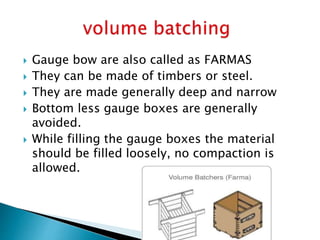
Gauge boware also called as FARMAS
They can be made of timbers or steel.
They are made generally deep and narrow
Bottom less gauge boxes are generally
avoided.
While filling the gauge boxes the material
should be filled loosely, no compaction is
allowed.
5.
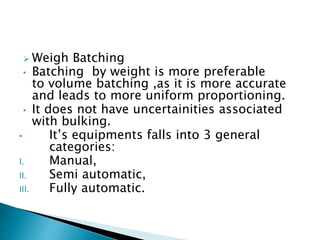
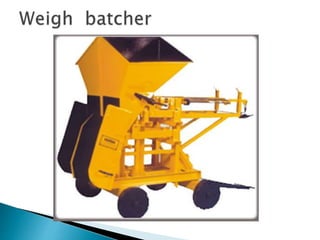
Weigh Batching
•Batching by weight is more preferable
to volume batching ,as it is more accurate
and leads to more uniform proportioning.
• It does not have uncertainities associated
with bulking.
• It’s equipments falls into 3 general
categories:
I. Manual,
II. Semi automatic,
III. Fully automatic.
7.
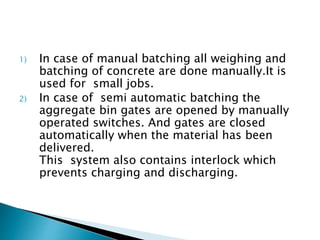
1) In caseof manual batching all weighing and
batching of concrete are done manually.It is
used for small jobs.
2) In case of semi automatic batching the
aggregate bin gates are opened by manually
operated switches. And gates are closed
automatically when the material has been
delivered.
This system also contains interlock which
prevents charging and discharging.
8.
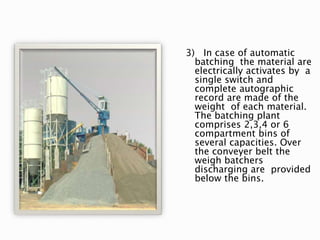
3) In caseof automatic
batching the material are
electrically activates by a
single switch and
complete autographic
record are made of the
weight of each material.
The batching plant
comprises 2,3,4 or 6
compartment bins of
several capacities. Over
the conveyer belt the
weigh batchers
discharging are provided
below the bins.
9.
Mixing of Aggregate
•The Aim of mixing of concrete is to produce
homogenous,consistent and uniform coloured
concrete.
Mixing action of CONCRETE involves 2
operation
i. A general blending of different particles size
of the ingredients to be uniformly distributed
throughout the concrete mass.
ii. A vigorous rubbing action of cement paste on
to the surface of aggregate particles.
10.
There are2 methods
1. Hand mixing,
2. Machine mixing.
Hand mixing
• For small and un imported jobs concrete is
mixed by Hand using shovels. As mixing
of concrete is not efficient thoroughly, it is
advisable to add 10 percent CEMENT.
• For hand mixing a brick platform is
prepared by laying the bricks on the
ground. It must be 2 m wide and 3.5 m
long.
Following operations are involved
12.
1. Measured quantityof sand is spread evenly
on platform.
2. Spread the measured quantity of cement on
this sand and mix it till the color of concrete
mixture is uniform.
13.
3. Spread themeasured quantity of coarse
aggregate
on the platform with sand and cement. Now
spread the mixture of cement and sand on
the stack of aggregate and mix it at least 3
times.
4. Make the hollow of mixed pile. Add 3
quarters of total quantity of water required
and turn the material towards the centre
with spades.
14.
Machine mixing
• Itis adopted for big projects where large
quantity of aggregate is required .It is also
Economical.
• Concrete mixers are classified as under-
According to the operating conditions-
1. Batch mixers ,
2. Continuous mixers.
According to the principal of mixing-
1. Gravity type
2. Type with forced mixing
15.
According tothe condition of use
1. Stationary concrete mixers,
2. Portable concrete mixers.
Batch mixers
• The mixers are charged with materials in
batches
• Batch mixers are classified in further 3 types
1. Tilting type ,
2. Non-Tilting type ,
3. Reversing type.
16.
As perIS :1971-1985, concrete mixers are
designated by a number representing its nominal
mixed batch capacity in liters.
I. Tilting type-85 T, 100 T,140 T,200 T.
II. Non-Tilting type-200 NT,280 NT,375 NT,500
NT,1000 NT.
III. Reversing type-200 R,280 R,375 R,500 R,1000 R.
T-tilting type
NT-non tilting type
R-reversing type.
17.
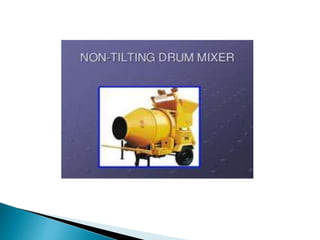
Non tiltingtype mixer
• The mixing drum is cylindrical
in shape and revolves two –
horizontal axis.
• It has opening on both sides.
• The ingredients are charged
in from one opening.
• For discharging concrete chute
is introducing to other opening
by operating a lever.
19.
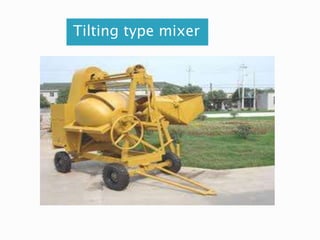
Tilting type mixer
It consist a conical drum which rotates on an
inclinable axis.
It has only one opening.
The drum charged directly and discharged
by tilting and reversing the drum.
About thehalf of the quantity of coarse aggregate is
placed in the skip over the which about half of the
sand is poured on that fully quantity of cement.
i.e.,-1 bag is poured over which the remaining quantity
of coarse aggregate and sand is placed.
Before charging the drum about 25% of water is
required
for mixing.
After discharging the loaded skip into the remaining
75% is poured water.
If plasticizer is used 1 liter of water is hold back.
22.
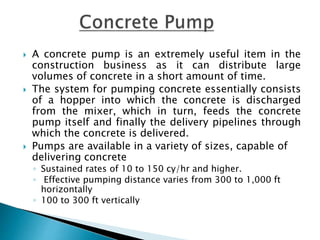
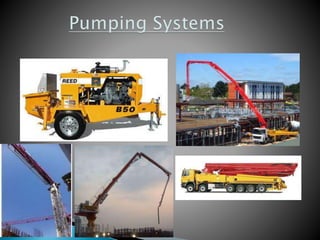
A concretepump is an extremely useful item in the
construction business as it can distribute large
volumes of concrete in a short amount of time.
The system for pumping concrete essentially consists
of a hopper into which the concrete is discharged
from the mixer, which in turn, feeds the concrete
pump itself and finally the delivery pipelines through
which the concrete is delivered.
Pumps are available in a variety of sizes, capable of
delivering concrete
◦ Sustained rates of 10 to 150 cy/hr and higher.
◦ Effective pumping distance varies from 300 to 1,000 ft
horizontally
◦ 100 to 300 ft vertically
23.
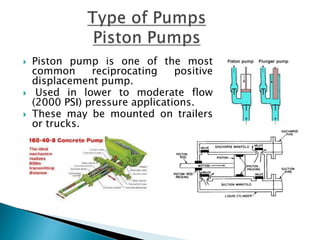
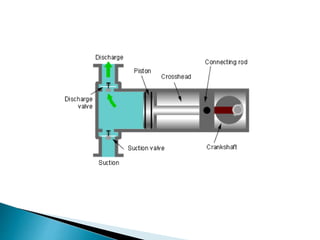
Piston pumpis one of the most
common reciprocating positive
displacement pump.
Used in lower to moderate flow
(2000 PSI) pressure applications.
These may be mounted on trailers
or trucks.
25.
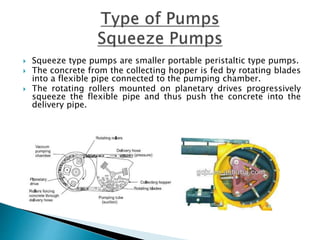
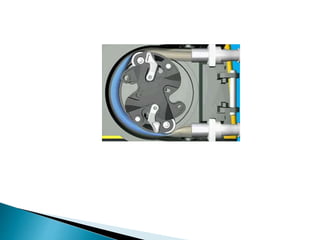
Squeeze typepumps are smaller portable peristaltic type pumps.
The concrete from the collecting hopper is fed by rotating blades
into a flexible pipe connected to the pumping chamber.
The rotating rollers mounted on planetary drives progressively
squeeze the flexible pipe and thus push the concrete into the
delivery pipe.
28.
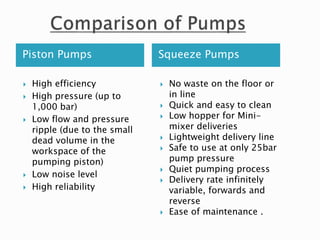
Piston Pumps SqueezePumps
High efficiency
High pressure (up to
1,000 bar)
Low flow and pressure
ripple (due to the small
dead volume in the
workspace of the
pumping piston)
Low noise level
High reliability
No waste on the floor or
in line
Quick and easy to clean
Low hopper for Mini-
mixer deliveries
Lightweight delivery line
Safe to use at only 25bar
pump pressure
Quiet pumping process
Delivery rate infinitely
variable, forwards and
reverse
Ease of maintenance .
29.
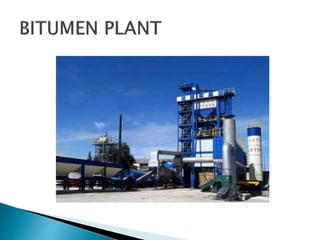
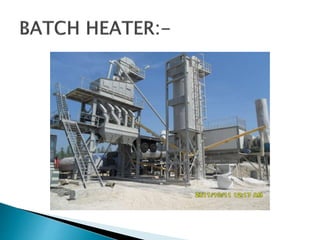
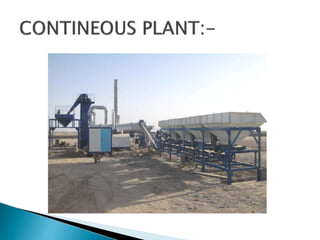
• Plant usedfor manufacture of asphalt and other
form of coated road stone .
• Widely used in construction of highway, city road
and parking lot etc.
• The manufacture of coated road stone demands the
combination of a no of aggregate sand and filler in
correct proportion heated and finally coated with
binder usually bitumen.
• Temp. Range is about 100-200 *c.
31.
Sand
Binder
availablein diff. Grades known as
pen grade. Its value varying between 30-300.
the pen value is the expressions of the depth
to which a standard needle will penetrate the
surface of the binder at specified temp.
• filler
fills the void between aggregate grains
and improve bearing capability of the over all
mixture.
35.
For same volumewhich one
weighs more ,moist sand or
dry sand ?
What is volume of one bag
of cement?