Chapter 4: Igneous Structures
and Field Relationships
Figure 4-1. a.
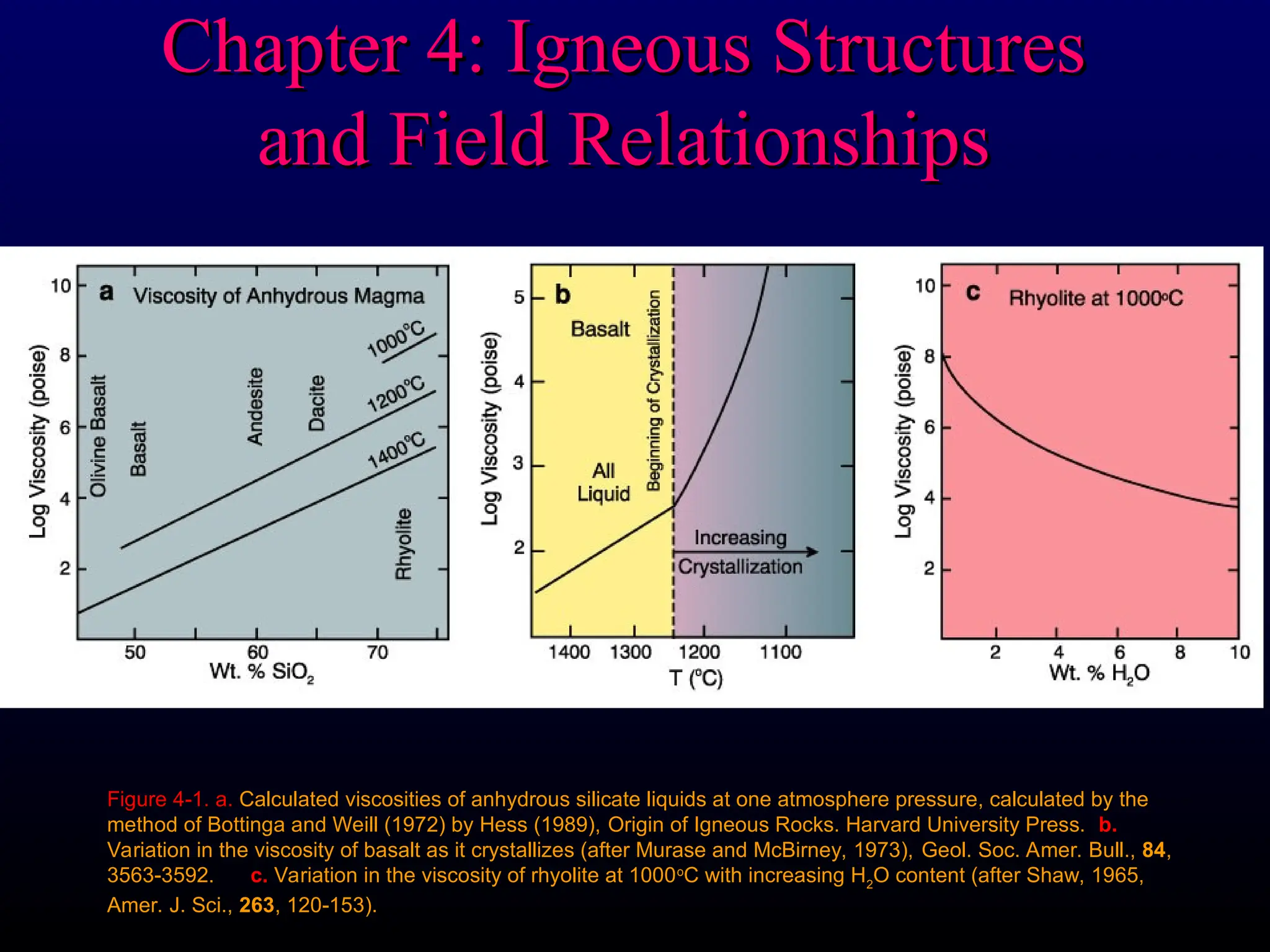
Figure 4-1. a. Calculated viscosities of anhydrous silicate liquids at one atmosphere pressure, calculated by the
Calculated viscosities of anhydrous silicate liquids at one atmosphere pressure, calculated by the
method of Bottinga and Weill (1972) by Hess (1989),
method of Bottinga and Weill (1972) by Hess (1989), Origin of Igneous Rocks. Harvard University Press.
Origin of Igneous Rocks. Harvard University Press. b.
b.
Variation in the viscosity of basalt as it crystallizes (after Murase and McBirney, 1973),
Variation in the viscosity of basalt as it crystallizes (after Murase and McBirney, 1973), Geol. Soc. Amer. Bull.,
Geol. Soc. Amer. Bull., 84
84,
,
3563-3592.
3563-3592. c.
c. Variation in the viscosity of rhyolite at 1000
Variation in the viscosity of rhyolite at 1000o
o
C with increasing H
C with increasing H2
2O content (after Shaw, 1965,
O content (after Shaw, 1965,
Amer. J. Sci.,
Amer. J. Sci., 263
263, 120-153
, 120-153)
).
.
Figure 4-20
Figure 4-20.
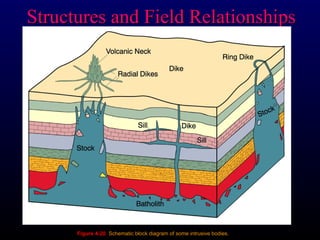
. Schematic block diagram of some intrusive bodies.
Schematic block diagram of some intrusive bodies.
Structures and Field Relationships
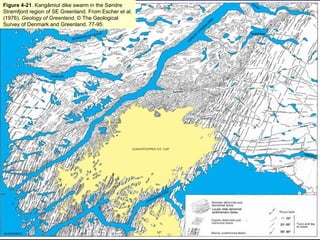
Figure 4-21. Kangâmiut dike swarm in the Søndre
Strømfjord region of SE Greenland. From Escher et al.
(1976), Geology of Greenland, © The Geological
Survey of Denmark and Greenland. 77-95.
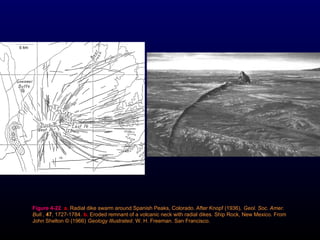
Figure 4-22. a. Radial dike swarm around Spanish Peaks, Colorado. After Knopf (1936), Geol. Soc. Amer.
Bull., 47, 1727-1784. b. Eroded remnant of a volcanic neck with radial dikes. Ship Rock, New Mexico. From
John Shelton © (1966) Geology Illustrated. W. H. Freeman. San Francisco.
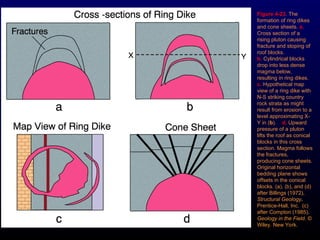
Figure 4-23. The
formation of ring dikes
and cone sheets. a.
Cross section of a
rising pluton causing
fracture and stoping of
roof blocks.
b. Cylindrical blocks
drop into less dense
magma below,
resulting in ring dikes.
c. Hypothetical map
view of a ring dike with
N-S striking country
rock strata as might
result from erosion to a
level approximating X-
Y in (b). d. Upward
pressure of a pluton
lifts the roof as conical
blocks in this cross
section. Magma follows
the fractures,
producing cone sheets.
Original horizontal
bedding plane shows
offsets in the conical
blocks. (a), (b), and (d)
after Billings (1972),
Structural Geology.
Prentice-Hall, Inc. (c)
after Compton (1985),
Geology in the Field. ©
Wiley. New York.
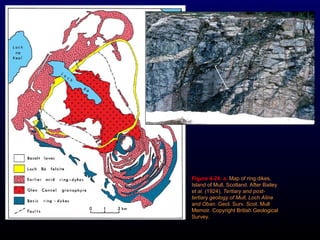
Figure 4-24. a. Map of ring dikes,
Island of Mull, Scotland. After Bailey
et al. (1924), Tertiary and post-
tertiary geology of Mull, Loch Aline
and Oban. Geol. Surv. Scot. Mull
Memoir. Copyright British Geological
Survey.
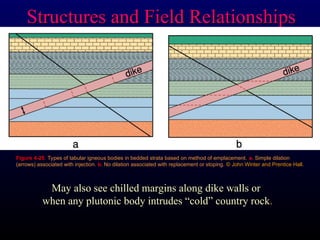
Figure 4-25. Types of tabular igneous bodies in bedded strata based on method of emplacement. a. Simple dilation
(arrows) associated with injection. b. No dilation associated with replacement or stoping. © John Winter and Prentice Hall.
© John Winter and Prentice Hall.
Structures and Field Relationships
May also see chilled margins along dike walls or
when any plutonic body intrudes “cold” country rock
when any plutonic body intrudes “cold” country rock.
.
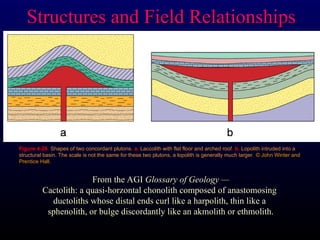
Figure 4-26. Shapes of two concordant plutons. a. Laccolith with flat floor and arched roof. b. Lopolith intruded into a
structural basin. The scale is not the same for these two plutons, a lopolith is generally much larger. © John Winter and
© John Winter and
Prentice Hall.
Prentice Hall.
Structures and Field Relationships
From the AGI Glossary of Geology —
Cactolith: a quasi-horzontal chonolith composed of anastomosing
ductoliths whose distal ends curl like a harpolith, thin like a
sphenolith, or bulge discordantly like an akmolith or ethmolith.
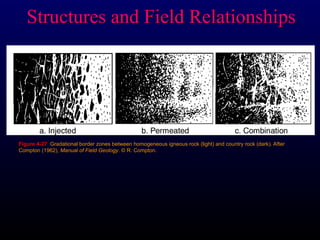
Figure 4-27
Figure 4-27.
. Gradational border zones between homogeneous igneous rock (light) and country rock (dark). After
Gradational border zones between homogeneous igneous rock (light) and country rock (dark). After
Compton (1962),
Compton (1962), Manual of Field Geology
Manual of Field Geology. © R. Compton.
. © R. Compton.
Structures and Field Relationships
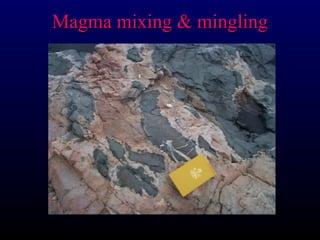
Magma mixing & mingling
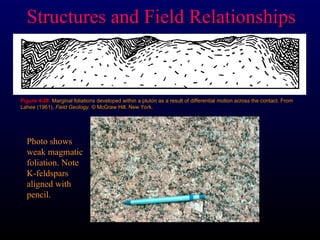
Figure 4-28
Figure 4-28.
. Marginal foliations developed within a pluton as a result of differential motion across the contact. From
Marginal foliations developed within a pluton as a result of differential motion across the contact. From
Lahee (1961),
Lahee (1961), Field Geology. ©
Field Geology. © McGraw Hill. New York.
McGraw Hill. New York.
Structures and Field Relationships
Photo shows
Photo shows
weak magmatic
weak magmatic
foliation. Note
foliation. Note
K-feldspars
K-feldspars
aligned with
aligned with
pencil.
pencil.
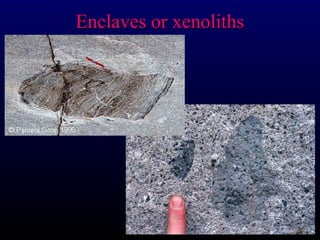
Enclaves or xenoliths
Figure 4-29
Figure 4-29.
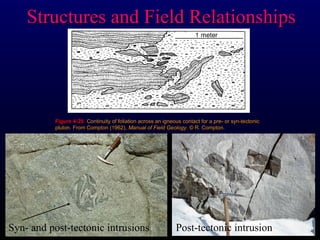
. Continuity of foliation across an igneous contact for a pre- or syn-tectonic
Continuity of foliation across an igneous contact for a pre- or syn-tectonic
pluton. From Compton (1962),
pluton. From Compton (1962), Manual of Field Geology
Manual of Field Geology. © R. Compton.
. © R. Compton.
Structures and Field Relationships
Syn- and post-tectonic intrusions Post-tectonic intrusion
Figure 4-30
Figure 4-30.
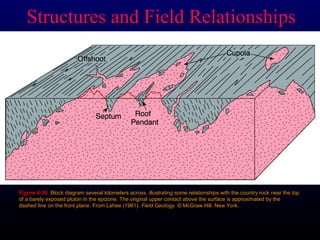
. Block diagram several kilometers across, illustrating some relationships with the country rock near the top
Block diagram several kilometers across, illustrating some relationships with the country rock near the top
of a barely exposed pluton in the epizone. The original upper contact above the surface is approximated by the
dashed line on the front plane. From Lahee (1961),
dashed line on the front plane. From Lahee (1961), Field Geology. ©
Field Geology. © McGraw Hill. New York.
McGraw Hill. New York.
Structures and Field Relationships
Figure 4-31
Figure 4-31.
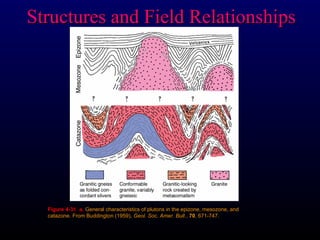
. a.
a. General characteristics of plutons in the epizone, mesozone, and
General characteristics of plutons in the epizone, mesozone, and
catazone.
catazone. From Buddington (1959),
From Buddington (1959), Geol. Soc. Amer. Bull.
Geol. Soc. Amer. Bull.,
, 70
70, 671-747.
, 671-747.
Structures and Field Relationships
Figure 4-32
Figure 4-32.
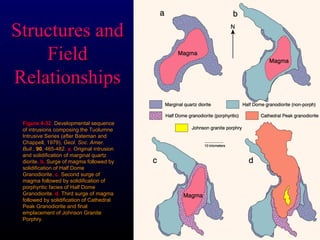
. Developmental sequence
Developmental sequence
of intrusions composing the Tuolumne
Intrusive Series (after Bateman and
Chappell, 1979),
Chappell, 1979), Geol. Soc. Amer.
Geol. Soc. Amer.
Bull.
Bull.,
, 90
90, 465-482.
, 465-482. a.
a. Original intrusion
Original intrusion
and solidification of marginal quartz
diorite.
diorite. b.
b. Surge of magma followed by
Surge of magma followed by
solidification of Half Dome
Granodiorite.
Granodiorite. c.
c. Second surge of
Second surge of
magma followed by solidification of
porphyritic facies of Half Dome
Granodiorite.
Granodiorite. d.
d. Third surge of magma
Third surge of magma
followed by solidification of Cathedral
Peak Granodiorite and final
emplacement of Johnson Granite
Porphry.
Porphry.
Structures and
Structures and
Field
Field
Relationships
Relationships
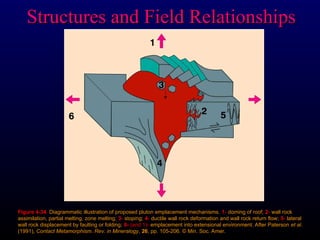
Figure 4-34
Figure 4-34.
. Diagrammatic illustration of proposed pluton emplacement mechanisms.
Diagrammatic illustration of proposed pluton emplacement mechanisms. 1
1-
- doming of roof;
doming of roof; 2
2-
- wall rock
wall rock
assimilation, partial melting, zone melting;
assimilation, partial melting, zone melting; 3
3-
- stoping;
stoping; 4
4-
- ductile wall rock deformation and wall rock return flow;
ductile wall rock deformation and wall rock return flow; 5
5-
- lateral
lateral
wall rock displacement by faulting or folding;
wall rock displacement by faulting or folding; 6-
6- (and 1)-
(and 1)- emplacement into extensional environment. After Paterson
emplacement into extensional environment. After Paterson et al
et al.
.
(1991),
(1991), Contact Metamorphism. Rev. in Mineralogy
Contact Metamorphism. Rev. in Mineralogy,
, 26
26, pp. 105-206. © Min. Soc. Amer.
, pp. 105-206. © Min. Soc. Amer.
Structures and Field Relationships
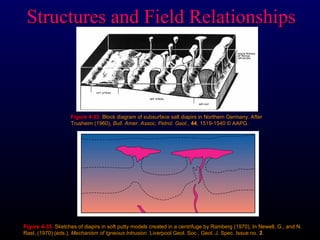
Figure 4-35
Figure 4-35.
. Sketches of diapirs in soft putty models created in a centrifuge by Ramberg (1970), In Newell, G., and N.
Sketches of diapirs in soft putty models created in a centrifuge by Ramberg (1970), In Newell, G., and N.
Rast, (1970) (eds.),
Rast, (1970) (eds.), Mechanism of Igneous Intrusion
Mechanism of Igneous Intrusion. Liverpool Geol. Soc., Geol. J. Spec. Issue no.
. Liverpool Geol. Soc., Geol. J. Spec. Issue no. 2
2.
.
Figure 4-33
Figure 4-33.
. Block diagram of subsurface salt diapirs in Northern Germany. After
Block diagram of subsurface salt diapirs in Northern Germany. After
Trusheim (1960),
Trusheim (1960), Bull. Amer. Assoc. Petrol. Geol.
Bull. Amer. Assoc. Petrol. Geol.,
, 44
44, 1519-1540 © AAPG.
, 1519-1540 © AAPG.

igneous structures y field relationships

  • 1.
    Chapter 4: IgneousStructures Chapter 4: Igneous Structures and Field Relationships and Field Relationships Figure 4-1. a. Figure 4-1. a. Calculated viscosities of anhydrous silicate liquids at one atmosphere pressure, calculated by the Calculated viscosities of anhydrous silicate liquids at one atmosphere pressure, calculated by the method of Bottinga and Weill (1972) by Hess (1989), method of Bottinga and Weill (1972) by Hess (1989), Origin of Igneous Rocks. Harvard University Press. Origin of Igneous Rocks. Harvard University Press. b. b. Variation in the viscosity of basalt as it crystallizes (after Murase and McBirney, 1973), Variation in the viscosity of basalt as it crystallizes (after Murase and McBirney, 1973), Geol. Soc. Amer. Bull., Geol. Soc. Amer. Bull., 84 84, , 3563-3592. 3563-3592. c. c. Variation in the viscosity of rhyolite at 1000 Variation in the viscosity of rhyolite at 1000o o C with increasing H C with increasing H2 2O content (after Shaw, 1965, O content (after Shaw, 1965, Amer. J. Sci., Amer. J. Sci., 263 263, 120-153 , 120-153) ). .
  • 2.
    Figure 4-20 Figure 4-20. .Schematic block diagram of some intrusive bodies. Schematic block diagram of some intrusive bodies. Structures and Field Relationships Structures and Field Relationships
  • 3.
    Figure 4-21. Kangâmiutdike swarm in the Søndre Strømfjord region of SE Greenland. From Escher et al. (1976), Geology of Greenland, © The Geological Survey of Denmark and Greenland. 77-95.
  • 4.
    Figure 4-22. a.Radial dike swarm around Spanish Peaks, Colorado. After Knopf (1936), Geol. Soc. Amer. Bull., 47, 1727-1784. b. Eroded remnant of a volcanic neck with radial dikes. Ship Rock, New Mexico. From John Shelton © (1966) Geology Illustrated. W. H. Freeman. San Francisco.
  • 5.
    Figure 4-23. The formationof ring dikes and cone sheets. a. Cross section of a rising pluton causing fracture and stoping of roof blocks. b. Cylindrical blocks drop into less dense magma below, resulting in ring dikes. c. Hypothetical map view of a ring dike with N-S striking country rock strata as might result from erosion to a level approximating X- Y in (b). d. Upward pressure of a pluton lifts the roof as conical blocks in this cross section. Magma follows the fractures, producing cone sheets. Original horizontal bedding plane shows offsets in the conical blocks. (a), (b), and (d) after Billings (1972), Structural Geology. Prentice-Hall, Inc. (c) after Compton (1985), Geology in the Field. © Wiley. New York.
  • 6.
    Figure 4-24. a.Map of ring dikes, Island of Mull, Scotland. After Bailey et al. (1924), Tertiary and post- tertiary geology of Mull, Loch Aline and Oban. Geol. Surv. Scot. Mull Memoir. Copyright British Geological Survey.
  • 7.
    Figure 4-25. Typesof tabular igneous bodies in bedded strata based on method of emplacement. a. Simple dilation (arrows) associated with injection. b. No dilation associated with replacement or stoping. © John Winter and Prentice Hall. © John Winter and Prentice Hall. Structures and Field Relationships Structures and Field Relationships May also see chilled margins along dike walls or May also see chilled margins along dike walls or when any plutonic body intrudes “cold” country rock when any plutonic body intrudes “cold” country rock. .
  • 8.
    Figure 4-26. Shapesof two concordant plutons. a. Laccolith with flat floor and arched roof. b. Lopolith intruded into a structural basin. The scale is not the same for these two plutons, a lopolith is generally much larger. © John Winter and © John Winter and Prentice Hall. Prentice Hall. Structures and Field Relationships Structures and Field Relationships From the AGI Glossary of Geology — Cactolith: a quasi-horzontal chonolith composed of anastomosing ductoliths whose distal ends curl like a harpolith, thin like a sphenolith, or bulge discordantly like an akmolith or ethmolith.
  • 9.
    Figure 4-27 Figure 4-27. .Gradational border zones between homogeneous igneous rock (light) and country rock (dark). After Gradational border zones between homogeneous igneous rock (light) and country rock (dark). After Compton (1962), Compton (1962), Manual of Field Geology Manual of Field Geology. © R. Compton. . © R. Compton. Structures and Field Relationships Structures and Field Relationships
  • 10.
    Magma mixing &mingling Magma mixing & mingling
  • 11.
    Figure 4-28 Figure 4-28. .Marginal foliations developed within a pluton as a result of differential motion across the contact. From Marginal foliations developed within a pluton as a result of differential motion across the contact. From Lahee (1961), Lahee (1961), Field Geology. © Field Geology. © McGraw Hill. New York. McGraw Hill. New York. Structures and Field Relationships Structures and Field Relationships Photo shows Photo shows weak magmatic weak magmatic foliation. Note foliation. Note K-feldspars K-feldspars aligned with aligned with pencil. pencil.
  • 12.
  • 13.
    Figure 4-29 Figure 4-29. .Continuity of foliation across an igneous contact for a pre- or syn-tectonic Continuity of foliation across an igneous contact for a pre- or syn-tectonic pluton. From Compton (1962), pluton. From Compton (1962), Manual of Field Geology Manual of Field Geology. © R. Compton. . © R. Compton. Structures and Field Relationships Structures and Field Relationships Syn- and post-tectonic intrusions Post-tectonic intrusion
  • 14.
    Figure 4-30 Figure 4-30. .Block diagram several kilometers across, illustrating some relationships with the country rock near the top Block diagram several kilometers across, illustrating some relationships with the country rock near the top of a barely exposed pluton in the epizone. The original upper contact above the surface is approximated by the of a barely exposed pluton in the epizone. The original upper contact above the surface is approximated by the dashed line on the front plane. From Lahee (1961), dashed line on the front plane. From Lahee (1961), Field Geology. © Field Geology. © McGraw Hill. New York. McGraw Hill. New York. Structures and Field Relationships Structures and Field Relationships
  • 15.
    Figure 4-31 Figure 4-31. .a. a. General characteristics of plutons in the epizone, mesozone, and General characteristics of plutons in the epizone, mesozone, and catazone. catazone. From Buddington (1959), From Buddington (1959), Geol. Soc. Amer. Bull. Geol. Soc. Amer. Bull., , 70 70, 671-747. , 671-747. Structures and Field Relationships Structures and Field Relationships
  • 16.
    Figure 4-32 Figure 4-32. .Developmental sequence Developmental sequence of intrusions composing the Tuolumne of intrusions composing the Tuolumne Intrusive Series (after Bateman and Intrusive Series (after Bateman and Chappell, 1979), Chappell, 1979), Geol. Soc. Amer. Geol. Soc. Amer. Bull. Bull., , 90 90, 465-482. , 465-482. a. a. Original intrusion Original intrusion and solidification of marginal quartz and solidification of marginal quartz diorite. diorite. b. b. Surge of magma followed by Surge of magma followed by solidification of Half Dome solidification of Half Dome Granodiorite. Granodiorite. c. c. Second surge of Second surge of magma followed by solidification of magma followed by solidification of porphyritic facies of Half Dome porphyritic facies of Half Dome Granodiorite. Granodiorite. d. d. Third surge of magma Third surge of magma followed by solidification of Cathedral followed by solidification of Cathedral Peak Granodiorite and final Peak Granodiorite and final emplacement of Johnson Granite emplacement of Johnson Granite Porphry. Porphry. Structures and Structures and Field Field Relationships Relationships
  • 17.
    Figure 4-34 Figure 4-34. .Diagrammatic illustration of proposed pluton emplacement mechanisms. Diagrammatic illustration of proposed pluton emplacement mechanisms. 1 1- - doming of roof; doming of roof; 2 2- - wall rock wall rock assimilation, partial melting, zone melting; assimilation, partial melting, zone melting; 3 3- - stoping; stoping; 4 4- - ductile wall rock deformation and wall rock return flow; ductile wall rock deformation and wall rock return flow; 5 5- - lateral lateral wall rock displacement by faulting or folding; wall rock displacement by faulting or folding; 6- 6- (and 1)- (and 1)- emplacement into extensional environment. After Paterson emplacement into extensional environment. After Paterson et al et al. . (1991), (1991), Contact Metamorphism. Rev. in Mineralogy Contact Metamorphism. Rev. in Mineralogy, , 26 26, pp. 105-206. © Min. Soc. Amer. , pp. 105-206. © Min. Soc. Amer. Structures and Field Relationships Structures and Field Relationships
  • 18.
    Structures and FieldRelationships Structures and Field Relationships Figure 4-35 Figure 4-35. . Sketches of diapirs in soft putty models created in a centrifuge by Ramberg (1970), In Newell, G., and N. Sketches of diapirs in soft putty models created in a centrifuge by Ramberg (1970), In Newell, G., and N. Rast, (1970) (eds.), Rast, (1970) (eds.), Mechanism of Igneous Intrusion Mechanism of Igneous Intrusion. Liverpool Geol. Soc., Geol. J. Spec. Issue no. . Liverpool Geol. Soc., Geol. J. Spec. Issue no. 2 2. . Figure 4-33 Figure 4-33. . Block diagram of subsurface salt diapirs in Northern Germany. After Block diagram of subsurface salt diapirs in Northern Germany. After Trusheim (1960), Trusheim (1960), Bull. Amer. Assoc. Petrol. Geol. Bull. Amer. Assoc. Petrol. Geol., , 44 44, 1519-1540 © AAPG. , 1519-1540 © AAPG.