Concept of Operations for
Uncrewed Urban Air Mobility
© 2022. The Boeing Company. All Rights Reserved. Not Subject to Export Regulations. 09/22 AQ
Introduction
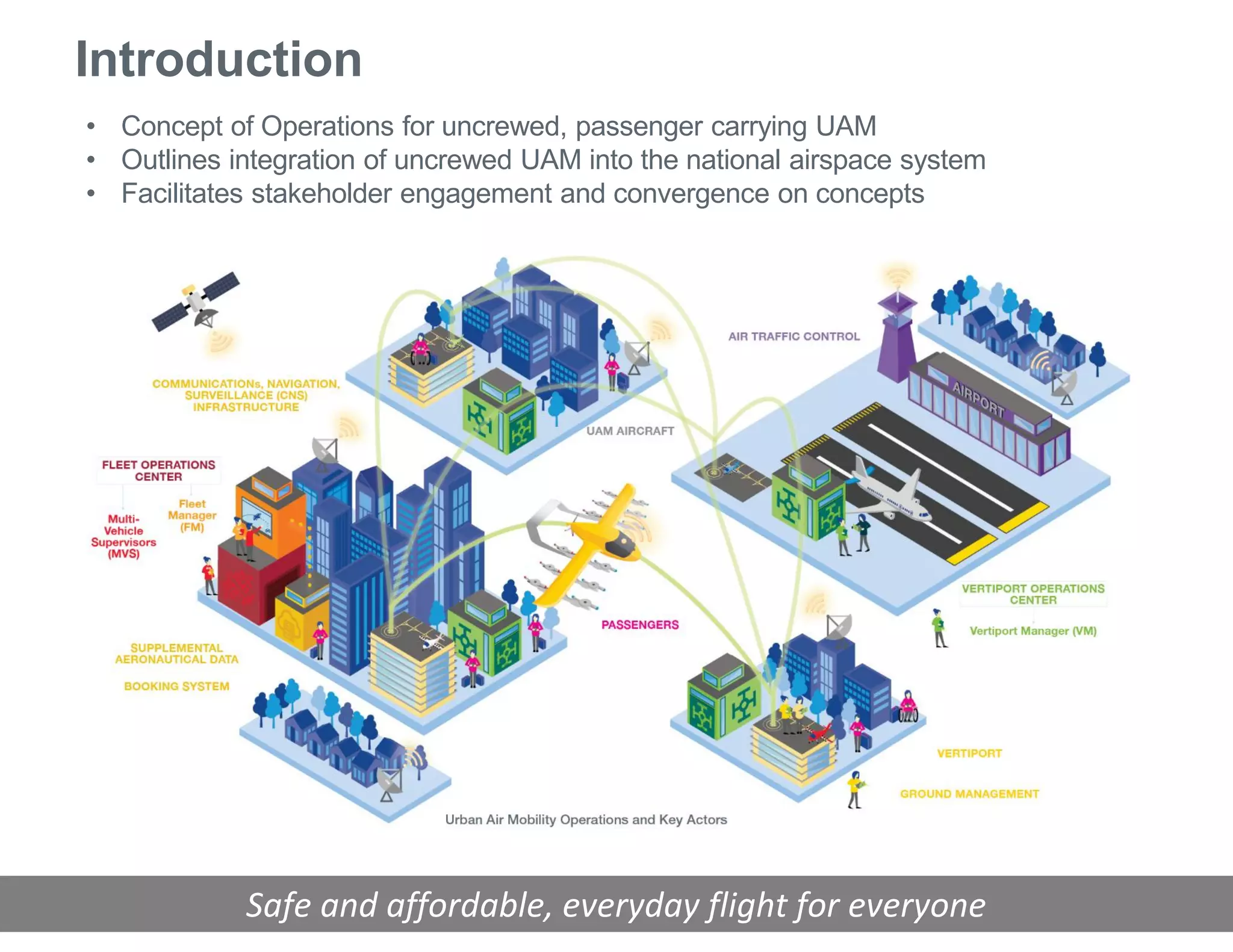
• Concept of Operations for uncrewed, passenger carrying UAM
• Outlines integration of uncrewed UAM into the national airspace system
• Facilitates stakeholder engagement and convergence on concepts
Safe and affordable, everyday flight for everyone
Key Stakeholders
Stakeholders Example Role
Flying Public and Flying Public and
Community Advocacy
Long Beach Community Economic Council Share environmental or societal concerns and potential impact of AAM on
individual communities. Work with industry to effectively plan and
implement changes to safely integrate UAM into the local airspace.
Regulatory Agencies FAA, EASA, CAA Work to support the safe integration of UAM into the airspace.
Trade Associations AUVSI, AIA, GAMA Work with industry to support national competitiveness and to further
advance policies.
Standards Development Organizations RTCA, EUROCAE, ASTM Aim to develop industry consensus-based standards to be used as a
basis for certification.
UAM Industry Wisk, SkyGrid, Insitu, Aura, Skyports, Vertical,
Joby, Altitude Angel, Eve
Develop technology to advance the mobility industry—including
aircraft, UTM systems, command-and-control links, vertiports, etc.
Traditional Airspace Users General Aviation, American Airlines, United,
Delta, Boeing, Airbus
Work with UAM industry to identify solutions to safely integrate aircraft
into airspace and partner on sustainable airspace opportunities.
R&D Testing Agencies NASA, SESAR Identify and support industry testing and promote collaboration to
further advance and validate research.
Federal, State, and Local Policymakers U.S. Congress, State Representatives, Mayors Advance the level of safety in UAM and work with industry to develop a
comprehensive integration strategy with increased innovation.
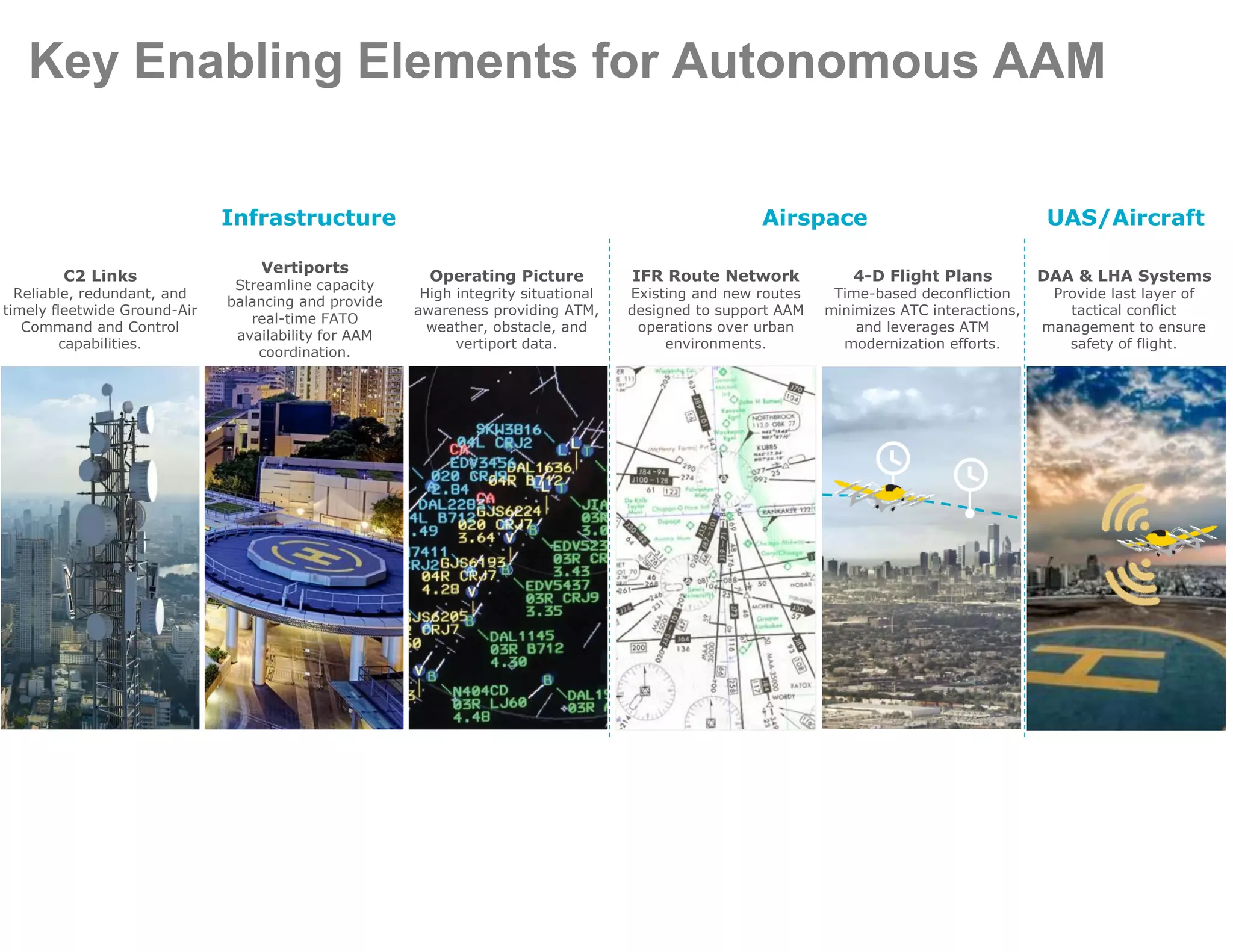
Infrastructure Airspace UAS/Aircraft
Key Enabling Elements for Autonomous AAM
Vertiports
Streamline capacity
balancing and provide
real-time FATO
availability for AAM
coordination.
Operating Picture
High integrity situational
awareness providing ATM,
weather, obstacle, and
vertiport data.
C2 Links
Reliable, redundant, and
timely fleetwide Ground-Air
Command and Control
capabilities.
IFR Route Network
Existing and new routes
designed to support AAM
operations over urban
environments.
4-D Flight Plans
Time-based deconfliction
minimizes ATC interactions,
and leverages ATM
modernization efforts.
DAA & LHA Systems
Provide last layer of
tactical conflict
management to ensure
safety of flight.
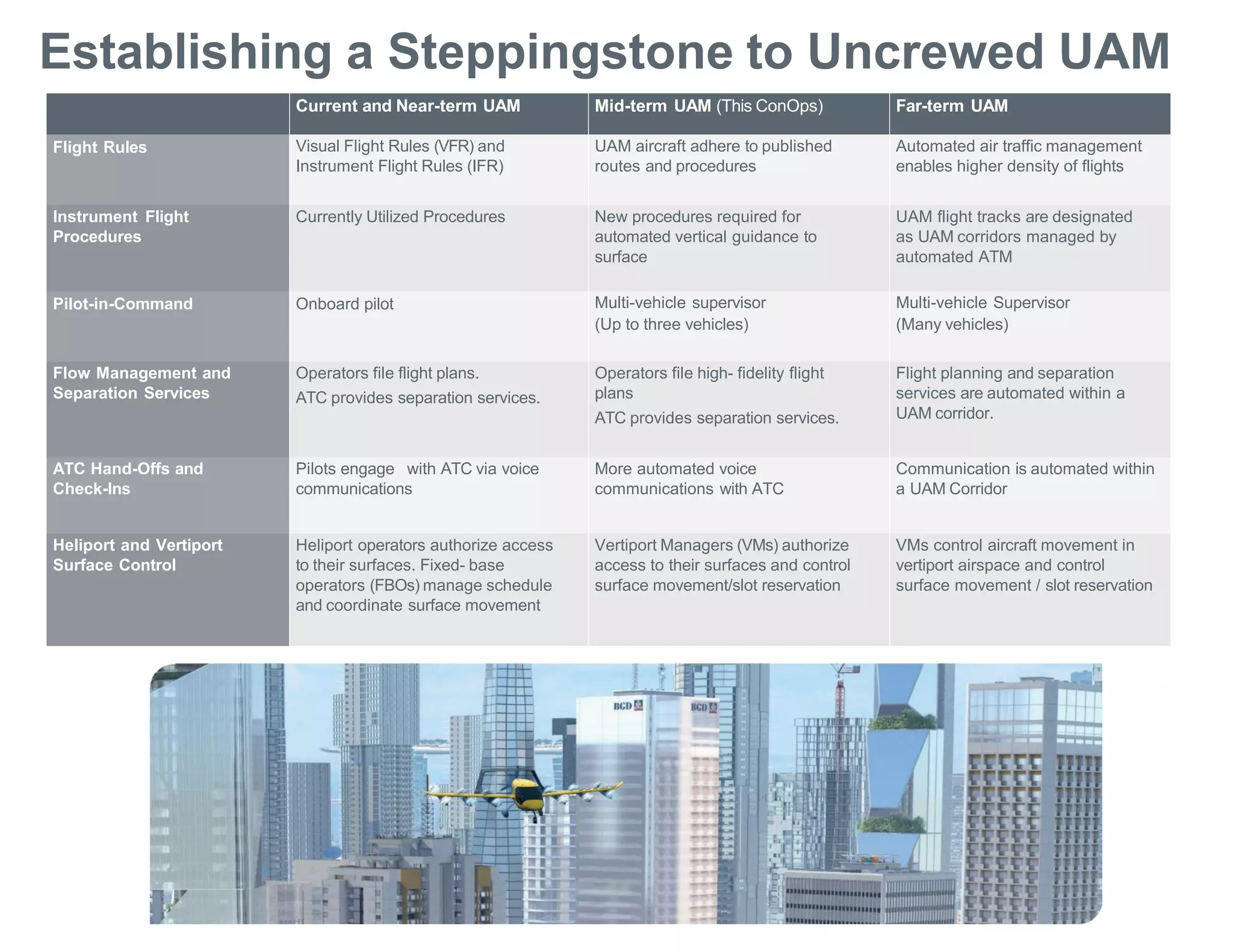
Establishing a Steppingstone to Uncrewed UAM
Current and Near-term UAM Mid-term UAM (This ConOps) Far-term UAM
Flight Rules Visual Flight Rules (VFR) and
Instrument Flight Rules (IFR)
UAM aircraft adhere to published
routes and procedures
Automated air traffic management
enables higher density of flights
Instrument Flight
Procedures
Currently Utilized Procedures New procedures required for
automated vertical guidance to
surface
UAM flight tracks are designated
as UAM corridors managed by
automated ATM
Pilot-in-Command Onboard pilot Multi-vehicle supervisor
(Up to three vehicles)
Multi-vehicle Supervisor
(Many vehicles)
Flow Management and
Separation Services
Operators file flight plans.
ATC provides separation services.
Operators file high- fidelity flight
plans
ATC provides separation services.
Flight planning and separation
services are automated within a
UAM corridor.
ATC Hand-Offs and
Check-Ins
Pilots engage with ATC via voice
communications
More automated voice
communications with ATC
Communication is automated within
a UAM Corridor
Heliport and Vertiport
Surface Control
Heliport operators authorize access
to their surfaces. Fixed- base
operators (FBOs) manage schedule
and coordinate surface movement
Vertiport Managers (VMs) authorize
access to their surfaces and control
surface movement/slot reservation
VMs control aircraft movement in
vertiport airspace and control
surface movement / slot reservation
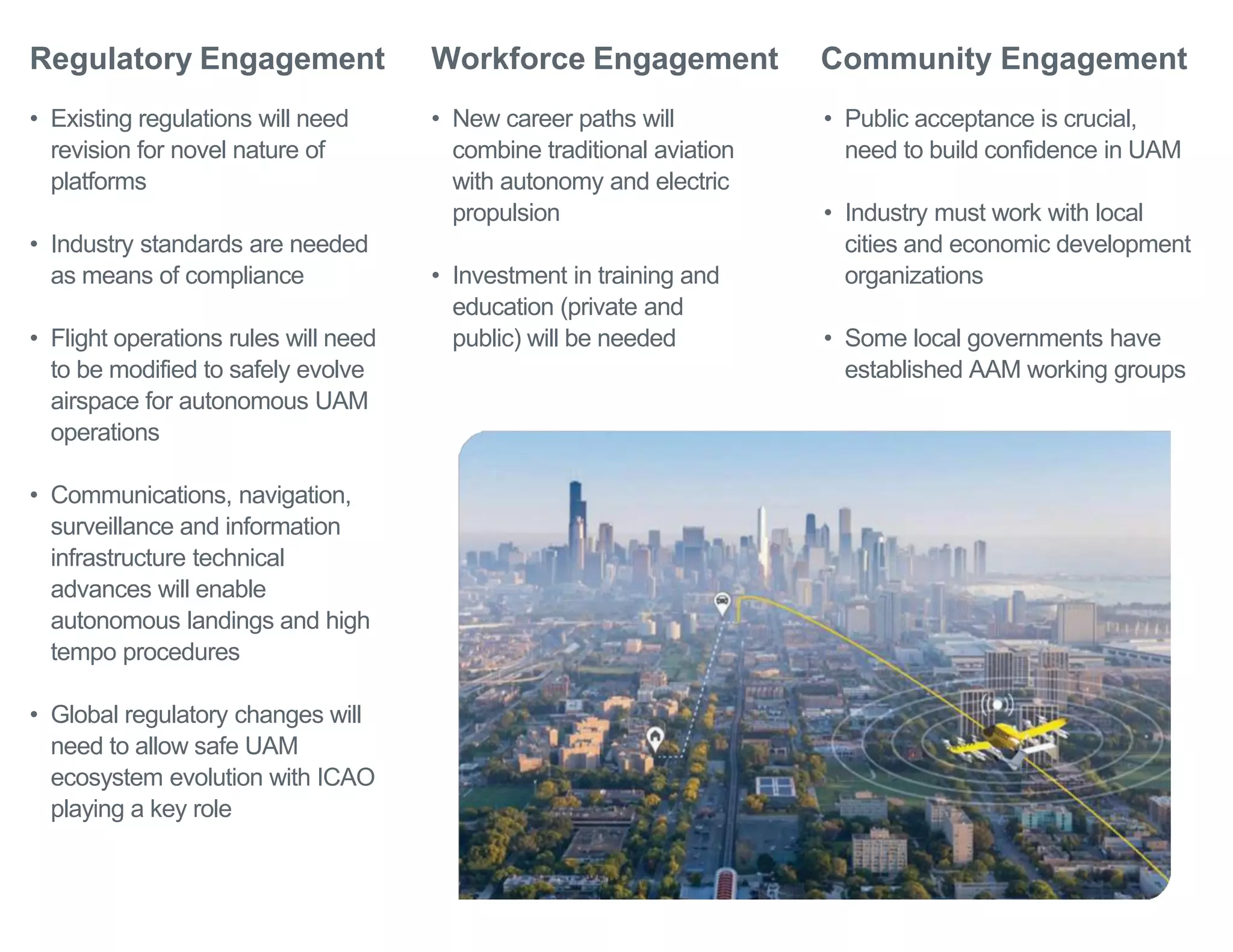
Workforce Engagement
• New career paths will
combine traditional aviation
with autonomy and electric
propulsion
• Investment in training and
education (private and
public) will be needed
Community Engagement
Regulatory Engagement
• Existing regulations will need
revision for novel nature of
platforms
• Industry standards are needed
as means of compliance
• Flight operations rules will need
to be modified to safely evolve
airspace for autonomous UAM
operations
• Communications, navigation,
surveillance and information
infrastructure technical
advances will enable
autonomous landings and high
tempo procedures
• Global regulatory changes will
need to allow safe UAM
ecosystem evolution with ICAO
playing a key role
• Public acceptance is crucial,
need to build confidence in UAM
• Industry must work with local
cities and economic development
organizations
• Some local governments have
established AAM working groups
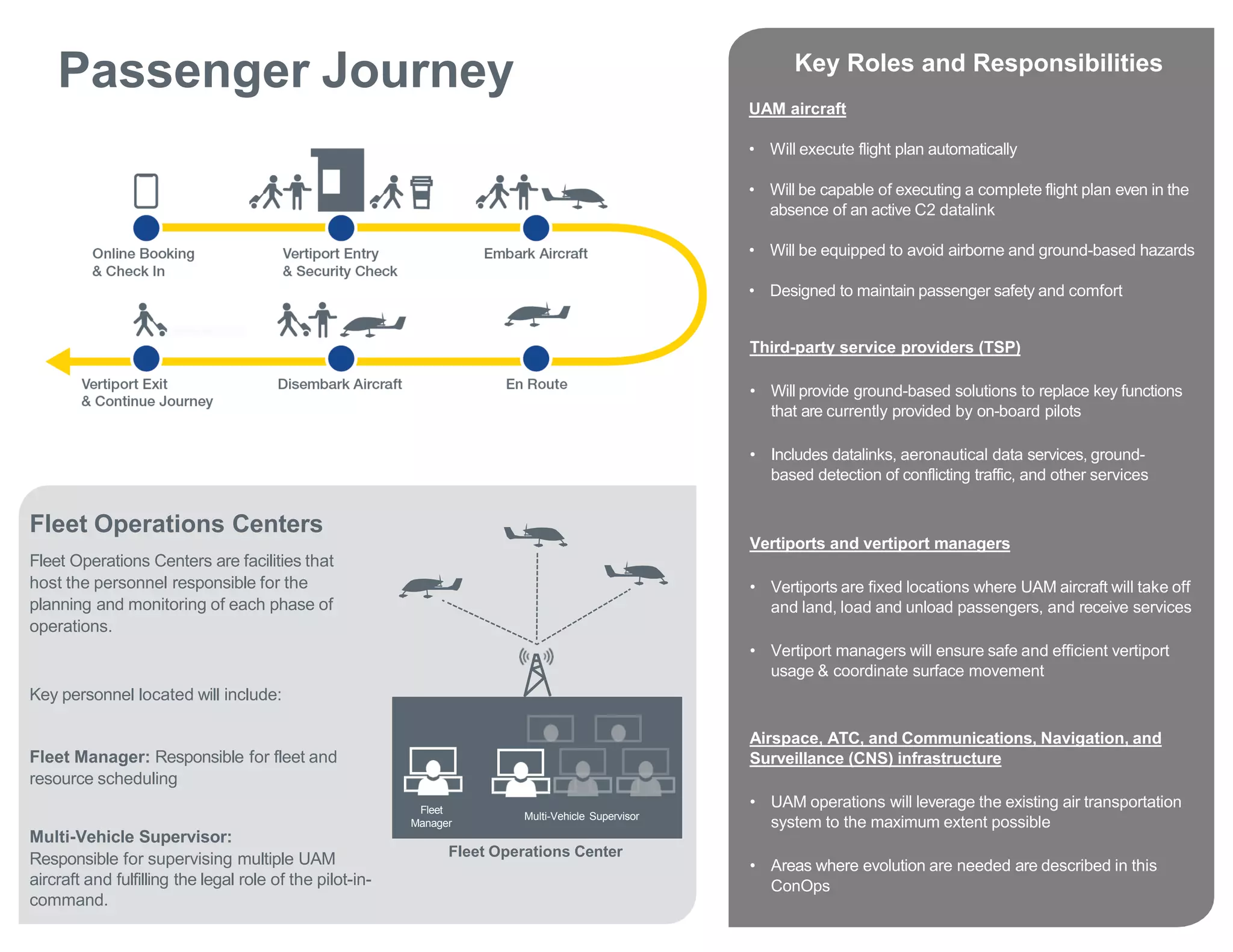
Fleet Operations Centers
Fleet Operations Centers are facilities that
host the personnel responsible for the
planning and monitoring of each phase of
operations.
Key personnel located will include:
Fleet Manager: Responsible for fleet and
resource scheduling
Multi-Vehicle Supervisor:
Responsible for supervising multiple UAM
aircraft and fulfilling the legal role of the pilot-in-
command.
Key Roles and Responsibilities
UAM aircraft
• Will execute flight plan automatically
• Will be capable of executing a complete flight plan even in the
absence of an active C2 datalink
• Will be equipped to avoid airborne and ground-based hazards
• Designed to maintain passenger safety and comfort
Third-party service providers (TSP)
• Will provide ground-based solutions to replace key functions
that are currently provided by on-board pilots
• Includes datalinks, aeronautical data services, ground-
based detection of conflicting traffic, and other services
Vertiports and vertiport managers
• Vertiports are fixed locations where UAM aircraft will take off
and land, load and unload passengers, and receive services
• Vertiport managers will ensure safe and efficient vertiport
usage & coordinate surface movement
Airspace, ATC, and Communications, Navigation, and
Surveillance (CNS) infrastructure
• UAM operations will leverage the existing air transportation
system to the maximum extent possible
• Areas where evolution are needed are described in this
ConOps
Passenger Journey
Fleet Operations Center
Fleet
Manager
Multi-Vehicle Supervisor
ETA
+4:00
ETA
+5:00
ETA
+3:00
ETA
+2:00
ETA
+1:00
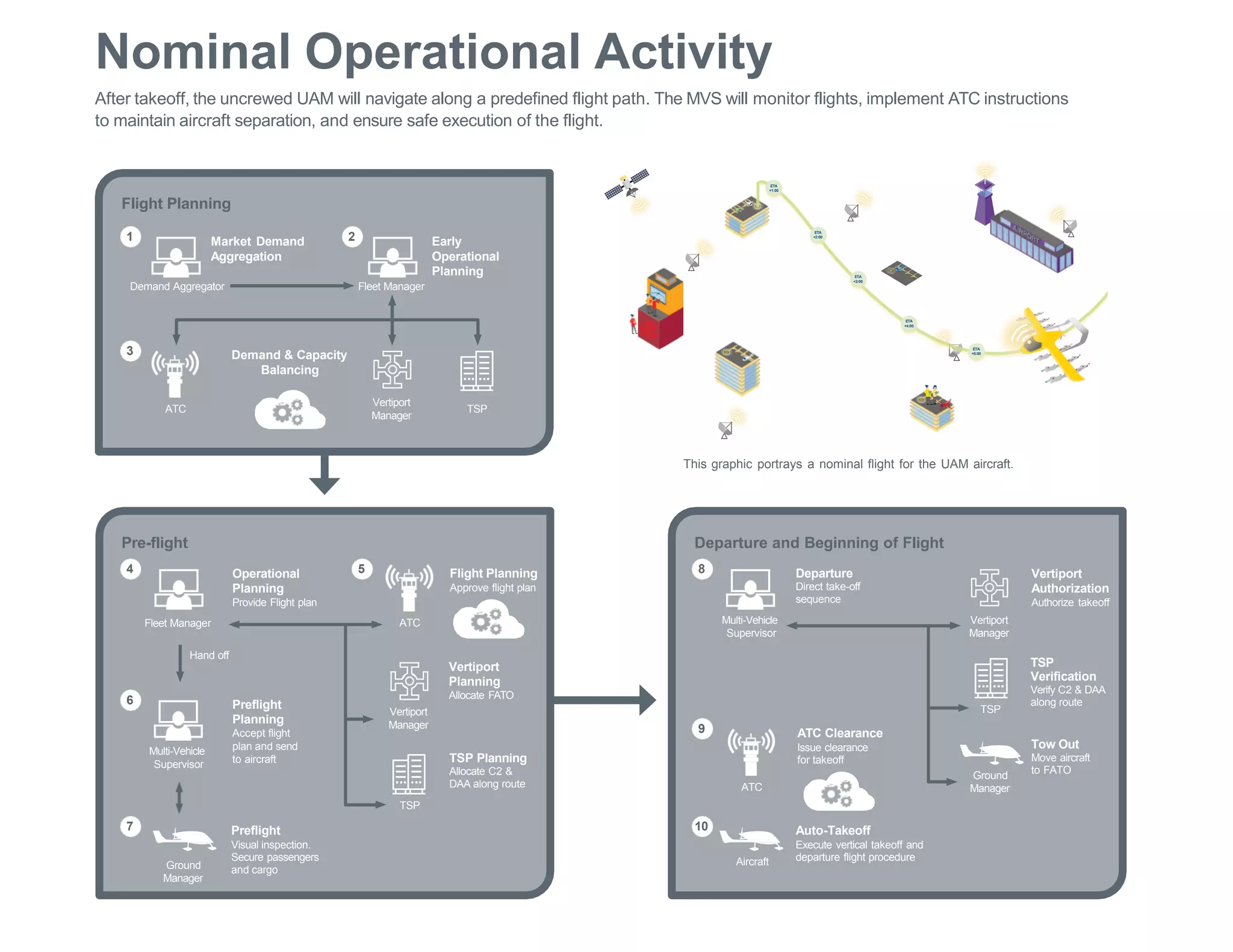
This graphic portrays a nominal flight for the UAM aircraft.
Nominal Operational Activity
After takeoff, the uncrewed UAM will navigate along a predefined flight path. The MVS will monitor flights, implement ATC instructions
to maintain aircraft separation, and ensure safe execution of the flight.
4 8
9
10
5
6
7
Pre-flight Departure and Beginning of Flight
Operational
Planning
Provide Flight plan
Departure
Direct take-off
sequence
Preflight
Planning
Accept flight
plan and send
to aircraft
Preflight
Visual inspection.
Secure passengers
and cargo
Auto-Takeoff
Execute vertical takeoff and
departure flight procedure
Tow Out
Move aircraft
to FATO
Flight Planning
Approve flight plan
Vertiport
Planning
Allocate FATO
TSP Planning
Allocate C2 &
DAA along route
Vertiport
Authorization
Authorize takeoff
TSP
Verification
Verify C2 & DAA
along route
Multi-Vehicle
Supervisor
Hand off
Multi-Vehicle
Supervisor
Ground
Manager
Ground
Manager
Aircraft
TSP
Fleet Manager
ATC Clearance
Issue clearance
for takeoff
Vertiport
Manager
1
3
2
Flight Planning
Market Demand
Aggregation
Demand & Capacity
Balancing
Early
Operational
Planning
Demand Aggregator
TSP
Fleet Manager
ATC
Vertiport
Manager
ATC
ATC
Vertiport
Manager
TSP
Approach and Landing
Autoland
Approach and
land; Avoid
hazards, if any
Approach & Landing
Confirmations
Affirm landing slot
Affirm autoland
ATC Clearance
Monitors the flight
and instructs as
needed
Tow In
Move aircraft
to gate
Multi-Vehicle
Supervisor
Ground
Manager
Aircraft
Vertiport
Authorizations
Verify FATO is safe
Vertiport (14) to approach and
Manager (15) to land on
14
&
15
16
17
Inflight
Inflight Supervision
Monitors airspace, flight
path, and aircraft health.
Hazard Resolution
Manages hazard
resolution if needed,
Self-Flying
Executes cleared
flight plan
Flight
Monitoring
Follows the flight and
instructs if needed
Hazard
Resolution
Address hazards
(e.g., DAA) if needed,
with support from
TSP.
Multi-Vehicle
TSP supports.
Supervisor
Multi-Vehicle
with support from TSP.
Supervisor
Aircraft
Aircraft
Post-flight
Post-flight
Secure systems
Generate report
Post-flight
Disembark
passengers
Unload cargo
Mission Report
Accept and log
Multi-Vehicle
Supervisor
Fleet Manager
Turnaround
Procedure
Check systems
Charge battery;
Clean cabin
Ground
Manager
Ground
Manager
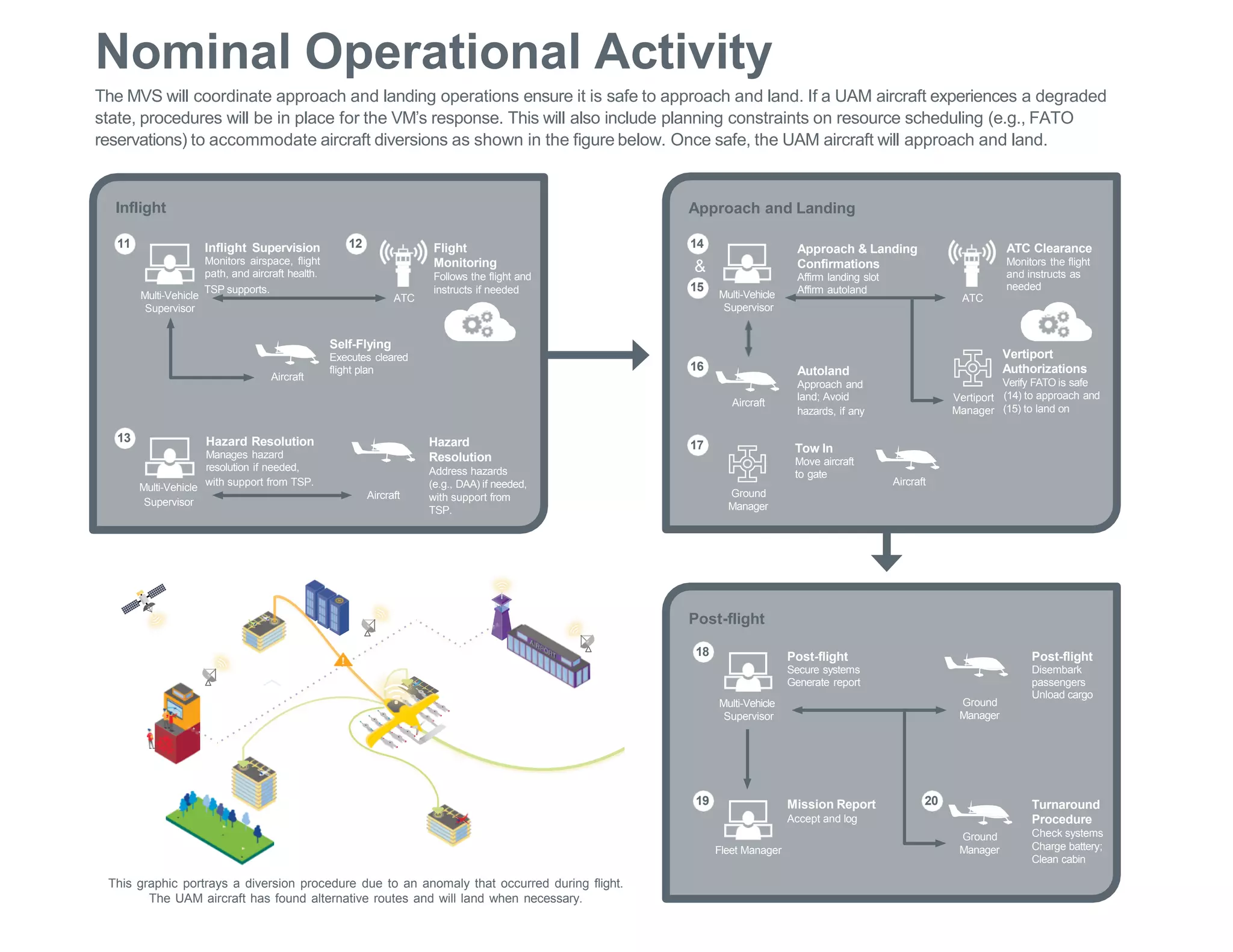
This graphic portrays a diversion procedure due to an anomaly that occurred during flight.
The UAM aircraft has found alternative routes and will land when necessary.
11
13
18
19 20
12
The MVS will coordinate approach and landing operations ensure it is safe to approach and land. If a UAM aircraft experiences a degraded
state, procedures will be in place for the VM’s response. This will also include planning constraints on resource scheduling (e.g., FATO
reservations) to accommodate aircraft diversions as shown in the figure below. Once safe, the UAM aircraft will approach and land.
Aircraft
ATC ATC
Nominal Operational Activity
© 2022. The Boeing Company. All Rights Reserved. Not Subject to Export Regulations. 09/22 AQ
https://www.boeing.com/innovation/con-ops
Feedback
• As we build together, the industry will change shape and evolve. We invite your inputs and feedback.
• Please sent an email with feedback to urbanairmobility@boeing.com
Disclaimer: Please do not include any confidential information because all feedback will become the property of The Boeing Company

CONCEPT OF OPERATIONS: THE TRANSITION FROM CREWED TO UNCREWED UAM

  • 1.
    Concept of Operationsfor Uncrewed Urban Air Mobility © 2022. The Boeing Company. All Rights Reserved. Not Subject to Export Regulations. 09/22 AQ
  • 2.
    Introduction • Concept ofOperations for uncrewed, passenger carrying UAM • Outlines integration of uncrewed UAM into the national airspace system • Facilitates stakeholder engagement and convergence on concepts Safe and affordable, everyday flight for everyone
  • 3.
    Key Stakeholders Stakeholders ExampleRole Flying Public and Flying Public and Community Advocacy Long Beach Community Economic Council Share environmental or societal concerns and potential impact of AAM on individual communities. Work with industry to effectively plan and implement changes to safely integrate UAM into the local airspace. Regulatory Agencies FAA, EASA, CAA Work to support the safe integration of UAM into the airspace. Trade Associations AUVSI, AIA, GAMA Work with industry to support national competitiveness and to further advance policies. Standards Development Organizations RTCA, EUROCAE, ASTM Aim to develop industry consensus-based standards to be used as a basis for certification. UAM Industry Wisk, SkyGrid, Insitu, Aura, Skyports, Vertical, Joby, Altitude Angel, Eve Develop technology to advance the mobility industry—including aircraft, UTM systems, command-and-control links, vertiports, etc. Traditional Airspace Users General Aviation, American Airlines, United, Delta, Boeing, Airbus Work with UAM industry to identify solutions to safely integrate aircraft into airspace and partner on sustainable airspace opportunities. R&D Testing Agencies NASA, SESAR Identify and support industry testing and promote collaboration to further advance and validate research. Federal, State, and Local Policymakers U.S. Congress, State Representatives, Mayors Advance the level of safety in UAM and work with industry to develop a comprehensive integration strategy with increased innovation.
  • 4.
    Infrastructure Airspace UAS/Aircraft KeyEnabling Elements for Autonomous AAM Vertiports Streamline capacity balancing and provide real-time FATO availability for AAM coordination. Operating Picture High integrity situational awareness providing ATM, weather, obstacle, and vertiport data. C2 Links Reliable, redundant, and timely fleetwide Ground-Air Command and Control capabilities. IFR Route Network Existing and new routes designed to support AAM operations over urban environments. 4-D Flight Plans Time-based deconfliction minimizes ATC interactions, and leverages ATM modernization efforts. DAA & LHA Systems Provide last layer of tactical conflict management to ensure safety of flight.
  • 5.
    Establishing a Steppingstoneto Uncrewed UAM Current and Near-term UAM Mid-term UAM (This ConOps) Far-term UAM Flight Rules Visual Flight Rules (VFR) and Instrument Flight Rules (IFR) UAM aircraft adhere to published routes and procedures Automated air traffic management enables higher density of flights Instrument Flight Procedures Currently Utilized Procedures New procedures required for automated vertical guidance to surface UAM flight tracks are designated as UAM corridors managed by automated ATM Pilot-in-Command Onboard pilot Multi-vehicle supervisor (Up to three vehicles) Multi-vehicle Supervisor (Many vehicles) Flow Management and Separation Services Operators file flight plans. ATC provides separation services. Operators file high- fidelity flight plans ATC provides separation services. Flight planning and separation services are automated within a UAM corridor. ATC Hand-Offs and Check-Ins Pilots engage with ATC via voice communications More automated voice communications with ATC Communication is automated within a UAM Corridor Heliport and Vertiport Surface Control Heliport operators authorize access to their surfaces. Fixed- base operators (FBOs) manage schedule and coordinate surface movement Vertiport Managers (VMs) authorize access to their surfaces and control surface movement/slot reservation VMs control aircraft movement in vertiport airspace and control surface movement / slot reservation
  • 6.
    Workforce Engagement • Newcareer paths will combine traditional aviation with autonomy and electric propulsion • Investment in training and education (private and public) will be needed Community Engagement Regulatory Engagement • Existing regulations will need revision for novel nature of platforms • Industry standards are needed as means of compliance • Flight operations rules will need to be modified to safely evolve airspace for autonomous UAM operations • Communications, navigation, surveillance and information infrastructure technical advances will enable autonomous landings and high tempo procedures • Global regulatory changes will need to allow safe UAM ecosystem evolution with ICAO playing a key role • Public acceptance is crucial, need to build confidence in UAM • Industry must work with local cities and economic development organizations • Some local governments have established AAM working groups
  • 7.
    Fleet Operations Centers FleetOperations Centers are facilities that host the personnel responsible for the planning and monitoring of each phase of operations. Key personnel located will include: Fleet Manager: Responsible for fleet and resource scheduling Multi-Vehicle Supervisor: Responsible for supervising multiple UAM aircraft and fulfilling the legal role of the pilot-in- command. Key Roles and Responsibilities UAM aircraft • Will execute flight plan automatically • Will be capable of executing a complete flight plan even in the absence of an active C2 datalink • Will be equipped to avoid airborne and ground-based hazards • Designed to maintain passenger safety and comfort Third-party service providers (TSP) • Will provide ground-based solutions to replace key functions that are currently provided by on-board pilots • Includes datalinks, aeronautical data services, ground- based detection of conflicting traffic, and other services Vertiports and vertiport managers • Vertiports are fixed locations where UAM aircraft will take off and land, load and unload passengers, and receive services • Vertiport managers will ensure safe and efficient vertiport usage & coordinate surface movement Airspace, ATC, and Communications, Navigation, and Surveillance (CNS) infrastructure • UAM operations will leverage the existing air transportation system to the maximum extent possible • Areas where evolution are needed are described in this ConOps Passenger Journey Fleet Operations Center Fleet Manager Multi-Vehicle Supervisor
  • 8.
    ETA +4:00 ETA +5:00 ETA +3:00 ETA +2:00 ETA +1:00 This graphic portraysa nominal flight for the UAM aircraft. Nominal Operational Activity After takeoff, the uncrewed UAM will navigate along a predefined flight path. The MVS will monitor flights, implement ATC instructions to maintain aircraft separation, and ensure safe execution of the flight. 4 8 9 10 5 6 7 Pre-flight Departure and Beginning of Flight Operational Planning Provide Flight plan Departure Direct take-off sequence Preflight Planning Accept flight plan and send to aircraft Preflight Visual inspection. Secure passengers and cargo Auto-Takeoff Execute vertical takeoff and departure flight procedure Tow Out Move aircraft to FATO Flight Planning Approve flight plan Vertiport Planning Allocate FATO TSP Planning Allocate C2 & DAA along route Vertiport Authorization Authorize takeoff TSP Verification Verify C2 & DAA along route Multi-Vehicle Supervisor Hand off Multi-Vehicle Supervisor Ground Manager Ground Manager Aircraft TSP Fleet Manager ATC Clearance Issue clearance for takeoff Vertiport Manager 1 3 2 Flight Planning Market Demand Aggregation Demand & Capacity Balancing Early Operational Planning Demand Aggregator TSP Fleet Manager ATC Vertiport Manager ATC ATC Vertiport Manager TSP
  • 9.
    Approach and Landing Autoland Approachand land; Avoid hazards, if any Approach & Landing Confirmations Affirm landing slot Affirm autoland ATC Clearance Monitors the flight and instructs as needed Tow In Move aircraft to gate Multi-Vehicle Supervisor Ground Manager Aircraft Vertiport Authorizations Verify FATO is safe Vertiport (14) to approach and Manager (15) to land on 14 & 15 16 17 Inflight Inflight Supervision Monitors airspace, flight path, and aircraft health. Hazard Resolution Manages hazard resolution if needed, Self-Flying Executes cleared flight plan Flight Monitoring Follows the flight and instructs if needed Hazard Resolution Address hazards (e.g., DAA) if needed, with support from TSP. Multi-Vehicle TSP supports. Supervisor Multi-Vehicle with support from TSP. Supervisor Aircraft Aircraft Post-flight Post-flight Secure systems Generate report Post-flight Disembark passengers Unload cargo Mission Report Accept and log Multi-Vehicle Supervisor Fleet Manager Turnaround Procedure Check systems Charge battery; Clean cabin Ground Manager Ground Manager This graphic portrays a diversion procedure due to an anomaly that occurred during flight. The UAM aircraft has found alternative routes and will land when necessary. 11 13 18 19 20 12 The MVS will coordinate approach and landing operations ensure it is safe to approach and land. If a UAM aircraft experiences a degraded state, procedures will be in place for the VM’s response. This will also include planning constraints on resource scheduling (e.g., FATO reservations) to accommodate aircraft diversions as shown in the figure below. Once safe, the UAM aircraft will approach and land. Aircraft ATC ATC Nominal Operational Activity
  • 10.
    © 2022. TheBoeing Company. All Rights Reserved. Not Subject to Export Regulations. 09/22 AQ https://www.boeing.com/innovation/con-ops Feedback • As we build together, the industry will change shape and evolve. We invite your inputs and feedback. • Please sent an email with feedback to urbanairmobility@boeing.com Disclaimer: Please do not include any confidential information because all feedback will become the property of The Boeing Company