1
Programming in C
2
Flow of Control
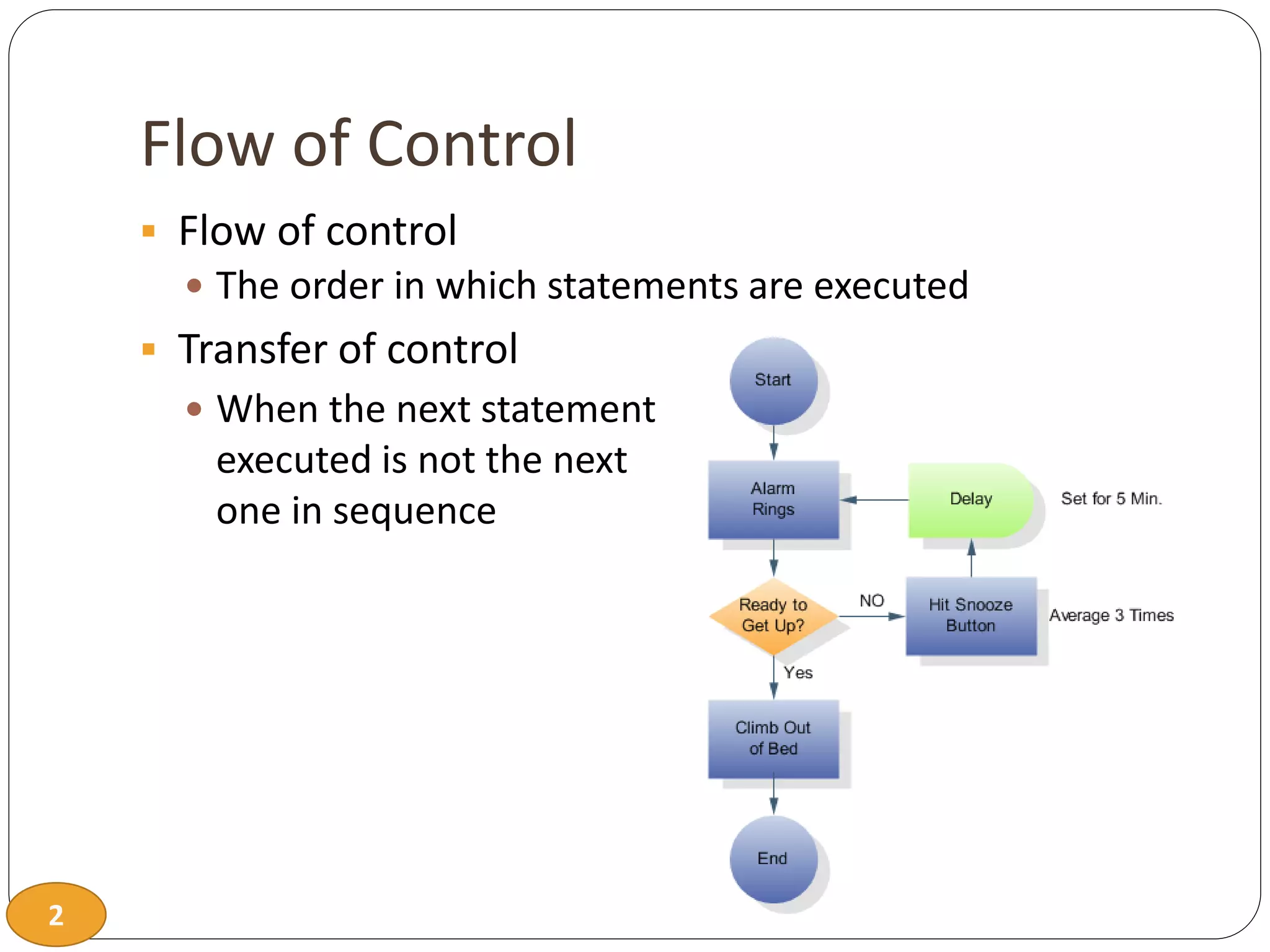
 Flow of control
 The order in which statements are executed
 Transfer of control
 When the next statement
executed is not the next
one in sequence
3
Flow of Control
 Control structures
combination of individual statements into a logical unit
that regulates the flow of execution in a program or
function
 Sequence
 Selection (Making Decisions)
 Repetition (Looping)
4
Boolean Expressions
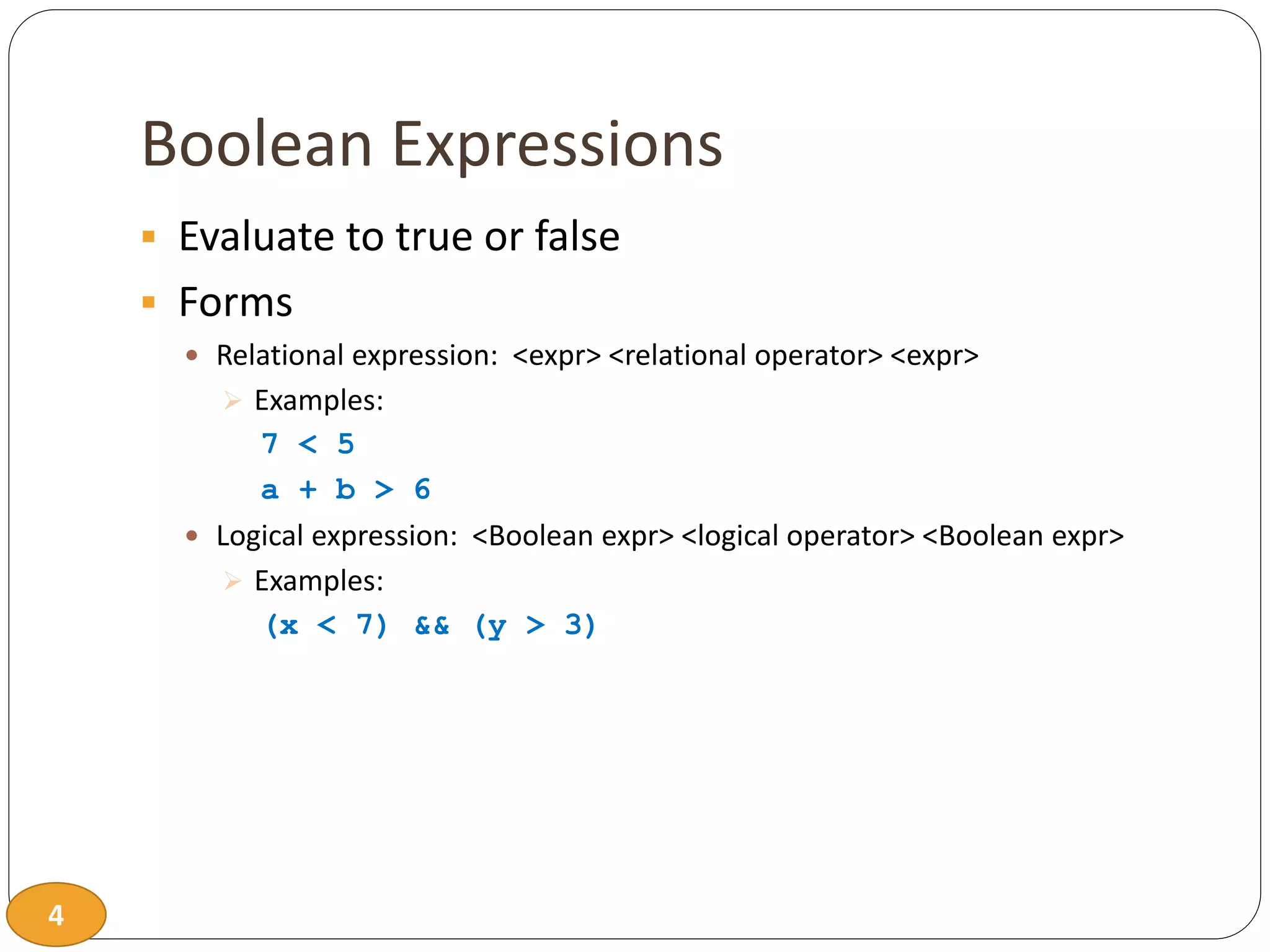
 Evaluate to true or false
 Forms
 Relational expression: <expr> <relational operator> <expr>
 Examples:
7 < 5
a + b > 6
 Logical expression: <Boolean expr> <logical operator> <Boolean expr>
 Examples:
(x < 7) && (y > 3)
5
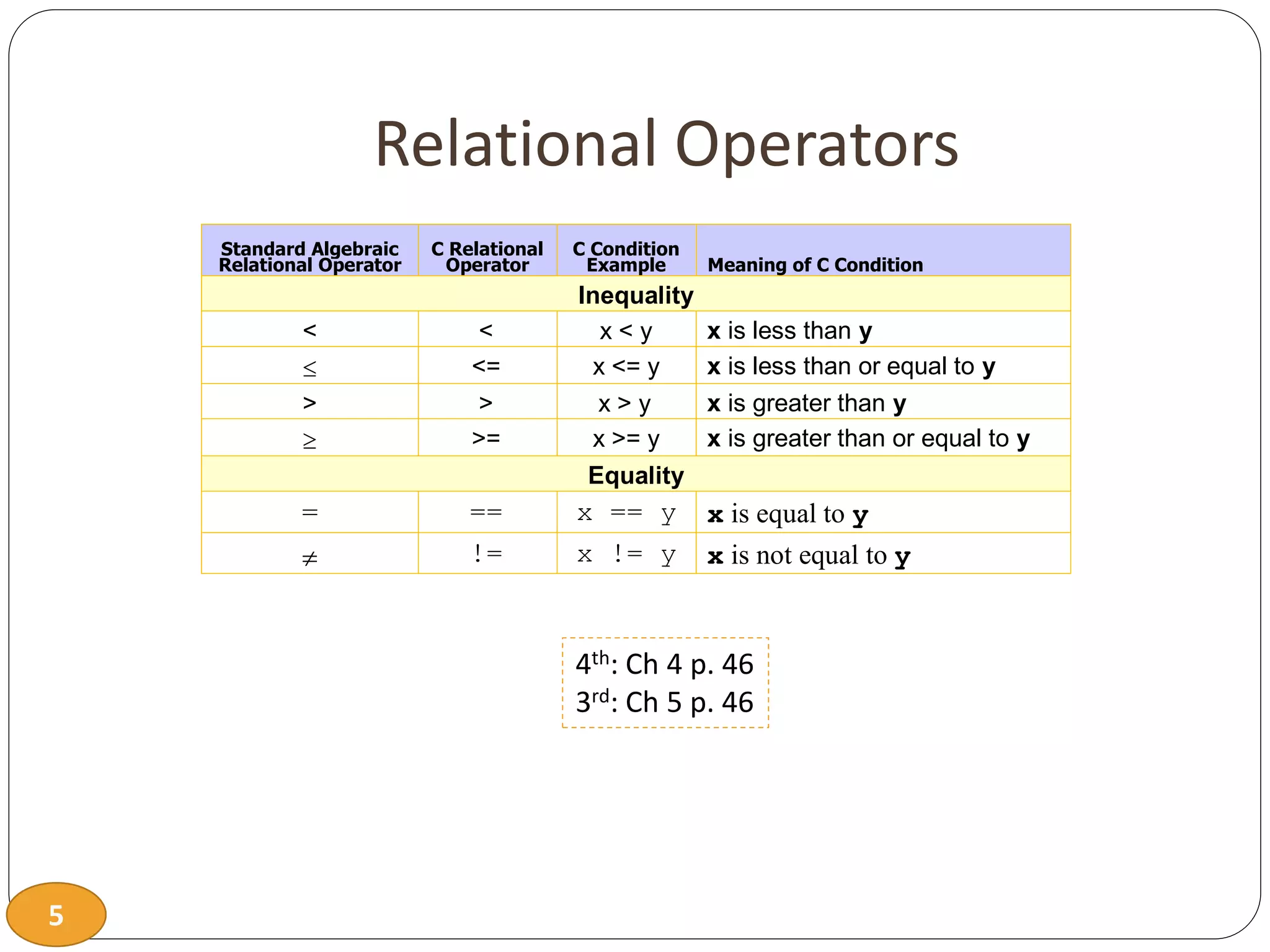
Relational Operators
Standard Algebraic
Relational Operator
C Relational
Operator
C Condition
Example Meaning of C Condition
Inequality
< < x < y x is less than y
 <= x <= y x is less than or equal to y
> > x > y x is greater than y
 >= x >= y x is greater than or equal to y
Equality
= == x == y x is equal to y
 != x != y x is not equal to y
4th: Ch 4 p. 46
3rd: Ch 5 p. 46
6
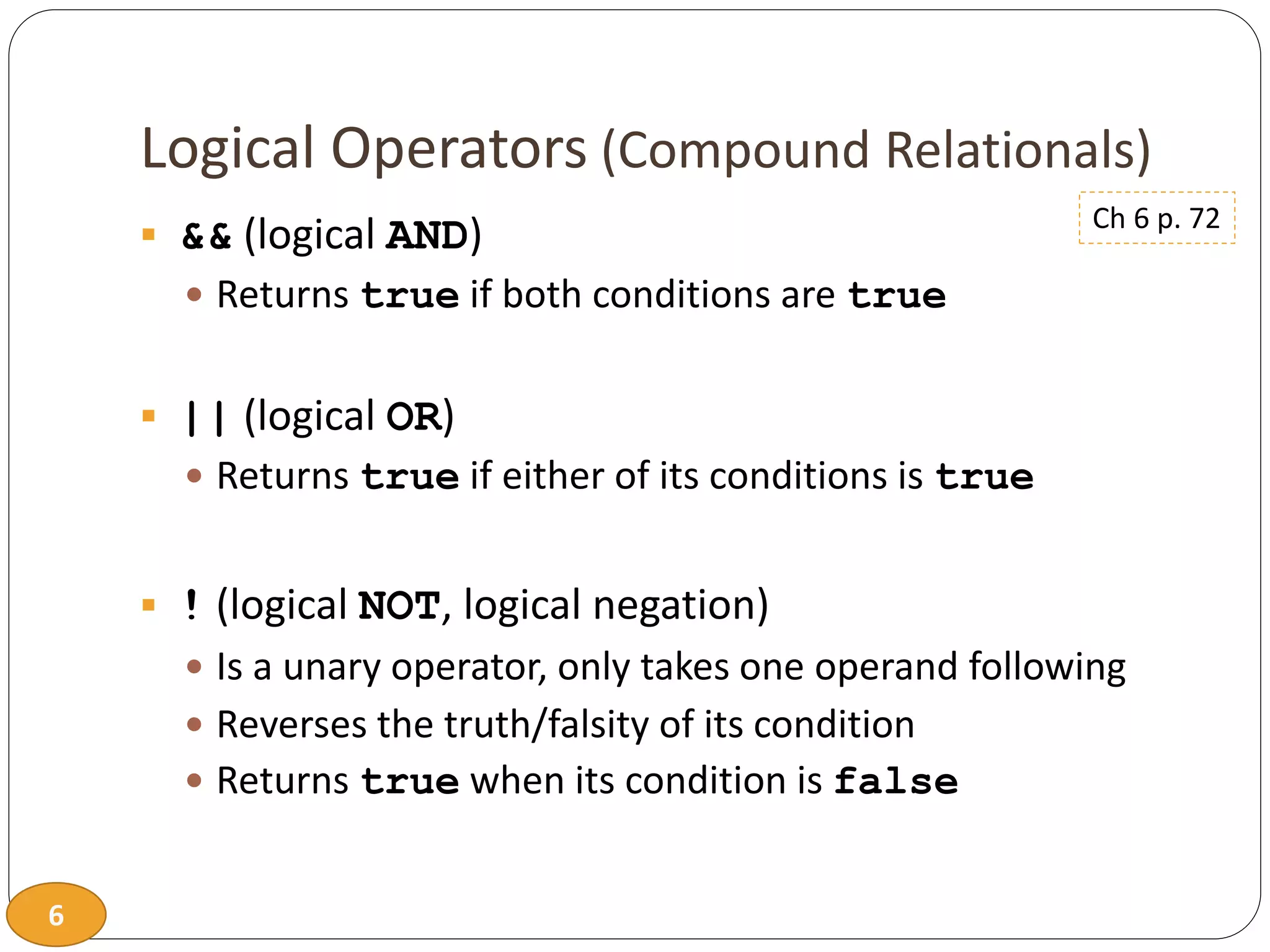
Logical Operators (Compound Relationals)
 && (logical AND)
 Returns true if both conditions are true
 || (logical OR)
 Returns true if either of its conditions is true
 ! (logical NOT, logical negation)
 Is a unary operator, only takes one operand following
 Reverses the truth/falsity of its condition
 Returns true when its condition is false
Ch 6 p. 72
7
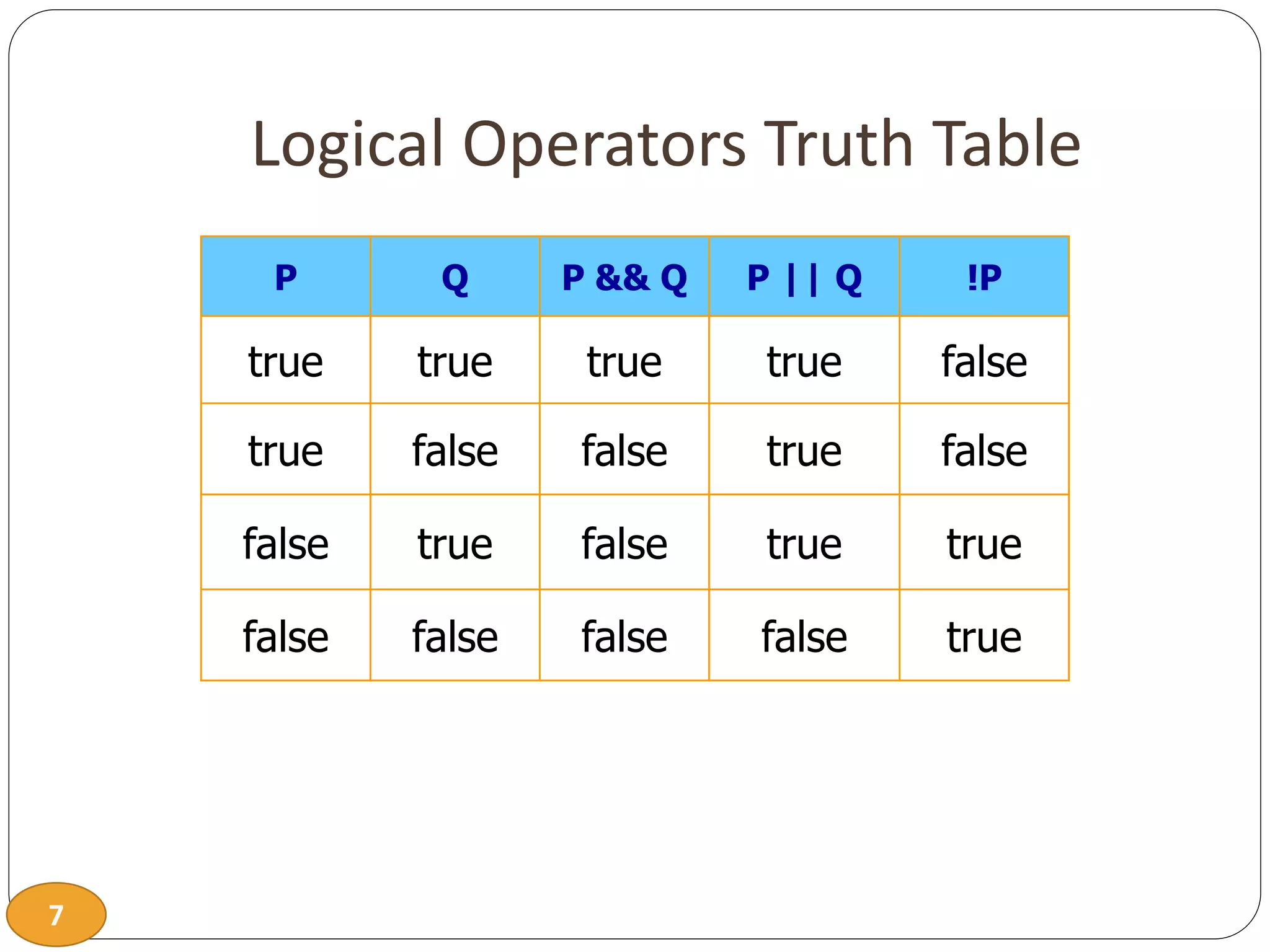
Logical Operators Truth Table
P Q P && Q P || Q !P
true true true true false
true false false true false
false true false true true
false false false false true
8
Precedence of Operators
1. (), []
2. Unary +, unary -, !, ++, --
3. Type casting
4. * , / , %
5. + , -
6. <, <=, >, >=
7. ==, !=
8. &&
9. ||
10. =
9
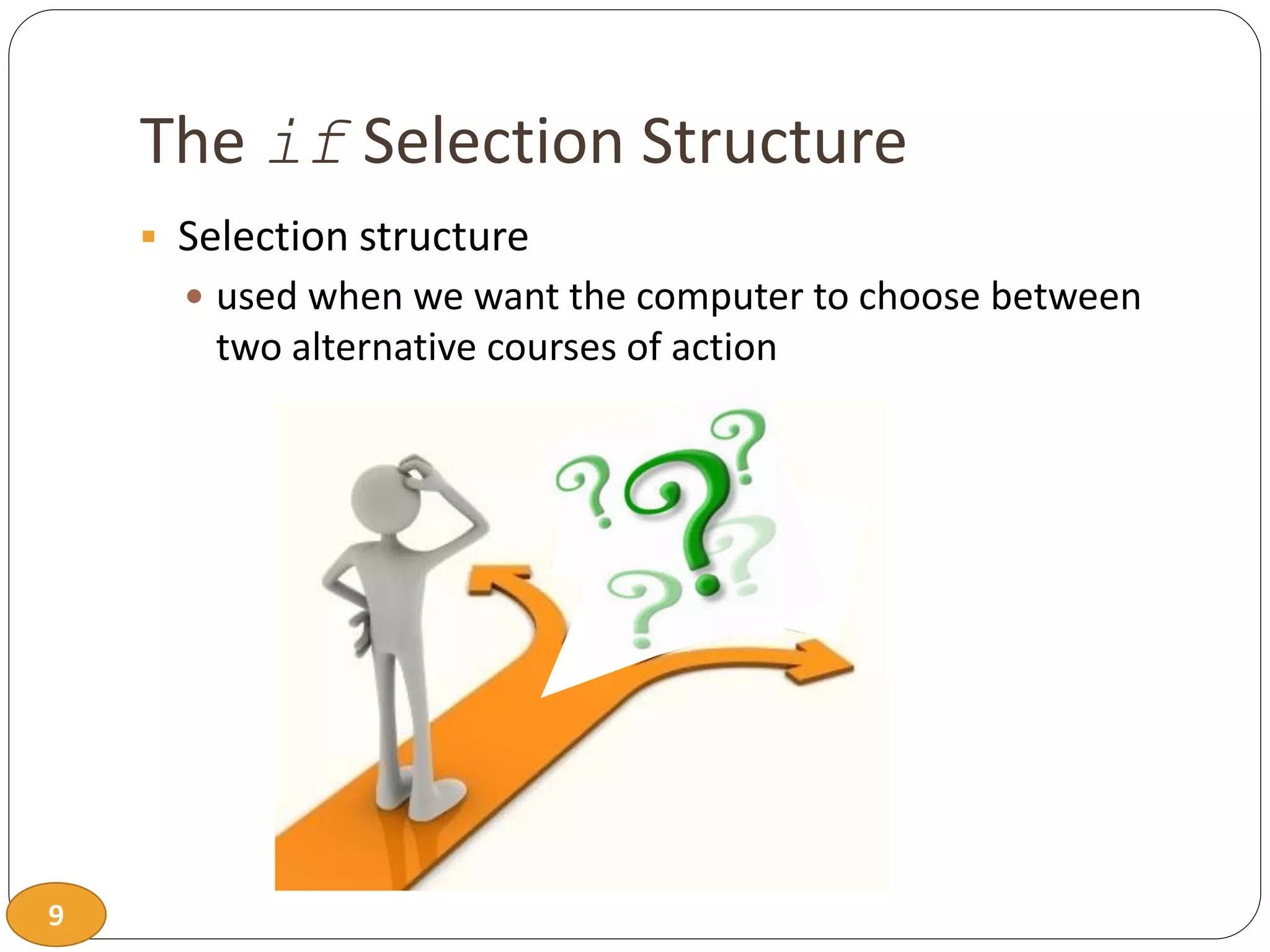
The if Selection Structure
 Selection structure
 used when we want the computer to choose between
two alternative courses of action
10
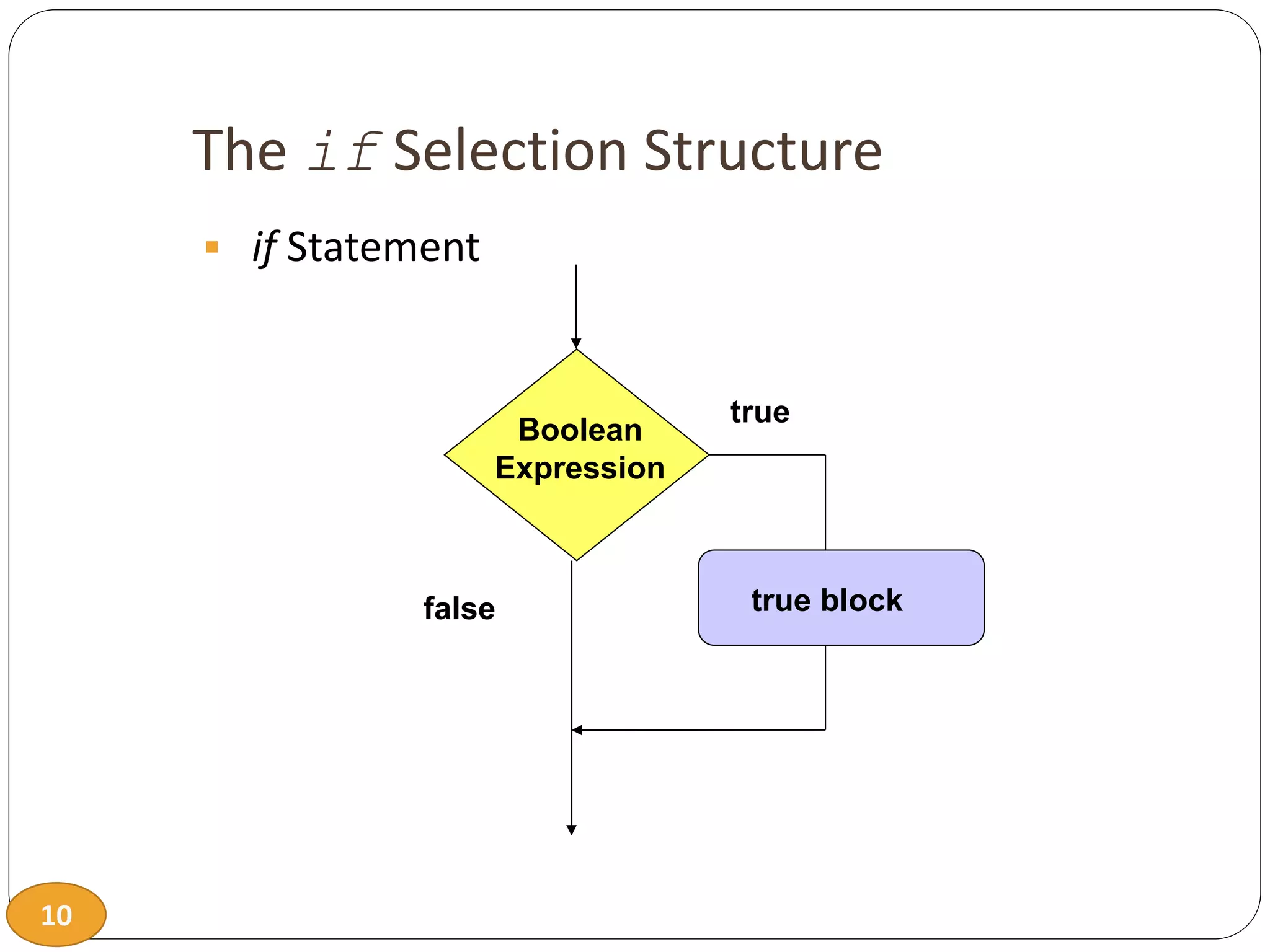
The if Selection Structure
 if Statement
true block
Boolean
Expression
true
false
11
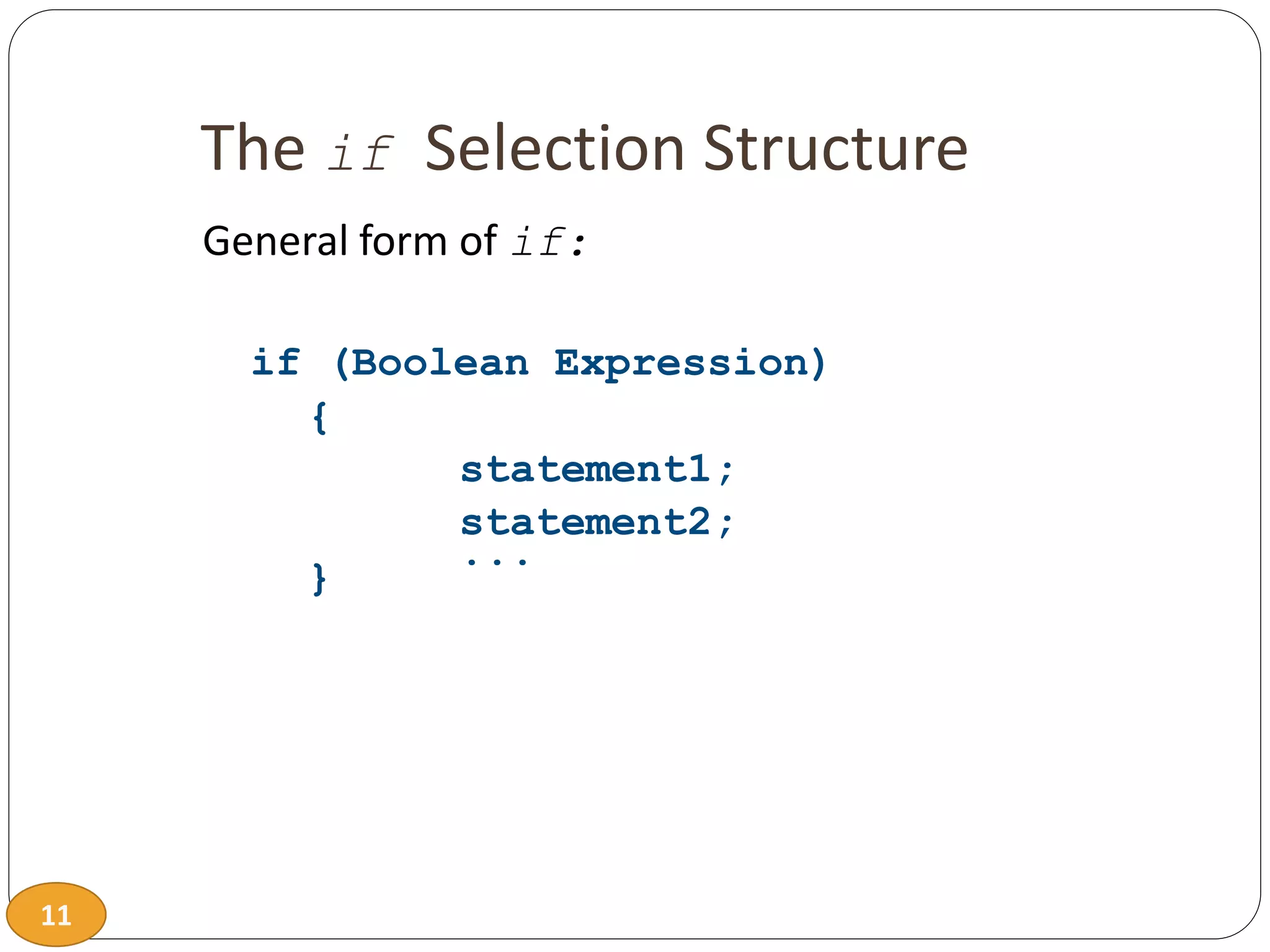
The if Selection Structure
General form of if:
if (Boolean Expression)
{
statement1;
statement2;
...
}
12
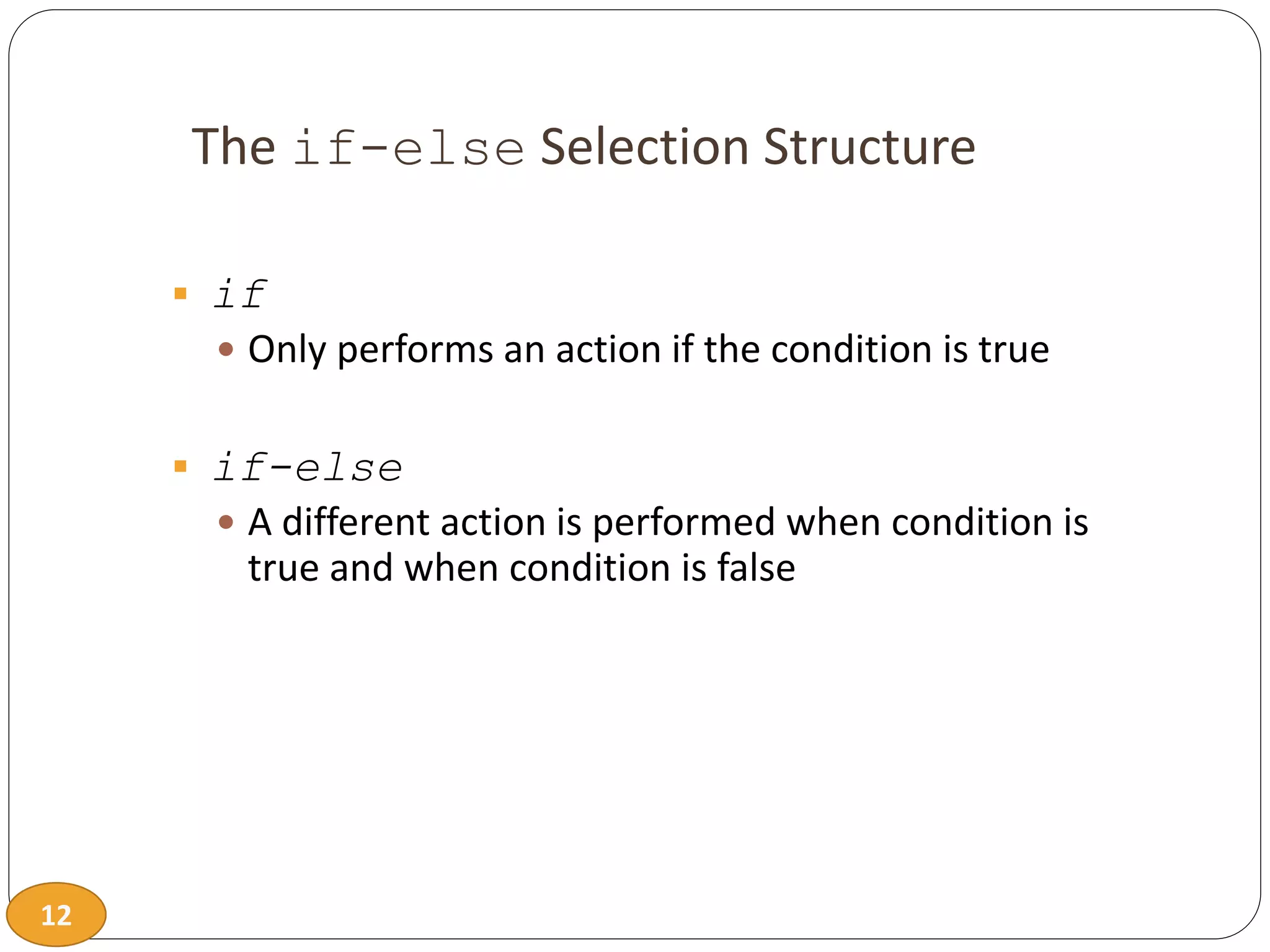
The if-else Selection Structure
 if
 Only performs an action if the condition is true
 if-else
 A different action is performed when condition is
true and when condition is false
13
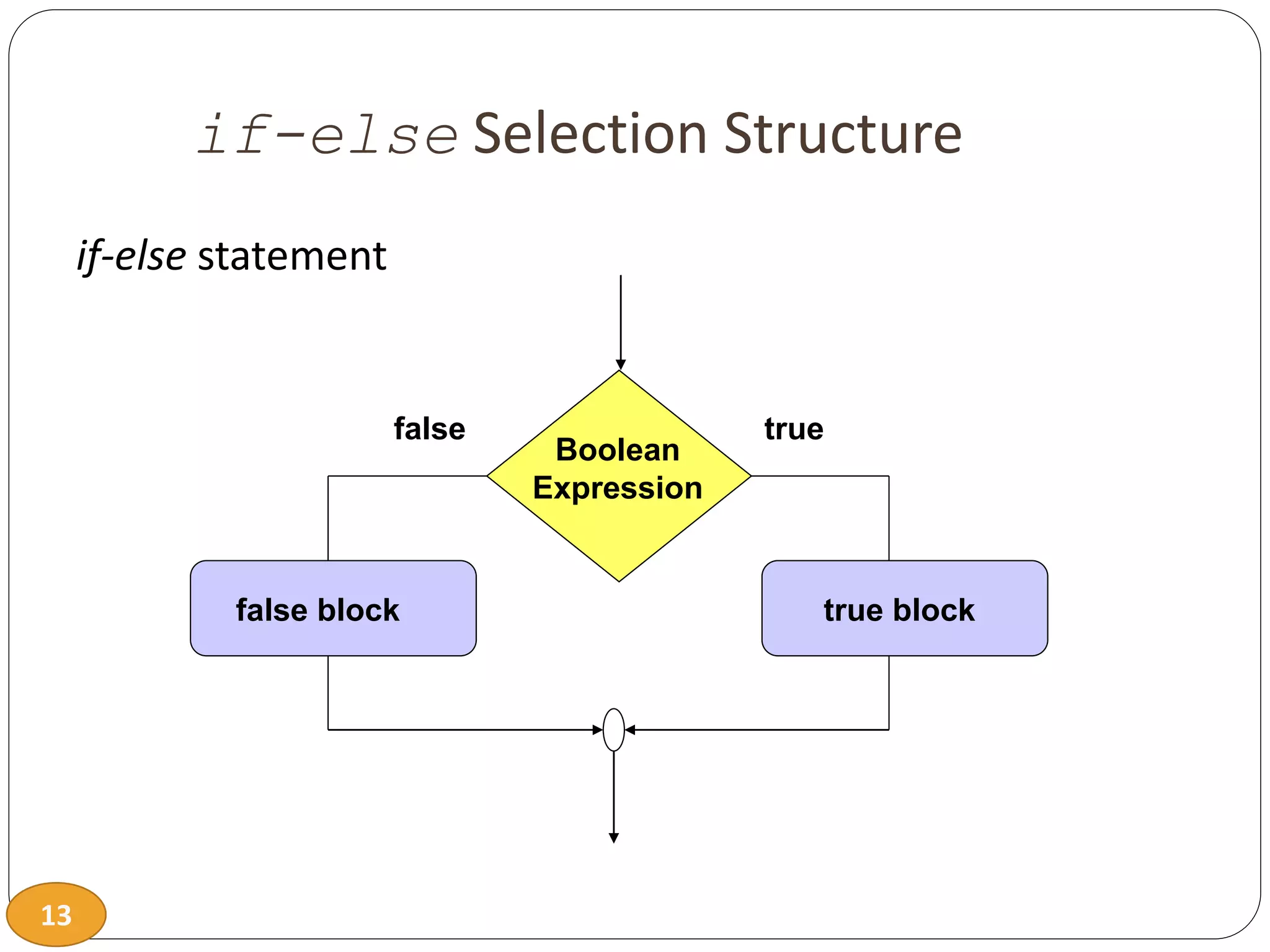
if-else Selection Structure
false true
if-else statement
false block
Boolean
Expression
true block
14
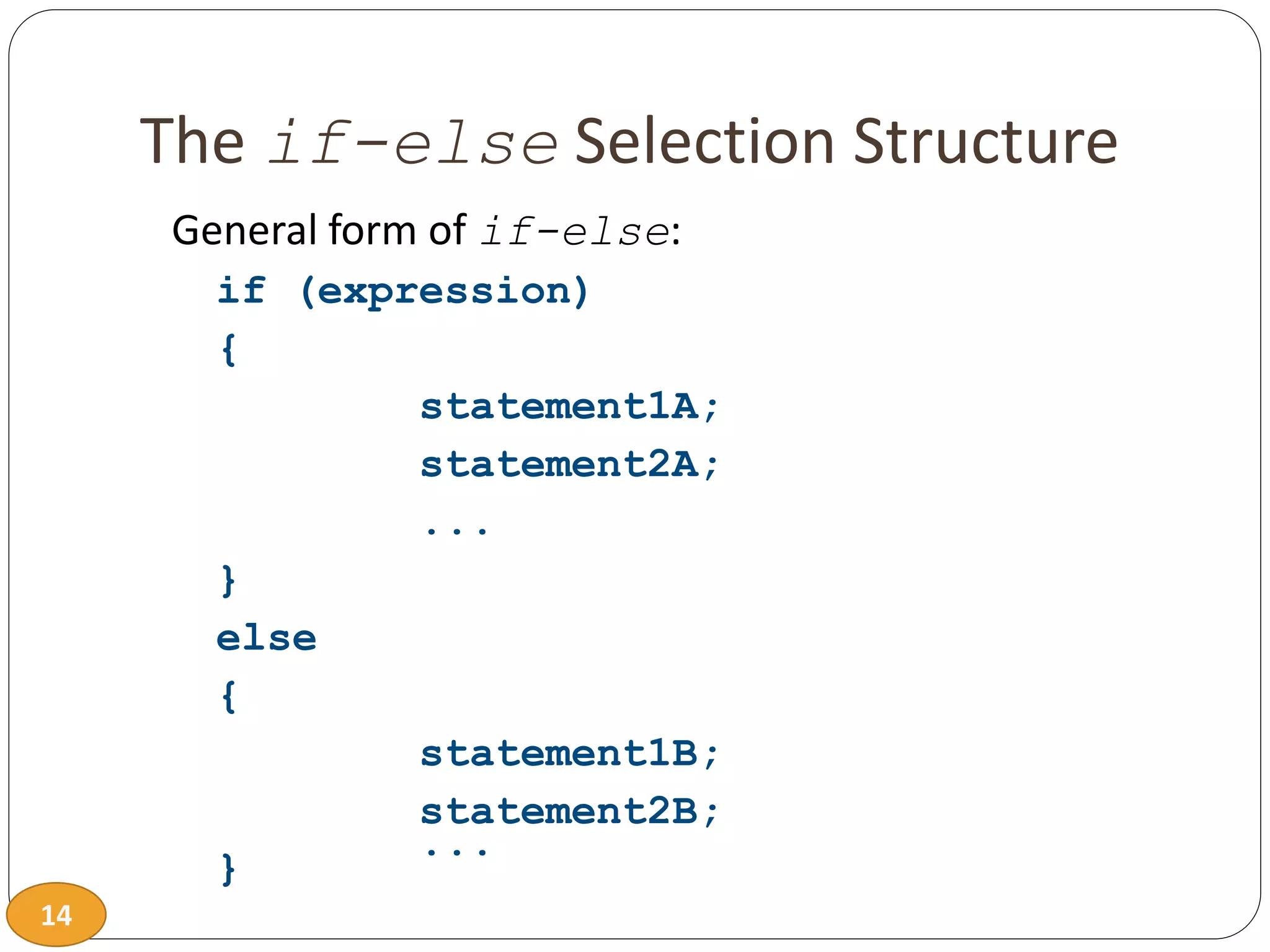
The if-else Selection Structure
General form of if-else:
if (expression)
{
statement1A;
statement2A;
...
}
else
{
statement1B;
statement2B;
...
}
15
The if-else Selection Structure
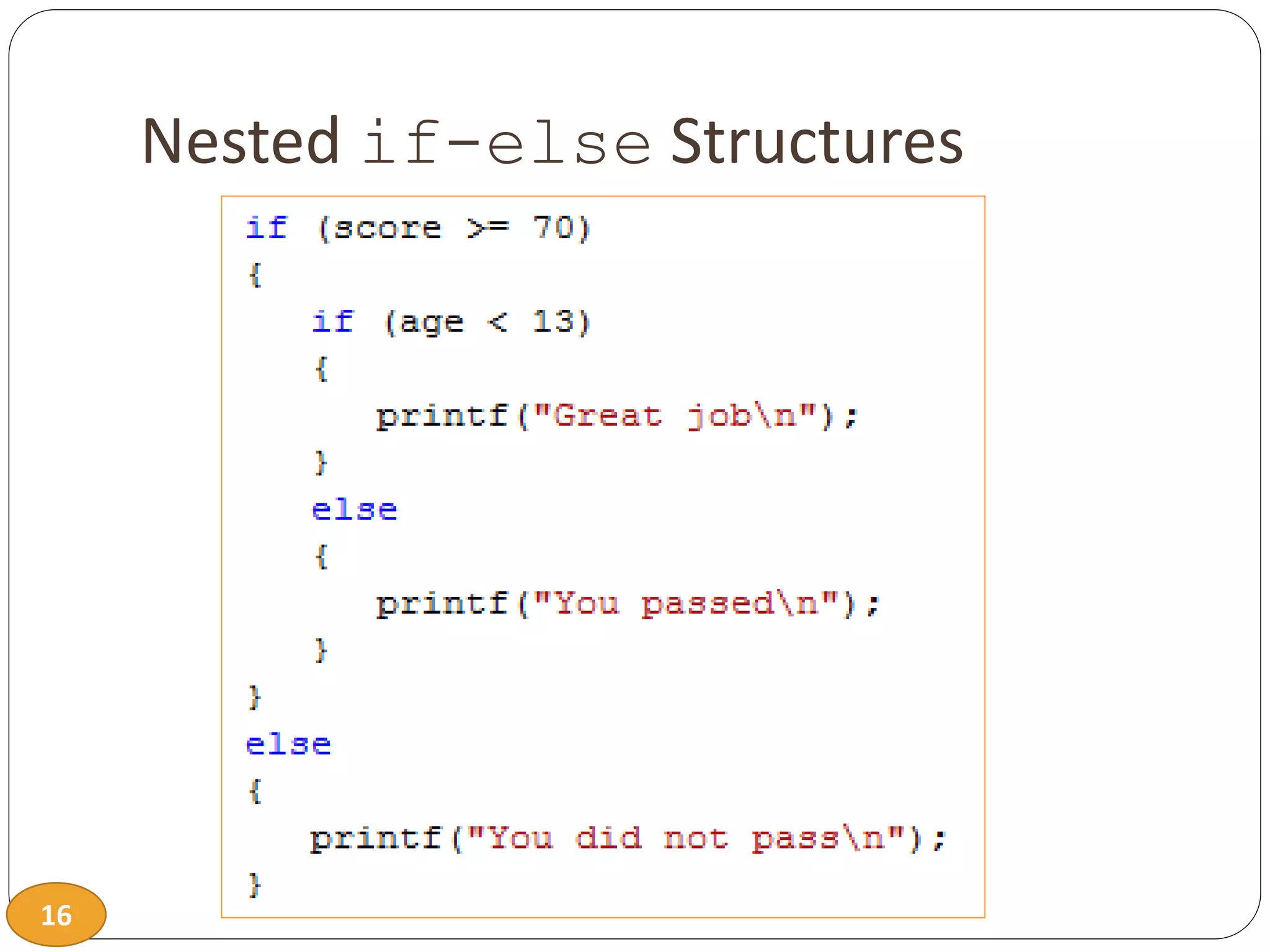
 Nested if-else structures
 Test for multiple cases by placing if-else selection
structures inside if-else selection structures.
16
Nested if-else Structures
17
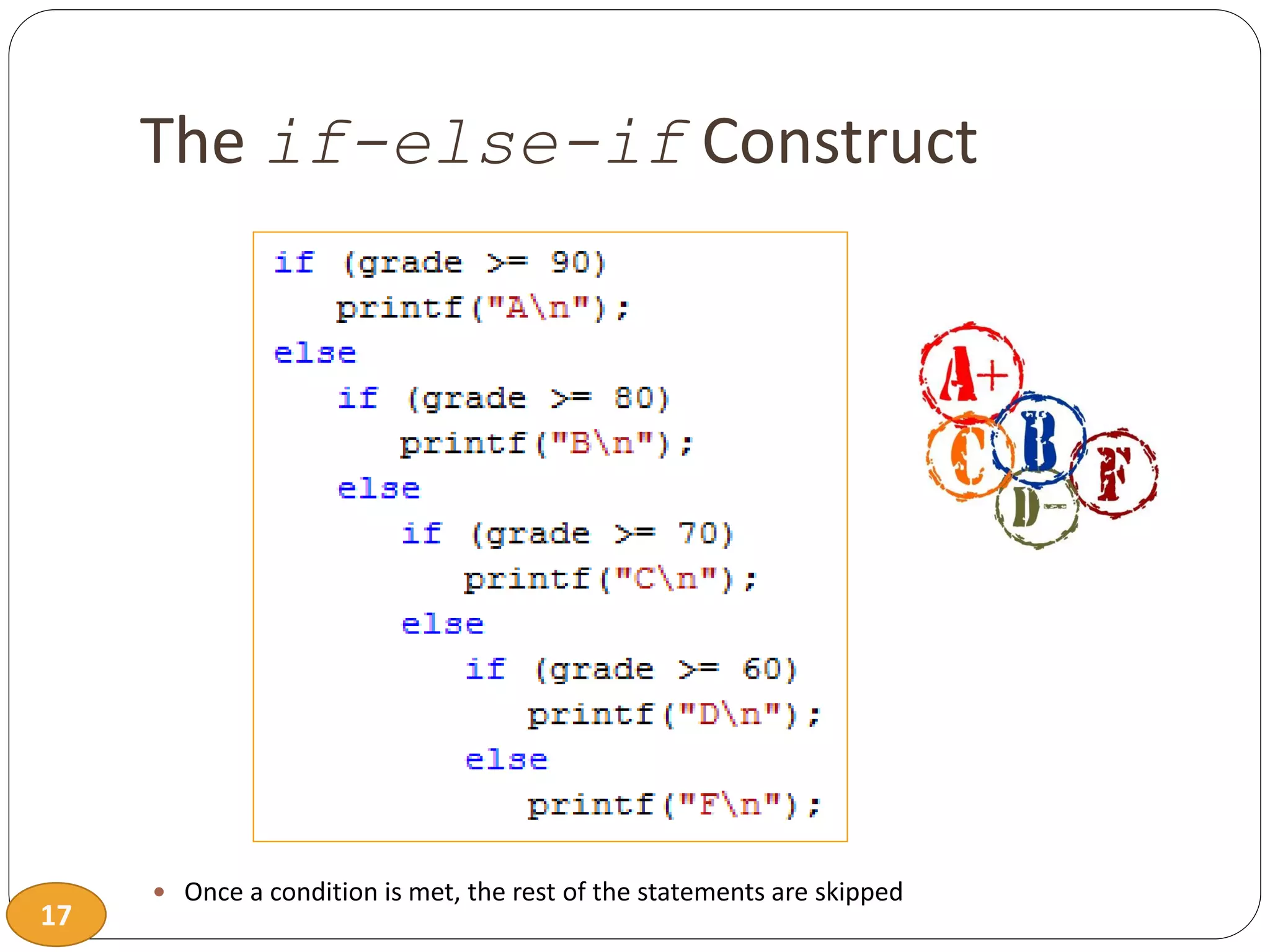
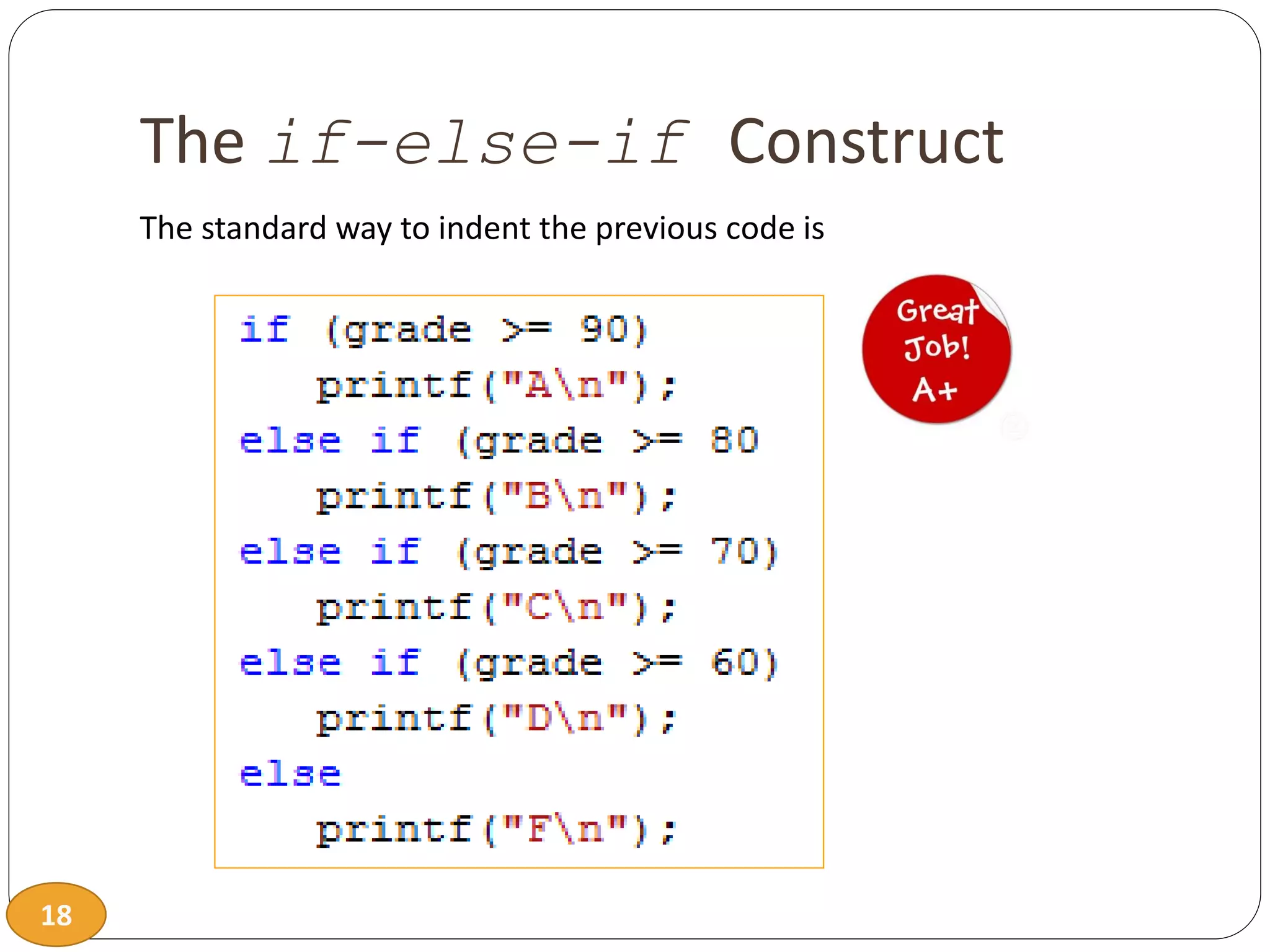
The if-else-if Construct
 Once a condition is met, the rest of the statements are skipped
18
The if-else-if Construct
The standard way to indent the previous code is
19
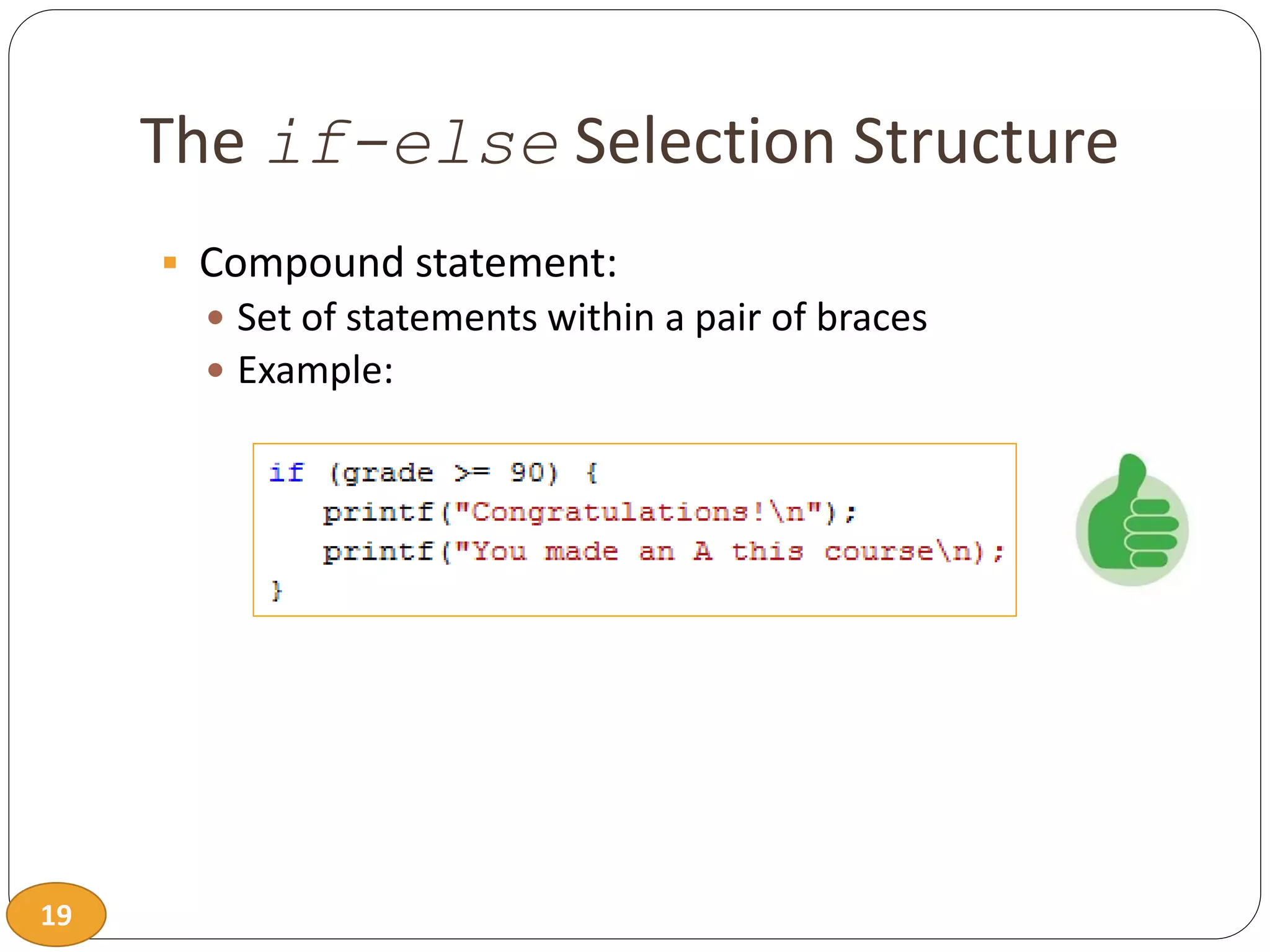
The if-else Selection Structure
 Compound statement:
 Set of statements within a pair of braces
 Example:
20
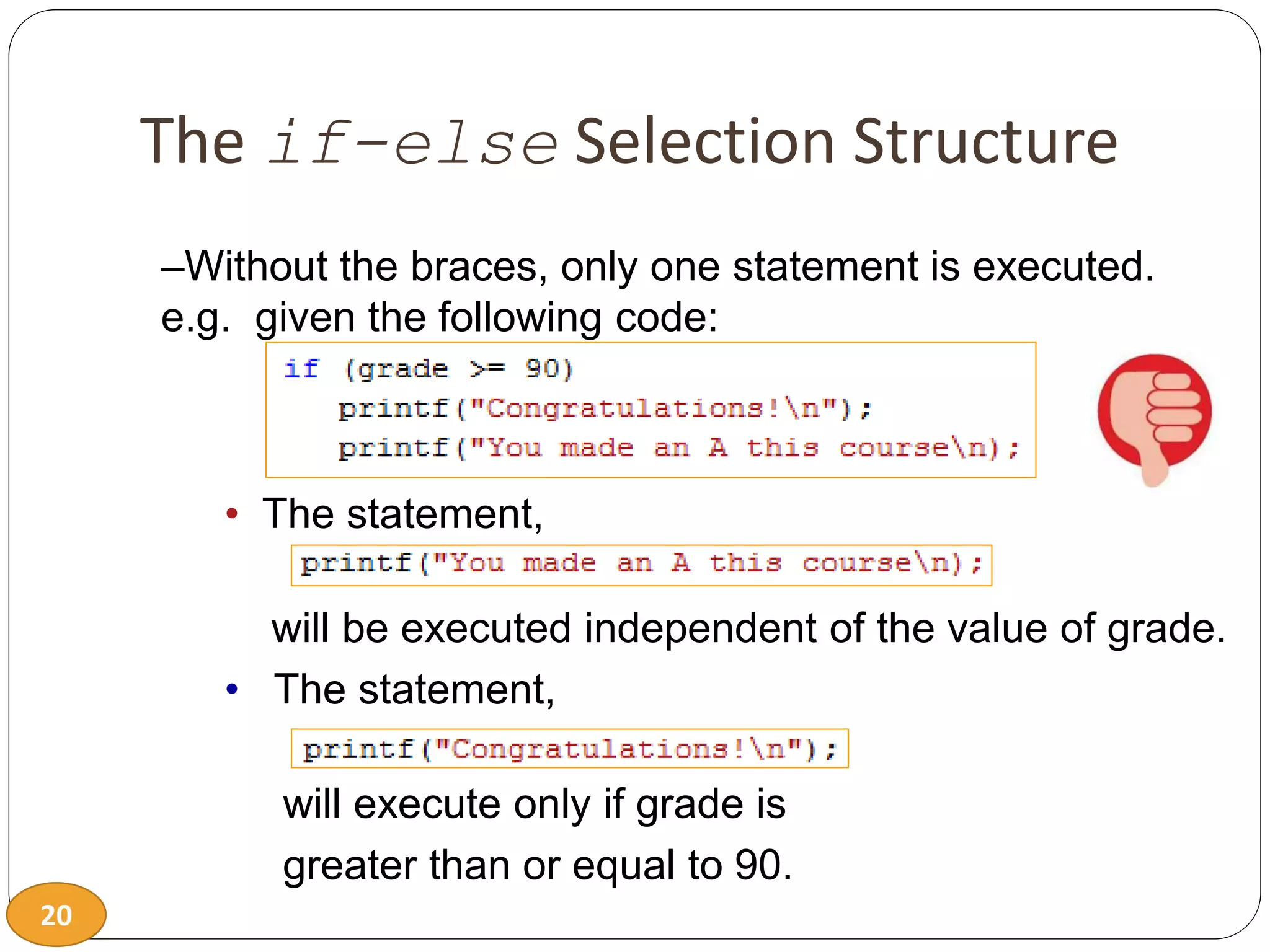
The if-else Selection Structure
–Without the braces, only one statement is executed.
e.g. given the following code:
• The statement,
will be executed independent of the value of grade.
• The statement,
will execute only if grade is
greater than or equal to 90.
21
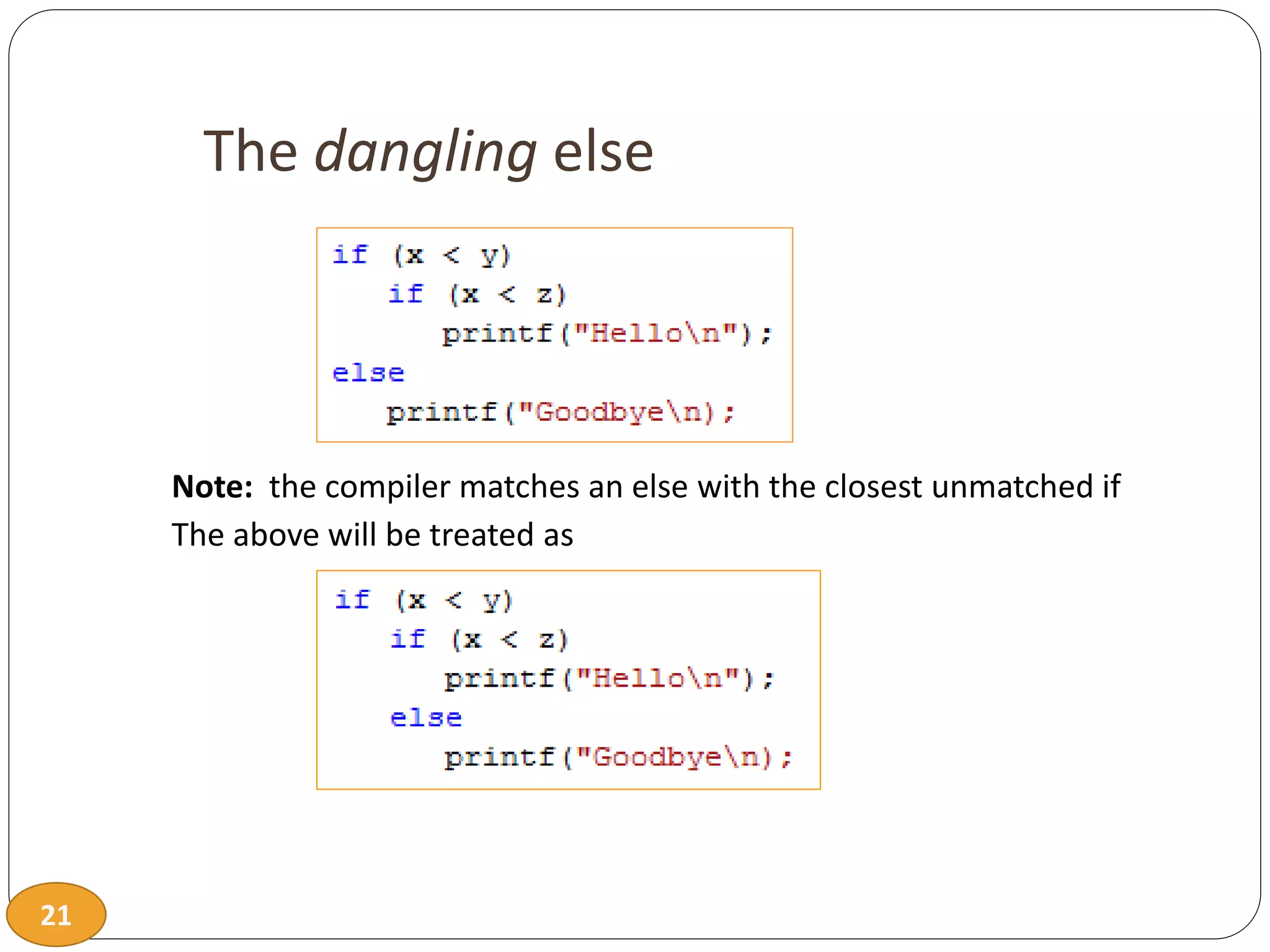
The dangling else
Note: the compiler matches an else with the closest unmatched if
The above will be treated as
22
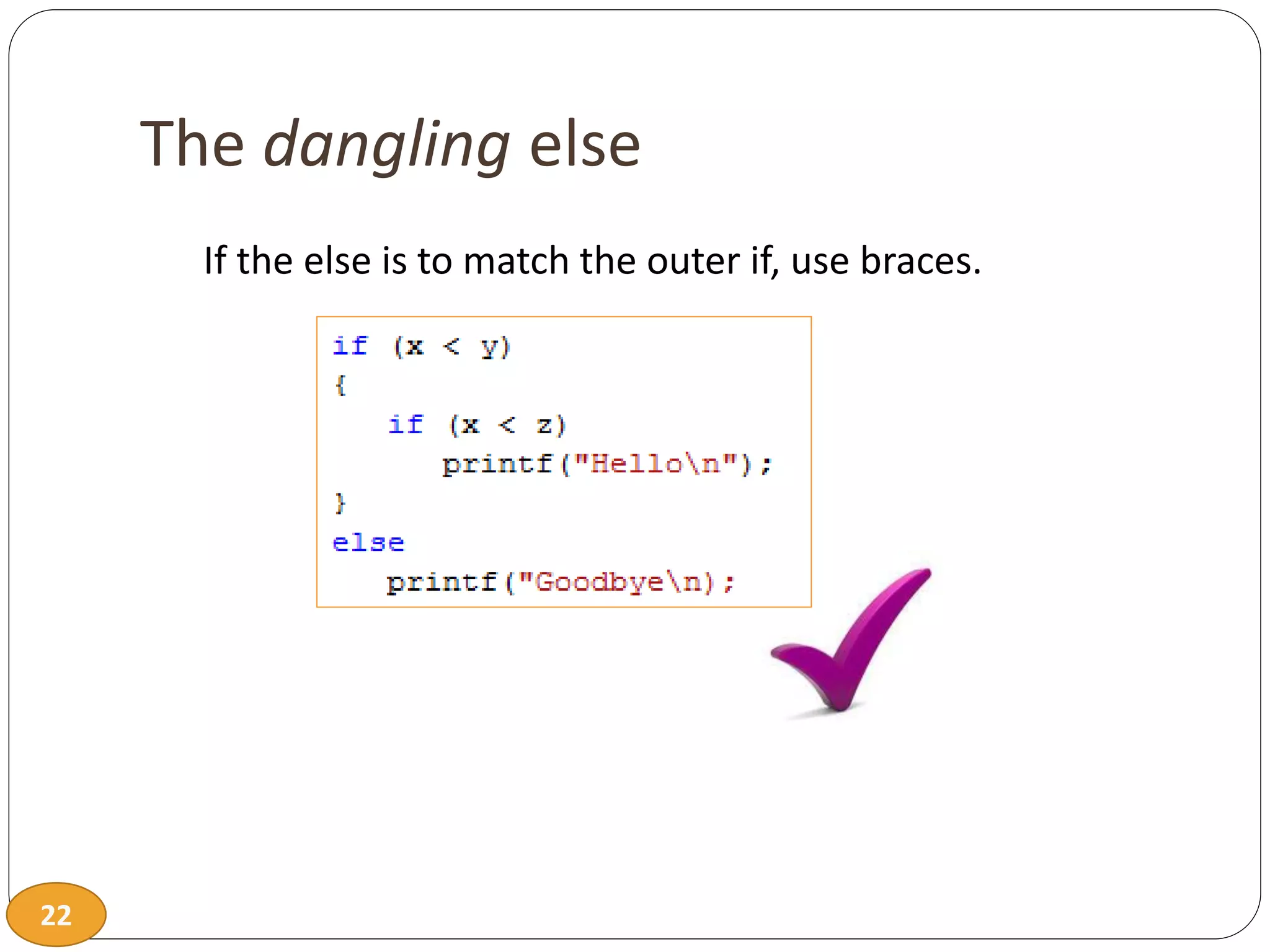
The dangling else
If the else is to match the outer if, use braces.
23
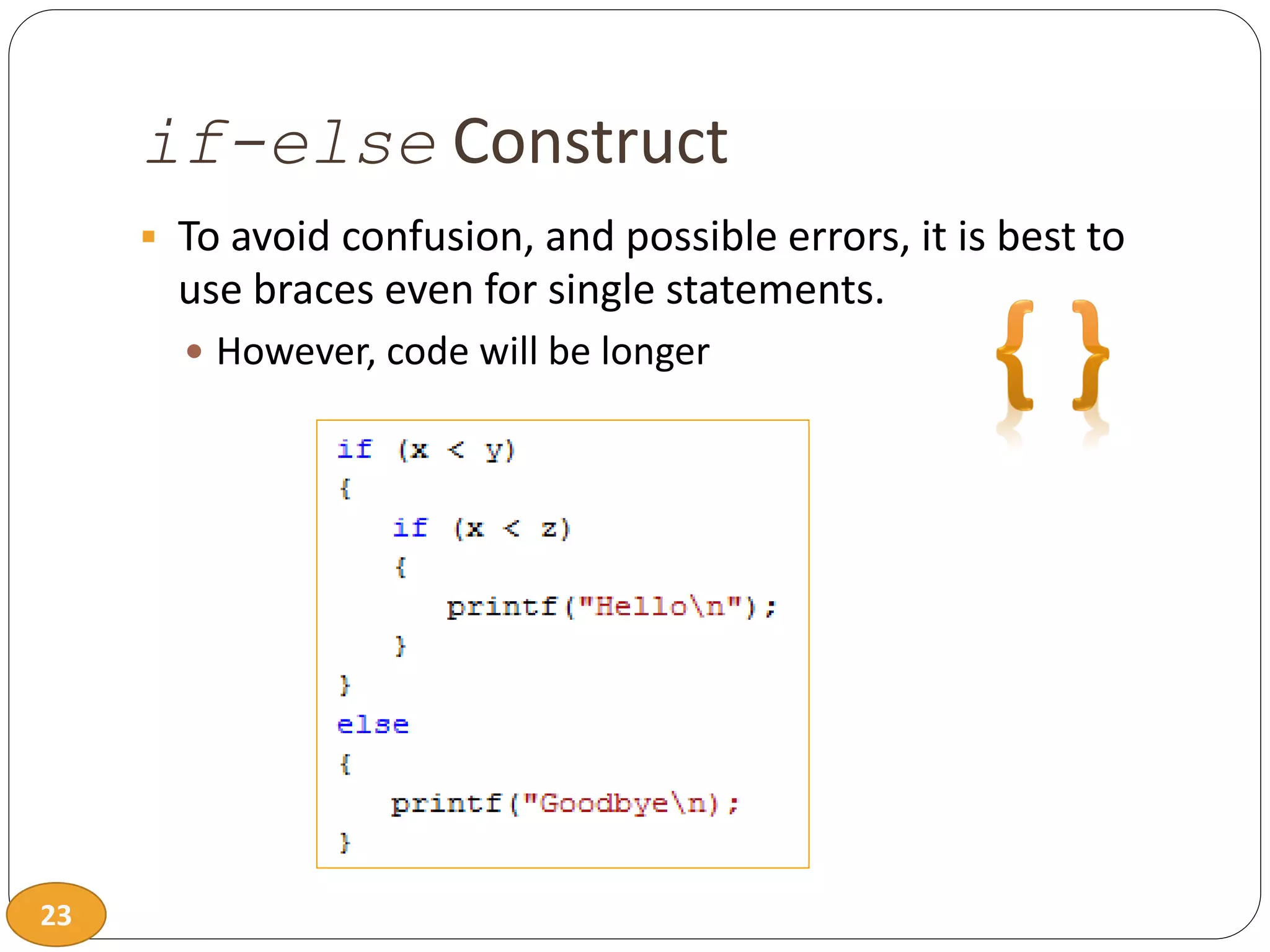
if-else Construct
 To avoid confusion, and possible errors, it is best to
use braces even for single statements.
 However, code will be longer
24
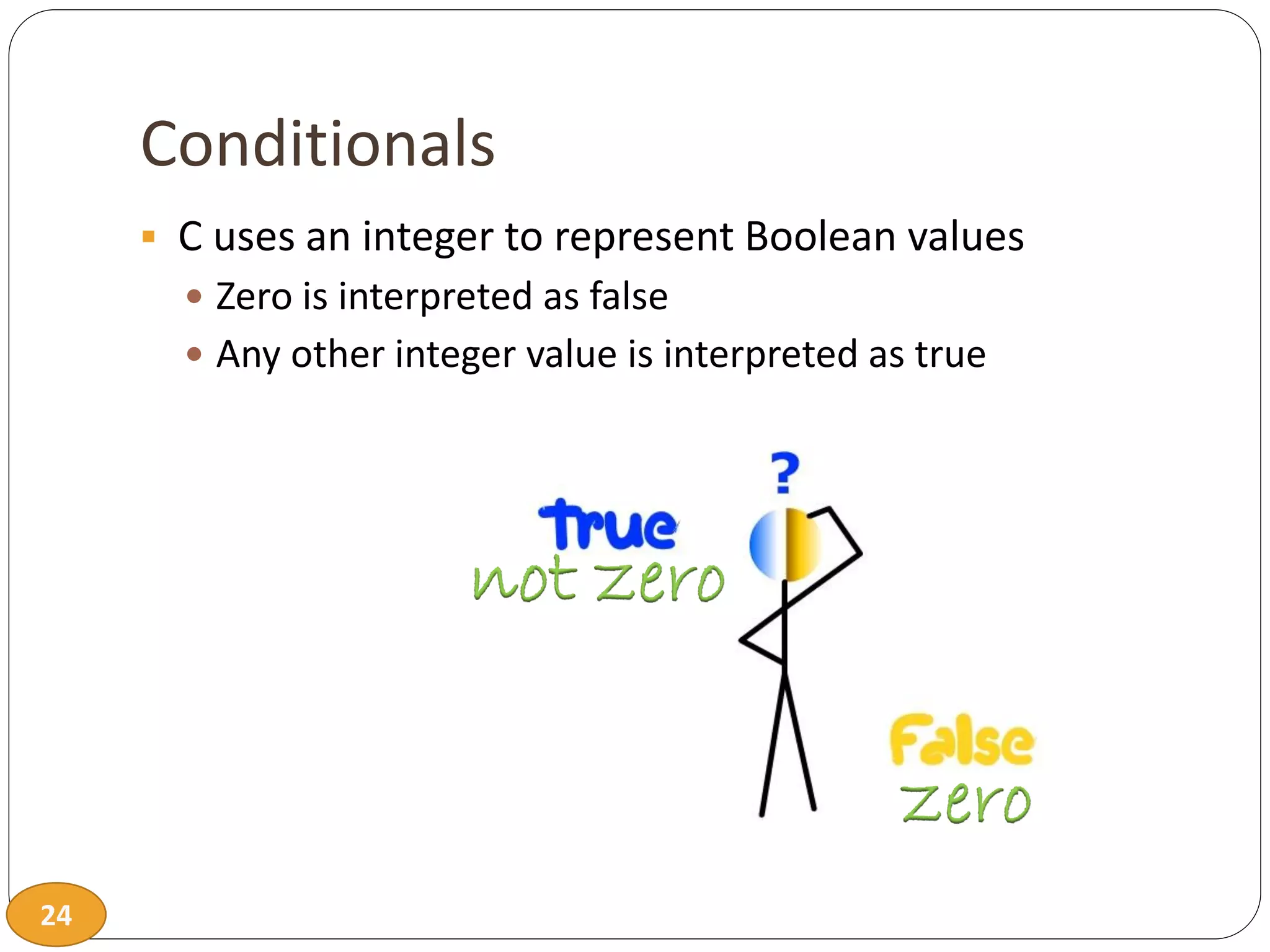
Conditionals
 C uses an integer to represent Boolean values
 Zero is interpreted as false
 Any other integer value is interpreted as true
25
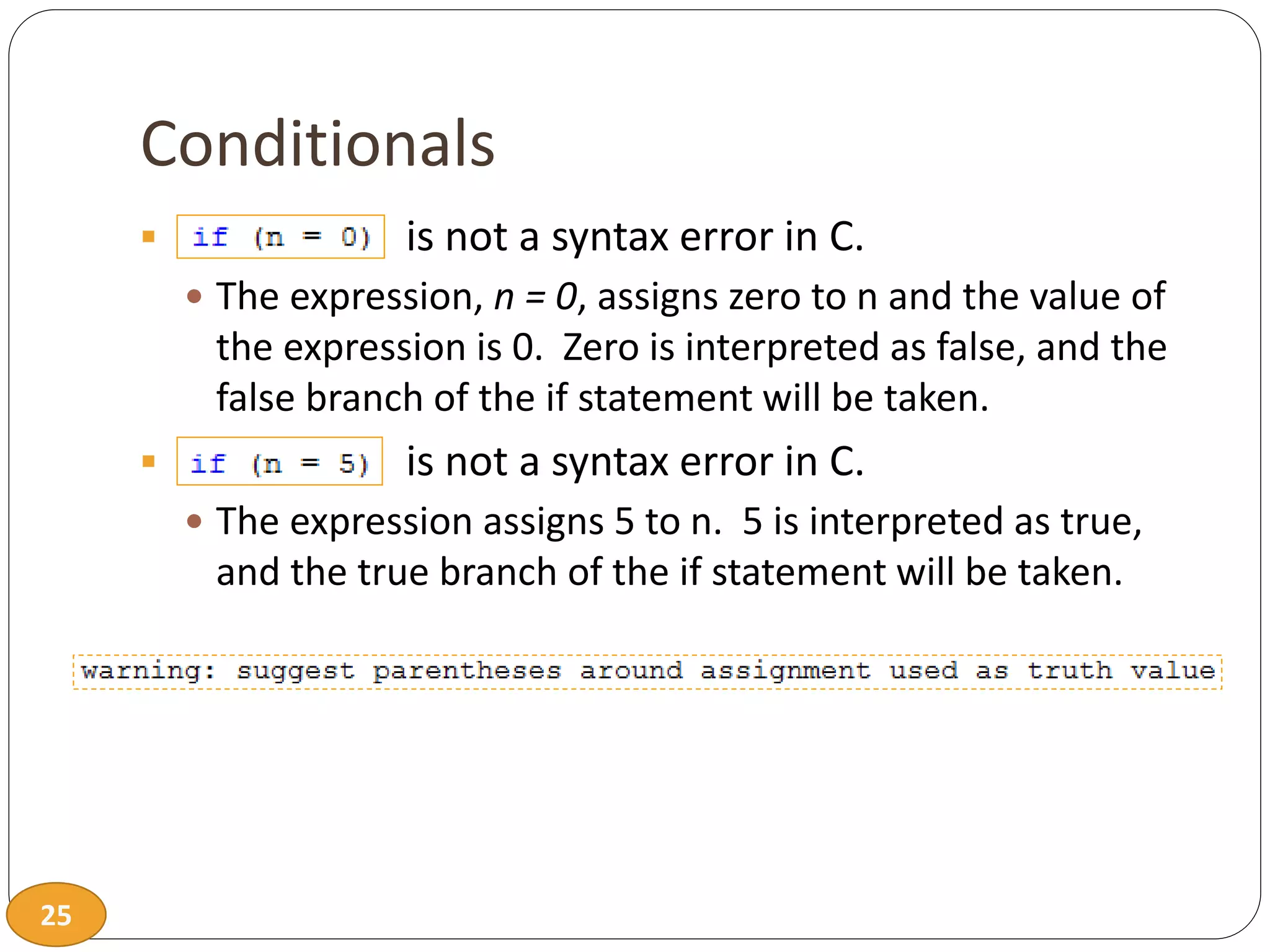
Conditionals
 is not a syntax error in C.
 The expression, n = 0, assigns zero to n and the value of
the expression is 0. Zero is interpreted as false, and the
false branch of the if statement will be taken.
 is not a syntax error in C.
 The expression assigns 5 to n. 5 is interpreted as true,
and the true branch of the if statement will be taken.
26
Conditionals
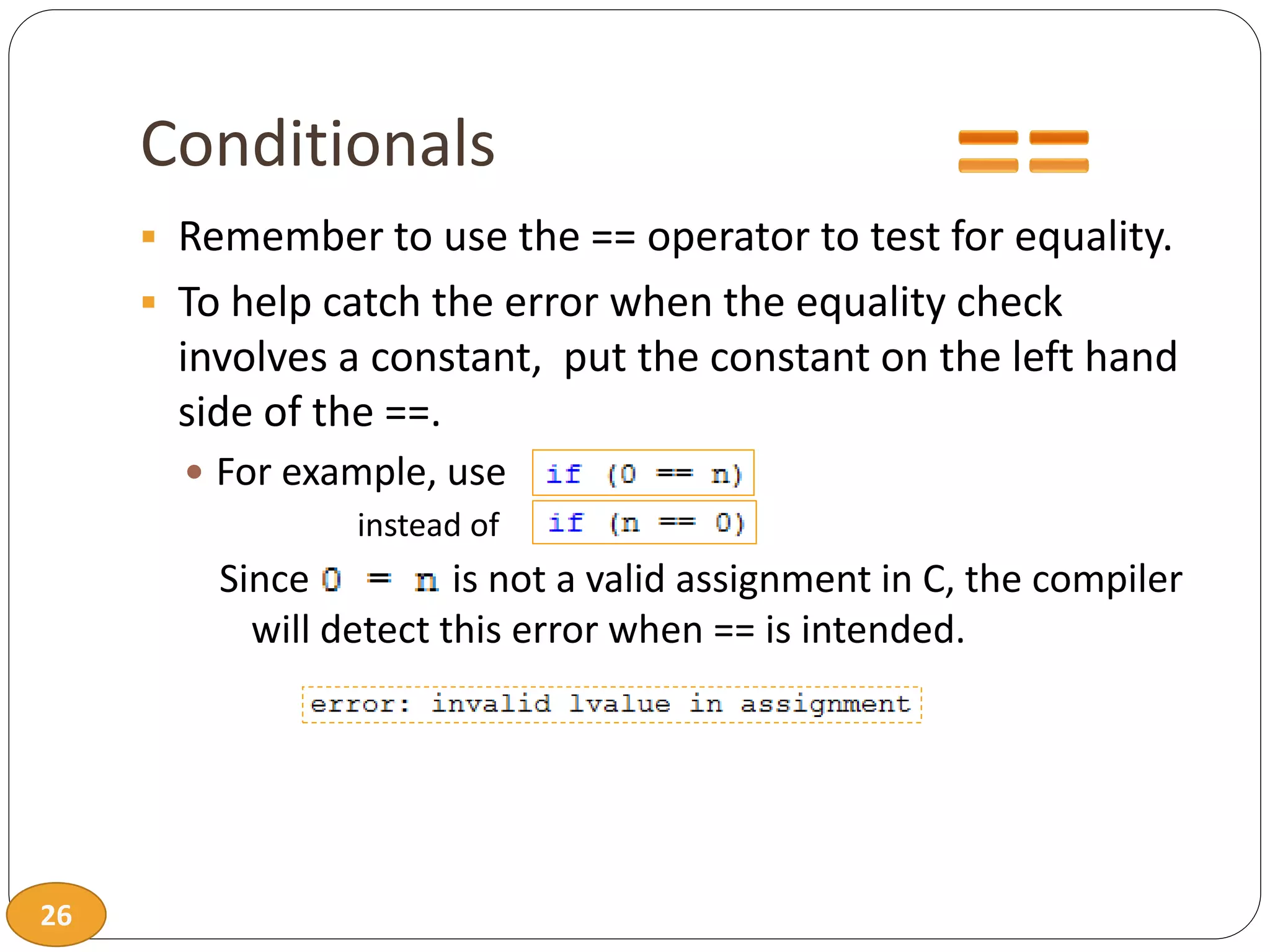
 Remember to use the == operator to test for equality.
 To help catch the error when the equality check
involves a constant, put the constant on the left hand
side of the ==.
 For example, use
instead of
Since is not a valid assignment in C, the compiler
will detect this error when == is intended.
27
The switch Multiple-Selection Structure
 switch
 Useful when variable or expression is tested for multiple
values
 Consists of a series of case labels and an optional
default case
28
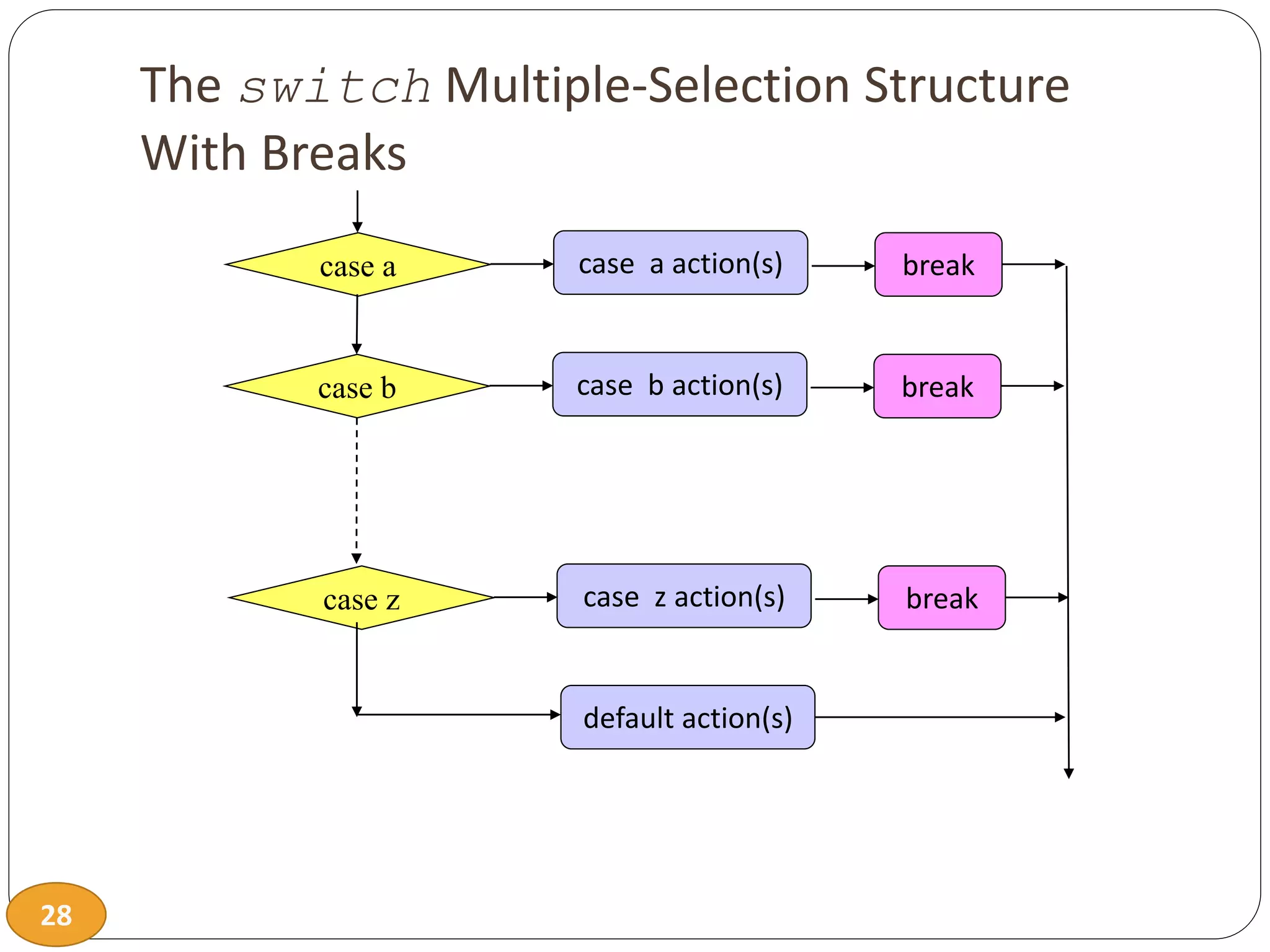
The switch Multiple-Selection Structure
With Breaks
case a case a action(s) break
case b case b action(s) break
case z case z action(s) break
default action(s)
29
The switch Multiple-Selection Structure
Without Breaks
case a case a action(s)
case b case b action(s)
case z case z action(s)
default action(s)
30
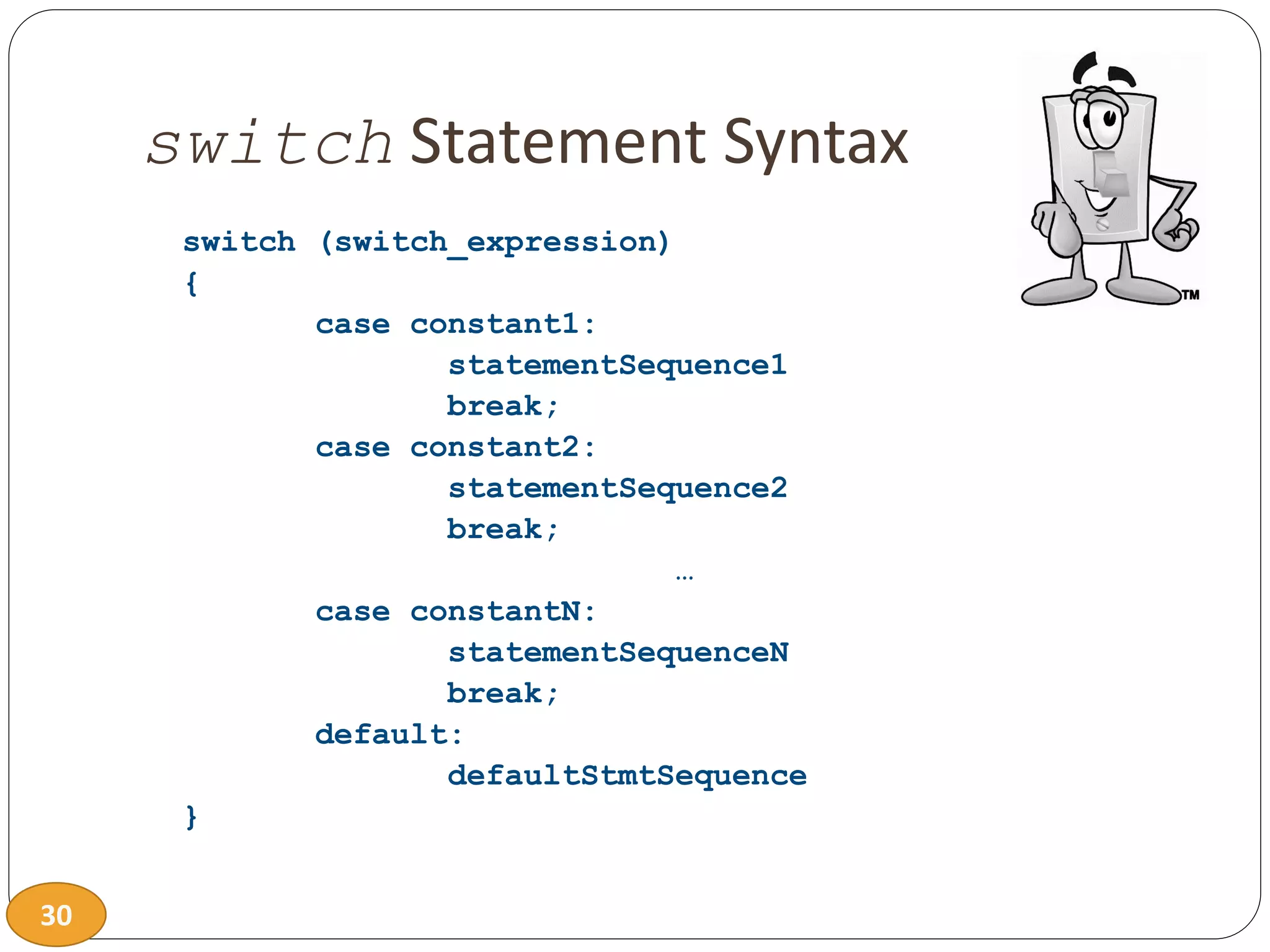
switch Statement Syntax
switch (switch_expression)
{
case constant1:
statementSequence1
break;
case constant2:
statementSequence2
break;
…
case constantN:
statementSequenceN
break;
default:
defaultStmtSequence
}
31
switch Statement
 The switch_expression is compared against the values
constant1, constant2, …, constantN
 constant1, constant2, …, constantN must be simple
constants or constant expressions.
 Can be a char or an int
 Best to use the same type constant as the switch expression
 If not, a type conversion will be done.
32
switch Statement Reminder
 The switch statement ends
 break statement
 end of the switch statement
 When executing the statements after a case label, it
continues to execute until it reaches a break
statement or the end of the switch.
 If you omit the break statements, then after executing
the code for one case, the computer will continue to
execute the code for the next case.
33
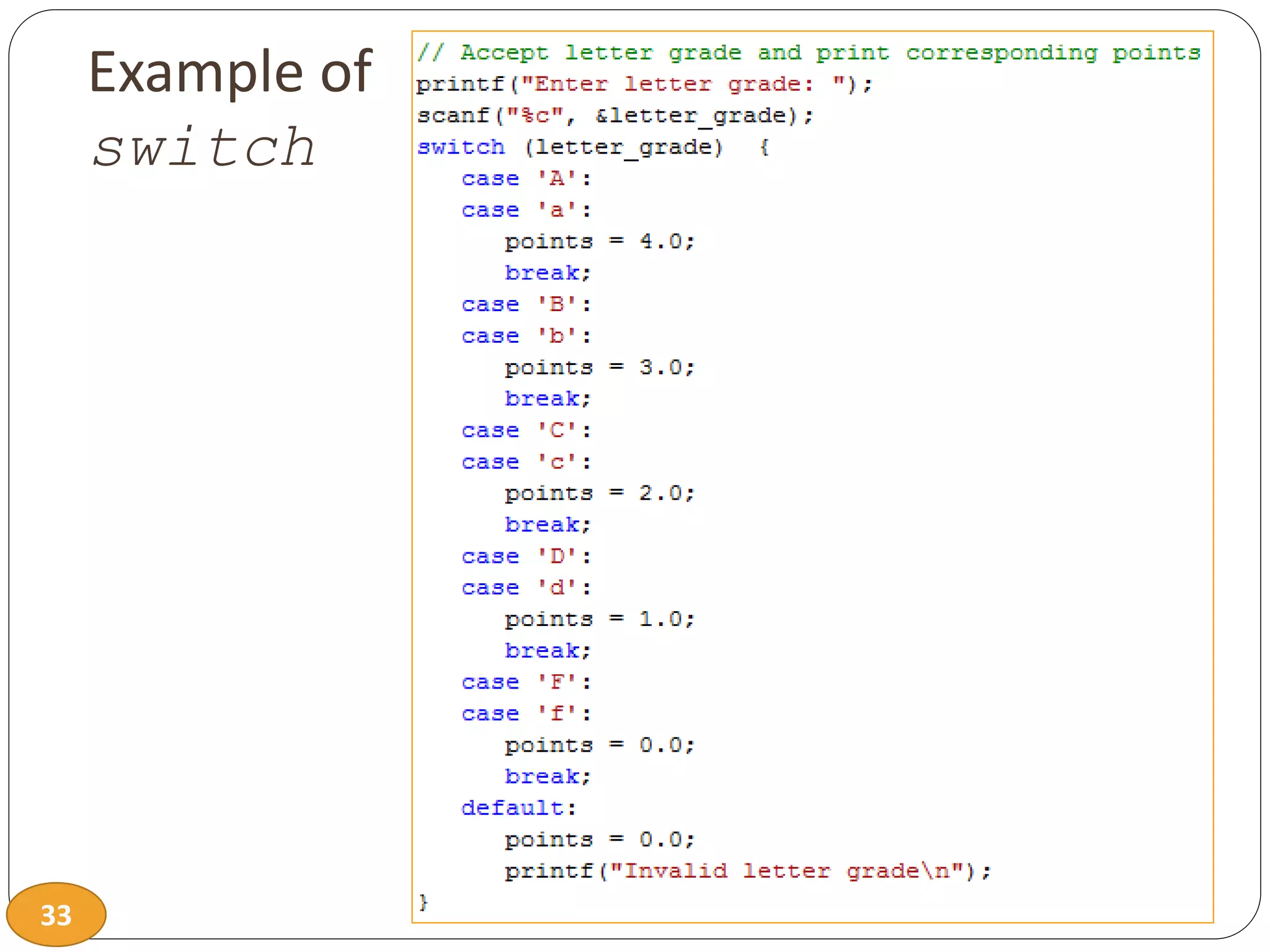
Example of
switch
34
Programming in C
T H E E N D

Ch05.pdf

  • 1.
  • 2.
    2 Flow of Control Flow of control  The order in which statements are executed  Transfer of control  When the next statement executed is not the next one in sequence
  • 3.
    3 Flow of Control Control structures combination of individual statements into a logical unit that regulates the flow of execution in a program or function  Sequence  Selection (Making Decisions)  Repetition (Looping)
  • 4.
    4 Boolean Expressions  Evaluateto true or false  Forms  Relational expression: <expr> <relational operator> <expr>  Examples: 7 < 5 a + b > 6  Logical expression: <Boolean expr> <logical operator> <Boolean expr>  Examples: (x < 7) && (y > 3)
  • 5.
    5 Relational Operators Standard Algebraic RelationalOperator C Relational Operator C Condition Example Meaning of C Condition Inequality < < x < y x is less than y  <= x <= y x is less than or equal to y > > x > y x is greater than y  >= x >= y x is greater than or equal to y Equality = == x == y x is equal to y  != x != y x is not equal to y 4th: Ch 4 p. 46 3rd: Ch 5 p. 46
  • 6.
    6 Logical Operators (CompoundRelationals)  && (logical AND)  Returns true if both conditions are true  || (logical OR)  Returns true if either of its conditions is true  ! (logical NOT, logical negation)  Is a unary operator, only takes one operand following  Reverses the truth/falsity of its condition  Returns true when its condition is false Ch 6 p. 72
  • 7.
    7 Logical Operators TruthTable P Q P && Q P || Q !P true true true true false true false false true false false true false true true false false false false true
  • 8.
    8 Precedence of Operators 1.(), [] 2. Unary +, unary -, !, ++, -- 3. Type casting 4. * , / , % 5. + , - 6. <, <=, >, >= 7. ==, != 8. && 9. || 10. =
  • 9.
    9 The if SelectionStructure  Selection structure  used when we want the computer to choose between two alternative courses of action
  • 10.
    10 The if SelectionStructure  if Statement true block Boolean Expression true false
  • 11.
    11 The if SelectionStructure General form of if: if (Boolean Expression) { statement1; statement2; ... }
  • 12.
    12 The if-else SelectionStructure  if  Only performs an action if the condition is true  if-else  A different action is performed when condition is true and when condition is false
  • 13.
    13 if-else Selection Structure falsetrue if-else statement false block Boolean Expression true block
  • 14.
    14 The if-else SelectionStructure General form of if-else: if (expression) { statement1A; statement2A; ... } else { statement1B; statement2B; ... }
  • 15.
    15 The if-else SelectionStructure  Nested if-else structures  Test for multiple cases by placing if-else selection structures inside if-else selection structures.
  • 16.
  • 17.
    17 The if-else-if Construct Once a condition is met, the rest of the statements are skipped
  • 18.
    18 The if-else-if Construct Thestandard way to indent the previous code is
  • 19.
    19 The if-else SelectionStructure  Compound statement:  Set of statements within a pair of braces  Example:
  • 20.
    20 The if-else SelectionStructure –Without the braces, only one statement is executed. e.g. given the following code: • The statement, will be executed independent of the value of grade. • The statement, will execute only if grade is greater than or equal to 90.
  • 21.
    21 The dangling else Note:the compiler matches an else with the closest unmatched if The above will be treated as
  • 22.
    22 The dangling else Ifthe else is to match the outer if, use braces.
  • 23.
    23 if-else Construct  Toavoid confusion, and possible errors, it is best to use braces even for single statements.  However, code will be longer
  • 24.
    24 Conditionals  C usesan integer to represent Boolean values  Zero is interpreted as false  Any other integer value is interpreted as true
  • 25.
    25 Conditionals  is nota syntax error in C.  The expression, n = 0, assigns zero to n and the value of the expression is 0. Zero is interpreted as false, and the false branch of the if statement will be taken.  is not a syntax error in C.  The expression assigns 5 to n. 5 is interpreted as true, and the true branch of the if statement will be taken.
  • 26.
    26 Conditionals  Remember touse the == operator to test for equality.  To help catch the error when the equality check involves a constant, put the constant on the left hand side of the ==.  For example, use instead of Since is not a valid assignment in C, the compiler will detect this error when == is intended.
  • 27.
    27 The switch Multiple-SelectionStructure  switch  Useful when variable or expression is tested for multiple values  Consists of a series of case labels and an optional default case
  • 28.
    28 The switch Multiple-SelectionStructure With Breaks case a case a action(s) break case b case b action(s) break case z case z action(s) break default action(s)
  • 29.
    29 The switch Multiple-SelectionStructure Without Breaks case a case a action(s) case b case b action(s) case z case z action(s) default action(s)
  • 30.
    30 switch Statement Syntax switch(switch_expression) { case constant1: statementSequence1 break; case constant2: statementSequence2 break; … case constantN: statementSequenceN break; default: defaultStmtSequence }
  • 31.
    31 switch Statement  Theswitch_expression is compared against the values constant1, constant2, …, constantN  constant1, constant2, …, constantN must be simple constants or constant expressions.  Can be a char or an int  Best to use the same type constant as the switch expression  If not, a type conversion will be done.
  • 32.
    32 switch Statement Reminder The switch statement ends  break statement  end of the switch statement  When executing the statements after a case label, it continues to execute until it reaches a break statement or the end of the switch.  If you omit the break statements, then after executing the code for one case, the computer will continue to execute the code for the next case.
  • 33.
  • 34.