Introduction of Data Communication
Data Communications is the transfer of data or information between a source and a receiver.
The source transmits the data and the receiver receives it. The actual generation of the
information is not part of Data Communications nor is the resulting action of the information at
the receiver.
Data Communication is interested in the transfer of data, the method of transfer and the
preservation of the data during the transfer process.
 All communication never be considered as a data communication.
Although the terms of communication and data communication are commonly used
interchangeably. We can say that is data communication when data generated for communication
is communicated in a specific way.
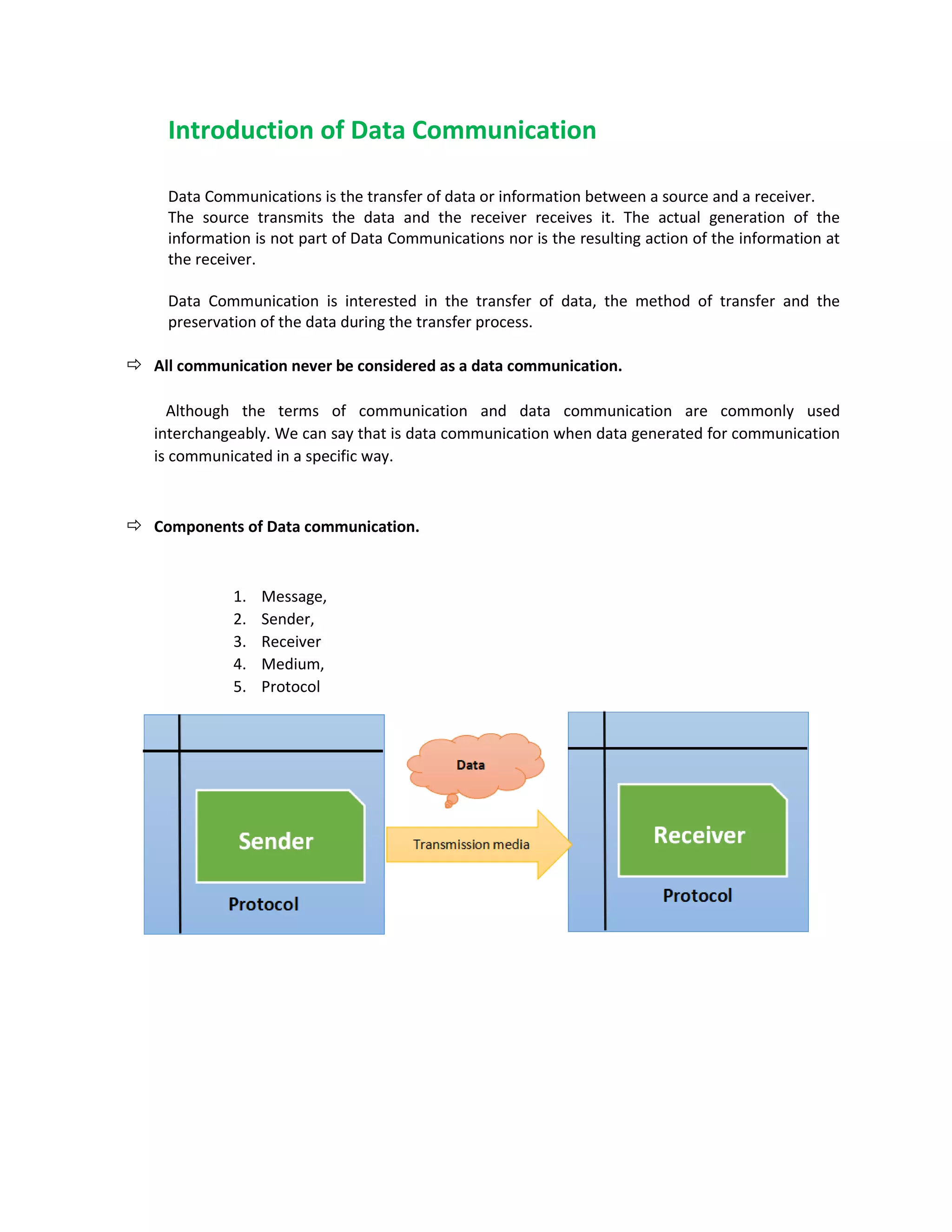
 Components of Data communication.
1. Message,
2. Sender,
3. Receiver
4. Medium,
5. Protocol
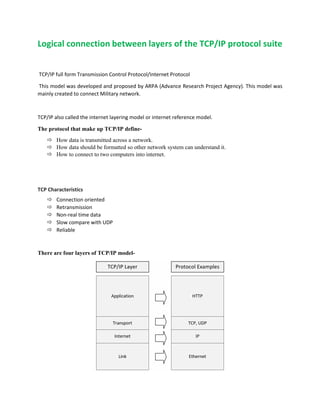
Logical connection between layers of the TCP/IP protocol suite
TCP/IP full form Transmission Control Protocol/Internet Protocol
This model was developed and proposed by ARPA (Advance Research Project Agency). This model was
mainly created to connect Military network.
TCP/IP also called the internet layering model or internet reference model.
The protocol that make up TCP/IP define-
 How data is transmitted across a network.
 How data should be formatted so other network system can understand it.
 How to connect to two computers into internet.
TCP Characteristics
 Connection oriented
 Retransmission
 Non-real time data
 Slow compare with UDP
 Reliable
There are four layers of TCP/IP model-
Application Layer
Application layer interacts with an application program, which is the highest level of OSI model. The
application layer is the OSI layer, which is closest to the end-user. It means the OSI application layer allows
users to interact with other software application.
Transport Layer
Transport layer builds on the network layer in order to provide data transport from a process on a source
system machine to a process on a destination system. It is hosted using single or multiple networks, and
also maintains the quality of service functions.
It determines how much data should be sent where and at what rate. This layer builds on the message
which are received from the application layer. It helps ensure that data units are delivered error-free and
in sequence.
Transport layer helps you to control the reliability of a link through flow control, error control, and
segmentation or de-segmentation.
The transport layer also offers an acknowledgment of the successful data transmission and sends the next
data in case no errors occurred. TCP is the best-known example of the transport layer.
Internet Layer
An internet layer is a third layer of TCP/IP layers of the TCP/IP model. It is also known as a network layer.
The main work of this layer is to send the packets from any network, and any computer still they reach
the destination irrespective of the route they take.
The Network Interface Layer
Network Interface Layer is this layer of the four-layer TCP/IP model. This layer is also called a network
access layer. It helps you to defines details of how data should be sent using the network.
It also includes how bits should optically be signaled by hardware devices which directly interfaces with a
network medium, like coaxial, optical, coaxial, fiber, or twisted-pair cables.
Encapsulation  Application – Physical layer Sender
De-capsulation  Physical – Application Receiver
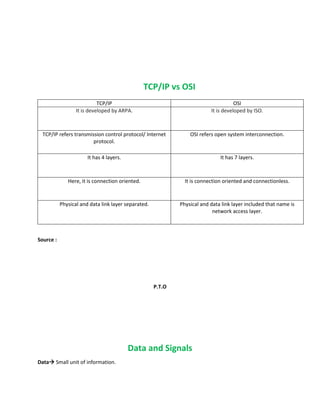
TCP/IP vs OSI
TCP/IP OSI
It is developed by ARPA. It is developed by ISO.
TCP/IP refers transmission control protocol/ Internet
protocol.
OSI refers open system interconnection.
It has 4 layers. It has 7 layers.
Here, it is connection oriented. It is connection oriented and connectionless.
Physical and data link layer separated. Physical and data link layer included that name is
network access layer.
Source :
P.T.O
Data and Signals
Data Small unit of information.
Data type 
 Analog data,
 Digital Data
Signal Signal is an electromagnetic current that is used for carrying data from one device to another
device.
Signal type 
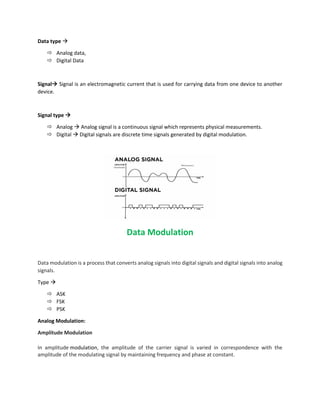
 Analog  Analog signal is a continuous signal which represents physical measurements.
 Digital  Digital signals are discrete time signals generated by digital modulation.
Data Modulation
Data modulation is a process that converts analog signals into digital signals and digital signals into analog
signals.
Type 
 ASK
 FSK
 PSK
Analog Modulation:
Amplitude Modulation
In amplitude modulation, the amplitude of the carrier signal is varied in correspondence with the
amplitude of the modulating signal by maintaining frequency and phase at constant.
Frequency Modulation
In frequency modulation, the frequency of the carrier signal is varied in correspondence with the
amplitude of the modulating signal by maintaining amplitude and phase at constant.
Phase Modulation
In phase modulation, the phase of the carrier signal is varied in correspondence with the amplitude of the
modulating signal by maintaining amplitude and frequency at constant.
Source:
 https://www.watelectronics.com/what-is-analog-modulation-types-its-applications/
 http://www.telecomworld101.com/Intro2dcRev2/page14.html
 https://www.guru99.com/tcp-ip-model.html

Mid term Topic

  • 1.
    Introduction of DataCommunication Data Communications is the transfer of data or information between a source and a receiver. The source transmits the data and the receiver receives it. The actual generation of the information is not part of Data Communications nor is the resulting action of the information at the receiver. Data Communication is interested in the transfer of data, the method of transfer and the preservation of the data during the transfer process.  All communication never be considered as a data communication. Although the terms of communication and data communication are commonly used interchangeably. We can say that is data communication when data generated for communication is communicated in a specific way.  Components of Data communication. 1. Message, 2. Sender, 3. Receiver 4. Medium, 5. Protocol
  • 2.
    Logical connection betweenlayers of the TCP/IP protocol suite TCP/IP full form Transmission Control Protocol/Internet Protocol This model was developed and proposed by ARPA (Advance Research Project Agency). This model was mainly created to connect Military network. TCP/IP also called the internet layering model or internet reference model. The protocol that make up TCP/IP define-  How data is transmitted across a network.  How data should be formatted so other network system can understand it.  How to connect to two computers into internet. TCP Characteristics  Connection oriented  Retransmission  Non-real time data  Slow compare with UDP  Reliable There are four layers of TCP/IP model-
  • 3.
    Application Layer Application layerinteracts with an application program, which is the highest level of OSI model. The application layer is the OSI layer, which is closest to the end-user. It means the OSI application layer allows users to interact with other software application. Transport Layer Transport layer builds on the network layer in order to provide data transport from a process on a source system machine to a process on a destination system. It is hosted using single or multiple networks, and also maintains the quality of service functions. It determines how much data should be sent where and at what rate. This layer builds on the message which are received from the application layer. It helps ensure that data units are delivered error-free and in sequence. Transport layer helps you to control the reliability of a link through flow control, error control, and segmentation or de-segmentation. The transport layer also offers an acknowledgment of the successful data transmission and sends the next data in case no errors occurred. TCP is the best-known example of the transport layer. Internet Layer An internet layer is a third layer of TCP/IP layers of the TCP/IP model. It is also known as a network layer. The main work of this layer is to send the packets from any network, and any computer still they reach the destination irrespective of the route they take. The Network Interface Layer Network Interface Layer is this layer of the four-layer TCP/IP model. This layer is also called a network access layer. It helps you to defines details of how data should be sent using the network. It also includes how bits should optically be signaled by hardware devices which directly interfaces with a network medium, like coaxial, optical, coaxial, fiber, or twisted-pair cables. Encapsulation  Application – Physical layer Sender De-capsulation  Physical – Application Receiver
  • 4.
    TCP/IP vs OSI TCP/IPOSI It is developed by ARPA. It is developed by ISO. TCP/IP refers transmission control protocol/ Internet protocol. OSI refers open system interconnection. It has 4 layers. It has 7 layers. Here, it is connection oriented. It is connection oriented and connectionless. Physical and data link layer separated. Physical and data link layer included that name is network access layer. Source : P.T.O Data and Signals Data Small unit of information.
  • 5.
    Data type  Analog data,  Digital Data Signal Signal is an electromagnetic current that is used for carrying data from one device to another device. Signal type   Analog  Analog signal is a continuous signal which represents physical measurements.  Digital  Digital signals are discrete time signals generated by digital modulation. Data Modulation Data modulation is a process that converts analog signals into digital signals and digital signals into analog signals. Type   ASK  FSK  PSK Analog Modulation: Amplitude Modulation In amplitude modulation, the amplitude of the carrier signal is varied in correspondence with the amplitude of the modulating signal by maintaining frequency and phase at constant.
  • 6.
    Frequency Modulation In frequencymodulation, the frequency of the carrier signal is varied in correspondence with the amplitude of the modulating signal by maintaining amplitude and phase at constant. Phase Modulation In phase modulation, the phase of the carrier signal is varied in correspondence with the amplitude of the modulating signal by maintaining amplitude and frequency at constant. Source:  https://www.watelectronics.com/what-is-analog-modulation-types-its-applications/  http://www.telecomworld101.com/Intro2dcRev2/page14.html  https://www.guru99.com/tcp-ip-model.html