1
Lecture No. 4: Computer Viruses
Lecturer: Dr. Mazin Alkathiri
Department of Information Technology
,
College of Computers
Seiyun University
September , 2024
Computer Viruses
A virus is a computer code or malware program, which is capable of
affecting computer data badly by corrupting or destroying them. cause a
computer to behave in unexpected ways, or interfere with the operation of
the network, all while concealing and replicating itself.
The defining characteristic of viruses is that they are self-replicating
computer programs which install themselves without the user's consent.
Why people create computer viruses?
• Some virus writers consider their creations to be works of art, and see virus
writing as a creative hobby.
• Viruses have been written as research projects, pranks, vandalism, to attack
the products of specific companies.
• Some viruses were intended as "good viruses". They spread improvements to
the programs they infect, or delete other viruses.
• These viruses are, however, quite rare, still consume system resources, may
accidentally damage systems they infect.
•Following are the major types of computer virus −
1.Worms
This is a computer program that replicates itself at a swift pace. Unlike a computer
virus, it is self-contained and hence does not need to be part of another program to
propagate itself.
•burrow through and between networks to change or overwrite data.
Types of Virus
2.Trojan Horse
A Trojan Horse is also a sort of destructive program that remains disguised in a
normal software program.
•appear to be legitimate programs but when opened, damage software codes.
Types of Virus
3.Bombs
It is similar to Trojan Horse, but Logic bombs have some specialty; these include a
timing device and hence it will go off only at a particular date and time.
Types of Virus
Types of Viruses
• Boot Sector Virus
• Infects the boot or MBR of diskettes and hard drives through the sharing of infected disks and pirated software
applications
• Once your hard drive is infected all diskettes that you use in your computer will be infected
• Program Virus
• Becomes active when the program file (usually with extensions .BIN, .COM, .EXE, .OVL, .DRV) carrying the virus is opened
• It then makes copies of itself and will infect other programs on the computer
• Multipartite Virus
• Hybrid of a Boot Sector and Program viruses
• It infects program files and when the infected program is active it will affect the boot record
Types of Viruses
• Stealth Virus
• Disguises itself to prevent from being detected by antivirus software
• It alters its file size or conceals itself in memory
• Polymorphic Virus
• Act like a chameleon, changing its virus signature (binary pattern) every time it multiples and infects a new file
• Macro Virus
• Programmed as a macro embedded in a document, usually found in Microsoft Word and Excel
• Once it gets in to your computer, every document you produce will become infected
• Relatively new type of virus and may slip by your antivirus software if you don't have the most recent version
installed
10
worst computer viruses in history
10
1. Mydoom (2004)
• Creator: Unknown, likely a Russian hacker.
• Purpose: To launch DDoS attacks and create a backdoor for remote control.
• Damage: Estimated at $38 billion.
• Details: Mydoom spread through email at unprecedented speed, crashing servers and slowing internet traffic globally. The worm also left a backdoor on infected
computers, allowing hackers to control these systems.
2. Sobig (2003)
• Creator: Unknown, suspected to be a single hacker or small group.
• Purpose: To create a botnet for spamming.
• Damage: Estimated at $30 billion.
• Details: Sobig, particularly its variant Sobig.F, spread rapidly through email, generating mass amounts of spam that overwhelmed email servers, particularly in
corporate environments, and forced some organizations to shut down their email services temporarily.
3. Klez (2001)
• Creator: Unknown, likely from Asia.
• Purpose: To spread via email, disable antivirus software, and corrupt files.
• Damage: Estimated at $19.8 billion.
• Details: Klez spread by spoofing email addresses and disabling antivirus software on infected systems, making it difficult to detect and contain. The virus
corrupted files and caused massive disruptions to corporate and individual users’ email systems.
4. ILOVEYOU (2000)
• Creator: Onel de Guzman, a college student from the Philippines.
• Purpose: Likely intended for financial gain or as an experiment.
• Damage: Estimated at $15 billion.
• Details: Sent with the subject line “I LOVE YOU,” this virus spread rapidly via email attachments, overwriting files and infecting all contacts in users’ address
books. It affected both personal and organizational systems, causing substantial disruption.
5. WannaCry (2017)
• Creator: Allegedly linked to North Korea’s Lazarus Group.
• Purpose: Ransomware, encrypting data and demanding payment in Bitcoin.
• Damage: Estimated at $4 billion.
• Details: WannaCry spread across systems in over 150 countries by exploiting a Windows vulnerability known as EternalBlue. It encrypted files on infected
systems, demanding a ransom for decryption and affecting many critical services, including hospitals and government agencies.
11
6. Zeus (2007)
• Creator: Suspected to be a cybercriminal group from Eastern Europe.
• Purpose: To steal banking credentials for financial theft.
• Damage: Estimated at $3 billion.
• Details: Zeus was a Trojan horse that infected millions of computers, primarily stealing banking login details. It created a massive botnet used for criminal
activities, including money theft from bank accounts.
7. Code Red (2001)
• Creator: A hacker group known as “Lion” from China.
• Purpose: To exploit a Microsoft IIS server vulnerability and launch DDoS attacks.
• Damage: Estimated at $2.4 billion.
• Details: Code Red targeted Microsoft IIS web servers and infected hundreds of thousands of systems, including U.S. government servers. It attempted to carry out
a DDoS attack on the White House website, which required a change in IP to avoid the attack.
8. SQL Slammer (2003)
• Creator: Unknown.
• Purpose: Likely an experiment to exploit vulnerabilities in SQL servers.
• Damage: Estimated at $1 billion.
• Details: SQL Slammer was a worm that spread quickly, exploiting a vulnerability in Microsoft SQL servers. It caused widespread internet slowdowns, affected
banking and airline systems, and disrupted ATMs.
9. CryptoLocker (2013)
• Creator: Likely a Russian hacker, possibly Evgeniy Bogachev.
• Purpose: Ransomware, demanding payment in Bitcoin to decrypt files.
• Damage: Estimated at $665 million.
• Details: CryptoLocker encrypted files on infected computers, demanding ransom for decryption keys. It affected millions of users and organizations, with some
victims paying the ransom to recover their data.
10. Sasser (2004)
• Creator: Sven Jaschan, a German teenager.
• Purpose: Likely a test of vulnerabilities without malicious intent.
• Damage: Estimated at $500 million.
• Details: Sasser spread by exploiting a Windows vulnerability, causing infected systems to crash and reboot repeatedly. It caused delays in services globally,
particularly impacting airlines, hospitals, and news organizations.
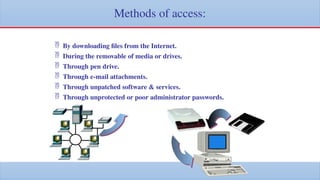
Methods of access:
 By downloading files from the Internet.
 During the removable of media or drives.
 Through pen drive.
 Through e-mail attachments.
 Through unpatched software & services.
 Through unprotected or poor administrator passwords.
•impact of virus on computer systems −
Disrupts the normal functionality of respective computer system.
Disrupts system network use.
Modifies configuration setting of the system.
Destructs data.
Disrupts computer network resources.
Access confidential data.
Impact of Virus
•The most fundamental method of detection of virus is to check the functionality of
your computer system; a virus affected computer does not take command properly.
•However, if there is antivirus software in your computer system, then it can easily
check programs and files on a system for virus signatures.
Virus Detection
Signs that Computer is Infected
• Functions slower than normal
• Responds slowly and freezes often
• Restarts itself often
• See uncommon error messages, distorted menus, and dialog boxes
• Notice applications fail to work correctly
• Fail to print correctly
Different virus preventive measures.
•Installation of an effective antivirus software.
•Patching up the operating system.
•Patching up the client software.
•Putting highly secured Passwords.
•Use of Firewalls.
Virus Preventive Measures
Most Effective Antivirus
• Following are the Best Antivirus Software of 2023
• Bitdefender: Best Overall
• Avira: Best Value for Your Money
• AVG: Best for Solo Entrepreneurs
• McAfee: Best for Multi-Device Protection
• Malwarebytes: Best for Real-Time Protection
• Avast: Best for Remote Workers
• F-Secure: Best for Plan Customization
• G DATA: Best for Comprehensive Features
• Trend Micro: Best for Phishing Protection
• ESET: Best for Technical Users

Computer Introduction (Computer Viruses )-Lecture04

  • 1.
    1 Lecture No. 4:Computer Viruses Lecturer: Dr. Mazin Alkathiri Department of Information Technology , College of Computers Seiyun University September , 2024
  • 2.
    Computer Viruses A virusis a computer code or malware program, which is capable of affecting computer data badly by corrupting or destroying them. cause a computer to behave in unexpected ways, or interfere with the operation of the network, all while concealing and replicating itself. The defining characteristic of viruses is that they are self-replicating computer programs which install themselves without the user's consent.
  • 3.
    Why people createcomputer viruses? • Some virus writers consider their creations to be works of art, and see virus writing as a creative hobby. • Viruses have been written as research projects, pranks, vandalism, to attack the products of specific companies. • Some viruses were intended as "good viruses". They spread improvements to the programs they infect, or delete other viruses. • These viruses are, however, quite rare, still consume system resources, may accidentally damage systems they infect.
  • 4.
    •Following are themajor types of computer virus − 1.Worms This is a computer program that replicates itself at a swift pace. Unlike a computer virus, it is self-contained and hence does not need to be part of another program to propagate itself. •burrow through and between networks to change or overwrite data. Types of Virus
  • 5.
    2.Trojan Horse A TrojanHorse is also a sort of destructive program that remains disguised in a normal software program. •appear to be legitimate programs but when opened, damage software codes. Types of Virus
  • 6.
    3.Bombs It is similarto Trojan Horse, but Logic bombs have some specialty; these include a timing device and hence it will go off only at a particular date and time. Types of Virus
  • 7.
    Types of Viruses •Boot Sector Virus • Infects the boot or MBR of diskettes and hard drives through the sharing of infected disks and pirated software applications • Once your hard drive is infected all diskettes that you use in your computer will be infected • Program Virus • Becomes active when the program file (usually with extensions .BIN, .COM, .EXE, .OVL, .DRV) carrying the virus is opened • It then makes copies of itself and will infect other programs on the computer • Multipartite Virus • Hybrid of a Boot Sector and Program viruses • It infects program files and when the infected program is active it will affect the boot record
  • 8.
    Types of Viruses •Stealth Virus • Disguises itself to prevent from being detected by antivirus software • It alters its file size or conceals itself in memory • Polymorphic Virus • Act like a chameleon, changing its virus signature (binary pattern) every time it multiples and infects a new file • Macro Virus • Programmed as a macro embedded in a document, usually found in Microsoft Word and Excel • Once it gets in to your computer, every document you produce will become infected • Relatively new type of virus and may slip by your antivirus software if you don't have the most recent version installed
  • 9.
  • 10.
    10 1. Mydoom (2004) •Creator: Unknown, likely a Russian hacker. • Purpose: To launch DDoS attacks and create a backdoor for remote control. • Damage: Estimated at $38 billion. • Details: Mydoom spread through email at unprecedented speed, crashing servers and slowing internet traffic globally. The worm also left a backdoor on infected computers, allowing hackers to control these systems. 2. Sobig (2003) • Creator: Unknown, suspected to be a single hacker or small group. • Purpose: To create a botnet for spamming. • Damage: Estimated at $30 billion. • Details: Sobig, particularly its variant Sobig.F, spread rapidly through email, generating mass amounts of spam that overwhelmed email servers, particularly in corporate environments, and forced some organizations to shut down their email services temporarily. 3. Klez (2001) • Creator: Unknown, likely from Asia. • Purpose: To spread via email, disable antivirus software, and corrupt files. • Damage: Estimated at $19.8 billion. • Details: Klez spread by spoofing email addresses and disabling antivirus software on infected systems, making it difficult to detect and contain. The virus corrupted files and caused massive disruptions to corporate and individual users’ email systems. 4. ILOVEYOU (2000) • Creator: Onel de Guzman, a college student from the Philippines. • Purpose: Likely intended for financial gain or as an experiment. • Damage: Estimated at $15 billion. • Details: Sent with the subject line “I LOVE YOU,” this virus spread rapidly via email attachments, overwriting files and infecting all contacts in users’ address books. It affected both personal and organizational systems, causing substantial disruption. 5. WannaCry (2017) • Creator: Allegedly linked to North Korea’s Lazarus Group. • Purpose: Ransomware, encrypting data and demanding payment in Bitcoin. • Damage: Estimated at $4 billion. • Details: WannaCry spread across systems in over 150 countries by exploiting a Windows vulnerability known as EternalBlue. It encrypted files on infected systems, demanding a ransom for decryption and affecting many critical services, including hospitals and government agencies.
  • 11.
    11 6. Zeus (2007) •Creator: Suspected to be a cybercriminal group from Eastern Europe. • Purpose: To steal banking credentials for financial theft. • Damage: Estimated at $3 billion. • Details: Zeus was a Trojan horse that infected millions of computers, primarily stealing banking login details. It created a massive botnet used for criminal activities, including money theft from bank accounts. 7. Code Red (2001) • Creator: A hacker group known as “Lion” from China. • Purpose: To exploit a Microsoft IIS server vulnerability and launch DDoS attacks. • Damage: Estimated at $2.4 billion. • Details: Code Red targeted Microsoft IIS web servers and infected hundreds of thousands of systems, including U.S. government servers. It attempted to carry out a DDoS attack on the White House website, which required a change in IP to avoid the attack. 8. SQL Slammer (2003) • Creator: Unknown. • Purpose: Likely an experiment to exploit vulnerabilities in SQL servers. • Damage: Estimated at $1 billion. • Details: SQL Slammer was a worm that spread quickly, exploiting a vulnerability in Microsoft SQL servers. It caused widespread internet slowdowns, affected banking and airline systems, and disrupted ATMs. 9. CryptoLocker (2013) • Creator: Likely a Russian hacker, possibly Evgeniy Bogachev. • Purpose: Ransomware, demanding payment in Bitcoin to decrypt files. • Damage: Estimated at $665 million. • Details: CryptoLocker encrypted files on infected computers, demanding ransom for decryption keys. It affected millions of users and organizations, with some victims paying the ransom to recover their data. 10. Sasser (2004) • Creator: Sven Jaschan, a German teenager. • Purpose: Likely a test of vulnerabilities without malicious intent. • Damage: Estimated at $500 million. • Details: Sasser spread by exploiting a Windows vulnerability, causing infected systems to crash and reboot repeatedly. It caused delays in services globally, particularly impacting airlines, hospitals, and news organizations.
  • 12.
    Methods of access: By downloading files from the Internet.  During the removable of media or drives.  Through pen drive.  Through e-mail attachments.  Through unpatched software & services.  Through unprotected or poor administrator passwords.
  • 13.
    •impact of viruson computer systems − Disrupts the normal functionality of respective computer system. Disrupts system network use. Modifies configuration setting of the system. Destructs data. Disrupts computer network resources. Access confidential data. Impact of Virus
  • 14.
    •The most fundamentalmethod of detection of virus is to check the functionality of your computer system; a virus affected computer does not take command properly. •However, if there is antivirus software in your computer system, then it can easily check programs and files on a system for virus signatures. Virus Detection
  • 15.
    Signs that Computeris Infected • Functions slower than normal • Responds slowly and freezes often • Restarts itself often • See uncommon error messages, distorted menus, and dialog boxes • Notice applications fail to work correctly • Fail to print correctly
  • 16.
    Different virus preventivemeasures. •Installation of an effective antivirus software. •Patching up the operating system. •Patching up the client software. •Putting highly secured Passwords. •Use of Firewalls. Virus Preventive Measures
  • 17.
    Most Effective Antivirus •Following are the Best Antivirus Software of 2023 • Bitdefender: Best Overall • Avira: Best Value for Your Money • AVG: Best for Solo Entrepreneurs • McAfee: Best for Multi-Device Protection • Malwarebytes: Best for Real-Time Protection • Avast: Best for Remote Workers • F-Secure: Best for Plan Customization • G DATA: Best for Comprehensive Features • Trend Micro: Best for Phishing Protection • ESET: Best for Technical Users

Editor's Notes

  • #7  boot sector viruses include Monkey, NYB (also known as B1) Morris Worm Ghostball was the first multipartite virus discovered. 
  • #8 Brain (reportedly created by software developers as an anti-piracy measure) Polymorphic viruses are usually distributed via spam, infected sites, or through the use of other malware. URSNIF, VIRLOCK, VOBFUS, and BAGLE or UPolyX are some of the most notorious polymorphic viruses in existence Concept was the first macro virus, appearing in July 1995 and targeted Microsoft Word.