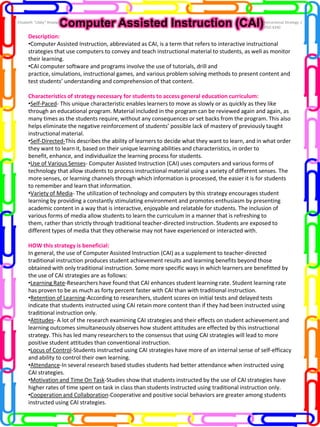
Computer Assisted Instruction (CAI)

Elisabeth “Libby” Rowland

Instructional Strategy 1
SPED 4340

Description:
•Computer Assisted Instruction, abbreviated as CAI, is a term that refers to interactive instructional
strategies that use computers to convey and teach instructional material to students, as well as monitor
their learning.
•CAI computer software and programs involve the use of tutorials, drill and
practice, simulations, instructional games, and various problem solving methods to present content and
test students’ understanding and comprehension of that content.
Characteristics of strategy necessary for students to access general education curriculum:
•Self-Paced- This unique characteristic enables learners to move as slowly or as quickly as they like
through an educational program. Material included in the program can be reviewed again and again, as
many times as the students require, without any consequences or set backs from the program. This also
helps eliminate the negative reinforcement of students’ possible lack of mastery of previously taught
instructional material.
•Self-Directed-This describes the ability of learners to decide what they want to learn, and in what order
they want to learn it, based on their unique learning abilities and characteristics, in order to
benefit, enhance, and individualize the learning process for students.
•Use of Various Senses- Computer Assisted Instruction (CAI) uses computers and various forms of
technology that allow students to process instructional material using a variety of different senses. The
more senses, or learning channels through which information is processed, the easier it is for students
to remember and learn that information.
•Variety of Media- The utilization of technology and computers by this strategy encourages student
learning by providing a constantly stimulating environment and promotes enthusiasm by presenting
academic content in a way that is interactive, enjoyable and relatable for students. The inclusion of
various forms of media allow students to learn the curriculum in a manner that is refreshing to
them, rather than strictly through traditional teacher-directed instruction. Students are exposed to
different types of media that they otherwise may not have experienced or interacted with.
HOW this strategy is beneficial:
In general, the use of Computer Assisted Instruction (CAI) as a supplement to teacher-directed
traditional instruction produces student achievement results and learning benefits beyond those
obtained with only traditional instruction. Some more specific ways in which learners are benefitted by
the use of CAI strategies are as follows:
•Learning Rate-Researchers have found that CAI enhances student learning rate. Student learning rate
has proven to be as much as forty percent faster with CAI than with traditional instruction.
•Retention of Learning-According to researchers, student scores on initial tests and delayed tests
indicate that students instructed using CAI retain more content than if they had been instructed using
traditional instruction only.
•Attitudes- A lot of the research examining CAI strategies and their effects on student achievement and
learning outcomes simultaneously observes how student attitudes are effected by this instructional
strategy. This has led many researchers to the consensus that using CAI strategies will lead to more
positive student attitudes than conventional instruction.
•Locus of Control-Students instructed using CAI strategies have more of an internal sense of self-efficacy
and ability to control their own learning.
•Attendance-In several research based studies students had better attendance when instructed using
CAI strategies.
•Motivation and Time On Task-Studies show that students instructed by the use of CAI strategies have
higher rates of time spent on task in class than students instructed using traditional instruction only.
•Cooperation and Collaboration-Cooperative and positive social behaviors are greater among students
instructed using CAI strategies.
WHEN this strategy may be beneficial:
While Computer Assisted Instruction (CAI) strategies have proven beneficial for students, research
tells us that these strategies are effective and beneficial to a greater degree, and are more appropriate
in certain situations and among specific student populations:
•Younger versus Older Students- Many studies based on comparison show that CAI is more beneficial to
implement with younger students than older students. Although CAI strategies are generally beneficial
for all students, Elementary students are impacted more by this strategy than Secondary students.
•Economically Disadvantaged versus Economically Comfortable Students- Research shows that CAI
produces greater benefits for economically disadvantaged students than those from more privileged
backgrounds.
•Lower versus Higher-Level Cognitive Material/Outcomes- CAI strategies are more effective and
appropriate for teaching lower-level cognitive material than higher-level cognitive material.
All of the above research-based findings make the same basic assertion, and that is that CAI strategies
are especially useful and effective for facilitating basic and fact oriented learning such as rote
memorization skill.
Explanation of accommodation/strategy on IEP for receiving student and other inquirers (Basic
Definition):
Student receiving accommodation/strategy- “To help you learn all of the things that I will be teaching in
class you will get to do some of your class work and homework on the computer by using a computer
program that is a perfect match to all of the ways that you learn. It has been set up just for you with the
way that you learn in mind. Anytime that I tell the class to work by themselves, or read, or go to your
stations, you will get to go to the computer and do your work or readings by clicking on the computer
program and getting started.“
Other Inquirers-“Computer Assisted Instruction (CAI), which is sometimes called Computer Based
Instruction (CBI), is basically the use of a computer in delivering instruction or teaching curriculum to
students.”
Populations in which the strategy has proven effective:
This versatile instructional strategy has been implemented effectively producing beneficial learning
outcomes across various populations of students in both general education and special education.
However the versatility of this strategy along with its ability to be customized for individual students
makes it especially beneficial to implement with special education students. The following populations
of special education, or exceptional students have experienced the greatest benefits from its
implementation: Other Health Impairment (OHI), Emotional Behavior Disorder (EBD), Intellectual
Disability (ID), Hearing Impaired, English Language Learners (ELL), Speech and Language Impairments,
and Learning Disabilities.
Implementation Procedure during instruction and testing/assessments:
Implementation of strategy during instruction in secondary math class1.Tool introduction and use
2.Teacher monitoring and evaluation
3.Data collection and analysis
Implementation of strategy during testing/assessments in secondary math class•Students will be given individualized quizzes and tests using the program software.
•Quizzes will be taken every Friday and will be designed around individual student’s progression through
curriculum.
•Tests will be taken at the end of each unit and will also be individualized to accommodate each
students current skill acquisition status for that unit of math content.
•Class quizzes and tests will be administered on the computer via the software program and will be of a
multiple choice format including one short answer question.
Computer assisted instruction strategy

Computer assisted instruction strategy

  • 1.
    Computer Assisted Instruction(CAI) Elisabeth “Libby” Rowland Instructional Strategy 1 SPED 4340 Description: •Computer Assisted Instruction, abbreviated as CAI, is a term that refers to interactive instructional strategies that use computers to convey and teach instructional material to students, as well as monitor their learning. •CAI computer software and programs involve the use of tutorials, drill and practice, simulations, instructional games, and various problem solving methods to present content and test students’ understanding and comprehension of that content. Characteristics of strategy necessary for students to access general education curriculum: •Self-Paced- This unique characteristic enables learners to move as slowly or as quickly as they like through an educational program. Material included in the program can be reviewed again and again, as many times as the students require, without any consequences or set backs from the program. This also helps eliminate the negative reinforcement of students’ possible lack of mastery of previously taught instructional material. •Self-Directed-This describes the ability of learners to decide what they want to learn, and in what order they want to learn it, based on their unique learning abilities and characteristics, in order to benefit, enhance, and individualize the learning process for students. •Use of Various Senses- Computer Assisted Instruction (CAI) uses computers and various forms of technology that allow students to process instructional material using a variety of different senses. The more senses, or learning channels through which information is processed, the easier it is for students to remember and learn that information. •Variety of Media- The utilization of technology and computers by this strategy encourages student learning by providing a constantly stimulating environment and promotes enthusiasm by presenting academic content in a way that is interactive, enjoyable and relatable for students. The inclusion of various forms of media allow students to learn the curriculum in a manner that is refreshing to them, rather than strictly through traditional teacher-directed instruction. Students are exposed to different types of media that they otherwise may not have experienced or interacted with. HOW this strategy is beneficial: In general, the use of Computer Assisted Instruction (CAI) as a supplement to teacher-directed traditional instruction produces student achievement results and learning benefits beyond those obtained with only traditional instruction. Some more specific ways in which learners are benefitted by the use of CAI strategies are as follows: •Learning Rate-Researchers have found that CAI enhances student learning rate. Student learning rate has proven to be as much as forty percent faster with CAI than with traditional instruction. •Retention of Learning-According to researchers, student scores on initial tests and delayed tests indicate that students instructed using CAI retain more content than if they had been instructed using traditional instruction only. •Attitudes- A lot of the research examining CAI strategies and their effects on student achievement and learning outcomes simultaneously observes how student attitudes are effected by this instructional strategy. This has led many researchers to the consensus that using CAI strategies will lead to more positive student attitudes than conventional instruction. •Locus of Control-Students instructed using CAI strategies have more of an internal sense of self-efficacy and ability to control their own learning. •Attendance-In several research based studies students had better attendance when instructed using CAI strategies. •Motivation and Time On Task-Studies show that students instructed by the use of CAI strategies have higher rates of time spent on task in class than students instructed using traditional instruction only. •Cooperation and Collaboration-Cooperative and positive social behaviors are greater among students instructed using CAI strategies.
  • 2.
    WHEN this strategymay be beneficial: While Computer Assisted Instruction (CAI) strategies have proven beneficial for students, research tells us that these strategies are effective and beneficial to a greater degree, and are more appropriate in certain situations and among specific student populations: •Younger versus Older Students- Many studies based on comparison show that CAI is more beneficial to implement with younger students than older students. Although CAI strategies are generally beneficial for all students, Elementary students are impacted more by this strategy than Secondary students. •Economically Disadvantaged versus Economically Comfortable Students- Research shows that CAI produces greater benefits for economically disadvantaged students than those from more privileged backgrounds. •Lower versus Higher-Level Cognitive Material/Outcomes- CAI strategies are more effective and appropriate for teaching lower-level cognitive material than higher-level cognitive material. All of the above research-based findings make the same basic assertion, and that is that CAI strategies are especially useful and effective for facilitating basic and fact oriented learning such as rote memorization skill. Explanation of accommodation/strategy on IEP for receiving student and other inquirers (Basic Definition): Student receiving accommodation/strategy- “To help you learn all of the things that I will be teaching in class you will get to do some of your class work and homework on the computer by using a computer program that is a perfect match to all of the ways that you learn. It has been set up just for you with the way that you learn in mind. Anytime that I tell the class to work by themselves, or read, or go to your stations, you will get to go to the computer and do your work or readings by clicking on the computer program and getting started.“ Other Inquirers-“Computer Assisted Instruction (CAI), which is sometimes called Computer Based Instruction (CBI), is basically the use of a computer in delivering instruction or teaching curriculum to students.” Populations in which the strategy has proven effective: This versatile instructional strategy has been implemented effectively producing beneficial learning outcomes across various populations of students in both general education and special education. However the versatility of this strategy along with its ability to be customized for individual students makes it especially beneficial to implement with special education students. The following populations of special education, or exceptional students have experienced the greatest benefits from its implementation: Other Health Impairment (OHI), Emotional Behavior Disorder (EBD), Intellectual Disability (ID), Hearing Impaired, English Language Learners (ELL), Speech and Language Impairments, and Learning Disabilities. Implementation Procedure during instruction and testing/assessments: Implementation of strategy during instruction in secondary math class1.Tool introduction and use 2.Teacher monitoring and evaluation 3.Data collection and analysis Implementation of strategy during testing/assessments in secondary math class•Students will be given individualized quizzes and tests using the program software. •Quizzes will be taken every Friday and will be designed around individual student’s progression through curriculum. •Tests will be taken at the end of each unit and will also be individualized to accommodate each students current skill acquisition status for that unit of math content. •Class quizzes and tests will be administered on the computer via the software program and will be of a multiple choice format including one short answer question.